Surviving My Book Clubs

Surviving My Book Clubs

 It hasn’t been a great week.

Since we are now in the 52nd week since the nation began the deliberate descent into the odd conflation of Oligarchy and White Christian Nationalism, I really hadn’t expected much in the way of unfettered joy this week, but Halloween brought a momentary release from the drear and doom, a lovely escape into fantasy with my trick and treating granddaughter and, I assume, a candy corn fueled sugar high.

Now, settling back into more of the same dreary assault on fact, human aspiration, and science, I turn to the most immediate challenges arriving in the coming week – my book club assignments.

I belong to two book clubs, one a legacy of magical friendships in Oregon and the second an attempt to find connection and purpose in our new home in Connecticut. The first, begun on the banks of a duckpond in Ashland, Oregon, is idiosyncratic, reader’s choice, a wild Willy Wonka ride careening from mainstream popular literature. Colm Toibin’s Long Island, to Alvaro Enrique’s You Dreamed of Empires. We meet virtually and, now that some of us have left the duckpond, spend much of the meeting catching up. The second, the Simsbury Mystery Book Club, has been directed by the same reader/author for more than a decade. She shares my taste in mysteries (especially a fondness for the snappy banter in David Handler’s “Hoagy and Lulu” mysteries), but organizes the season’s slate by topic. Last year, we read five “Mysteries Without Murder”, clever and fun.

This month (this week!) I will be responding to a book I really don’t like in both book discussions. The Duckpond book belongs in the “dark and disturbing, not actually factual, but close enough to wring despair from the most exhausted conscience” category. I’ll finish it by Friday and carry it with me until worms turn and justice descends for all.  I’m no fan of the assigned mystery either, but it has been mildly energizing to find that the book offered this month is clunky enough and distasteful enough to nudge me into sitting down to work on a book I started to write months ago. 

For years I’ve said (and mostly felt) that I write for my own pleasure. Do I wish my novels had found grateful readers? Of course I do, but I’ve been ok knowing that they’re not bad and that I actually managed to finish the various challenges I set myself. Then, I walk into a book store and see piles of unremarkable new novels, each enthusiastically endorsed by packs of authors whose unremarkable old novels ostensibly sold well enough to assure the credibility of each labored blurb. I have been approached by aspiring authors and have coughed up a few bland blurbs that may have appeared as books found their way into print, but I’m a ruthless reader, and the few reviews I’ve written have been far from insistent. I’ll give a book twenty pages, then pitch back in the library bin if it lacks grace, or style, or purpose, or voice, or humor, or insight, or information. I bring home eight to ten books a week and return all but one or two. Hope springs eternal; I’ll hit a dry spell, then find someone like Kevin Wilson (Nothing to See Here), or Gabrielle Zevin (Tomorrow and Tomorrow and Tomorrow and The Storied Life of A.J. Fikry), and the tank is suddenly full again and the motor’s starts to hum. To be fair to the Duckpond, You Dreamed of Empires, a book that asks a lot of the reader, is also a book I’ll recommend to anyone who enjoys a challenge.

So, I’m not without appreciation for writers other than myself, but still …

I’ve been reading the chapters I knocked out a few months ago, hope nibbling at the self-protective defenses of the mind, when I start to receive a series of emails, ostensibly from folks who have found my books interesting. Several appear to be from folks who direct enormous on-line book clubs, clubs that consider and celebrate the most significant new writers in America. Their very complimentary letters suggest that they know my work, adore my work, and want to bring it to a wider audience. Would I be willing to address the club as they finish their appreciation of my wit and wisdom? Yesterday brought an even more enticing appreciation of a collection of essays, published as Side Effects May Include Astral Sex, a title giving a nod to a piece published in The Impractical Cogitator when the first Trump White House endorsed medical hooey and snake oil as the pandemic began.

I received an email with the title – “Goodreads is missing one very sarcastic voice – Yours!” 

The body of the message was equally insightful:

“Ever notice how mediocrity somehow gets front-row seats on Goodreads Listopia while the truly intelligent, satirical, and culturally aware books like Side Effects May Include Astral Sex are left standing in the hallway, arms crossed, waiting to be noticed? 😏

Let’s fix that injustice…

Side Effects May Include Astral Sex deserves to be seen, discussed, and admired ,not left floating in digital limbo. Let’s give it the stage presence it deserves.”

Having been floating without complaint in digital limbo, arms crossed, for more than a decade, I was intrigued, and, yes, moved, by the message’s sincerity and kind interest in my work.

But then … 

It’s probably a scam.

I suspect that I’m meant to leap into frenzied activity, energized by my champion’s conviction that she can bring me to an admiring public, sending a gushing response which allows the purported fan to access some portal necessary to my financial ruin.So, no, I have not and will not respond, however enthusiastically I agree with the writer’s estimation of that collection. I will turn back to the unfinished novel, remembering that I did enjoy creating the world in which the action takes place. I’ve got bodies piling up in the book tentatively entitled Murder in the Round, an account of a season gone horribly wrong in a Shakespeare Festival somewhat similar to my beloved and absolutely murder-free festival in Ashland, Oregon. I just have to figure out how to plant some false leads and a few more stiffs.

When You Get To A Fork In The Road, Take It

When You Get To A Fork In The Road, Take It

I’ve written several guides to American colleges and universities, all of which were intended to bring attention to excellent liberal arts colleges  unappreciated outside of their region. My own experience as a geographically challenged 18 year old in arriving at Kenyon College in Gambier, Ohio, roughly an hour north of Columbus, Ohio in 1964 informed that enterprise, as I found myself in a Gothic paradise, not entirely by accident, but certainly without any intelligent preparation. My parents were hardly more tuned in, as they booked me a flight to Cleveland, yes, also in Ohio, but roughly 110 miles from Gambier. It took me four hours to hitch rides to my college home.

I return to Kenyon as often as I can and consider myself ridiculously lucky to have had the opportunity to live on that campus. It was in the hope of helping others find their way that I became a college counselor in addition to teaching and coaching. I was happily working with great kids at University Liggett School in Michigan when four sophomores brought me a set of challenges I had not anticipated. Susie Mascarin and Aaron Krickstein were missing a ton of classes as they played in junior tennis tournaments throughout the year, handing in assignments as they headed to Dallas or Minneapolis. Equally academically stressed, Costa Papista played for the Sudbury Wolves, in the Ontario Hockey League, and Jimmy Carson played for the Verdun Junior Canadiens. Both were on the road every weekend and even farther from home during playoffs.

I met with each of the kids as they began planning for the junior year, ready to help them prepare for the process of working with Division I athletic programs. I began with an enthusiastic description of what their careers as college athletes might look like, then moved to the academic issues that might pop up as they tried to balance competitive athletics with a rigorous college curriculum.

After the pregnant silence that followed, each of the kids patiently explained that college might be peachy, but they were going pro immediately following graduation. I suggested that there were no guarantees in leaving school, that many athletes never found professional success. I had to bring up the possibility that injury or illness could end a career before it began. Surely, I thought, even a few years at the college level could only enhance their chances of reaching the highest level of competition in their sport.

Thanks, Mr. Arango, you’re a swell guy. We’ll take our chances.

My memory is that Costa Papista played for one more season with the Wolves, was injured, wasn’t drafted by the NHL, and ended up playing for the University of New Brunswick. Not a terrible outcome.

Susie Mascarin won the US Open Girls Singles Championship, played in the Australian Open, the French Open, the Wimbledon Championship, and reached the 4th round of the US Open.

Jimmy Carson played for ten seasons in the NHL and while playing for the LA Kings became the second teenager to score 50 goals in a season, scoring 55 goals in his second season, the NHL record for the most goals scored by a United States-born player.

Aaron Krickstein won five consecutive junior championships and became the youngest player to win a singles title on the ATP tour, finishing with nine titles in his ATP career. Along the way, he defeated Ivan Lendl, Boris Becker, Stefan Edberg, Pete Sampras, Matts Wilander, and Andre Agassi, but he is best known for a five set battle vs Jimmy Connors in the 1991 US Open, a match that lasted more than four hours and ended in a 5th set tie breaker.

The Connors-Krickstein knock-down, drag-out marathon often comes up at this time of year, as the US Open nears the quarter-finals. I haven’t run into Aaron since leaving Michigan, but I’ve come closer to Connors than I might have expected.

Near the end of my exceedingly fortunate teaching career at Cate School in Carpinteria, California, I was awarded a sabbatical leave in which I managed to write two novels and America’s Best Kept College Secrets, the sort of guide I mentioned earlier. I hiked in the mountains to clear my head, and  played golf mostly to get outdoors and walk in pretty places. I was/am terrible, but every once in a while I’d treat myself and drive into the Santa Ynez Hills to play or practice on the Rancho San Marcos course where the pros play. I’d spring for a round once or twice a year, but for 15 bucks I could spend the morning on the practice facilities and feel pretty spiffy.

I got out to practice early and the guy in the office told me the course was closed as two golfers had rented it for the day. Apparently they were high stakes gamblers and had thousands of dollars riding on each hole, so needed to keep the hoi polloi at bay. I could use the practice tees, pitching greens, and sand traps, but had to stay away from the course. 

No problem. I just wanted to hit some balls. Try to hit some balls. Let me be clear – When I hit a tee shot it makes a muffled “thunk”. On a great day, I might hear a medium “thwack”.

I was at the end of the practice tee thwacking and thunking  when I  heard sounds I will not be able to fully describe. 

Canons? Howitzers? 

Two guys at the other end of the tees were launching moon shots. There are many unspoken articles of etiquette (or at least, there were) about practice tee behavior; it was considered impolite to gawk or mock anyone’s drives.  But, rocket fire, c’mon.

So I gawked.

It was very early on a mountain morning, dew was on the grass, wisps of fog hugged the ground, and in the dim light I saw …  Michael Jordan and Jimmy Connors demolishing golf balls and muttering when their drives fall short of the 300 yard marker.

I messed around as long as they stayed on the driving range, then carefully left the course without intruding on their vibe.

I’ve been watching sports for a long time and knew that premier athletes are not like mere mortals,  but that lesson was very forcibly brought home to me that morning.

I still play at golf. Carrying my bag and walking alone on nice (cheap) courses. Our local municipal course is beautiful and I can walk nine holes for 24 bucks. I don’t keep score, and I’m still thunking and thwacking.

I think about that post-career Connors, still ferocious, terrifyingly strong, and Aaron Krickstein, a high school sophomore, sitting in my office, smiling, assuring me that he was determined to play against the very best in the world, no matter what. 

Buh-Buh-Buh

Buh-Buh-Buh

The final assessment of Covid’s lingering brain-walloping will come long after my sincerely walloped brain has ceased its cluttered sputter. I’ve been hit twice, fewer than most, maybe, more than those in my cohort. The second round was a gift from a friend. It happens. No hard feelings.

I took the palliative dose of Paxlovid, felt relatively little physical distress, wandered off into isolation, and went slightly off-kilter,I think, although I suspect that it isn’t really possible for a brain to assess its own dysfunction. My memory is that the mental acuity base line kept jogging all over the place at the best of times.  I would guess that we all have moments of dislocation or bouts of gauze befouled memory. Frustrating. Perhaps a bit more frequent as the decades roll along, but, if not predictable, at the very least manageable. 

Names began to slide away from me about six years ago. For longer than I deserved, I was the go-to guy on names, pretty quick to remember even the least incandescent of acquaintances. I could still bring up quasi-intact snippets of literature and significant dates in history. In the last two years, I’ve been increasingly less sure of my memory and acutely aware that names had become more than slippery. I had begun to organize my conversations so that I had time and opportunity to fish for names a bit before it became absolutely necessary to actually bring one to voice. The good news is that I have no more than two or three conversations outside my immediate family in any given week, so the circumlocution necessary to bring the right name to voice became part of the fun in watching Dad invent ways to finish a sentence without finishing a thought.

Looking back on my muddling before retreating to my bedroom for a week, I feel great fondness for the brain that eventually got where it wanted to go, eventually found the words it needed to find. That brain may not have been razor sharp, but it was capable of middle-of-the-road, adequate conversation with most people in most settings. That brain had been active enough to pull together six chapters in a new novel, active enough to slog through books and articles that were moderately challenging. That brain allowed me to watch films all the way to the end. I recall that I had the ability to sign and send messages I had composed. Pretty heady stuff.

During the week I spent in my room, I watched schlock on my computer and hoped I’d fall asleep. Sometimes I did. Sometimes I’d go for almost twenty hours as episodes rolled by. I don’t even know the names of shows or films I summoned. I lost taste and smell, though both are returning. I lost ten pounds.

This is the first post I’ve written in more than three months. It’s one thing to be an impractical cogitator and quite another to be incapable of cogitation. I’ll gladly try to scramble back to impracticality, and give myself some credit for sticking with the 44 hour audio biography of Mark Twain, written by Ron Chernow and read by Jason Culp, a masterful evocation of the puzzle that was Twain by Chernow and an extraordinary performance by Culp. I followed up with Ken Burns’ documentary on Twain, and have plans to visit the Mark Twain house, about 30 minutes south of here, next week. I’ve got Mansfield Park and Anne Patchett’s Essays waiting at the library, and I intend to write in celebration of Ichiro Suzuki’s induction into the Baseball Hall of Fame. 

Inch-by-bleeping-inch.

Not Writing About The University of Dayton

Not Writing About The University of Dayton

So, as most of us do, I awoke this morning from a dream about the NCAA Mid-Majors, the teams outside the Power Five Conferences (Big Ten, SEC, ACC, Big 12, and Big East). In the dream I was writing about the odd and often uncertain trajectory of Mid Major teams, like the University of Dayton.

Here’s the thing, I will not be writing about the Mid Majors, although there is a story there to be told, many stories to be told. The introduction of the transfer portal has meant that teams outside the Power Five lose their best players to transfer at the end of a season, essentially becoming the equivalent of the NCAA’s “G” League. These Mid-Majors were the universities we loved emerging from the dogpile as “Cinderella” teams in the midst of March Madness, the surprises victors: Richmond, Coppin State, Hampton, Florida Gulf Coast, Middle Tennessee State, Oral Roberts, St. Peter’s, Princeton, Fairleigh Dickinson, University of Maryland Baltimore County.

So, Cinderella’s pumpkins now leave town before the ball begins.

No, I will not be writing the definitive or even the cursory account of a subject that came to me uninvited as I hacked into my CPAP. I would not be writing even had I been stewing about the plight of Mid-Majors for the past decade. John Feinstein would have written a masterful and insightful book, had he lived to see the current NCAA basketball season end. He wrote about sitting on the bench with Bobby Knight in A Season on the Brink and in Caddy for Life, wrote about Bruce Edrwards, Tom Watson’s caddy who fought ALS. He loved sports and had the tenacity to research and write generously.

And then, there’s McPhee. 

John McPhee wrote A Sense of Where You Are, a profile of Bill Bradley as he finished his career at Princeton. The book came out in 1965 as I continued to slide happily past all formal attempts to educate me at Kenyon. McPhee’s book was an education. It is one of the two or three books that remains my touchstone as a reader and as a writer. I slept through classes but read everything by McPhee that I could get my hands on. I read The Headmaster, his book about Frank Boyden, legendary Headmaster at Deerfield. I read Oranges, which is, not surprisingly, about oranges. Later, I offered my sophomores Oranges, a short read, as a model of close observation in writing descriptively. I’ve read McPhee on bark canoes, settlers in Alaska, a hybrid airship, tennis, nuclear institutions, and the Army Corps of Engineers’ efforts to control the Mississippi.

McPhee comes to mind because I just put down Rough Sleepers, Tracy Kidder’s recent account of the life and work of Jim O’Connell, the physician whose life work has been with the unhoused in Boston. It’s a remarkable book; O’Connell is a remarkable man, as was Dr. Paul Farmer, the medical anthropologist profiled in Kidder’s Mountains Beyond Mountains. Kidder’s work is meticulous and animated, and he credits McPhee as his literary mentor, describing him as the most elegant journalist.

I will also praise two other writers: Roger Angell and George Will. 

Angell was the chief fiction editor at The New Yorker whose writing about baseball is evocative, elegant, elegiac. His Five Seasons: A Baseball Companion is a stunning account of one of baseball’s most dramatic half-decades and a particular favorite in that it features vivid accounts of Angell’s encounters with vociferous Tiger fans in Detroit.

Will is the Pulitzer Prize winning political columnist for The Washington Post, a notable voice in political journalism and a die hard, life-long fan of the Chicago Cubs. His columns on baseball are among the most engaging and insightful I’ve read, and his book, Men At Work: The Craft of Baseball has a prominent place on the bookshelf in my bedroom. His description of the skills that Tony Gwynn, Tony LaRussa, Orel Herschiser, Cal Ripken Jr., and Jim Gott brought to the sport equals McPhee’s account of Bradley’s squaring up to take a shot, recognizing immediately with a sense of where he was, that a basketball hoop was placed less than an inch too low.

I confessed to my daughter that I lack the grit to take on the Mid-Major story; I don’t remember if I called myself lazy and feckless, but I might have. She’s both insightful and kind, asking me to think about my statement slightly differently. I have done three editions of a book about more than a hundred American colleges and universities, America’s Best Kept College Secrets, a book that remains one of America’s Best Kept Secret Resources on Choosing a College. I had the juice to research and write that book more than once.

The Mid-Majors will have to fend for themselves. The world is upside down this week again; the Man-Who-Would-Be-King is trampling the economy and human rights. Our dogs just ate another carpet. I’m starting to be able to sing along with the tv ads for Jardiance.

Let’s see what shows up in my dreams tonight.

Hello, again

Hello, again

What have I been doing for the last month?

Not writing anything lighthearted and hopeful enough to post on the cogitator, obviously, and that speaks, of course, to the visceral experience of dread, disappointment, and disgust which I share with those of you who do not celebrate the subversion of enlightened democratic social order.

Ah well. Nice while it lasted, I suppose.

So, what HAVE I been doing? Trying to write, trying to read, wrestling with two young dogs, giving advice to two older dogs, cleaning the kitchen, shopping on EBAY, watching brain numbing schlock on my 81 streaming services, and combing through Facebook in order to find tigers who have bonded with weasels and foxes who play with border collies.

I’ve never been much of a presence on Facebook, dropping in every few weeks to see if everyone I know is OK. I’ll add a huzzah to birthday greetings and congratulate newlyweds and newborns. From the depths about a month ago I started to click on short reels of border collies doing what border collies do best (being smart and active). One clever dog led to another, and now  I am no longer invited to shout out and congratulate the humans who once inhabited my Facebook universe but wake each day invited to join yet another highly segmented, increasingly specialized animal friend group:

 Border Collies, I Love Border Collies, Border Collie Puppies, Border Collie Puppies For Adoption, Bull Moose Who Chase Border Collies,  Rubik’s Cube for My Dog, David Attenborough’s Dog Riding the Bus, Does Your Dog Jump On Guests? (Guests? The only guests we see are bears, deer, and squirrels, and YES my dogs jump on anything that moves!), Bull Moose Crossing Highways, Pool Time At Doggy Daycare, Foxes Listening to Music, Things You Get With A Golden Retriever (mostly hair, apparently), Deer Coming Through Doggy Doors, Bears on Trampolines, Foxes Playing With Puppies, Bison Charging Buses in Yellowstone, People adopting Lion Cubs, People hugging Swans, SOOOO many Russians Wrestling Bears,, Signs Your Dog Is Happy! (“Soft Eyes, etc.), Angry Sheep Facing Off Against Border Collies, More Than One -Can You Guess What Animal Is Locked In My Car?, How To Reassure A Dog That Love Persists Even When Not Allowed To Share Bathroom… 

Occasionally another stream opens up. Apparently I am also the person who needs: Warrior Chair Tai Chi (Lots of hip clapping!) How To Remove Price Tags With Flame, Something Scientific About Leaving A Carrot in The Toilet For 24 Hours (Titled “They Should Teach This In School!”), and many, many “helpful” tips on aging gracefully, almost all of which require some sort of physical activity, so …

For the past week, however, the first thing I’ve seen when opening Facebook is a portal entitled: “My Cat Is An Asshole.” I don’t currently have a cat, but this post is the kind of dangerous provocation I have worked very hard to avoid. I stay away from political exchange because I am barely hanging on as it is. Do I need to defend this cat? I’d have to open the reel to begin with, and I’m pretty sure the cat universe is one I do not need to enter. Maybe the cat is a terrible, horrible, very bad cat. Am I providing hope and succor by watching whatever atrocities it performs and responding with a big thumbs up? Will that have any effect on the cat, the owner, or the universe?

Look, I know the obvious remedy is to leave Facebook permanently unopened even if it means I miss out on another reel of bears playing on trampolines (I mean, Pretty Great!), but … occasionally a random post will point me to a realm of knowledge and expertise I had not known I lacked. Using flame to remove labels, for example. 

I’m walking away from Facebook for a while, taking time to work on the Cogitator and my most recent not-very-mysterious mystery, and using flame to remove labels. What makes more sense in this nonsensical quadrant of decline known as now?

Friendship

Friendship

Apparently friendship comes more easily to some of us than to others. The universe puts people in our path, personalities mesh or collide, and in rare cases, something about a turn of phrase or artful shrug of shoulder sends the clear message that this is a person with whom I’d like to spend some time.

Those encounters came fairly easily in my work in schools; I got paid to read books, have conversations, and step out into bright autumn days to “coach” teams that operated perfectly well without my intrusion. I had smart colleagues who functioned with an operating sense of humor and an abiding commitment to the young people in our universe. Retirement was daunting, but I connected with the Oregon Shakespeare Festival and Southern Oregon’s Hospice thrift store. My wife’s meaningful work with dogs and dog owners brought other wonderful people to our small farm. Covid, fire, and relocation in Connecticut changed the dimensions of our lives, bringing family closer and adding two new pups to our household, but offering few opportunities to make friends.

I’ve written about “book friends”, people I’ve bumped into who share my love of books. Those conversations have popped up in airports, waiting rooms, and auto repair shops. Not often, not nearly often enough, and have  brought only fleeting connections. 

Yesterday I stood in the check out line at Trader Joe’s, watching the bags fill and the cashier artfully nudging the cookies to the bottom of a bag where they would remain safely protected by cereal boxes until I brought the haul home. I happened to look up as a woman in the adjacent line joked with her cashier as her bags filled, “That’s why they tell us not to shop when we’re hungry!”

My response was reflexive, immediate, and completely uninvited. “What if I’m always hungry?” 

Not the most exquisite bon mot, but her response was to hold up a box of cookies and say, “These will not get home safely.”

As we paid up and maneuvered our carts along the small corridor leading to the exit, I saw her standing aside, that box of cookies open and held out to me as I walked by. We laughed, I thanked her and left the cookies untouched. “These guys might actually make it home today,” I suggested as I waved and pushed my cart into the parking lot.

Even as I tossed the bags into the back of my car I wondered how I might have been able to communicate how much I appreciated her sense of humor, how to suggest that my wife would love to meet her, that we’d be delighted to have her visit or meet us for coffee (and cookies). It would have been weird, or at least unseemly, to linger in the parking lot hoping to start a conversation. 

And so it goes.

A sense of humor goes a long way, willingness to see and connect with another human being goes a long way, belief in the goodness of a guy checking out at Trader Joe’s on a Saturday afternoon goes a long way. As was the case with my airport book friends, this potential friendship remains purely hypothetical. 

It helps a bit to think of the possibility that potential friendships might pop up again. I’ll have to develop the skill necessary to keep a conversation going, even in a parking lot, without appearing predatory or simply goofy. 

Goofy’s probably ok. Worth a try.

Sentences

Sentences

Sentences

You can’t judge a book by its cover, except … 

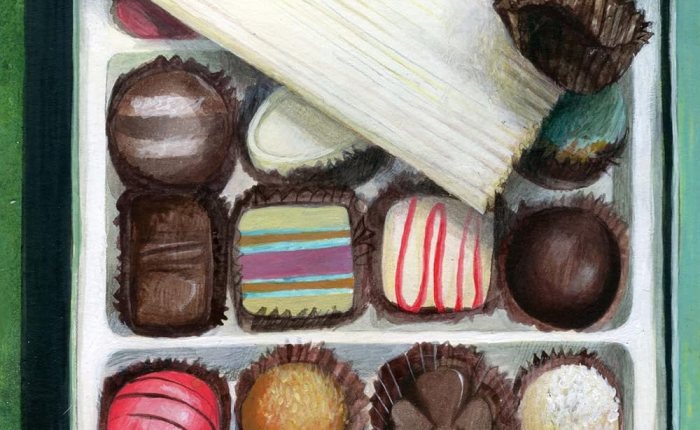
The cover of Reading Style – A Life in Sentences by Jenny Davidson displays the medley of chocolate bonbons I’ve always hoped I’d find in a magical box of perfect confection. In the book, Davidson narrates her sweet life as a reader, and she was/is a dauntingly ambitious reader. In addition to the frequently cited masters of prose (Austen, Flaubert,Fielding, Burgess, Nabokov, and Eliot), she cites works by Lionel Shriver, Thomas Pynchon, Roland Barthes, and my newly discovered favorite stylist, Helen DeWitt among many other masters of the craft.

If I had any success as a teacher peddling significant books to very bright and savvy adolescents it was in taking time to read novels and short stories sentence by sentence, and plays line by line. I would trot out J.D. Salinger’s collection, Nine Stories, near the start of the sophomore year, goading my classes into reading the widely admired “For Esme with Love and Squalor”, keeping track of voice and language. That’s more than enough to keep track of as even the most unadorned of sentences has weight. 

“Squalor. I’m extremely interested in squalor.”

That’s Esme’s request of the writer on a rainy afternoon in a tea shop. 

The scene and voice change as the narrator is pulled into the war, allowing the observation, “She wrote to him fairly regularly, from a paradise of exclamation points and inaccurate observations.”

I leave these and the subsequent examples without comment; they are yours to do with as you will.

A less familiar story, “Down at the Dinghy” offers this description of the central character. “Her joke of a name aside, her general unprettiness aside, she was – in terms of permanently memorable, immoderately perceptive, small-area faces – a stunning and final girl.”

OK, kids, “final”?

I have a short list of sentences I’ve grabbed as I read, some profound and some piercing. 

We also read Slaughterhouse Five, in which Vonnegut offers, “Everything was beautiful and nothing hurt.”

A few for your consideration:

“She was becoming herself and daily casting aside that fictitious self which we assume like a garment with which to appear before the world.”

Kate Chopin – The Awakening.

“The pieces I am, she gather them and gave them back to me, all in the right order.”

Toni Morison – Beloved

“At the still point, there the dance is.”

T.S. Eliot – The Four Quartets

The novella, The English Understand Wool, by Helen DeWitt is almost too rich to read before going to bed. Explaining what she means by suggesting that the English understand wool, the Germans understand precision, the Swiss understand discretion, the (seventeen year old) narrator observes:

“When I speak of these forms of understanding, I do not mean that they are instantiated in every individual of a nation, a culture. I think of this thing which in France is taken so seriously, the terroir, the importance of a particular soil in conjunction with the water, the sun, the aspect of the land, and how this affects the grape.”

“In sooth, I know not why I am so sad.”

Well, it’s the first line of Scene 1 in Act I of The Merchant of Venice. Curtain up. Here we are. Lots of very dramatic stuff ahead and at least two soliloquies that are quoted at the drop of a hat – 

Shylock’s “I am a Jew. Hath not a Jew eyes? Hath not a Jew hands, organs, dimensions, senses, affections, passions; fed with the same food, hurt with the same weapons, subject to the same diseases, healed by the same means, warmed and cooled by the same winter and summer as a Christian?”

Portia’s “The quality of mercy is not strained, etc”

The first line, spoken by Antonio, is often overlooked. The play is about Shylock, or Portia (tests of suitors, etc), right? Let’s get into the pound of flesh. But … What if the play is about Antonio?

Portia is a judge; Shylock is a moneylender. Antonio is the merchant of Vence. It’s his flesh at risk, of course, but what if in addition, the play is set into motion by Antonio’s willingness to pledge a pound of himself  in order to secure a loan necessary to fund frat-bro Bassanio’s wooing of Portia? 

Portia, by the way, has a grand old time mocking the suitors who do not have the cleft chin and chiseled features rocked by Bassanio, a good old, fairly dim, boy willing to see Antonio sliced and diced if it means he has a shot at Portia.

As Hamlet reminded Polonius when asked what he was reading, “Words, words, words.” It really is all about the words after all, isn’t it?

Mystery Book Club

Mystery Book Club

I’m relatively new in town, still disconnected, unconnected, at loose ends, so I decided to join one of our excellent library’s book clubs. The Adult Book Club turned out to be a book club for adults instead of a …you know, so I hopped into the Mystery Book Club, an enterprise in its 23rd year, moderated for all 23 years by an author of some pretty engaging mysteries. My fans (?) know that I’ve written three novels which could be considered  mysteries, if “mystery” means at least one of the characters gets bumped off. 

Some impatient readers have noted that I lose interest in plot somewhere around page 12, leaving those who fancy a well crafted whodunnit in the lurch, so I appreciate writers who can devise interesting schemes and characters whose foibles make the reader (me) want to slog through 300 pages of set up, execution, and red herrings. It happened that I grew up with bookshelves pretty much exclusively dedicated to murder, some from what’s known as “The Golden Age of Mysteries”, elegant mysteries written by Dorothy Sayers, Agatha Christie, Josephine Tey, Ngaio MarshMary Roberts Rhinehart, Margery Allingham, and some later, slightly less formal but conventional mystery authors including JohnDickson Carr (locked room mysteries in particular), Ellery Queen, Rex Stout, and Erle Stanley Gardner.

Apparently things got tough after WWII as the next wave to hit the family bookshelves was a bit darker, exactly what I needed as I ached my way through the miasma of adolescence. With my own school boy fondness for grotesquerie in mind, I offered an elective, in my last few years as a teacher in a wonderful independent school that allowed independent curricula –

 “Tough Guys, Tough Towns”, kicking off with Jim Thompson (The Killer Inside Me), then easing into Charles Willeford (Pick Up), Ross McDonald (The Galton Case), Raymond Chandler (The Long Goodbye), Mickey Spillane (I, the Jury), Lee Child (The Killing Floor), Richard Stark/pen name of Donald Westlake (Slayground), and Elmore Leonard (Maximum Bob).

Now comfortably settled into what I like to call the “Where did I leave my glasses” years, I’ve floundered a bit, but found a new home in Three Pines, the idyllic village in Quebec, mostly the setting for the Armand Gamache mysteries written by Louise Penny. I find comfort in realizing that these are humane, complex, compelling novels, driven by character (and food), but not wickedly complex murders.

They give me hope.

In any case, I’m starting the second novel to be “discussed” by the Mystery Club, a “Hap and Leonard Novel”, Honky Tonk Samurai, by Joe Lansdale, and realizing that I may have overestimated the pleasure to be had in sitting with thirty people who have all read the same case, met the same actors, and seen the same denouement. Not much to say (or hear) unless the novel has the complexity of human experience such as Penny provides in the very human exchanges inThree Pines. 

In an earlier life freelancing for a funky film magazine, “The Velvet Light Trap”, then published by the University of Wisconsin, now hosted by the University of Texas, I wrote a semi-scathing review of Magic, a film starring Anthony Hopkins, featuring Ann-Margaret, in which a vile ventriloquist’s dummy carries out unspeakable acts of creepiness. See, the thing about ventriloquism is that we enjoy the trick of a performer throwing his voice. It’s a trick that works because we know that there’s no other voice available other than the performer’s. Film pretty much allows a thousand voices to land anywhere the script demands. Trees talk in the Wizard of Oz; I wasn’t impressed by the trees, and I wasn’t impressed with Fats, the filth spewing dummy in Magic

(Should any reader care to be terrified by a similar wooden villain, dig up Dead of Night, a British anthology film in which Alberto Calvancanti directs a final segment which provides actual surprise and delicious frisson.) 

We have three more books lined up, none of which I’ve read before. I may love one and find a new author to follow. I may not. My hope, in any case, is that someone says something that allows me to consider the possibility of making a book friend.

I’ve written elsewhere about book friends and the peculiar ease with which one can find a cordial mind in sharing titles of books we admire. Maybe someone will say something like, “This one was ok, but have you read A Fatal Grace? 52 Pickup? The Jugger? The Snow Man? 

You had me at A Fatal Grace.

Everything Old is New Again?

Everything Old is New Again?

I generally stop at the top of the driveway to check the mail if I’ve been out on an errand. It’s not a long driveway, but unless we run out of kibble or I need a book from the library, the “mail”, such as it is, sits untended and neglected for days. We like our postal delivery person quite a lot; he is kind to our pack of hounds when he drives in to deliver a package, so I’ll rouse myself after a few days of letting the mail sit just to honor his good faith in delivering whatever has been bulk mailed our way. I should just keep the recycling bin at the top of the driveway as well.

I mentioned my lack of interest in the mail to a younger guy at the printer’s store …* 

*Almost everyone I speak with is younger, and I consciously wrote lack of interest instead of “disinterest” because I was trained to note that to be disinterested is to have no particular personal involvement in a situation. As the world has spun, however, and in contemporary usage, disinterest is now considered a proper choice when describing a lack of interest. I could stay testy, but  Kurt Vonnegut and the Tralfamadorians remind me that the proper response to unexpected change is, “So it goes.”

I could also note that the printer shop is where I go to get photographs printed up as there are no photography stores in my universe and Kodak now makes pharmaceutical products, an observation that meshes nicely with the conversation I have cited but not described. I spoke of the excitement with which I once checked the mail and my lethargy as a mail patron today. I’m pretty sure the guy at the counter said “Huh” and handed me a print.

In my 1950’s file, “Gone But Not Forgotten”, I have a lumpy recollection of finally receiving the “toy” advertised in the back of a comic book, a plastic scuba diver, described as a frogman, who, when filled with baking soda, would actually dive in my bathwater. Now THAT made checking the mail worthwhile. Code rings, sea monkeys, Charles Atlas exercise manuals, and X-Ray Vision glasses were pretty hot stuff, but so was the delivery of catalogs, at that point in the evolution of merchandising, arriving once a year, in October or November, in time for Christmas list compositions. 

Magazines too were worth the wait. I’m sure The New Yorker and The New Republic offered deep thoughts and important cultural observations to the adults, but I zipped to the mailbox for Sports Illustrated and The Saturday Evening Post.

I’ve just received the latest issue of Sports Illustrated, published in time to offer a preview of athletes and events coming soon in the Paris Olympics. The magazine had disappeared for a while but showed up this month and may be a quarterly or not? I get all the basic sports info I need from cable tv and the world wide web these days, but I do miss smart and often very funny writing from sports guys with a ton of perspective about the sports they cover. Until I’m sure a print copy of SI is on the way, I’m certainly not going to run to the mailbox looking for a magazine that as far as I can gather is mildly hypothetically alive at the moment.

On the other hand, the Saturday Evening Post, which I thought had conked out sometime in the blurry late years of the 1960’s, has been reconstituted under several auspices, currently publishing six issues a year by a nonprofit, The Saturday Evening Post Society. I’ve just subscribed and expect to hop up the driveway on a more ambitious schedule as the delivery of a print edition approaches.

The history of the magazine is as complex as the history of the nation it sought/seeks to serve. F. Scott Fitzgerald wrote more than sixty short stories for the Post, including two of my favorites, “Babylon Revisited ” and “Bernice Bobs Her Hair, both of which are often included in contemporary anthologies of best short fiction. A lengthy article by Jack Alexander in March, 1941 was the first to describe the early successes of Alcoholics Anonymous and is considered a significant milestone in AA’s history. Other authors included a remarkable range of sensibilities, from Agatha Christie, P.G. Wodehouse, Ray Bradbury, Robert Heinlein, Kurt Vonnegut,and Ogden Nash to William Faulkner, Edith Wharton, JohnSteinbeck, and William Saroyan. 

Without hunkering down in an account of my misspent youth, I admit that rather than participate in life as I knew it, I read widely, grabbing every opportunity to read anything NOT assigned in grades three through twelve. I could often get through an issue of the Post before being nabbed by the school’s librarian. I got through the current runs pretty quickly and began dusting off copies our library had wedged in a basement shelf. Discretion was never my strongest suit, and when compelled to participate in the eighth grade recitation competition, I found a poem in The Saturday Evening Post  that amused me, “Pershing at the Front” by Arthur Guiterman. The great attraction of the piece was that it included a word so powerful, so outrageous that I knew my audience would be shocked into silent horror. The opening of the poem is unremarkable:

“The General came in a new tin hat

To the shell-torn front where the war was at;

With a faithful Aide at his good right hand

He made his way toward No Man’s Land,

And a tough Top Sergeant there they found,

And a Captain, too, to show them round.”

Stanza by stanza, Pershing and his companions move from trench to trench, the Sergeant whispering as they progress toward the front. 

“The silence lay in heaps and piles

And the Sergeant whispered, “Just three miles.”

And the Captain whispered, “Just three miles.”

And the Aide repeated, “Just three miles.”

“Just three miles!” the General swore,

“What the hell are we whispering for?”

And the faithful Aide the message bore,

“What the hell are we whispering for?”

And the Captain said in a gentle roar,

“What the hell are we whispering for?”

“Whispering for?” the echo rolled;

And the Sergeant whispered, “I have a cold.”

Should you feel compelled to research the poem, you will find that contemporary versions have cauterized the ending, replacing “…the hell…” with “What in the heck are we whispering for?”, a line that no longer scans properly and is absolutely nothing that General John J.  Pershing might have said in the midst of battle. I spoke my truth, spat out the inflammatory (!) words, and sat happily in my classroom as the audience reeled. Lest a reader find this an innocuous recitation, it’s worth noting that in my youth the word “hell” was routinely replaced with “heck”, “what the hay”, “what in the Sam Hill”, and the least disturbing of all, “ H – E Double Hockey Sticks”.

Recurring cartoons, such as Ted Kay’s Hazel, which ran in the Post from 1943 until 1969 were simultaneously puzzling and intriguing. We didn’t have a maid; no one I knew had a maid. I guessed there was much to learn about the wider world, even more than identifying the sources of domestic help humor, so I concentrated on decoding the images that appeared on the cover of the magazine each week.

A number of illustrators contributed to the magazine, including Earl Mayan whose Yogi Berra cover still lives in my imagination, but the Norman Rockwell covers operated at a level that has informed my sense of self for decades. Almost all of the adults I knew were artists, architects, and authors, pretty darned serious about their work and pretty darned convinced that abstract expressionism and modern architecture had finally surpassed the pedestrian figurative and sentimental sensibilities of previous generations. My problem was that I had lost myself (no mean feat!)  in illustrations by Howard Pyle, N.C. Wyeth, J.C. Leyendecker, Arthur Rackham, and Maxfield Parrish.  I don’t remember Rockwell’s name coming up in the endless conversations describing the ways in which contemporary society clearly just didn’t understand genius, but if it had, I’m pretty sure they would have used a word like “kitsch” to describe his work.

Here’s what I understood about the art that Norman Rockwell presented: 

Sure, the subjects of his scenes could have been described as sentimental in that it was clear that the artist was fond of kids, dogs, baseball, adults, holidays, and the American landscape. Me too, with the possible exception of adults. Every portrait was posed, of course, but they felt to me like snapshots of a world I would probably like considerably more than the life I happened to inhabit.

His paintings too were suffused with good natured wit. I can’t begin to describe the best of the more than 300 covers Rockwell did for the Post, but one, published in February of 1960 encapsulated the wry unselfconscious view of the artist in the act of creating a cover. Known now as the Triple Self-Portrait, the painting actually shows at least seven self-portraits, three of Rockwell, and small self-portraits by Durer, Van Gogh, Picasso, and Rembrandt. Rockwell sits on a stool, back to the viewer,craning his neck and slumping sideways to catch his reflection in a mirror set to his left. His unfinished sketch is a face floating in the upper center of the stretched canvas. The portraits of the celebrated artists have been pinned on the upper right hand corner of the canvas, what could be considered five unfinished roughed out self-portraits of Rockwell are tacked to the upper left of the canvas. The image of Rockwell in the mirror is less clear, and light reflected on his glasses creates a pair of white circles in the slightly out of focus face.

Yes, I am a sucker for mirror magic. Indelible images stick with me as I remember Citizen Kane, The Lady From Shanghai, Last Year in Marienbad, but the Rockwell cover is a notably non-”arty” use of the mirror, simultaneously a peek behind the curtain and recognition of the artist’s impulse to transform the awkward figure in the mirror to the larger and more impressively detailed portrait on the canvas. Equally self-deprecating is Rockwell’s inclusion in other paintings, essentially cameos similar to the shots Alfred Hitchcock included in his modern films. He’s in the corner of the painting I’ve included at the top of this piece, one of a crowd crossing a street as a sailor and young woman have a conversation I want to hear outside a club which will never welcome them as members.

I still find his droll depiction of sports and holidays amusing and his celebrations of a nation’s best instincts reassuring, but have not yet escaped the conviction that, for the most part, the people in his world didn’t look much like me, and the circumstances in which they found themselves, however momentarily distressing or awkward, indicative of lives lived far more bountifully than mine. Network television did all that it could to remind me of households I would never meet, but the Rockwell paintings were far more evocative.

I have no idea what the newly reconstituted Saturday Evening Post will present me as I summon the will to trudge up the driveway to inspect the mail. The most recent edition presented an article on falconry and an archived examination entitled, “Who Really Started the Pop Revolution?”. Seems just about right and certainly worth checking the mail from time to time. 

It’s a wonder I can think …

It’s a wonder I can think …

“When I look back on all the crap I learned in High School

It’s a wonder I can think at all …”

Paul Simon considers this the most interesting part of his song, “Kodachrome”, a song which was banned in several places at several moments because Kodachrome was/is a word trademarked by the Eastman Kodak company. In marketing film for cameras, Eastman invented the word “Kodak” because he thought “K” was a strong letter. All of that aside, the notion that an unremarkable high school education served only to muddle cognitive efficiency for subsequent years grabbed a lot of attention.

When the song was released, I was in a doctoral program in the Human Relations Program offered by the Education Department of the University of Massachusetts. The department had been turbo-charged by a free-thinking rogue from Stanford, Dwight Allen, whose mission was the transformation of educational leadership to encourage innovation and social justice – an iniative that quickly devolved in my cohort to “schools without schooling”. I was also employed as a secondary school teacher (History of Rock and Roll, Popular Psychology) in my two years of part-time course work at UMASS, having barely completed the minimal requirements set by my secondary school and the equally minimal demands made by my college. 

I’ve kept my report cards and transcripts from those years, documents which I offered to my children as an antidote to the pressure cooker expectations of the schools they attended. They were far more successful than I was and found their way to colleges and careers that seem to have suited them. No debilitating display of awards and prizes from this side of the family to raise the temperature during their school years, so I offered my own tattered educational record as evidence of one way of surviving school without having learned much of anything, leaving them room to succeed when and how they wished.

The point is that I didn’t learn crap of any sort in High School; if my thinking is occasionally muddled or skewed, that’s on me. Occasionally is hardly the appropriate term these days as life seems to get foggier with every passing year. Why wouldn’t I be boggled after almost 80 years of bouncing around in a nation that went from ventriloquists performing on radio (?) to the Surgeon General begging for warnings on social media platforms. 

Here’s what I learned by the time I escaped from High School (actually a perfectly humane boarding school with some pretty nifty teachers, had I been unstuck enough to meet them halfway): The country looks like Beaver, Wally, Ozzie, Ricky Nelson, and John F. Kennedy; everyone in California hangs ten and drives beach buggies; people from other countries have amusing accents; people from the South and Texas have amusing accents; the invention of Tang was somehow connected with the Space Program; it’s funny to hear a large bus driver threaten to punch his wife and send her to the moon; drunks are funny; rural poor people are funny; it isn’t great to be Black in America; every generation is more financially successful than the preceding generation; science will solve all problems; cigarettes aren’t bad if they have a filter.

Times change. Heal all wounds? Maybe not so much.

Today Eastman Kodak limps along after bankruptcy, shaking their corporate fists at the scoundrels who created cameras that don’t need film and images that arrive instantly without having to be sent away to be processed. I’ve got boxes of Kodachromed memories I probably ought to scan and archive somewhere … except that I’m increasingly aware that nobody particularly cares what I thought was spectacular at the World’s Fair in New York in 1964. Spoiler alert- it’s not the Small World ride, which cost the equivalent of almost 10 dollars and which brought our own small world the most aggressive ear worm of all time. 

I think therefore I am.

Yeah, but if I don’t think, am I?

OK,here’s something I can blame on my pretty humane boarding school: Fondness for institutional food. 

When I travel, I prefer to find a cafeteria that offers aerated mashed potatoes and gummy gravy. Sure, sometimes that means eating in a Hospital cafeteria, shoveling globby broccoli away while folks sleepwalk down from waiting rooms. 

It’s a wonder I can think at all.