Loveable Losers

Loveable Losers

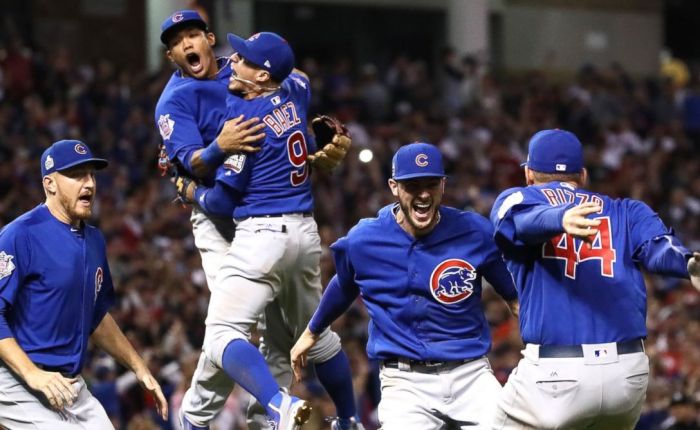
After one hundred and eight years of watching other teams celebrate a World Series victory, the Chicago Cubs have finally ended the drought and brought a championship home to long-suffering Cub fans.  The series went to seven games, dramatic shifts in the lead gave the seventh game far more punch than we’ve seen in most tilts, a rain delay kept the suspense alive, pitchers played the part pitchers should play, unsung heroes emerged, steady vets provided leadership, two great managers contended with wily genius, and the right teams were in the series.

One of the things I like about sportswriting is the freedom to jump from one strongly held conviction to another at mid-season, even mid-game, as momentum changes and vivid personalities emerge..  Writers love to tag an early contender a “team of destiny”, with the caveat that there might be other teams with equally fated destinies lying in wait.  From the start of the season, it appeared that this was the Cubs’ season; they got off to a rip snorting start with a line-up that appeared inevitably a World Series machine.  Then, somewhere in August, it also became the Indians’ season, as a squad with remarkable pitching and one of the best infielders of the modern age emerged in the other city by the lake.

Oh, and they hadn’t taken a series victory since 1948.

Now, THAT was a team of destiny.  How many stories can any one team provide without devolving into fantasy?

The ’48 Indians were owned by baseball’s greatest showman, Bill Veeck (rhymes with wreck) who is now best remembered for the stunts he pulled as owner of the St. Louis Browns, particularly for putting Eddie Gaedel, at three feet and seven inches the shortest man who ever played in the majors, in as a pitch hitter in a double-header against the Detroit Tigers.  Gaedel, who took four straight pitches, walked to first base, and retired with an on-base percentage of .1000.

Less well remembered is the role that Veeck played in bringing the first black ballplayers to the American League.  Larry Doby was the second player to break the color barrier, making his first appearance as an Indian in July of 1945.  In 1948, legendary Negro League pitcher, Satchel Paige, appeared in his first game as an Indian, the oldest major league rookie on record, taking the mound at the age of 42.

To be completely transparent, Satchel Paige’s actual age was always a subject of some contention.  Next to Yogi Berra, Paige may be the most frequently quoted baseball player, responding with evasive wisdom to almost every question posed him.  Asked about his age, Paige famously replied, ” If someone asked you how old you were and you didn’t know your age, how old would you think you were?”

Doby, who went on win RBI and homerun championships in the American League and who was voted to the All Star team seven times, was also the second black manager in major league baseball.  He and Paige were to become the first African American baseball players to win a world series with the 1948 Indians.  Their accomplishments stand on their own, but Veeck, whose interest in the Negro League was long-standing, had tried to integrate baseball as early as 1942, when his bid to bring Negro League players to the Phillies cost him the chance to own the team as the commissioner of baseball at the time was not ready to end segregation.

So, kudos to Branch Rickey, the Brooklyn Dodgers, and Jackie Robinson; their struggle to break the color barrier is the stuff of history.  But, let’s not forget the Indians, who had to win a sudden-death play off game in 1948 against the Boston Red Sox, the last major league team to integrate, holding out until 1959.

Good news – Bad news.  The world series in 2016 between the Cubs and the Indians was the equivalent of a battle-to-the-death between unicorns and pandas; anyone with a heart hated to see either team lose.

Kris Bryant, the fresh-faced wunderkind whose heroic performance had much to do with the Cubs’ success this year and with the fondness fans feel for the club, found himself in the sort of awkward corner into which on-the-field sports reporters love to push young players, asked to respond to yet another hypothetical question:   “If the Cubs win the series, won’t fans of the loveable losers see the team as just another ball club?”

Uh, ok.  No?  Yes?  Who cares?

The Curse of the Bambino finally left the Red Sox (don’t get me started), and its fans became Red Sox Nation after the Sox finally pounded their way to the top in 2004.  Again, a sense of perspective is important in evaluating the degree of sympathy to lend to the suffering fan.  The Red Sox have won eight world series and played in twelve.  A total of 36 Hall of Famers have played for the Sox, 14 of whom were inducted as Red Sox.  Again, citing transparency, Roger Clemens could be included in the list of extraordinary players who played for Boston; Dom DiMaggio should be in the Hall of Fame (don’t get me started – save a place for Pete Rose, Joe Jackson, Jack Morris, Trammell and Whitaker, Barry Bonds, and (ugh) Clemens).

All of which is to suggest that if non-affiliated proto-fans are looking for a place to invest their love and loyalty, the current crop of ballplayers laboring for the Cleveland Indians include some exceedingly loveable winners, including shortstop Francisco Lindor and Cy Young Award winner Corey (Kluobot) Kluber.  Perhaps the most loveable of all, however, is Indian manager, Terry Francona, whose dad, Tito Francona, played for the Indians from 1959 to 1964.  Not only is Francona among the most highly respected baseball strategist, his calm and steady leadership is evidenced by the success he has had, both as the Indians manager and as the manager who finally took the Red Sox to their long-postponed world series triumph.

Not to sidetrack the Red Sox bandwagon, but Francona was hired to manage the Sox after Manager Grady Little’s team lost the ALC series in 2003 and fired after having led the Sox to World Championships in 2004 and 2007, after racking up 1000 games as the manager of the Red Sox, and after losing the AL Wild Card spot to the Rays as the team folded like a Flamenco dancer’s fan in September of 2011.   His post-season winning record as manager of the Red Sox was .622, and his regular season percentage of .545 tops  Joe Cronin, Boston’s second winningest manager from 1935-1947.

Oh, and fired after having had a heart attack and returning to take the Sox back to victory in the series.  Just saying.

So, Congratulations, Cubs!  They are a great team and deserve the continued support of fans who now know the thrill of victory.

And for the Indians, wait until next year.


The Other Holiday Film Guide

The Other Holiday Film Guide

The number of holiday films has grown exponentially as the Hallmark Channel requires constant feeding, or another deluded studio executive forgets herself and green lights an instant classic in which Tyler Perry, Kirstin Wiig, Eddie Murphy, or Progressive Insurance’s huckster, Flo, play all the parts.  It doesn’t matter; we’d have to start on the day after Halloween just to put a dent in our list of must-see Christmas favorites.

But, see, Thanksgiving is not just a fly-by, not just a ritual gorge-a-thon, not just parades, or football, or even the arrival of Santa on 34th Street. No, my dumplings, Thanksgiving brings the bounty of the harvest, the first hints of winters deep chill, sodden leaves stuck to the soles of shoes, darkness in the afternoon, and above all, the gathering of kith and kin.  As the only holiday contriving and coercing the confluence of family and food, Thanksgiving arrives with burdens other holidays do not bear and without the distractions (gifts, easter baskets, fireworks) within which other holidays can take refuge.  Oh, there is excess on the horizon; thrifty shoppers leap from the table to take their place in the writhing horde, hoping to reach a discounted PlayStation before being kicked to the floor and trampled on America’s newest holiday, Black Friday, but the actual giving-of-thanks event is up for grabs on a yearly basis.

The table has to groan, and that means that someone has to cook, which means living up to whatever standard previous Thanksgivings have established, unless it means that several people have to cook, which means each cook is in immediate competition with every other chef and with whatever standard previous Thanksgivings have established.  Young people are tired and bored; older people are tired and bored. Now, force-fed and lethargic, hosts and guests need the magic of cinema to restore their faith in the celebration of hearth and home.  There may not be a plethora of Thanksgiving films, but the best of them deserve a place at the table, as it were.

Planes, Trains, and Automobiles

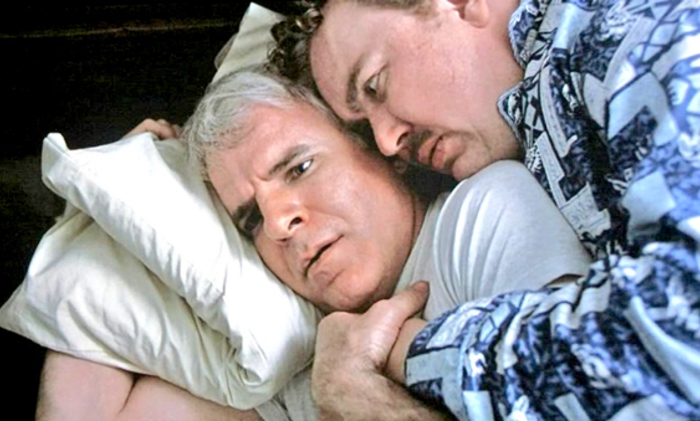
If you only screen one film this month, make it Planes, Trains, and Automobiles, even if you have seen it before, even if you saw it last week.  There aren’t many films that bring the exactly right director with exactly the right leading players to exactly the right film.  John Hughes managed it more than once, with the ensemble in The Breakfast Club and with Matthew Broderick and Alan Ruck  in Ferris Bueller’s Day Off.  Working against the grain of the mismatched buddy, odd couple, genre, Hughes found in Steve Martin and John Candy a couple not only oddly mismatched but authentically in need of each other.

Fair Warning.  This is a comedy with an edge.  No sex or violence to make family viewing terminally awkward, but Martin’s character, a rigid and controlling executive contending with the madness that is seasonal travel, unleashes streams of obscenities with unrestrained fury, particularly in a scene in which his rental car has not proved to be satisfactory.  Even in his early days of madcap comedy, Steve Martin skidded from frantic to frenzied, hinting at a strain of dislocation or discontent just beneath the surface.  His nemesis/better half is played by John Candy, an actor whose clumsy sweetness was the more poignant for his discomfort with his own bulk; even his deliciously campy villains, Dr. Tongue, for example in Dr. Tongue’s 3D House of Beef, seem to apologize for taking the space that they occupy.

Fair Warning.  This is a comedy that can break your heart.  Martin treats Candy shabbily; Candy sees himself as Martin sees him.  The ending is not so much happy as restorative.  Candy’s character needs a home; Martin’s character needs a heart.  Fortunately, John  Hughes had the brain, and this film manages to treat them and the holiday with generous good will.

Incidentally, as one fascinated by the impact given a film by character actors, I particularly admire Edie McLurg who steals the scene as the rental car agent at whom Steve Martin unlooses a torrent of vile epithets as she did as the principal’s secretary in Ferris Bueller Day’s Off and as the campus tour guide in Van Wilder.


The next three films are set around family and Thanksgiving, and both are well worth watching, but each deals with the difficulties that can find their way into the best of families.  That holiday icon, Leo Tolstoy, put it best:  “All happy families are alike; each unhappy family is unhappy in its own way.”

Home for the Holidays

I don’t know another film that is as true to the disconcerting mix of resignation, loyalty, discord, loss, decency, injury, humor, or distance that marks the families I have known.  Not a comedy, not a drama, Home For the Holidays assembles a cast that might esasily have spun out of whack but which, caught by a strong narrative and the deft direction of Jodie Foster, inhabits characters who ring true to life.

Made in 1995, the film appeared as Robert Downey, Jr.’s personal life was falling very publicly apart, background which gave his role in this film more weight than it might have had, and than it occupies on a later viewing.  Holly Hunter is a woman of a certain age, leaving a failed career (she’s just been fired) and a daughter (Claire Danes) who promises to have her first sexual encounter while her mother is heading home to Baltimore for the holiday.  Hunter’s parents, Anne Bancroft and Charles Durning, live in a home so crammed with marginally garish knock knacks that we experience the claustrophobia their children must have known.

Downey plays Hunter’s gay brother whose homosexuality is pointedly not mentioned though acknowledged.  In this performance, as in his best work, Downey brings comic energy to a manic character in pain.  Looking back at him from  a distance, I am aware of Downey’s capacity for kindness, a gift that brings Hunter, and the audience, safely home from a visit that might have roughed us up a bit.

Dylan McDermot is perfectly cast as the odd man out, long before he took up creepiness in American Horror Story, and the impossibly brittle Geraldine Chaplin adds spice to holiday conversation by telling the family secrets we long to know.

Hannah and Her Sisters

Many critics consider Hannah and Her Sisters the best of Woody Allen’s films; it won three major Academy Awards:  Best Supporting Actor (Michael Caine), Best Supporting Actress (Diane Wiest) , and Best Original Screenplay.  Categorized as a comedy/drama,  it may be his most personal, despite his identification in lighter films with the many neurotic nebishes he has played to comedic effect.

His character in this film is paralyzed in existential distress, as Allen’s characters often are, incapable of maintaining a sustaining relationship while hovering at the edge of a family once his.  His divorced wife, Hannah, played by his divorced wife, Mia Farrow, who, in this film is married to Michael Caine, who, in this film is knocked sideways by his passion for Hannah’s sister, Barbara Hersey, who, in this film is married to Max Van Sydow, who, in this film has reduced Hersey to something like catatonic infantilism.  Lloyd Nolan and Maureen Sullivan play the parents of the sisters.The film begins and ends with Thanksgiving dinners but is structured in five story arcs, one of which allows the third sister, Diane Wiest, and Allen to bring the film to an oddly resolved  end.

Pieces of April

Rounding out the holiday dysfunctional family films of distinction, Pieces of April reminds us that Katie Holmes once had a very promising career as she shines in this quirky, bittersweet comedy/drama as the estranged daughter of a (surprise) dysfunctional family.

April lives in a dingy, almost palpably filthy apartment in New York with a boyfriend who will disappear in the course of the film.  Recognizing that her mother’s illness will likely take her within the year, April invites her family to New York for Thanksgiving.  She has never prepared a meal, the oven in the apartment gives out well before the family arrives, she has to connect quickly with people in her apartment.

Meanwhile the other elements of dysfunction are on the road, each working out their own issues, with April, and with their journey.  Patricia Clarkson as April’s dying mother, Joy, was nominated for an Academy Award as a Supporting Actress.  Oliver Platt was well received as April’s father, clinging to the strands of a relationship with his daughter, hoping that Thanksgiving allows mother and daughter to reconnect.  John Gallagher, Jr., who won a Tony on Broadway in Spring Awakening, plays April’s stoned brother while Alison Pill, familiar to watchers of The Newsroom, plays a sister resentful of the role April once played as favorite child and fearful that conflict between her mother and April could accelerate the course of her mother’s illness.

It sounds grim, perhaps, but Pieces of April is good hearted, often funny, and well paced.  The film was introduced at the Sundance Festival, and was warmly received.  Shot on video for two hundred thousand dollars in three weeks, the film looks great and is a model of efficient filmmaking.  The script is by Peter Hedges who also wrote What’s Eating Gilbert Grape, Dan in Real Life, and About a Boy.

There are other films in which Thanksgiving is the focal holiday, from Disney’s Squanto: A Warrior’s Tale to Thankskilling, in which vulnerable teens are stalked by a killer turkey.  The holiday may be at its darkest in The Ice Storm, which has a great cast (Kevin Kline, Joan Allen, Toby Maguire, a young Christina Ricci , Elijh Wood, and Sigourney Weaver) and is directed by Ang Lee.  This is a powerful, disturbing and worthwhile film; maybe watch it in July?

I can’t recommend What’s Cooking with all five stars as it drops into melodrama once or twice too often, but it’s pretty interesting as it presents Thanksgiving as experienced by Vietnamese, Latino, Jewish, and African American families, and, when the actors aren’t screaming at each other, it, too, is funny and good hearted.

If none of these fits the bill, there’s nothing like a turkey induced coma, stretched on the couch, watching/ not watching three hours of football.


Official Start of the Holiday Season

Official Start of the Holiday Season

Today is Halloween.  Some  pumpkins remain in shop windows, but most of the small shops have already decked their halls with snowscapes and bright packages.  It’s clear that in our part of the world, the ramp-up to Christmas has begun.  Whereas the day after Thanksgiving once signalled the first tentative steps toward Christmas, full Christmas countdown appears to have begun in earnest here before we have even fallen back and changed our clocks.

It’s not as though it used to sneak up on me in the past; my memory is that I was in unlovely and sleep-deprived agitation for much of the last two weeks before Christmas, once the classroom windows had been decorated, Christmas cards had begun to be displayed on the kitchen counter, and dog-eared pages from the Spiegel catalog given the critical attention my brother and I thought they deserved.  As I consider Christmas in those days, we enjoyed two holiday seasons: the catalog season and the days before Christmas when we were finally released from school.

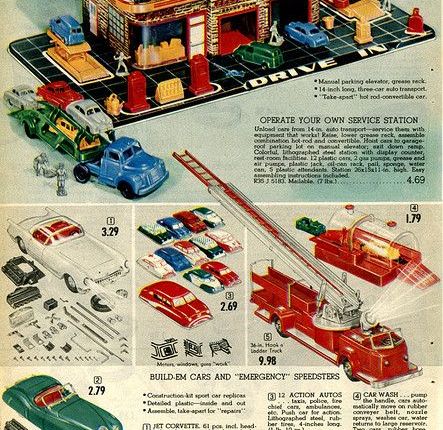
I’m guessing the catalog arrived just before Thanksgiving, although I wonder now that it came through the mail at all, given that the Holiday edition must have weighed five pounds.  There were other equally weighty catalogs, of course, Sears Roebuck and Montgomery Ward.  There was nothing wrong with those, but our mother actually bought clothing from Spiegel, and so we hoped she might be more likely to follow up on our detailed assessment of each exhaustively researched toy.  Our local hardware store, too, mailed us a full color circular featuring bikes, sports equipment, Radio Flyer wagons, and pump action faux Winchester BB guns, the only note of frivolity from a store that sold lumber and plumbing supplies.

We looked through them all, quickly ignoring the slick mailers offering sliced hams or flavored cheeses, and equally expeditiously thumbing through the exotic and prohibitively expensive toys from FAO Schwartz, admiring the authenticity of Swiss made clockwork robots and gigantic stuffed animals, but recognizing that these were not intended for kids such as we were.

TV commercials left us cold.  They were poorly filmed, as if kids would not notice lumpy direction and repetitive, mindless narration, and they presented toys no one wanted.  We knew quality when we saw it –  the Fanner 50 cap pistol from Mattel with its impala striped grip and long barrel, the Roy Rogers double holster set, and the DeLuxe Service Station with a collection of cars, gas pumps, a car wash, an elevator to transport cars to the parking lot on the roof, and two bays with lifts for full service.

I don’t remember parcels arriving from Spiegel in Chicago; most shopping probably took place at the local drug and book store or at the variety store in the larger town near ours. We never owned most of the toys we found in those catalogs.  My brother never had the authentic medieval castle with drawbridge and turrets; we never had to figure out how to use the smoke pellets that came with the Lionel train set.  It didn’t matter a bit.  The fun was in exercising our considered judgment, toy by toy.  I remember literally dreaming about wearing full cowboy regalia, boots and spurs, and saddling up a pinto pony to ride off to adventure.  I really didn’t expect to find the pony or the gear under the tree, but for considerable  stretches of time, imagining was more than good enough.

My own kids missed out on Holiday catalogs.  My eldest spent hours hunkered down in well appointed toy shops, developing a discerning eye for toys of quality; the younger two raced up and down the aisles of Toys R Us, pulling the pink Barbie convertible or the sleek pedal powered Cadillac from their parking places, backing and filling, until we moved on to Legos, or action figures, or electronic games.  By the time the Toys R Us catalog arrived, the kids were familiar with the merchandise.  They had seen the toys as they were, smaller and less magical.  Their lists sent to Santa rarely included the over-advertised and now familiar big-box offerings.  I’m pretty sure my daughter asked for a pony for a startling number of years in succession, probably not completely expecting its arrival but savoring the possibility that one Christmas might smell of pony rather than of pine.  She may be hoping still.

Most folks bemoan the early arrival of holiday hoopla, and they are not wrong to point out the relentless commercialization of Christmas; they are correct in recognizing the grim spectacle of Black Friday mayhem turning the Thanksgiving weekend into gladiatorial combat.  “Who needs six weeks of chipmunks gargling holiday classics on radio and in every shopping destination?” they cry. They’re not wrong about that either.

On the other hand, we need some time to dream and imagine, some time to write long letters to friends we haven’t seen in a year, some time to bake, decorate, and distribute cookies we only see at Christmas.  My brother’s family lives in Connecticut; my sister lives in North Carolina.  I could have Amazon send their gifts directly to them, but, with enough time, I can wrap their presents, write goofy greetings on each gift, push them into thick boxes, and get them out in the mail in time to find a place under a tree.

My plan these days is to have my shopping done, for the most part, by Thanksgiving.  I’ve already hidden two gifts in the hall closet and expect a few more to land in the next week.  I am wrapping challenged and need time to start over when I tape unnoticed clumps of dog fur in the center of an otherwise reasonably well wrapped package.  I need time to round up newspapers with which to protect gifts in transit, and I need time to uncover and display the decorations my kids made year after year until they became distracted by their emerging lives.

All the same, Halloween is too early.  We have the somber shifting of the seasons and the necessary summoning of grace in order to be truly thankful for all that we have and all that we love.

I’ll just pile the catalogs  on the kitchen table for now and give my time to standing outdoors as another lovely autumn moves by.