I Think Therefore I Am, I Think

I Think Therefore I Am, I Think

“There are no secrets that time will not reveal.” Jean Racine

Relax. 

I’m not going to spill the tawdry grotesqueries of character that have afflicted me and all who know me, and I’m not going to make reference to the big secrets that tumbled out of family archives eons after the information might have done some good. No, I’m going to describe three afflictions that accompanied me throughout the years, nothing terrible, really, just impediments that were problematic as I groped my way from the first grade to the twelfth. 

Loyal readers know of my fascination with the work done by Oliver Sacks and other neurologists. We’ve been poking and prodding, electrifying, drugging, depriving, operating, and generally mucking around in brains for centuries. Fair enough. Brains are fascinating. We can say a bit about some of the mechanics of brain activity and localize some functions, but the most complete description of how the brain works is a mildly furry generalization: “The brain sends and receives chemical and electrical signals throughout the body.” 

Signals? That’s it? Apparently some make us sleepy, and some allow us to feel pain.

Here are my top five questions about the brain?

  1. What is thought?
  2. What is sleep?
  3. How do neurons communicate with each other?
  4. How do we compute?
  5. What causes the fascinating anomalies – The Man Who Mistook his Wife for a Hat, Face Blindness, Synesthesia, Walking Corpse Syndrome, Alien Hand Syndrome

OK, five more:

  1. What is autism spectrum disorder and how/why does it exist?
  2. Foreign accent syndrome – after a stroke some people speak with an accent? Huh?
  3. Why does a urinary tract infection cause short term memory loss?
  4. What is consciousness?
  5.  Is there thought in a coma?

I love my brain and thank it daily for the wonderful thoughts it gives me. I don’t thank it for the intrusive earworms and whatever it is that causes me to hum, tap, bounce, fidget, wiggle, and draw in the air. Each of those unbidden tics is apt to appear at any time; some are constant. My wife has her least favorite, the hum. My daughter reminds me that my constant tapping of my feet causes vibrations that make her sea sick. I’ve unintentionally terrified a drowsy family when I walk down the hall dragging my knuckles against the uneven boards on the wall. Apparently it can sound like snare drums or machine gun fire.

And, of course, I am not aware of any of this.

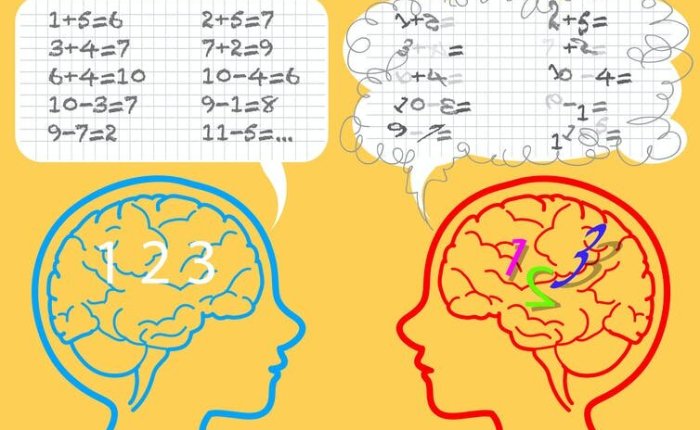
I was at least fifty years away from the humiliation that was Math, Algebra, Geometry, and Statistics when I realized I have dyscalculia, a disorder that that experts define with rigorous specificity: “Dyscalculia is a learning disorder that affects a person’s ability to understand number based information and math.” What exactly is it that a person with dyscalculia can’t do? Process numbers visually, put them in short term memory, have language to describe them, plug in long term memory, understand quantities and amounts, and carry out calculations.

Fractions? Graphs? Logarithms? Geometry?

Not even on the screen.

I got by when I could translate a task into a word problem. Language works for me as math cannot. Do I feel better understanding why I was designated dunce throughout my school years? Not much.

The third issue is not hard-wired.

As a lad I closed the door to my room and read until I could read no more. I read all the usual stuff … and … a staggering number of British mysteries, comedies, dramas, histories, and fiction. By the end of my fifth grade year, orthography had become the next tar pit for this unconventional speller. Did I spell “Rose” as“Rows”. I did not. But with Dorothy Sayers firmly occupying my mid-brain, I spelled “honor” as “honour”, “humor” as “humour”, “defense” as “defence”, and “theater” as “theatre”. As I type these examples, my self-correcting word processing program is spilling red correction fluid all over the virtual page. Exactly as my teachers did.

Please do not think that this orthographic route was affectation; I still spell with choices that aggravate the heck out of my editors. Here is an example of a sentence spelled in a fashion that would make any red blooded American speller gag.

“I am paralysed as I analyse the manouevers a traveller must catalogue as part of a flavour or colour, how to organise not apologise, when one does labour for a neighbour.”

Today, with the generous loss of school day memories, I am ok with being a tapping, dyscalculiac, British speller. It was a long hard slog, and my academic record is impressively tattered, but I got through somehow.

Brains! Who knew!

Amnesia and deja vu – I think I’ve forgotten this before – Steven Wright

Amnesia and deja vu – I think I’ve forgotten this before – Steven Wright

What’s in my wallet? 

Not cash, not for a long time. Only one card, until now, as well.

Somewhere along the way I got confuddled by points, rewards, and miles, and essentially use a debit card that does not reward me, but does keep track of the actual balance in my bank account. I haven’t thought about credit cards for a while until I was offered a card that would allow me to buy stuff I frequently buy online without being charged for shipping. Free monograms, too, as if I need to see my initials every time I put on my pajamas. I hang them up in the morning; I can pretty much expect that they are still mine when I head to bed at night.

Let’s leave suppositions about my pajamas aside; it’s been a while since I divulged my most notably guarded secrets in order to register a card I barely need and will hardly use. Name, address, email – sure. But then came the security questions, intimate information that only I and whatever nameless, faceless corporate entity compiling the shards of my life will share.

I’ve handled those in the past with ease. Best friend as a kid? No problem. Favorite football team? You’re kidding. Michigan, Duh. But this time, the question asked was: “What’s the name of a college you applied to but did not attend.” 

Uh, now they’re not only asking me to scuff around in memories established when I was essentially brain fogged by hormones and family drama, they are also hitting me right in the mistakes I’ve made/choices I flubbed/ opportunities I let slide away jackpot.

Between CATS, Freud, Oliver Sachs, and Marcel Proust, the subject of memory has been extravagantly worked over. Assuming you have the score of CATS pinging in your brain at all times, I need only ask: “Midnight. Has the moon lost its memory?” Too rich for my blood and one more example of a tentative fungo hit into a field of surmise. On the other hand, Sigmund Freud was a physician even when working in the realm of the subconscious mind, and he too had his doubts about memory: “Our memory has no guarantees at all, and yet we bow more frequently than is objectively justified to the compulsion to believe what it says.” Oliver Sachs, a neurologist (author of the remarkable The Man Who Mistook His Wife for a Hat), took it a step further. “It is startling to realize that some of our most cherished memories may never have happened – or may have happened to someone else.”

Wait. What? Our memories may have happened to someone else? Is the corollary that someone is walking around with my memories? Actually, with only a moment’s reflection, I’ve got a boatload of memories I would be happy to offload.

Be that as it may, Rosiland Cartwright, a neuroscientist whose research was primarily in the area of sleep (a phenomenon which we don’t understand, by the way), argues that “Memory is never a precise duplicate of the original … it is a continuing act of creation.”  

That supposition may have its most compelling example in the work of Marcel Proust, whose novel A la recherche du temps perdu/In Search of Lost Time, is comprised of seven volumes, over a million words, examining recollections of childhood and adulthood, famously inspired (maybe) by a crumb of a puffy cake known as a madeleine. 

Here’s a tiny excerpt:

”And at once the vicissitudes of life had become indifferent to me, its disasters innocuous, its brevity illusory – this new sensation having had on me the effect which love has of filling me with a precious essence; or rather this essence was not in me it was me. … Whence did it come? What did it mean? How could I seize and apprehend it? … And suddenly the memory revealed itself. The taste was that of the little piece of madeleine which on Sunday mornings at Combray (because on those mornings I did not go out before mass), when I went to say good morning to her in her bedroom, my aunt Léonie used to give me, dipping it first in her own cup of tea or tisane. The sight of the little madeleine had recalled nothing to my mind before I tasted it. And all from my cup of tea.”

I rarely read all seven volumes, but the notion endures that a sight, a smell, a warm wind on one’s shoulders can catapult us into a rich tapestry of memory, a notion that persists despite the discovery that in the first draft it was a tartine rather than a madeleine that shook loose Proust’s avalanche of memory.

What shook loose the avalanche at my desk was the ostensibly unprovocative “What college did you apply to but did not attend?”

I can’t reveal the one word answer that is now among the tightest of safety precautions attached to my financial record, but let’s just pretend that it is a name that signifies the highest aspiration of any college applicant, a name that evokes tradition, excellence, and a passport to a lifetime of power and privilege. So, but, I did not attend. Looking back on it, I got some juice throughout most of my senior year as an applicant to this bastion of academic superiority. I was just as not-denied as thousands of other applicants; decisions used to arrive by mail on or around April 15th in those days, so I got a good long run out of an application that was doomed from the outset. I was also not denied yet at another smaller but also snappy college, more than good enough when it came to sweatshirt recognition. Oh, and I also applied to this other college, I guess, because … well, I wanted to be nice to the admissions representative who actually spoke to me and encouraged me to apply. He wasn’t as sharply dressed as the other college reps, and the letter he sent after his visit had a troubling grammatical error. “It was nice to OF met you,” he wrote. ‘Nice to HAVE met you,” I breathed, giving him the benefit of the doubt as his secretary might have misunderstood his dictation. In hindsight I suspect it was a form letter, so not great, but also an actual letter, putting this third place option in a different category than the other not-to-be-attended non options.

It was the only college in straits dire enough to accept me.

I still have that letter, along with the report cards chronicling my lackluster performance throughout my school career. The trace memory of myself as the younger person not attending those colleges has changed over the years; I can see myself as I was  more clearly now, disappointed that I floated along so thoughtlessly, so carelessly, but aware that I had shut down well before I was sent to boarding school at the age of ten. I kept my terminally unimpressive reports, along with various letters warning me of imminent ejection from schools and college so that my children would never feel pressured to excel. All three were and are substantial people, not a shred of carelessness among them; they have racked up academic honors and found lives of purpose.

So, that worked.

If I was any good as a teacher during a career of more than forty years, it was because I had been the student who didn’t engage, didn’t get traction, couldn’t catch on first time around. I worked with kids of great ability whose reports looked very much like mine. I knew what many other teachers hadn’t figured out – nobody WANTS to be in the doghouse. And, Mr. What College Did You Not Attend, I wrote a guide identifying great college options for students who would not be striding across the campus at that bastion of academic prestige.

So, that worked too.

Basketball, World Cup, and a tribute in Butter

Basketball, World Cup, and a tribute in Butter

One might be tempted to hail the impossibility of obtaining season tickets for the 2023-2024 University of Iowa’s Women’s Basketball Women’s season as a pretty powerful indication that women’s sports have reached a new level of popularity. Of course the Women’s National Soccer Team has played to sold out crowds, Women’s Gymnastics are a predictable draw, the women’s Euro League has filled stadiums.  The final game between Iowa and LSU drew 10 million viewers, and the NCAA is considering selling the rights to the women’s NCAA basketball tournament separately from the rest of its championships.

Hawkeye Fever in women’s basketball is intense as Caitlin Clark, NCAA Women’s Basketball Player of the Year, enters her senior season. Ticket sales are one thing, but Clark joined an elite group of athletes whose likeness have been carved in butter at the Iowa State Fair. By elite, I mean three. Clark joins Kurt Warner, Hall of Fame quarterback and graduate of Northern Iowa University, and Jack Trice, the first African-American athlete to play at Iowa State University. Iowa State’s stadium is named after Trice, who died after sustaining injuries in a 1923 game against the University of Minnesota.

Caitlin Clark holds a slew of records, many of which were viewed by the millions watching the 2023 NCAA basketball tournament. She scored 40 points in two consecutive games; in one of those games she recorded a triple double – 41 points, 12 assists, and 10 rebounds. She hit eight three point shots in the final game against LSU, eventual winner of the tournament.

Sportscaster Rich Eisen suggested that “the best shooter in the US is playing college ball,” to which Hall of Fame basketball player and analyst Reggie Miller responded, “Caitlin Clark is amazing.”

That’s impressive, but I gotta think the butter statue still beats any other tribute.

Excitement surrounding the start of the 2023-2024 season is building as Clark will face stiff competition from LSU’s young championship team, a physical and talented South Carolina team coached by Dawn Staley, and perennial contender, the University of Connecticut, coached by Gino Auriemma in his 38th season at the helm.

That’s really what I wanted to get to in starting this piece. I’ve been a fan of UCONN women’s basketball for years. I grew up in Connecticut, but my fandom began in the Rebecca Lobo era, 1992-1995. I could wax rhapsodic about UCONN’s dominance, capturing eleven NCAA Championships, four in a row from 2013-2016, but my experience in watching basketball in the years following UCONN’s championship streak has informed my appreciation of the sport. National Champions South Carolina, Notre Dame, Stanford, Baylor, and LSU and the teams they beat in the finals, Mississippi State, Arizona, and Iowa (also UCONN) are terrific teams. NCAA Women’s Basketball is exciting, challenging, and, most significantly, has reached parity among a number of excellent programs.

How? Why? I’m going to suggest that the UCONN juggernaut, like the NY Yankees, Tom Brady’s New England Patriots, and the US Olympic Gymnastic programs demonstrated skill at the highest level, allowing many to jump on board, and in the case of the Yankees, develop strong antipathy as well. The MLB and NFL had plenty of viewers anyway, but America loves winners, and UCONN won big and won often.

This observation explains, I think, the rising tide that carried all boats. UCONN is still very much in the mix, but its success has bred a plethora of equally exciting programs. 

So too, the success of the Women’s National Soccer Team (USWNT) changed the face of soccer in the United States and around the world, and created the impetus that brought superior teams to this year’s FIFA Women’s World Cup. The US won four World Cup titles and Four Olympic gold medals, but the 1996 Olympic Games and the 1999 World Cup final super charged the success of the sport. More than 76,000 people watched the gold medal match between the US and China, and more than 90,000 filled the Rose Bowl for the 1999 World Cup match, again against China.

Just as WNBA players such as Rebecca Lobo, Sue Bird, Maya Moore, Lisa Leslie, Cynthia Cooper, Sheryl Swoopes, Breanna Stewart, and Brittney Griner are names to conjure with, so Mia Hamm, Brandy Chastain, Michelle Akers, Julie Foudy, Abby Wambach, Alex Morgan, Megan Rapinoe, and Carli Lloyd have become familiar as members of the USWNT. Just as the pool of talented and experienced women playing soccer at the highest level has grown in the US, so have the numbers of talented female players on the world stage.

The US bowed out early in this year’s World Cup, barely escaping the group stage and losing to Sweden in the round of 16. In earlier years, I might have signed off after my team was eliminated, but the quality and personality of several surviving teams allowed me to enjoy the quarterfinals and to anticipate the semifinals. Having now seen all 32 teams in action, I can offer three observations:

  1. The US team on the field was less dangerous than the teams that have moved on. The coaching was bizarre. Julie Ertz played in the wrong spot, Alex Morgan didn’t score, Rose Lavelle was not able to play at full strength, Lindsey Horan is a beast, and look out for Sophia Smith, Lynn Williams, Trinity Rodman, Naomi Girma, and Alyssa Thompson.
  2. The women playing football at the Cup level are remarkable athletes and almost superhumanly tough. 
  3. Whereas I cannot identify a particular character in describing the US side, I have no problem in differentiating between the meticulously controlled brand of football as played by Japan and the brutally physical game played by Colombia. Neither of those excellent teams survived the round of 16, but neither went out easily.

World Cup play is still ongoing, but the US Open tennis tournament begins in about a week. Is Coco Gauff ready to break through? Can Ons Jabeur finally win a final Slam match? Is Jessica Pegulathe best US player? If the past informs the future, will the next Open champion be from Kazakhstan, Belarus, or Poland? 

If Pegula wins it all, surely the city of Buffalo will do what it takes to carve her likeness in butter, or beef on weck, or spaghetti parmesan. Greatness demands tribute.

I Accuse the Butler in the Pantry with Salad Shears

I Accuse the Butler in the Pantry with Salad Shears

Twice a month my mother walked into our village’s small library with a sturdy canvas sack, waved at the librarian’s empty desk, and swept a row of books off the shelf into the bag. She read mysteries, exhausting the library’s stock as she traveled alphabetically by author, returning the alphabetical end of authors, Patricia Wenworth (Miss Silver Deals With Death) through Margaret Yorke (Once A Stranger) and starting again with Robert Arthur, Jr. (The Case of the Stuttering Parrot) through Lillian Jackson Braun (The Cat Who Could Read Backwards). Some authors, notably Agatha Christie,  Dorothy Sayers, Rex Stout, Mary Roberts Rhinhart, Josephene Tey, P.D. James, Dick Francis, and later Mary Stewart were in her permanent collection, immediately available if she went through the canvas bag too quickly.

Having retreated to my room sometime in 1958, I grabbed and read most of her haul as she finished, developing a fondness for complicated murders and crafty detection which remains to this day. It’s probably not surprising that what was once a relatively homogenous genre has splintered into a very wide range of murderous narratives; even a casual visit to the nightly news brings fresh accounts of unspeakably vile behavior from coast to coast. My wife and I have become inured to these rancid accounts, huffing with contempt as yet another husband is nabbed after conducting a sketchy search on a home computer. My favorite was the question: “How long can a body last before it starts to smell?” A close second is the pithy: “Neck Snap Break?” Wives, too, seem to have dumbed down the art, siphoning bleach into hubby’s coffee as a means of starting a new romance. Without bogging down in the catalog of homicidal varieties, I will confess that I am fond of police procedurals when cases are handled by Jo Nesbo or Michael Connelly and equally pleased when brilliant amateurs bumble their way to brilliant solutions.

I’d like to be more charmed by “Cozy” mysteries, but even those featuring baked goods, charming seaside villages, basset hounds, and burgeoning romance lack the tang of an old fashioned murder in a locked room or the icy charm of a contemporary serial killer.

All of this is at play this afternoon as I contend again with my own inability to write the sort of novel I might actually like to read. There are a plethora of hideous things to do to victims and a gigantic catalog of quirky habits and curious obsessions with which to decorate my masters of detection, and yet, as I set out once again, I find myself sliding into the most overworked and obvious crimes and settings. My inclination is to inhabit the persona of the quirky, brilliant sleuth and let a case come to him as cases must. I still need a crime to solve. Does inspiration arrive on cue? No, then I find myself searching for “hideous ways to murder someone”, barely done researching the efficacy of venom milked from the common krait when it strikes me that should anyone in my zip code disappear without explanation, that search will land me in the top tier of suspects to be sweated in an airless interrogation cell.

I did find out, however, that the common krait is one of the “Big Four” most poisonous of snakes, information that has left me with skin still crawling. The other three are Russell’s viper, the indian cobra, and the saw-scaled viper, information which has guaranteed that I will never set foot in India. 

Leaving vipers aside for the moment (forever!), I’m currently reading Thomas Perry’s The Butcher’s Boy, in which a “button man” dispatches his target, a U.S. Senator, by putting curare in the water glass holding his dentures. Duh! Who wouldn’t think of that? Obvious!

Recently a very kind acquaintance asked me which of the books I’ve written would be one he might enjoy. I loved writing each of them, but it’s become clear to me that although they amused me, I’m more than a little shy on plot. Sure, things happen, but “plodding” would be a kind term of description of the events that creep across the two or three hundred pages of wry discourse on affairs of no concern to anyone outside my brain.

I do still read quite a number of mysteries, not alphabetically by author, but with little critical ambition. A relatively forgettable novel (Can’t remember the title) presented “The Rules of the Game” from the Golden Age of Detective Fiction – all ten of which are presented below as further impediments to any project I might begin, allergic to rules as I am:

  1. The criminal must be presented early in the story, but must not be anyone whose thoughts the reader has been allowed to know.
  2. All supernatural or preternatural agencies are ruled out as a matter of course.
  3. Not more than one secret room or passageway is allowed.
  4. No hitherto undiscovered poisons may be used, nor any appliance which will need a long scientific explanation at the end.
  5. No person from China may figure in the story.
  6. No accident must ever help the detective, nor must he have an unaccountable intuition that turns out to be right.
  7. The detective himself must not commit the crime.
  8. The detective is bound to declare any clues he may discover.
  9. The sidekick of the detective, the Watson, must not conceal from the reader any thoughts which pass through his mind; his intelligence must be slightly, but very slightly, below that of the average reader.
  10. Twin brothers, and doubles generally, must not appear unless we have been duly prepared for them.

Leaving aside the unfortunate misogyny and racism of the Golden Age, the rules do prevent the sort of “Evil Twin” or unreliable narration that can make contemporary detection fatuous and annoying. Kudos to those of an earlier time who foresaw supernatural horseplay and the sharing of thoughts belonging to nasty characters; it’s a shame that our most successful contemporary thrill merchants pretty much obliterate the rules.

So, the gauntlet has been thrown, the challenge etched in blood. I have the temerity to scoff at authors who regularly churn out more plot in an hour than I have in a lifetime; now it’s my turn to play by the rules. My opus, the mystery I was born to write, ought to be finished by Halloween at the latest.

Or … 

Not-So-Grand-Slam

Not-So-Grand-Slam

“Back pedal, assume trophy position, hit through the ball, and aim for the orange cone.”

I’m one of three “Adult Tennis Players” on the court with a local club’s tennis pro moonlighting during the summer as an instructor for the town‘s recreational and activity programs. The governing outfit is actually called “Simsbury Culture, Parks, and Recreation”, and I’m the lone septuagenarian returning to tennis after having been sidelined (In tennis, would the term be “discourted”?) by the ravages of time and noncompliant vertebrae. I can aim for the orange cone; anybody can aim at objects. The actions leading to delivery of a tennis ball to the cone, however, appear now to be in the realm of:

“No-problem-doing-any-of-this-five-years-ago-but-not-happening-tonight”

Let’s start with backpedaling. The gurus at Exercise.com remind me that backpedaling is a simple maneuver calling upon my quads, glutes, hamstrings, and calves. Their instructions are terse -”Keep your hips low at about ¼ of a squat position, take small steps backward continuously, and continue for the desired time or distance.” 

We could start with the  mobile ¼ squat; not happening. The thing about assuming the demi-squat is that for some period of time, perhaps only a few seconds, my lumpencorpse is to suspend itself between standing on a flat surface and sitting without a chair while taking short steps backward and continuously. I can still do crossword puzzles and tie my shoes, but something happened to my balance when my left side went numb. Simply walking backwards has become an issue; I seem to lose track of myself in space.

The process of walking, forward or backward, would be made more ungainly if I were to look straight up as I attempt to move. Down is ok, but up is the wake-up call for vertigo. Is there any posture that would ask me to shuffle backwards while looking straight up?

The trophy position replicates the figure standing atop the participation trophy, head up, racquet back, arm extended to the sky. The figure is also bent at the waist, curving against gravity and nature. 

That’s not happening either, but the instructor hits a wobbling lob falling in a perfect arc, falling at terminal velocity as it leaves his side of the court and enters mine. I’ve been instructed to get trophied, use my non-racquet hand as a guide, reach up, and drive this rapidly dropping object back at the instructor before it hits the ground. 

So, to summarize: Can’t squat, back pedal, or assume the position. I let the ball bounce and poke it back across the net in a pathetic invitation to have it fed back to me before I have brought my racquet back to protect myself.

I go to the back of the line, bounce somewhat , and imperfectly repeat until the drill is finished, but the tang of uncertain memory intrudes. I believe I have known the satisfaction of perfectly timing a dropping lob, raising fist and racquet to the skies, delivering a eviscerating return to an opponent no longer willing to call me friend. I have back pedaled and skidded. In the summer of 1963, my touch with a loosely strung Jack Kramer racquet, a wood racquet weighing a hefty 13.3 ounces, was artful. I could run all day and swim a mile to cool off. Without a second thought I ate burgers and fries sodden with animal grease, snuck cigarettes when I could, and slept until noon.

All of which is to explain why I signed up for the next lesson and why I have a bag of tennis balls in the back of my car. 

I can’t do what I once did easily. I can’t even do what I once did with considerable effort. When injured, I visited an osteopath and a physical therapist who manipulated me back into mobility, but they haven’t helped me remember the name of that movie, that actor, that book, that place we went that time, whenever. My brother and I comfort each other as we keep misplacing nouns. Why verbs, adjectives, and adverbs are within reach I cannot say, but I do apologize to those who need to know where the grocery store is and only get “Near the …. Across from …. That pretty place …. Smells like ink.” 

I can sense the frustration my fumbling brings to conversations; I’m trying to have nouns handy before I speak. Then there’s tennis; the poor sap attempting to move me around a tennis court doesn’t shake his head and mumble under his breath, but I do feel obliged to get up, stretch as much as I can, shuffle backwards and try to assume the trophy position.

I won’t look like …. That guy …. Won at that place …. Short hair …. Whatever ….