“There are no secrets that time will not reveal.” Jean Racine
Relax.
I’m not going to spill the tawdry grotesqueries of character that have afflicted me and all who know me, and I’m not going to make reference to the big secrets that tumbled out of family archives eons after the information might have done some good. No, I’m going to describe three afflictions that accompanied me throughout the years, nothing terrible, really, just impediments that were problematic as I groped my way from the first grade to the twelfth.
Loyal readers know of my fascination with the work done by Oliver Sacks and other neurologists. We’ve been poking and prodding, electrifying, drugging, depriving, operating, and generally mucking around in brains for centuries. Fair enough. Brains are fascinating. We can say a bit about some of the mechanics of brain activity and localize some functions, but the most complete description of how the brain works is a mildly furry generalization: “The brain sends and receives chemical and electrical signals throughout the body.”
Signals? That’s it? Apparently some make us sleepy, and some allow us to feel pain.
Here are my top five questions about the brain?
- What is thought?
- What is sleep?
- How do neurons communicate with each other?
- How do we compute?
- What causes the fascinating anomalies – The Man Who Mistook his Wife for a Hat, Face Blindness, Synesthesia, Walking Corpse Syndrome, Alien Hand Syndrome
OK, five more:
- What is autism spectrum disorder and how/why does it exist?
- Foreign accent syndrome – after a stroke some people speak with an accent? Huh?
- Why does a urinary tract infection cause short term memory loss?
- What is consciousness?
- Is there thought in a coma?
I love my brain and thank it daily for the wonderful thoughts it gives me. I don’t thank it for the intrusive earworms and whatever it is that causes me to hum, tap, bounce, fidget, wiggle, and draw in the air. Each of those unbidden tics is apt to appear at any time; some are constant. My wife has her least favorite, the hum. My daughter reminds me that my constant tapping of my feet causes vibrations that make her sea sick. I’ve unintentionally terrified a drowsy family when I walk down the hall dragging my knuckles against the uneven boards on the wall. Apparently it can sound like snare drums or machine gun fire.
And, of course, I am not aware of any of this.
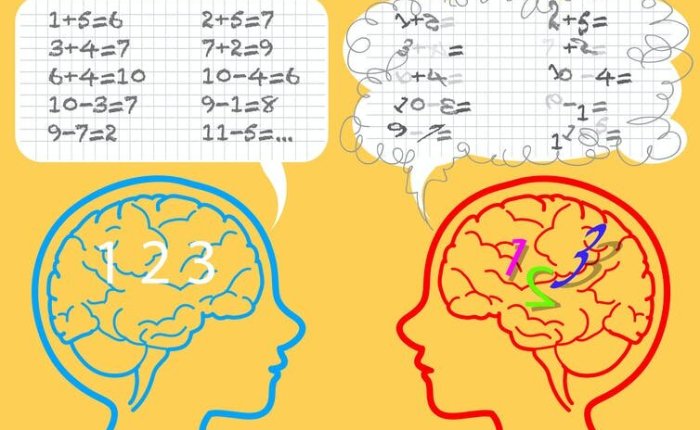
I was at least fifty years away from the humiliation that was Math, Algebra, Geometry, and Statistics when I realized I have dyscalculia, a disorder that that experts define with rigorous specificity: “Dyscalculia is a learning disorder that affects a person’s ability to understand number based information and math.” What exactly is it that a person with dyscalculia can’t do? Process numbers visually, put them in short term memory, have language to describe them, plug in long term memory, understand quantities and amounts, and carry out calculations.
Fractions? Graphs? Logarithms? Geometry?
Not even on the screen.
I got by when I could translate a task into a word problem. Language works for me as math cannot. Do I feel better understanding why I was designated dunce throughout my school years? Not much.
The third issue is not hard-wired.
As a lad I closed the door to my room and read until I could read no more. I read all the usual stuff … and … a staggering number of British mysteries, comedies, dramas, histories, and fiction. By the end of my fifth grade year, orthography had become the next tar pit for this unconventional speller. Did I spell “Rose” as“Rows”. I did not. But with Dorothy Sayers firmly occupying my mid-brain, I spelled “honor” as “honour”, “humor” as “humour”, “defense” as “defence”, and “theater” as “theatre”. As I type these examples, my self-correcting word processing program is spilling red correction fluid all over the virtual page. Exactly as my teachers did.
Please do not think that this orthographic route was affectation; I still spell with choices that aggravate the heck out of my editors. Here is an example of a sentence spelled in a fashion that would make any red blooded American speller gag.
“I am paralysed as I analyse the manouevers a traveller must catalogue as part of a flavour or colour, how to organise not apologise, when one does labour for a neighbour.”
Today, with the generous loss of school day memories, I am ok with being a tapping, dyscalculiac, British speller. It was a long hard slog, and my academic record is impressively tattered, but I got through somehow.
Brains! Who knew!
 The Impractical Cogitator