It’s a wonder I can think …

It’s a wonder I can think …

“When I look back on all the crap I learned in High School

It’s a wonder I can think at all …”

Paul Simon considers this the most interesting part of his song, “Kodachrome”, a song which was banned in several places at several moments because Kodachrome was/is a word trademarked by the Eastman Kodak company. In marketing film for cameras, Eastman invented the word “Kodak” because he thought “K” was a strong letter. All of that aside, the notion that an unremarkable high school education served only to muddle cognitive efficiency for subsequent years grabbed a lot of attention.

When the song was released, I was in a doctoral program in the Human Relations Program offered by the Education Department of the University of Massachusetts. The department had been turbo-charged by a free-thinking rogue from Stanford, Dwight Allen, whose mission was the transformation of educational leadership to encourage innovation and social justice – an iniative that quickly devolved in my cohort to “schools without schooling”. I was also employed as a secondary school teacher (History of Rock and Roll, Popular Psychology) in my two years of part-time course work at UMASS, having barely completed the minimal requirements set by my secondary school and the equally minimal demands made by my college. 

I’ve kept my report cards and transcripts from those years, documents which I offered to my children as an antidote to the pressure cooker expectations of the schools they attended. They were far more successful than I was and found their way to colleges and careers that seem to have suited them. No debilitating display of awards and prizes from this side of the family to raise the temperature during their school years, so I offered my own tattered educational record as evidence of one way of surviving school without having learned much of anything, leaving them room to succeed when and how they wished.

The point is that I didn’t learn crap of any sort in High School; if my thinking is occasionally muddled or skewed, that’s on me. Occasionally is hardly the appropriate term these days as life seems to get foggier with every passing year. Why wouldn’t I be boggled after almost 80 years of bouncing around in a nation that went from ventriloquists performing on radio (?) to the Surgeon General begging for warnings on social media platforms. 

Here’s what I learned by the time I escaped from High School (actually a perfectly humane boarding school with some pretty nifty teachers, had I been unstuck enough to meet them halfway): The country looks like Beaver, Wally, Ozzie, Ricky Nelson, and John F. Kennedy; everyone in California hangs ten and drives beach buggies; people from other countries have amusing accents; people from the South and Texas have amusing accents; the invention of Tang was somehow connected with the Space Program; it’s funny to hear a large bus driver threaten to punch his wife and send her to the moon; drunks are funny; rural poor people are funny; it isn’t great to be Black in America; every generation is more financially successful than the preceding generation; science will solve all problems; cigarettes aren’t bad if they have a filter.

Times change. Heal all wounds? Maybe not so much.

Today Eastman Kodak limps along after bankruptcy, shaking their corporate fists at the scoundrels who created cameras that don’t need film and images that arrive instantly without having to be sent away to be processed. I’ve got boxes of Kodachromed memories I probably ought to scan and archive somewhere … except that I’m increasingly aware that nobody particularly cares what I thought was spectacular at the World’s Fair in New York in 1964. Spoiler alert- it’s not the Small World ride, which cost the equivalent of almost 10 dollars and which brought our own small world the most aggressive ear worm of all time. 

I think therefore I am.

Yeah, but if I don’t think, am I?

OK,here’s something I can blame on my pretty humane boarding school: Fondness for institutional food. 

When I travel, I prefer to find a cafeteria that offers aerated mashed potatoes and gummy gravy. Sure, sometimes that means eating in a Hospital cafeteria, shoveling globby broccoli away while folks sleepwalk down from waiting rooms. 

It’s a wonder I can think at all.
Dogs

Dogs

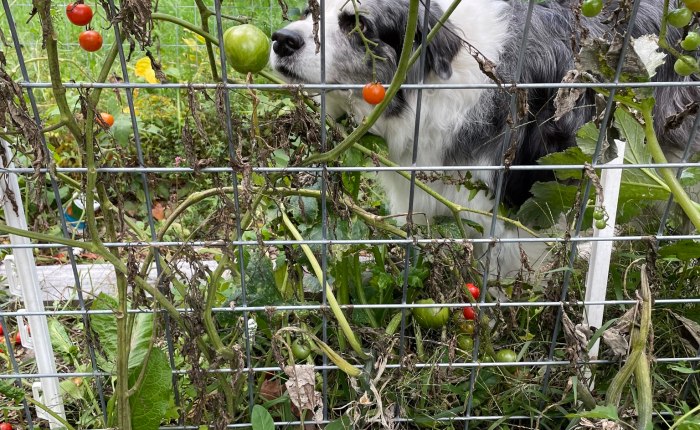
The puppies currently not eating the baseboards in our sun porch were delivered by Caesarian Section exactly eleven weeks ago. Their mother, Gem, our five year old Border Collie, had a difficult pregnancy, and there were tough hours when we thought we had lost both Gem and her three pups. We did lose one in the birth canal, a girl, but brought two boys and their mom home, emotionally spent but brimming with gratitude. Gem, still woozy, slept in the car and on her bed when we got home. The two tiny puppies were carried home in a knitted ski hat placed inside a thermal sandwich bag. One was considerably larger than the other and a good bet to survive the night; the other was tiny and at risk. Our ten year old, Banner, had been left at home and was puzzled by the urgency with which we set up a critical care nest for both pups.

Both of the puppies currently not eating the flooring in our sun porch made it through the night, and our concern about the smaller, an ingenious problem solver we call McGyver, faded as he gained weight and combative spunk, successfully pinning his brother, a wonderfully goofy fluffball named Gus Gus, in a series of wrestling matches that continues to this day. Gem turned out to be a more attentive mother than we had imagined, and Banner has slowly warmed to the new dogs, this morning finally inviting them to play on our lawn.

Banner is moving slowly and often in pain. I sink my fingers in his thick fur and scruffle his neck and ears as he slowly finds a way to fold himself with less discomfort. I remember him as a puppy and as a mature therapy dog, He’s always been hungry and generous, and those qualities remain in full. Tough days and tough choices lie ahead, but today my job is to ease him to his pad and remind him that he is loved. 

When the puppies currently not chewing the flowerpots on the front porch are ten, I will be 88 years old, if I stay viable. There is always the possibility that one or more new dog may join our pack, but I’m settling into the notion that these are probably my last puppies. The phrase “Memento mori” is not unfamiliar, but I haven’t needing reminding for quite a while. Gem, meanwhile, has just settled into a patch of sunlight outside the dining room sliding door, stretching out as her hormone ravaged tattered coat begins to show signs of returning to its lush abundance. 

I didn’t grow up with dogs. Three adopted dogs were around for a short while, but the boxer and the bulldog were hit by cars soon after arriving at our home by the busy road, and the third went to my grandparents’ home where he lived happily and uncrushed for the rest of his dachshund days. In what may be an impulse common to college seniors anticipating graduation and entry into the adult world, I adopted a puppy made available on the front steps of the small grocery store in town. The advertised cost of this freckled puppy of no particular breed was $10.00, but as sales had not been brisk, and patrons had grown tired of stepping over the dog basket, she came to me at no cost. I called her Charity, and was a reasonably attentive owner until a fantastic job opportunity took me to Switzerland, leaving Charity in the warmth of my former mother-in-law’s care. On returning to the US, I missed having a dog and adopted another freckled dog of no particular breed when my son was about four. He got to name the dog and so, Fong Humphrey bounded through a year with us before he was killed while we were away on a trip to meet Raffi, Sharon, Lois, and Bram in Canada. 

I wasn’t sure I could love a dog again, but dogs have a way of appearing in my life when they should.

My wife and I like to describe the day we met. I was interviewing for a job; the acquaintance assigned to take me on tour forgot to show up, and Mary stepped up. Life was complicated for both of us at the time, but I now absolutely believe in love at first sight. Over the course of the next year, we figured things out, and her dog, Hopper, and my son made us a family. There is no doubt in my mind that had Hopper not approved, I’d still be a bachelor. I’m also convinced that Hopper brought out the best in me. He was a great and active dog of several particular breeds who let me love him. He was failing some years later as we began a move from Massachusetts to Alabama. I drove down early with Hopper in his car bed, stopping frequently to check on him, encouraging him to sniff all the way, state-by-state, hoping he’d make it to the new house. Hopper had time with the kids and the new yard, but he was slowing and in pain. A kind vet came to our home at the end, and I held him in my arms as he passed.

I still miss him, but recognize that he left me two great gifts. It’s always dangerous to swim in these waters, but as I held Hopper, I was convinced that he had a spirit, that all mammals have a spirit, that I have a spirit. In addition, for reasons that don’t matter, until Mary, until the kids, until Hopper, I had only known emotional detachment. The grief I felt when Hopper died was an emotion I could not summon when my parents and grandparents died. This grief lasted for months, long after Mary was ready to bring a new dog to our family. 

It’s pretty clear to me that kids have their distinctive personality from the start, and so do dogs. I picked a German Shepherd puppy because he fell asleep on my feet. Having far too much confidence in my ability to untangle the description of the dog in German, I mistook his breeding as a Schutzhund to mean he was a sport dog rather than a “protection dog”. Maus (Fledermaus Bat Ears) was goofy, a mostly unlikely protection dog, wonderfully patient and affectionate with our small kids, but useful when door-to-door solicitors arrived unannounced. The protection side emerged later when we had moved to California and lived in a boarding school community. Too many strangers too close made Maus jumpy, and finally, we had to return him to his breeder in Georgia. I wept again as I watched him loaded into an airplane at LAX.

While still in Alabama,Mary had become interested in dog sports and tried to find a dog who could compete in obedience trials, searching the entire region for an Australian Shepherd with an engaging personality. This search led her to visit a number of more than moderately revolting puppy mills operated by more than moderately revolting owners, including one whose sales pitch included presenting a dog who urinated on command. With incredible tenacity Mary kept searching until she found a breeder in Wisconsin with an adorable puppy she would call Fax, because the owner could fax information but could not fax the dog. 

I’ve written elsewhere about our first border collie, Blitz, a tremendous dog athlete and intuitively effective therapy dog. I’ve also described Jinx, who in her last years, virtually blind, wandered off, became confused in a snowstorm, stumbled into a swimming pool and lay overnight with the fur on her paws frozen to the side of the pool. We rescued her the next morning and built a sauna in a bathroom to bring her back from the brink. She wobbled to my son’s embrace and lived another year. I’ve written about her son, Satch, an irresistibly charming and handsome blue merle border collie who loved children and was unfailingly kind, and Jinx’s daughter, Rogue, maddeningly strong willed with an impish sense of humor and keenly intelligent mind. 

My love for each of these dogs is profound, and I miss each one, finding a bit of Satch in Banner’s fondness for broccoli and pears, and quite a lot of Rogue in Gem’s ability to resist our requests that she not take off like a bottle rocket when the local bears move through our woods. Hopper, Maus, Fax, Blitz, Jinx, Satch, Rogue – all gone and still with me.

One of my students was puzzled by our inclusion of dog after dog in our family. “You know they’re going to die. You know it’s going to break your heart. Why would you keep doing that to yourselves?”

I’m watching Banner sleep on his back with his paws in the air. For the hour or so that he naps, he isn’t hurting. I’ll give him his meds this afternoon and a CBD biscuit this evening. I’m far from ready to let him go; he’s just starting to be the elderly and occasionally corrective uncle the puppies need in order to develop their dog manners and protocols. He’ll sleep next to my end of the couch tonight as I watch the news and wake me in the morning with his howl indicating that I better get up and prepare his breakfast.

Who knows what’s coming next? I don’t. I do know that I can’t imagine not having loved each one of these good dogs. 

Meanwhile, the puppies have figured out that I might have a plastic bag filled with broccoli sprouts somewhere on or about my person. At eleven weeks they sit for treats and occasionally come when they are called. We’ll see more of who they will become week by week, but they have already taken their place in the heart of our life.

That’s why.

Changelings

Changelings

I’ve been working on several projects for years, years and years. My very clever son reminds me that I have the choice to walk away, clear the decks, and start something I might conceivably finish. It’s good advice, and were I a less stubborn or more imaginative man, I would absolutely wipe the slate clean and drop these decaying projects in a flash.

But, not yet.

About ten years ago I took the fifth draft of a play I started almost six years earlier to a writer’s workshop at the college I attended. My memory is porous, but I can guess at the date because I was not yet familiar with Google Docs and needed a tutorial to enter my script and to read the scripts of the other aspiring playwrights. It was not a pretty process, and had the work of others not been safeguarded, I might have erased decades of work by at least ten people. 

I’ve avoided writing groups because I don’t take suggestions. Also, I’m behind on my reading of the greatest works of the 20th Century; why would I slug my way through other folk’s work in process? I did have a writing coach for a while who gathered the chicks every month to peck at our work. It was supposed to be collaborative pecking, but I was often so perplexed by the putative author’s choice of subject that I offered very little in the way of helpful response.

The playwriting seminar was directed by established playwrights, people whose work had been produced on some major stages. My group of five worked with a very nice guy who had just had a successful run on the visiting artist stage of the Steppenwolf Theater company in Chicago. Impressive. Unfortunately, he was my kind of reader, which is to say, he offered no specific suggestions on revising the play I’d dragged across the country, leaving critical response to the other four wanna-be playwrights in the group.

I’m not going to trash the work the other four presented except to say that each had bubbled up from unresolved issues, and each was essentially a three act complaint. I did read them carefully, looking for choices that might be effective in my work. Knowing how fragile my confidence had become, I was gentle and encouraging to all four authors; after all, I’d only written one play that made it to any stage, and that play, A Night of Terror, was pretty much a sloppy pastiche of horror films and “comically” altered Burt Bacharch tunes.  At least it was only one act. My cohort’s work was exhaustive to say the least.

For all I know, all four have been produced and are packing houses in every major city. 

But I doubt it.

Their work aside, and I am happy to put their work aside, my compatriots thought my play was a pile of steaming rat spume and offered such advice as, “Who would watch this thing?”. That was exactly the question I brought to the workshop, answered with compact emphasis on day three of the program.

I almost packed up and flew home a week early, but we’d given our scripts to some acting students who happened to be around that summer. My actors found me that afternoon and talked about the scene they’d like to play.  They seemed to be interested in the parts and worked with me on shading inflection so the characters emerged as I had intended. They took the play seriously.

That was encouraging and disturbing.

A Night of Terror had been written as a joke: 

“You think you are here for an evening’s entertainment, but you have found …A NIGHT OF TERROR!”

I hoped it would amuse someone, but nothing about it was personal or important to me. The play I’d brought, Changelings, was not really plot driven, which is to say, there was hardly any movement from scene to scene or from the first act to the second. Plot is pretty much always my nemesis, but at least I am aware of the lack of forward progress. I’d tried to move things along this time, but, yeah, plot was tertiary.

Not great, but at least this play was not one of those contrivances in which the butler answers the phone … “Yes, inspector, Major Hargreave was killed with a golf club in the study where he had gone to alter his last will and testament before his sister, Rowena Chompalot, arrived with her paramour, Tony Cul de Sac, the professional golfer and convicted arsonist.”

Still.

As is almost always the case in my “dramatic” work, the bulk of this play was conversation at best and extended soliloquy at worst. The title makes reference to children left by fairies in place of a real child. The changelings in the play were almost entirely transnational adoptees, and they had a lot to say about growing up as outsiders, even in their family. So much to say. No room for plot here.

I sat in a small audience in the theater as the actors offered staged reading. I’m sure the other plays were adequately presented. The actors had labored over Gaelic or Slavic accents, and worked pretty hard in trying to find the rhythm in a hip hop street battle. My scene took place in a meeting room; Robert,an angry 30 year old Ogala Lakota taken from his birth family has described his conflicted feelings about living in two cultures to Toni, a twenty-five year old Cambodian adoptee.

Toni

OK, I’m , I mean, I never thought about a lot of that stuff, but it hits home for me. In a different way, kind of. One of the things I’m  aware of now is that the way people see me is not the way I see myself.  If you stopped me on the street and asked me to tell you the most important things about me, I wouldn’t start with Cambodian. I don’t think I’d even say Cambodian. Or Asian.  That’s not how I see me.  I might say I work in a bank. But… It’s confusing.

Robert said something that really hit me. I’m a little ashamed of being Cambodian and then ashamed of being ashamed if that makes any sense? Sometimes I wonder about how my family sees me, you know? Like do they see me as a Cambodian girl? Am I a daughter, really?  Or a sister?

No forward motion, but when the actors spoke the lines, I felt … vindicated. Was I appropriating cultures? Not entirely sure then, pretty sure now. I heard real voices, though, and real issues.  Good enough then.

I stayed for the rest of the course, tinkered with the script, flew home, and put it away. I take it out from time to time, primarily because I like some of the people who live in those lines. I’m attached to them and their stories. It’s not a play, really, and I don’t have the mechanisms necessary to build dramatic unity. 

As I said earlier, I’m stubborn and a little low in imagination. I might come up with something worth producing, but I’d have to get past the feeling that writing this thing was enough. 

I’ll just read it again and see what else I’ve put in the slush pile for revision. It’s probably time to move on.

Need to Know?

Need to Know?

I knew there was a universe in which cluelessness festered untreated, but when I found “When is Cinco de Mayo?” among the most frequently Googled searches, I had to face my own cyber innocence. I Googled Google searches and found more, much more, than I had feared.

We’ll get to the many disturbing searches regarding personal health and hygiene, but let’s jump right into murder and mayhem. 

In the best of mystery novels, a killer evades detection for several hundred pages, the brilliant sleuth trailing the malefactor to his lair in the last chapter. Apparently not the case out here with actual humans. To say that murderers in real life are occasionally witless is to understate the stunning ineptitude of more than several who have turned to Google for help in stumping (sorry) the law. Several years ago my kids and I  joked about the “What size wood chipper do I need for human bones?” murder, but a recent and fairly local grotesquerie  added heft and weight (sorry) to the body (sorry) of information available to even the least discerning of homicide investigators.

Brian Walshe would have been the primary suspect in the murder of his wife in Cohasset, Massachusetts even had he not Googled his way into conjecture. His character had already been established when he was caught in a fairly transparent art scam, stealing a real Warhol painting from a friend and attempting to sell a fake on ebay. Times were tough for Brian; he was headed to prison and needed a quick infusion of cash to keep the wheels of justice clogged. His wife was last seen on New Year’s Day in 2023, her remains still not found, and Brian was counting the days until insurance policies paid off.

Remains still not found, but investigators thought there might be a clue in  Walshe’s search history. Twenty searches were entered on January 1st; these are among the most particular.:

“How long before a body starts to smell?”

“10 ways to dispose of a dead body if you really need to.”

“How long for someone to be missing to inherit?”

“Can you throw away body parts?”

“Hacksaw best tool to dismember?”

The other 15 are equally stunning, but there is something disarming (sorry) about the “…if you really need to.” Not just because a dead body is a messy encumbrance, you understand, but because in some instances, under certain circumstances, you REALLY need to ditch a corpse. 

I was also struck by the economy of “Hacksaw best tool to dismember?”.

Pithy. 

 I was tempted to search for other tools when one really needs to dispose of the … uh … you know, but figure that a quick perusal of my own search history would then include, “Anything better than a hacksaw to dismember?” or the more specific,  “I can’t find a hacksaw at my local hardware store. Is lye as good if you have a body you really need to ditch?”

Many of Walshe’s questions might have been answered in a word or two. Simple “Yes”, “No”, “Try lye” responses.

 “Can you throw away body parts”, however, seems to demand more detailed information. Does every state or municipality have the same regulations with regard to recycling limbs and organs? Do limbs go to one pile and organs to another? And then, there’s the How To element necessary for the novice. No, a written response is inadequate. What’s called for is a plodding, self-congratulatory YouTube Do-It-Yourself tutorial. I picture a garage, plastic sheeting,cheerful voice-over, and the Hobart 6614-2 meat saw.

Enough of this ghoulish nonsense! Let’s see what’s on America’s mind.

“What to do if a dolphin wants to mate with me”. 

OK, fair enough. I have no advice.

There are a number of searches that fall into the “Who would win…” category, some of which are clearly poorly thought out. “Who would win if Batman fought Superman?”, for example, ignores the reality that one works in a cave, drives a car (pretty great ride, but still), and is human, whereas the other is (mostly) invulnerable, has super strength, ray gun vision, and can fly. 

Batman is the subject of another question that had me lost in thought for a while. I’m particularly fond of search questions that open doorways of the mind. How does this person see the world? Is a circuit missing, a basic premise overlooked, alternate reality at work?

The question: “If both of Batman’s parents are dead, then how was he born?”

Uh … where does one begin? Actually, it is the combative force of the intrusion of the word  “then” in the question that gives me pause. This is not an innocent question; there’s an agenda here. If … then. It’s a “gotcha!” question. 

To continue.

“Am I a sociopath?” Hey, I’m no psychiatrist, but if you have to ask …

“Why is my poop green?”

No, I get this one.

It’s midnight, who you gonna call? Nudge a sleeping partner and try to ease a conversation toward a recent and alarming discovery? Wait until morning and check the tint? With whom? This is not an office water cooler question. This is not a waiting-in-line at Starbucks conversation. Interrupt a physician busily saving children’s lives with what may be nothing more than a passing (sorry) anomaly? No way. Let the internet handle this one. 

“Why does Donald Duck come out of a shower wearing a towel if he doesn’t usually wear pants?” 

Exactly! Who hasn’t had the same question?

 Let’s leave aside the reality that there is no answer unless we believe that a Disney animator somewhere has a conviction about duck modesty with regard to showering. 

Donald is not the only puzzling semi-nudist cartoon figure. How many of your conversations at  dinner parties or teacher conferences have been elevated by identifying cartoon characters who get away with going pantless or topless year after year? Mickey Mouse wears pants; pants are not unknown in the fictive world in which Donald, Chip, Dale and countless others carry out their daily routine. To further confuse the issue, Donald wears a hat and a tie, Bugs Bunny wears gloves, Yogi Bear, a hat. Porky the Pig wears a sports jacket unbuttoned, displaying his endearing pinkness.  Winnie the Pooh? Nada. 

With some trepidation, I cite a search concerning human costumery.

 “Was Sarah Palin a bear, a beaver, or an otter when appearing on The Masked Singer?” 

Once again, the inquiring mind is probably best served by calling up the video of the former Vice Presidential candidate’s performance, in which she, as a bear, “rapped” Baby Got Back. by Sir Mix-a-Lot. Imagine how unfortunate it might have been had she not been costumed as a bear.

In a curious bit of synchronicity, I have a semi-personal connection with at least one musician who also covered the song. “Baby Got Back”, was featured in an episode of Glee in 2013, not performed by a cast member but by Jonathan Coulton, who had recorded a lyrical version accompanied by acoustic guitar. Turns out Couton hadn’t agreed to have his version broadcast, was miffed, and sued Fox TV. Coultan couldn’t get no satisfaction, but released the song again on Itunes as “Glee’s cover of my cover of a Sir-Mix-a-Lot’s song”. 

Coulton is best known as a composer in the genre known as “geek rock”, most currently celebrated for his work on the stage version of SpongeBob musical. He made a living composing music for video games (Portal and Portal 2) and has released a number of albums including Smoking Monkeys and Artificial Heart. Knowing nothing of his career, but knowing he was a Whiffenpoof, I contacted Coulter in 2012 as I did some (10 minutes) research while writing A Whiff of Murder, a thoroughly unnecessary novel combining the history of Yale’s premier acapella singing group, The Whiffenpoofs, and a poorly conceived murder mystery. I’d heard one of Coulton’s songs, “The Future Soon” sung by another acapella group he’d belonged to and was hooked. It’s a lyrically evocative semi-lovesong, delivered by a shunned suitor planning to convert himself into a robot.

“Here on Earth they’ll wonder

As I piece by piece replace myself

And the steel and circuits will make me whole

But I’ll still feel so alone

Until Laura calls me home.”

A geek rock Whiffenpoof was exactly what I needed to flesh out the novel, so I called Coulton and heard his voice … on a machine.

How did I get here?

Oh, yes, mockery of other people’s ill-conceived searching. This, from the author of Side Effects May Include Astral Sex and OtherObservations from the Pandemic, Climate Death, and Cultural Meltdown.

People in glass houses, etc.