I’ve written several guides to American colleges and universities, all of which were intended to bring attention to excellent liberal arts colleges unappreciated outside of their region. My own experience as a geographically challenged 18 year old in arriving at Kenyon College in Gambier, Ohio, roughly an hour north of Columbus, Ohio in 1964 informed that enterprise, as I found myself in a Gothic paradise, not entirely by accident, but certainly without any intelligent preparation. My parents were hardly more tuned in, as they booked me a flight to Cleveland, yes, also in Ohio, but roughly 110 miles from Gambier. It took me four hours to hitch rides to my college home.
I return to Kenyon as often as I can and consider myself ridiculously lucky to have had the opportunity to live on that campus. It was in the hope of helping others find their way that I became a college counselor in addition to teaching and coaching. I was happily working with great kids at University Liggett School in Michigan when four sophomores brought me a set of challenges I had not anticipated. Susie Mascarin and Aaron Krickstein were missing a ton of classes as they played in junior tennis tournaments throughout the year, handing in assignments as they headed to Dallas or Minneapolis. Equally academically stressed, Costa Papista played for the Sudbury Wolves, in the Ontario Hockey League, and Jimmy Carson played for the Verdun Junior Canadiens. Both were on the road every weekend and even farther from home during playoffs.
I met with each of the kids as they began planning for the junior year, ready to help them prepare for the process of working with Division I athletic programs. I began with an enthusiastic description of what their careers as college athletes might look like, then moved to the academic issues that might pop up as they tried to balance competitive athletics with a rigorous college curriculum.
After the pregnant silence that followed, each of the kids patiently explained that college might be peachy, but they were going pro immediately following graduation. I suggested that there were no guarantees in leaving school, that many athletes never found professional success. I had to bring up the possibility that injury or illness could end a career before it began. Surely, I thought, even a few years at the college level could only enhance their chances of reaching the highest level of competition in their sport.
Thanks, Mr. Arango, you’re a swell guy. We’ll take our chances.
My memory is that Costa Papista played for one more season with the Wolves, was injured, wasn’t drafted by the NHL, and ended up playing for the University of New Brunswick. Not a terrible outcome.
Susie Mascarin won the US Open Girls Singles Championship, played in the Australian Open, the French Open, the Wimbledon Championship, and reached the 4th round of the US Open.
Jimmy Carson played for ten seasons in the NHL and while playing for the LA Kings became the second teenager to score 50 goals in a season, scoring 55 goals in his second season, the NHL record for the most goals scored by a United States-born player.
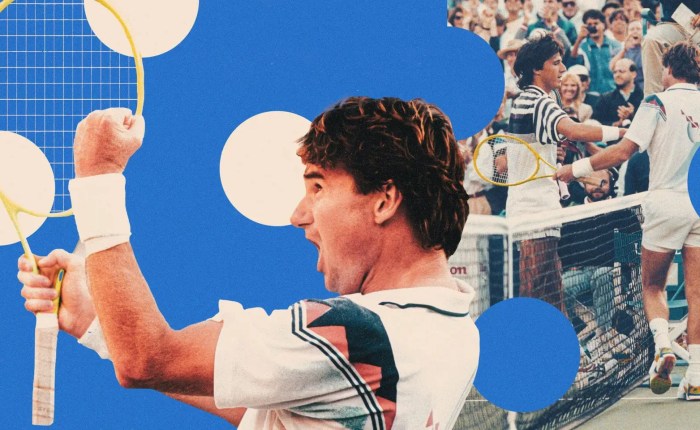
Aaron Krickstein won five consecutive junior championships and became the youngest player to win a singles title on the ATP tour, finishing with nine titles in his ATP career. Along the way, he defeated Ivan Lendl, Boris Becker, Stefan Edberg, Pete Sampras, Matts Wilander, and Andre Agassi, but he is best known for a five set battle vs Jimmy Connors in the 1991 US Open, a match that lasted more than four hours and ended in a 5th set tie breaker.
The Connors-Krickstein knock-down, drag-out marathon often comes up at this time of year, as the US Open nears the quarter-finals. I haven’t run into Aaron since leaving Michigan, but I’ve come closer to Connors than I might have expected.
Near the end of my exceedingly fortunate teaching career at Cate School in Carpinteria, California, I was awarded a sabbatical leave in which I managed to write two novels and America’s Best Kept College Secrets, the sort of guide I mentioned earlier. I hiked in the mountains to clear my head, and played golf mostly to get outdoors and walk in pretty places. I was/am terrible, but every once in a while I’d treat myself and drive into the Santa Ynez Hills to play or practice on the Rancho San Marcos course where the pros play. I’d spring for a round once or twice a year, but for 15 bucks I could spend the morning on the practice facilities and feel pretty spiffy.
I got out to practice early and the guy in the office told me the course was closed as two golfers had rented it for the day. Apparently they were high stakes gamblers and had thousands of dollars riding on each hole, so needed to keep the hoi polloi at bay. I could use the practice tees, pitching greens, and sand traps, but had to stay away from the course.
No problem. I just wanted to hit some balls. Try to hit some balls. Let me be clear – When I hit a tee shot it makes a muffled “thunk”. On a great day, I might hear a medium “thwack”.
I was at the end of the practice tee thwacking and thunking when I heard sounds I will not be able to fully describe.
Canons? Howitzers?
Two guys at the other end of the tees were launching moon shots. There are many unspoken articles of etiquette (or at least, there were) about practice tee behavior; it was considered impolite to gawk or mock anyone’s drives. But, rocket fire, c’mon.
So I gawked.
It was very early on a mountain morning, dew was on the grass, wisps of fog hugged the ground, and in the dim light I saw … Michael Jordan and Jimmy Connors demolishing golf balls and muttering when their drives fall short of the 300 yard marker.
I messed around as long as they stayed on the driving range, then carefully left the course without intruding on their vibe.
I’ve been watching sports for a long time and knew that premier athletes are not like mere mortals, but that lesson was very forcibly brought home to me that morning.
I still play at golf. Carrying my bag and walking alone on nice (cheap) courses. Our local municipal course is beautiful and I can walk nine holes for 24 bucks. I don’t keep score, and I’m still thunking and thwacking.
I think about that post-career Connors, still ferocious, terrifyingly strong, and Aaron Krickstein, a high school sophomore, sitting in my office, smiling, assuring me that he was determined to play against the very best in the world, no matter what.
 The Impractical Cogitator