Wait! The Big Ten Has 14 Teams and One Of Them Is Rutgers?

Wait!  The Big Ten Has 14 Teams and One Of Them Is Rutgers?

To every thing there is a season, and long, steamy summer days clearly belong to baseball, but, without ignoring the crucial games just before the All Star break, I start to look to the fall and football, allowing myself to leaf through Street and Smith’s College Football Preview.  Chucking neutrality aside, I check Michigan’s place in the pre-season guesswork, assuming that guide is likely to be accurate if Michigan is properly placed in the mix of teams contending for a national championship then turn to the wealth of other information in the hefty magazine including presentation of pre-season All Americans at each position and evaluations of each team’s depth and strength.  Teams are ranked within their conference, the likely champions getting the most ink, the runners-up quarter page blurbs.

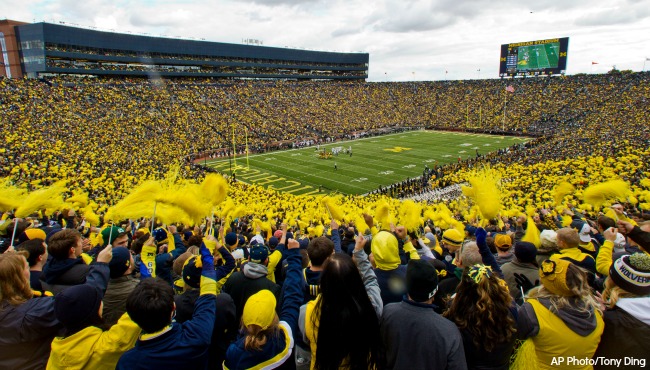
Conferences – aye, there’s the rub.  Michigan, a founding member of the Big 10, a midwestern conference made up of flagship public universities (with the exception of Independent Northwestern), now plays Penn State, Maryland, and Rutgers.  The conference can’t even call themselves the Big 10 anymore; the conference is now its own logo – BIG – which has been craftily shaded so the uninformed viewer can almost see a 10 hidden in the letters but will see two divisions of seven each season until sanity returns.

The flux in which we live has accustomed me to change, but I do treasure tradition and pageantry, pomp, circumstance, and rabid rivalry.  Once upon a time, most rivalries took place within long-established athletic conferences, but college athletics, I am told, generates a considerable amount of income, roughly SEVEN BILLION dollars which colleges and universities count on to … to … well, to do whatever it is that they do when they are not playing games, but to get to SEVEN BILLION, conferences had to add championship games to have one last mega-event before the bowl games.  The old familiar cozy conferences simply no longer brought in enough revenue, so abracadabra, tradition be damned and geography ignored.

A few of the conferences have not changed over the course of my lifetime as a fan; the Ivy League, for example, has been made up of the same eight distinguished colleges since 1954; almost all of the rest of the Division I conferences have changed both in composition and character.  Some of the changes made sense up to a point; the Big Five Conference made up of Cal, USC, UCLA, Stanford, and Washington became the Big Six with the addition of Washington State and then the Pacific 8 with the addition of Oregon and Oregon State.  As Arizona and Arizona State were poached from the Western Athletic Conference (WAC), the conference became the PAC 10.  The thoughtful reader will have noted that Arizona does not (yet) enjoy a Pacific coastline, but at least is within driving distance of the ocean, whereas Colorado and Utah, the institutions recently departed from the Big 12 and the Mountain West Conference, are considerably less Pacific.  Oh, and the Big 12 has ten teams.  I’m just saying.

The slide began in the late ’90s, but by 2013, madness had truly set in, traditional rivalries were abandoned, and the familiar regional associations gave way to collections that seem jury-rigged Frankenconfrences; odd bits of one were attached to limbs of another.  In retrospect, the dissolution of the Big 8 (Nebraska, Iowa State, Colorado, Kansas, Kansas State, Missouri, Oklahoma and Oklahoma State) allowed the first of the new super-conferences to spawn imitators as its members joined with Texas, Texas A&M, Baylor, and Texas Tech to create the Big 12, large enough that competition was divided into the Big 12 North and the Big 12 South, which mirrors the division of the Southeastern Conference (SEC) which was also split when the SEC picked off Arkansas which had defected from the conference depth-charged when the Texas colleges jumped into the Big 12 and South Carolina which had been homeless since ditching the ACC and the dominance of the North Carolina colleges.

But, wait!  There’s more.  The already over-large SEC added Texas A&M and Missouri, both of which deserted the Big 12, which made that conference shaky, especially as there were widespread rumors that Texas was about to bolt as well.  Texas is the straw that stirs the drink in the region with access to television money the others do not see, just as Notre Dame with its own independent contract with NBC had the golden ticket, allowing them to play a schedule of their choosing in football while playing basketball in the Big East, that is, until the Golden Domers by virtue of what must have been a Papal encyclical, have remained independent in football, bound to play only five games within their new home, the Atlantic Coast Conference (ACC), but regular members in all other sports … except hockey, which now joins the BIG.

Let’s remember that like the Big East, the ACC has been most notably a basketball conference.  Why then, oh why, would Notre Dame join up, being as the clever will have noted, not on the Atlantic or even adjacent to states that are?  Why would the ACC, having its own well established traditions welcome feisty and independent Notre Dame?  Probably a union of like-minded academic institutions?  We think not.

There is this.  On any given Saturday, lacking the expensive football package from my cable provider, I am lucky if I can find more than one televised game from any single conference.  Generally, the conference game I will see is some sort of match-up, a rivalry game or a game on which a title might depend.  Of the twelve to fourteen teams in the conference, only two or four at most hit the screen.  Maybe NBC could work in one more?  Oh, that’s right!  They have a contract with Notre Dame.  Every Notre Dame game will have a national audience, and that suggests that Notre Dame and every team playing Notre Dame gets a share of national television bounty.  So, unlovely ACC football gets a shot in the arm, a national audience, name recognition while recruiting outside the Atlantic region, and dough that is split up among the members of the conference.  Yes, The North Carolina State Wolfpack is assured a national audience this fall as are Wake Forest’s Demon Deacons

Notre Dame gets to play most its traditional (and very telegenic) rivals (USC, Navy, Boston College, and Michigan State),  games that offer little challenge at crucial resting points in the season (Temple, Miami University of Ohio, and Navy), and two games against teams (Georgia and Stanford) that are strong enough to boost Notre Dame’s chances of landing a playoff spot or juicy bowl game.

Win-win.

My beef isn’t with making money or trying to enhance the recruiting profile outside of the region; college sports are no longer the bastion of purely amateur athletics played for the beauty of the game.  I am saddened, however, that Missouri no longer plays Nebraska, that Syracuse no longer battles Georgetown in basketball.  This spring, Johns Hopkins joins the BIG in lacrosse, leaving its own traditional regional rivalries behind.  Traditions seem to have died a quick death with the stroke of a pen.

OK, maybe I’m slightly miffed that Notre Dame didn’t elect to keep Michigan among its “must-have” independent games, or maybe I’m just a fussy curmudgeon. In any case,  I’ve got two months, fourteen days, and eight hours to get over myself before the opening game against Florida, and my therapist is on speed dial.


Making Vegetables Sexy?

Making Vegetables Sexy?

In an article entitled,” The Easiest Way To Eat More Vegetables”, researchers were credited with having found ” an ingenious way to get people to eat more vegetables”, not quite the same subject, but that’s apparently how research gets turned around.  In any case, the idea is this:  Presented with four categories of vegetables prepared in exactly the same way but labeled differently – Basic (beets, corn, green beans),  Healthy (vitamin rich-corn, antioxidant-rich  squash), Restrictive healthy (reduced sodium corn, carrots with sugar-free citrus dressing) and Indulgent ( rich buttery roasted sweet corn, dynamite chili and tangy lime-seasoned beets), diners most frequently chose the most evocatively indulgent menu.

Thus, at the crossroads of science and marketing, research indicates that we choose options that sound tasty.  I suppose that’s why restaurants go to the trouble of hiring itinerant authors looking for work between novels to bring the full force of literary imagination to their carte du jour.

It happens that I know what it is to face the bleak reality of an artless menu, having lived for a few years in a tiny Swiss village far from the elegant eateries in Zürich or Geneva.  No, in the hinterland dining options are notably rural and menus roughly translated.  I would not have needed translation, of course, had I been as clever as any Swiss child, able to speak four or five languages with functional fluency.  My rudimentary command of Swiss German allowed me to avoid some grotesqueries of communication.  Some, but not many.

Without dwelling on the fine points of inflection which separate the Swiss German word for chicken and the word for dog. suffice it to say that my visit to the town’s butcher went badly when I inadvertently ordered a hefty slab of dog breast.  My attempts to clarify this request aroused the butcher to greater ire as in an attempt to make myself understood, I pumped up the volume.  He apparently thought I really wanted that dog flesh, really wanted it, so much so that I dropped the deferential meekness which had characterized my tenure as a stranger in a strange land.   To him, I now understand, I was a barbaric Amerikaner screaming for dog meat and brooking no refusal.

This did not end well.

From that point on I was persona non grata in the village’s metzgerei, receiving no greeting but the untranslated,  “No meat for you”.

So, obviously, I needed help when  it came to deciphering the menu at the local restaurant, and when I say local, I mean not visited by diners not born in the Gemeinde with the exception of the previously mentioned barbarian.  My host was always pleased to see me; obviously word of my canine fixation had not reached the Gasthof.  His command of English was immeasurably better than my Schweizerdeutsch but somewhat spotty, particularly when it came to adjectives, and, since it is precisely in evaluating the power of adjectival impact in convincing diners that tastiness lay ahead, his suggestions were, well, blunt.

Slight digression here in noting that every language has oddities of usage that probably mirror the culture’s deepest compulsions, but as I am entirely steeped in my own experience of language, I don’t recognize those oddities as I did in encountering Swiss translation.  The point being that the Swiss in this small village used the word “must” in virtually any situation:  “You must pay now.”  “You must now go to the laundry.”  “You must from here take that road.”

That being noted, my host’s urgings may sound less threatening.  “You must have the little cow.  Before it takes no milk from his mother, yes?  So small it has tiny skin, You know?  Little cow in the cream with potatoes that are shavings.  I put also in onion.”

I quite liked the candor with which the folks in my village spoke, if I understood them, and I appreciate it still.  The town seems to have grown more suburban in the forty years since I last chose not to eat the little cow with tiny skin; there are at least eight restaurants in the hamlet now, all of which cater to trade from outside the village.  Just as I now check the reviews posted on restaurants that are new to me, travellers can read comments posted in English on various sites.  It seems candor remains the expression of choice, and diners are given fair warning in language I appreciate.

“The restaurant makes already from the outside a dingy impression, what is going on inside.”  Who knows, really what is going on inside, but it sounds dingy to me as well.  The meticulousness with which these diners assess the restaurant is impressive but occasionally puzzling.  “The price/performance ratio is not.”  I see, but not …?  “The chef greeted us friendly and very sympathetically…”.  I could have used some sympathy,  but let it go, let it go.

To return to the subject under examination, let us consider the menu at our locally esteemed steak and chop-house, a restaurant with a reputation as one of the best in the Pacific Northwest, then sneak a peek at a description of an entrée at a fast-food chain, just to see how adjectives drive the appetite.

First, the mission statement provided by Omar’s Restaurant in Ashland:

It is our mission to provide our guests with the freshest and highest quality food products that are locally sourced whenever possible. It is our passion to turn these bounties of the land and sea into handcrafted, from scratch products for you. We hand cut all of steaks that are aged for an extra 6 weeks to ensure tenderness and enhance flavor. We receive 3 to 5 fish deliveries a week from local and global waters. We make all of our soups, dressings, sauces, and stocks from scratch. We do all of this in order to ensure that you, our valued customer enjoy delicious home cooked meal, from our kitchen to your plate.(sic)

It happens that every word in this introduction to Omar’s is true; the food is locally sourced, the chefs are passionate about their craft, the steaks are hand cut and aged, fish arrives frequently from global waters, and soups and sauces are made from scratch.

But… are we drooling?

No reservation is needed at Carl’s Jr’s various outlets.  Drive up, step in, read the menu on the wall and consider the Jim Beam Bourbon Burger.

Unwind with the Jim Beam® Bourbon Burger. Featuring a chargrilled beef patty topped with bacon, crispy onion , swiss cheese, fresh lettuce and tomato — slathered in a rich and tangy sauce flavoured with Jim Beam bourbon.

OK, fairly evocative.  Slathered.  Good word.  How about McDonald’s Maple Bacon Dijon burger?

Layered with thick-cut Applewood smoked bacon sprinkled with sweet maple seasonings, creamy Dijon sauce, grilled onions, smooth white cheddar, and crisp leaf lettuce, on a quarter pound of 100% pure beef with no fillers, additives, or preservatives, with your choice of an artisan roll or sesame seed bun. 

Thick-cut Applewood smoked bacon has more oomph than the pedestrian bacon or cured pork product, and this cheese is not simply white cheddar but smoooooth.  Getting close to whetting the appetite.

As a youth I was forced to eat unpalatable meals, the memory of which still make the gorge rise, so let’s take one of the standard components and see what a few well placed adjectives can do.  The lowly turnip is a root vegetable, easy to store over long periods of time as are the other root vegetables – bulrushes, onions, chufa, taro corns, yams, virtually any sort of tubers.  With some effort, the bulb of the turnip can be massaged into something like presentable food, perhaps by chopping, rinsing, then mashing the turnip into paste served hot with butter, slightly less bitter than the untreated turnip.

A word often used in describing the turnip is pungent, but pungent is not the sort of word to slide into the carte du jour, but powers of invention  abound in menu-speak, so here goes:

Early Harvest White Turnips in an Adelle-rind pasteurized cow & sheep’s milk 

Turnip Adelle is vibrant young turnip in a soft-ripened bloomy-rind cheese melange. With a light, fluffy texture and a flavor of butter and citrus, this creamy, smooth turnip in cheese melts in the mouth.

I know turnips far too well, and no amount of Adelle cheese would save them from being the roots that they are, but … sounds almost … tasty.  En Guete, mittenand!


Fear Strikes Out

Fear Strikes Out

Jimmy Piersall died last week at the age of eighty-seven.  I was no fan of the Boston Red Sox of his era, but Piersall was an exceptional outfielder and a lively counterpoint to the stolid genius of Ted Williams, his most celebrated teammate.  He was a kid from Waterbury, Connecticut, a local guy, volatile and troubled, who had the tough job of replacing crowd favorite Dom DiMaggio in centerfield.  Dominic DiMaggio was the youngest of the DiMaggios and was largely overshadowed by Williams and his brother, Joe, but was an outstanding center fielder and a solid offensive player as well.  Consistent and a great teammate, spectacled DiMaggio, known as the Little Professor, was a quietly effective player.  Piersall was a loose cannon, and, although he played for seventeen years, he was an unpredictable and frequently off-putting teammate, both disturbed and disturbing.

With candor, he called himself “crazy” and spent much of his rookie year in a mental hospital where he received electro-convulsive treatment for what was then called manic depression, today known as bipolar disorder.  Many contemporary fans, even the most rabid, will likely not remember the part that Piersall played in raising awareness of mental illness at a time in which few celebrities were willing to admit to weaknesses or frailties of any kind.

Despite his bouts of incapacitating illness, Piersall, who came up to the majors with the Red Sox, won a spot on several All Star teams and won Golden Glove awards throughout his career.  Casey Stengel, who managed him on the New York Mets, came to consider him the best defensive outfielder he had ever seen, putting him ahead of Joe DiMaggio as a center fielder.  Piersall’s ability to anticipate the flight of a baseball was uncanny, and, until he threw his arm out competing against Willie Mays, his ability to read baserunners’ intentions made him doubly dangerous in the field.  Nevertheless, Stengel, who championed Piersall at the end of his career, observed, “He’s great, but you have to play him in a cage.”

Piersall acknowledged his struggles, speaking freely about his mother’s mental illness and his own demons.  The film, Fear Strikes Out, was an adaptation of the book Piersall had written with Nat Hentoff.  Starring Anthony Perkins, whose vibrating nervousness made him the obvious actor to play Norman Bates in Psycho, the film wandered from Piersall’s plainspoken admission of illness to a conventional sob story about an athlete pushed to the edge by an over-demanding father.

Piersall hated the movie and frequently spoke about the cowardice Hollywood had shown in avoiding a real presentation of his disorder.  Those who followed the game, however, were reminded on  a daily basis that this outfielder played by a different set of rules.  He took a bow after making each catch, tipping his hat to the stands.  He had a hair-trigger and was quick to fight with opponents and with his own teammates.  He battled with umpires and threw his bat at pitchers.  After hitting his hundredth home run, Piersall ran the bases backwards.

Poets and lyrical fans evoke the beauty of the game waxing rhapsodic o’er the emerald fields and dusty vermillion base paths; truth tellers move beyond spectacle and metaphor to descriptions of grit and heart, weakness and failure, champions and goats.  Baseball is also the stuff of legends, some sparkling and some tawdry, every anecdote documented in the exhaustive historical register that has recorded every at bat, every hit, every run batted in.

And, from time to time, baseball offers the rich panoply of sport (nice phrase!) and characters more vivid than pop out of any other sport, with the possible exception of boxing.  What other sport relishes nicknames as baseball does?  What other sport has the likes of Joltin’ Joe DiMaggio, Dennis Oil Can Boyd, Harry Suitcase Simpson, Double Duty Radcliffe, Dizzy Dean, Big Poison and Little Poison Waner, King Kong Keller, Mudcat Grant Satchel Paige, Poosh Em Up Tony Lazzeri, Three Finger Brown, No Neck Williams, Choo-Choo Coleman?

There is a fine line between eccentricity and disorder, and any spectator who saw Al “The Mad Hungarian” Hrabosky’s routine on the mound had to wonder if the line had been crossed.  He grunted entire conversations to himself, pounding his glove, occasionally spitting, kicking dirt as he circled.  Normal?  Bill “Spaceman” Lee, another pitcher, was fond of tossing what he called the “Leephus”, a towering low-speed blooper pitch.  Rube Waddell pitched his way into the Hall of Fame, but was notorious for leaving the field to chase fire engines and other shiny things.  Lest zaniness be ascribed only to pitchers, recently retired outfielder, Manny Ramirez, generally described as “Manny being Manny”, raced to catch a tough fly ball, gave a high-five to a fab in the stands and then completed the play with a throw to the infield.

Billy Martin, a spark plug second baseman and manager was a confirmed carousing fighter, carrying his short fuse into every confrontation, on and off the field.  His fight with Piersall was a meeting of the unhinged, but one of his last fights, a bar fight with Ed Whitson, a pitcher nursing a smouldering resentment at what he took to be mistreatment by Martin as Yankee manager was likely one he had tried to avoid.  Whitson, all six feet and three inches of fighting fury, kicked Martin in the groin, breaking Martin’s arm by the end of the fracas.  Unlike Cobb, Martin was generally well liked, until his temper got the best of him.

Armchair psychiatrists might nominate any number of other notable ballplayers as variants from the norm, some darker variants than others.  Ty Cobb, for example, exhibited what could be considered consistent sociopathology throughout his career.  He would have said that he played the game hard, the way it should be played, filing his spikes to a razor-sharp edge, throwing himself into a slide into second base spikes high.  It was Cobb who jumped into the stands to beat an armless heckler, who assaulted a groundskeeper and choked the man’s wife when she tried to pull him off her husband.  Criticized for beating a man with no hands, Cobb replied with some heat, “I don’t care if he has no feet,” a troubling and confusing rejoinder.

Jimmy Piersall was scrappy, eccentric, and unpredictable; he was also brave and honest, living in plain sight.  He had it right from the start; in his case, fear struck out.


The Pizza Essay, Yale, and Bad News For College Admissions Officers Everywhere

The Pizza Essay, Yale, and Bad News For College Admissions Officers Everywhere

I try not to predict doom and disaster on a regular basis; those predictions are not outside the realm of possibility, but, what the hey, we can’t do much about most of them, and I’m exhausted just having gone through the raft of “sky is falling” stories in today’s news feeds. Additionally, I’m no economist and no political savant, so my opinions are no more informed than anyone else’s and really not very interesting.

I do know a lot about colleges and college admissions, however, having counseled thousands of students and having worked in several college admissions offices. My guidebook, America’s Best Kept College Secrets has not found the market I had hoped it might, but it represent forty years of visiting and evaluating colleges and forty years of working with college admissions professionals. I’ll deal with the book’s purpose after I have dealt with the buzz surrounding the admission of a young woman, Carolina Williams of Brentwood, Tennessee, to Yale University, ostensibly on the strength of her application essay, a paean to Papa John’s Pizza , her favorite sort of pizza, which she claims to order every day.

Williams was admitted to Yale although she intends to attend Auburn University. Among the several documents she submitted in the course of her application, were a series of short essays, one of which, having to do with something she loved to do, prompted Williams to write about ordering pizza, suggesting that pizza, “…smells like celebration…tastes like comfort…looks like self-sufficiency.” A note accompanying her letter offering admission made reference to another essay, one in which she had written about her determination to read a hundred books in a year, and admitted that her pizza rhapsody had made him laugh, and then order pizza.

Basking in the approval of her application, Williams shot a tweet off to Papa John’s and received a congratulatory response:

Carolina Williams @justcarolina22

I just want @PapaJohns to know that I wrote a college essay about how much I love to order their pizza and it got me into Yale

pic.twitter.com/lDlzEErHCn

Follow

Papa John’s Pizza

@PapaJohns

@justcarolina22 CONGRATS, CAROLINA!! We’re so honored that you wrote about us in your essay! Send us a DM, please @AskPapaJohns

10:15 AM — 9 May 2017

The corporate offices of Papa John’s quickly jumped at the chance to attach themselves to Carolina’s success, not only offering her congratulations but an internship at the end of her freshman year, a gift card promising pizza for a year, a pizza party for her dorm, and some nifty(?) Papa John’s swag, all of which is an appropriate response from the world of pizza.

I have to assume that Carolina Williams is a very accomplished student, not merely an academic powerhouse racking up high grades in AP courses and scoring near the top of the charts on standardized testing, but notably successful in other enterprises. Yale admitted just about seven percent of applicants this season, 2,272 applicants from a highly qualified applicant pool of 32,900 students. These 2,272 are remarkable students, as are many of the 30,000 who did not receive an offer of admission. Carolina Williams must have presented a compelling application, but as an English teacher and admissions professional, I’m guessing her short essay in celebration of pizza was not among the top thousand essays and had virtually nothing to do with her offer of admission.

Buzz, however, is buzz, and the word around the lockers is that colleges reward quirky essays about ordinary experiences. Having encouraged overwrought, anxiety-laden college applicant for decades, I know that even the most astute lose perspective and abandon ordinary good judgment as deadlines approach. Essays spin wildly out of control, a new strategy replaces the last as topics are dissected, then chucked, then brought back, then chucked … and so on. There is more than enough paralysis when it come to the application process without having to contend with the suspicion that there are one, two or maybe three, topics that colleges want to hear about.

Service, for example, or overcoming obstacles, or the admiration of people who have overcome obstacles in providing service, or whatever the next “pizza” essay inspires.

The entire process of applying to college is tricky from the start. No matter how much research a student has done, no matter how carefully crafted the application, no matter how substantial the student’s attainments. Decisions are in the hands of strangers who evaluate applications based on the particular needs of their institution. The applicant has to apply with the confidence that he or she is completely capable of performing at the highest level in the company of other students attending the college while having to consider the reality that at places such as Yale, 93% of applicants will not be offered admission.

That’s daunting and made more daunting by the crazy subterranean rumors that still float from senior class to senior class. “Penn likes essays about Ben Franklin.” “UVA likes essays about Thomas Jefferson.” “Essays should be funny.” “Essays should be poignant.” “Every essay should include every honor or prize you have ever won.” To this sad collection, we will likely add, “The pizza essay got that kid into Yale.”

As is true when contending with life’s most perplexing challenges, the best advice has always been remarkably simple: “Be authentic, tell the story only you can tell and tell it in language that allows the reader to hear your own voice.”

Stanford University is unthinkably competitive with regard to admission to its undergraduate programs, offering admission to 2050 applicants from the pool of 44,073 excellent students who completed applications this year. The 4.65% admitted are undoubtedly superior students, but I’d be surprised if more than a hundred wrote essays so surprising in content or exquisite in composition that the committee stood as one and lost themselves in applause. Most applicants probably kept it simple.

Here’s what Stanford advises applicants at the start of the process:

“We want to hear your individual voice in your writing. Write essays that reflect who you are and write in a natural style. Begin work on these essays early, and feel free to ask your parents, teachers and friends to provide constructive feedback. Ask if the essay’s tone sounds like your voice.”

America’s Best Kept Secrets, now in its third edition, was written to a purpose other than strategic assault on the most competitive colleges. There are tons of books that purport to offer an advantage in seeking admission. My book describes colleges in every region of the country that actually accept students. The book is subtitled, “An Affectionate Guide to Outstanding Colleges and Universities”; the website offers information on, “colleges for real people”. These are colleges that are highly regarded, provide exceptional opportunities in numbers of areas, and accept at least 50% of those who apply. Some of large public universities, some small colleges.

I have visited each campus and have found each has much to offer; Parents and friends of high school seniors are familiar with a small number of colleges; this book was written to broaden the search, to add some spice to the mix. I’m fond of the colleges in the book and hope others will consider exploring new territory as they begin the college search.

In the end, the process seems to work out reasonably well. Colleges make decisions about students and then the tables turn and students make decisions about colleges. I’m sure the strong business program at Auburn (one of the colleges profiled in the book) and some scholarship assistance had much to do with Carolina’s decision to turn down Yale, but she did admit that Auburn’s campus offers both Papa John’s and Chik-fil-A on campus.

Congrats, Carolina, and bon appetit!


Accentuate The Positive …

Accentuate The Positive …

The nice people at Harvard Medical School sent a message that arrived in my in-box early this morning, and just in the nick of time.  The gist of the attached article was that those of us who maintain  a positive attitude have a lower risk of dying of all causes than do gloomy and negative folks.

Good to know but I’m pretty sure that fear of dying may not be the best path to positivity, and, in my experience, positivity is its own reward, not that I’m knocking longevity.  I am very much aware of the diversity of personalities; a wide variety of predilections and attitudes bounce around me every day.  It happens that I am inclined to be cheerful, occasionally obnoxiously cheery; I could help it, I suppose, dial it back, especially early in the morning, but, as I noted earlier, I like being positive.  According to Harvard, that’s a good thing, and I’m pleased that it may be, but walking in sunshine did not come without effort, and I recognize that it isn’t easy to move from a realistic view of the greater world, the complexity of life, and human mortality to cheerful appreciation of the day given to us.  I do feel a twinge of  hopelessness when I stop to catalog the impediments to good cheer, and hope does not always arrive on demand.

In what may appear a digression, I recall the lengthy rant delivered by Allen Iverson, at the time the best player on basketball’s Philadelphia ’76ers, after having been fined for arriving late to a team practice :

“We sitting in here — I’m supposed to be the franchise player, and we in here talking about practice. I mean, listen: We talking about practice. Not a game. Not a game. Not a game. We talking about practice. Not a game. Not the game that I go out there and die for and play every game like it’s my last. Not the game. We talking about practice, man.”

Iverson was a complicated and often misunderstood player, and I don’t intend to pile on long after Iverson retired from the sport, but even as I understand friction with his coach and the futility of playing for an unsuccessful franchise, I think Iverson is mistaken in separating “the game” from practice.  I know that we keep better track of performance in games, keep record of performance in games, pay players for their performance in games; the game itself does count.

Of course it does.

Let’s take a quick step sideways, however, to situations we who do not play sports professionally actually experience.  We notice that a person we consider a friend works very hard to impress the people he works with but doesn’t listen very carefully to what we say, doesn’t notice when we are troubled, doesn’t extend himself when we could really use a kind word.

Which is real, the thoughtless friend or the eager employee?

The temptation is to say both, keeping the two worlds separate, but we are describing a single person whose life is made up of actions taken or withheld on a daily basis.  The bad news may be that in life, there’s no difference between practice and the game, the good news may be that because there’s no difference between practice and the game what we practice is, for the most part, what we  and what we get.

My readers will not be surprised to learn that I live in a town that offers classes on the practice of mindfulness, a class I should probably take.  My understanding is that the mindfulness taught here involves meditative consciousness of what is happening within and without in the moment.  Grounding oneself in the present makes sense to me as it is all we actually have, and I admire those who take on that practice.

But, without beating the basketball analogy to death, a good practice involves the repetition of training in a variety of skills.  Mindfulness matters as we practice, but so do gratitude, generosity, kindness, resilience, and purpose.  It’s probably worth noting at this point that although I’m describing an active practice, those skills are applied in reaction to virtually everything we meet; we don’t become grateful or resilient in a vacuum.

Here’s where practicing gratitude and finding purpose gets hard.  Nobody is keeping score; practice and the game are one.  Aside from the promise of eternal life from the Harvard Medical School, what do we get out of practicing positivity?

And the answer is positivity.

I am reminded that the only experience I have of life is inside my head, and that my observations and conclusions may be singular, so what I’m suggesting may not be transferable.  I simply feel better feeling better.  I like feeling hopeful and I don’t like feeling crumby.  In my case, as a modestly self-absorbed ego-driven late-model adult, I am prone to resentment and grandiose expectation of entitlement.  It happens that when I practice those attitudes, I feel crumby.  I don’t like wallowing in festering resentments, and grandiosity has not served me well.

So, does Mr. Sunny Bunny just swallow twice and let the unicorns dance?  Not so much.  When I remember to remember, I put on my emotional sweats and practice all those positive traits I’ve described earlier.  I may not be authentically grateful or kind at the start of practice, but in time I change.  Acting as if I am glad to be living the life I live leads me to be glad I’m living the life I live.

Over time, and with a lot of practise, I have found the one sure way to start practice is to catch myself being myself.  I see an author applauded for work that has found publication, I look at the nine hundred thousand unpublished words I have written, and the resentment meter starts to climb.  The spiral inevitably takes me to an extensive accounting of the wrongs done me year after year.  This does not feel good, and I do not like the person I become when I practice petulance.

With time, I find I can see that petulant, ungrateful guy stuck in the mire, and I remember that although my history is what it was, it is not what I am.  What I am is what I do, and rather than feel crumby, I practice recognizing how much I can be grateful for.  Over the course of a rocky lifetime, people have treated me with kindness, forgiven me when I had no reason to expect forgiveness, offered me friendship and support.

OK, somewhat restored, I find that there are opportunities for me to offer all those gifts everywhere I look.  That’s my purpose and having a purpose provides the gumption I need to practice acting as my best self.

We’re talking about practice, man, and it’s always game time.


Fighting Fair

Fighting Fair

I recently found an archived broadcast of This American Life which introduced a curious body of research, an extended study of marriage, and of the markers indicating which were likely to be successful and which were destined to end early.  We’re talking science here, not anecdotal guesswork; couples were taped while engaged in a difficult conversation, temperature and heart rate measured, exchanges analyzed word-by-word.  As the broadcast continued, I tried to evaluate the markers in my own marriage,  recognizing almost immediately that I am a terminally difficult person, and even the most saintly of spouses ought to leave me out on the curb with a “Free for the taking” sign pinned to my chest.  Nonetheless, I resolved to listen as thoughtfully as I could, if only to see where my least helpful attitudes and habits might be eliminated slightly adjusted.

I expected that couples who carried out these conversations with raised voices and signs of agitation would surely be the most likely to wash up on the rocky shores of divorce, and some of the loudest did.  But volume did not indicate injury.  As the exchanges bounced back and forth between partners, the analysts scored the pair, giving up to four points to those who, in the midst of a difficult exchange, offered expressions of understanding and support and scores up to minus four when sarcasm, intimidation, insult, or belittling entered the fray.

The take-away?  I was relieved to learn that all couples disagree, and often disagree a lot.  Successful marriages allow each partner to be heard and valued no matter how frequently the top four areas of disagreement pop up.  Couples that go the distance disagree about sex, money, the kids, and how to spend time, even disagree at full volume, yet walk away from an unresolved  conversation having done no damage to each other.

It seems pretty clear that couples that don’t talk flounder, and couples that drop into personal attack leave scars that don’t heal.

All of which raises a significant question:  When/How do couples learn to disagree?  What are the qualities of a fair fight?

I can’t remember when my wife and I discovered that we had learned how to fight fairly. We had probably limped along for three or four years, basically in perfect accord.  Maybe.   In case it proves helpful to another battling couple, I’ll admit that one of my failings/strengths is that I don’t remember squabbles, tiffs, spats, etc. I heat up quickly, cool down quickly, and let it go, and by let it go, I mean completely forget the what/why/when.  My wife is more deliberate, takes things more seriously,  and remembers everything.  As a result, I frequently have to be reminded of unfortunate choices I might have made in earlier disagreements, reminders which I do not welcome, but have to admit do provide a wider context for the next conversation.

It was with that next conversation in mind that I stumbled on a response that allowed me a vestige of dignity and recognized the acuity with which my wife’s memory works.  When I remember to say it, I can respond to the description of behavior that I really do not remember by saying, “You might be right.”  It is an admission of my uncertainty and my willingness to suspend disbelief in the moment, and, you know, she might be right.

There have been some significant lessons we’ve learned in the ring over the past thirty-three years.  I am now able to see that people fight in different modes and with differing purposes.  As I have confessed, I warm up quickly, occasionally have the grace to hear myself and want to apologize and finish whatever has been started; it’s taken me a long time to learn that some people need to take some time, perhaps leave the room, not to continue the conversation until the next day.  My pursuit demanding closure, and usually I am embarrassed to say, closure on my terms, has not gone well.

A fight is fair, we think, when each of us is able to acknowledge the emotions under a disagreement, emotions which can be as simple as hating to have disagreement or as complex as treading near the fault lines of shame and loss that accompanied us into adulthood.  I’m trying to get better at this tough assignment, which by another name is honesty.  I have had to circle back more than occasionally to apologize and to admit that once again, she almost certainly might have been right, or right enough, but some vestige of shame or damaged pride overrode common sense one more time.

I know I have not fought fair when my wife feels I have dismissed her concerns and  opinions or attempted to ride rough shod over them.  I know that acknowledging her position in the moment plays a significant role in resolving our conflicts, which ought to be about the issue rather than my frustration with having an issue.  If I’m honest about many of our disagreements, they flare when my wife asks something of me that I don’t want to do, and usually the “I-don’t-wanna-do-that” is about precaution or attention to detail.  I could say I’m a “Big Picture” guy, but it’s more accurate to say that I don’t pay attention to detail and hope that good enough will be good enough.  That may not sound all that awful, but my wife does care about detail and feels that my version of good enough might end up really badly.  It has taken me a long time to understand that my downplaying her concerns, essentially deflecting her requests of me, is not only dismissive but hurtful.

So, I have that to work on.

Finally, it goes without saying that in a fair fight, disagreement sticks to the issues rather than personality,  leaving each partner uninjured, even if failure to reach agreement remains unsure. I’ve been personally attacked in other situations, and found it almost impossible to restore a friendship or professional relationship when things have been said that cannot be taken back.  My wife and I both know that personal attack in the midst of a heated discussion does much more damage than holding diametrically opposed points of view.  It wouldn’t take much to devastate me, I know, and, in my case, I love my wife completely, even when I’m foaming at the mouth, so personal attacks have not been part of our difficult conversations.

I’ve climbed up on the soapbox in the past to badger my readers into listening more carefully and thoughtfully in virtually any situation.  That is great advice, advice I wish I took more often.  I know disagreement will crop up in the next thirty-three years of our marriage, but I’m pretty sure I can do a great deal to prevent a fight, fair or foul, by actually listening to what it is that my wife wants me to hear.


Graduates, I Stand Before You Today Prepared to Offer More Advice Per Square Diploma Than You Have Ever Heard … Ever

Graduates, I Stand Before You Today Prepared to Offer More Advice Per Square Diploma Than You Have Ever Heard … Ever

Graduations are generally a good thing.  Years of hard work, some work, no work, are rewarded with a twenty-second stroll across a stage and a handshake.  Proud families whoop, videos and selfies abound; for the lucky grad, the event brings laughter, tears, and appreciation for opportunities well met.  Graduation usually take place in the spring, and colleges and schools spruce themselves up for the event, so what’s not to love?

For reasons I can’t explore in this essay, the Greatest Shows On Earth have given out; no more circus high wire acrobatics.  Where then can we find that agonizing pleasure of watching an individual wobbling to find balance, facing a calamitous fall with no safety net?  Well, student graduation speeches come pretty close.  The best of them soar, leaving an audience giddy with appreciation of risks taken and pitfalls avoided; the worst of them are eminently cringe-worthy, uniting an entire auditorium in shared pain.

Some student speeches may be maudlin or wax hyperbolic, but no matter how tortured the language, these are authentic attempts to capture something important before leaving a place that means many things to many people.  Speaking publicly is tough; speaking before an audience of friends, enemies, teachers, parents, siblings, grandparents, sundry odd relatives in for the weekend from Iowa, past romances, romances anticipated, crying babies, and that guy who saw you walk out of the bathroom with toilet paper hanging from the back of your pants – that’s daunting.

So, we’ll cut the student speeches the slack that they deserve.  The shortest are blessedly short, and the longest rarely cause an audience to slump in exhaustion.

Adults invited to speak, however, rarely escape their own worst instincts.  It is gratifying to be asked to speak, I am sure; it seems folks rarely turn down the honor.  As social media demonstrates, we all have strong opinions and feel obliged to share them; why should we be surprised that a speaker arrives ready to deliver those opinions to a captive crowd?  The basic flaw in the whole “Every graduation needs a notable speaker” concept is that, with rare exceptions, the speaker is not attached to, aware of, interested in, the individuals attending the event; the speech, almost necessarily, has to be about the speaker, even when  the speaker couches his/her remarks as confidences passed on to the fortunate few present.

Most of us can sit through a sixty minute lecture if we have any interest in the subject.  Sure, an animated address is more captivating, but we can chalk up the lost hour as an opportunity to learn something we hadn’t known or understood.  A sixty minute graduation speech, however, is torturous; there’s no escape without appearing rude, and under full sun or amidst the contending aromas in any gymnasium, seated on folding chairs, trapped with a faulty sound system that delivers every other word (“Is … on?  Can … hear … in … back?”, every vestige of proud celebration is smothered.

The varieties of excruciating graduation speeches are many and profoundly unfortunate; there is not time nor room enough to provide the catalogue, but one arrives with grim regularity at nine graduations out of ten.  The speaker waffles for a bit, the sort of pre-address throat clearing that is intended to provide the audience with the speaker’s qualification to hold the space hostage.  Gaining purchase, the speaker then reveals his/her obligation to give the graduates as much good advice as possible before they lumber into the wider world.

Don’t get me wrong.  There are some excellent speeches that offer advice, but … they generally land on one point of concern, maybe two at the most.  An original or lightly understood insight is presented, examples follow, best wishes close it up, and the whole thing is over in about twenty minutes.  On with the show!

George Saunders at Syracuse University –

“Err in the direction of kindness. Do those things that incline you toward the big questions, and avoid the things that would reduce you and make you trivial.”

David Foster Wallace at Kenyon College –

“Twenty years after my own graduation, I have come gradually to understand that the liberal arts cliché about teaching you how to think is actually shorthand for a much deeper, more serious idea: learning how to think really means learning how to exercise some control over how and what you think.”

Steve Jobs at Stanford University –

“Remembering that you are going to die is the best way I know to avoid the trap of thinking you have something to lose. You are already naked. There is no reason not to follow your heart.”

Bad speeches are legion, and I can’ cite them because nobody remembers what the speaker said.  The hallmarks of the forgettable speech are grotesque length and droning presentation of advice already very familiar.  Think about all the advice you have been given, sort out the obviously mistaken advice (the best cure for a rash is bleach).

Without much trouble we pretty much all know the sort of advantage that reasonably good advice brings.  We know that a job done poorly is less estimable than a job done well.  We know that persistence often brings greater results than giving up.  We know that facing challenges may take courage.  We know that there is danger in following the crowd.

Doing something about any of these or the thousand other now familiar sets of instructions is the hard part, and it is unlikely that the speaker will be hanging around when we have to summon courage, or persistence, or good sense, or honesty.  We’ll be there, of course, and what sustains us in the moment is not advice given in a graduation address but the example of estimable behavior we have witnessed in those around us.  We know courage when we see it.  We hear honesty when it arrives.  We see the dignity in those who persist, and we know the value of a job done with dedication and care.

Hmmmm.   That sounds like a pretty good graduation speech.  Operators are standing by to take your call.


I Know I Had It This Morning

I Know I Had It This Morning

I’d like to think …  well, that’s kind of the subject of today’s discourse.  I’d like to be able to think.

I started writing a novel I intended to title Time To Forget, set on a college campus, in which I would describe a popular professor’s growing concern about the deterioration of his memory.  In the early chapters he lost the occasional word; by the middle, entire concepts had disappeared.  The experience was not so much of memories erased, but of memories so slight and fragile that in attempting to recall them, they floated further into obscurity.

It wasn’t hard to come up with examples; they’re all around me.  Identification with the character came much too easily.  I backed away.  The novel is still-born, not without merit, but too disturbing to finish.

I quite liked this section at the start; you’ll catch the overwrought tone of a weary academic.

In the dead of night, in the hour of the wolf, startled awake, I try to bring any of it back.  I get no purchase.  As I sit at my desk today, I recover shards of it, but the likely possibility that I’ll lose it all again brings the familiar thrill of terror. It takes an act of will to shake it sideways.  I have learned to distract myself by flipping on  the light next to the bed, staring purposefully at the window, half-closed, imagining myself raising and lowering it, raising, lowering.  

My time is about to run out, and, in an egregious piece of bad planning, the universe intends for me to linger long enough to realize that not only will my experience of being end, but that my own memory of my existence will fade before my time runs out.  

Uh, too close for comfort.

Yesterday’s plan was to drive to my brother’s house for a short visit.  It’s not a bad drive, about two hours each way.  When driving alone, I like to listen to an audio-book, but when with my daughter, I count on her to invent a challenging and diverting exercise-of-the-mind, pretty much her stock in trade as one of the nation’s most engaging and provocative conversationalists.  In but a moment she presented what ought to have been a reasonably straightforward exchange:  She presents an actor, I am to reply identifying a film in which the actor has appeared, she then responds with another actor also in the film, I come back with another film in which the second actor has appeared, and so on, we are to hope, ad infinitum.

The first hint of imminent disaster came within seconds of her lobbing me an easy first actor, thus:

She:  Dustin Hoffman

Me:  (OK, I know a bunch of films with Dustin Hoffman, but I have to pick one that features an actor that will leave her speechless, incapable of response …. No … I want the game to continue … OK, OK …  Mrs. Doubtfire should work.  That gives her a couple of options.  She’ll get Robin Williams.)   Robin Williams

She:  No, you give me a movie.

Me:  I did, from Mrs. Doubtfire. Robin Williams

She:  (Already wary) OK, so, you’re saying Mrs. Doubtfire?

Me:  Yes.

She: Sally Field.

Me:  Got it now!  Soap Dish!

She: (OK, this might work) Robert Downey Junior

Me:  (Cleverly) I’m not going to give you Gwyneth Paltrow

She:  Good. (Hey, he remembers to name a movie)

Me:  Mark Ruffalo

She:  You want me to take the movies and you take the actor?  There are only two of us, two jobs, whatever one you want.

That part got better; that was actually the easy part.  The hard part was coming up with names that I knew perfectly well, familiar names, obvious names.  Endlessly patient, the quiz mistress gave me a great deal of latitude in working my way from the clumsy approximations to something close to an actual name.

Given Ben Affleck, for example, I wanted to get cagey, show my teeth just a bit, avoid any of the obvious roles, so, remembering that he appeared in an odd and disturbing fantasy comedy, I began the work of bringing the title to mind.  I knew everything about it:  It was condemned by the Catholic League even before it was released, directed by Kevin Smith, had a bunch of my favorite actors – Matt Damon, Alan Rickman, Linda Fiorintino, Janeane Garofalo – all I was missing was the title.

Me:  I know this.  I know this.  (Then told her all the information above)

She: (Nodding, willing to be helpful)  OK, starts with a “D”

Me:  Starts with a “B”.

She:  Think of Password.  Not Catma, but …

Me:  Batma?

She D!  D!  D!

Me: Oh!  Dogma!

Sainthood will fall upon her.  We continued to play.

Mangling the work of countless artists, I suggested answers such as:

“Cameron Diaz. Got this.  There’s A Problem With Mary … No … What’s Wrong With MaryThere’s This Thing With Mary“.  With latitude again rather than attitude, she responded, “There’s Something About Mary?”

“Penelope Cruz.  I know, I know … Velvet Sky!”  No response.  “Violet Sky?”  Nothing.  “Violent Sky?”  Again with charity, “You mean, Vanilla Sky?”

The disturbing part is not that I have faulty recall of titles I once, and intermittently still, know; the problem is that only a short while ago, if I had issues with recall, it had to do with finding the proper noun.  That was easy enough to negotiate; I could use all-purpose words, You know, Whatcha-ma-call-it, Thing-a-ma-jig, What’s-it, Whose-it, Thing-y.

“Honey, where did you leave the Whose-it that was in  the kitchen?”

That actually called for several more passes before the item was identified as a spatula, which, to be fair, is not a word that comes up often in daily conversation. No, the search for absent nouns was challenging enough; disappearing adjectives are a whole other order of misplacement.  Not much room to fake it.


Unlike the professor in my stunted novel, my concern is not appearing purely competent to the outside world, or as was the case on our trip, in quickly trading film titles, but in losing access to the richness of language. Aside from my family and best friends, I love words, and I will miss them if the days bring increasing ____ uh _____ you know ____ Whatcha-ma-call-it.


On Broadway

On Broadway

New Yorkers have long known that the current generation of Broadway production is all about revivals and musical adaptations of successful films.  Rogers, Hammerstein, Hart, Porter, Coward, Berlin – the hills are alive with the sound of recycling.  Yes, an original production appears from time to time, but for every Hamilton there are three Hello Dollys and a pair of Showboats.  Need something more current? Tap those toes to Groundhog Day The Musical, Legally Blonde The Musical, Shrek The Musical, Waitress The Musical, Sunset Boulevard The Musical, and Amelie The Musical.

Really?  Amelie?

An unusual opportunity has come my way as my wife went to school with a producer constantly on the lookout for the next bright Broadway bound idea.  I see every production here in Southern Oregon; she’s asked me to pass on any new work that might do well in the Big Apple.  She has said she needs gripping contemporary dramas, new voices, fresh ideas; I beg to differ.

I’ve sent her my slate of hot prospects, any one of which could be bouncing its way as the centerpiece of next year’s Macy’s Thanksgiving Parade, a once-proud celebration of music and spectacle culminating with the arrival of Santa and Mrs. Claus, now devolved into Broadway’s version of product placement.

Mr. Ed The Musical

The Great White Way has long hoped for a bit of equine humor with a dry twist.   Mr. Ed, the astounding American Pharoah, displays a shaky baritone warbling the familiar “A Horse Is A Horse Of Course, Of Course” but who cares?   Ed’s manipulation of his ostensible owner,  Wilbur Post (“Hay, Wilbur”), darkens the show with Gone Girl gaslighting,  setting Louis Black as Wilbur up as an ineffectual and psychologically disordered stooge (“What’s The Matter, Wilbur?”).

The Bachelor The Musical

Roses for everyone!  Twenty high-strung, conniving, emotionally wounded women provide an unmatched chorus of voices on the show’s title song.  Lyricist Chuck Palahniuk’s deft patter ( Total Heartbreak Never Ends/  No Skank Here Was Making Friends.  Although Corinne Opened Up To You/  You Didn’t Need To Bonk The Shrew.) elevates the pedestrian script.  Daniel Baldwin’s off-handed portrayal of the show’s host is completely incomprehensible.  Lindsay Lohan’s desperate also-ran Bachelorette is both compelling and truly disturbing.

Talent Round Up Day The Musical

This clumsy pandering to nostalgia-bound Boomers plumps an ersatz Annette, Darlene, and Clubmaster, Jimmy, in a noxious triangle set against a ripped-off Chorus Line musical confession.  Fresh faced Eric Von Detten (Brink) almost saves the last act as Cubby, the driven drummer whose frantic timpani solo brings this mess to life for a fleeting moment.

The Newlywed Game The Musical

From the signature game show anthem to the disturbing “Where’s The Strangest Place You’ve Made Whoopie”, this challenging and thoughtful examination of the early years of marriage raises questions perhaps better left unanswered, particularly in the awkward duet, “I Thought You Liked That”.  Johnny Depp is miscast as provocateur Bob Eubanks, but the rest of the cast carries the day.  Dakota Fanning as the wrong girl married to the wrong guy breaks hearts nightly at the Orpheum.


The Rifleman The Musical

Sensing a shift as older generations take their leave, the NRA commissioned this faux-western musical in the hope of bringing an iconic and well armed figure back from TVLand obscurity.  Against all odds it works.  Lin-Manuel Miranda holds the audience hostage with the stirring “I’ve Got My Sights On You”.  Bernadette Peters as the Rifleman’s nemesis, Shotgun Polly, rocks. “My Cold Dead Hands” in a delightful dream sequence set in the Arlington Cemetery.

Hogan’s Heroes The Musical

Never has a prisoner-of-war camp been more lively!   Matthew Broderick is the wily Hogan routinely outsmarting Neil Patrick Harris’  rigidly obtuse Colonel Wilhelm Klink.  Harris’ dimwitted Junker Kommandant does most of the musical heavy lifting, leaving to Broderick fast paced-bamboozling with Seth Rogan’s Sergeant Hans Schultz (“I Know Nussing!”).  Hyper-hormoned French detainee, Louis LeBeau (Zak Efron channelling Maurice Chevalier) and zaftig camp follower Megan Hilty romp through the raucous “What’s A Latrine For If Not For Love?”

Leave It To Beaver The Musical

Hugh Jackman is Ward, Kristin Chenoweth, June, and delightfully miscast Martin Short the Beaver.  This airy farce is reminiscent of the most artfully choreographed French comedies as indiscrete couples in flagrante delicto narrowly escape exposure.   Wally (Taylor Lautner) stolidly juggles his three girlfriends while keeping the aroused Eddie Haskell (Jesse Eisenberg) on a short leash and away from June.  Short’s Beaver whines charmingly, particularly in his rendition of “Miss Landers, You Are So Hot”.  Chenoweth is one of Broadway’s signature voices, never better when chiding her distracted husband, “Ward, You Have To Talk To The Beaver”.


Taking Parenting Personally

Taking Parenting Personally

From time to time I wonder how my children survived this parent.

My kids turned out fine.  Better than fine.  By any objective assessment, they are superb people – smart, funny, kind, responsible, honest, resourceful, and compassionate.  In fact, if I had to draw attention to anything approaching a failing it might be that they are, all three, perhaps a bit too generously compassionate at times.

I can live with that.

Nature?  Nurture?

Here’s what I know with certainty: All three children were absolutely themselves from the first moment I met them. My wife and I probably had some impact upon their developing character, a somewhat uncertain supposition given the amusement with which my children have observed my attempts to pass on the wisdom I have acquired along life’s bumpy path.  My wife is a unfailingly practical person, connected to all those elements that make up what they call the “real world”, whereas I tend to operate in blissful ignorance of how things actually manifest, preferring my own rosy imagined planetary home.  They probably picked up something from both of us; we hope it was our best.

Sure, school and friends, fads and fashions occasionally appeared to have influenced them to some slight degree, but each slipped into the assumed persona, found it wanting, and returned to true north almost immediately.  Each of the three has differing enthusiasms and quirks, but in terms of character, each is solid in the same way.

Which is a good thing because as a parent I missed some important cues, operated with faulty judgment, and let them down in ways that ought to have darkened their path.  I’m not brave enough to describe the worst of my failures, but I know my deformities of character caused collateral damage at significant points in their childhood.

My intention had been to present a list of observations that might inform good parenting, but it has become increasingly clear to me that only one is necessary:

Don’t take things personally.

Yes, parenting is a serious enterprise, and there is no doubt that we invest a great deal of our abilities and our predilections in the raising of our children.  The stakes are high, and there’s no escaping the emotional tangle as kids make their way to adulthood.  No matter how we try to separate our hopes from theirs, we want what we want for them.  Some days we can keep our notions of what their future should bring at bay; some days we don’t do so well.

We’re attached, and that’s a good thing, even when it gets awkward.

But … attachment can bring some fuzziness of perspective.  I choose not to document every misstep I have taken as a parent, in part because I’m sure I’m still making them, but there are three that haunt me because in taking a child’s behavior personally, I did damage when they most needed support.

My son and I can laugh about it now, but when he was eight or nine, I took him to the video store (remember those?) to pick any video he wanted.  Any video!  What a great dad!  What a generous and giving dad!

Just pick one, I said.  The minutes went by.

Ready to pick one?  Ok, let’s just pick one.  Hey, we have to move along.  Want to pick one?  Yo, “tempus fugit”, pick one.  What is the matter with you?   PICK ONE!

I snapped.

Flawed, self-obsessed fathead that I am, I snapped.  I took it personally.  Obviously, my rancid wretch of a son had no concept of gratitude.  This was not a trip I wanted to take.  This was for HIM.  My so-called parents never….  When I was a kid …. Come on!

Look, there were tons of family of origin crap not yet resolved that fueled this huff-fest, and it’s part of the reason I knew I had some work to do, but nonetheless, I admit I raged.

Rigid with fury I swept him up, angrily strode to the car, tossed him into his seat, buckled his seat-belt, revved the engine with terminal prejudice, and squealed out of the parking lot.  All of that was reprehensible, but I added insult to injury by calling him a name that came to me from the dark side.

How bad was it?  I’ll leave it to you to decide.

I think I said “Toe faced vermin”.  He maintains that I said “Toad face vermin.”

Either way, I’m ashamed as I write and should be, but the worst was yet to come.

Why had my son not picked his video?  Because as a shorter human, his field of vision did not include the family favorite section; all that he could see were the salacious covers of R-Rated videos.  Porky’s.  Hard Bodies.  Revenge of the Nerds.

He was embarrassed, and I took it personally.  Thank God my son is made of better stuff than I.  There is no way to undo my terrible judgment, but he’s forgiving, moderately amused at my idiocy and my distress.

I failed to recognize depression in two of my children, chiding them for failing to share my excitement for one activity or another.  They spent too much time in their room, too much time in bed, too little time chatting with us.  I knew that school days had not been particularly joyful, but I had no idea how saddened they were in not having friends, in not being recognized.

They were in pain, and I missed it.  I don’t think I ever said, “Get over yourself”, the vermin line still rang in my ears, but that’s what I wanted to shout.  “Come on.  You have so many advantages in life.  So much to be grateful for”, which, as I look back on it, was essentially born of my narcissistic belief that their sadness was somehow a commentary on my worth as a parent.  Hadn’t I done enough?  Hadn’t I provided enough?

“What am I doing wrong” – about as obtuse and self-absorbed a question as I can recall.

My children were sensitive, intelligent, and often anxious.  How did I miss the paralysing effect of anxiety? I am no stranger to social anxiety myself; if I could go through life without having to speak with anyone outside of family on the phone, I’d be delighted.  I hate heading into unfamiliar circumstances; I’m terrible at small talk, and uncomfortable in almost any new social setting.  I fret and fumble and often wish I could just stay in bed.

But, when my kids did not want to go to a play, or the circus, or the ballgame, or on road trips, when they didn’t want to watch a great tv show, read a great book, of course, I took it personally, frustrated that they missed out on things I was sure would bring them pleasure.  They weren’t so sure and told me so, but I didn’t listen to their anxiety; I only saw them miss opportunities I hadn’t had as a child and thought they should grab.

I’m guessing I’m not the only father who fell into parenting with a set of beliefs about the way kids should be, who too frequently felt judged as a parent, who forgot how confusing and uncertain childhood is for much of the time.  I’m pretty sure I’m not alone in having regrets.

I wish I had been a steadier, more consistently affirming, more readily understanding father.  I do. That’s what I can take personally.