Missed Opportunities

Missed Opportunities

Missed opportunities.  Hmmmm.  Where to begin?

I could walk to the shrine of Our Lady of Disappointment wherein the catalog of life-changing flub ups reside or skip to the Pillar of Indecision, finding there lashed the tens of thousands of chances missed.  Poor judgment, impulsive reaction, clumsy hesitation, fearful posturing – the faces of mangled opportunity are many and varied.

Some opportunities once missed are lost forever. Harsh words can’t be unsaid, can’t be unheard.  Betrayed trust leaves a permanent stain. Forgiveness withheld, apology withheld, amends withheld, love withheld – these have an expiration date.

Some missed opportunities are the roads not taken, the careers not chosen, the lives not led.  It was Archimedes who plonked down in a bathtub and noticed that his body displaced a quantity of water equal to the mass of his mass.  Apparently there were witnesses present at the event able to report that the dripping philosopher cried, “Eureka!” as he stumbled, naked, into posterity.  Choices we make displace other opportunities; having joined the circus, we don’t go to medical school.  In Economics, the phenomenon is termed “Opportunity Cost”, the cost of taking one action to the exclusion of another.  If, for example, I choose to watch a re-broadcast of the episode in which Mr. Ed, the talking horse, feels unloved and decides to become the first horse in space (“The Horsetronaut” first broadcast in October of 1961), I lose the opportunity in that half-hour to write deathless prose that might have inspired mankind and prevented world famine.

That may be an exaggeration, but you see my point.

The cost of missed opportunity need not be attached to mutually exclusive choices.  It is in this realm, that of opportunities not YET taken, that possibility flourishes.  I guess I’m thinking of sloshing some of that displaced bath water back into the tub.  Those neglected gifts, the aptitudes we have postponed developing, the interests we let lie fallow -they may have wilted a bit and need some tending, but doors we may have walked stiffly past might still be opened. Doors we have bolted in our personal relationships shut us in as much as they shut others out; how can we estimate the cost of apologies not offered or not accepted, thanks not given or not accepted?

There’s nothing original in observing that we may feel the deepest regret in the loss of a future that will not happen; shattered futures hang heavily upon us.  In some instances, however, we have opportunities to mend the future to some extent.  When in Casablanca Ilsa Lund walks into Rick’s cafe (“Everybody comes to Rick’s”), they have a chance to face the future they have lost.  Rick and Ilsa will move on to lives other than those they had imagined, but they are reconciled and healed.  They will always have Paris, and that is not merely good enough; it is simply good.

Since I’ve wallowed in cinematic schmaltz for a moment, I might as well trot out the next goopy reference.  The lesson taught in The Dead Poet’s Society was that we must seize the day, Carpe Diem, but the alternate truth is that days unseized go on and on in the course of a lifetime.  Let’s put Archimedes back in the tub and consider seizing the next day or the one that follows, “Postero Die”, looking back at opportunities not yet taken but still available.

In this relative universe, it’s never too late to be on time.

Yearbooks

Yearbooks

Sad but not unexpected news came in the mail today.  I was informed that there are no plans to present this year’s Reveille, my college’s yearbook, first published in 1855 and published every year since then.  Apparently, a printed record of one’s collegiate life is no longer needed or wanted.  My college is not alone; A few years ago, I tried to buy a yearbook for my son and daughter when they graduated from their alma maters, but none were published then either.

I will miss yearbooks; they have presented a sort of emotional and anthropological snapshot of particular sorts of institutions at particular points in history. Photos capture the prevailing fashions and attitudes, artless comments throughout the book reveal the language and cultural influences which prevailed among students about to enter the work world in that era. I own something like fifty yearbooks from schools and colleges I happened not to have attended.  Some have peripheral historical significance, such as the Princeton yearbook published in the year that F. Scott Fitzgerald and Edmund Wilson graduated, but any whiff of significance is purely accidental.  I found that Princeton yearbook in a barn in Maine next to a set of instructional manuals on the operation of the McCormick Deering Grain Binder.  I passed on the manual, but paid top dollar (OK, actually three dollars) for the yearbook.

I started collecting yearbooks as a sophomore in high school.  For reasons that shall remain undisclosed, it often happened that I was held captive did detention in fortunate enough to spend a great deal of time in my school’s library, an undistinguished library in most areas, but one that had amassed a significant collection of school and college yearbooks.  It never occurred to me to wonder why the Rollins College Tomokan, the Union College Garnet, or Babson College’s Babsonian came to rest in the bowels of a small school’s library, but rest there they did until my enforced solitude in the building’s basement compelled me to find some kind, any kind,  of diversion.  Later, in my college years, I again used what might have been time better spent in pursuit of study in my major field (which was not yearbooks) rather than combing through my college’s annuals and others that happened to wash up in the college’s archives.

I would go on to become a college counselor for much of my career, endlessly fascinated by the stories college students had to tell about themselves.  I’d like to think that I had some intuitive impulse to prepare for a vocation, but the truth is that for me there is a world of conjecture in any yearbook. The National Lampoon High School Yearbook remains a triumph of invention because, like The Breakfast Club and Pretty in Pink, it understood the complexities of adolescent idiocy, not merely the self-important posturing and posing, but the unguarded yearning as well.  The 1958 Tomokan was equally transparent, presenting the sisters of various sororities in charming vignettes, fraternity boys with similar affection, jamming the non-affiliated on a few pages of tiny photographs.  I’ve done my homework since seeing that Tomokan, finding in the 1951 Tomokan the senior portrait of Fred McFeely Rogers of Latrobe, Pennsylvania, Mr. Rogers to the rest of us, the man who spoke at exactly 124 words per minute, the rate at which children best process language, who maintained his  weight at 143 pounds for most of his life because it takes 1 letter to say I, four to say love, and three to say you, the same Mr. Rogers, who transferred to Rollins in Florida from Dartmouth in New Hampshire, from what was then an all-male Ivy League winter playground to a small co-ed college in Florida best known for water skiing.

It’s often a lovely day in that neighborhood.

That’s what I mean.  There are stories within stories, and every yearbook sets the backdrop against which young people began the process of becoming themselves, or losing themselves, or hiding themselves. My  Princeton yearbook, the 1917 Bric-A-Brac, would have appeared just as the United States entered World War I.  Much is made of the annual musical comedy written and performed by students in the Triangle Club, and particular attention is drawn to the plot and lyrics written by Fitzgerald. “…both were out of the ordinary and well above the usual Triangle Club standard.”  From all accounts, Fitzgerald pretty much ignored the petty demands of schoolwork in order to write the show, flunked out of Princeton, and found himself in the army as the nation entered the war.

The 1917 edition of Pot Pourri, the annual published by Phillips Academy Andover, chronicled the disruption of school activities as members of the junior and senior classes trained for military service. Athletics were suspended as the boys marched with precision in order to prepare for trench warfare.  My copy of the 1940 edition of The Dial, yearbook of the Hill School, celebrates the career of young men about to leave the fun and frolic of school days for the hardship and danger of war.  My father-in-law’s photo in that yearbook presents the high school senior’s version of the wry smile I first saw when meeting him for the first time. Within the next three years, he would be flying in a B-24 over the oil fields of Romania, completing mission after mission until his plane was shot down.  He was held in a prisoner-of-war camp, escaping only to learn that his parents had been told he was missing and presumed dead.

I have college yearbooks from the post-war era, years in which G.I.s put away silver stars and purple hearts, changed from uniforms of the day to chinos, returned to the classrooms and the fraternities with the sound of war still in their ears.  Their portraits are more serious, more composed, and their ambitions more grounded.  Many lived in married housing; their children saw them graduate.

My own yearbooks document the cataclysmic upheaval of the 1960’s.  In the first half of the decade, there are few changes from the books published in the 1950’s.  Big events included football games, dances, Proms, fraternity and sorority rushes, hilarious fund-raisers in which men dressed as women, kissing booths, pie eating contests. Things started to change, very slowly;  in November of 1963, JFK was assassinated, and Dr.  Martin Luther King, Jr. led a March on Poverty, delivering  the “I Have A Dream” speech in front of the Lincoln Memorial, calling for an end to racism.  But my freshman year in college, 1964-1965, was the first in which first year students (frosh) did not have to wear the class “beanie” and survive the ritual dismemberment known as freshman-sophomore cane rush.  By the end of that year, a chapter of Students for A Democratic Society had been formed, protesting the annual “War Ball”, a dance hosted by the college’s students enrolled in the ROTC program.  The Free Speech Movement had already begun at Berkeley, and by the time I graduated, college campuses had become hotbeds of political activism, many going on strike in May of 1970, after Ohio National Guardsmen opened fire on students at Kent State University.

The 1965 yearbook resembled the last forty yearbooks in substance and design.  Within two years, the yearbook had become a “yearbox”, a collection of highly stylized photographs which could be combined in any order.  And now, yearbooks have become, as they always intended to be, things of the past, too posed and too static in a digital age.  Even video yearbooks have begun to disappear as an ordinary phone can hold thousands of memories to be posted and re-posted at will.

I am of an age.  Each of us is.  But we follow those who have gone on before us.  I’ve spent a lifetime looking back at the histories of people I’ve never known.  I’ve made up stories about all of them, followed their imagined lives, mourned with them, celebrated with them.  Time wasted?  Perhaps  In a sense I’ve been able to live several lives, none of them with much impact, but with the conviction that no matter how fashion and language change, the path remains remarkably the same.


How I Love To Conversate

How I Love To Conversate

I find that chatting with people who live in the Rogue Valley or who have stopped by for a visit is by far best part of the volunteer work that I do; chatting comes easily as the shop benefiting Southern Oregon Hospice is splendid, the cause it serves is noble, and the likelihood of finding remarkable bargains almost guaranteed.  As a confirmed thrift shopper myself, I am delighted to ring up a half-price sale of a set of vintage golf clubs or a designer gown, to congratulate the buyer and to admire the purchase.  We are not what we buy, but there are affinities that emerge with the choices we make. I like hearing the stories people have to tell, and I find that asking a question or two seems to give folks permission to talk about where they have been and what they have found along the way.

I had expected that I’d meet a fair number of visitors in town for a short stay, catching performances at the Oregon Shakespeare Festival, and I do, of course, so I ask about the plays they’ve seen, about their travels, about the routines they have established over years of bringing family and friends to the Festival.  I meet a number of people who have retired to Ashland, Medford, Talent, Phoenix, people starting a new chapter of their lives.  I ask about the homes they have left, about jobs they once held, about family here and family left behind.  I ask about the homes they have known and the home they are making.  Our shop receives donations of well-kept furniture, china, linen, silverware, glassware, gadgets for the kitchen, serving dishes – all the items necessary to stocking a new house or apartment, inexpensively priced and virtually new.  Folks new to the region find us, discover treasures, and return as they settle in and figure out exactly what needs to be added in order to make the new place a home.

Some customers stop in every week, admiring new displays, checking in.  They linger, listening to the music we play, considering clothes on the rack, taking them to the dressing rooms, setting some aside and putting some away.  I ask about trips they have taken, trips they have planned, about visits from their children, about appointments with doctors.  The songs I play remind them of times past, of people they once cared for.  Stories begun the week before return with greater detail and with added twists and turns.

I’ve learned three true things about conversation.  Almost everyone likes to be asked about themselves, people need enough space to let a real answer emerge, and the real answer is honored by asking the next authentic question.

Think about the questions you wish someone would ask you.  What parts of your story would you like to share?  How could someone give you permission to tell that story?

The questions I ask are obvious:  Where did you grow up?  What was that like?  Have you been back?  What has changed?  Do you have brothers?  Sisters?  Are you in touch with them?  How did you come to live where you have?  What were you looking for?   What do you do to treat yourself when you need a treat?  What do you like best about where you live? About the work you do/did?  Do you like to read?  What movies have you loved?

Don’t get the wrong idea.  I’m not running an Inquisition from behind the counter; I don’t handcuff them to the register until they cough up a response.  I express an interest in having a conversation and enjoy those that do develop, but I don’t push or prod. It happens that I have a daughter with an uncommon gift for asking thoughtful questions.  I’ve learned a lot from her, especially in understanding that a really good question often has no easy answer; it may take fumbling to a first response, stopping to consider what I’ve said, reconsidering what I’ve said, clarifying what I’ve said, moving more boldly into the wider range of responses, and finally landing on something like a measured response to what might have seemed a simple question.

That process takes some time, and I have to trust that the person who raised the question actually wants my most complete answer.  If I were asked to name my favorite book, for example, I’d probably blurt out something like King Ottokar’s Sceptre (the 8th adventure in the chronicles of Tintin, Belgian boy-detective) almost immediately regret having exposed myself as an arrested juvenile, flop around a bit, recall that I was so absorbed in the novel that I ran a fever while reading Thomas Mann’s The Magic Mountain, but have read Louise Erdrich’s Love Medicine at least seven times, enjoying the book more with each reading, but then,  I read Heidi Julavits’ Uses of Enchantment in one shot, couldn’t put it down, yet, reading Cormac McCarthy’s Blood Meridian may have been the most emotionally draining reading experience in a long line of emotionally draining reading experiences.  I read Fitzgerald’s translation of The Odyssey every year and quote from it at the drop of a hat.  Does that count?

So, I guess, Love Medicine.

No, maybe Hamlet

And, really, who wants to wait around while I work all of that out?  The best news is that it doesn’t matter.  If I trust the person asking the question, I have the opportunity to think seriously about how I feed my mind and imagination, and it is the person asking the question who has given me that gift.  I’ll share what I can along the way, and that clumsy process can bring along something like a conversation if I allow room for another question or a comment and if I trust that I’m speaking with someone who actually wants to know what I think.

In the end it comes down to this – I ask questions because I do want to know what goes on in minds other than my own; I want to know what the human experience is for humans other than myself.  In asking, I’m hoping the person buying the ceramic parrot will trust me enough to believe that I want to know where she intends to put the four-foot tall bird.  Who knows where a conversation about that decision might end up?

Wait, maybe Carry on Jeeves?


Unclear on the Concept

Unclear on the Concept

I’m not always sure memory is my friend.

More often than I’d like to admit, a memory sponge lets loose and things I had hoped never to think of again come seeping across my forebrain (not an actual organ) slapping me with long-buried anxiety and shame forcefully enough that I am virtually living the grotesque moment yet again.   In almost every instance, these dreg-fests remind me of miscalculations, awkward misunderstandings, cues missed, localized idiocy.

I would like to assume that opportunities for misunderstanding abound and that any of us can, at any moment, lack a clear idea of what is being said to us, asked of us, in store for us, likely to affect us.  I’m not talking rocket science here; I don’t expect to understand anything about the Hohmann transfer orbit, for example.  No, I’m suggesting that very simple initiatives can be confounding, if we are unclear on the concept.

What kid has not put up a sign, grabbed a few cans of lemonade from the freezer, found a crayon, and set up a roadside stand pitching cold drinks to passing neighbors?  It seemed like a great idea to me, although I faced several impediments unique to my situation.  I had neither lemons not lemonade and had no neighbors or neighborhood. On the other hand, I had a skill I hoped would stop traffic.

I pitched my sign on the side of the highway near a gravel turn-out.

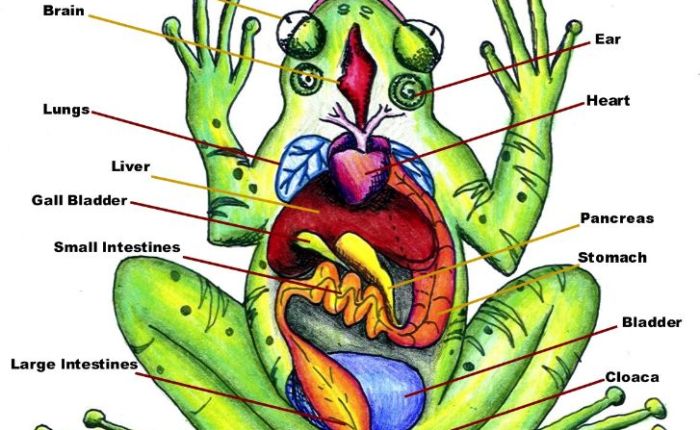
Dissections 50 Cents

This where the lack of clarity on the concept came in.

I’d better start by assuring readers that I loved animals, would never knowingly harm an animal, did not set fires, did not hear voices that were only inside my head, had actual friends that were not provided by a taxidermist.  I was a normal child in most aspects, a little dreamy maybe, gullible, easy to tease, but not unkind, certainly not cruel.

But, unlike the rest of my seventh grade classmates, I was fascinated with physiological systems and was very good at dissection.  Our set of encyclopedias had beautifully detailed overlays, colorful diagrams that revealed the organs and skeleton of fish and mammals.  I’d pored over those for years, so when the biology teacher dragged out the specimens soaked in formaldehyde, I could not wait to see if how real fish and frogs were put together.

It turns out that they are beautifully designed, miraculously designed.  Ordinarily distracted and obtuse during instruction, I listened carefully as the teacher explained the procedure, hoping to avoid the sorts of mistakes seventh graders had been known to make.  My penmanship was dreadful, but I had developed a steady hand while assembling model cars and in wiring the Progressive Radio Edu-Kit.  I worked carefully and slowly on the frog I had been given, making sure that every incision was clean and precise, staying after class to make sure that every organ and system had been properly identified.

My diagram was beautiful.

I saved it and the next two, and, although the specimens did dry out and did shrink a bit, when covered with plastic wrap, they looked very scientific.  I assumed anyone with a scientific turn of mind would celebrate my achievement and probably want to buy one of the three signed diagrams I had ready for sale.  I may have been wrong.

I did set up my dissection stand and stood watching traffic go by for a considerable period of time before a car stopped, and a woman with two children pulled over.  I can only guess at what she thought she was about to buy out of the kindness of her heart.  She stopped short when she was close enough to read the sign advertising my craftsmanship, threw her hands out flat as of to protect her children from a collision, turned and walked away.

In that moment I understood that my understanding of the human condition was incomplete.  I was mortified, embarrassed by my own idiocy, and filled with remorse that frogs once alive had become my shabby specimens.  I got through the rest of the year in Biology, but whatever impulse I had once felt toward further work in the sciences had been removed entirely.

In the course of a bumpy lifetime I have made more consequential misjudgments, certainly injured more people, and probably damaged the universe more profoundly, but I recognize in this stunning folly just how disconnected my sensibilities were from those of humans properly considered “normal”.  The only dissection I allowed myself from that time on was the bloodless dissection of sentences.  I still marvel at the intricacy with which life begins and is maintained, but there’s no need for me to take it apart.

I pull over when I see a lemonade stand, a brownie or cupcake stand.  I’ll buy whatever they’re selling, maybe a few extra, hand them more than I owe and tell them to keep the change.  Their product may not always be entirely edible, but at least they are clear on the concept.


The Waffle Barn

The Waffle Barn

I live in a small city in southern Oregon, practically perfect in every way; folks here are intellectually alive, culturally aware, decent and interesting.  The valley is strikingly beautiful and the climate is mostly mild with the occasional decorative snow fall.

This is Shakespeare country, home of the Oregon Shakespeare Festival, welcoming thousands of tourists each season, so it was probably inevitable that cutesy Shakespearean puns would pop up as local businesses attached themselves to the tourist trade.  We have a health food and vitamin shop known as All’s Well and two Puck’s Doughnut shops.  When it comes to Inns and Bed and Breakfasts, all bets are off.  The Bard’s Inn, The Windsor Inn, the Stratford Inn, Arden Forest Inn, A Midsummer’s Dream, Anne Hathaway’s B and B and Garden Suites,  and a dozen equally Elizabethan spots clog the local directory of places to land in town.

I get it.  Makes sense.  And then, out of nowhere, banners fly announcing the arrival of the Waffle Barn.  I like waffles; I like barns.  But, hey!  The combination is just wrong..

No matter how you pitch them, if you look at the pyramid of the major food groups, waffles belong right there at the base – securely anchored among the comfort foods.  And when might you need some comfort?  For a start:

Relationship in the dumpster?  Passed over for promotion?  Tried on clothes at the store and nothing fit?   Contacted by an old flame an old flame on Facebook looking younger and better than ever while your profile picture looks as if had been taken at the morgue?  IRS audit coming up?  Black cloud hovering overhead?  Wondering if it’s all worth while?  Looking back at a life seemingly frittered away?  Figuring out that your mom loved your sister more than she loved you?

Whatever.

Nothing is ever so daunting that it can’t be remedied with a late night ride on the Comfort Food Express.  Any one of the food friends listed below and/or any combination holds the promise of immediate relief.

Mac and cheese, chocolate,pot pies, any pie, biscuits and gravy, chocolate chip pancakes, mashed potatoes, fried chicken, more chocolate, green bean casserole, chicken soup, tamale pie, any other kind of pie, more chocolate, chips and salsa, milkshakes, sundaes, tuna casserole, chili, chili fries, chili mac and cheese, pizza… and waffles.

Of course, comfort arrives in different guises as you bounce around the globe.  Brits seem to  hunker down with mooshy things, mashed peas, boiled potatoes, custards, the highly regarded Spotted Dick (pudding made with suet and custard) and Bangers and Mash (sausages and mashed potatoes covered in brown sauce).  Drooping in Russia?  Order up some solyanka, but make sure to ladle in a dollop of sour cream to mellow out the pickled cucumbers,cabbage, dill, and brine that make this hearty broth.  Out of sorts in Poland?  Try the makaron ze smietana, a frothy pasta with strawberries and cream.  Yes, I said pasta with strawberries.

Butter, sugar, suet, fat, rich, sweet, salty – these are words that bring comfort.


I’ll tell you where comfort is not to be found.

In a barn.

Barns are for cows, and horses, and sheep, and hay, and grain, manure, and rats.  Large animals live there doing what large animals do around the clock.  People who work in barns dress for the job; no sandals, flip-flops, stiletto heels in the barn.  They wear boots.  Big boots, high boots, made of substances that can be hosed down daily.  Hosing, sweeping, pushing extraneous animal matter around – that makes up a good part of the day in the barn, unless you have to get in the first cut before the next rainstorm, in which case, you live in a world of swirling hay, spears of which embed themselves at will in any available expanse of skin.  Tossing hay long enough brings a shot at farmer’s lung, easy to contract after breathing in hay mold day after day.  And, let’s hope you haven’t baled up and stacked hay that is too wet as no one likes to see hay spontaneously combust.

I happen to like the ways barns smell; I admit it brings happy memories and, yes, even some comfort when the wind blows the right way.  Whatever involuntary Proustian reflex I might find in or around barns, however, would absolutely be shattered with the introduction of waffles, or chili fries, or mashed potatoes.

So, what are appropriate names for a waffle place?  The choices are many and obvious:

Batter Up!,  Waffle Tasty.  Waffle Yummy.  Waffle Good, Waffle World, Waffle Mart, Griddle and Determination, Love ‘Ya a Waffle Lot, Jawful of Waffle, Waffle Hut, Waffle Shack, Meet Your Waffle Maker, Waffle Irony, Full of Wa,  Full of Wha? Waffle’s R Us.

Have to get Shakesperian around here?  Hamlet, Eggs, and Waffles?  Merry Waffles of Windsor?  Much Ado About Waffles?

Would I turn around and pull in to any of these places?  Probably.  But if you really want to get my attention, it’s a lot simpler to just hang the banner –

Breakfast All Day – Waffles


Play Ball!

Play Ball!

Today, February 22nd, the world starts over again.

In Phoenix, Arizona at the beautiful new Salt River Field, the Arizona Diamondbacks take on the Grand Canyon University Antelopes, the Lopes, in the opening game of Spring Training in what is known as the Cactus League, pre-season major league baseball in Arizona.  Tomorrow, in the Grapefruit League, the Detroit Tigers play Florida Southern College’s Water Moccasins at the recently renovated Publix Field in Lakeland, Florida.  Times have changed as increasing numbers of fans fleeing the end of winter follow their teams to sunshine, and Spring Training facilities are spiffier, ticket prices higher, T-shirts and hats more expensive, and autographs harder to snare.  Nonetheless, the relaxed pace of training games, the appearance of rookies who might turn out to be stars, genuinely splendid weather, and the opportunity to see the best players in the game up-close and personal, all of that is catnip to baseball fans.

Today you can cheer for the Lopes or Diamondbacks for $6.00 and drop another six bucks tomorrow when the Brewers take on The University of Wisconsin Milwaukee Panthers at my favorite park, Maryvale Baseball Park, a scaled down park tucked into a neighborhood that seats about seven thousand laid back Brewers fans, the most loyal and cheerful fans in Arizona.  I’m not a Brewers fan, but I love sitting in the midst of a Wisconsin family reunion, cousins from Kenosha, twins down from Janesville, Uncle Bub from Green Bay now living in Appleton, the newlyweds from Eau Claire.  They rib each other mercilessly and send the kids out for the park’s signature Klement’s bratwursts.  The Brats are fabulous, but Klements hasn’t stopped there;  they not only offer other irresistible and distinctive sausages, they suit ’em up and race them.   Bets are laid down when the five costumed racing sausages (Brat, Polish Sausage, Italian Sausage, Hot Dog, and Chorizo) appear before the home team bats in the sixth inning.

Maryvale is a small town within the western city limits of Phoenix, but so gently removed from city life that an unprepared visitor can drive right by the park, confusing it with the Maryvale High School’s fields unless you stop for lunch at Wendy’s .  The park offers shaded seating, a necessity on some sun-baked afternoons, but for $8.00 a fan can camp out on  the grassy berm that extends from the third base bleachers to the first base bleachers, looking down into the bullpens cut into the berm on each side.  I watch baseball on television because I can’t get to games during the season, but I miss the distinctive pop of a fastball hitting the catcher’s mitt only a few feet from my place on the berm.

Actually, of course, I miss it all – the sweep of grass in the outfield, the puff of dust when a hard hit ball skids past second base, the smell of impending thunder as the grounds crew drags the tarp over the infield.  There’s even more to miss about baseball during Spring Training.  My son and I shared a section of the stands with scouts from twelve major league teams, sitting close to home plate as they clocked fastballs and counted the corners each pitcher could paint with consistency.  Until that afternoon, we had never seen a World Series Championship ring up close; that day we saw twenty.

We sat behind Peter Gammons, Groton and UNC educated sportswriter and ESPN baseball analyst, one of the three or four most respected baseball guys of our time, a shameless Red Sox homer, but capable of balanced reporting nonetheless.  My son showed precocious grace in not asking for an autograph but offering a handshake as Gammons attended his first game since recovering from a life threatening brain aneurysm.

We were behind home plate when a Cuban refugee named Aroldis Chapman first pitched for the Cincinnati Reds in a game against the Dodgers.  We had heard he threw hard, but until we saw the blur from mound to plate, pitch after pitch, some of which were actually strikes, we could not have imagined what a 105 mile an hour pitch looked like from the batter’s point of view.  We literally stood ten feet behind  Ichiro Suzuki at the Mariner’s park as he nailed runner after runner from deep centerfield, including a peg to FIRST base that clipped Jim Thome in stride.

Sadly the Cubs quirky stadium, HoHoKam Stadium in Mesa has been replaced with a shiny new park in Mesa, although it is probably for the best that one of the most dangerous viewing experiences has been taken out of circulation.  We sat above the third base dugout, happily hoping we might see a foul tip and go home with a ball, when Aramis Ramirez skinned a foul line drive over the first base dugout literally knocking a patron out of his seat.  From that point on, we sat behind a net or paid v.e.r.y. close attention to each at bat.

With no expectation other than catching a game, on March 21st, 2009, we drove in heat and painfully slow-moving traffic from Peoria to Surprise, a western suburb.  The Rangers and Royals share the park, one of the prettiest, and on that evening, the Rangers hosted the Dodgers in what was a fairly uneventful game, until the crowds parted, the atmosphere turned electric, and a procession emerged.  Muhammad Ali supported by his wife, Wayne Gretzky, George Brett, and Joe Torre.

And we got to see a ball game as well.

Spring Training has a rich history including some exotic choices for pre-season locale back before Arizona and Florida claimed the season.  At the turn of the Twentieth Century, Hot Springs, Arkansas hosted the greatest number of teams (Chicago White Stockings, Cleveland Spiders, Detroit Tigers, Pittsburgh Pirates, Cincinnati Reds, Brooklyn Dodgers, and Boston Red Sox).  Fans who travelled to Hot Springs in 1918 would have seen a Red Sox pitcher shoved into emergency duty in the outfield.  Babe Ruth looked promising, knocking two home runs, including one  that is alleged to have soared more than five hundred feet, landing in a nearby Alligator farm.  Mr. Wrigley’s Chicago Cubs trained on Catalina Island in the 1920’s, a convenience for Wrigley as he owned the island.  The Dodgers trained in Cuba and the Dominican Republic.

The Cactus League exists because Bill Veeck, one of baseball’s greatest showmen and innovators having trained his Boston Brewers in Ocala, Florida, where segregation was harshly enforced, in 1946 took his next team, the Cleveland Indians to Tucson and convinced the Giant’s owner to train in Phoenix.  A year later Veeck signed Larry Doby, the second African-American to play in the major leagues, the first to come directly from the Negro Leagues,  and the first in the American League.

I’m pleased that spring baseball in Arizona has its roots in an owner’s farsighted and humane vision, pleased that eight National league teams and seven American League teams meet in pre-season play, and pleased that an ambitious fan can pack a lot of baseball in a fairly short trip.  And, it’s worth noting that whatever Saint Patrick’s Day might look like back in Chicago, the Cactus League version is much less about green beer and much more about familiar team hats decked with shamrocks and presented in rich Kelly green. You ain’t seen baseball hats until you’ve seen a green rattlesnake forming the familiar Diamondback “D”.

I’ll close with two thoughts.  The first was written by Jim Murray, Pulitzer Prize sportswriter for the Los Angeles Times:

Spring is the time of the year when the ground thaws, trees bud, income taxes fall due, and everybody wins the pennant.

The second, a thoughtful, perhaps unexpectedly reflective statement from Hall of Famer Rickey Henderson, a remarkable player and widely known for referring to himself in the third person, as in “Rickey needs a hit tonight”.

I love playing this game and every spring training feels like the first.


Apocalypse When?

Apocalypse When?

I suspect we will look back on the last fifteen years as the era in which post-apocalyptic literature and film became the imaginative default in our own perilous world, in the same way that ill-tempered aliens and radioactive mutant insects appeared as the threat of nuclear war became chillingly real in the 1950’s.   Contending with monsters on the screen allowed a sense of mastery over forces we feared and could not control in the same fashion that fairy tales brought children face to face with ogres, trolls, goblins, witches, and adults capable of unspeakable cruelty.  It’s possible that kids’ fascination with dinosaurs and sharks also allows a sense of mastery of large and fearsome forces, as does, in later years, spiraling into space on death-defying thrill rides.

Just a theory.

Theories such as those abound, and the supposition of environmental end times is certainly at work, particularly among writers who will live beyond the Baby Boomers.  Raised in prosperity, distracted by their own life journey, that generation does not leave a secure future.  The theory currently held by the President’s advisor, Steve Bannon, derives from his somewhat idiosyncratic take on speculative work done by William Strauss and Neil Howe.  The Strauss-Howe Generational Theory was first presented in their book, Generations, and then expanded in The Fourth Turning to suggest that four particular sorts of generations move through history, each producing a cycle of moods, which they call turnings.  In recent history, the generations have cycled in this order:  The Lost Generation,the  G.I. Generation, the Silent Generation, the Baby Boom Generation, Generation X, the Millennial Generation, and the Homeland Generation.

The four turnings describe the cycles of history with particular attention to two notable polar opposites, generations experiencing Awakening and generations experiencing Crisis.  Awakening describes the attack upon institutions in the name of autonomy and personal spiritual growth.  Strauss and Howe considered the consciousness movement (Boom Generation) which began in the 1960’s as the most recent Awakening.  Awakening, they posit, is followed by Unravelling, the third turning.  Institutions weaken, individualism is more important than coalescence.  The Long Boom and the Greedy 80’s are evidence of an Unravelling leading to Crisis, the fourth turning.

Crisis often involves war in which existing institutions are destroyed and then rebuilt resulting in renewed civic involvement and the creation of stronger institutions.  1929’s Wall Street Crash and the outbreak of W.W.II were the last Crisis.  The generation that came of age as the nation went through Unravelling became adults during the Crisis, they, the G.I. generation,were  a generation that pulled things together, a civic generation as personal sacrifice was necessary in order to survive. In Howe and Strauss’ terms,this was  a Hero generation.  The next generation, born during Crisis, came to an age in which all attention was directed toward the Crisis.  These, the Silent Generation, were adaptive, in the authors’ terms, an archetype they call the Artist.  As this cycle ended, the next generation, the Baby Boom, born near the end of Crisis, inherit a rejuvenated nation and the freedom to become idealists, Prophets, a self-conscious force toward Awakening.  Good news/bad news is that it is this generation that is at the helm when the cycle takes the nation to Crisis.  The theory observes that, for the most part, leaders in almost all arenas today are members of the Boom generation.  Waiting to take their place is Generation X, what is called a Nomad Generation or Reactive Generation, a generation bringing Awakening.

Bannon’s interpretation assumes conflagration and the most damaging war yet.  As he sees it, the Boom generation moved up at a moment of great prosperity and success, the dawn of what was the height of American global supremacy. The Nomads, GenX, are moving into Awakening, in reaction to the mess the Boom generation leaves behind.  Right behind them,  Millennials have to pick up the pieces as we hit yet another Crisis, and for Bannon, the Fourth Turning, Crisis, means global war.  His take is that the cycle of Crisis has played itself out with the American Revolution, The Civil War, Depression and World War Two.  He predicts the next cycle will bring war on an even greater scale.  Apocalypse.

Bannon’s mission has been to find a leader willing to bust up the existing systems in order to be able to deal with a Crisis already underway.  Given his place in the halls of power, should crisis mean war, it won’t be easy to separate this supposed generational mood and the self-fulfilling convictions of a presidential advisor.

I am intrigued by generational theory, but on a bad day, my more personal impulse toward thinking apocalyptically has to do with the Antarctic and Greenland’s ice sheets melting, and that’s a lot of ice, about the size of the United States and Mexico combined.  I’m made uneasy in learning that more than half of all the animals in the world have disappeared since 1970, and a quarter of all species of mammal are in danger of extinction; I don’t want to say goodby to Polar Bears, Rhinos, Snow Leopards, Mountain Gorillas, Albacore Tuna (Sorry, Charlie) .  The Great Barrier Reef is well on the way to becoming the OK Barrier Reef.  Species after species are throwing up their paws and fins in a final salute to a planet that can no longer support them.  Oklahoma has become Earthquake Central, experiencing more than a thousand quakes per year greater than 3.0 on the Richter Scale.  More than a billion barrels of wastewater injected near faults have the state rocking on a regular basis.

So, there’s that.

Apparently, however, there is reason to hope that many of what seemed irreversible trends are actually capable of reversal, and that all is not necessarily lost.  We may not need Mad Max on Fury Road in the next few years; maybe we won’t have to host the Hunger Games instead of the Olympics.  Despite the reluctance of some camps to give science and scientists the credit they are due, economic advantage goes to those who find ways to make thing work, and scientists are generating new, economically advantageous solutions to real problems on a daily basis.

Finally, the apocalyptic impulse, I’ve been advised is not out there, but in here, and by in here I mean in my Baby Boomer mindset.  We, the Boom Generation, have had it our way for so long, held on our positions of authority for so long, continue to live for so long, that, at some point we begin to believe (because, I mean, Come On!) the world probably can’t go on without us.

I’ll admit that I do equate my extinction with total extinction because I’ll be extinct.  That’s about as far as my projections can go.  Can I conceive of planting a tree that my grandchild might swing on after my personal extinction has taken place? Absolutely.Beyond any positive legacy I can leave behind,  I actually think that my children and their generation have the ability to make the world work at least as well as we have – not much of a challenge there!

So, whether the generational cycles are predictive or things just happen to happen, those who follow my generation will have to work quickly to set things right.  I’ll be as extinct as the Snow Leopard, but I really don’t believe the world ends with me.

Awkward Questions

Awkward Questions

Relax.

I’m not going to ask any awkward questions.  I may describe a few, perhaps walk timidly around a few, but flat-out asking is not on the menu today.  The truth is that any question is potentially awkward, with a host of variables determining the amount of searing heat that arrives in having it addressed.

You have been skiing, let’s say, and arrive at work on Monday, slightly wind burned, stopping at the Keurig K575 for a restorative Americano when a colleague asks, “I tried to call you yesterday.  Where were you?”  No problem, easy enough, chat for a bit and back into the day.  If, on the other hand, you snuck out of town to hook up with an old flame and your current inamorato/a asks the exact same question, the throat thickens, mouth dries, arms cross, the nape of the neck reddens, starts to burn, you do that touch the nose thing now commonly understood to be the preface to a lie, and resort to the hemahemahema burble that signals total meltdown.

None of us leap into life with a set of instructions, but we learn pretty early on that some questions are acceptable, perhaps even expected, and other absolutely taboo.  The thing about taboos is that they have the force of law, punishment by exile, and yet, they are never spoken.  There are tons of behaviors we might consider unsavory or unfortunate, kidnapping, say, or murder, but it would be only mildly awkward to ask a friend if anyone in his/her family had ever been kidnapped or murdered.  Ask the same friend if anyone in the family had been a cannibal, and the stakes get much higher.

Cultures differ in what they consider taboo, but no matter where we find ourselves, some subjects will simply never come up in conversation with anyone but a therapist, an attorney, or a judge.  Those steeped in the wizarding world know, for example, that speaking the name of Voldemort He-Who-Must-Not-Be-Named is a cultural taboo broken only by wizards determined to face and defeat the Dread Lord.  So, taboos can change over time, as we have seen as words once considered unspeakable are now spoken with stunning regularity, at full volume, on television, while others, once distasteful but widely used, have become imbued with such danger to the culture that they can only be mentioned as the _ word if mentioned at all.

Some questions are discouraged in most settings, not taboo but not polite.  It’s pretty clear that we are not invited to ask folks how much money they make, although, in the case of celebrities and billionaires, apparently it is OK.  I’m not sure how I’d respond if a billionaire asked me how much I have tucked away, feels a little awkward.  Then, of course, there are the dozens of questions concerning the most intimate details of one’s personal life that are absolutely out-of-bounds, except that I am confronted with most of them as I wait to check out at the supermarket.  Even when not framed as questions, questions are implied.

So, I push my cart to my place in line behind a gaggle of twenty-somethings stocking up on strawberries and quarts of rum, locked in ferocious debate over the number of bottles needed.  I’m trapped between In Touch, Star, People, and US; so far just mildly disturbing.  Life Style?  Ouch!  Kim Kardashian announces, “I have Cellulite.  So What?”

Not looking, turning, turning, maybe National Geographic, Rolling Stone, Tribute to Elvis, but no.

Cosmopolitan.

Every cover offers timely caution or advice.  Sure, it’s just advice, but doesn’t the need for advice come from failure, frailty, frustration?  And isn’t the supposition that all that disappointment documents partners who have been … inadequate?  I’ve yet to see a Cosmo cover trumpet, “Congrats!  You’ve got a great thing going!”  “Hey, you’ve never been more fulfilled!”  No, stuck in line, I have to consider the universe of questions that arise from this month’s cover question: “What to do when your guy gets all quiet.”

I have no idea what the problem is or might be; I don’t want to know.  And yet, the mind races. Isn’t the purported advice essentially asking if your guy gets quiet?  Whenever.  And what you/he/we need to do about that?  If it’s a problem.  Which it must be, or nobody would need the advice.

Back again in a month’s time.  I’m in the Express Line behind the person stocking up on cat food, fifty cans, with coupons, that have expired.  Two cover stories shout from In Touch this week.  Kardashians spill their guts for a change.  “Sisters in Crisis:  All Three Humiliated By Their Men”.  A smaller photo, a detail shot of a  woman’s legs asks the provocative question, “Guess Who?  Cellulite at 22.”  Still ok.  Rhymes, could stay in my head, but ok.  Cat food dropped can-by-can in shopping bag.  Cashier loses count.  Starting over.

Cosmopolitan – Hmmm.  Apparently Hillary Duff is back.  I won’t ask, I won’t.  From where?  And then, down to business.

“The Number One Thing Men Are Good For… Besides … You Know!”

Wait.  What?  There’s a numbered list of things men are good for?  Rank ordered?   Aren’t they obvious?  You know, loving partnership, support, friendship, close conversation, company at end-of-life.  That stuff?  Is any one of those clearly ahead of any other?  Somehow I think I’m on the wrong track again.

Oscar Wilde observed that, “questions are never indiscreet, answers sometimes are.”  That’s the nub of the matter, really; once you know, you can’t unknow.  A few years ago I happened to stumble on a website that presented the salaries earned by my colleagues.  I should have applied my Cosmo defense.  Not looking, turning away, closing the page.

I didn’t, and from that point on, I couldn’t see those colleagues as I had before taking a bite of the apple; at times, an answer carries a heavy price.  I’m not generally inclined to quote Scripture, but it’s worth considering that the enduring account of how we fell from innocence  suggests that what seemed a simple question, “What happens if we eat this?” had far-reaching consequence.

So he drove out the man; and he placed at the east of the garden of Eden Cherubim, and a flaming sword …”

Side note:  You really don’t want to cross Cherubim.  These are not pudgy kiddies with wings but supernatural creatures  something like a Sphinx but with four faces (man, ox, lion, eagle), capable of bursting into flame and striking with the force and speed of lightning.


A Hero For Every State

A Hero For Every State

Late in the evening, almost thirty years ago, a friend confided that he envied me.  “You have no idea how lucky you are to have  a child you know will turn out to be a person you like as an adult.”  I am luckier than he could have known; I have three children, all now adults, who are just about my favorite people on the planet.  Each has particular gifts, and each has a distinctive personality; all three of them have a delicious sense of humor, and each is capable of reducing me to panting laughter on a regular basis.

All three have displayed a thoroughly admirable interest in subjects of great import, by which I mean comics and superheroes.  Again, their tastes in heroes differ slightly, but each is more than capable of describing the qualities necessary to heroism on a grand scale.

My eldest at about age ten was trapped in a car with me on a long trip; we had listened to every cassette, counted every out-of-state license plate, essentially run out of diversions, while the road before us spooled out hour after hour. In a moment if inspired invention, he grabbed his notebook and began the process of inventing a superhero whose mutated abilities sprang from the condition found in his or her home state (or adopted state, if not mutated but simply alien).

I can’t find that notebook, and my memory is imperfect.  I am certain that Wisconsin was home to Beer Man, a hero whose super power allowed him to spray beer at high pressure from various orifices as needed.  Apparently, he also had the ability somehow create beer as well, as he was not tethered to a vat or keg of any kind.  Spray from his pores gave him the sleek mobility of a hydrofoil, able to glide at speed, even when scaling the highest tower.

Without the document as guide, the rest of the line-up is pure conjecture.  It is possible that the state of Maine produced The Lobster, a red-faced hero who used her mighty claws in the fight against overfishing on the Atlantic coast.  It’s equally possible that Jersey Boy tapped the toxic fumes hanging over Newark, Union City, and Camden, essentially becoming a human flamethrower.  I can’t be sure.  Or, that may actually have happened.

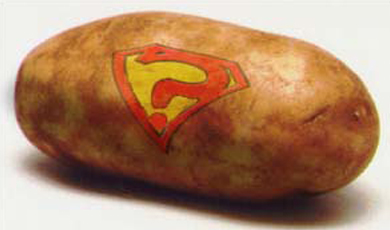
Perhaps unfairly, we reduce regions to tag lines, states to fruits and vegetables. Is Idaho, one of the Northwest’s most picturesque winter wonderlands simply about potatoes?  Surely not, and yet we present The Spud, gender unknown, who uses its thousand eyes to keep track of malefactors from Wyoming to Washington.  The disgraced former hero from Idaho, Famous Potato, now sadly operates out of  her home in the Hollywood Hills, attending red carpet events where, over-indulging, she routinely gets fried.

Some states are more dangerous to encapsulate than others.  Missouri, for example, the Show Me State, would be poorly served by guardians such as The Voyeur or The Flasher. The origin of the nickname is in an address given by Willard Duncan Vandiver, a congressman who at the end of the Nineteenth Century explained the character of the state in inspired oratory.

“I come from a state that raises corn and cotton and cockleburs and Democrats, and frothy eloquence neither convinces nor satisfies me. I am from Missouri. You have got to show me.”

I know, Missouri doesn’t raise Democrats as it used to, but cockleburs?  You betcha!  The cocklebur has three notable characteristics, any one of which would propel a character into the superhero hall of expedience.  Cockleburs produce small football shaped spines which grab the passerby like an octopus with fangs.  That power alone would be almost enough, but wait … there’s more.  Generally unpleasant when fully grown, the cocklebur is actually much more dangerous as a seedling.  Not only is this hell-weed capable of stabbing, it is also highly toxic, poisoning countless grazing animals each year, and, in a final bow to youth, it tastes delicious when at its most toxic.  Thus, Spiny Cocklebur would be a youngster, covered with spines and bursting with toxins.

Several states have attached themselves to birds, bees, and mammals.  Louisiana is the Pelican State, Utah the Beehive State, and Michigan the Wolverine State.  Too easy!  It’s a challenge to slap Oregon’s mascot around until The Beaver turns feisty enough to sink its buckteeth into crime.  And then, take Iowa, the Hawkeye State; I’m pretty sure it is the only state characterized by a body part, although Alabama claims to be the Heart of Dixie.

Some states have gone way out of their way to squelsh remarkable heroism.  South Carolina is now the Palmetto State; we might have had a better chance to come up with something had they stuck with the Iodine State, the Rice State, or the Swamp State.  Imagine the sting that Iodine Lass could land on the open wounds of her nefarious foes. Fear The Rice Man pounding his adversaries with useless carbs!  Swamp Thing has a franchise of its own, but imagine Swampy, a blobish entity of indeterminate size and shape, able to take the form of a villain’s most disturbing nightmare, travelling on globbish stumps, holding within its jiggling form all the swamp creatures caught up in Swampy’s sudden ascent from its bed, a filth filled Aquaman, calling the denizens of the swamp to do his bidding.

In the name of all that is proud and fine in your home state, rise to this challenge!  Give honor to the heroes ready to pick up the burden of guarding your borders. Come on, Ohio, let’s see what Buckeye, a giant shrub, can do.  What about it, South Dakota?  You’ve got Four Presidents made of stone hanging on the side of a mountain; kick those bad boys into gear!  Little Rhody.  What are you, Chicken?  OK, Oklahoma, Can  Sooner make time shift?  Lone Star, not simply an alien, but a luminescent ball of fire.  Imagine the sticking power of North Carolina’s Tar Heely, backing enemies down, heel by heel.  New Mexico, Land of Enchantment?  OK. let’s see what spells Mistress Enchantment can spin when aroused.

It’s on! Operators are standing by to take your call.


Word Problems

Word Problems

Let it be known that I have enormous respect for those who are good at math.  My wife is.  I am not.  No hard feelings.  No bitter, bitter pill to swallow.  Just part of the tapestry of life.

Is my life reasonably rich and full?  Sure, but tossing in the depths of a tortured, sleepless night it all comes back to me – the regret, the mistakes, the shame.  In my several years in Algebra II, there were the occasional moments of clarity, sudden sharp bursts of insight, none of which resulted in anything like competence, but most of which amused my teachers for the fleeting seconds during which I seemed to waken from math induced stupor.

Looking back on it, I can see why I seemed stubbornly resistant to instruction.  The problem was never that I didn’t like math, or didn’t like the teacher, or didn’t work at math.  Alright, it might have been true that I didn’t work at it, but the more pertinent observation is that abstraction and hypothetical constructions make the veins in my temple swell and throb.  Plonk a graph up on the board and start talking about axes and slopes and I’m fading, fading.

Sorry.  What was the question?

Sadly, Word Problems, the one area in which I did show promise, sprang a trap of their own from which I could not escape.  I understood the frustration of my math impaired brothers, and there were a few,  who asked, “When am I ever going to use this stuff in my real life?”

Not I.

Word problem are all about real life.  The situations posed in word problems were easier for me to sort out than they were for the math wizards all about me.  These were stories.  These were vignettes opening a door into the trials and tribulations of people such as I, people who could not figure out how to get the right combination of candies, had to pack and could not find the area of a suitcase, went to the track but could not figure out the odds.  I knew these people; I felt for these people.  With their safety and well-being in mind, I plunged into each problem, determined to get them to their destination before a train going in the other direction took their children away.

This wasn’t math.  This was Reality Math.

Ah, and perhaps you have already sensed where the problem might lie.  I did care, cared so much that I found myself so engaged in the “what ifs”, the “yes, buts”, and, worst of all, the “what happens next”, that I forgot about the math part and lost my self in conjecture on the state of humans tempest-tossed in an uncaring world.

I think they call that distracted.

Here’s what I mean:

In a group of 120 people, 90 have an age of more 30 years, and the others have an age of less than 20 years. If a person is selected at random from this group, what is the probability the person’s age is less than 20?

Ok, you can do the math, but consider for a moment how those under 20 year-olds feel in the company of a massive number of people over thirty.  How much over thirty?  We don’t know.  How much under twenty are in the miserable minority?  Again.  No clue.  Are we talking about toddlers and octogenarians?  What kind of  group is this?

So, let’s say this is some kind of cult.  The leader is about forty-three, his brides, all twenty of them, are under fifteen.  What kind of world is this?

Or, this could be row A through D in the Elizabethan Theater at the Oregon Shakespeare Festival, in which case, all the over-thirty adults are actually over seventy, and the under twenty not-yet-adults are under twelve, grandchildren dragged from meaningful participation in their own lives to a matinée performance of Richard III, in which case, the question ought not ask the probability of finding an under-twenty but rather is the under-twenty capable of speech after three hours of watching the House of York come to its entirely appropriate end at the Battle of Bosworth Field.

Dany bought a total of 20 game cards some of which cost $0.25 each and some of which cost $0.15 each. If Dany spent $4.20 …

OK, stop right there.  Who spells Danny as Dany?  I can tell you who – Daenerys Targaryen, daughter of Aeyres Targaryen, the Mad King.  Before she was riding dragons, her brother/cousins Rhaegar and Viserys called her Dany, as you might expect.  I have no idea what her cuddle buddy, Khal Drogo, called her in close moments out of the public eye, but that consideration draws me quickly into consideration of  the development of the fictive language of the Dothraki, more than distraction enough, but a strong and strange memory pulls me even further away from the idiotic game cards in question.

On a flight from Los Angeles to Dallas, I was seated next to two Klingons.

Apparently Dallas was hosting a major Star Trek convention, and these two were performing in what had been billed as “A Klingon Fight To The Death”.  I got that much out of them before they retreated into speaking only in what I took to be Klingonese, the language used by Klingons in an episode entitled, “The Trouble With Tribbles”.  They did pause long enough to assure me that they were not speaking Klingonase, a variation of the language which had been introduced in Star Trek novels of the 1980’s.  That cleared up, I put my seat back and snoozed, comforted by the guttural bandying of insults tossed around by my seatmates.

BaQa! (Klingonese for something vile)  They were again in my row on the flight back to Los Angeles but now in human form.  Having exhausted conversation in Klingonese, they were pleased to fill me in on the weekend’s activities in what sounded to me very Californian English.  I would have considered this chance meeting entirely unlikely had I not seen the documentary, Trekkies, in which I learned that there is a Star Trek convention somewhere in the world every weekend.

Having now referred to Star Trek for the second time this week, I need to wrap up this late-in-life math apologia. Thank God my wife can work out how many game cards of each denomination Dany got for her $4.20; I’m still trying to figure out how many wives the cult guy has salted away.