Had A Bad Week? Read This.

Had A Bad Week? Read This.

David Vobora was a heck of a quarterback, running back, and linebacker for Churchill High School in Eugene, Oregon.  Pretty good basketball player too.   Vobora was an even more effective linebacker for the University of Idaho Vandals, leading the team in tackles and winning first team All WAC honors as a senior.  A legitimate NFL prospect, David Vobora entered the draft in 2008 and sat on pins and needles as round by round, two hundred and fifty-one names were called before his.

As the last player drafted in that season, Vobora joined the company of other last-drafted players, known in their season as “Mr. Irrelevant”  There is considerable hoopla following the draft; Mr. Irrelevent is flown to California to receive the “Lowsman” Trophy, an awkward salute to the Heisman Trophy awarded college football’s best player. The Heisman pose is famous, displaying an artful athlete evading a tackle.  The “Lowsman” features a player fumbling the ball.

All in good fun, right?

Some Mr. Irrelevants have gone on to play with success in the NFL, and Vobora, who started as linebacker for the St. Louis Rams, is one of them.  His career lasted four years, after which, it might have been assumed, he would sink into obscurity.

And he almost did.

The commonly held conviction in the NFL is that players play, and players play with pain.  Vobora played with excruciating pain after a shoulder injury, an injury which would finally end his career, and, as other players have done, he became dependent on pain medication during his last year as a professional athlete.  A stint in a rehab facility and serious reevaluation of his life led Vobora to move to Dallas, where he opened an ambitious training facility, Performance Vault, Inc. in Dallas, specializing in training elite athletes and active duty Special Forces.  A career in the NFL, however short, and the establishment of a thriving business serving athletes might be enough for many of us.

Not for David Vobora.

Here’s where David’s story meets that of Retired US Army Staff Sergent, Travis Mills, one of only five quadruple amputees to survive their  tour of duty.  Miles was on his third tour of duty in Afghanistan when an improvised explosive device (IED) took both his legs and his arms.  Today, Miles is an author and inspirational speaker, traveling widely with his message, “Never Give Up.  Never Quit”.  Today, Wills describes himself as “recalibrated”, able to achieve at a high level with prosthetic arms, hands, and legs.

Impressed by Mills’ resilience and energy, Vorora introduced himself to the veteran and asked, “When was the last time you worked out?”  It was not a question Travis Mills expected; he tried to be tactful, reminding Vorbora that he had no arms or legs.

And David Vorbora replied, “So?”

Mills was the first to begin a training regimen usually taken on by elite athletes;  Vorbora established the not-for-profit Adaptive Training Foundation in order to be able to provide training for other veterans at no cost.  In beginning their work together, Vobora asked Mills to describe the fears he felt in taking on rigorous athletic training.  “Falling,” Mills replied.  “No arms and legs – Gravity wins.”  Together they found ways to adapt, starting with core strength, but also developing balance and confidence.  From the start, it was clear that while the physical aspects of adaptive training were important, an important benefit was in treating those who worked with him as athletes not simply disabled vets.

Vobora had faced his own crisis, questioning his identity if no longer a football player.  These veterans had suffered life-altering injury; what remained for them if no longer soldiers?  Many who approached Vobora had struggled with depression; some had considered suicide.

In a nine week training program called REDEFINE, amputees, veterans injured in combat, work through their fears and physical limitations to become adaptive athletes with a strong sense of identity and purpose.  David Vobora drew on his own experience to design a program intended to, “Restore, Recalibrate, and Redeploy,”.  A recalibrated Mills is one of the vets who has been restored and now is deployed in a career which brings hope to audiences across the nation.

It’s pretty clear in seeing David Vobora work with his athletes that he has been restored as well.

“So I train them here and I train them like pro athletes. What’s the difference if the guy has a leg or not? If a linebacker comes in with a knee scoped, we would create training around that knee as it heals. So what is the difference?  And they come alive through that.”

He speaks of his loss of football as necessary to his understanding of those who have lost their identity; he sees courage, grit, and strength on a daily basis and considers himself lucky to have found his calling.

“What I’m doing now has a purpose. I know who David is without football. And he’s a guy who gets to help train our first double-amputee to summit Antarctica (Vinson Massif).”

David Vobora’s Foundation, Adaptive Training, maintains a website at  http://adaptivetrainingfoundation.org. Pictures and videos do much more to communicate the work Vobora does than any article.  If the thought of a double amputee taking on Mount Vinson isn’t enough to put your challenges into perspective, take a look at Limbitless, The Super Bowl Commercial You Didn’t See.

Quotations used in this article appeared in the Nov.15, 2016 edition of The Player’s Tribune, an article entitled, “The Breakthrough”


Down The Rabbit Hole

Down The Rabbit Hole

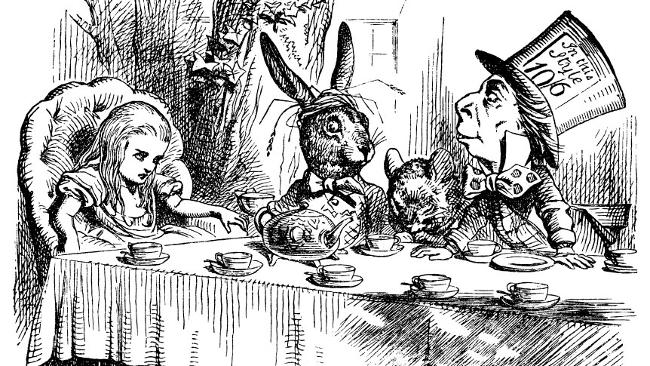
Lewis Carroll had Alice tumble into Wonderland via a rabbit hole, tossing her into a madcap, fantastical, occasionally disturbing journey in the company of  anthropomorphized mice, playing cards, flamingos, dodos, shrubbery, and the rabbit.  She wakes, shakes off the imminent beheading per the queen’s fiat, and presumably lives reasonably untraumatized until her further adventures are begun by walking through a looking-glass.

The contemporary rabbit hole opens as we click our way to a site, find an associated next site, and the next, and the next, and so on. In the same fashion that Netflix, Hulu, DVRs, and a growing company of aggregators allow binge-viewing, once we begin hopping from site-to-site, hours, days, weeks are lost somewhere between L.L. Bean and the 1964 World’s Fair (Corona Ash Dump converted into Flushing Meadows Corona Park – you could look it up).

Brief sidebar on binge viewing:  My wife and I found ourselves compelled to watch Jack Bauer waterboard dangerous characters for weeks at a time, essentially watching all 24 episodes of 24 in something like thirty hours.  Slightly abashed, we confessed our obsession to a friend who had the next two seasons at hand and could feed our addiction.  His experience with the series was more dramatic than ours in that he had been so caught up in hour 14 that he failed to notice that his car had been stolen from the driveway adjoining the room in which he sat.

In the spirit of adventure, taking courage from Alice and countless others who have dropped into the hole, I plan to pick a site at random and see where it takes me, allowing myself only thirty minutes of rabbit time.

How about Orson Welles?  Why not?  Welles is certainly worth a few minutes of idle perusing.

Hmmm.  the site offers a side-trip to Crime and Scandal,  pretty much have to follow that one.  Lots to choose from here, but I’m dropping into 8 Would-be Presidential Assassins and find that Richard Lawrence, an unhinged Englishman who believed himself cheated of his right to take the British throne attacked Andrew Jackson in the Capitol Building.  His gun misfired twice, allowing Jackson time to beat Lawrence to the ground with his cane.

There has been some talk of Jackson recently as the current campaign has some similarities with Jackson’s populist following and the election of an outsider to the White House.  I trust Wikipedia (and support it as well) so here we go.

Andrew Jackson

Ok, what’s up with Jackson?  Ouch!  Turns out that in 1824, he ran for office against John Quincy Adams and Henry Clay, received a plurality of popular and electoral votes but failed to get a majority, which deadlock sent the election to the House of Representatives who chose Adams, demonstrating what Jackson called a “corrupt bargain” between Adams and Clay.  Jackson determined not be robbed again, as a result of which his followers founded what was to become the Democratic Party, drove hard in 1828 and helped Jackson win in a landslide.

That’s the connection I was looking for, but the sidenote is that apparently in the heat of the campaign, an Adams supporter accused Jackson’s wife, Rachel, of having committed bigamy in marrying Jackson.  Although the charge was true, Jackson blamed Rachel’s death of a heart attack on the slur cast upon his wife’s honor.  Rachel died two weeks before Jackson took office.  So, of course, I wanted to know more about bigamy.

A quick look at the site reveals that for the most part, bigamy and polygamy are illegal.  No surprise there, except that in Egypt, the situation is more complex.  Apparently in Egypt, polygamy is fine if the first wife agrees to the situation.  Obviously, then, time to go to Egypt, but outside of the limited purview of Wikipedia.

Egypt is the largest Arab country, and despite the many enticements of an Egyptian rabbit hole, I want to check my understanding of what exactly is meant by the term Arab.

If you have landed in beingarab.com, you know know that Arabians are not defined by ethnicity but by being people who live in the Arabic world.  This is the sort of circular definition that annoys me, but, recognizing my own shortcomings as a person, I stick with the site until it identifies Arab cuisine as Lebanese cuisine, schwarma as the most famous Arab snack and baklawa as the favorite sweet.

Where to now?  The pull of schwarma is obvious, but the hummus laden nod to Lebanon and the similarity of baklawah and baklava pulled me in two directions.

I chose baklawa, landed on baklava, and immediately to a site describing Lebanese food.  Huzzah!  Two-for-one.  And yet … the blogger’s rhapsody about baklawa takes a curiously personal turn almost from the start.

“The role baklawa plays in the repertoire of the Lebanese home cook is formidable. Most every Lebanese woman of my parents’ generation makes her baklawa for special occasions, especially Christmas. We swoon over baklawa to such a degree that it’s like our little pet, our little coosa. We call it our baklawi (bit-LAY-wee), just like you might call me Maureenie, or my sister Pegsie, or your mother Mommy.”

Huh?  Our little pet?  Our little coosa?

Coosa is a sweet summer squash, and calling a child or pet “coosa” is comparable to calling the same “pumpkin”, so there’s that.

And, down the rabbit hole I go, not in search of other herbaceous vines but looking for pet names given children.  Using absolutely no discrimination, I tag the first site on the list.

Here we go again.

Beginning with pumpkin butter, the list includes, bunny, honey bunny, then veers to quinoa, cheese weasel, and cookie ears and countless others of dubious origin.

My 30 minutes are up, my curiosity reasonably completely extinguished (I lost it somewhere near Baby Cakes), and the rabbit hole now ready for sealing.  Time to power down, and yet… my own batch of names affectionately tossed around is crowding out my plans to take another crack at the novel stalled somewhere in the fifth chapter.

It doesn’t take much to remind me of my three kids, each of which deserves a far better tag than that I came up with in their formative years.  A few of the worst pop up immediately; I shrivel, I baste myself with shame, I cringe.  Toot Snoot?   Puffle?  Tiger Toes?  Really?

The pain is too great.  I think I need to search for “affirmations” just to get back to reasonable self-acceptance.

individuality


No Weezing The Juice – Guilty Pleasures

No Weezing The Juice – Guilty Pleasures

The great films, the universally admired and critically acclaimed films, rest safely in a pantheon of cinematic nobility.  Lines from these films are deathless and frequently quoted.  In some cases, the import or impact of the entire film can be evoked in a single line, in some cases, a single word.  Recognition is immediate, obvious.

“There’s no place like home.”

“I’m the king of the world.”

“Frankly, my dear, I don’t give a damn.”

“Rosebud”

All well and good, pass out the Oscars, cue Robert Osborn.

My pleasures, however, are often of the guiltier sort, not simply the less critically esteemed but the more commonly reviled.  These are gems that have not found an audience and wide distribution, that have faded from memory, that were too narrow in their appeal, or too broad in their humor.  These are films that dragged out the C List actors for the primary roles and filled the rest of the cast from a cattle call at Riker’s Island.

It was Daniel Webster who said of Dartmouth, “It is, Sir, a small college.  And yet, there are those who love it.”  Why Dartmouth needed defending in terms of its size, I cannot guess, but the analog might be, “They are, Sirs and Madams, films of small reputation.  And yet, there are those who love them.”

The title of this piece is taken from one of those unadmired films, Encino Man (Where the Stone Age Meets the Rock Age),  a triumph of inspired casting, pairing a long-frozen recently unearthed caveman, Brendan Frazier, with two unpopular high school students, Pauly Shore and Sean Astin.  Despite having been pulled from frozen ground, Frazier is inherently much coooler (as it were) than Astin and Shore, and so the kids on the fringe hitch their star to Frazier’s wagon, and merriment ensues.

This might be a fairly conventional and forgettable teen pic were it not for Shore’s distinctive California super-slacker vocabulary and intonation.  No written transcript can do justice to Shore’s performance, but in an attempt to bring it to the ear, the title phrase is elicited when Shore puts his mouth on the nozzle of the Frosty Freeze machine, stealing (“weezing” in Shore speak) the confection as the proprietor of the convenience store, familiar with Shore”isms” yells, “No weezing … the juh -woose”.  Shore’s signature term of affection is also presented with a beat in the middle and rising inflection on the last syllable.  “Bud …Dee”

Shore speaks most expressively in defending his constant presence at Astin’s family dinner table:

“If you’re edged ’cause I’m weazin all your grindage, just chill. ‘Cause if I had the whole brady bunch thing happenin’ at my pad, I’d go grind over there, so dont tax my gig so hard-core cruster.”  

Does it help to know that “grindage” is food?  Perhaps not.  This is not easy to untangle, especially for a cruster.

This from 1988’s Tape Heads, starring John Cusack (oiled hair and pencil thin moustache) and Tim Robbins (totally geeked out) as aspiring (terrible) video directors who kidnap a Menudo concert in order to give a showcase to their favorite musicians, The Swanky Mode, played by Sam Moore (of Sam and Dave) and Junior Walker. Mary Crosby plays a music journalist promoting the Video Aces.

Cusack:  You look ravishing and I’d like to chew on your thighs.

Crosby:  I thought we had a professional relationship.

Cusack: So I’ll pay.

Tape Heads gives me a great deal of pleasure, and I refuse to feel any guilt at all, since this is certainly the best unappreciated and relentlessly amusing backstage parody of video/music fame.  The cameos alone should be enough to pull this film from the depths of obscurity.  Consider this list:

King Cotton as Roscoe, King of the Chicken and Waffle empire, Soul Train’s Don Cornelius, Doug E. Fresh, Ted Nugent, Connie Stevens, Jello Biafra, ‘Weird Al’ Yankovic, Doug McClure, Jesica Walter, Bobcat Goldthwait, and Courtney Love as an uncredited floozie spreading peanut butter on a naked presidential candidate.

The meta videos are astounding and all the more fun in that Michael Nesmith, former Monkee, one of the pioneers of the music video industry, produced this film and had a large part in framing the two outstanding videos ostensibly produced by Cusack and Robbins’ Video Aces.  The first of these, a cover of Devo’s “Baby Doll” covered by a Swedish group called Cube Squared, is a paint spattered folly.  The other, an accidental filming of a group about to be killed by a rogue spy satellite, The Blender Children, propels the Aces into notoriety.

OK, there are some pleasures about which I do feel a twinge of guilt, maybe more than a twinge.  So, from the closely guarded list of films I probably should not have seen more than twice, 1999’s Mystery Men.

I will try to present the absurd plot of Mystery Men, but appreciation of the film comes in welcoming a team of “super” heroes whose skills are … lame.

The original team consists of Mr. Furious (Ben Stiller), The Shoveler (William H. Macy), and The Blue Rajah (Hank Azaria).  A somewhat successful hero, Mr. Amazing (Greg Kinnear) enlists the group to face arch-villain Casanova Frankenstein (Geofrey Rush) who with the help of Tony P (Eddie Izard) and the Disco Boys unleashes the “Psycho-fraculator”, causing the team to recruit new members, The Spleen (Paul Reubens), Invisible Boy (Kel Mitchell), and The Bowler (Jeanine Garofalo) assisted by The Sphinx (Wes Studi) and Doc Heller (Tom Waits).

Among the aspirants who don’t make the team are Pencil-Head, Son of Pencil-Head, Squeegee Man, and Dane Cook as The Waffler (brandishes a waffle iron).  Cee Lo Green has a bit part as a mobster.

This spoof of super hero movies was probably ahead of its time, or at least, its intentions misunderstood, as a goofy salute to the over-the-top Batman productions that hit the screen at the time.  It’s a clever film and great fun especially as Mr. Furious and The Bowler engage in running conversation about the odd emphasis William Shatner gives any statement .  Hank Azaria’s British accent is impressive, and the film’s dialogue is pretty sharp throughout with a distinctly mock-heroic affect as in these pronouncements:

The Shoveler: We’ve got a blind date with destiny … and it looks like she ordered the lobster.

Mr. Furious:  Well, here I thought I was with a couple of real superheroes, but really, it’s Lazy Boy and The  Recliner.

The Shoveler:  We struck down evil with the mighty sword of teamwork and the hammer of not bickering.

Tossing a bone to the unsuccesful petitioner, The Waffler:

Waffler:  I… am the Waffler. With my griddle of justice, I BASH the enemy in the head, or I burn them like so! I also have some truth syrup, which is low in fat.

Finally, please picture Tom Waits as Doc Heller delivering this description of the psychofrakulator:

It’s a psychofrakulator. It creates a cloud of radically-fluctuating free-deviant chaotrons which penetrate the synaptic relays. It’s concatenated with a synchronous transport switch that creates a virtual tributary. It’s focused onto a biobolic reflector and what happens is that hallucinations become reality and the brain is literally fried from within.

… which, I’m pretty sure, is what actually happened to Tom Waits.

Look, I can’t defend this next next one, and I’m not even going to hint at the plot.

Dude, Where’s My Car?

Ashton Kutcher is Jesse.  Seann William Scott is Chester.  After a night of brain-numbing excess they discover that Jesse has a tattoo on his back , “Dude!”; Chester has a tattoo, “Sweet!”.  Each cannot see his own tattoo; they must ask the other to read it to them.

And so, from Dude, Where’s My Car:


Dude! You got a tattoo!

So do you, dude! Dude, what does my tattoo say?

“Sweet!” What about mine?

“Dude!” What does mine say?

“Sweet!” What about mine?

“Dude!” What does mine say?

“Sweet!” What about mine?

“Dude!” What does mine say?

“Sweet!” What about mine?

“Dude!” But what does mine say?

“Sweet!” What about mine?

“Dude!” What does mine say?

“S – wee – t!” What about mine?

…and so on.

When The Words Just Get In The Way

When The Words Just Get In The Way

David Foster Wallace used the term “snoot” to describe the sorts of people who torture themselves and others by relentlessly calling attention to infelicities of language.  I suspect Wallace  was simultaneously expressing the folly in swimming upstream against the tide of commonly accepted (mis)usage while admitting that no true snoot can nod, smile, and walk away from a conversation in which a person is described as nauseous rather than nauseated, disinterested rather than uninterested, as one who has honed in on rather than homed in on.

In the same fashion that a person raised with great wealth can ask for sympathy due to a life held captive in a golden cage, the snoot can point to the injury done him day-after-day by speakers determined to play fast and loose with language.  Snoots are reviled for doing what they seem incapable of not doing.

No sympathy?

I don’t snoot friends or civilians because I have made more than my share of mistakes and have been mortified when corrected.  Pride certainly went before the fall in my case, and dangerous snootery may have been nipped in the bud fairly early on.

As an early example, just when I thought my active vocabulary was more than adequate, a word, lugubrious, came at me sideways, marginally out of context, a word that I sensed had authority and agency, but a word just beyond my grasp.

I probably should have looked it up.  But no.

I must have been about thirteen when I ran into lugubrious, one of the hundreds of words I never bothered to look up, counting on my keen ability to read contextually, and so spent the next decade misusing the word on a fairly consistent basis.  That is to say, I didn’t continuously use the word, but I was consistent in using it incorrectly.

Listen to the stretch and pull of the word said with any sort of emphasis.  Luh- GOOO- brious.  Sounds sort of oily, no?  So that’s where I went.  Every person described as lugubrious I took to be oily.   Dickens, for example, wrote works that are rife with lugubrious characters who are more than a little oily, and I frequently found the word attached to undertakers or morticians, who seemed an oily lot to me.  It was only when I read a reference to a lugubrious love song that I was brought up short.  I suppose there are conditions in which one might refer to love as oily, but even I sensed I must have been flying through language by the seat of my pants once again.  It was but the work of minutes with a good dictionary  to realize my mistake and to find that if I wanted to tag someone as terminally oily, ripe with greasy moralizing smugness, the words I needed were unctuous or oleaginous.  If I was after fawning, boot-licking, smarmy sycophants, I’d have to find some middle ground between servile and obsequious.

So, lugubrious.   Not oily.

Lugubrious is a very useful descriptor for exaggerated, heavy, gloomy, melancholy that draws attention to itself.  I would have been better prepared for life if anyone had the wit to suggest that Eeyore, A.A. Milne’s passive-aggressive, terminally depressive donkey, is a lugubrious self-pitying sinkhole, sucking joy and oxygen from the Hundred Acre Wood, not that I retain strong feelings about his mopey string of laments predictably something along the lines of,  “Pay no attention to me.  I’ll just eat thistles and sit here by myself “.

Sorry.  Lost focus for a moment.

Today, at an advanced age, I am delighted to find that words new to me still pop up, often in otherwise entirely accessible accounts.  An article on the furor surrounding the current election, particularly the seamier scandals, made use of the word, louche, a term I’d found earlier in this example from an article entitled, “Gloria Vanderbilt Gets Kinky”, found at The Daily Beast in June, 2009:

“Eventually, this short, louche novel that began with warmth and zest and cheekiness, wanders around aimlessly in magenta caftans.”

Personification is one thing; a novel, even a cheeky novel, wandering around in purple caftans is a different order of figurative language.

I’d seen the word used to describe seedy neighborhoods or sordid confessionals and intuited that louche probably had something to do with things being seedy or sordid, and once again, my keen contextual reading served me well.  Louche is generally defined as disreputable or indecent.  OK, useful enough, but, with only a few moments of reflection, it occurred to me that we have a mother lode of words within easy reach that travel near indecent or disreputable.  Sordid and seedy, to begin with.

To return to the unsavory (that works!) neighborhood, an obvious choice of descriptor might be squalid, reminding fans of J.D. Salinger of Esme, the indelible character who in asking a writer to send her a story declares, “I prefer stories about squalor.” Squalid hovels are wretched, shabby, generally insalubrious.  Applied to persons rather than places, squalid shoots us to sleazy, tawdry, cheap, foul, degenerate, ignominious, base, seamy … surely a more than adequate supply of adjectives to meet the needs of almost any conversation.

So, why louche?  Who really needs it?

I would have chucked it quickly had I not done what I had so rarely done, actually gone to the Oxford Dictionary and tracked down the origin of the word.  It’s French, as anyone might have guessed, but derived from the Latin, luscus, having impaired vision.  When the French got hold of it, they used louche to mean-cross-eyed or squinting, and some of us may remember when folks squinted at unseemly behavior or looked cross-eyed at those things that were considered offensive.

La and Voila.

There is an outside chance that I’ll use the word lugubrious sometime in the next decade (May the fates given me ten more years to spout snootily!), but I can’t see myself getting all louche on novels or even on Vanderbilts.  Still, it’s good to know it’s there in case I find myself in a dimly lit nightclub, sitting in a banquette with deeply cracked upholstery, avoiding contact with walls covered in crumbling faded maroon velvet, feet sticking to the yellowed tile floor, hoping to catch sight of the sagging remains of a once vibrant chanteues, a discarded mobster’s moll.

How louche would that be!


The Last Lesson

The Last Lesson

I must have been in seventh grade, working my way through the literature book given to us at the start of the year, when I encountered the story, “The Last Lesson” by Alphonse Daudet.  My ability to focus and follow direction was as poor then as it is now, and I often tuned out of whatever lesson of the day my teacher had in mind to read story after story, with no regard for the curricular plan the teacher might have had in mind; “The Last Lesson” was never assigned.

I’ve placed the entire story at the bottom of this post should a reader care to check my memory.

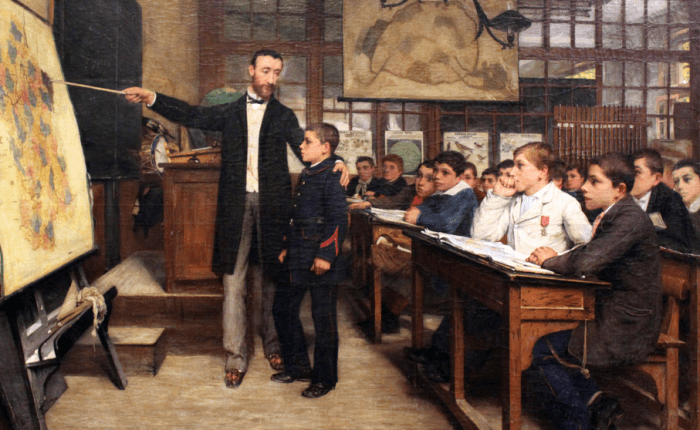
The author brings to mind the day on which his school in the province of Alsace was no longer to be a French province, but one belonging to Germany.  The author’s teacher explains that this class is the last to be taught in French; from this point on, all instruction will be in German.  What struck me then, as now, was the recognition that loss of one’s language would mean the loss of the identity, personhood, established in the discarded language.  I completely failed to understand the political, cultural, and social dislocation the author and his family would inevitably face; I remember only feeling worried that the student in the story might not be able to learn the new language quickly enough to remain safe.

I was relieved that we didn’t discuss the story in class; I can’t imagine what my seventh grade self would have had to say about any part of it.  I read it at least four times, for reasons I can’t really explain.  It’s a serious story and sad; I think I was moved by the sense of loss and regret in the story, emotions I rarely allowed myself.

I’ve never talked about the story to anyone until today.

I am frequently surprised by which of the books and stories I have encountered in the course of a lifetime have stuck with any kind of permanence.  The books I taught are all there, for the most part, some have more immediacy than others.  The Odyssey comes to mind frequently as does Zen and the Art of Motorcycle Maintenance; I taught Siddhartha for years (the novel, not the pilgrim), and found a way to pull Love Medicine into my elective courses, no matter the ostensible subject of the course.

Each of these, and many others,are available somewhere in my negotiations with the world, and each of them has taught me something valuable about being human.  I read widely throughout my schooling, generally preferring to wallow in other worlds than to face our own.  I loved all sorts of novels but generally did not give much attention to short stories, or poetry for that matter.  I suspect that I knew on some level that language in stories and poems was more compressed and took more unpacking than my undisciplined mind was able to manage.  Poetry and short stories were work; I preferred a magic carpet.

Oddly, “The Last Lesson” appears more vividly than I might have imagined, and, I think, for reasons I could not give voice to as a child.  The student in the story will lose his language, and with that loss will lose all that the had known and all that had been.

As assiduously as I have tried to believe that I live safely in a country in which there are people who look darker than or different from others, or who hold convictions that a majority do not hold, the idea that there might come a “last lesson” has been with me for a lifetime.  One day, I  feared, the mask would slip, the trap-door would open, the gates would clang shut.

Consider the hashtag #YesAllWomen.  With forceful simplicity it presents a reality that women live, an absolute reality.  No argument.

I can’t speak for anyone but myself, but my fears take me to YesAllBrownPeople, to YesAllPeopleOfColor, to YesAllJews, to YesAllLGBTPeople, to YesAllDisabledPeople, to YesAllWhoDisagree.

Since I have no control over much that happens around me, all I can do today is to hope that we aren’t facing a last lesson, that there is enough good will to bring us back from the brink.

THE LAST LESSON

Alphonse Daudet

I WAS very late for school that morning, and I was terribly afraid of being scolded, especially as Monsieur Hamel had told us that he should examine us on participles, and I did not know the first thing about them. For a moment I thought of staying away from school and wandering about the fields. It was such a warm, lovely day. I could hear the blackbirds whistling on the edge of the wood, and in the Rippert field, behind the sawmill, the Prussians going through their drill. All that was much more tempting to me than the rules concerning participles; but I had the strength to resist, and I ran as fast as I could to school.
As I passed the mayor’s office, I saw that there were people gathered about the little board on which notices were posted. For two years all our bad news had come from that board—battles lost, conscriptions, orders from headquarters; and I thought without stopping:

“What can it be now?”

Then, as I ran across the square, Wachter the blacksmith, who stood there with his apprentice, reading the placard, called out to me:

“Don’t hurry so, my boy; you’ll get to your school soon enough!”

I thought that he was making fun of me, and I ran into Monsieur Hamel’s little yard all out of breath.

Usually, at the beginning of school, there was a great uproar which could be heard in the street, desks opening and closing, lessons repeated aloud in unison, with our ears stuffed in order to learn quicker, and the teacher’s stout ruler beating on the desk:

“A little more quiet!”

I counted on all this noise to reach my bench unnoticed; but as it happened, that day everything was quiet, like a Sunday morning. Through the open window I saw my comrades already in their places, and Monsieur Hamel walking back and forth with the terrible iron ruler under his arm. I had no open the door and enter, in the midst of that perfect silence. You can imagine whether I blushed and whether I was afraid!

But no! Monsieur Hamel looked at me with no sign of anger and said very gently:

“Go at once to your seat, my little Frantz; we were going to begin without you.”

I stepped over the bench and sat down at once at my desk. Not until then, when I had partly recovered from my fright, did I notice that our teacher had on his handsome blue coat, his plaited ruff, and the black silk embroidered breeches, which he wore only on days of inspection or of distribution of prizes. Moreover, there was something extraordinary, something solemn about the whole class. But what surprised me most was to see at the back of the room, on the benches which were usually empty, some people from the village sitting, as silent as we were: old Hauser with his three-cornered hat, the ex-mayor, the ex-postman, and others besides. They all seemed depressed; and Hauser had brought an old spelling-book with gnawed edges, which he held wide-open on his knee, with his great spectacles askew.

While I was wondering at all this, Monsieur Hamel had mounted his platform, and in the same gentle and serious voice with which he had welcomed me, he said to us:

“My children, this is the last time that I shall teach you. Orders have come from Berlin to teach nothing but German in the schools of Alsace and Lorraine. The new teacher arrives to-morrow. This is the last class in French, so I beg you to be very attentive.”

Those few words overwhelmed me. Ah! the villains! that was what they had posted at the mayor’s office.

My last class in French!

And I barely knew how to write! So I should never learn! I must stop short where I was! How angry I was with myself because of the time I had wasted, the lessons I had missed, running about after nests, or sliding on the Saar! My books, which only a moment before I thought so tiresome, so heavy to carry—my grammar, my sacred history—seemed to me now like old friends, from whom I should be terribly grieved to part. And it was the same about Monsieur Hamel. The thought that he was going away, that I should never see him again, made me forget the punishments, the blows with the ruler.

Poor man! It was in honour of that last lesson that he had put on his fine Sunday clothes; and I understood now why those old fellows from the village were sitting at the end of the room. It seemed to mean that they regretted not having come oftener to the school. It was also a way of thanking our teacher for his forty years of faithful service, and of paying their respects to the fatherland which was vanishing.

I was at that point in my reflections, when I heard my name called. It was my turn to recite. What would I not have given to be able to say from beginning to end that famous rule about participles, in a loud, distinct voice, without a slip! But I got mixed up at the first words, and I stood there swaying against my bench, with a full heart, afraid to raise my head. I heard Monsieur Hamel speaking to me:

“I will not scold you, my little Frantz; you must be punished enough; that is the way it goes; every day we say to ourselves: ‘Pshaw! I have time enough. I will learn to-morrow.’ And then you see what happens. Ah! it has been the great misfortune of our Alsace always to postpone its lessons until to-morrow. Now those people are entitled to say to us: ‘What! you claim to be French, and you can neither speak nor write your language!’ In all this, my poor Frantz, you are not the guiltiest one. We all have our fair share of reproaches to address to ourselves.

“Your parents have not been careful enough to see that you were educated. They preferred to send you to work in the fields or in the factories, in order to have a few more sous. And have I nothing to reproach myself for? Have I not often made you water my garden instead of studying? And when I wanted to go fishing for trout, have I ever hesitated to dismiss you?”

Then, passing from one thing to another, Monsieur Hamel began to talk to us about the French language, saying that it was the most beautiful language in the world, the most clear, the most substantial; that we must always retain it among ourselves, and never forget it, because when a people falls into servitude, “so long as it clings to its language, it is as if it held the key to its prison.” 1 Then he took the grammer and read us our lesson. I was amazed to see how readily I understood. Everything that he said seemed so easy to me, so easy. I believed, too, that I had never listened so closely, and that he, for his part, had never been so patient with his explanations. One would have said that, before going away, the poor man desired to give us all his knowledge, to force it all into our heads at a single blow.

When the lesson was at an end, we passed to writing. For that day Monsieur Hamel had prepared some entirely new examples, on which was written in a fine, round hand: “France, Alsace, France, Alsace.” They were like little flags, waving all about the class, hanging from the rods of our desks. You should have seen how hard we all worked and how silent it was! Nothing could be heard save the grinding of the pens over the paper. At one time some cock-chafers flew in; but no one paid any attention to them, not even the little fellows who were struggling with their straight lines, with a will and conscientious application, as if even the lines were French. On the roof of the schoolhouse, pigeons cooed in low tones, and I said to myself as I listened to them:

“I wonder if they are going to compel them to sing in German too!”

From time to time, when I raised my eyes from my paper. I saw Monsieur Hamel sitting motionless in his chair and staring at the objects about him as if he wished to carry away in his glance the whole of his little schoolhouse. Think of it! For forty years he had been there in the same place, with his yard in front of him and his class just as it was! But the benches and desks were polished and rubbed by use; the walnuts in the yard had grown, and the hop-vine which he himself had planted now festooned the windows even to the roof. What a heart-rending thing it must have been for that poor man to leave all those things, and to hear his sister walking back and forth in the room overhead, packing their trunks! For they were to go away the next day—to leave the province forever.

However, he had the courage to keep the class to the end. After the writing, we had the lesson in history; then the little ones sang all together the ba, be, bi, bo, bu. Yonder, at the back of the room, old Hauser had put on his spectacles, and, holding his spelling-book in both hands, he spelled out the letters with them. I could see that he too was applying himself. His voice shook with emotion, and it was so funny to hear him, that we all longed to laugh and to cry. Ah! I shall remember that last class.

Suddenly the church clock struck twelve, then the Angelus rang. At the same moment, the bugles of the Prussians returning from drill blared under our windows. Monsieur Hamel rose, pale as death, from his chair. Never had he seemed to me so tall.

“My friends,” he said, “my friends, I—I—”

But something suffocated him. He could not finish the sentence.

Thereupon he turned to the blackboard, took a piece of chalk, and, bearing on with all his might, he wrote in the largest letters he could:

“VIVE LA FRANCE!”

Then he stood there, with his head resting against the wall, and without speaking, he motioned to us with his hand:

“That is all; go.”


Loveable Losers

Loveable Losers

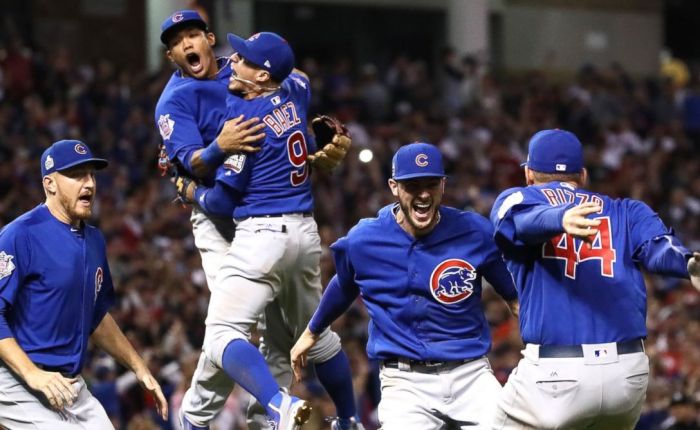
After one hundred and eight years of watching other teams celebrate a World Series victory, the Chicago Cubs have finally ended the drought and brought a championship home to long-suffering Cub fans.  The series went to seven games, dramatic shifts in the lead gave the seventh game far more punch than we’ve seen in most tilts, a rain delay kept the suspense alive, pitchers played the part pitchers should play, unsung heroes emerged, steady vets provided leadership, two great managers contended with wily genius, and the right teams were in the series.

One of the things I like about sportswriting is the freedom to jump from one strongly held conviction to another at mid-season, even mid-game, as momentum changes and vivid personalities emerge..  Writers love to tag an early contender a “team of destiny”, with the caveat that there might be other teams with equally fated destinies lying in wait.  From the start of the season, it appeared that this was the Cubs’ season; they got off to a rip snorting start with a line-up that appeared inevitably a World Series machine.  Then, somewhere in August, it also became the Indians’ season, as a squad with remarkable pitching and one of the best infielders of the modern age emerged in the other city by the lake.

Oh, and they hadn’t taken a series victory since 1948.

Now, THAT was a team of destiny.  How many stories can any one team provide without devolving into fantasy?

The ’48 Indians were owned by baseball’s greatest showman, Bill Veeck (rhymes with wreck) who is now best remembered for the stunts he pulled as owner of the St. Louis Browns, particularly for putting Eddie Gaedel, at three feet and seven inches the shortest man who ever played in the majors, in as a pitch hitter in a double-header against the Detroit Tigers.  Gaedel, who took four straight pitches, walked to first base, and retired with an on-base percentage of .1000.

Less well remembered is the role that Veeck played in bringing the first black ballplayers to the American League.  Larry Doby was the second player to break the color barrier, making his first appearance as an Indian in July of 1945.  In 1948, legendary Negro League pitcher, Satchel Paige, appeared in his first game as an Indian, the oldest major league rookie on record, taking the mound at the age of 42.

To be completely transparent, Satchel Paige’s actual age was always a subject of some contention.  Next to Yogi Berra, Paige may be the most frequently quoted baseball player, responding with evasive wisdom to almost every question posed him.  Asked about his age, Paige famously replied, ” If someone asked you how old you were and you didn’t know your age, how old would you think you were?”

Doby, who went on win RBI and homerun championships in the American League and who was voted to the All Star team seven times, was also the second black manager in major league baseball.  He and Paige were to become the first African American baseball players to win a world series with the 1948 Indians.  Their accomplishments stand on their own, but Veeck, whose interest in the Negro League was long-standing, had tried to integrate baseball as early as 1942, when his bid to bring Negro League players to the Phillies cost him the chance to own the team as the commissioner of baseball at the time was not ready to end segregation.

So, kudos to Branch Rickey, the Brooklyn Dodgers, and Jackie Robinson; their struggle to break the color barrier is the stuff of history.  But, let’s not forget the Indians, who had to win a sudden-death play off game in 1948 against the Boston Red Sox, the last major league team to integrate, holding out until 1959.

Good news – Bad news.  The world series in 2016 between the Cubs and the Indians was the equivalent of a battle-to-the-death between unicorns and pandas; anyone with a heart hated to see either team lose.

Kris Bryant, the fresh-faced wunderkind whose heroic performance had much to do with the Cubs’ success this year and with the fondness fans feel for the club, found himself in the sort of awkward corner into which on-the-field sports reporters love to push young players, asked to respond to yet another hypothetical question:   “If the Cubs win the series, won’t fans of the loveable losers see the team as just another ball club?”

Uh, ok.  No?  Yes?  Who cares?

The Curse of the Bambino finally left the Red Sox (don’t get me started), and its fans became Red Sox Nation after the Sox finally pounded their way to the top in 2004.  Again, a sense of perspective is important in evaluating the degree of sympathy to lend to the suffering fan.  The Red Sox have won eight world series and played in twelve.  A total of 36 Hall of Famers have played for the Sox, 14 of whom were inducted as Red Sox.  Again, citing transparency, Roger Clemens could be included in the list of extraordinary players who played for Boston; Dom DiMaggio should be in the Hall of Fame (don’t get me started – save a place for Pete Rose, Joe Jackson, Jack Morris, Trammell and Whitaker, Barry Bonds, and (ugh) Clemens).

All of which is to suggest that if non-affiliated proto-fans are looking for a place to invest their love and loyalty, the current crop of ballplayers laboring for the Cleveland Indians include some exceedingly loveable winners, including shortstop Francisco Lindor and Cy Young Award winner Corey (Kluobot) Kluber.  Perhaps the most loveable of all, however, is Indian manager, Terry Francona, whose dad, Tito Francona, played for the Indians from 1959 to 1964.  Not only is Francona among the most highly respected baseball strategist, his calm and steady leadership is evidenced by the success he has had, both as the Indians manager and as the manager who finally took the Red Sox to their long-postponed world series triumph.

Not to sidetrack the Red Sox bandwagon, but Francona was hired to manage the Sox after Manager Grady Little’s team lost the ALC series in 2003 and fired after having led the Sox to World Championships in 2004 and 2007, after racking up 1000 games as the manager of the Red Sox, and after losing the AL Wild Card spot to the Rays as the team folded like a Flamenco dancer’s fan in September of 2011.   His post-season winning record as manager of the Red Sox was .622, and his regular season percentage of .545 tops  Joe Cronin, Boston’s second winningest manager from 1935-1947.

Oh, and fired after having had a heart attack and returning to take the Sox back to victory in the series.  Just saying.

So, Congratulations, Cubs!  They are a great team and deserve the continued support of fans who now know the thrill of victory.

And for the Indians, wait until next year.


The Other Holiday Film Guide

The Other Holiday Film Guide

The number of holiday films has grown exponentially as the Hallmark Channel requires constant feeding, or another deluded studio executive forgets herself and green lights an instant classic in which Tyler Perry, Kirstin Wiig, Eddie Murphy, or Progressive Insurance’s huckster, Flo, play all the parts.  It doesn’t matter; we’d have to start on the day after Halloween just to put a dent in our list of must-see Christmas favorites.

But, see, Thanksgiving is not just a fly-by, not just a ritual gorge-a-thon, not just parades, or football, or even the arrival of Santa on 34th Street. No, my dumplings, Thanksgiving brings the bounty of the harvest, the first hints of winters deep chill, sodden leaves stuck to the soles of shoes, darkness in the afternoon, and above all, the gathering of kith and kin.  As the only holiday contriving and coercing the confluence of family and food, Thanksgiving arrives with burdens other holidays do not bear and without the distractions (gifts, easter baskets, fireworks) within which other holidays can take refuge.  Oh, there is excess on the horizon; thrifty shoppers leap from the table to take their place in the writhing horde, hoping to reach a discounted PlayStation before being kicked to the floor and trampled on America’s newest holiday, Black Friday, but the actual giving-of-thanks event is up for grabs on a yearly basis.

The table has to groan, and that means that someone has to cook, which means living up to whatever standard previous Thanksgivings have established, unless it means that several people have to cook, which means each cook is in immediate competition with every other chef and with whatever standard previous Thanksgivings have established.  Young people are tired and bored; older people are tired and bored. Now, force-fed and lethargic, hosts and guests need the magic of cinema to restore their faith in the celebration of hearth and home.  There may not be a plethora of Thanksgiving films, but the best of them deserve a place at the table, as it were.

Planes, Trains, and Automobiles

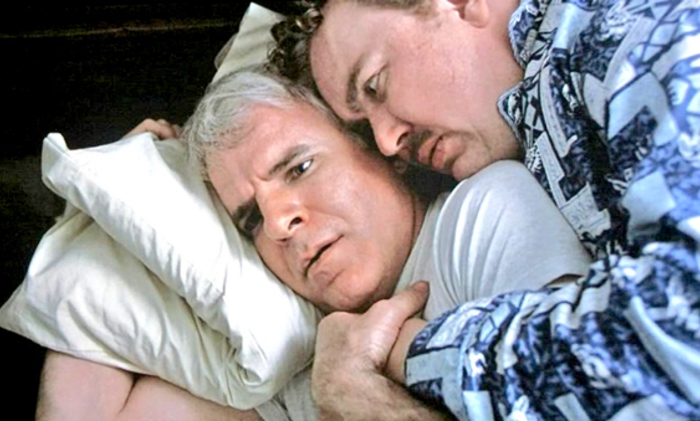
If you only screen one film this month, make it Planes, Trains, and Automobiles, even if you have seen it before, even if you saw it last week.  There aren’t many films that bring the exactly right director with exactly the right leading players to exactly the right film.  John Hughes managed it more than once, with the ensemble in The Breakfast Club and with Matthew Broderick and Alan Ruck  in Ferris Bueller’s Day Off.  Working against the grain of the mismatched buddy, odd couple, genre, Hughes found in Steve Martin and John Candy a couple not only oddly mismatched but authentically in need of each other.

Fair Warning.  This is a comedy with an edge.  No sex or violence to make family viewing terminally awkward, but Martin’s character, a rigid and controlling executive contending with the madness that is seasonal travel, unleashes streams of obscenities with unrestrained fury, particularly in a scene in which his rental car has not proved to be satisfactory.  Even in his early days of madcap comedy, Steve Martin skidded from frantic to frenzied, hinting at a strain of dislocation or discontent just beneath the surface.  His nemesis/better half is played by John Candy, an actor whose clumsy sweetness was the more poignant for his discomfort with his own bulk; even his deliciously campy villains, Dr. Tongue, for example in Dr. Tongue’s 3D House of Beef, seem to apologize for taking the space that they occupy.

Fair Warning.  This is a comedy that can break your heart.  Martin treats Candy shabbily; Candy sees himself as Martin sees him.  The ending is not so much happy as restorative.  Candy’s character needs a home; Martin’s character needs a heart.  Fortunately, John  Hughes had the brain, and this film manages to treat them and the holiday with generous good will.

Incidentally, as one fascinated by the impact given a film by character actors, I particularly admire Edie McLurg who steals the scene as the rental car agent at whom Steve Martin unlooses a torrent of vile epithets as she did as the principal’s secretary in Ferris Bueller Day’s Off and as the campus tour guide in Van Wilder.


The next three films are set around family and Thanksgiving, and both are well worth watching, but each deals with the difficulties that can find their way into the best of families.  That holiday icon, Leo Tolstoy, put it best:  “All happy families are alike; each unhappy family is unhappy in its own way.”

Home for the Holidays

I don’t know another film that is as true to the disconcerting mix of resignation, loyalty, discord, loss, decency, injury, humor, or distance that marks the families I have known.  Not a comedy, not a drama, Home For the Holidays assembles a cast that might esasily have spun out of whack but which, caught by a strong narrative and the deft direction of Jodie Foster, inhabits characters who ring true to life.

Made in 1995, the film appeared as Robert Downey, Jr.’s personal life was falling very publicly apart, background which gave his role in this film more weight than it might have had, and than it occupies on a later viewing.  Holly Hunter is a woman of a certain age, leaving a failed career (she’s just been fired) and a daughter (Claire Danes) who promises to have her first sexual encounter while her mother is heading home to Baltimore for the holiday.  Hunter’s parents, Anne Bancroft and Charles Durning, live in a home so crammed with marginally garish knock knacks that we experience the claustrophobia their children must have known.

Downey plays Hunter’s gay brother whose homosexuality is pointedly not mentioned though acknowledged.  In this performance, as in his best work, Downey brings comic energy to a manic character in pain.  Looking back at him from  a distance, I am aware of Downey’s capacity for kindness, a gift that brings Hunter, and the audience, safely home from a visit that might have roughed us up a bit.

Dylan McDermot is perfectly cast as the odd man out, long before he took up creepiness in American Horror Story, and the impossibly brittle Geraldine Chaplin adds spice to holiday conversation by telling the family secrets we long to know.

Hannah and Her Sisters

Many critics consider Hannah and Her Sisters the best of Woody Allen’s films; it won three major Academy Awards:  Best Supporting Actor (Michael Caine), Best Supporting Actress (Diane Wiest) , and Best Original Screenplay.  Categorized as a comedy/drama,  it may be his most personal, despite his identification in lighter films with the many neurotic nebishes he has played to comedic effect.

His character in this film is paralyzed in existential distress, as Allen’s characters often are, incapable of maintaining a sustaining relationship while hovering at the edge of a family once his.  His divorced wife, Hannah, played by his divorced wife, Mia Farrow, who, in this film is married to Michael Caine, who, in this film is knocked sideways by his passion for Hannah’s sister, Barbara Hersey, who, in this film is married to Max Van Sydow, who, in this film has reduced Hersey to something like catatonic infantilism.  Lloyd Nolan and Maureen Sullivan play the parents of the sisters.The film begins and ends with Thanksgiving dinners but is structured in five story arcs, one of which allows the third sister, Diane Wiest, and Allen to bring the film to an oddly resolved  end.

Pieces of April

Rounding out the holiday dysfunctional family films of distinction, Pieces of April reminds us that Katie Holmes once had a very promising career as she shines in this quirky, bittersweet comedy/drama as the estranged daughter of a (surprise) dysfunctional family.

April lives in a dingy, almost palpably filthy apartment in New York with a boyfriend who will disappear in the course of the film.  Recognizing that her mother’s illness will likely take her within the year, April invites her family to New York for Thanksgiving.  She has never prepared a meal, the oven in the apartment gives out well before the family arrives, she has to connect quickly with people in her apartment.

Meanwhile the other elements of dysfunction are on the road, each working out their own issues, with April, and with their journey.  Patricia Clarkson as April’s dying mother, Joy, was nominated for an Academy Award as a Supporting Actress.  Oliver Platt was well received as April’s father, clinging to the strands of a relationship with his daughter, hoping that Thanksgiving allows mother and daughter to reconnect.  John Gallagher, Jr., who won a Tony on Broadway in Spring Awakening, plays April’s stoned brother while Alison Pill, familiar to watchers of The Newsroom, plays a sister resentful of the role April once played as favorite child and fearful that conflict between her mother and April could accelerate the course of her mother’s illness.

It sounds grim, perhaps, but Pieces of April is good hearted, often funny, and well paced.  The film was introduced at the Sundance Festival, and was warmly received.  Shot on video for two hundred thousand dollars in three weeks, the film looks great and is a model of efficient filmmaking.  The script is by Peter Hedges who also wrote What’s Eating Gilbert Grape, Dan in Real Life, and About a Boy.

There are other films in which Thanksgiving is the focal holiday, from Disney’s Squanto: A Warrior’s Tale to Thankskilling, in which vulnerable teens are stalked by a killer turkey.  The holiday may be at its darkest in The Ice Storm, which has a great cast (Kevin Kline, Joan Allen, Toby Maguire, a young Christina Ricci , Elijh Wood, and Sigourney Weaver) and is directed by Ang Lee.  This is a powerful, disturbing and worthwhile film; maybe watch it in July?

I can’t recommend What’s Cooking with all five stars as it drops into melodrama once or twice too often, but it’s pretty interesting as it presents Thanksgiving as experienced by Vietnamese, Latino, Jewish, and African American families, and, when the actors aren’t screaming at each other, it, too, is funny and good hearted.

If none of these fits the bill, there’s nothing like a turkey induced coma, stretched on the couch, watching/ not watching three hours of football.


Official Start of the Holiday Season

Official Start of the Holiday Season

Today is Halloween.  Some  pumpkins remain in shop windows, but most of the small shops have already decked their halls with snowscapes and bright packages.  It’s clear that in our part of the world, the ramp-up to Christmas has begun.  Whereas the day after Thanksgiving once signalled the first tentative steps toward Christmas, full Christmas countdown appears to have begun in earnest here before we have even fallen back and changed our clocks.

It’s not as though it used to sneak up on me in the past; my memory is that I was in unlovely and sleep-deprived agitation for much of the last two weeks before Christmas, once the classroom windows had been decorated, Christmas cards had begun to be displayed on the kitchen counter, and dog-eared pages from the Spiegel catalog given the critical attention my brother and I thought they deserved.  As I consider Christmas in those days, we enjoyed two holiday seasons: the catalog season and the days before Christmas when we were finally released from school.

I’m guessing the catalog arrived just before Thanksgiving, although I wonder now that it came through the mail at all, given that the Holiday edition must have weighed five pounds.  There were other equally weighty catalogs, of course, Sears Roebuck and Montgomery Ward.  There was nothing wrong with those, but our mother actually bought clothing from Spiegel, and so we hoped she might be more likely to follow up on our detailed assessment of each exhaustively researched toy.  Our local hardware store, too, mailed us a full color circular featuring bikes, sports equipment, Radio Flyer wagons, and pump action faux Winchester BB guns, the only note of frivolity from a store that sold lumber and plumbing supplies.

We looked through them all, quickly ignoring the slick mailers offering sliced hams or flavored cheeses, and equally expeditiously thumbing through the exotic and prohibitively expensive toys from FAO Schwartz, admiring the authenticity of Swiss made clockwork robots and gigantic stuffed animals, but recognizing that these were not intended for kids such as we were.

TV commercials left us cold.  They were poorly filmed, as if kids would not notice lumpy direction and repetitive, mindless narration, and they presented toys no one wanted.  We knew quality when we saw it –  the Fanner 50 cap pistol from Mattel with its impala striped grip and long barrel, the Roy Rogers double holster set, and the DeLuxe Service Station with a collection of cars, gas pumps, a car wash, an elevator to transport cars to the parking lot on the roof, and two bays with lifts for full service.

I don’t remember parcels arriving from Spiegel in Chicago; most shopping probably took place at the local drug and book store or at the variety store in the larger town near ours. We never owned most of the toys we found in those catalogs.  My brother never had the authentic medieval castle with drawbridge and turrets; we never had to figure out how to use the smoke pellets that came with the Lionel train set.  It didn’t matter a bit.  The fun was in exercising our considered judgment, toy by toy.  I remember literally dreaming about wearing full cowboy regalia, boots and spurs, and saddling up a pinto pony to ride off to adventure.  I really didn’t expect to find the pony or the gear under the tree, but for considerable  stretches of time, imagining was more than good enough.

My own kids missed out on Holiday catalogs.  My eldest spent hours hunkered down in well appointed toy shops, developing a discerning eye for toys of quality; the younger two raced up and down the aisles of Toys R Us, pulling the pink Barbie convertible or the sleek pedal powered Cadillac from their parking places, backing and filling, until we moved on to Legos, or action figures, or electronic games.  By the time the Toys R Us catalog arrived, the kids were familiar with the merchandise.  They had seen the toys as they were, smaller and less magical.  Their lists sent to Santa rarely included the over-advertised and now familiar big-box offerings.  I’m pretty sure my daughter asked for a pony for a startling number of years in succession, probably not completely expecting its arrival but savoring the possibility that one Christmas might smell of pony rather than of pine.  She may be hoping still.

Most folks bemoan the early arrival of holiday hoopla, and they are not wrong to point out the relentless commercialization of Christmas; they are correct in recognizing the grim spectacle of Black Friday mayhem turning the Thanksgiving weekend into gladiatorial combat.  “Who needs six weeks of chipmunks gargling holiday classics on radio and in every shopping destination?” they cry. They’re not wrong about that either.

On the other hand, we need some time to dream and imagine, some time to write long letters to friends we haven’t seen in a year, some time to bake, decorate, and distribute cookies we only see at Christmas.  My brother’s family lives in Connecticut; my sister lives in North Carolina.  I could have Amazon send their gifts directly to them, but, with enough time, I can wrap their presents, write goofy greetings on each gift, push them into thick boxes, and get them out in the mail in time to find a place under a tree.

My plan these days is to have my shopping done, for the most part, by Thanksgiving.  I’ve already hidden two gifts in the hall closet and expect a few more to land in the next week.  I am wrapping challenged and need time to start over when I tape unnoticed clumps of dog fur in the center of an otherwise reasonably well wrapped package.  I need time to round up newspapers with which to protect gifts in transit, and I need time to uncover and display the decorations my kids made year after year until they became distracted by their emerging lives.

All the same, Halloween is too early.  We have the somber shifting of the seasons and the necessary summoning of grace in order to be truly thankful for all that we have and all that we love.

I’ll just pile the catalogs  on the kitchen table for now and give my time to standing outdoors as another lovely autumn moves by.


Bounders, Rakes, and Cads

Bounders, Rakes, and Cads

Words change on us when we aren’t looking.

For example, I innocently used the word thug the other day, meaning to refer to a brutish person employed in bringing physical violence to those who failed to meet obligations, such as gambling debts; mobsters send out thugs, I would have said, as enforcers.  I could have said goon or torpedo, or lout or ruffian, or hoodlum, but thug is the word I have heard in that context for much of my life. I was told it derived from the Hindi and Nepalese word, thugee,  for a person who robs and murders

Then I happened to hear John McWhorter, an Associate Professor of English and Comparative Literature at Columbia respond to the retraction of the word, thug, by President Obama and the Mayor of Baltimore, after having described the actions of those who looted stores following the death of Freddie Gray while in the custody of Baltimore police as violence done by thugs.

“Well, the truth is that thug today is a nominally polite way of using the N-word. Many people suspect it, and they are correct. When somebody talks about thugs ruining a place, it is almost impossible today that they are referring to somebody with blond hair. It is a sly way of saying there go those black people ruining things again. And so anybody who wonders whether thug is becoming the new N-word doesn’t need to. It’s most certainly is.”

If McWhorter is right, and I have no reason to doubt his assertion, I am once again several decades behind the times and apt to make blunders of similar insensitivity on a regular basis.  I’m cautious and increasingly aware that my presumptions about language get me into awkward situations, but I rarely have the wit to pause in mid-sentence seeking assurance that I haven’t casually stepped into blunderland once again.  Instead, I find myself using terms no longer employed in ordinary speech. My exchanges are with ordinary folks who, for the most part, are patient with my lapses into language last used when Teddy Roosevelt and Hiram Johnson ran as the nominees of the Bull Moose Party.  They are kind, or, I suspect, weary enough, to think happy thoughts while I ramble on in anachronistic incoherence.

Consider these bad boys, for example, the louts, persons whose intentions are not charitable; It strikes me that they actually fall into a number of sub-categories, each of which describes subtle but important differences of villainy.  For purposes of clarity, then, it may be salutary to consider the spectrum of words of disapprobation.

Ahem.

I use the word salutary to mean beneficial, but also to mean beneficial particularly in sitiuations in which the process might be unpleasant; no one says it might be salutary to eat ice cream. Vegetables, maybe.  In the same fashion, disapprobation is slightly stronger than disapproval but less condemning than, say, condemning.

Might as well start with louts.  Louts are oafish.  They may be primitives, brusiers, lugs, knuckle-dragging cavemen, or they may be hooligans, yahoos, or roughnecks.  Loutish behavior is churlish, uncouth and aggressive.  That said,  a churl, to be precise, can be a person lacking courtesy, but more properly simply means a person of low birth, a peasant.  Louts and churls may occupy the same space,but they are not the same species.

Similarly, to describe someone as a boor is to imply that their behavior is offensive, insensitive, and often intrusive, too loud and too persistent.  A swine comes into your home, puts his feet on your dining room table, belches, tells vile jokes, and breathes cigar smoke into your face.  Positively boorish.  Boors make poor company and should be avoided whenever possible; they may be off-putting, but not necessarily  immoral.

Cads and bounders, now there we have bad behavior.  These are identified by the purposefully self-aggrandizing things they do at another’s expense, although their actions are manipulative or exploitative, not generally physically threatening, with one notable exception.  Sexual predators are cads; they are bounders.

Despicable is despicable, but … there is one slightly less reprehensible character to introduce.  Known as the “rakehell” or rake, this reprobate is addicted to misbehavior.  Actually, the clinical description is ” habituated to immoral behavior”.  Oddly, the word “rakish” generally means jaunty or sporty rather than describing a roue, libertine or debauchee.  At his worst, a rake approaches caddishness, but at his best, he may be a merry rascal, a rogue running up debts, maybe gambling a bit recklessly, a profligate, prodigal, a spendthrift, ducking his debts.

That settled, how is it that there are so few terms that properly describe women capable of comparable perfidy?  Certainly the capacity for bad behavior is relatively evenly distributed among genders.  Even with the grudging admission that many of the terms used for men are attached to physical strength, it is a revealing question because in this descent into misbehavior, we are likely to find that derogatory terms used for women are most commonly words that shame rather than describe, thereby demonstrating misogyny rather than social censure.  One study found two hundred and twenty words that describe a sexually promiscuous woman and twenty that describe a promiscuous man.

So, all two hundred and twenty words are out-of-bounds, from doxy and trollop to hussy and vamp. Bad behavior is not gender bound, however, and the occasion may arise in which a female rapscalilion has to be called out.

At her worst, she’s a black widow, like Griselda Blanco, La Madrina, the Cocaine Godmother, Queen of Narco-Trafficing, responsible for several hundred murders, or Vera Renczi who poisoned her husband, son, and thirty other men, some of whom ought to have caught on before slugging down the arsenic aperetive.

The drop-off to the next level of misbehavior is startling, sliding from poisoner of afternoon tea or axe weilding murderer, the deadly black widow, to minx.  Women can be boorish, of course, but are more likely to be described as fishwives, loud and rude.  Look about us:  No oafettes, goonesses, she-bounders.

A college friend invented epithets on the fly, a very helpful skill in the heat of the moment, especially for those of us who have missed the memo on words that have changed meaning.

“I hope that phlegm juggling son of a reindeer finds open sores on his eyelids.”  It’s a benediction to be used with care, but until I’m corrected, injurious only to reindeer.


Is This Heaven?

Is This Heaven?

I watched The Field of Dreams again tonight.

No reason, really.  I’ve seen  it six or seven times, usually late at night, never intending to watch it all the way through, but losing track of time, staying up too late.  It’s fanciful, and fun, a little heavy-handed at times, but good-hearted and hopeful, and restorative.

And sometime, after the field has been built in an Iowa corn field, sometime after the field works its magic, sometime when dreams take hold, I tear up again, as I always do, and again I am surprised and confused by overwhelming emotion,  by hope and loss and reconciliation.

It’s about baseball, of course, and baseball is just a game, although for some of us there’s something sustaining about the game, not necessarily, the day-to-day ballgames, but the game itself.  It’s no accident that it was this game that first lived beyond the season in what were called Hot Stove leagues, allowing coots such as I am to huddle for warmth and swap strongly held convictions about what pitcher could mow down what batter in what situation, and who was the greatest, and which line up could prevail in any situation.  Rogers Hornsby, the Hall of Fame infielder who holds the record for the highest batting average in the major leagues, .424 in 1924, put it this way:

“People ask me what I do in the winter when there’s no baseball.  I’ll tell you what I do.  I stare out the window and wait for spring.”

It matters that baseball keeps track of itself with an earnestness that other games do not.  Live ball or dead ball, spitball, raised mound, designated hitter – we know some things with certainty.  So, for example, we know Lou Gehrig batted in 185 runs in 1931 as part of the Yankees Murderer’s Row.  Why is that an important thing to know?  Well, the National League leader in RBIs this year, Nolan Arenado,  knocked in 133, and two years ago, Mike Trout took the American League title with 111.  It’s not the records themselves that are important, although it is difficult for purists when steroid use jumped up the number of home runs in a season; what matters is the conversation, the continuum, the community that experiences the game as an inheritance.

George Will, the crusty and often curmudgeonly political analyst, grows positively rhapsodic when writing about the game.

“Baseball is Heaven’s gift to mortals.”

The film touches on all of that but also allows the field to call to other, perhaps deeper, emotions.  It’s about dreams deferred, about investing heart and soul in unlikely causes, about faith, about making amends, about longing for gifts we could not dare to request.  It is about fathers and about sons and about the rituals that allow fathers and sons to connect with each other despite the strictures of being a father or a son.

I’m snuffling almost from the start but lose it all completely when Kevin Costner, who as a son had turned his back on a father who died too young, picks up a ball and asks a father returned, “You want to play catch?”

Here’s how poet Donald Hall recalls his own experience with his father.

”Baseball is fathers and sons.  Football is brothers beating each other up in the backyard, violent and superficial.  Baseball is the generations, looping backward forever with a million apparitions of sticks and balls. . . . Baseball is fathers and sons playing catch, lazy and murderous, wild and controlled, the profound archaic song of birth, growth, age and death.”

It’s complicated.  I never had a father, never played catch.  That still hurts, could be the sort of wound that festers and embitters.  But I have sons, and I have a daughter, and I did play catch with them.

One summer I took one of my boys on a Hall of Fame pilgrimage.  We stopped in Cooperstown and Canton and Springfield, and South Bend.  On the way home, we stopped in Iowa.

We drove right up to the edge of that field, parked, took out our gloves, and walking toward the first base line, I heard what I had longed for without knowing it was a longing.

“Hey, Dad.  Want to play catch?”

In the film, players come to the field and ask, “Is this Heaven?”  and the answer they receive is “No, it’s Iowa”.

I sit today feeling grateful that for me it has been Iowa, or Michigan, or California, or Oregon, or wherever I am.