Dogs

Dogs

The puppies currently not eating the baseboards in our sun porch were delivered by Caesarian Section exactly eleven weeks ago. Their mother, Gem, our five year old Border Collie, had a difficult pregnancy, and there were tough hours when we thought we had lost both Gem and her three pups. We did lose one in the birth canal, a girl, but brought two boys and their mom home, emotionally spent but brimming with gratitude. Gem, still woozy, slept in the car and on her bed when we got home. The two tiny puppies were carried home in a knitted ski hat placed inside a thermal sandwich bag. One was considerably larger than the other and a good bet to survive the night; the other was tiny and at risk. Our ten year old, Banner, had been left at home and was puzzled by the urgency with which we set up a critical care nest for both pups.

Both of the puppies currently not eating the flooring in our sun porch made it through the night, and our concern about the smaller, an ingenious problem solver we call McGyver, faded as he gained weight and combative spunk, successfully pinning his brother, a wonderfully goofy fluffball named Gus Gus, in a series of wrestling matches that continues to this day. Gem turned out to be a more attentive mother than we had imagined, and Banner has slowly warmed to the new dogs, this morning finally inviting them to play on our lawn.

Banner is moving slowly and often in pain. I sink my fingers in his thick fur and scruffle his neck and ears as he slowly finds a way to fold himself with less discomfort. I remember him as a puppy and as a mature therapy dog, He’s always been hungry and generous, and those qualities remain in full. Tough days and tough choices lie ahead, but today my job is to ease him to his pad and remind him that he is loved. 

When the puppies currently not chewing the flowerpots on the front porch are ten, I will be 88 years old, if I stay viable. There is always the possibility that one or more new dog may join our pack, but I’m settling into the notion that these are probably my last puppies. The phrase “Memento mori” is not unfamiliar, but I haven’t needing reminding for quite a while. Gem, meanwhile, has just settled into a patch of sunlight outside the dining room sliding door, stretching out as her hormone ravaged tattered coat begins to show signs of returning to its lush abundance. 

I didn’t grow up with dogs. Three adopted dogs were around for a short while, but the boxer and the bulldog were hit by cars soon after arriving at our home by the busy road, and the third went to my grandparents’ home where he lived happily and uncrushed for the rest of his dachshund days. In what may be an impulse common to college seniors anticipating graduation and entry into the adult world, I adopted a puppy made available on the front steps of the small grocery store in town. The advertised cost of this freckled puppy of no particular breed was $10.00, but as sales had not been brisk, and patrons had grown tired of stepping over the dog basket, she came to me at no cost. I called her Charity, and was a reasonably attentive owner until a fantastic job opportunity took me to Switzerland, leaving Charity in the warmth of my former mother-in-law’s care. On returning to the US, I missed having a dog and adopted another freckled dog of no particular breed when my son was about four. He got to name the dog and so, Fong Humphrey bounded through a year with us before he was killed while we were away on a trip to meet Raffi, Sharon, Lois, and Bram in Canada. 

I wasn’t sure I could love a dog again, but dogs have a way of appearing in my life when they should.

My wife and I like to describe the day we met. I was interviewing for a job; the acquaintance assigned to take me on tour forgot to show up, and Mary stepped up. Life was complicated for both of us at the time, but I now absolutely believe in love at first sight. Over the course of the next year, we figured things out, and her dog, Hopper, and my son made us a family. There is no doubt in my mind that had Hopper not approved, I’d still be a bachelor. I’m also convinced that Hopper brought out the best in me. He was a great and active dog of several particular breeds who let me love him. He was failing some years later as we began a move from Massachusetts to Alabama. I drove down early with Hopper in his car bed, stopping frequently to check on him, encouraging him to sniff all the way, state-by-state, hoping he’d make it to the new house. Hopper had time with the kids and the new yard, but he was slowing and in pain. A kind vet came to our home at the end, and I held him in my arms as he passed.

I still miss him, but recognize that he left me two great gifts. It’s always dangerous to swim in these waters, but as I held Hopper, I was convinced that he had a spirit, that all mammals have a spirit, that I have a spirit. In addition, for reasons that don’t matter, until Mary, until the kids, until Hopper, I had only known emotional detachment. The grief I felt when Hopper died was an emotion I could not summon when my parents and grandparents died. This grief lasted for months, long after Mary was ready to bring a new dog to our family. 

It’s pretty clear to me that kids have their distinctive personality from the start, and so do dogs. I picked a German Shepherd puppy because he fell asleep on my feet. Having far too much confidence in my ability to untangle the description of the dog in German, I mistook his breeding as a Schutzhund to mean he was a sport dog rather than a “protection dog”. Maus (Fledermaus Bat Ears) was goofy, a mostly unlikely protection dog, wonderfully patient and affectionate with our small kids, but useful when door-to-door solicitors arrived unannounced. The protection side emerged later when we had moved to California and lived in a boarding school community. Too many strangers too close made Maus jumpy, and finally, we had to return him to his breeder in Georgia. I wept again as I watched him loaded into an airplane at LAX.

While still in Alabama,Mary had become interested in dog sports and tried to find a dog who could compete in obedience trials, searching the entire region for an Australian Shepherd with an engaging personality. This search led her to visit a number of more than moderately revolting puppy mills operated by more than moderately revolting owners, including one whose sales pitch included presenting a dog who urinated on command. With incredible tenacity Mary kept searching until she found a breeder in Wisconsin with an adorable puppy she would call Fax, because the owner could fax information but could not fax the dog. 

I’ve written elsewhere about our first border collie, Blitz, a tremendous dog athlete and intuitively effective therapy dog. I’ve also described Jinx, who in her last years, virtually blind, wandered off, became confused in a snowstorm, stumbled into a swimming pool and lay overnight with the fur on her paws frozen to the side of the pool. We rescued her the next morning and built a sauna in a bathroom to bring her back from the brink. She wobbled to my son’s embrace and lived another year. I’ve written about her son, Satch, an irresistibly charming and handsome blue merle border collie who loved children and was unfailingly kind, and Jinx’s daughter, Rogue, maddeningly strong willed with an impish sense of humor and keenly intelligent mind. 

My love for each of these dogs is profound, and I miss each one, finding a bit of Satch in Banner’s fondness for broccoli and pears, and quite a lot of Rogue in Gem’s ability to resist our requests that she not take off like a bottle rocket when the local bears move through our woods. Hopper, Maus, Fax, Blitz, Jinx, Satch, Rogue – all gone and still with me.

One of my students was puzzled by our inclusion of dog after dog in our family. “You know they’re going to die. You know it’s going to break your heart. Why would you keep doing that to yourselves?”

I’m watching Banner sleep on his back with his paws in the air. For the hour or so that he naps, he isn’t hurting. I’ll give him his meds this afternoon and a CBD biscuit this evening. I’m far from ready to let him go; he’s just starting to be the elderly and occasionally corrective uncle the puppies need in order to develop their dog manners and protocols. He’ll sleep next to my end of the couch tonight as I watch the news and wake me in the morning with his howl indicating that I better get up and prepare his breakfast.

Who knows what’s coming next? I don’t. I do know that I can’t imagine not having loved each one of these good dogs. 

Meanwhile, the puppies have figured out that I might have a plastic bag filled with broccoli sprouts somewhere on or about my person. At eleven weeks they sit for treats and occasionally come when they are called. We’ll see more of who they will become week by week, but they have already taken their place in the heart of our life.

That’s why.

Changelings

Changelings

I’ve been working on several projects for years, years and years. My very clever son reminds me that I have the choice to walk away, clear the decks, and start something I might conceivably finish. It’s good advice, and were I a less stubborn or more imaginative man, I would absolutely wipe the slate clean and drop these decaying projects in a flash.

But, not yet.

About ten years ago I took the fifth draft of a play I started almost six years earlier to a writer’s workshop at the college I attended. My memory is porous, but I can guess at the date because I was not yet familiar with Google Docs and needed a tutorial to enter my script and to read the scripts of the other aspiring playwrights. It was not a pretty process, and had the work of others not been safeguarded, I might have erased decades of work by at least ten people. 

I’ve avoided writing groups because I don’t take suggestions. Also, I’m behind on my reading of the greatest works of the 20th Century; why would I slug my way through other folk’s work in process? I did have a writing coach for a while who gathered the chicks every month to peck at our work. It was supposed to be collaborative pecking, but I was often so perplexed by the putative author’s choice of subject that I offered very little in the way of helpful response.

The playwriting seminar was directed by established playwrights, people whose work had been produced on some major stages. My group of five worked with a very nice guy who had just had a successful run on the visiting artist stage of the Steppenwolf Theater company in Chicago. Impressive. Unfortunately, he was my kind of reader, which is to say, he offered no specific suggestions on revising the play I’d dragged across the country, leaving critical response to the other four wanna-be playwrights in the group.

I’m not going to trash the work the other four presented except to say that each had bubbled up from unresolved issues, and each was essentially a three act complaint. I did read them carefully, looking for choices that might be effective in my work. Knowing how fragile my confidence had become, I was gentle and encouraging to all four authors; after all, I’d only written one play that made it to any stage, and that play, A Night of Terror, was pretty much a sloppy pastiche of horror films and “comically” altered Burt Bacharch tunes.  At least it was only one act. My cohort’s work was exhaustive to say the least.

For all I know, all four have been produced and are packing houses in every major city. 

But I doubt it.

Their work aside, and I am happy to put their work aside, my compatriots thought my play was a pile of steaming rat spume and offered such advice as, “Who would watch this thing?”. That was exactly the question I brought to the workshop, answered with compact emphasis on day three of the program.

I almost packed up and flew home a week early, but we’d given our scripts to some acting students who happened to be around that summer. My actors found me that afternoon and talked about the scene they’d like to play.  They seemed to be interested in the parts and worked with me on shading inflection so the characters emerged as I had intended. They took the play seriously.

That was encouraging and disturbing.

A Night of Terror had been written as a joke: 

“You think you are here for an evening’s entertainment, but you have found …A NIGHT OF TERROR!”

I hoped it would amuse someone, but nothing about it was personal or important to me. The play I’d brought, Changelings, was not really plot driven, which is to say, there was hardly any movement from scene to scene or from the first act to the second. Plot is pretty much always my nemesis, but at least I am aware of the lack of forward progress. I’d tried to move things along this time, but, yeah, plot was tertiary.

Not great, but at least this play was not one of those contrivances in which the butler answers the phone … “Yes, inspector, Major Hargreave was killed with a golf club in the study where he had gone to alter his last will and testament before his sister, Rowena Chompalot, arrived with her paramour, Tony Cul de Sac, the professional golfer and convicted arsonist.”

Still.

As is almost always the case in my “dramatic” work, the bulk of this play was conversation at best and extended soliloquy at worst. The title makes reference to children left by fairies in place of a real child. The changelings in the play were almost entirely transnational adoptees, and they had a lot to say about growing up as outsiders, even in their family. So much to say. No room for plot here.

I sat in a small audience in the theater as the actors offered staged reading. I’m sure the other plays were adequately presented. The actors had labored over Gaelic or Slavic accents, and worked pretty hard in trying to find the rhythm in a hip hop street battle. My scene took place in a meeting room; Robert,an angry 30 year old Ogala Lakota taken from his birth family has described his conflicted feelings about living in two cultures to Toni, a twenty-five year old Cambodian adoptee.

Toni

OK, I’m , I mean, I never thought about a lot of that stuff, but it hits home for me. In a different way, kind of. One of the things I’m  aware of now is that the way people see me is not the way I see myself.  If you stopped me on the street and asked me to tell you the most important things about me, I wouldn’t start with Cambodian. I don’t think I’d even say Cambodian. Or Asian.  That’s not how I see me.  I might say I work in a bank. But… It’s confusing.

Robert said something that really hit me. I’m a little ashamed of being Cambodian and then ashamed of being ashamed if that makes any sense? Sometimes I wonder about how my family sees me, you know? Like do they see me as a Cambodian girl? Am I a daughter, really?  Or a sister?

No forward motion, but when the actors spoke the lines, I felt … vindicated. Was I appropriating cultures? Not entirely sure then, pretty sure now. I heard real voices, though, and real issues.  Good enough then.

I stayed for the rest of the course, tinkered with the script, flew home, and put it away. I take it out from time to time, primarily because I like some of the people who live in those lines. I’m attached to them and their stories. It’s not a play, really, and I don’t have the mechanisms necessary to build dramatic unity. 

As I said earlier, I’m stubborn and a little low in imagination. I might come up with something worth producing, but I’d have to get past the feeling that writing this thing was enough. 

I’ll just read it again and see what else I’ve put in the slush pile for revision. It’s probably time to move on.

Need to Know?

Need to Know?

I knew there was a universe in which cluelessness festered untreated, but when I found “When is Cinco de Mayo?” among the most frequently Googled searches, I had to face my own cyber innocence. I Googled Google searches and found more, much more, than I had feared.

We’ll get to the many disturbing searches regarding personal health and hygiene, but let’s jump right into murder and mayhem. 

In the best of mystery novels, a killer evades detection for several hundred pages, the brilliant sleuth trailing the malefactor to his lair in the last chapter. Apparently not the case out here with actual humans. To say that murderers in real life are occasionally witless is to understate the stunning ineptitude of more than several who have turned to Google for help in stumping (sorry) the law. Several years ago my kids and I  joked about the “What size wood chipper do I need for human bones?” murder, but a recent and fairly local grotesquerie  added heft and weight (sorry) to the body (sorry) of information available to even the least discerning of homicide investigators.

Brian Walshe would have been the primary suspect in the murder of his wife in Cohasset, Massachusetts even had he not Googled his way into conjecture. His character had already been established when he was caught in a fairly transparent art scam, stealing a real Warhol painting from a friend and attempting to sell a fake on ebay. Times were tough for Brian; he was headed to prison and needed a quick infusion of cash to keep the wheels of justice clogged. His wife was last seen on New Year’s Day in 2023, her remains still not found, and Brian was counting the days until insurance policies paid off.

Remains still not found, but investigators thought there might be a clue in  Walshe’s search history. Twenty searches were entered on January 1st; these are among the most particular.:

“How long before a body starts to smell?”

“10 ways to dispose of a dead body if you really need to.”

“How long for someone to be missing to inherit?”

“Can you throw away body parts?”

“Hacksaw best tool to dismember?”

The other 15 are equally stunning, but there is something disarming (sorry) about the “…if you really need to.” Not just because a dead body is a messy encumbrance, you understand, but because in some instances, under certain circumstances, you REALLY need to ditch a corpse. 

I was also struck by the economy of “Hacksaw best tool to dismember?”.

Pithy. 

 I was tempted to search for other tools when one really needs to dispose of the … uh … you know, but figure that a quick perusal of my own search history would then include, “Anything better than a hacksaw to dismember?” or the more specific,  “I can’t find a hacksaw at my local hardware store. Is lye as good if you have a body you really need to ditch?”

Many of Walshe’s questions might have been answered in a word or two. Simple “Yes”, “No”, “Try lye” responses.

 “Can you throw away body parts”, however, seems to demand more detailed information. Does every state or municipality have the same regulations with regard to recycling limbs and organs? Do limbs go to one pile and organs to another? And then, there’s the How To element necessary for the novice. No, a written response is inadequate. What’s called for is a plodding, self-congratulatory YouTube Do-It-Yourself tutorial. I picture a garage, plastic sheeting,cheerful voice-over, and the Hobart 6614-2 meat saw.

Enough of this ghoulish nonsense! Let’s see what’s on America’s mind.

“What to do if a dolphin wants to mate with me”. 

OK, fair enough. I have no advice.

There are a number of searches that fall into the “Who would win…” category, some of which are clearly poorly thought out. “Who would win if Batman fought Superman?”, for example, ignores the reality that one works in a cave, drives a car (pretty great ride, but still), and is human, whereas the other is (mostly) invulnerable, has super strength, ray gun vision, and can fly. 

Batman is the subject of another question that had me lost in thought for a while. I’m particularly fond of search questions that open doorways of the mind. How does this person see the world? Is a circuit missing, a basic premise overlooked, alternate reality at work?

The question: “If both of Batman’s parents are dead, then how was he born?”

Uh … where does one begin? Actually, it is the combative force of the intrusion of the word  “then” in the question that gives me pause. This is not an innocent question; there’s an agenda here. If … then. It’s a “gotcha!” question. 

To continue.

“Am I a sociopath?” Hey, I’m no psychiatrist, but if you have to ask …

“Why is my poop green?”

No, I get this one.

It’s midnight, who you gonna call? Nudge a sleeping partner and try to ease a conversation toward a recent and alarming discovery? Wait until morning and check the tint? With whom? This is not an office water cooler question. This is not a waiting-in-line at Starbucks conversation. Interrupt a physician busily saving children’s lives with what may be nothing more than a passing (sorry) anomaly? No way. Let the internet handle this one. 

“Why does Donald Duck come out of a shower wearing a towel if he doesn’t usually wear pants?” 

Exactly! Who hasn’t had the same question?

 Let’s leave aside the reality that there is no answer unless we believe that a Disney animator somewhere has a conviction about duck modesty with regard to showering. 

Donald is not the only puzzling semi-nudist cartoon figure. How many of your conversations at  dinner parties or teacher conferences have been elevated by identifying cartoon characters who get away with going pantless or topless year after year? Mickey Mouse wears pants; pants are not unknown in the fictive world in which Donald, Chip, Dale and countless others carry out their daily routine. To further confuse the issue, Donald wears a hat and a tie, Bugs Bunny wears gloves, Yogi Bear, a hat. Porky the Pig wears a sports jacket unbuttoned, displaying his endearing pinkness.  Winnie the Pooh? Nada. 

With some trepidation, I cite a search concerning human costumery.

 “Was Sarah Palin a bear, a beaver, or an otter when appearing on The Masked Singer?” 

Once again, the inquiring mind is probably best served by calling up the video of the former Vice Presidential candidate’s performance, in which she, as a bear, “rapped” Baby Got Back. by Sir Mix-a-Lot. Imagine how unfortunate it might have been had she not been costumed as a bear.

In a curious bit of synchronicity, I have a semi-personal connection with at least one musician who also covered the song. “Baby Got Back”, was featured in an episode of Glee in 2013, not performed by a cast member but by Jonathan Coulton, who had recorded a lyrical version accompanied by acoustic guitar. Turns out Couton hadn’t agreed to have his version broadcast, was miffed, and sued Fox TV. Coultan couldn’t get no satisfaction, but released the song again on Itunes as “Glee’s cover of my cover of a Sir-Mix-a-Lot’s song”. 

Coulton is best known as a composer in the genre known as “geek rock”, most currently celebrated for his work on the stage version of SpongeBob musical. He made a living composing music for video games (Portal and Portal 2) and has released a number of albums including Smoking Monkeys and Artificial Heart. Knowing nothing of his career, but knowing he was a Whiffenpoof, I contacted Coulter in 2012 as I did some (10 minutes) research while writing A Whiff of Murder, a thoroughly unnecessary novel combining the history of Yale’s premier acapella singing group, The Whiffenpoofs, and a poorly conceived murder mystery. I’d heard one of Coulton’s songs, “The Future Soon” sung by another acapella group he’d belonged to and was hooked. It’s a lyrically evocative semi-lovesong, delivered by a shunned suitor planning to convert himself into a robot.

“Here on Earth they’ll wonder

As I piece by piece replace myself

And the steel and circuits will make me whole

But I’ll still feel so alone

Until Laura calls me home.”

A geek rock Whiffenpoof was exactly what I needed to flesh out the novel, so I called Coulton and heard his voice … on a machine.

How did I get here?

Oh, yes, mockery of other people’s ill-conceived searching. This, from the author of Side Effects May Include Astral Sex and OtherObservations from the Pandemic, Climate Death, and Cultural Meltdown.

People in glass houses, etc.

While the music lasts …

While the music lasts …

I’ve heard the term “earworm” to describe an unwanted refrain that gets stuck somehow, somewhere in the middle brain, craftily sneaking past the guardians of sanity, occasionally arriving in full, chorus and verse, or, perhaps more maddeningly, perversely clanging in with shards of remembered lyrics. In my case, the issue is not that the tune is unwanted or incompletely delivered; I quite like the songs that start and  spend the day with me. The issue is that those around me are far less likely to be pleased when I allow lyrics originally recorded by a manic beaver to bubble out at the breakfast table. “Brusha, Brusha, Brusha … With the new Ipana … With the brand new flavor … It’s dandy for your teeth.” Actually, of course, the last word grows more profound as it is exaggerated in two syllables -”Teeee – Eeeeeth”. We may not share the same estimation of the tune, but let’s be clear in acknowledging that all too few songs include the term “dandy” as an expression of quiet superiority.

Well, I’ve just enjoyed a dandy weekend celebrating the continued good health of an acapella group a few friends and I pulled together almost 60 years ago. Reunions are tricky business for the most part, but when singers from across the decades return to our alma mater, much of the murkiness of revisiting the past is clarified by shared love of the music and of the remarkable physical experience of standing in shared sound. We sing in parts, and are tentative at the outset, not entirely sure that memory of each song’s dimensions will return as the other parts pile on. A gifted music director, a graduate who arranged some of the most impressive pieces we all sing, nudged us through exercises and scales, prodding us into voice with gentle humor. Before we had begun working on any of the songs we would perform last weekend, he coaxed us into moments in which Martin Buber would have delighted, moments in which I and Thou merge, in which I, we, become voice.

I stood in joy, tears welling, arms and legs resembling the flesh of freshly plucked fowl. There have been many moments in which I’ve been moved to tears by a book, or a film, or a poem, or a speech. I actually sniffle fairly frequently, to the amusement of those watching me yield to sentiment. This was different, not simply in its power but in its clarity. No artifice, no manipulation, no self-awareness, no purpose other than being, finally, set free.

We sang the old songs, of course, and there was great pleasure in performing them well. An audience enjoyed the performance, and the future of the group looks bright. I enjoyed singing with men returning for their 50th reunion and with a gaggle of rising juniors and seniors, determined to keep the tradition of acapella singing alive. I’ve got a commemorative hat featuring our logo, a bemused owl, and the phrase, “Since 1965”. The recording will go on line soon, and I’ll foist it on anyone who will listen. I organized a display of photographs of the group as it evolved over the decades, and presented the collection to the college’s archives. I suspect the box will sit unseen in the library’s basement, and the recording will reach a small audience of kind friends and family. Tempus fugit and, as a much older acapella group at Yale promised, “We’ll pass and be forgotten with the rest.”

I sit here now, slightly more completely human than the emotionally depleted pessimist who drove to Ohio while waiting for the world to fall apart. The world still has some lumps to take, but I’ve lived what Eliot promised. I am the music as long as the music lasts.

Meh

Meh

“Marley was dead.”

OK, not the opening line you’d expect to launch a holiday classic. Punchy, sure, but dark. Really dark. This from “The Man Who Invented Christmas”? What lessons for a mortal such as I? Let’s assume a lightly regarded author hopes to move from obscurity to neglect. The formula is seemingly established: Start dark (really dark) then redeem the central character from darkness in the last chapter. 

Start dark.

I wrote a novel, The Christmas Quilt, some years ago with no expectation that it would find an audience, primarily as an excuse for me to wallow in the sort of coded sentiment that brings a gulping, snorting, soul-liberating tear-fest. I started in full sunlight, the central character awakening from dreams filled with exquisite fabrics to a fulfilling day as a quilter. I tossed a few challenges her way, but gave her a best friend who remains one of my favorite people. Spoiler Alert- she does not survive the book, but the spirit of Christmas does, hence the previously mentioned cathartic weeping.

Snuffle, sniffle, blow nose and repeat. 

But not dark. I hadn’t really experienced dark.

Ten years ago I could summon a good snuffle and sleep soundly. Yes, we knew grave shifts in climate were likely and political discord was threatening, but, you know, later. 

I began this piece as a whimsical reflection on my descent into catatonic acceptance of a truly devastating future. A friend sent an article (one of several hundred I’ve read) prophesying the end of Democracy in the US, asking for my thoughts on the author’s reasoned description of White Christian Nationalism. Operation Red Map, a reactionary Supreme Court, a clown car congress, and a relentless stream of threats from the former President offering little hope for an orderly transition of power in November and January. This week storms from Texas to Iowa have swept tornadoes across the middle of the country as the seacoast south experiences flooding at a catastrophic level, and the dreadful insistence on vaporizing Hammas in Palestine has cost thousands of lives and terrible famine, polarizing the voters most likely to prevent the political cataclysm I fear in November.

I haven’t been able to summon whimsy for some time; the landscape is growing darker by the day. Am I steaming, railing, marching, protesting, bombarding editors with my reasoned outrage?

Nope.

I sit in my comfy home in Connecticut and for the first time understand the meaning of the term “gobsmacked”. The relentless litany of awful has knocked me into flat-affect narcolepsy.

Only a few years ago, I was roused to action as firestorms raged throughout the west, deciding to become a climate migrant. Our best laid retirement plans simply hadn’t worked out; it was time to migrate!

Things had looked pretty simple in 2014. We bid Cate School and Edenic Carpinteria, California farewell and retired to the almost equally paradisiacal Rogue Valley, settling on a small farmstead near Ashland, Oregon. Mary developed a thriving enterprise training dogs on our two agility fields, and I joined the company of the Ashland Shakespeare Festival as an audio describer working with visually impaired patrons.

Ok, the first summer was daunting – weeks of 100 degree days filled with smoke from the Butte Fire in California and others in Washington, and Idaho. So, that wasn’t great.

But wait …there’s more!

The next summer fires destroyed almost 50,000 acres in Kern County’s Erskine Fire  and 132,000 acres in the Soberanes Fire along the Big Sur near Monterey. In October of 2017, the Northern California Firestorm spread through Napa, Sonoma, Lake, Burre, and Solano Counties, burning 245,000 acres. In December of 2017, the Thomas fire started near Santa Paula and quickly spread, burning almost 300,000 acres in Filmore, Ojai, and Ventura, forcing the evacuation of students from Thacher School to the Cate School campus. In January, heavy rains caused erosion, flood, mud and debris flow, sweeping away 129 residences, damaging another 300. The 21 fatalities included a student we had taught and her father. Although fires continued to flare on all sides, the Camp Fire in 2018 was even more notably devastating, sweeping through northern California, destroying the town of Paradise, killing dozens in that town and more than 85 people in the adjoining counties. Damage caused by the Camp Fire was estimated at 16.5 billion dollars. The President(tourist?) visited the smoking remains of what was once Paradise and expressed his regret to the people of “Pleasure”. 

Insult to injury.

By comparison, we in the Valley had only to deal with a summer of relentless smoke. We’d been expecting the usual five to six weeks of troubling smoke, but it was in the course of this summer that we learned to check the Air Quality Index on a daily basis to see if we could safely walk outside. I’m not sure if other regions were as attuned to the index as those in the Valley became. I look up today’s index here in Connecticut and see that we can expect air quality ranging from 10 to 15. That’s good. Most folks out here have never heard of the Air Quality Index, much less check it daily.

The yardstick runs from 0 to 500. An AQI above 100 is considered “unhealthy” for sensitive groups; the “red zone”, just plain unhealthy for anything alive, is an AQI above 150. During the summer of 2018, we regularly saw an AQI of 200 or better. As a result, the town of Ashland, a vacation destination, saw tourism drop by 80%. The Shakespeare Festival struggled mightily, installing air filters in the theater and moving performances in the Elizabethan (outdoor) theater to the local high school’s stage. Almost 50% of the season’s performances had to be canceled altogether. 

In the summer of 2019, more than 7,500 fires burned in California alone, but with the exception of a spike in July and August, the air was mostly breathable. Persistent drought, however, lowered the supply of ground water to a dangerously low level. Our neighbors’ well went dry. We took a deep breath and hoped the town and the Festival could recover.

But, no … in September of 2020, we caught on fire.

In early September, 2020, the account published in the New York Times read, “A two-week stretch of 110-degree days sends the fire department scrambling to rescue people overcome by heat, and tests a force already accustomed to tough summers.”

Our home was ¼ mile from the path of the firestorm which reduced our town to cinders, and consumed more than 2800 homes and commercial buildings in a span of four hours. We heard fuel tanks exploding, saw black smoke rising, shoved our dogs and the Go Bags in the car, and evacuated to what we hoped would be a safe refuge.

Our home survived, but in the subsequent weeks, the Air Quality Index in our region was regularly above 400.

Oh, and in March, 2020, Covid. 

2020 as a whole was not a great year. We were in the midst of the pandemic, the worst heat wave on record arrived in the summer (126 degrees in Canada!), Europe flooded, George Floyd was killed in Minnesota, three million animals died in Australia’s worst fire, Ruth Bader Ginsberg died, “murder hornets” arrived in the US, and there were so many hurricanes that we exhausted the alphabetical names and had to resort to the Greek alphabet, Amy Coney Barret replaced Ginsberg, and Kavanaugh and Gorsuch joined the Supreme Court.

So, we swallowed twice, drove by the rubble that had once been the Umpqua Bank, eyed the vault, the only remnant of buildings in town, realized that without the bank to block our view, we could see our home from its parking lot, began looking at the record of snowfall in Vermont, New Hampshire, and Connecticut, and began the process of searching for our next home. We moved to northern Connecticut in January of 2021, stomped through moderately heavy snow fall, settled as best we could, and kept up with the news of the nation and the world by subscribing to six newspapers on-line and watching the nightly news, assuming it probably couldn’t get worse.

And yet … 

2021: Rioters (tourists?) stormed the Capital, Hurricane Ida hit Louisiana, Winter Storm Uri knocked out power in Texas, Daunte Wright was killed in Minnesota, the Delta Variant arrived, the “fetal heartbeat bill” was enacted in Texas, the supply chain was still sluggish, the Taliban returned to power, and Russia built up troops on the border with Ukraine.

2022: Russia invades Ukraine, a gunman killed 19 students and two teachers in Uvalde, Texas, the Supreme Court overturned Roe vs Wade, Shinzo Abe was assassinated, Will Smith slapped Chris Rock, Gas prices hit $5.00, Hurricane Ian slammed Florida, a cruise ship docked in NY dragging an endangered whale, and although in December, the holidays were merry and bright again, the temperature dropped 40 degrees in an afternoon, another gift of climate catastrophe, but nothing compared to the “snow bomb cyclone” that pounded Buffalo. You’d think a planet called upon to invent a term such as “snow bomb cyclone” would be on high alert, but here’s the next necessary neologism “climate numb-out”.

Hurricanes, monsoons, drought, landslides, reservoirs and rivers going dry, leaving me with the observation the philosopher Mediocrates is reputed to have offered:

 “Meh”.

The world as we know it not only will not exist in a decade’s time, it has already experienced non-reversible change. The outlook is not brilliant even for those of us who are currently alive. Even less brilliant for Polar Bears, Rhinos, North Atlantic Right Whales, Black footed ferrets, and Orangutans.

And then, all my news sources and the three brilliant columnists I follow agree that we are about five months from the End of Democracy.

So dark, right? 

But I wake, check my email, finish a crossword puzzle, read a book, mindfully eat and snack, watch tv, and go to bed. 

Just as “climate numb-out” describes this slack environmentalist, “fatalistic proto-slave” is as close as I can come in describing the energy I give to righting any of the world’s wrongs.

It took THREE visits from the other side to convince Scrooge that he was part of a greater, richer, more fulfilling humane world. It may take more than that to pull me back from the mushy discontent of a half-swallowed “Meh”.


Remember …

Remember …

This morning the New York Times featured a story on competitive game play this morning, citing the pleasure a new combatant has found in churning through questions provided by Learned League, the Torquemada of Trivia sites, an outfit that snared me four years ago. Administered by a software engineer whose nom-de-torture is Thorsten A. Integrity, they describe the invitation only exercise in brain sharpening as, “The Greatest Trivia League in all the land. 

Here’s the breathy report from the NYT’s first time player:

“I got a Learned League invitation from a colleague a few weeks ago, and began playing last Monday, at the inception of the league’s 100th season. I spent far too many minutes this past week staring in agony at trivia questions and trying desperately to summon knowledge from the deepest parts of my brain.”

The article appeared on Monday. On the previous Friday I had grubbed my way to one correct answer out of the six questions.

Here’s one:

Q.Restylane, Perlane, Juvederm, and Belotero are among the popular brands of injectable dermal fillers made from what acid, which occurs naturally in skin and other tissues?

A.Hyaluronic Acid

It’s ok for me to reveal the answer to this question because yesterday’s daily “trivia” contest has closed. At this point I have two options:

  1. Suggest that I answered or could have answered this question
  2. Admit that I was and am – I’d say “clueless”  – but apparently “injectable dermal filler” is the clue, and let’s just pause to note that “injectable dermal filler” refers to shooting juice into the face in the hope of smoothing out the ravages of time and care. I won’t go into all the possible side effects and complications of a poke in the face, but I watch the nightly news and Jeopardy so I’ve seen countless references to hematoma,  stroke, and death whenever poking takes place, in the face or elsewhere.

So, the clever reader will correctly intuit that I failed to score that point yesterday and fell from 24th of 28 contestants to 26th. I’ve been paying to “compete” in this league for several years, enjoying many of the challenging quizzes, but not particularly concerned about how my performance on the six daily questions compared with the scores generated by anyone else. That’s still the case, but claiming only one correct response from the yesterday’s six challenges felt pretty crumby, not simply because it revealed the depth of my ignorance with regard to Brazilian Mixed Martial Artists and lack of appreciation of Spanish sheep-milk cheese, but because the fun I find in this pursuit arrives when I meet questions that are cleverly constructed. I love questions that might not offer an immediate answer but which can reveal a thought process that leads to an answer.

It happens that I dragged Hamlet (the play, not the Dane) into my classroom something like twenty times over my teaching career; I can’t quote entire scenes, but I can find my place reasonably quickly. The widely appreciated lines are so familiar that actors playing the role have to learn to ignore the voices in the audience spouting “To be or not to be …”. They know it’s coming, they can sense the audience preparing to add voice to the moment, there’s no stopping it, and yet, the interpretation of the role depends in part on the actor’s choices in taking on that soliloquy. 

Other lines are equally poignant, but less well known. Tuesday’s quiz included this question:

Q4. THEATRE – In Shakespeare’s Hamlet, in Act 5, Scene 2 (the play’s final scene, just after Hamlet’s dying words), a character referred to as “Ambassador” states, “The sight is dismal, / And our affairs from England come too late. / The ears are senseless that should give us hearing / To tell him his commandment is fulfilled, / That [BLANK]. / Where should we have our thanks?” What statement, itself the title of a 1966 play, fills in the blank?

I found my place quickly but paused to admire the rope thrown to those who may not have been entirely familiar with the play but who had familiarity enough to recognize that the citing of another play opened other doors to memory. I’m guessing that even those who had not read or seen Rosencrantz and Guildenstern Are Dead might remember these two unfortunates sent to their death by Hamlet. The bodies do mount up as the play proceeds; If we consider Hamlet responsible for Ophelia’s checking out, he can be credited with removing nine of the ten major characters (including himself). Not Ted Bundy, but …

Today’s musings, however, have to do with the slippery satisfaction in messing around with trivial things. Look, I’m aware of the names I can’t remember, words I can’t find in conversation, the slow, steady incursion of fuzz and fur as I attempt to process the ordinary events of the day. I get it. I watch the sorts of shows that people my age watch; I’m pretty sure there are no real miracle cures, but I choose to believe that doing crosswords and paying to be stumped in trivia challenges keeps some of the lights on.

And … it’s fun when something I’d not thought about in years bubbles up as a trivia question. Thorsten Integrity may never ask me what the Cisco Kid’s horse’s name was, which baseball player has the record for hitting the most foul balls, what Scotland’s national animal is, what toy was invented in a search for a new form of rubber, who was the first woman to appear on a box of Wheaties, how much did Billie Jean King earn when she won at Wimbledon in 1967, but each one of those questions unleashes a torrent of other equally unimportant but emotionally satisfying shards of information.

So, the Cisco Kid’s horse was named Diablo, his sidekick, Pancho, rode Loco, Duncan Renaldo played Cisco, Leo Carrillo played Pancho, Leo Carrillo State Park is on the Pacific Highway, just west of Malibu near Neptune’s Net, the restaurant featured in Point Break. Mel Blank played Pancho on the radio.  Blank also voiced Barney Rubble, Captain Caveman, Cosmo Spacely, and Fruit Loops’ Toucan Sam as well as most of the characters in Warner Brothers cartoons. 

Brandon Belt of the Giants hold the MLB record for longest pitch at bat (21 pitches) during which time he hit 16 foul balls, but I grew up admiring Luke Appling, Hall of Fame shortstop for the Chicago White Sox, who routinely hit a dozen or more foul balls, ordinarily to wear down and annoy opposing pitchers like Dizzy Trout who got so flustered that after 14 foul balls he threw his glove at Appling and said, “Hit this, you &%$&”. Appling’s ability to put the ball where he wanted it to go allowed him to outwit the White Sox bean counters who didn’t want players to autograph and give away baseballs. Appling routinely hit first in batting practice and sliced a dozen foul balls into the stands to amuse spectators. When the Yankee bench was riding him, he hit eight foul balls into their dugout. Appling was left handed until his teenage years when he became right handed in order to be able to play shortstop.

Scotland’s national animal is the unicorn, the mythical creature which also shares the heraldic neighborhood with the non-mythical but equally happily crowned lion representing the United Kingdom. Wales is a constituent nation within the United Kingdom, but its heraldic champion, the dragon, is not featured in the UK’s crest. Wales is among the Six Nations competing in Rugby union, currently not faring well, but historically heroic. A match against New Zealand’s Original All Blacks in 1905 began with a haka, the traditional dance of the Maori people to which the Welch responded by singing their national anthem, the first time an anthem had been sung at an athletic event. 

Silly Putty emerged from attempts to find a substitute for rubber during World War II. The substance contains silicone polymers and can be stretched, bounced, and returned to its original shape. Generations of silly putterers have also used the substance to copy images from newspapers or comic books, generating hours of fun filled hi jinx as images are distorted. Silly Putty was used by astronauts to secure objects in zero gravity. On a personal note, it also tastes terrible.

Elinor Smith, an aviator known as the Flying Flapper of Freeport, was the first woman to appear on a box of Wheaties. The more celebrated Babe Didrikson Zaharias was the first female athlete to appear on a box of Wheaties. A remarkable athlete, after leaving high school Babe Didrikson won an AAU championship in track for her team, winning five of six events – notable, but more remarkable in that she was the only member of the team. She was an outstanding basketball player, pitched in three Major League Spring Training games, championship bowler, diver, and roller skater. She won two gold medals and a silver at the 1932 Olympic Games, ( 80 m hurdles, javelin, high jump) setting four world records and still the only Olympic athlete to win medals in separate running, throwing, and jumping events.

And then … she took up golf. She was the only woman to have played professional golf against men until Annika Sorenstam played in the Colonial in 2003 and was one of the founding members of the LPGA, winning more than 70 tournaments before falling ill with colon cancer, dying in 1953 at the age of 45. 

Billie Jean King won a voucher worth 45 Pounds when she won at Wimbledon in 1967. Last month Jannik Sinner and Aryna Sabelenka each received more than two million dollars in winning the Australian Open. Parity in payment for women in tennis is largely the result of King’s work throughout the decades, beginning with the founding of the Women’s Tennis Association and the Women’s Sports Foundation. Billie Jean King won 129 singles titles, and her career earnings totaled $1.966,487.00.

Virtually every broadcast of a major tennis event features the phrase King brought to competition in all sports at all levels, “Pressure is  a Privilege.” Last week Caitlin Clark broke the NCAA women’s scoring record in basketball. When questioned about the pressure she felt as the countdown to the record began, she responded simply, “Pressure is a Privilege”.

Celebrate?

Celebrate?

Take a deep breath … ok … shake it off …

I’ve been stupefied for months, whimsy-eviscerated, and slogging along in fear of a future I had hoped my children would not know. Stupefaction acknowledged, and malaise, paralysis, demoralization slightly sluffed aside, I’m determined to bring the Cogitator back to life, because, why not?

So, let’s start with “stupefied”, a handy word indicating befuddlement and the inability to think or feel properly. I first encountered the term as I first encountered most sophisticated concepts, in a comic strip. I learned a lot from Walt Kelly; Pogo offered wry satire as the anthropomorphic characters in the Okefenokee Swamp batted fairly large ideas around. The denizens of Al Capp’s Dogpatch, however, were for the most part caricatures of rural Southerners (i.e. Moonbeam McSwine, Sadie Hawkins, ), although other vivid characters also thrust their way into the public eye – Evil Eye Fleagle, General Bullmoose, Jubilation T. Cornpone, Pantless Perkins, and … Stupefyin’ Jones … a female character identified as “A Walking Aphrodisiac”. The slightest glimpse of this character caused men to be frozen in place, rooted to the ground, incapable of speech or gesture.

Stupefied.

So, it hasn’t been THAT bad around here, but bad enough to have forestalled following up on a subject suggested by my daughter, a world-class inventor of generative questions. She remembered an assignment I’d given a writing class years ago. I had challenged them to describe an imagined museum they would like to visit and to describe its collection in detail. I hadn’t intended the assignment as a means of profiling character, but some of the results did reveal more about the writers than they might have intended; I did not linger in the “Museum of Mistakes I Wish I could Forget”, for example, or do more than scan the “Museum of Things I wish I had Not Eaten”. A visit to the “Museum of Missing Memories” was interesting enough, but the inspiration for the assignment had come from a museum encounter of my own, years earlier, a completely unexpected tour of the “Toaster Museum” in Bellingham, Washington.

I’ve written about the museum in an earlier post, so I’ll spare the reader my gushing appreciation of the varieties of toasters assembled in three fairly large exhibition spaces. Cool toasters, but what struck me most forcibly were the Polaroid photographs of the curator/toaster fan with toasters he had admired but not been able to snag for the museum. 

I found myself in an unvarnished celebration of toasters, and, from my point of view, a celebration of whatever it is in the human spirit that responds to the call of beauty. I haven’t been doing nearly enough celebration recently, so I vowed to respond to my daughter’s latest challenge – Holidays that don’t exist but should.

The rules of engagement preclude reference to any of the widely unrecognized celebrations already on the calendar. I guess Polar Bear Day has gained some clout as bathers apparently do find themselves taking a plunge on January 1st; International Polar Bear Day, however, is right around the corner – February 27th. Saturday, January 27th, was Chocolate Cake Day (missed it!), only a few days before Data Privacy Day, but a full month before Public Sleeping Day (?). I have plans for Drive-In-Movie Day (June 6th) and Thrift Shop Day (August 17th), but I’ll give a pass to Rice Krispie Treat Day (September 18th) … too sweet for my taste.

So, what’s left to celebrate? 

Terrible TV Shows That Are Actually Kind Of Great Day

Terrible is in the mind of the beholder, and tastes differ, but when a show is palpably off-putting to even the most undiscerning of viewers, we have a winner. There are some concepts that ought to have brought a network some concern; were no execs sitting around a table when My Mother the Car was pitched? Shows don’t appear without a platform; someone said, “Sounds good. I’ll write a check.” No accounting for taste,but these are BUSINESS decisions. We’ll consider performances and “scripts” in a minute, but let’s take a look at a few concepts that seem questionable in retrospect. 

Concepts that actually weren’t that great –

Networks can be forgiven for leaping at pilots that feature an actress such as Patty Duke, recent winner of an Oscar as Best Supporting Actress as young Helen Keller in The Miracle Worker. Compelling, intelligent, radiant, a young Patty Duke must have seemed perfect for any role played by a teen actress. Producer Sidney Sheldon, who would later get away with an equally outlandish but successful concept in developing I Dream of Jeannie, was keen enough an observer of human behavior to notice that Duke often presented two distinct sides to her personality. His pitch? The Patty Duke Show, in which Duke played two IDENTICAL cousins. Get it? They look exactly alike (as cousins do), but one’s a “normal” flighty teen aged girl, the other a sophisticated “European” cousin. They are identical because their fathers were identical twins. See? There’s actually a third “identical”, a southern cousin, played by Duke in a blonde wig. 

Pastry Duke was later diagnosed with bipolar disorder.

Just to put the truly terrible conceptual category to bed, we have to consider a show that most of us never had the chance (Thank God) to see:

Heil, Honey! I’m Home.

Produced in 1990 for the British Satellite Broadcasting and released (one episode) on Galaxy, Heil, Honey was a spoof of American sitcoms (particularly I Love Lucy) in which the Hitlers in 1938 find themselves living next to Jewish Neighbors, and comic hijinks ensue. Seemed like a good idea? The unscreened later episodes featured a cartoon intro patterned on the opening of Bewitched. Probably didn’t help much.

It is interesting to note that The Producers, Mel Brooks’ first film, is widely appreciated although on its release The New Republic’s Stanley Kauffmann observed that, “…Springtime for Hitler does not even rise to the level of tastelessness”. It helps, I think, that “Springtime” is a Jewish writer’s gag within a gag within a gag, ridiculing Hitler, and clearly intended as an overblown tribute to tastelessness. Brooks knows tasteless; it’s his stock in trade. Pretty sure Heil,Honey is more than one step beyond.

So, what I’m heading to belong in the “Guilty Pleasure” category. I’m happy to admit I’ve watched most episodes of Gilligan’s Island, Green Acres, Family Affair, The Munsters, Batman,The Many Loves of Dobie Gillis, and many more intentionally vapid amusements. No, I’m about to drop into the nether regions of “reality” tv to endorse two absolutely unredeemable  shows that held me captive for most of their run.

There’s reality and then there’s reality. The major network versions include several shows that fall for me into the “Don’t Miss An Episode” category, most notably Survivor, Top Chef, The Great Pottery Throwdown, Alone, Next Level Chef, The Amazing Race, Taskmaster, The Big Brunch, and The Great British Baking Show. None of those, by the way, made the top ten in terms of viewership last season. Both iterations of Below Deck, on the other hand? Solid fan base.

  • Side note: Jury Duty belongs in the “reality hoax” category and is one of the most engaging, inspiring, satisfying, and restorative shows I have ever seen.

The guilt that accompanies my less widely reputed favorite reality shows derives from what philosophers would term “the sleaze factor”. I have watched far too many unpleasant versions belonging to the “Celebrity” category, “celebrity” being a term that is used extremely loosely. No kudos here for Dr. Drew’s Celebrity Rehab, Rock of Love with Bret Michaels, or Flavor of Love starring Flava Flav. Dance Moms? The Mole? Higher quality, but meh.

The two widely and properly undigested shows that remain indelibly in my memory are Meghan Wants a Millionaire and Tool Academy.

I have no memory of any of the other matchmaker reality jaunts, but Meghan’s search for love sticks with me, not because she (Meghan Hauserman who had washed out of Rock of Love with Bret Michaels) was a compelling or vivid character, but because the show only aired three episodes before it was discovered that one of the contending “millionaires” had murdered his wife and committed suicide in a hotel room in British Columbia after the show had filmed. 

There’s nothing extra goopy about the show when placed against the backdrop of other “mating” reality shows, but I can’t watch any subsequent shows pitting aspiring mates against each other without wondering if one of them bought a wood chipper and Googled “How Long Before A Dead Body Starts To Smell.”

Tool Academy stands on its own merits. The premise was that long suffering girlfriends sent their bad boy partners to this relationship boot camp. The insensitive, exquisitely crude louts were properly labeled as ‘tools’ in need of remedial socialization. In challenges designed to test their … humanity? … the tools learned to appreciate qualities the producers deemed essential. The tools had been given blazers when arriving, but had to earn the badges that moved them from tool to healthy romantic prospect. Each challenge offered a badge to be won: Honesty, Humility, Communication, Trust, Fidelity, Maturity, Commitment, Dedication, Appreciation, and Modesty. 

Not bad.

In fact, I can think of no higher praise for a show that I am reluctant to mention in the company of educated men and women.

Not bad.

So, the bells ring and the trumpets sound! It’s Terrible TV Shows That Are Actually Kind Of Great Day!!

Treat?

Treat?

Happy Halloween!

I shout that seasonal greeting with all the oomph I can muster as I am just returned from a last-minute Trick or Treat shopping trip in search of the particular treat (Sour Patch Kids/NOT watermelon) demanded by the trickster headed our way tonight. This was a foray into seasonal commerce I’ve not attempted for a few years, and whereas much remains the same (a truly overwhelming stockpile of sweet decadence aisle after aisle), the merchandising machinery is more complex. Momentarily overwhelmed, I pause before a colorful array of choco-mayhem. How complicated is the M and M universe? I knew there had been some steamy exchanges about the humanized pitch persons touting the various confections, but had no idea how many bite-sized characters remain. There are ELEVEN remaining varieties of M and Ms packaged in several varieties of sizes. Against all odds, Mars Inc, the candy juggernaut owned by the 4th largest privately held corporation in the US, has apparently employed a marketing anthropomorphic impulse which occasionally bulges into social and political statements, inoffensive to most but seemingly disturbing to those allergic to efforts to promote inclusion and diversity.  

I was just looking for a bag of candy, but I’ve learned that pundits on the right have been particularly offended by several of the recent initiatives. Tucker Carlson opined,”Woke M and Ms have returned. The Green M and M got her boots back but is apparently now a lesbian, maybe, and there is also a plus-size obese purple M and M. So we’re going to cover that, if course. Because that’s what we do.”

Woke or not, all eleven flavors weighed down the shelves at each of the stores I visited; I met Plain, Peanut, Peanut Butter, Almond, Caramel, Pretzel, Dark Chocolate, Mint, Crispy Cookie Fudge Brownie, and the newest, confection – Caramel Cold Brew. Most of these come in a variety of sizes, and even not counting in M and M minis, Campfire Smores, Mad Scientist Mix, or the seasonal faves (Christmas green and red, Hanukkah blue and white, Kwanza green, yellow, and red, and Easter’s White Chocolate Strawberry Shake), the mass of chocolate bound by a thin candy shell is impressive. By now, America seems to have accepted the challenge of eating anthropomorphic candy, chomping down any of the colorful spokespersons without much guilt.

But M and Ms, however personified, were not on my list.

 No one-stop shopping here; it took a deep dive into the candy bins at three stores before finding Sour Patch Kids nestled next to the Jolly Ranchers, Life Savers, Sweet Tarts, Twizzlers, Gummy Bears,Skittles,AirHeads, Charms, Swedish Fish, Nerds, Fun Dip, Dots, Turkish Taffy,Laffy Taffy, Atomic Fireballs, Abba-Zabba, Bit-O-Honey. Apparently these and a few generic knock-offs occupy the infamously NOT chocolate section of the candy aisles.

Mission finally accomplished and any candy craving I might have brought to this outing now extinguished, I put out the Halloween flags at the head of the driveway and wait to hear the knock at the door. We no longer put out carved pumpkins because our town has the highest density of black bears not in Alaska, and black bears are hungry and testy at this time of year. I’d leave out a pumpkin or two if we hadn’t seen the bears in our garage last summer and spotted one under my window as I wrote a column this fall. I’m aware that they are forced to forage for acorns when they can’t find a tasty pumpkin on the porch. Acorns! How’s that for a skimpy meal before hibernation? And yet, safety first. Dig into the acorns, Bruins.

My granddaughter will be arriving soon with an empty candy sack and a healthy appetite for Sour Patch children. She was a mummified fairy queen last year, but has shifted persona this season, arriving soon as “Lumpstump”, a tree like Ooblet found in Badgetown. Badgetown is a seaside town in Oob, I am told, a locale inviting video game players designated as  Frunbuns, Peaksnubs, Mossprouts, and Mimpuns to a dance battle with the aforementioned Lumpstump. There is no clear evidence to determine whether the objects sprouting from the Lumpstump’s skull are ears or horns, but the Lumpstump approaching my door has opted for horns, and they are impressive.

I’ve written at length about the rare opportunity to assume a well conceived persona, even for a single evening. The impulse to assume an identity endorses qualities that may not be visible in ordinary street clothing. Part of the delicious agony in preparing for Halloween is in deciding which elements must emerge in the light of the moon. Shall I be Batman or a Smurf? Mummy or Lumpstump?

These are questions of some importance to a few imaginative children and decisions not easily made. 

I would wax philosophical on the implications surrounding the choice of one persona over another, but there’s a knock at the door and a terrifying demand for treats. I’ll grab the sack of Sour Patch orphans and respond with delight in meeting the creature on my doorstep, warbling the refrain all good children must:

Trick or Treat

Trick or Treat

Gimme Something Good To Eat

Gimme Candy

Gimme Gum 

Hurry Up And

Gimme Some 

I Think Therefore I Am, I Think

I Think Therefore I Am, I Think

“There are no secrets that time will not reveal.” Jean Racine

Relax. 

I’m not going to spill the tawdry grotesqueries of character that have afflicted me and all who know me, and I’m not going to make reference to the big secrets that tumbled out of family archives eons after the information might have done some good. No, I’m going to describe three afflictions that accompanied me throughout the years, nothing terrible, really, just impediments that were problematic as I groped my way from the first grade to the twelfth. 

Loyal readers know of my fascination with the work done by Oliver Sacks and other neurologists. We’ve been poking and prodding, electrifying, drugging, depriving, operating, and generally mucking around in brains for centuries. Fair enough. Brains are fascinating. We can say a bit about some of the mechanics of brain activity and localize some functions, but the most complete description of how the brain works is a mildly furry generalization: “The brain sends and receives chemical and electrical signals throughout the body.” 

Signals? That’s it? Apparently some make us sleepy, and some allow us to feel pain.

Here are my top five questions about the brain?

  1. What is thought?
  2. What is sleep?
  3. How do neurons communicate with each other?
  4. How do we compute?
  5. What causes the fascinating anomalies – The Man Who Mistook his Wife for a Hat, Face Blindness, Synesthesia, Walking Corpse Syndrome, Alien Hand Syndrome

OK, five more:

  1. What is autism spectrum disorder and how/why does it exist?
  2. Foreign accent syndrome – after a stroke some people speak with an accent? Huh?
  3. Why does a urinary tract infection cause short term memory loss?
  4. What is consciousness?
  5.  Is there thought in a coma?

I love my brain and thank it daily for the wonderful thoughts it gives me. I don’t thank it for the intrusive earworms and whatever it is that causes me to hum, tap, bounce, fidget, wiggle, and draw in the air. Each of those unbidden tics is apt to appear at any time; some are constant. My wife has her least favorite, the hum. My daughter reminds me that my constant tapping of my feet causes vibrations that make her sea sick. I’ve unintentionally terrified a drowsy family when I walk down the hall dragging my knuckles against the uneven boards on the wall. Apparently it can sound like snare drums or machine gun fire.

And, of course, I am not aware of any of this.

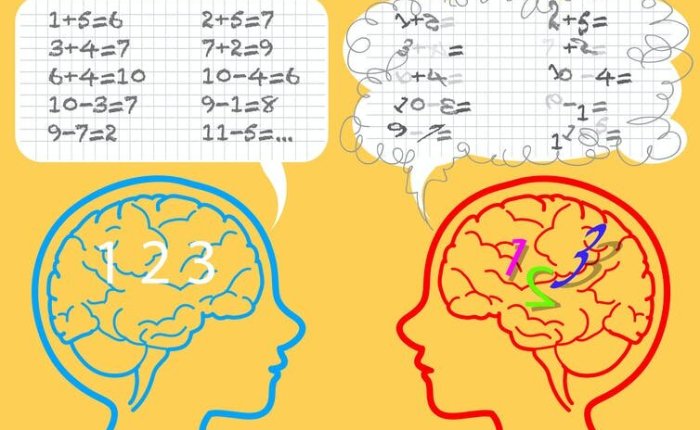
I was at least fifty years away from the humiliation that was Math, Algebra, Geometry, and Statistics when I realized I have dyscalculia, a disorder that that experts define with rigorous specificity: “Dyscalculia is a learning disorder that affects a person’s ability to understand number based information and math.” What exactly is it that a person with dyscalculia can’t do? Process numbers visually, put them in short term memory, have language to describe them, plug in long term memory, understand quantities and amounts, and carry out calculations.

Fractions? Graphs? Logarithms? Geometry?

Not even on the screen.

I got by when I could translate a task into a word problem. Language works for me as math cannot. Do I feel better understanding why I was designated dunce throughout my school years? Not much.

The third issue is not hard-wired.

As a lad I closed the door to my room and read until I could read no more. I read all the usual stuff … and … a staggering number of British mysteries, comedies, dramas, histories, and fiction. By the end of my fifth grade year, orthography had become the next tar pit for this unconventional speller. Did I spell “Rose” as“Rows”. I did not. But with Dorothy Sayers firmly occupying my mid-brain, I spelled “honor” as “honour”, “humor” as “humour”, “defense” as “defence”, and “theater” as “theatre”. As I type these examples, my self-correcting word processing program is spilling red correction fluid all over the virtual page. Exactly as my teachers did.

Please do not think that this orthographic route was affectation; I still spell with choices that aggravate the heck out of my editors. Here is an example of a sentence spelled in a fashion that would make any red blooded American speller gag.

“I am paralysed as I analyse the manouevers a traveller must catalogue as part of a flavour or colour, how to organise not apologise, when one does labour for a neighbour.”

Today, with the generous loss of school day memories, I am ok with being a tapping, dyscalculiac, British speller. It was a long hard slog, and my academic record is impressively tattered, but I got through somehow.

Brains! Who knew!

Amnesia and deja vu – I think I’ve forgotten this before – Steven Wright

Amnesia and deja vu – I think I’ve forgotten this before – Steven Wright

What’s in my wallet? 

Not cash, not for a long time. Only one card, until now, as well.

Somewhere along the way I got confuddled by points, rewards, and miles, and essentially use a debit card that does not reward me, but does keep track of the actual balance in my bank account. I haven’t thought about credit cards for a while until I was offered a card that would allow me to buy stuff I frequently buy online without being charged for shipping. Free monograms, too, as if I need to see my initials every time I put on my pajamas. I hang them up in the morning; I can pretty much expect that they are still mine when I head to bed at night.

Let’s leave suppositions about my pajamas aside; it’s been a while since I divulged my most notably guarded secrets in order to register a card I barely need and will hardly use. Name, address, email – sure. But then came the security questions, intimate information that only I and whatever nameless, faceless corporate entity compiling the shards of my life will share.

I’ve handled those in the past with ease. Best friend as a kid? No problem. Favorite football team? You’re kidding. Michigan, Duh. But this time, the question asked was: “What’s the name of a college you applied to but did not attend.” 

Uh, now they’re not only asking me to scuff around in memories established when I was essentially brain fogged by hormones and family drama, they are also hitting me right in the mistakes I’ve made/choices I flubbed/ opportunities I let slide away jackpot.

Between CATS, Freud, Oliver Sachs, and Marcel Proust, the subject of memory has been extravagantly worked over. Assuming you have the score of CATS pinging in your brain at all times, I need only ask: “Midnight. Has the moon lost its memory?” Too rich for my blood and one more example of a tentative fungo hit into a field of surmise. On the other hand, Sigmund Freud was a physician even when working in the realm of the subconscious mind, and he too had his doubts about memory: “Our memory has no guarantees at all, and yet we bow more frequently than is objectively justified to the compulsion to believe what it says.” Oliver Sachs, a neurologist (author of the remarkable The Man Who Mistook His Wife for a Hat), took it a step further. “It is startling to realize that some of our most cherished memories may never have happened – or may have happened to someone else.”

Wait. What? Our memories may have happened to someone else? Is the corollary that someone is walking around with my memories? Actually, with only a moment’s reflection, I’ve got a boatload of memories I would be happy to offload.

Be that as it may, Rosiland Cartwright, a neuroscientist whose research was primarily in the area of sleep (a phenomenon which we don’t understand, by the way), argues that “Memory is never a precise duplicate of the original … it is a continuing act of creation.”  

That supposition may have its most compelling example in the work of Marcel Proust, whose novel A la recherche du temps perdu/In Search of Lost Time, is comprised of seven volumes, over a million words, examining recollections of childhood and adulthood, famously inspired (maybe) by a crumb of a puffy cake known as a madeleine. 

Here’s a tiny excerpt:

”And at once the vicissitudes of life had become indifferent to me, its disasters innocuous, its brevity illusory – this new sensation having had on me the effect which love has of filling me with a precious essence; or rather this essence was not in me it was me. … Whence did it come? What did it mean? How could I seize and apprehend it? … And suddenly the memory revealed itself. The taste was that of the little piece of madeleine which on Sunday mornings at Combray (because on those mornings I did not go out before mass), when I went to say good morning to her in her bedroom, my aunt Léonie used to give me, dipping it first in her own cup of tea or tisane. The sight of the little madeleine had recalled nothing to my mind before I tasted it. And all from my cup of tea.”

I rarely read all seven volumes, but the notion endures that a sight, a smell, a warm wind on one’s shoulders can catapult us into a rich tapestry of memory, a notion that persists despite the discovery that in the first draft it was a tartine rather than a madeleine that shook loose Proust’s avalanche of memory.

What shook loose the avalanche at my desk was the ostensibly unprovocative “What college did you apply to but did not attend?”

I can’t reveal the one word answer that is now among the tightest of safety precautions attached to my financial record, but let’s just pretend that it is a name that signifies the highest aspiration of any college applicant, a name that evokes tradition, excellence, and a passport to a lifetime of power and privilege. So, but, I did not attend. Looking back on it, I got some juice throughout most of my senior year as an applicant to this bastion of academic superiority. I was just as not-denied as thousands of other applicants; decisions used to arrive by mail on or around April 15th in those days, so I got a good long run out of an application that was doomed from the outset. I was also not denied yet at another smaller but also snappy college, more than good enough when it came to sweatshirt recognition. Oh, and I also applied to this other college, I guess, because … well, I wanted to be nice to the admissions representative who actually spoke to me and encouraged me to apply. He wasn’t as sharply dressed as the other college reps, and the letter he sent after his visit had a troubling grammatical error. “It was nice to OF met you,” he wrote. ‘Nice to HAVE met you,” I breathed, giving him the benefit of the doubt as his secretary might have misunderstood his dictation. In hindsight I suspect it was a form letter, so not great, but also an actual letter, putting this third place option in a different category than the other not-to-be-attended non options.

It was the only college in straits dire enough to accept me.

I still have that letter, along with the report cards chronicling my lackluster performance throughout my school career. The trace memory of myself as the younger person not attending those colleges has changed over the years; I can see myself as I was  more clearly now, disappointed that I floated along so thoughtlessly, so carelessly, but aware that I had shut down well before I was sent to boarding school at the age of ten. I kept my terminally unimpressive reports, along with various letters warning me of imminent ejection from schools and college so that my children would never feel pressured to excel. All three were and are substantial people, not a shred of carelessness among them; they have racked up academic honors and found lives of purpose.

So, that worked.

If I was any good as a teacher during a career of more than forty years, it was because I had been the student who didn’t engage, didn’t get traction, couldn’t catch on first time around. I worked with kids of great ability whose reports looked very much like mine. I knew what many other teachers hadn’t figured out – nobody WANTS to be in the doghouse. And, Mr. What College Did You Not Attend, I wrote a guide identifying great college options for students who would not be striding across the campus at that bastion of academic prestige.

So, that worked too.