Basketball, World Cup, and a tribute in Butter

Basketball, World Cup, and a tribute in Butter

One might be tempted to hail the impossibility of obtaining season tickets for the 2023-2024 University of Iowa’s Women’s Basketball Women’s season as a pretty powerful indication that women’s sports have reached a new level of popularity. Of course the Women’s National Soccer Team has played to sold out crowds, Women’s Gymnastics are a predictable draw, the women’s Euro League has filled stadiums.  The final game between Iowa and LSU drew 10 million viewers, and the NCAA is considering selling the rights to the women’s NCAA basketball tournament separately from the rest of its championships.

Hawkeye Fever in women’s basketball is intense as Caitlin Clark, NCAA Women’s Basketball Player of the Year, enters her senior season. Ticket sales are one thing, but Clark joined an elite group of athletes whose likeness have been carved in butter at the Iowa State Fair. By elite, I mean three. Clark joins Kurt Warner, Hall of Fame quarterback and graduate of Northern Iowa University, and Jack Trice, the first African-American athlete to play at Iowa State University. Iowa State’s stadium is named after Trice, who died after sustaining injuries in a 1923 game against the University of Minnesota.

Caitlin Clark holds a slew of records, many of which were viewed by the millions watching the 2023 NCAA basketball tournament. She scored 40 points in two consecutive games; in one of those games she recorded a triple double – 41 points, 12 assists, and 10 rebounds. She hit eight three point shots in the final game against LSU, eventual winner of the tournament.

Sportscaster Rich Eisen suggested that “the best shooter in the US is playing college ball,” to which Hall of Fame basketball player and analyst Reggie Miller responded, “Caitlin Clark is amazing.”

That’s impressive, but I gotta think the butter statue still beats any other tribute.

Excitement surrounding the start of the 2023-2024 season is building as Clark will face stiff competition from LSU’s young championship team, a physical and talented South Carolina team coached by Dawn Staley, and perennial contender, the University of Connecticut, coached by Gino Auriemma in his 38th season at the helm.

That’s really what I wanted to get to in starting this piece. I’ve been a fan of UCONN women’s basketball for years. I grew up in Connecticut, but my fandom began in the Rebecca Lobo era, 1992-1995. I could wax rhapsodic about UCONN’s dominance, capturing eleven NCAA Championships, four in a row from 2013-2016, but my experience in watching basketball in the years following UCONN’s championship streak has informed my appreciation of the sport. National Champions South Carolina, Notre Dame, Stanford, Baylor, and LSU and the teams they beat in the finals, Mississippi State, Arizona, and Iowa (also UCONN) are terrific teams. NCAA Women’s Basketball is exciting, challenging, and, most significantly, has reached parity among a number of excellent programs.

How? Why? I’m going to suggest that the UCONN juggernaut, like the NY Yankees, Tom Brady’s New England Patriots, and the US Olympic Gymnastic programs demonstrated skill at the highest level, allowing many to jump on board, and in the case of the Yankees, develop strong antipathy as well. The MLB and NFL had plenty of viewers anyway, but America loves winners, and UCONN won big and won often.

This observation explains, I think, the rising tide that carried all boats. UCONN is still very much in the mix, but its success has bred a plethora of equally exciting programs. 

So too, the success of the Women’s National Soccer Team (USWNT) changed the face of soccer in the United States and around the world, and created the impetus that brought superior teams to this year’s FIFA Women’s World Cup. The US won four World Cup titles and Four Olympic gold medals, but the 1996 Olympic Games and the 1999 World Cup final super charged the success of the sport. More than 76,000 people watched the gold medal match between the US and China, and more than 90,000 filled the Rose Bowl for the 1999 World Cup match, again against China.

Just as WNBA players such as Rebecca Lobo, Sue Bird, Maya Moore, Lisa Leslie, Cynthia Cooper, Sheryl Swoopes, Breanna Stewart, and Brittney Griner are names to conjure with, so Mia Hamm, Brandy Chastain, Michelle Akers, Julie Foudy, Abby Wambach, Alex Morgan, Megan Rapinoe, and Carli Lloyd have become familiar as members of the USWNT. Just as the pool of talented and experienced women playing soccer at the highest level has grown in the US, so have the numbers of talented female players on the world stage.

The US bowed out early in this year’s World Cup, barely escaping the group stage and losing to Sweden in the round of 16. In earlier years, I might have signed off after my team was eliminated, but the quality and personality of several surviving teams allowed me to enjoy the quarterfinals and to anticipate the semifinals. Having now seen all 32 teams in action, I can offer three observations:

  1. The US team on the field was less dangerous than the teams that have moved on. The coaching was bizarre. Julie Ertz played in the wrong spot, Alex Morgan didn’t score, Rose Lavelle was not able to play at full strength, Lindsey Horan is a beast, and look out for Sophia Smith, Lynn Williams, Trinity Rodman, Naomi Girma, and Alyssa Thompson.
  2. The women playing football at the Cup level are remarkable athletes and almost superhumanly tough. 
  3. Whereas I cannot identify a particular character in describing the US side, I have no problem in differentiating between the meticulously controlled brand of football as played by Japan and the brutally physical game played by Colombia. Neither of those excellent teams survived the round of 16, but neither went out easily.

World Cup play is still ongoing, but the US Open tennis tournament begins in about a week. Is Coco Gauff ready to break through? Can Ons Jabeur finally win a final Slam match? Is Jessica Pegulathe best US player? If the past informs the future, will the next Open champion be from Kazakhstan, Belarus, or Poland? 

If Pegula wins it all, surely the city of Buffalo will do what it takes to carve her likeness in butter, or beef on weck, or spaghetti parmesan. Greatness demands tribute.

I Accuse the Butler in the Pantry with Salad Shears

I Accuse the Butler in the Pantry with Salad Shears

Twice a month my mother walked into our village’s small library with a sturdy canvas sack, waved at the librarian’s empty desk, and swept a row of books off the shelf into the bag. She read mysteries, exhausting the library’s stock as she traveled alphabetically by author, returning the alphabetical end of authors, Patricia Wenworth (Miss Silver Deals With Death) through Margaret Yorke (Once A Stranger) and starting again with Robert Arthur, Jr. (The Case of the Stuttering Parrot) through Lillian Jackson Braun (The Cat Who Could Read Backwards). Some authors, notably Agatha Christie,  Dorothy Sayers, Rex Stout, Mary Roberts Rhinhart, Josephene Tey, P.D. James, Dick Francis, and later Mary Stewart were in her permanent collection, immediately available if she went through the canvas bag too quickly.

Having retreated to my room sometime in 1958, I grabbed and read most of her haul as she finished, developing a fondness for complicated murders and crafty detection which remains to this day. It’s probably not surprising that what was once a relatively homogenous genre has splintered into a very wide range of murderous narratives; even a casual visit to the nightly news brings fresh accounts of unspeakably vile behavior from coast to coast. My wife and I have become inured to these rancid accounts, huffing with contempt as yet another husband is nabbed after conducting a sketchy search on a home computer. My favorite was the question: “How long can a body last before it starts to smell?” A close second is the pithy: “Neck Snap Break?” Wives, too, seem to have dumbed down the art, siphoning bleach into hubby’s coffee as a means of starting a new romance. Without bogging down in the catalog of homicidal varieties, I will confess that I am fond of police procedurals when cases are handled by Jo Nesbo or Michael Connelly and equally pleased when brilliant amateurs bumble their way to brilliant solutions.

I’d like to be more charmed by “Cozy” mysteries, but even those featuring baked goods, charming seaside villages, basset hounds, and burgeoning romance lack the tang of an old fashioned murder in a locked room or the icy charm of a contemporary serial killer.

All of this is at play this afternoon as I contend again with my own inability to write the sort of novel I might actually like to read. There are a plethora of hideous things to do to victims and a gigantic catalog of quirky habits and curious obsessions with which to decorate my masters of detection, and yet, as I set out once again, I find myself sliding into the most overworked and obvious crimes and settings. My inclination is to inhabit the persona of the quirky, brilliant sleuth and let a case come to him as cases must. I still need a crime to solve. Does inspiration arrive on cue? No, then I find myself searching for “hideous ways to murder someone”, barely done researching the efficacy of venom milked from the common krait when it strikes me that should anyone in my zip code disappear without explanation, that search will land me in the top tier of suspects to be sweated in an airless interrogation cell.

I did find out, however, that the common krait is one of the “Big Four” most poisonous of snakes, information that has left me with skin still crawling. The other three are Russell’s viper, the indian cobra, and the saw-scaled viper, information which has guaranteed that I will never set foot in India. 

Leaving vipers aside for the moment (forever!), I’m currently reading Thomas Perry’s The Butcher’s Boy, in which a “button man” dispatches his target, a U.S. Senator, by putting curare in the water glass holding his dentures. Duh! Who wouldn’t think of that? Obvious!

Recently a very kind acquaintance asked me which of the books I’ve written would be one he might enjoy. I loved writing each of them, but it’s become clear to me that although they amused me, I’m more than a little shy on plot. Sure, things happen, but “plodding” would be a kind term of description of the events that creep across the two or three hundred pages of wry discourse on affairs of no concern to anyone outside my brain.

I do still read quite a number of mysteries, not alphabetically by author, but with little critical ambition. A relatively forgettable novel (Can’t remember the title) presented “The Rules of the Game” from the Golden Age of Detective Fiction – all ten of which are presented below as further impediments to any project I might begin, allergic to rules as I am:

  1. The criminal must be presented early in the story, but must not be anyone whose thoughts the reader has been allowed to know.
  2. All supernatural or preternatural agencies are ruled out as a matter of course.
  3. Not more than one secret room or passageway is allowed.
  4. No hitherto undiscovered poisons may be used, nor any appliance which will need a long scientific explanation at the end.
  5. No person from China may figure in the story.
  6. No accident must ever help the detective, nor must he have an unaccountable intuition that turns out to be right.
  7. The detective himself must not commit the crime.
  8. The detective is bound to declare any clues he may discover.
  9. The sidekick of the detective, the Watson, must not conceal from the reader any thoughts which pass through his mind; his intelligence must be slightly, but very slightly, below that of the average reader.
  10. Twin brothers, and doubles generally, must not appear unless we have been duly prepared for them.

Leaving aside the unfortunate misogyny and racism of the Golden Age, the rules do prevent the sort of “Evil Twin” or unreliable narration that can make contemporary detection fatuous and annoying. Kudos to those of an earlier time who foresaw supernatural horseplay and the sharing of thoughts belonging to nasty characters; it’s a shame that our most successful contemporary thrill merchants pretty much obliterate the rules.

So, the gauntlet has been thrown, the challenge etched in blood. I have the temerity to scoff at authors who regularly churn out more plot in an hour than I have in a lifetime; now it’s my turn to play by the rules. My opus, the mystery I was born to write, ought to be finished by Halloween at the latest.

Or … 

Not-So-Grand-Slam

Not-So-Grand-Slam

“Back pedal, assume trophy position, hit through the ball, and aim for the orange cone.”

I’m one of three “Adult Tennis Players” on the court with a local club’s tennis pro moonlighting during the summer as an instructor for the town‘s recreational and activity programs. The governing outfit is actually called “Simsbury Culture, Parks, and Recreation”, and I’m the lone septuagenarian returning to tennis after having been sidelined (In tennis, would the term be “discourted”?) by the ravages of time and noncompliant vertebrae. I can aim for the orange cone; anybody can aim at objects. The actions leading to delivery of a tennis ball to the cone, however, appear now to be in the realm of:

“No-problem-doing-any-of-this-five-years-ago-but-not-happening-tonight”

Let’s start with backpedaling. The gurus at Exercise.com remind me that backpedaling is a simple maneuver calling upon my quads, glutes, hamstrings, and calves. Their instructions are terse -”Keep your hips low at about ¼ of a squat position, take small steps backward continuously, and continue for the desired time or distance.” 

We could start with the  mobile ¼ squat; not happening. The thing about assuming the demi-squat is that for some period of time, perhaps only a few seconds, my lumpencorpse is to suspend itself between standing on a flat surface and sitting without a chair while taking short steps backward and continuously. I can still do crossword puzzles and tie my shoes, but something happened to my balance when my left side went numb. Simply walking backwards has become an issue; I seem to lose track of myself in space.

The process of walking, forward or backward, would be made more ungainly if I were to look straight up as I attempt to move. Down is ok, but up is the wake-up call for vertigo. Is there any posture that would ask me to shuffle backwards while looking straight up?

The trophy position replicates the figure standing atop the participation trophy, head up, racquet back, arm extended to the sky. The figure is also bent at the waist, curving against gravity and nature. 

That’s not happening either, but the instructor hits a wobbling lob falling in a perfect arc, falling at terminal velocity as it leaves his side of the court and enters mine. I’ve been instructed to get trophied, use my non-racquet hand as a guide, reach up, and drive this rapidly dropping object back at the instructor before it hits the ground. 

So, to summarize: Can’t squat, back pedal, or assume the position. I let the ball bounce and poke it back across the net in a pathetic invitation to have it fed back to me before I have brought my racquet back to protect myself.

I go to the back of the line, bounce somewhat , and imperfectly repeat until the drill is finished, but the tang of uncertain memory intrudes. I believe I have known the satisfaction of perfectly timing a dropping lob, raising fist and racquet to the skies, delivering a eviscerating return to an opponent no longer willing to call me friend. I have back pedaled and skidded. In the summer of 1963, my touch with a loosely strung Jack Kramer racquet, a wood racquet weighing a hefty 13.3 ounces, was artful. I could run all day and swim a mile to cool off. Without a second thought I ate burgers and fries sodden with animal grease, snuck cigarettes when I could, and slept until noon.

All of which is to explain why I signed up for the next lesson and why I have a bag of tennis balls in the back of my car. 

I can’t do what I once did easily. I can’t even do what I once did with considerable effort. When injured, I visited an osteopath and a physical therapist who manipulated me back into mobility, but they haven’t helped me remember the name of that movie, that actor, that book, that place we went that time, whenever. My brother and I comfort each other as we keep misplacing nouns. Why verbs, adjectives, and adverbs are within reach I cannot say, but I do apologize to those who need to know where the grocery store is and only get “Near the …. Across from …. That pretty place …. Smells like ink.” 

I can sense the frustration my fumbling brings to conversations; I’m trying to have nouns handy before I speak. Then there’s tennis; the poor sap attempting to move me around a tennis court doesn’t shake his head and mumble under his breath, but I do feel obliged to get up, stretch as much as I can, shuffle backwards and try to assume the trophy position.

I won’t look like …. That guy …. Won at that place …. Short hair …. Whatever …. 

Taylor Swift, Kafka, and Ronald Gladden

Taylor Swift, Kafka, and Ronald Gladden

Readers familiar with my feckless scribbling will not be surprised to find yet another terminally muddled speculation on books, popular culture, the world as it exists from time to time, and the joy of writing solely for one’s own amusement. 

From whence, you ask, do these furry ruminations arrive? Do they just clatter down the chimney like Santa at midnight? Today, in fact, they do. I begin this scattergram with my meeting with Joe, the chimney guy from Naugatuck. How do Joe and I end up on the same hearth? Like Frederic, apprentice to the pirates who are eventually tamed in Penzance, I am a slave to duty; repair of our chimney had been on the list of bullets to be bitten for more than a year. I saw Joe’s work online, took out the checkbook, and gave him a call. I will not admit the countless unfounded and unfortunate estimations of character I had made in seeing Joe and his body art for the first time, but I confess they were many, which is the more unfortunate in that I number Ink Master, the televised tattoo competition, among my guilty pleasures. Within seconds, however, Joe had won his place in my pantheon of heroes by admitting that he had “Googled” me and was delighted to meet an author in person. 

I’ve frequently described the stack of self-published and almost entirely unpurchased books sitting on a shelf in the living room, books of little or no interest to the general reading public. I’ve found peace in admitting that for me, writing a novel is essentially the equivalent of completing a tough crossword puzzle; it exercises the mind, offers satisfaction in the completion of the task, and keeps me off the streets and out of handcuffs. 

And yet …

I still recall a July afternoon in Santa Barbara. The glitterati were doing whatever it is glitterati do in Santa Barbara; I was in the parking lot of my favorite thrift shop. In moments I would be rifling through previously-loved clothing in search of the elusive “Score” – the once-in-a-lifetime-find, the Picasso in the bin full of cracked frames, a Gutenberg Bible at the bottom of a pile of books. My juices were already bubbling as I stepped out of the car. 

Then, a woman with a shopping cart waved at me. “Are you a writer?” she asked.

“Why, yes. Yes, I am” I froze in place. “Why do you ask?”

“You look like a writer.”

That may not be as good as it gets, but it’s as good as I got. 

Joe’s got his retainer, I assume the chimney will be repaired, I sit on a Sunday morning determined to wade through the articles I’ve set aside during the past week. I’ve done what I could to absorb the news throughout the week; today I wallow in Op Ed and critical reviews. I subscribe to four major news outlets – lots of opinions to get through, but I trip down a rabbit hole within minutes of opening my files. Suzanne Garfinkle-Crowell, founding director of the Academy for Medicine and the Humanities at Mount Sinai writes, “Taylor Swift Has Rocked My Psychiatric Practice” in the New York Times. The article describes a phenomenon; In her experience, Swift’s music, Swift’s persona, provides, “ …a kind of big sister through the daily agonies of being a teenage girl: unsteady friendships, the 24-hour firing squad of the internet and, of course, the endless longing to feel seen and valued.” Garfinkle-Crowell goes on to describe these young women – “Who is the Swiftie? In my practice, these patients share certain characteristics. Raised on a healthy diet of kindness and fairness, she is sensitive, ambitious and a bit of a perfectionist.” Providing a kind of hero who meets these young women where they are, Swift provides an external analog, the young woman who can feel deeply but not be destroyed by feeling. The psychiatrist notes that in difficult circumstances, many of her patients have begun to ask, “What would Taylor do?”

There’s a lot to consider here; too much for one essay. I’ll have to circle back, and look forward to circling back, but as limited as my generational experience is, I have to wonder if there have been many cultural figures of similar impact. Gandhi, Martin Luther King, Jr., Anne Frank, Hellen Keller, for some of us the Obamas, sure, but at a distance. As a retired teen did I feel that Elvis, or Holden Caulfield, or the Beatles had answers I could not summon? Even when I found myself “itchin’ like a man on a fuzzy tree” – psychologically All Shook Up, I never found myself wondering, “What Would Elvis Do?”

Returning to Joe and his unsolicited affirmation of myself as a man of letters, I picked up the next article, “Everyone Likes Reading, So Why Are We So Afraid Of It?” by A. O. Scott, formerly a film critic with the Times. I like Scott as a reviewer; he described the film, 65 in this fashion, “Millions of years ago, a guy from another planet landed on this one. Like most survivors, he had a moody little girl with him.” This article has to do with the battles over books in this age of partisan culture sniping; the subtitle is, “What it means to read has become a minefield.”

Scott presents Franz Kafka’s aphorism that “a book must be the ax for the frozen sea within us”, and goes on to write, “By itself, the violence of the metaphor is tempered by its therapeutic implication. Less frequently quoted is Kafka’s previous sentence: “What we need are books that hit us like the most painful misfortune, like the death of someone we loved more than we love ourselves, that make us feel as though we had been banished to the woods, far from any human presence, like a suicide.”

Uh, I understand that Scott is moving toward a defense of literature that confronts our humanity, even as that confrontation is ugly, and dangerous, and frightening. No argument from me, but on this morning in June, even as I count the blessings that abound, ugly, dangerous, and frightening are realities as well, and I could use a big brother or sister to meet me where I am, as I am. One of the authors I most respect as a writer, Cormac McCarthy, died this week. I’ve read his work with delight and disgust; he was a magician. I belong to a book club that may never forgive me for picking Blood Meridian as our shared read. When it came time for me to select the book those friends would take on this month, however, I picked Hello Beautiful by Ann Napolitano because I wanted to spend time with characters I wish I’d known. I’m a sucker for kindness, and there were times I was gifted with tears. Kafka may have needed an ax to get at the frozen sea; I’ll choose kindness.

All of which is to return to books and Taylor Swift and to introduce a goofy reality show, Jury Duty, in which a very ordinary guy meets a series of complicated events with unfailing generosity and kindness. No spoilers here. Watch Jury Duty, meet Ronald Gladden, and then, ask yourself, “What would Ronald Do?”

You Are Not The Primary Account Holder

You Are Not The Primary Account Holder

Let’s begin with the admission that I have more than enough trouble negotiating people and events in the actual world. I’m also nonplussed by repairs of any kind, do-it-yourself kits, maps, calendars, large animal medicine, preparing steel cut oatmeal, fractions, and breakdancing in the Olympics. The list goes on, but these are all present in the space time continuum known as here and now. In the virtual world, I might as well wear a virtual chinchilla costume and beg the trillion virtual commercial markets to skin me quickly.

Today’s flaying of character has to do with a puzzling and unwelcome message from our bank, Wells Fargo, a national bank, admired far and wide for its integrity, except when caught foisting invisible accounts on unwary customers. We joined the Wells Fargo family when we moved to Oregon and took on a mortgage. One of our best friends rode with the Wells Fargo Stagecoach in parades and round-ups across the western states. My daughter has a plush Wells Fargo horse in her collection of plush horses. 

So, our bank.

In days of yore, I could walk into a building and speak to a human; I was separated from the teller by thick glass, but I could see a person in there, clearly alive and present. During the early days of the pandemic, that branch closed its doors, still operating but not accessible to civilians. No problem; my on-line portal was responsive to my clever passwords and instantly coughed up the information I needed. There were the inevitable glitches from time to time, but they were almost entirely glitches born of my own ineptitude. 

Yesterday, however, came the most unkindest cut of all. The virtual bank recognized my password, brought up a familiar opening page, and then informed me that I was not the primary account holder and could not, therefore, get anywhere close to where I needed to go. A dozen phone calls and e-messages later, I came to fully understand that humans no longer inhabited this fiscal planet. I was, literally, screaming into the void. For the first time in my life, I tossed an ugly injunction to a recorded voice. 

Faint satisfaction there.

Not easily defeated, I’ll carry my dilemma to a branch not far from here. I’ve seen people there. Humans. The issue will likely be resolved, but the damage is done.The business of banking goes on, but my sense of self is once again wounded. 

Not the primary account holder? Not Me? Then Who?

Sure, the potential loss of our capital future is disturbing, but the demotion from prime account holder to mere observer reminds me of the puzzle that has been my identity from the start. I was born in Colombia and christened (I think) as Pedro Arango y Leighton. An ill-fated marriage ended relatively quickly, and I entered the United States a citizen attached to my mother’s maiden name, Elizabeth Leighton. She remarried and took on the name Elizabeth Wolff. I spoke little English at the time and not much Spanish, and for a multitude of reasons did not often hear my name. When my brother was born, I entered primary school as Peter Wolff. Fine with me. I liked having the same name as my brother, and my classmates seemed to find my name unexceptional.

For my sins, however, I was sent off to boarding school at the age of ten, registered as Pedro Arango-Wolff. This was notably less fine with me for any number of reasons. From that point on, I would have to explain that my brother was my brother, even though we had different last names. Bad enough. The more immediate impact was that the snakepit that was this junior boarding school was packed with boys who took great pleasure in taunting the easily identifiable other, a Hispanic kid with a Spanish name. Ok, a partly Spanish name. Some pruning took place as I left eighth grade and headed to the second boarding school, where I was registered as Pedro Arango. In my college years, I was Pedro Arango, P.L. Arango, P. Leighton Arango, and, to a small group of friends, “Boom” Arango. “Time to straighten things out,” I said to myself as my college bid me an uncelebrated and early farewell and I prepared to enlist in the US Navy. “I shall serve as Peter Leighton Arango-Wolff” I announced and took an enlistment oath under that name. Great fun in boot camp as our drill instructor loved to call me “Angry Wolf”, assuming I was Native American.

Returning to finish up at my poorly used college, I must have had a name, but I’ve lost my diploma. I assume I was still Peter Arango-Wolff as I was living on the GI Bill at that point. I changed back to Pedro Leighton Arango as I started my teaching career, but when I turned 50, I had to admit that I still did not pronounce my own first name well. I could manage “Pay-Dro”, which was better than one of my teachers who persisted in calling me “Pee-Dro”, but still. Back we went to Peter, and here we are.

Oh, lest I forget. In virtually any situation demanding the presentation of my last name, I have learned to spell it out, slowly and with emphasis on the letters as they follow one upon the last. One might not think Arango too much of a mouthful to manage, but, believe me, I’ve heard every mangled near and not-so-near miss. I’m actually quite fond of “Avenge-o”, great name for a superhero- Captain Avenge-O! Today I pick up the phone and spell it out – ARA – N- GO, always tempted to say, “pretty much what it sounds like,” but restrain myself. I’m often asked to repeat the spelling. 

So, there I was, happily opening a virtual conversation with my old friend and former mortgage holder, Wells Fargo, expecting the immediate connection to all that is mine, when the news hit home. “Sorry, pal. Not today.” Or more precisely, “Sorry Pal, You are not you today.” Whoever I was, I dialed every number I could find, spelling my name carefully when asked, “ARA – N -GO”. No dice. 

Still not me, apparently.

Once, as a sophomore, I was asked what name I would like to have, if I could have any name in the world. For reasons that escape me, I came up with “Stu Wepler”. I have not found it necessary to use that name in the intervening 62 years, but today, who knows?

Why Not Baseball?

Why Not Baseball?

This essay ended up as a reflection on the sustaining value of quality. I thought I might begin with friendship, or a book, or a film, but then, the tangled strands of memory got caught in the loom once again, particularly the transition from a partisan emotional attachment to a particular baseball team to a greater appreciation of genius, beauty, and character. Sure, I could have chosen literature or the arts as the medium, but why not baseball?

I was in my first year at my second boarding school in the autumn of 1960, the year in which the U2 Spy plane piloted by Gary Gary Powers was brought to earth by a Soviet missile, the US sent its first soldiers into Vietnam, The Civil Rights Act was signed by President Dwight D. Eisenhower, and JFK became the first president born in the 20th Century. I’m pretty sure all those events happened, but the most significant event from my point of view, was Bill Mazerowski’s ninth inning home run, a long line drive that gave the Pirates the deciding game of the World Series. My dormitory included one kid from Pittsburgh and a lot of guys from Connecticut, some of whom rooted for the Red Sox if they lived east of Hartford and some for the Yankees from the western half of the state.

I lived in northwestern Connecticut and had been devoted to the Yankees from the first wobbling images of Yankee games broadcast on WPIX, Channel 11, narrated by Mel Allen and Red Barber. The northwest corner wasn’t far from New York City, but television reception was iffish on crystal clear afternoons and virtually obscured as storms moved through the region. I counted on Allen and Barber to bring the games to life even as the screen was filled with horizontal bands of black. Allen was The Voice of the Yankees, mellow and blessed with a honeysuckle voice thick with witticisms that had traveled with him from Tuscaloosa, Alabama. Barber had been a notable announcer for the Dodgers whose broadcasts on Channel 9, WOR might as well have been filmed underwater, under muddy water as the signal hardly made it to my corner of the state. Barber was noted for the vivid expressions he had picked up in Mississippi – “Sittin’ in the catbird seat”, “slicker than boiled okra”, “tied up in a croker sack”, but holds my admiration to this day for his determination to keep profanity from entering his vocabulary at any time. His fear was that in a moment of excitement he might blurt out a vulgarism that would offend his listeners. I share his intentions and fail daily.

Mel was on the mike on October 13 when Ralph Terry tossed Mazerowski the fat ball that crushed my soul. 

“There’s a drive into deep left field, look out now…! That ball is going … going … gone! The World Series is over! Mazeroski … hits it over the left field fence for a home run, and the Pirates win it 10-9 and win the World Series!… And the fans go wild.”

This fan did NOT go wild; this fan watched Nick Litchfield, the kid from Pittsburgh, strut around campus for the next eight months. 

Life went on, of course, and my intensive “How to Become A Human Being” program took much of my time, but when Mazerowski was elected to the Hall of Fame, the dark and unattractive underbelly of this aspiring human took a nasty turn. In addition to recognizing a more complete understanding of the corroding power of resentment reanimated, I have to take a long look at what was bubbling up, and what animated the taking of myself back to Forbes Field in 1960 when in the present I sat in reasonable contentment, happily near almost all of the people I love best and without a virtual cloud on the horizon, with the exception of existential angst, of course.

I had forgiven Ralph Terry. Leave us not forget that the Yankees had allowed NINE runs before Mazerowski added to the tally. I was ok with Yogi Berra as well; Berra was too short to catch the ball as it cleared the fence. I have ½ inch on Berra, but I can’t see myself making the catch either. Aaron Judge, 6’7”, would have fielded it like a pop fly.

But alternate histories have no place here.

The plain truth is that from the age of five or six I really did not do well with humans. I can’t remember precisely when I shut the door to my room and lost myself in books, but books are virtually all that I do remember until I became a sports fan. I listened to games in my room and watched on television when my teams were in town. For several years children’s classics gave way to stories about baseball – about real baseball players, and fictional players, only slightly older than I, who defied expectation, overcame adversity, and played their way to victory. When asked what Christmas present was the best I ever received, the thrill of opening the wrapper and finding The Fireside Book of Baseball arrives as vividly today as it did in 1956.

Remarkable writers have written about sports, some of the most estimable about baseball. I won’t trot out the entire list of writers whose perception of the game has fired my imagination, but two, Roger Angell and George Will, are essentially men of letters who fell in love with the game and who write unapologetically about baseball in the same fashion that Joseph Campbell wrote about the power of myth. 

This was a new recognition that perfection is admirable but a trifle inhuman, and that a stumbling kind of semi-success can be much more warming. Most of all, perhaps, these exultant yells for the Mets were also yells for ourselves, and came from a wry, half-understood recognition that there is more Met than Yankee in every one of us. I knew for whom that foghorn blew; it blew for me.

Roger Angell

“All I remember about my wedding day in 1967 is that the Cubs lost a double-header.” George Will

Angell suggested that the only path beyond blind partisan allegiance is expertise, an observation which I took to mean an appreciation of greatness in players and teams other than one’s own. 

Do I cite Angell in order to mouth a mamby pamby paean to Mazeroski, a long-overdue tribute to a clutch ballplayer? 

Nah. One homerun does not a Hall of Famer make, and if defensive skill is the criterion, the list of exquisitely talented fielders not in the Hall is as long as an A’s losing streak. Do a search for Jim Edmonds. The first word you’ll encounter is “Catch”. Not this catch or that catch but the seemingly endless string of improbable catches, any one of which rivals the iconic catches in baseball lore. When Edmonds became eligible for consideration, he garnered 2.5% of Hall of Fame votes and was relegated to the heap of overlooked defensive wizards.

Like a runner inching his way down the third base line as a pitcher winds up, I am slowly edging toward the purpose of this confession. Having buried the lead several pages ago, my intention is still to describe the transition from juvenile devotion to a team, the Yankees, to an appreciation of grace, skill, and heart wherever it appears. As a child, I gave my heart to the Yankees for the same reason kids wear superhero costumes on Halloween and are fascinated by dinosaurs and sharks. I lacked agency, authority, power, and they were powerful. 

But childhood ends. In my case on October 12, 1960. All was not lost, however. That Pirates team, for example, included Roberto Clemente, among the most complete and certainly most graceful players of all time. In addition to Clemente, the National League was stuffed with greatness – Willie Mays, Ernie Banks, Orlando Cepeda, Stan Musiel, Eddie Matthews, and Hank Aaron. American League rivals included Ted Williams, Minnie Minoso, Nellie Fox, Brooks Robinson, Al Kaline, Luis Aparicio, Vic Power, and Harvey Kuenn. Against all odds, throughout the next 60 years, magical ball players continued to break into a lineup and blaze with glory. 

As I write, I am reminded of a spring training game in Peoria, Arizona, an early evening game in which the best seats had been sold out. My son and I sat on the lawn behind right field, above the bullpens on the side of the outfield. We were there to see Ichiro Suzuki, the Mariner’s newly acquired bushido batsman. His career in Japan had been extraordinary, and we would have made the trip if only to see him hit and run the bases. He won my admiration before spring training had begun. He’d worn the number 51 in Japan and had asked pitcher Randy Johnson if he could have the number in Seattle, assuring the pitcher that he would bring the number no shame. No shame? That year he was Rookie of the Year, AL MVP, won a Gold Glove and Silver Slugger Award, and was the first rookie to lead voting for the All Star game. On that evening in March, however, that was yet to come. We’d seen him hit a single and steal second in the first inning, more than excitement enough for us, but in the third, the Padres’ bats warmed up and runners were on first and second. Ichiro was playing relatively deep, read the batter’s stance, took off at the crack of the bat, and nailed the runner at third. Early in the regular season he would cut down Terrance Long of the A’s with a rope to third that was simply immortalized in Japan as “The Throw”. 

I can’t truly pay tribute to Ichiro as a hitter, but like Curry’s delicate shot from mid-court, like the mid-air acrobatics of Randy Moss, Ichiro Suzuki’s courtly extension of his bat signified a kind of kinesthetic genius.

I stopped in at the National Baseball Hall of Fame last week on the way home from a college reunion. Ichiro won’t be eligible for election to the Hall until 2025, but the museum had mounted an extensive display of records held by various players, many of which belong to Suzuki. Ichiro has visited the museum frequently, holding the bats of celebrated players, weighing them in his hands to feel the density, the “sweet spot” in each bat. He wanted to hold the bat used by George Sisler, former St. Louis Browns first baseman, whose record for hits in a single season had held until 2004 when Suzuki’s set the new mark of 257 hits. He visited Sisler’s grave in St. Louis, explaining,

“I wanted to do that for a grand upperclassman of the baseball world. I think it’s only natural to want to do that, to express my feelings in that way.”

Those of us who were devoted to his career remember his response when readying to face dominant pitcher Daisuke Matsuzaka – 

“I hope he arouses the fire that’s dormant in the innermost recesses of my soul. I plan to face him with the zeal of a challenger.”

So, the Yankees were pretty terrific in 1960,  but then the Giants were pretty terrific, and the Dodgers, and the Cards, and the Braves, and the Reds, and the Mariners, and now, the Astros and the Rays.

I stood in front of Ichiro’s locker in Cooperstown and reminded myself that more grace and more beauty is likely to appear when I least expect it, I wouldn’t mind being on the lawn above a bullpen to see it arrive

Welcome Back, You!

Welcome Back, You!

Against all odds I’ve lived beyond the confines of a 50th college reunion, now joining superannuated loyal alumni returning to campus as a“Perennial”, a tag that is far more generous and far less descriptive than “Shambling Husk of a Person Seeking Connection With a Life Only Dimly Recalled”. So it was as a Perennial that I drove up the hill again to find the campus essentially where I left it, but subtly altered as open views have been filled with new construction and familiar haunts have evolved into freshly coined businesses. A long central path runs down the backbone of this college town and campus, slightly more congested as classes return and Amish carts bring handmade goods to stalls along the path. Banners and signs waved a jaunty greeting as I parked between a dusty Dodge Caravan and a sleek Rolls Royce convertible. I can’t begin to guess at the slog the chipper development staff goes through – organizing this spectacle and housing pop up a week or so after the Commencement litter has been swept up. They were universally chipper on day one but somewhat brittle by Sunday mid-morning as they had heard one too many complaints about the fluffiness of towels in dormitory accommodations. 

The President made his rounds, dutifully extolling the generosity of the loyalists whose classes had contributed millions to the small college’s coffers. Some of the Perennials were in that cohort; most of my pals were still trying to figure out how we thought we could retire and still pay the cable bill.

But, happy to be back, and resigned to seeing flags and pennants reminding us of the many generations of graduates who followed our tattered retreat from the groves of academe in the riot of the late 1960’s. Most of the signs welcomed us back by class, but since some of us had outlived our reunions, one sign in particular struck me as oddly impersonal and unsettlingly familiar.

“Welcome Back, You.”

An unadorned “Welcome Back” fits all sizes and raises no curious flights of fancy. “Welcome Back … You”? 

The first impression is that the college thinks it should know me, but just can’t quite come up with a name. Rather than stumble and guess, “Welcome Back … Terry?”, the sign signifies a warmish welcome and the admission of the droll ravages of time. Almost immediately, however, I hear a different intonation as I consider the greeting spoken. Not just the word, “You”, but an elbow in the ribs, perhaps, or a light punch on the arm. “You devil, you.” “You scamp, you”, You joker, you”. This is a welcome accompanied by the curious mixture of affection and correction offered by those who know us well enough to see beyond our public personae. Nudge nudge, wink wink.

I suspect those whose collegiate years were filled with triumph and celebrity hear a different greeting, but those of us who tried the patience of the place understand that this reckoning is the gift that keeps on giving. I’m ok now, too long in the tooth to be dangerous and too diminished in charisma to be an attractive distraction. Welcome Back, Me, the college says, pretty sure the worst that will happen is that I complain about soap.

The theme song of my early years was, “I Did It My Way”, and while Sinatra may not have given much room to his few regrets, mine are heaped like kegs at a frat party, a simile I choose with some caution. I spent the summer before my freshman year in a house in the woods on the Upper Cape, above the elbow, near Thoreau’s cabin and a short walk from the Bay. I read everything I could get my hands on, especially histories of European literary and artistic movements. At the end of the summer, I packed a backpack, grabbed a guitar, and headed off to find the intellectual playground of my dreams.

I’m not sure I read anything assigned in the debacle that was my first three and a half years on that campus. I have no memory of riveting conversations with professors, no fault of theirs as I was only fleetingly and rarely in the classroom. Paradise Lost? More like Paradise Ignored.

I mention the social and academic wasteland that was my collegiate career to introduce one of the unexpected pleasures this Perennial found over the course of a weekend. I listened to my classmates and appreciated the lives they had lived. I sat with a friend who had taught in schools such as those I knew comparing notes on “the Duke of dark corners” in Measure for Measure and arguing whether Shakespeare intended us to see The Merchant of Venice as belonging to Shylock or to Antonio, the actual merchant, and if so, whether Antonio’s opening lines, “In sooth I know not why I am sad…” is an unarticulated, unintended declaration of his love for Bassanio, the moronic frat boy, and in that reading, if the character of Portia has to be reassessed. 

Regrets? I could have had a thousand conversations such as that in my college years and did not. But, welcomed back, I could bring the person I had become to a place that had wished me well. 

That sign now means something more to me. “Welcome Back, all that you regret and all that you love, and all that you are.” “Welcome Back, You”.

Hair Today, Dye Tomorrow

Hair Today, Dye Tomorrow

I’m not a punster; I am somewhat reluctant to foist my leaden and wholly obvious jests on an innocent public. My daughter, however, is both irrepressible and gifted. I’d give her credit for some of her best, but the loosely meshed trawling net that passes for a brain has perfected an easy-in, easy-out memory cleansing swirl that leaves me wondering why I am standing in front of the toaster. Recovering witticisms? Not today.

You have to believe me when I tell you I have heard some crackerjack puns, none of which are accessible at the moment, but uncertain imagination informs me that a good pun elevates the speaker and her audience. Puns clearly have their place, but is that place in the naming of hair salons, dog grooming boutiques, and tawdry motels? There are, of course, the good, the bad, and the unspeakable at play on business signs. Let’s start with the building blocks: Salons have two rich sources, hair and the tools used to do something with hair. Dog groomers have dogs, their breeds, their body parts, and things that dogs do. Motels and restaurants, well, I guess the gloves are off when it comes to them; anything goes. 

The number of “Dew Drop Inns” in America is both incalculable and inevitable. “Auto Stay Here”, “No Place Bedder” “, just sad. I came across a pretty nifty motel somewhere in the southern Berkshires of Massachusetts, “The Arms of Morpheus”. Classy, classic, and intellectually challenging enough to demand immediate check-in. Well done! Slicker and sadder motel spawn in somewhat the same vein – “Cupid Villa”. Once seen, not forgotten, however, an unwanted conundrum raises questions not worth asking. 

Let’s get back to hair with a slight jog into unnecessary and overwrought celebrity hair talk. I haven’t thought much about “The Slap Heard Around the World”, although a quick scan of those banned from the Oscars (all men) raises more doubts than certainties – Adam Kimmel (registered sex offender), Richard Gere (practicing Tibetan Buddhist who criticized China, Harvey Weinstein (serial rapist), Carmine Caridi (pirated Academy scanners), Bill Cosby (serial rapist) and Will Smith (slapper). Of the many unanswered questions jostling for space in my shrinking brain, why Chris Rock, whose documentary, Good Hair, a treatise on how Black women have perceived their hair, a documentary sparked by Rock’s three-year-old daughter’s question -”Why don’t I have good hair?” – that Chris Rock, would take a shot at Jada Pinkett Smith’s alopecia? 

Fine. Unanswered questions abound.

An incomplete list of salon puns would fill this space and spill into the next five editions of the Impractical Cogitator, but even a slight foray into the world of salon wit demonstrates the fluency of language. As I begin to gather some of the most evocative examples, I have to wonder why other enterprises wallow in bland uniformity.

The obvious and inevitable place to start is with “hair puns”, a genre I did not imagine exploring, and yet …

Hair Today, Hair Today and Gone Tomorrow, Hair and There, Hairphernalia, Hair Loom, Hairanoia, Hairway to Heaven, Thairapy, A Breath of Fresh Hair, Heroes and Hairoines, Millionhairs, Vanity Hair, Hair When You Need It, Hairforce One, The Hair Port, Hairs Johnny, Hair Apparent, Hair-O-Dynamics, Hair We Are Again, Hairely Human, Hair-O-Space, The Gang’s All Hair, and an oddly personalized greeting – Fancy Meeting You, Hair!

Not even close to finished with that category, but, wait! There’s more.

A couple of generative homonyms, “sheer” and “shear” throw open wide the gates of invention. So, “sheer” can mean diaphanous, essentially see-through, and also unmitigated/utter (The sheer brazen dishonesty of some politicians is stunning) and precipitous (They faced the sheer face of the cliff with some distress). Obviously, “shear” is the action of clipping off the wool of something, well, wooly.

Let’s go!

Shear Madness, Shear Heaven, Shear Joy, Shear Luck, Shear Delight, Shear Determination, Shear Chance, Shear Variety, Shear Amazement … and so on. Of course, true wit is not confined by standard usage, thus, Shearlock Homes. 

The following enterprises are real, do exist, are open right now, and charge for whatever services they provide:

Che Bangs – Probably not a shout out to Che Guevara, maybe invoking Ricky Martin’s She Bangs. Bangs being associated with hair?

Lunatic Fringe – So, crazy good? 

Hair Today, Dye Tomorrow – Always good to suggest mortality in any commercial venture.

Anita Haircut – Let’s hope someone named Anita is involved at some level.

Julius Scissor – OK, let’s give credit for a classical reference, but knowing the general state of cultural literacy in the republic at the moment, can’t we assume this will be confused with Orange Julius?

Jack The Clipper – Not as off putting as The Rape of the Lock (mock heroic poem by Alexander Pope), but close, close. 

Equally menacing? I’ll Cut You.

Headonism – This one is interesting. The pitch is in the class of services located in faux boho, self-deprecating, pricey, shabby chic niche neighborhoods. West Hollywood – “WeHo”? Mission District? Wicker Park? Not my neck of the woods.

I live in a small town that presents three major styling options: The Hair Loft, peterdominic salon and spa, and Hair Gallery at the Mill. I don’t know Peter or Dominic, but they seem to share (and maybe shear) nicely. This is or was farm country, so the Hair Loft is like “Hay Loft” but … you know. I think of a “gallery” as an exhibition space, but whatever they do at the Mill is probably not what I might expect.

My son cuts my hair. I sit outside on a stool as he torches up the clippers, starts at the front and sweeps through whatever vestiges of hair I bring to him. Should he wish to go public, there seems only one appropriate name left.

Hair’s Looking At You, Kid.

A Picture Is Worth …?

A Picture Is Worth …?

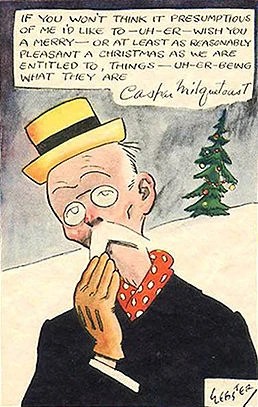
Recently a friend sent me some cartoons inked by H.T. Webster, whose signature character, Caspar Milquetoast, embodied many of the characteristics I have described as my own. They’re great (the cartoons, not the characteristics), and I’ll hunt down some of his other work, particularly Life’s Darkest Moments, a lighthearted romp through the indignities that give our untroubled lives some savor. I’m grateful to have met Webster at a distance of almost a century, and will add him to the curious band of cartoonists and illustrators who, for better or for worse, in childhood molded the strange confabulation of personalities which is your author.

I spent a great deal of time alone as a child. How that came to be is a matter for another day and, probably, another platform. For a variety of reasons, then, I sat in some quiet corner reading anything that sat nearby. The usual collection of books, and stacks of newspapers, magazines, comic books, and comic strips. Comics, cartoons and cartoonists zig and zag all over the cultural map, some self-consciously world aware, some chuckling along with mindless vapidity. The mainstream, Sunday comics I met in the 1950’s were more than odd enough.

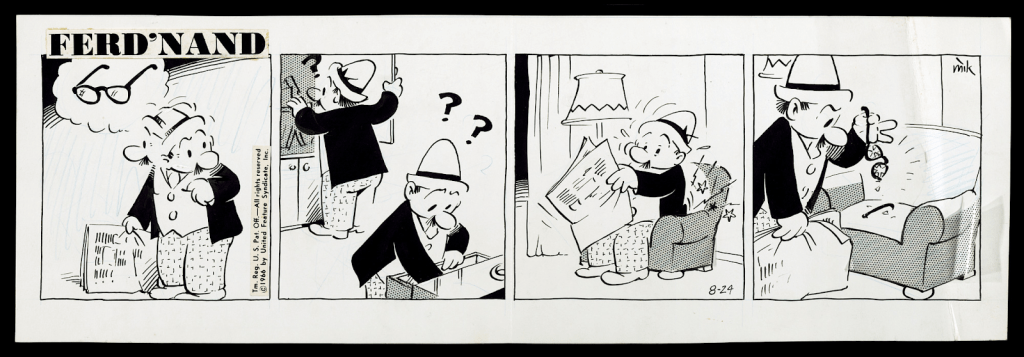
Let’s start with FERD’NAND, a cartoon character drawn by a Dutch artist. FERD’NAND was vaguely European, apparently mute, a silent man-child like Charlie Chaplin meeting ordinary circumstances with mildly unexpected consequences.

See? He sat on his glasses! 

I didn’t roar with laughter, but I got it. 

Snuffy Smiff, however …

This was in “The Funny Papers” …  so, apparently funny? Great Granny’s Bussle! I could decode some of what was going on. Two Appalachian men (Clem and Rufe) know each other. That was about it. Over the years I came to understand that uneducated poor people were apparently considered funny. I could also visit Dogpatch where L’il Abner was immune to Daisy Mae’s short skirt and open blouse and folks also bludgeoned language. 

I missed a lot of semi-heavy handed satirical action in Dogpatch, but a primitive political sensibility seeped in as I happily read Walt Kelly’s Pogo. Set in a southern swamp with some of the curious language used by less educated creatures, Pogo, an opossum, was thoughtful and insightful; his best friend, Albert the alligator, was considerably less intelligent and almost insufferably self-centered.. Miz Mam’selle Hepzibah, a skunk, longed for Pogo as Miss Piggy was to long for Kermit. The swamp’s bard was a mud turtle, Churchy LaFemme, whose lyrics once heard could never be forgotten. No holiday is complete, for example without this stirring modern carol:

Deck us all with Boston Charlie

Walla Walla Wash, n’ Kalamazoo

Nora’s freezing on the trolley

Swaller dollar cauliflower alleygaroo

It was Walt Kelly who gave Pogo the phrase that remains the most concise assessment of the modern age:

One of my most treasured possessions is the campaign button touting Pogo for President in 1956.”I Go Pogo!” I also have a Nelson Rockefeller, George McGovern, and Ross Perot campaign button, but can’t find my Elvis Christmas cookie tin.

I am now the age my grandparents were when I landed on them for weeks or months at a time. I think I’m fairly spry and reasonably competent; I’d love to have my granddaughter stay, and I’m pretty sure I’d stock the house with books, toys, and games she might enjoy. My grandmother was a classical pianist who had gone deaf and whose literary interests were impenetrable, but maybe closest to a spiritualist conviction that spirits continue to evolve after death, and by evolve, she meant creep from graveyards to overtake the living. My grandfather was less deaf, nervous, more than kind, but perpetually hunched in what seemed a state of permanent dyspepsia. My only clear memory of him is the sound of his urgent stifled belching and the ring of dried Maalox around his mouth.

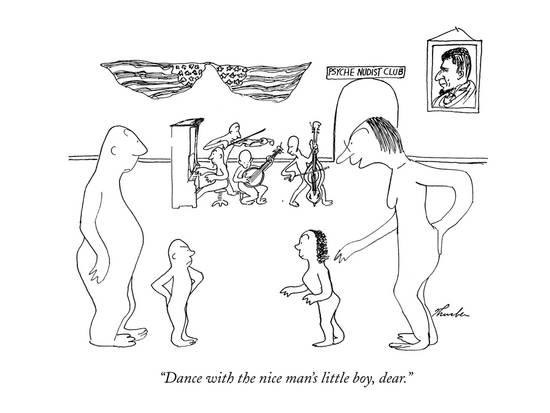
They took the New Haven Register, so my comic needs were met. They did read, or had read; there were books in the house. Most were as arcane as my grandmother’s poetry, but three oddities had somehow remained on the shelf: Is Sex Necessary? Or, Why You Feel The Way You Do by E.B. White and James Thurber, The Peter Arno Pocketbook, and We Buy Old Gold, a collection of cartoons by George Price. I knew E.B. White as the author of Stuart Little and James Thurber was a local celebrity and much admired in our house. Thurber’s illustrations were fanciful at best and terrifying taken out of context. Here’s one I found in the empty hours in a silent house:

James Thurber was a cartoonist whose drawings were barely representational but oddly evocative. This exceedingly simple drawing has lomg been a model of understated comic genius. So many questions unanswered.

At the age of seven, everything I knew about sex I’d found in Peter Arno’s cartoons in The New Yorker. I knew Arno’s work was sophisticated because several of our family friends had pasted his work in their guest bathrooms – always a sign of approbation in our circle. I have come to admire Arno’s wry wit, and it has been suggested that his cartoons “saved” the New Yorker in 1926 -1927 when his work appeared 63 times plunked in the middle of lengthy prose pieces.

He was particularly fond of drawing showgirls in various states of undress but stopped short of putting children in a nudist colony as Thurber had. 

This one was one of the few I could understand even as a lad untutored in the ways of showgirls.

I’ve saved George Price for last, in part because his sense of humor was absurd and touchingly humane. We Buy Old Gold is chock full of evocative cartoons, but as an extensive stay with grandparents came about as roads throughout the state were flooded and my hometown largely washed away, this one remains a poignant reminder of the pleasure Price brought in some lonely moments. I found the book in a “Take This For Free” basket outside a book barn in Maine and drag it out at least once a year to remember how grateful I am for humor.

I Just Can’t Change My Mind

I Just Can’t Change My Mind

I consider myself a thoroughly ordinary, inoffensive, fairly milquetoast kind of guy. I bathe. I floss. I know how to use a washing machine. I laugh too loud, some would say, although, come on. It seems, however, that some people (ok, my immediate family) find a few of my foibles somewhat jarring, and by jarring they mean maddening. 

For example, I tap. Tap my feet, tap a drum roll on any surface, tap the wall as I walk, tap the sink as I do the dishes, tap the computer as I write this sentence. There are variations of tapping, of course. Flicking a dishtowel, spinning a coin or bottle cap, riffling the pages of a book. Pens and pencils will be flipped, erasers or caps tapped, flipped back, perhaps lightly tossed in the air, returned to the hand for some reckless flip tapping, accompanied by a generous drum roll with the other hand. Apparently I tap my feet as I sit, and in moments of exuberance, “play” a tune with my fingers as my feet provide syncopation. Should this be brought to my attention, I freeze, carefully crossing my feet at the ankles to prevent tapping. Silent. Unmoving. Until I begin to rub the shoes together, gradually tapping one with the other.

Blissfully unaware of my curious and constant fidgeting, I am obviously  in need of intervention. None of us are keeping track of the number of times I am rebuked, shoved, poked, or swatted per day, but it’s a number alright. Never see it coming. I am startled and confused. My victims assume I’m on high rev, bursting with energy. How do I see myself? Well, the question doesn’t come up all that often, but when asked what sort of creature I consider my spirit animal, I’m inclined to nominate something fuzzy and slow moving. Maybe not slow moving, but deliberate. A panda, say, or a … no, a panda.

The zookeepers here, however, put me in the insect category. Which bugs are the most insistently in the face, constantly moving, humming with purposeless activity? Which are swatted away but which cannot be deflected? On a good day, they suggest, I’m a mosquito or moth; apparently on a bad day I’m a horsefly. 

Bad enough, but then too, I hum. The soundtrack of my life is on shuffle and with me throughout the day. I could burst into song and spout the lyrics, but even I observe the basic elements of common courtesy. No, I hum a quiet, steady hum, usually sticking with one song at a time, but occasionally slipping from one to another. I used to assume that I was not alone in waking each morning with the song-of-the-day playing in my brain. I also assumed that everyone kept a constant concert, just popping up. I wake with a tune in my head (“Stay” by Maurice and the Zodiacs, “The Pirate King” from The Pirates of Penzance, “Rum and Coca Cola” as performed by the Andrews Sisters, “Luck Be A Lady” from Guys and Dolls, and the everpresent “Zip-Ah-Dee-Do-Dah”). The range of uninvited tunes is impressively random. Then, as the day progresses, a thousand words encountered in a thousand contexts, put the needle in a new groove. I make oatmeal, and cereal reminds me of the Sugar Pops jungle – “Kell-Ogs Sugar Corn Pops (Bang! Bang!) Sugar Pops are tops!”. That pushed aside, I grab a spoon and hear Doris Day – “By the light of the silvery moon, I want to spoon”, which reminds me of ten other Doris Day songs – “Que Sera Sera”, “Teacher’s Pet”, “Everybody Loves a Lover”, and on and on.

Today’s selections began with the Beatles’ “You Never Give Me Your Money, you only give me your funny paper …”, morphed into “O-O-O-O-O-Klahoma, every night my honey lamb and I sit and talk and watch a hawk making lazy circles in the sky”, and is currently hovering near “Take me home, Oh Muddah, Faddah, Take me home, I hate Grenada. Don’t leave me, out in the forest, where, I might, get eaten by a bear.”

 My fictional spirit mentor, Winnie the Pooh, was a hummer. Some of his most insightful moments arrived in the midst of one of his hums. Several are wedged pretty close to the surface, so I’ll stick to only one, knowing it is likely to come dribbling out aloud at some point in the next few hours, probably when my wife is trying to read captions as we watch a Finnish detective procedural together.

The more it snows (tiddley pom)

The more it goes (tiddley pom)

The more it goes on snowing

And nobody knows (tiddley pom)

How cold my toes (tiddley pom)

Are growing

So that’s in there now. 

I drive my family nuts, I know, and I regret my involuntary tapping and singing as it intrudes unbidden in their lives. I stop (mostly) when corrected and really do try to squelch the most obnoxious of behaviors. Someone told me that the best way to escape an earworm is to begin singing “It’s a Small World After All,” as the mindless monotony of the tune blots out any other song that might have wished to persist. Good luck getting that one out once it arrives. The tricky part for me is that tapping and singing seem to be part of who I am. I don’t mind constructive commentary about my brain, but the brain does what the brain is built to do, and mine has a built-in jukebox and a time keeping metronome.  

There are more significant questions than “Who Put the Bomp In the Bomp Bah Bomp Bah Bomp?” but I’ll leave those to better, clearer minds and tap my way to bed, knowing there will be a fresh playlist queued up when I awake.