Surviving My Book Clubs

Surviving My Book Clubs

 It hasn’t been a great week.

Since we are now in the 52nd week since the nation began the deliberate descent into the odd conflation of Oligarchy and White Christian Nationalism, I really hadn’t expected much in the way of unfettered joy this week, but Halloween brought a momentary release from the drear and doom, a lovely escape into fantasy with my trick and treating granddaughter and, I assume, a candy corn fueled sugar high.

Now, settling back into more of the same dreary assault on fact, human aspiration, and science, I turn to the most immediate challenges arriving in the coming week – my book club assignments.

I belong to two book clubs, one a legacy of magical friendships in Oregon and the second an attempt to find connection and purpose in our new home in Connecticut. The first, begun on the banks of a duckpond in Ashland, Oregon, is idiosyncratic, reader’s choice, a wild Willy Wonka ride careening from mainstream popular literature. Colm Toibin’s Long Island, to Alvaro Enrique’s You Dreamed of Empires. We meet virtually and, now that some of us have left the duckpond, spend much of the meeting catching up. The second, the Simsbury Mystery Book Club, has been directed by the same reader/author for more than a decade. She shares my taste in mysteries (especially a fondness for the snappy banter in David Handler’s “Hoagy and Lulu” mysteries), but organizes the season’s slate by topic. Last year, we read five “Mysteries Without Murder”, clever and fun.

This month (this week!) I will be responding to a book I really don’t like in both book discussions. The Duckpond book belongs in the “dark and disturbing, not actually factual, but close enough to wring despair from the most exhausted conscience” category. I’ll finish it by Friday and carry it with me until worms turn and justice descends for all.  I’m no fan of the assigned mystery either, but it has been mildly energizing to find that the book offered this month is clunky enough and distasteful enough to nudge me into sitting down to work on a book I started to write months ago. 

For years I’ve said (and mostly felt) that I write for my own pleasure. Do I wish my novels had found grateful readers? Of course I do, but I’ve been ok knowing that they’re not bad and that I actually managed to finish the various challenges I set myself. Then, I walk into a book store and see piles of unremarkable new novels, each enthusiastically endorsed by packs of authors whose unremarkable old novels ostensibly sold well enough to assure the credibility of each labored blurb. I have been approached by aspiring authors and have coughed up a few bland blurbs that may have appeared as books found their way into print, but I’m a ruthless reader, and the few reviews I’ve written have been far from insistent. I’ll give a book twenty pages, then pitch back in the library bin if it lacks grace, or style, or purpose, or voice, or humor, or insight, or information. I bring home eight to ten books a week and return all but one or two. Hope springs eternal; I’ll hit a dry spell, then find someone like Kevin Wilson (Nothing to See Here), or Gabrielle Zevin (Tomorrow and Tomorrow and Tomorrow and The Storied Life of A.J. Fikry), and the tank is suddenly full again and the motor’s starts to hum. To be fair to the Duckpond, You Dreamed of Empires, a book that asks a lot of the reader, is also a book I’ll recommend to anyone who enjoys a challenge.

So, I’m not without appreciation for writers other than myself, but still …

I’ve been reading the chapters I knocked out a few months ago, hope nibbling at the self-protective defenses of the mind, when I start to receive a series of emails, ostensibly from folks who have found my books interesting. Several appear to be from folks who direct enormous on-line book clubs, clubs that consider and celebrate the most significant new writers in America. Their very complimentary letters suggest that they know my work, adore my work, and want to bring it to a wider audience. Would I be willing to address the club as they finish their appreciation of my wit and wisdom? Yesterday brought an even more enticing appreciation of a collection of essays, published as Side Effects May Include Astral Sex, a title giving a nod to a piece published in The Impractical Cogitator when the first Trump White House endorsed medical hooey and snake oil as the pandemic began.

I received an email with the title – “Goodreads is missing one very sarcastic voice – Yours!” 

The body of the message was equally insightful:

“Ever notice how mediocrity somehow gets front-row seats on Goodreads Listopia while the truly intelligent, satirical, and culturally aware books like Side Effects May Include Astral Sex are left standing in the hallway, arms crossed, waiting to be noticed? 😏

Let’s fix that injustice…

Side Effects May Include Astral Sex deserves to be seen, discussed, and admired ,not left floating in digital limbo. Let’s give it the stage presence it deserves.”

Having been floating without complaint in digital limbo, arms crossed, for more than a decade, I was intrigued, and, yes, moved, by the message’s sincerity and kind interest in my work.

But then … 

It’s probably a scam.

I suspect that I’m meant to leap into frenzied activity, energized by my champion’s conviction that she can bring me to an admiring public, sending a gushing response which allows the purported fan to access some portal necessary to my financial ruin.So, no, I have not and will not respond, however enthusiastically I agree with the writer’s estimation of that collection. I will turn back to the unfinished novel, remembering that I did enjoy creating the world in which the action takes place. I’ve got bodies piling up in the book tentatively entitled Murder in the Round, an account of a season gone horribly wrong in a Shakespeare Festival somewhat similar to my beloved and absolutely murder-free festival in Ashland, Oregon. I just have to figure out how to plant some false leads and a few more stiffs.
Sentences

Sentences

Sentences

You can’t judge a book by its cover, except … 

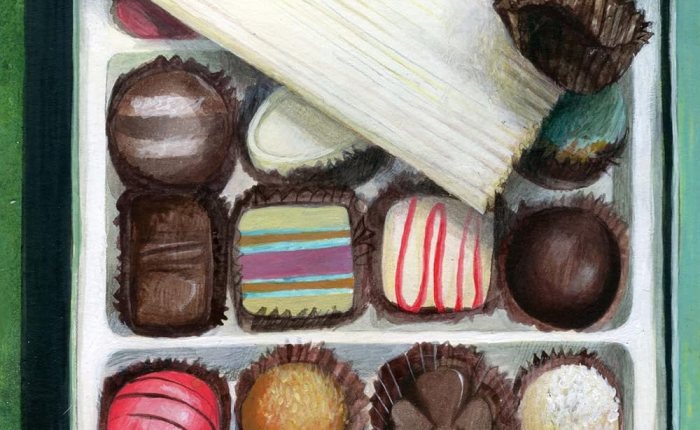
The cover of Reading Style – A Life in Sentences by Jenny Davidson displays the medley of chocolate bonbons I’ve always hoped I’d find in a magical box of perfect confection. In the book, Davidson narrates her sweet life as a reader, and she was/is a dauntingly ambitious reader. In addition to the frequently cited masters of prose (Austen, Flaubert,Fielding, Burgess, Nabokov, and Eliot), she cites works by Lionel Shriver, Thomas Pynchon, Roland Barthes, and my newly discovered favorite stylist, Helen DeWitt among many other masters of the craft.

If I had any success as a teacher peddling significant books to very bright and savvy adolescents it was in taking time to read novels and short stories sentence by sentence, and plays line by line. I would trot out J.D. Salinger’s collection, Nine Stories, near the start of the sophomore year, goading my classes into reading the widely admired “For Esme with Love and Squalor”, keeping track of voice and language. That’s more than enough to keep track of as even the most unadorned of sentences has weight. 

“Squalor. I’m extremely interested in squalor.”

That’s Esme’s request of the writer on a rainy afternoon in a tea shop. 

The scene and voice change as the narrator is pulled into the war, allowing the observation, “She wrote to him fairly regularly, from a paradise of exclamation points and inaccurate observations.”

I leave these and the subsequent examples without comment; they are yours to do with as you will.

A less familiar story, “Down at the Dinghy” offers this description of the central character. “Her joke of a name aside, her general unprettiness aside, she was – in terms of permanently memorable, immoderately perceptive, small-area faces – a stunning and final girl.”

OK, kids, “final”?

I have a short list of sentences I’ve grabbed as I read, some profound and some piercing. 

We also read Slaughterhouse Five, in which Vonnegut offers, “Everything was beautiful and nothing hurt.”

A few for your consideration:

“She was becoming herself and daily casting aside that fictitious self which we assume like a garment with which to appear before the world.”

Kate Chopin – The Awakening.

“The pieces I am, she gather them and gave them back to me, all in the right order.”

Toni Morison – Beloved

“At the still point, there the dance is.”

T.S. Eliot – The Four Quartets

The novella, The English Understand Wool, by Helen DeWitt is almost too rich to read before going to bed. Explaining what she means by suggesting that the English understand wool, the Germans understand precision, the Swiss understand discretion, the (seventeen year old) narrator observes:

“When I speak of these forms of understanding, I do not mean that they are instantiated in every individual of a nation, a culture. I think of this thing which in France is taken so seriously, the terroir, the importance of a particular soil in conjunction with the water, the sun, the aspect of the land, and how this affects the grape.”

“In sooth, I know not why I am so sad.”

Well, it’s the first line of Scene 1 in Act I of The Merchant of Venice. Curtain up. Here we are. Lots of very dramatic stuff ahead and at least two soliloquies that are quoted at the drop of a hat – 

Shylock’s “I am a Jew. Hath not a Jew eyes? Hath not a Jew hands, organs, dimensions, senses, affections, passions; fed with the same food, hurt with the same weapons, subject to the same diseases, healed by the same means, warmed and cooled by the same winter and summer as a Christian?”

Portia’s “The quality of mercy is not strained, etc”

The first line, spoken by Antonio, is often overlooked. The play is about Shylock, or Portia (tests of suitors, etc), right? Let’s get into the pound of flesh. But … What if the play is about Antonio?

Portia is a judge; Shylock is a moneylender. Antonio is the merchant of Vence. It’s his flesh at risk, of course, but what if in addition, the play is set into motion by Antonio’s willingness to pledge a pound of himself  in order to secure a loan necessary to fund frat-bro Bassanio’s wooing of Portia? 

Portia, by the way, has a grand old time mocking the suitors who do not have the cleft chin and chiseled features rocked by Bassanio, a good old, fairly dim, boy willing to see Antonio sliced and diced if it means he has a shot at Portia.

As Hamlet reminded Polonius when asked what he was reading, “Words, words, words.” It really is all about the words after all, isn’t it?

Mystery Book Club

Mystery Book Club

I’m relatively new in town, still disconnected, unconnected, at loose ends, so I decided to join one of our excellent library’s book clubs. The Adult Book Club turned out to be a book club for adults instead of a …you know, so I hopped into the Mystery Book Club, an enterprise in its 23rd year, moderated for all 23 years by an author of some pretty engaging mysteries. My fans (?) know that I’ve written three novels which could be considered  mysteries, if “mystery” means at least one of the characters gets bumped off. 

Some impatient readers have noted that I lose interest in plot somewhere around page 12, leaving those who fancy a well crafted whodunnit in the lurch, so I appreciate writers who can devise interesting schemes and characters whose foibles make the reader (me) want to slog through 300 pages of set up, execution, and red herrings. It happened that I grew up with bookshelves pretty much exclusively dedicated to murder, some from what’s known as “The Golden Age of Mysteries”, elegant mysteries written by Dorothy Sayers, Agatha Christie, Josephine Tey, Ngaio MarshMary Roberts Rhinehart, Margery Allingham, and some later, slightly less formal but conventional mystery authors including JohnDickson Carr (locked room mysteries in particular), Ellery Queen, Rex Stout, and Erle Stanley Gardner.

Apparently things got tough after WWII as the next wave to hit the family bookshelves was a bit darker, exactly what I needed as I ached my way through the miasma of adolescence. With my own school boy fondness for grotesquerie in mind, I offered an elective, in my last few years as a teacher in a wonderful independent school that allowed independent curricula –

 “Tough Guys, Tough Towns”, kicking off with Jim Thompson (The Killer Inside Me), then easing into Charles Willeford (Pick Up), Ross McDonald (The Galton Case), Raymond Chandler (The Long Goodbye), Mickey Spillane (I, the Jury), Lee Child (The Killing Floor), Richard Stark/pen name of Donald Westlake (Slayground), and Elmore Leonard (Maximum Bob).

Now comfortably settled into what I like to call the “Where did I leave my glasses” years, I’ve floundered a bit, but found a new home in Three Pines, the idyllic village in Quebec, mostly the setting for the Armand Gamache mysteries written by Louise Penny. I find comfort in realizing that these are humane, complex, compelling novels, driven by character (and food), but not wickedly complex murders.

They give me hope.

In any case, I’m starting the second novel to be “discussed” by the Mystery Club, a “Hap and Leonard Novel”, Honky Tonk Samurai, by Joe Lansdale, and realizing that I may have overestimated the pleasure to be had in sitting with thirty people who have all read the same case, met the same actors, and seen the same denouement. Not much to say (or hear) unless the novel has the complexity of human experience such as Penny provides in the very human exchanges inThree Pines. 

In an earlier life freelancing for a funky film magazine, “The Velvet Light Trap”, then published by the University of Wisconsin, now hosted by the University of Texas, I wrote a semi-scathing review of Magic, a film starring Anthony Hopkins, featuring Ann-Margaret, in which a vile ventriloquist’s dummy carries out unspeakable acts of creepiness. See, the thing about ventriloquism is that we enjoy the trick of a performer throwing his voice. It’s a trick that works because we know that there’s no other voice available other than the performer’s. Film pretty much allows a thousand voices to land anywhere the script demands. Trees talk in the Wizard of Oz; I wasn’t impressed by the trees, and I wasn’t impressed with Fats, the filth spewing dummy in Magic

(Should any reader care to be terrified by a similar wooden villain, dig up Dead of Night, a British anthology film in which Alberto Calvancanti directs a final segment which provides actual surprise and delicious frisson.) 

We have three more books lined up, none of which I’ve read before. I may love one and find a new author to follow. I may not. My hope, in any case, is that someone says something that allows me to consider the possibility of making a book friend.

I’ve written elsewhere about book friends and the peculiar ease with which one can find a cordial mind in sharing titles of books we admire. Maybe someone will say something like, “This one was ok, but have you read A Fatal Grace? 52 Pickup? The Jugger? The Snow Man? 

You had me at A Fatal Grace.

Almost Book Friends

Almost Book Friends

“Mind if I sit here”

Two things strike me simultaneously:  We’re in a busy airport, flights have been delayed by snow and ice, few seats are open, and I can’t remember the last time anyone was courteous enough to ask.  And, in that same instant, I detect an accent, mildly central European, perhaps Israeli.  This could get complicated.

As he sits, my seat neighbor points to my shoes and asks, “You a runner?”  I’m not and explain that I’m not, without going into an explanation of my personal shopping creed, a set of convictions so rigid that I often buy and wear shoes and clothing somewhat at odds with my true persona.  Cheap but serviceable, in other words.  As I write, it strikes me that may, in fact, be my true persona, but to return to the moment at hand.

He’s brought his shoes, he says, but isn’t sure he’ll have time to run as he is heading to Medford for an intensive training seminar involving plastics and coatings.  I’m not sure that any sentence could have more surely prompted me to trot out some elaborate shuffling with the book I had been reading, but this guy is not to be shuffled off.

“I was in San Diego once, when my son finished boot camp, but this is the Northwest, huh?”

I nod and ask the question that had to be asked.

Newark, New Jersey,  he says, not a pretty place to live, he says, but affordable.  His son now lives in Arizona.  Yuma.  He and his wife might visit again, but not in the summer.

I agree that Yuma, Arizona in the summer would be hot, hellacious actually, but I keep that assessment to myself.   He points to my book and asks what I’m reading.  Ordinarily I would have been trying to mute my discomfort in flying by reading a fairly grisly potboiling tough guy police procedural, but I’d finally started George Saunders’ first novel and had found it irresistible.  Most casual conversations die quickly when literary fiction arrives as a topic, but not this time.

“I was a terrible student.  I don’t think we read anything, really, maybe some short stories.”  I might have nodded again and slumped back  into ostentatious reading, but it turns out that I am fascinated by what people read in school.  I confessed that I had been a teacher and asked him if he could recall any particular stories or collection, scanning my own memory of what might have been on the list in the late 1960’s , when I figured he might have been a high school freshman.  Maybe, “Paul’s Case” I thought, or a Steinbeck short story.

The names came quickly.  “Leiningen vs the ants”, “The Most Dangerous Game” He paused, then shrugged.  “I don’t remember the others.””

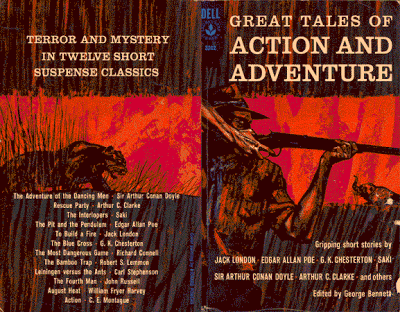
I do.  These were among the dozen stories contained in a remarkable collection, Great Tales of Action and Adventure, edited by George Bennett

Two copies of Great Tales of Action and Adventure are in my bookcase.  I bought both as used books from Powell’s.  I, too, read the stories in the ninth grade and can recall each in sharp detail.  Saki’s “The Interlopers”, still as unsettling as an extremely compact account of unexpected death at the paws of wild wolves could be.  I had been knocked out by Saki (H.H. Munro) and particularly taken with “Sredni Vashtar” and “The Open Window”, two stories with subtly surprising endings, a fondness for which unfortunately  crept into my own writing for the next decade, except for the subtle part.  “The Pit and the Pendulum” by Poe, “The Adventure of the Dancing Men” by Conan Doyle, ” “August Heat” by W.F. Harvey.  That one was a corker.  It’s not exactly a ghost story, but I found it again in a DC comic, Secrets of Sinister House.

This guy read twelve of my favorite stories!

I have three or four “book friends”.  I’ve met some of them no more than twice, but we fell into conversation about books and bonded.  We don’t share the same tastes, exactly, but we take books seriously, which is not to say that we bond over serious books.  Anyone who has experienced the rhapsody with which technologically minded people can speak of the Logitech Wireless solar keyboard K750 for Mac will understand that there is a subset of humans who are book nerds, book geeks.  We know each other almost immediately as we respond to even the slightest reference to any of the books we have loved (immoderately loved, recklessly loved – see?) as a Great White Shark does to freshly slaughtered chum.  Our voices rise, we lean into the conversation, we grab pencil and paper to copy down recommended reading.

Great Tales of Action and Adventure was a gateway read for me.  It was presented as a text to be considered in class, thus a collection worth studying.  And these were not dusty classics; these were the sorts of stories I had been reading for pleasure.  A clunky ninth grade book nerd had been given permission to take seriously a book I loved from the start.  That may have been the moment when I saw that I could be a teacher.

“My wife never read at all.”  I am jerked back from “Sredni Vashtar” to find myself in  a conversation with a potential book friend, a person to whom I might recommend one of the books I love.  “She didn’t know about books.  But now we read to each other.”

They read Kidnapped to each other, then Treasure Island.  The Chronicles of Narnia had been a great hit, followed by the C.S. Lewis’ Cosmic Trilogy (Out of the Silent Planet, Perelandra, and That Hideous Strength).  “We tried to read his books on philosophy and religion, but we didn’t understand them.”  I am impressed by their willingness to follow an author into a challenging conversation, but before I can respond with some suggestions they might enjoy, The Screwtape Letters, Surprised by Joy, he’s off again.

They’re reading L.L. Baum’s Oz books, now up to the fifth, which I recall is The Road to Oz, a strange, almost psychedelic, melange in which Dorothy Gale and the Shaggy Man, a disabled hobo, set out on an afternoon’s walk, meet two of Baum’s least engaging characters, Button Bright, a rich kid in a sailor suit, and Polychrome, the Rainbow’s daughter.  It’s all too precious until the gang arrives in Foxville.  Talking foxes are irresistible, and the chapter in Foxville almost saves the messy, Love Boat cast of faded characters brought out of retirement for a cameo appearance in this long wandering novel, but there’s no magic left in Baum’s Oz factory this time.

Baum was a racist, welcoming the extermination of Native Americans in a famous screed in which he describes Indians as “…a pack of whining curs who lick the hand of those that smite them.”  So, I’m not a fan even though I read the entire series as a kid.  I look over at my seat neighbor and decide we’ve made good use of our time waiting to board, but he will not be a book buddy.  I toss out a tentative recommendation, thinking they might enjoy reading The Golden Compass, but no pencil emerges, there’s no request for a piece of paper.

I can go for weeks without catching myself being myself, but as I wish my companion a good trip, I realize that before we had conversed, I had made up a story about him, based on his accent, his suit, his shoes.  I thought I was sitting next to a Willy Loman, a drab salesman pitching the plastic coatings in his line of coatings, liked but not well-liked. Perhaps that is his job, but at the end of the day, when he gets back from Medford, he’ll sit down with his wife and read The Emerald City of Oz to his wife, probably slowing down as they understand the crushing indebtedness facing the Gale family in the wake of the celebrated tornado’s churning through their farmstead.  They’ll talk about the characters, I guess, then go to bed, dreaming of the Gnome King and the plot to conqquer Oz.

I hope he reads better books along the way, but he is reading and enjoying reading.  I should have asked for his address. I have an extra copy of Great Tales of Action and Adventure; his wife might enjoy it.

Wait! You Haven’t Read That?

Wait!  You Haven’t Read That?

In my final decade as a teacher of English at Cate School in California, I found great pleasure in adding a course to the elective options given to students in their senior year.  I’d come to miss some of the books I most enjoyed teaching in my early years, and became determined to bring a few back into the classroom.  Fashions in literature change, less rapidly than some other elements in education perhaps, but with significant impact.  Abandoned are a number of books once found in every high school curriculum, from The Iliad and Tess of the D’Urbervilles to The Adventures of Huckleberry Finn and The Scarlet Letter.   A few familiar standards still appear; The Great Gatsby, for example, appears to have staying power far beyond that of equally highly regarded novels by Hemingway, Faulkner, and Steinbeck.  Over the years with my sophomores, I had brought back The Odyssey and Of Mice and Men, and had added newer books such as  All the Pretty HorsesNever Let Me Go, and Ordinary People and certainly would have added Station Eleven by Emily St. John Mandel, but there were so many books and so little time left for senior before they sailed into whatever remained of discussion of books in their college years.

So, I grabbed two trimesters for a course entitled, “Wait!  You haven’t read that?”, presenting books that I thought deserved a place in the great conversation between books in the auditorium of the mind.  At the start, Pride and Prejudice had slipped from view, but was soon to gain traction again and take its rightful place on the bookshelf.  I loved teaching the book, but had to give it up  as it gained popularity.  Mansfield Park is ready for the next jump if my successor is looking for a dark horse.  Hemingway’s In Our Time was an obvious choice as were Cormac McCarthy’s Blood Meridian, Kazuo Ishiguro’s The Remains of the Day, Flannery O’Connor’s Wise Blood, Kiran Desai’s The Inheritance of Loss, and Margaret Atwood’s Blind Assassin.  Best book/worst response?  Lolita (worth it!) .  Second Worst Response?  Molly Gloss’ Wildlife (Still hurts).

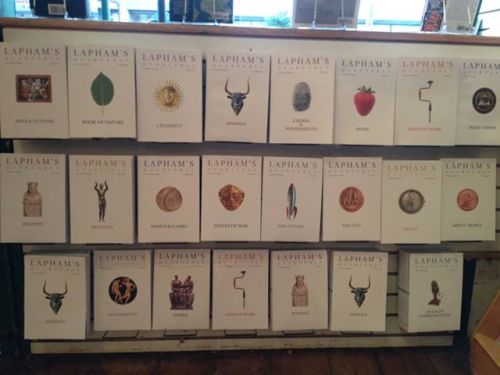
Ok, with a few spare minutes in retirement and in the spirit of  continuing the adventure, I’m lumping through Infinite Jest with my eldest son as a jesting buddy.  We’ll see.  In the meanwhile, I tell my friends about the authors who have recently jumped on my list, most notably Heidi Julavits, David Mitchell, and Kelly Link, but all of these went out the window this morning when, in an ill-advised moment, I picked up the Spring 2015 edition of Lapham’s Quarterly.

Seriously, unless you have world enough and time to track down the seventy to eighty authors/philosophers/lords of enterprise/scientists/poets/historians whose work is anthologized in each journal dedicated to bringing voices from the widest perspective over the widest span of time to the contemporary reader, remarkable voices collected in order to animate the various themes of the quarterly, don’t even read past the cover  I include the link so that the unwary can appreciate the sweep of ideas taken up in the life of this extraordinary quarterly.

My mistake was in picking up, Volume VII, Number 2 – Swindle and Fraud.  Lewis Lapham is the editor of the Quarterly and its moving force, but also something of a literary firebrand, an American aristocrat with truly democratic sensibilities.  Formerly the editor of Harper’s Magazine, Lapham is a prolific writer whose 2005 film, The American Ruling Class, is one of the most curiously arresting documentaries of its time.  Described as, “… the bedrock of classic academic purity and discipline,” Lapham also enjoys a wicked sense of irony, made clear in his preamble to Swindle and Fraud, in which he compares the emptying of trillions of dollars from the nation’s resources during the Great Recession to Houdini’s performance at the Hippodrome Theater in 1918, a performance in which Houdini made a five ton elephant disappear from the stage.  Writing of the great and general fleecing in 2008, Lapham writes, “Throughout the whole of its extended run, the spectacle drew holiday crowds into the circus tent of the tabloid press, and joyous in Mudville was the feasting on fools.”

Feasting on fools is celebrated in articles written by a range of observers including Bertolt Brecht and William Shakespeare, Bernie Madoff and Charles Ponzi.  Two articles captured me entirely:  “Manila” by Lawrence Osborne in which the author, fascinated by accounts of faked deaths, sets out to perpetrate an act of “pseudocide” by purchasing in Manila an authentic certificate of his own death and an excerpt from David Maurer’s The Big Con in which Maurer presents an extensive guide to the language of the confidence artist.  

The ease with which Osborne was able to buy a death certificate was disturbing, but I was instantly absorbed in tracking down the novel that sent Osborne off on his quest, a meticulously researched book (Osborne assures us it was written,”with an entertainingly maniacal attention to detail”), The Family Business, by Byron Bales, who as a private investigator in Bangkok knew the ins and outs of faked deaths and disappearances throughout Asia;  Amazon will sell me the paperback copy for thirty-five dollars, but I can pop it on my Kindle for less than three bucks.

Except that, I have to read The Big Con if only to further broaden my grasp of confidence lingo.  I’m ok with “The Big Store” (essentially the con run in The Sting) and “The Money Box” (a con in which the mark buys a machine he believes will actually make genuine paper money), but “Cackle-bladder”?  “Tin Mittens”?  “Laying the flue”?

Except that, I just finished “The Fully Licensed Whore, or, The Wife” by Patricia Highsmith, which is stunningly understated, as in this passage: “Sarah’s idea was to kill Sylvester with good food, with kindness, in a sense, with wifely duty.” This short piece by Highsmith is but one of the eighty or so spider webs into which Lapham is pleased to toss me, each of which carries me off into yet another web.  I last read Highsmith’s The Talented Mr. Ripley more than four years ago, intending at the time to follow up with the other four books in “The Ripliad”, so there goes tonight’s bout with Infinite Jest.

Wait!  You haven’t read those?