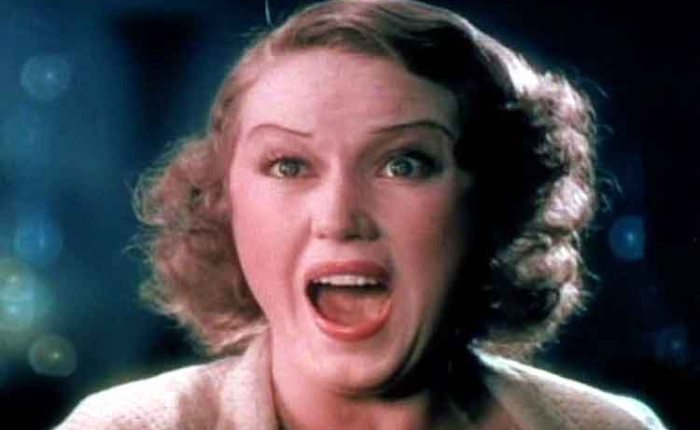
OOOOO… Verrrry Scary

OOOOO… Verrrry Scary


I  used to love to be scared, saving what remnants of allowance I had for roller coasters, fun houses, and terrifying jump-out-of-the-closet, hand-from-under-the-bed, masked-face-in-the-rear-view-mirror, seemingly nice guy-is-a-psychotic-slayer-on-a-spree, children-calling-demons-to-eat-their-parents  sorts of movies.  Not so much these days, which, I’m pretty sure, has something to do with having arrived at what Psalm 90 announces as my agenda until it isn’t.

“The days of our years are threescore years and ten; and if by reason of strength they be fourscore years, yet is their strength labour and sorrow; for it is soon cut off, and we fly away.”

Uh, yeah.  So, here I am at three score and ten, watching Youtube videos of kittens and puppies, checking to make sure the frolicking doesn’t spike my blood pressure, but knowing Halloween is just around the corner, and I love Halloween.  I have my inflatable vampire Tigger at the ready, not to be inflated before October 15 (there are rules, after all), and I’ve harvested the pumpkins, but really, it all feels very tame.

I’m seeking safe terror, which would be entirely oxymoronic were it not for my memories of countless hours watching movies presented as blood chillingly horrifying on late night televison.

They weren’t.

Nothing remotely chilling ever happened, although a few inspired something like unease, primarily because figures and shapes were obscured by fog and mist.  Every once in a while the station would pop for a classic in the Horror genre, Dracula, Frankenstein, The Invisible Man, the Mummy, but most weekends coughed up groaners such as The Attack of the 50 Foot Woman, Reptillicus, Dementia 13*, The Thing From Another World. The Magnetic Monster, Dr. Terror’s House of Horrors, Attack of the Crab Monsters, The Abominable Snowman, Varan The Unbelievable, or The Deadly Mantis.


housecats

It didn’t matter, primarily because I was staying up late, often at a pal’s house, and because the host of the show more than made up for the lameness of the film.  The late night host in my part of the world was a voice actor turned creepy celebrity named Zacherly.    Although he moved from station to station, Zacherly remained wryly mordant, descending into the crypt to visit his wife, Isobel, shut in a coffin, berating his assistant, Igor, hoisting severed heads dripping with chocolate syrup, drinking from vats bubbling and smoking, the occasional toad caught in his flagon.  Fog, and flashes of lightning set the stage, followed b y Zacherly’s trademark howl, “Give me LIGHT!”.

Cryptkeeper, undertaker, vampire… it was never really clear what sort of creature Zacherly purported to be, and no one cared.  His job was to lurk, toss gore-stained objects around the crypt and mock the film about to be shown.  He occasionally spoke over the dialogue, clarifying one heinous act after another.  More reguarly, a break in the action revealed him napping or otherwise entirely disengaged from the action  on the screen.

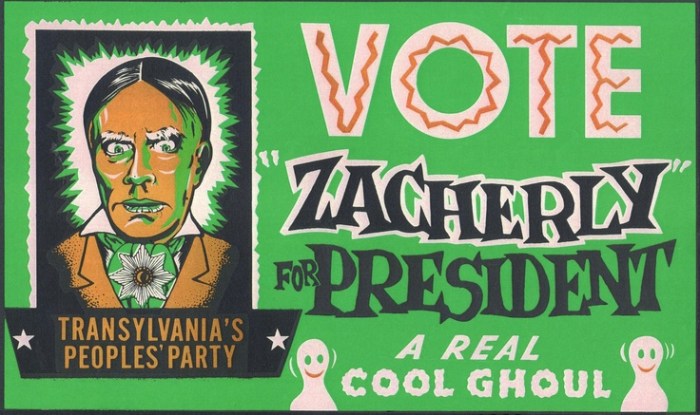
So popular was this character that he mounted a presidential campaign in 1960, unfortunately failing to win enough support to appear with Nixon and Kennedy in the first televised debates.
58daaa0a31853284052a77804938bd40

By the 1970’s many stations had cloned ghouls and vampires of their own, Vampira, Sinister Sydney, and, the most successful, Elvira, Mistress of the Dark.  Whereas Zacherly looked like something literally unearthed moments before showtime, clots of dirt still clinging to his decaying clothing, Elvira was hot stuff, exposing cleavage and valley girl snarkiness in response to movies as uninspired as those hosted by Zacherly.

My favorite successor, Count Floyd, played by Joe Flaherty, was the lead character on SCTV’s Monster Chiller Horror Theater, one of several “shows” presented as sketch comedy by the Canadian comedy troupe of Flaherty, Martin Short, Euegene Levy, John Candy, Andrea Martin, Catherine O’Hara, Harold Ramis, Rick Moranis, and Dave Thomas.

Among the other imagined programs offered by the “network” were Battle ofthe PBS Stars, pitting Carl Sagan vs Mr.Rogers in head-to-head combat, the soap opera, Days of the Week, and The Great White North, in which Doug and Bob McKenzie mocked Canada and things Canadian while guzzling beer and referring to each other as “hoseheads”.  SCTV deserves a posting all its own, but suffice it to say that Martin Short’s grinning character “experiencing some difficulty in completing high school” as a contestant on SCTV’s version of Jeapardy, Half-Wits is must-see TV.

hqdefault-1

Flaherty’s Count Floyd was clearly not happy to be hosting Monster Chiller Horror Theater; the network was cheap so Floyd doubled as weatherman and vampire.  The Count was also not too clear on the concept, playing a vampire who howled as a werewolf might.  He wasn’t helped by the selection of films he had to present.  He limped along with Swedish auteur Ingmar Bergman, but had trouble convincing the kids that The Odd Couple was “verrry scary”.  The camera often caught him sneaking a cigarette as the film paused for a commercial break, often openly contemptuous of the travesty on the screen, but he became absolutely riveted when the network screened soft-core horror such as Dr. Tongue’s 3D House of Stewardesses, Dr. Tongue’s 3D House of Cats, or Dr. Tongue’s Evil 3D House of Pancakes.

John Candy played the lisping villain, Dr. Tongue, with gravitas, ponderous self-importance mixed with bouts of unbridled lechery.  In a memorable scene from Dr. Tongue’s House of Stewardesses, Tongue orders his faithful deformed servant, Eugene Levy, to, “rip off their blouses and their skirts,” which the hunchback does with more efficiency than one might expect, given that he is bent double and can only shuffle from stewardess to stewardess.

With the commercial break we found Count Floyd, 3D glasses securely in place, begging the producer to kep the film rolling.

Verrrry scary.


Boom

Boom

I am one of the seventy-six million babies born in the United States between 1946 and 1964, a Baby Boomer, the generation once called the pig in the python, the bulge in the snake, not the first generation to be tagged as a generation, as the “Lost Generation” and the “Silent Generation” preceded us, but perhaps the first generation to be aware of ourselves as a generation.  It was relatively late in our generational journey that our parents’ generation, the “Greatest Generation” received their due, when Tom Brokaw wrote of them as the generation that fought, not for fame or recognition, but because it was the right thing to do.  I’m fairly certain that my parents did not consider themselves part of a great generation, the greatest generation.  From what I could gather, both the Depression and the war were hellish, and they did what they did because there were no alternatives to hanging on, making do, and living in a constant state of flux.  They shared the circumstances of their time, but in truth they were as poorly described by generational characteristics as were to be.

One Great Generation, one Lost, one Silent, and one … what?  A boom?  A bulge?

To be candid, we are also the “Me Generation”, privileged as other generations had not been, raised in post-war affluence with a sense of our generational superiority to the sleepy repressed stiffs littering the world and workplace, keenly aware of ourselves as the new generation.  Thus, the “generation gap” emerging at the end of the 1960’s as we believed ourselves the champions of social awareness and humanitarian progress battling the useless vestiges of antequated, social conventions and convictions.

We watched Howdy Doody,  wore coonskin hats, listened to The Witch Doctor, watched The Mickey Mouse Club. bought hula hoops, watched Leave It To Beaver, ate sugary cereal, watched Walt Disney’s Wonderful World of Color, ate TV dinners,, listened to Chubby Checker, watched The Flintstones, went to high school, waited to see if the Cuban Missile Crisis meant nuclear war, fooled around, watched American Bandstand, saw JFK die in Dallas, ate pop tarts, stole copies of Playboy, watched The Man From Uncle, listened to the Beatles, experimented with drugs, registered for the draft, marched and protested, watched Laugh-In, went to Canada, went to Viet Nam,   saw King and Kennedy die, went to Woodstock, saw Neil Armstrong walk on the Moon, watched The Mod Squad, wore bell bottoms, listened to Crosby, Stills, Nash, and Young, put flowers in our hair, listened to the Doors, became hippies or yuppies or Republicans or Democrats, got jobs, watched MASH, got married, had kids, got promoted, watched Charlie’s Angels, went to roller disco, lost jobs, watched Magnum P.I., got divorced,  watched the Cosby Show, got fat, lost hair, got old.

Looking back, we had a moment, somewhere between Watts and Detroit and Newark and Nixon’s resignation, when we might have made a difference.  For all of our pride in our highly evolved sensibilities and sensitivities, we became a lost generation ourselves,  a hedonistic, self-serving bulge, taking up space, distracted by pleasure.

We became the generation that did not recognize itself.  What happened, we wonder?  Weren’t we the generation that would change the world?

Look around.  I’m afraid we did.

We believed in progress, that every subsequent age would continue to flourish as ours had done, but we did not hold the opportunities given to us in trust for those who came next.  We liked the idea of an increasingly comfortable world so much that we wallowed in it without securing the future.  We knew the environment was fragile.  We knew natural resources were limited.  We knew that cities built in the desert would need water.  We knew garbage had to end up somewhere.  We knew people lived in poverty and violence.  We knew the rich got richer and the poor got poorer.  We knew we were distracting ourselves with mindless pleasures.  We knew that schools had become warehouses.  We knew that children went to bed hungry.

We made a lot of noise in the 1960’s, but what remains?  John Steinbeck wrote of the dignity shown by hard-working people of good will; the Rev. Martin Luther King, Jr. broke the silence of the Silent Generation with words that took us to the mountain.  Where is our voice now?  We once heard Dylan, but now, perhaps hear Stephen King spinning dark tales of fun house world and stalking killer clowns.

We are perched now on a thin branch at the top of a tall tree.  The eldest of us are now seniors, seventy years old, retired, hoping that in these “golden” days, seventy-five is the new fifty.

I’m pretty sure it isn’t, but life isn’t over yet for many of us.  Maybe there’s time enough to circle back and put a few things right, plant a few trees to provide shade for children we will never know.  We’re outnumbered now, finally; Millennial are the current bulge, and our python is looking flatter with every passing year.

I’d sure like to see us go out as the next generation that did what we could, even at the end, because it was the right thing to do.


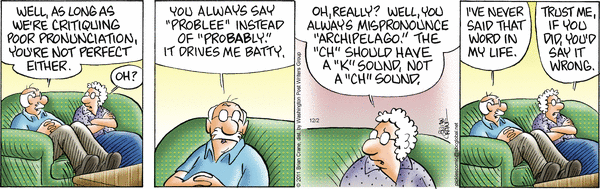
I Got Your Pronunciation Right Here… Waiting For You In Cholmondeley

I Got Your Pronunciation Right Here… Waiting For You In Cholmondeley

archipelago


A current political figure was recently roasted alive while appearing in Reno, Nevada, instructing a crowd of Nevadans that they incorrectly mispronounced the name of their state.  “Nuh- Vaahh – Dah”, he intoned, while an increasingly roiled crowd rejoined with active contempt, “Ne – Vah – Da”.

As a clueless singer once warbled, not understanding the fun of Cole Porter’s Lyrics, “You say potato, I say potato.  You say tomato,  I say tomato.  Potato, potato, tomato, tomato.  Let’s call the whole thing off.”

Pronunciation can get tricky and occasionally regional, as in the case of Nevada, Colorado, and Moscow, the location of the University of Idaho..  There is no “cow” in Moscow.

Just a bit farther northwest of Moscow, the largest city between Seattle and Minneapolis, Spokane, Washington is pronounced “Spo- Can” not “Spo- Cane”.  California offers the elegant San Diego oceanfront community, La Jolla, which is not “La Joll – A”, but “Lah- Hoya”, and the town used as the setting for Lost Horizans and countless western films, Ojai, is “Oh- Hi”, not “O-Jie”.

British place-names are notoriously idiosyncratic, defying all laws of reason and reasonablity.  The three that pop up fairly frequently are Magdalen (one of Oxford’s colleges), Marylebone (Sherlock Holmes’ neighborhood in London), and Cholmondeley (castle and garden in Cheshire).  So, Magdalen = Mawd-lin, Marylebone = Mar-Lee-bone, and Cholmondeley = Chumly.

As you had no doubt guessed.

That out of the way, let’s get to the meat and potatoes of this piece, no matter how you pronounce (or spell) potatoes.  I’m a self-confessed Snoot, particular about words, but it’s tough to know exactly how to pronounce words until the words are heard spoken aloud.  For example, we’ve swiped words from the French without permission or an instructional manual, so who really know what an American is supposed to do with “foyer”, “oeuvre”, or “haute couture”.  All sorts of words come leaping into common use from medicine, law, technology, and government as well, adding le mot juste (see?) but leaving us again vulnerable to Snoot shaming.

For many of us, it happens in our first semester at the Wow-You-Are-A-Smart-Coookie college of our choice.  We’ve done the reading; we’ve read the critical articles about the reading.  We have points aching to be spouted, the sorts of points that immediately establish a student as a force to be reckoned with and a potential academic luminary. We speak with cheerful force, looking about to see which heads nod in stunned admission of out brilliance, until,  from across the aisle or across the seminar table we see a languid  wave of forbearance. “I’m sure,” the quietly assured world traveller instructs us, “you mean to say …”, and we burn in silent shame, determined never to share an opinion in public again.

I read widely and a lot.  I read British mysteries, contemporary political journals, classic works of world literature, and countless biographies.  I knew words, but at second-hand.  Nobody I knew actually used words such as “hegemony”, “consummate” (the adjective, not the verb) , or “insouciant”.  Oddly, it never occurred to me that the words as I heard them in my head might not be correct.

Contextual reading had provided meaning, in most instances.  I could tell that consummate horsemanship meant really good at riding horses, and I sounded it out (in the brain) as “con-soo- mutt” whereas the cognoscenti used the pronunciation, “Kuh-n-suh-mitt”; down for the count with that one in Comp Lit 101.

Every slick historian I encountered in preparing for the freshman seminar in Comp Civ used the word “hegemony” to mean dominant power.  Happily I weighed in touting a nation’s “Hedge-a-mony”.  Hah!  “Do you mean “Hi-jem-uh-nee”?  Just shoot me.

I’m not even going to try to remember how I mangled “insouciant”.  Let’s just agree that my first year was essentially mangled beyond repair sometime before the second week of classes.

OK, there was one more humiliation waiting for this pretentious college freshman.  I had received a letter from my step-mother, asking how I had become so “hirsute”, which, of course, I took to mean spectacularly intelligent.  Made sense at the time.

I could have looked it up, but come on!  Why belabor the immediately obvious?  Had I one shred of humility or impulse toward self-preservation, I would have found out that hirsute means “hairy” or “shaggy” and was my stepmother’s way of suggesting I needed a haircut.

But, no.

Rebounding as only the young poseur could, I returned for the second semester with renewed chutzpah (don’t sound that out – separate post on Yiddish usage coming soon) and tossed the word pointedly into a heated discussion on absurdist drama.  “I don’t think Pirandello,” I bleated, “is as hirsute as the rest of you seem to feel.”

Yeah.

I survived the class because the prof thought I was being absurdist rather than knuckleheaded.  Points for me!

I confess that despite my comeuppances I am subject to involuntary Snootic response to some routinely mispronounced words, and, in the hope of saving the reader from the sort of pain I have brought upon myself – here they are:

Arc-tic not Ar-tic

Nuc-lee-ur not Nuc-yoo-lar

Ess-presso not Ex-presso

Lam- baste not Lam-bast

Cav-al-ree not Cal-va-ree (unless describing Biblical location)

Champ-at-the-bit not Chomp-at-the-bit

Or-i -ent not Or-i-ent-tate  – so dis-or-i-ented not dis-or-i-en-tated

And in a final burst of unsolicited Snootery –

To be objective is to be disinterested … to not give a rip is to be uninterested.  A referee should be disinterested but not uninterested.

A cache is a hiding place … cachet is superior status.  Gnomes may have some cachet as they maintain a cache of gold and jewels

Tenet is a belief held as true – a tenant rents an apartment.  ‘Never lose your deposit’, the tenet of most tenants.

Prostrate means face down – prostate is a gland near the bladder in males.  An exploding prostate caused the banker to fall prostrate on the gravel.

Tact describes a fine sense of what is appropriate – a tack is a sharp pin.  The diplomat showed little tact in using a tack to display offensive pictures of the dictator’s cat.

Libel describes defamation – liable can mean legally responsible or susceptible.  A journalist is liable when the victim of an untrue allegation alleges libel in the article.

A reader pores over material – an eater pouts milk on cereal – Poor Patti pores over her pores while pouring pears.

Averse means opposed to – adverse means unfavorable.  I am averse to adverse circumstances.

Something discrete is distinct – something discreet avoids attention.  Lazlo was discreet in identifying only six discrete instances of unlawful assault.

As a friend used to say, these are fun-facts to know and trade.  Pass them on, or file them away.

Forewarned is forearmed, but remember that to be forearmed is also to be smacked by a hulking attacker’s lower arm.

Maybe you don’t need to pass that along.


First Car Friday.  

First Car Friday.  


Every once in a while, I hear an idea that immediately fires the imagination and jump starts a trace of memory commanding enough to reach the surface.  I had not expected to find that sort of inspiration in the ordinary, every day work one of my children has been doing for about a year.  My liberally educated and very savvy son works as a social media consultant to a consortium of automobile dealerships, maintaining their websites, yelping as needed, relentlessly tweeting, and blogging, all efforts intended to build the prospective car buying public into a frenzy of anticipation as new models replace the old and as old models are in need of adoption.

Think about that for a moment.  He sits down every morning and writes about cars all day long, not the sort of subject that leaves room for much frivolity, wordplay, or invention, and yet, against all odds, he comes up with at least two or three concepts per day  capable of grabbing even the least motivated potential customer.  In the course of the year he has become familiar with makes and models, emerging trends, classic cars of the past, concept cars, muscle cars, electric cars, cars that float, cars that run on peanut oil,  cars modified to allow seven-foot NBA stars to drive from the back seat, cars that seat two, four, six, eight, twelve, and cars that never rust.

And the stories … cats in cars, soldiers in cars,  new mothers in cars, Ultimate Fighting champs in cars, adopted children in cars, holiday dinners in cars, proposals in cars, softball teams in cars, presidents in cars, zombies in cars, Girl Scouts in cars, stars in cars, tsars in cars … more heart-rending stories than a season of Oprah in cars.

And, in a fit of inspiration, First Car Friday.

Appealing to a broad audience, he threw open the gates of memory once a week.  Readers were invited to write in with a description of the first car they ever drove or owned.

Genius!  It’s not a subject that demands universal attention, but for those of us who have had a long-term meaningful relationship with a car, and you know who you are, he might as well have asked broken-hearted lovers to wallow in the most maudlin reminiscences of lost romance.

I intended to jump in with a rhapsodic description of the 1949 Willy’s Jeepster I drove for years both before and after the age at which a license might have been issued in the State of Connecticut.  I learned to drive by driving, first a tractor, then a truck, then the Jeepster, back when most enterprises were more casual.  And by casual, I mean driving a car that had no windows, no radio, and a heater that was essentially a hole in the floor.  Well, there actually were openings that could be called windows but no glass.  If the weather turned rugged, I could snap heavy plastic sheets into the frame of the doors and hope the hole in the floor heated quickly.  Rain and snow were challenging as the jeep’s wipers would not operate when the car accelerated, a function reportedly necessary to driving.

Late in the Jeepster’s life, somewhere around 1963, we tried to improve the fuel economy and performance by dropping medicinal balls into the gas tank.  We had been assured by an advertisement that these magical beans would add years to the life of the car.

They didn’t.

I don’t actually know what happened to the black Jeepster, one of two Jeepsters we owned.  Cars seemed to appear and disappear willy-nilly for a while.  A Plymouth Valiant with push-button transmission disappeared quickly, very quickly.  Volkswagen bugs, Karman Ghias, a Studebaker station wagon, a Ford Falcon, a Peugeot station wagon all pulled up at some point before I moved reluctantly on to quasi-adulthood and bought my first new car, a yellow Karman Ghia, then a Volkswagen camper, then another Karman Ghia, then a rusted-out BMW, then a Honda hatchback, then three Buck Le Sabres – two of which were stolen, one of which dropped off its axle on the way to The Empire Strikes Back – a Honda wagon, the first of three Volvos, a Honda civic, a Mazda hatchback, a Buick Skylark, a Volvo wagon, a Dodge conversion van, another Volvo, a Ford Taurus, three Plymouth Voyagers, a Honda Odyssey, and a Honda Accord.

See?  That’s what happens when you ask some of us about cars.

Observing the warmth of memory that enfolded me, the sweet, sad comfort in bringing old friends to mind (except the Honda and two Volvos that burst into flames and the Buick recovered from thieves who had left shreds of octopus in the back seat), I wondered if there were comparable exercises that might drag one down the dusty corridors of memory with equal satisfaction.

Sticking with the provocation  of “Firsts”, I’ve come up with three possibilities, to be tested as this post is read and considered.

First Pets?  First Job?  First Celebrity crush?

Surely the floodgates open as we remember that first pets, in my case a bulldog with the AKC name of Bernie’s Leatherneck Dan, known to us as Muscles.  He went the way of the Jeepster and as quickly as the Valiant.

There weren’t many jobs other than farming to be had in my world, and I did spend summers mowing and baling, picking shards of hay from my arms, legs, and neck.  My first “formal” job was peddling ( I can’t say selling) Fuller Brushes door-to-door, following by an equally unsuccsessful door-to-door career with the Collier’s Encyclopedia, which I could actually give away, if the fortunate recipient of my bounty bought the annual supplement year-after-year.  Very uplifting work.

As to celebrity crush?  No contest!

I saw Doris Day in By the Light of the Silvery Moon in 1953.  I was seven and on my first date, with Patty Gilbert, a classmate at the New Preston Elementary School (just a friend).  I liked Patty just fine, but Doris Day could sing, seemed really kind, smart, and spunky.  Since then, I’m now realizing, kind,smart, and spunky continued to pretty much set the standard from that point on.

First cars, first pets, first jobs, first celebrity crush – trot out one of these in an awkward moment of conversational impasse and see what you get.  If that doesn’t get things going, you are in a closed space with a creature with no soul … just saying.


Guess Who’s Coming To Dinner?

Guess Who’s Coming To Dinner?

My daughter has a gift for asking questions that are simultaneously amusing and provocative.  I won’t go into the full array, but I will confess that each one has caused me to think about myself and the world in very interesting and occasionally liberating ways.

Yesterday’s question was a variation of the “If you could invite anyone from anywhere in history to dinner, whom would you invite?”  Always good for conjecture, and indicative of the sort of host one might presume to be.

I love wit and loosely bridled merriment, so I’d be inclined to stack the list with pleasant souls and sparkling conversationalists.  The problem, of course, is that you won’t know which Abe Lincoln, Mark Twain, or Winston Churchill is going to show up; you might get the wryly humorous Lincoln or Twain, or their darker, despondent selves.  If Churchill has a snoot full when he arrives, buckle up your seat belts – it’s going to be a bumpy ride!

Similarly,  in the provocative mode, were I to seat Jesus next to Pat Robertson, what would they have to talk about?

Yesterday, however, my daughter challenged me to pick a movie whose cast would provide the best dinner table; she went one step further, adding that it could include anyone, living or dead.  I sputtered intelligently trying to obscure my pitiable response, then admitted that I would need quite a lot of time to work things out.  The same sorts of delicious or disastrous possibilities struck me immediately.

Based on his performance in The Wicker Man alone, I would love to see Nicholas Cage in confinement, but not exclusively by himself, as it might be more intense that I could handle at the dinner table.  I could choose Con Air, which would net me Nicholas Cage, John Cusack, and John Malkovich, or The Rock, bringing Cage and Sean Connery.  Cusack strikes me as affable and clever; Malkovich is every bit as fascinating as Cage, and probably as dangerous.  After all, it was Malkovich who said, “Some directors expect you to do everything; write, be producer, psychiatrist. Some just want you to die in a tragic accident during the shooting so they can get the insurance.”  So, there’s that.

Sean Connery, on the other hand … uh, better not use that phrase.  When interviewed, Connery boasted, “An open-handed slap is justified – if all other alternatives fail and there has been plenty of warning. If a woman is a bitch, or hysterical, or bloody-minded continually, then I’d do it.”  Not cool.

OK, so no Cage, Malkovich, or Connery.

The next ploy was to look at the films I’ve seen over and over, assuming the cast would make great company.  I am reluctant to share the list of films I have seen most often because there are some that are simply accidents of circumstance, including:

The 1960 version of The Time Machine, starring Rod Taylor, Alan Young, Yvette Mimieux, Sebastian Cabot, directed by George Pal – fifteen screenings at the USO in Charleston, South Carolina and aboard the USS Sellers DDG 11.  It was literally the only entertainment both ashore and on ship.  Maybe the conditions under which I lived my “life” colored my judgment, but it wasn’t half bad.  Did it get better with repetition?  Let’s put it this way; I’ve only seen it twice since then.  Yvette Mimieux was hot stuff in 1960 and Alan Young was abut to burst into the entertainment firmament with his role as Wilbur Post, straight man to Mr. Ed, the talking horse.  Rod Taylor was the box office draw, a less moody hunk than Rock Hudson, at his best in The Birds, to which I will refer before we’re done here.

Mighty Joe Young, made in 1949 as a follow-up to RKO’s blockbuster, King Kong.  Like King Kong, The Most Dangerous Game, and Top Hat, Mighty Joe Young was featured on WOR’s Million Dollar Movie, shown at least twice every day for a week and twice each afternoon on weekends before the evening shows. Kong scared the popcorn out of me, but Mighty Joe was a heartbreaker. I actually saw at least twenty films twice a day for a week, but Joe was the only one I watched through the ten times during the week and another six during the weekend; I think I had the flu, explaining why it all seems to float in delirium.

I did my graduate work on the films of Alfred Hitchcock, screening the same films again and again, which pulls Notorious, Shadow of a Doubt, North by Northwest, Psycho, The Birds, Marnie, and Frenzy into the top tally.  Notorious is a gem and a tempting choice because it gives me Cary Grant and Ingrid Bergman, both pretty intriguing people, but that’s just two, a dinner more intimate than I could manage.

By choice I have watched White Christmas at least sixty times and plan to watch it again this year.  I love the film, but Danny Kaye is the only star I have any interest in.  Sorry, Bing.  Bing also puts the kibosh on all the Road movies, which is a shame, because Bob Hope was quick witted and genial.  I’ve also seen Singin’ In The Rain many, many times, and always get a huge kick out of almost every scene, but it’s not a cast to spend an evening with, in the same way that Some Like It Hot is fabulous but promises an evening with Tony Curtis as well as with Marilyn Monroe, Jack Lemon, and Joe E. Brown.

No Tony Curtis.

It came down to this: Since I can’t get Mel Brooks and Robin Williams in the same cast, I hadda go with an ensemble, leaving me to choose between:

Ocean’s Eleven (both versions)

1960 – Frank Sinatra, Dean Martin, Sammy Davis, Jr., Joey Bishop, Angie Dickinson, Peter Lawford

2001 – George Clooney, Matt Damon, Andy Garcia, Julia Roberts, Casey Affleck, Elliot Gould, Bernie Mac, Carl Reiner, Don Cheadle

The Italian Job (both  versions) 1969 – Michael Caine, Noel Coward, Benny Hill

2003- Mark Wahlberg, Charlize Theron, Edward Norton, Jason Staham, Donald Sutherland

The Royal Tennenbaums – Danny Glover, Gene Hackman, Anjelica Houston, Bill Murray, Gwyneth Paltrow, Ben Stiller, Luke Wilson, Owen Wilson, Alec Baldwin (narrator)

The Grand Budapest Hotel – Ralph Fiennes, F. Murray Abraham, Adrien Brody, Wilem Dafoe, Jeff Goldblum, Harvey Keitel, Jude Law, Bill Murray, Edward Norton, Jason Schwartzman, Tilda Swinton, Owen Wilson

Tough choices, although the idea of sitting with Ralph Fiennes, Harvey Keitel, Wilem Dafoe, and Edward Norton is pretty heady stuff.

I haven’t cast my vote yet, in part because all these choices are appealing, but also because I can’t get over the Mel Brooks or Robin Williams table,and because the best raconteur at any table was Orson Welles, and because I want to see how large Tom Hardy’s neck really is, and because Kevin Spacey does impressions, and because I’m kind of obsessed with Keanu Reeves, and because, in the end, I need to see LA Confidential one more time to see what that cast might do at my dinner party, and because I also love Soapdish, and because Tropic Thunder does not get the respect it deserves, and because Magnolia never gets enough consideration, and because The Talented Mr. Ripley is the creepiest role Matt Damon ever played, and because nobody sees Tapeheads, and because I forgot about Kevin Kline, Meryl Streep, and Judy Dench.

This is how my daughter takes my brain hostage, and for that I am ever grateful.


Totally Gruntled And Funct

Totally Gruntled And Funct

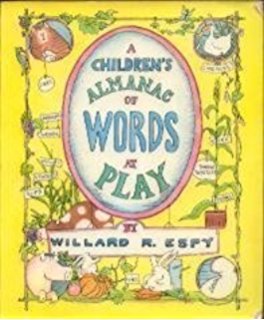
When my eldest son was in middle school, we found a vintage copy of Willard Espy’s Words At Play at the bottom of a pile of dusty books that had survived the 1970’s, long neglect,  and a hard life in unopened cartons across four moves .  The book  was chock full of acronyms, epigrams, spoonerisms, malapropisms, limericks, palindromes, riddles, puns, and poetry at play.

Things palindromic were of particular interest, from the simplest, “Madam, I’m Adam” to “A man, a plan, Panama,” and finally to “Marge let a moody baby doom a telegram”.  The idea of a computer program creating a sentence which can be read from front to back or back to front playing homage to “madam I’m Adam”, did not occur to us then, but the Director of Research at Google came up with one that has now expanded to 17,826 words.   “It begins with ““A man, a plan, a cameo, Zena, Bird, Mocha, Prowel, a rave, Uganda … and ends with “a wadna, Guevara, Lew, Orpah, Comdr, Ibanez, OEM, a canal, Panama!”  Probably more than any of us need to read.

The book became a nightly treat and may be at the root of my fascination with all things silly; it certainly gave me more than enough incentive to continue the hunt for oddities of language in everyday life (See postings : “Sang Froid, Schadenfreude, and Double Entendre”, Aug. 19, “Every Tom, Dick, and Harry”, July 21, “Words We Should Use And Words We Should Not”, May 26, “I’m Like Uh …”, April 29, and  “I Am Too Much A Snoot”, April 13.)

Espy was a wordsmith with a sense of the absurd and the gumption needed to track down odd words and odd uses of words; in his day, Espy was favorably compared to W. S. Sullivan, Ogden Nash, and Cole Porter.  Neither of us had realized that playing with words could be a vocation as well as an amusing habit that annoyed many people. In fact, the word vocation derives from the Latin vocatio”, a call or summons.  Espy put it more elegantly, ” words choose their lovers arbitrarily.”

Some are called to words more violently than others.  I once had a roommate who was offended that a teacher, “used so many words”; I didn’t know what to say without exhausting his daily quota.  On the other end of the spectrum, my cartoon  hero, Foghorn J. Leghorn, the bombastic rooster patrolling the Loony Tunes henhouse, always had a way with words, usually punctuated by his trademark space keeper, “I say … I say”.

After an accident has befallen him.  “Fortunately, I say, fortunately, I always carry a spare set of feather.”  Observing the vain attempts of a dog to win a battle of wits.  “I say, boy, you cover about as much territory as a flapper’s skirt, I say skirt.”  “I say, I say, that dog’s busier than a centipede, I say centipede, at a toe counting contest.”  The clarity of a Leghorn simile is perhaps best expressed in this oft repeated line from “Weasel While You Work”, “The snow, I say the snow, is so deep, you have to jack up the cows to milk ’em, I say milk ’em.”

All of the above is to prepare the reader for this week’s immersion in the nonsense that arrives with any examination of the words we use.

Let’s start with an obvious conundrum.  Why do flammable and inflammable mean the same thing?  All the other “in” words basically push the listener toward an opposite.  Insensitive is not sensitive; inert is not ert.

Wait.  There we go, exactly as I feared.  We’ve stumbled into the land of where-the-heck-does-that-come-from and why-does-it-continue-to-afflict-us?

It takes some digging, but the word inert is a composite of “in”, without or not, and “ars” or “artis”, as dinged by the French (zut) as “erte”, all meaning skill.  Which still leaves room for wonderment as “skill” is replaced by “energy” or “power” in the most common use of the word “inert”.

And so, the door is opened for the tsunami of words that have clear meaning with what seems a negative prefix (even when the word is not a negative word) but no meaning without the prefix.

disGRUNTLED, for example, is puzzling; disGUSTINGis not.

Though we don’t immediately think of “gustation” , the act of tasting, when the word “disgusting” is used, there’s little to confound us upon reflection.  Disgruntled, on the other hand, offers the possibility of “gruntled” or “gruntling”, which is a pleasure not to be ignored; it is a usage frequently appearing in the work of P.G. Wodehouse as Bertie Wooster is fond of describing the degree of gruntlement his companions have exhibited.

But, alas, the truth is less lovely, as is often the case.  We are accustomed to thinking of the prefix “dis” as meaning ‘opposite of’, whereas at one time it might also have meant “exceedingly” or “powerfully”.  So we’re off to a reasonable beginning here.  Then, the trick is to remember that it was once a practice to add “le” to a noun in order to make it a verb, as in “start” and “startle” or “spark” and “sparkle” .  Thus, “grunt”, generally an expression of displeasure is made into the verb “gruntle”, then amplified with the “dis” to express a great deal of displeasure.

The problem, of course, is that my “mind” immediately turns to “cat” and “cattle”, “rat” and “rattle”, “sad” and “saddle”, “tack” and “tackle”, “rank” and “rankle”, and on into a sleepless night.

Today, I am sorry to say, we no longer even go to that effort; we just take a noun and verb it.  “Interface” was a highly regarded verb for a short period; my hope is that it has gone back to its original happy state as a noun.  The obvious contemporary verbed nouns are “to google”, “to friend”, “to text”.  Don’t even think about it, do we?

As the title of this piece suggests, we still have to deal with “defunct”, as in “all over, dead-as-a-doornail,  finito,  kaput, fertig, really-most-sincerely-dead”.  We are troubled, n’est ce pas, with this funct business?  And yet, we sense that in this case, the “de” really does mean “not”, leaving us to work on the rest.

I know, you go to functional, as one might, but, you see, that inevitably takes us back to, “full of funct”, and dysfunctional then seeming to imply a paucity of funct.  We have to trek back to Latin once again for a word that was odd even in its day,  “functus” the past participle of “fungi” , to perform, to live”.

Ah hah!  The game is afoot.  “De-functusi”, “not perform, not move, not alive”.

Fans of functus/ fungi will immediately leap to an understanding of the word “fungible”, “to replace or to be interchangeable”… see, can “perform” as as the other?

Maybe not.

I’m grateful to  Willard Espy for his willingness to have fun with words and for his tacit encouragement of those of us who just like to horse around with language.

No “neigh” sayers out there?


Wait! Didn’t You Used To Be …

Wait!  Didn’t You Used To Be …

I just received a note from a friend who plans to attend hs 50th reunion at the boarding school we both attended.  I graduated a few years earlier than he, so I have already  missed that milestone, pleading distance, poverty, and committment to my responsibilities at home.

All of which was true… and yet.

Reunions are weird.

I guess they were slightly less weird when I was ten or twenty years out of college and still felt like a genially irresponsible, unformed energetic wunderkind.  At that point most of us still defined ourselves in terms of possibility, and familiar conditions and assumptions were still in place.  I had a reasonably thick head of hair, I could sit and stand without much grunting, and I was able to squeeze into the pair of pants I had been saving for the reunion without losing circulation in my legs.  I had been in touch with some classmates and looked forward to seeing how they had travelled life’s bumpy road.  Was I an unmitigated success?  Not yet, but the path still seemed clear.

At thirty years out, life had had its way with most of us.

We arrived with wives, or second wives, or with partners, or alone.  Some of us were in recovery; some of us were active in addiction or alcoholism.  A few had sent children on to our college; a few of us were terrified that our children had lost their way.  The most glittering stories of success were not necessarily those we had thought of as golden children; the most devastating failures seemed to have landed randomly.  Some of our number had died; a good number returned to campus having survived divorce, heart attack, stroke, cancer, and tragedy.

We were all looking back at fifty and wondering how many of us would not be back for the next reunion.

It was in this milestone year that I began to feel like one of the Lost Boys meeting the Pan who had aged.  If I squinted and concentrated on one feature, I could see the boy I knew as an awkward eighteen year old from West Virginia hiding in the sleek Dallas executive.  Overwhelmed by our transformations, I stood partially hidden in the college bookstore, site of reunion registration, trying to see if I could find something of myself in those returning from my era.

Some had aged well; they moved with brisk purpose, smiled easily, and fell back into familiar give and take with friends who seemed to have shared vacations in Sun Valley, Nantucket, Belize.  They stood in the Christmas card stance, wife and kids in tow, shining, careless, beautiful.

Others wore every year with grim determination, gray people, tight-lipped, deliberate, pausing before stepping to the curb, patting a hip pocket to make sure a wallet was secure.  Those with wives pointed to buildings and landscapes, offering a curt travelogue memory by memory.  Portly balding husbands bought ball caps, preening a bit, perhaps looking as I did for the trace of themselves that remained.

In my time, the college offered local boys scholarships, tugging them out of the small worlds in which they had prospered.  These had begun their time on campus with hesitant shyness, unfamiliar with the conventions of small college social niceties.  As they shone in the classroom or on fields, they  relaxed, found friendship, and claimed the place as their own.  Their families had applauded too loudly when their names were called at graduation; they turned quickly, willing their families invisible. Many had thickened in the years since graduation, arriving with wives suspicious of this precious place.  They appeared lost once again, looking about themselves as if to wonder who the person was who had once walked this campus so assuredly.  They struck up conversations with teammates, quickly exhausting memories of Saturday afternoons in October when all seemed possible.  Standing then, they clumsily disengaged, assuring each other that they would certainly call the next time they got to San Francisco.

I left early.

Last spring, however, the a cappella group I had started as a sophomore celebrated a 50th anniversary.  Over the years, many in my generation had lived relatively near each other, celebrating New Year’s Eve by landing with family at the home of one of the singers, almost all of whom lived on the East Coast.  They sang some of the old songs, particularly the ones that had been included on the albums; the less polished numbers were harder to recall.  Decade by decade the tradition of a cappella singing had been kept alive as newly auditioned recruits replaced the older groups, allowing us at the 25, 30, and 40  year marks to stage concerts in which current students, recent graduates, and vintage relics from the early days joined together to sing the songs we had learned in common.

Healthy competition among the decades inspired us to master new music as well, learning our parts at a distance, at first with cassettes, then with CDs, and then with mp3s.  The ramp-up to the 50th pulled most of us back into the group’s orbit, even those of us whose journey had taken us far from our roots.  I had recently retired, had no meaningful commitments to speak of, and missed both camaraderie and music.  Yes, distance was still an issue; travel from Oregon always involved several stops and at least a day in travel each way.

But singing our signature songs with close to a hundred men, some of whom are eighteen year old freshmen and one at least a seventy-three year old graduate, is magical, and 50th anniversaries only come around once.  Pushing my reunion allergy aside, I booked the flight and started to learn the baritone part to three songs that were entirely new to me.

Here’s the thing.  The nervous energy surrounding the preparation for the concert, and the shared risk taken on by, well, all of us, made the days on campus entirely purposeful. This was a celebration and authentic, not a reunion, which is, by its very nature, contrived.

A reunion calls each individual to the individual experience; we slip into the selves that we were, or we desert the selves that we were.  We compete, measure ourselves against our classmates; we covet or pity.  Friendships restored once a decade wear thin.

I had missed the particular pleasure I found in rehearsals, joking when we slipped off-key and puffing with pride when we pulled a new piece into shape, a friend of fifty years on my left, a recent grad on my right – just about as good as it gets.

The concert went well enough.  Some of the decade groups were remarkably good; ours was not.  The first number was solid, but we coughed up a hairball on one of our standards and limped through the last piece with enough dignity to leave the stage with some vestige of honor.  We sat and listened and saw our legacy before us.  Just about as good as it gets.

I’ll go to the next reunion, my class’ 50th in 2018, assuming I’m around and able.  There’s a chance I’ll hide in the bookstore for a while, but I’m eager to find out how other lives have gone.

When I was young, I’d be dragged here and there and always asked the same question:  “Will kids my age be there?”

Chances are, most of the folks at my 50th will be my age.


kksfw1636mfa