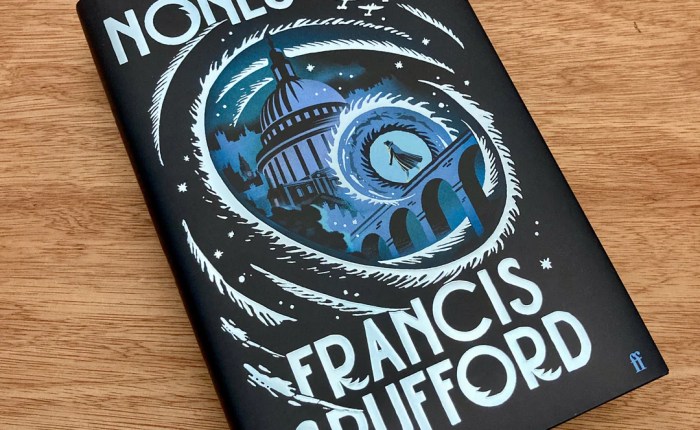
The novel is difficult to describe in that it presents an unlikely and compelling portrait of one woman’s attempt to prevent black shirted British fascists from summoning primordial power in order to reorder time and human history as the Blitz begins in wartime Britain, balancing apocalyptic celestial intervention with a convincing human narrative.
It’s a lot to contend with for any central character and a heck of a read.
I heard the author, Francis Spufford, interviewed, and thought I’d probably like a book by a fan of Britain’s Inklings, a writer in the mode of C.S. Lewis with a bone to pick with the author who abandoned one of Narnia’s first explorers, Susan Pavensi, “…no longer a friend of Narnia”, absented from the Last Battle because “…she’s interested in nothing now-a-days except nylons, and lipstick, and invitations.”
Iris Hawkins, Nonesuch’s central character, is smart, ambitious, and absolutely cares about nylons, lipstick, invitations, and lots of sex, and she’s at the heart of this version of Britain’s last battle.
Without getting into the transcendental geometry/geography of this cross-dimensional warscape, Iris has a moment away from combat on Christmas Eve in 1940 as she walks through rubble to The Old Church on the Thames embankment. The description of that experience managed to take me out of my daily descent into weltschmerz and grinding pessimism about the future. I thought it might be of use to other similarly bruised souls as the degradation of democracy and decency continues without pause.
The church is silent and crowded. Crammed into pews are the wealthy, the titled, officers and enlisted men, shopkeepers, cleaners, bohemians with shaggy hair, railway workers, secretaries.
“Kinds of people not usually crowded together, but commonly marked now, if you looked closely in the candlelight, with the strain of the last months… the retired general with skin as rough and gray with fatigue as the meat porter’s. The common flesh declared itself, and for once the different clothes looked more like costumes, all of them looser and worse-fitting than they had been before, picked arbitrarily off the rack and flung to the first person who caught them. Who’ll be the general tonight? Who’ll be the dustman? Who’ll be the duchess?”
“Smiles between strangers, an awkward good will. A speculative suspicion traveling from eye to eye, that there might be some other way altogether, some essential and unaccustomed way, of seeing these rivalrous animals you stood among, this rivalrous animal that you were yourself. Some other thing they all were, or might be, if you could but know it.”
A rag-tag choir, spinsters, young officers, a leonine bass, a few boy choristers sing In The Bleak Midwinter. Iris weeps as she hears the stanza:
What can I give Him,
Poor as I am?
If I were a shepard,
I would give a lamb.
If I were a wise man,
I would know my part,
Yet what can I give Him-
I must give my heart.
She wonders as she cries, not for the old story of the baby in the manger, at least not directly.
“It was something about a new beginning in a bad time, in a hard winter. A tender thing, a delicate thing, had just come into the world …The robes on the vicar and the choir, the midnight-best outfits of the posh congregation and the less posh congregation – all of it would rip and burn, or if it lasted through the war would fade and tatter, undone by time as thoroughly in the end as it would have been by blast or flames.”
In the moment, they were putting their faith in promises they didn’t know could be kept. Promises with no guarantee of safety, or of happy endings, any more than there was a happy ending for the baby in the manger. And yet they were trying to trust them anyway.”
“We’re breakable and our walls might as well be made of glass. Anything might happen. Moment to moment, anything at all. But by now, she thought, glancing at the faces, everyone here knew that. This was hope not delusion.
They were singing the walls up, that was what they were doing. They were making a shelter with their voices, by candlelight, in which vulnerable things, innocent things, new things could at least be hoped for. No guarantees.”
I’m afraid that vulnerable things, innocent things have been lost in the last year, that there were far fewer guarantees than I had believed, but for a few moments, lost in a book, I remembered what hope felt like and I remembered the conviction that rivalrous animals might be something other than the creatures we have become in this, our time of testing.

