Finally!

Finally!

I’ll admit that something in me had broken, that two hours of reading waiting room magazines had left me not simply groggy but impaired.  My speech was thick, my step uncertain; I tried to rouse myself from stupor as my wife emerged from her appointment.  I rose uncertainly, grunting in what I hoped was a supportive manner, holding the last magazine I had found, an issue of People devoted to fashion, pointing clumsily at a photo that filled half a page.

My wife is a photographer.  A really good photographer.  I am sure she thought that I found the picture magnificent or inspiring.  She would have been mistaken.  The page shone with the image of a glistening model languishing above two small paper towels, one stretched to its full length, the other slyly folded on an angle.  I shook the page with purposeful energy; she nodded, and asked me to smile, that being one of the demands a first responder is expected to ask the victim of a stroke.  I swatted the magazine again, unable to put my thoughts into words.

My wife nodded.  “I see.  Two towels.  What about them?”

The ‘what’ of this exchange was a full-page ad for self-tanning towelettes.

Let’s start with the self-tanning piece first.  The product advertised was the L’Oreal Sublime Bronze Towlette, a product offered at fine stores and equally fine web-sites everywhere.

Convenient and easy to use, these Sublime Bronze Towelettes for Body create a streak-free, natural looking tan. With enough self-tanner for one application, each towelette is perfect for at home or on the go. Made with Vitamin E and gentle AHAs (alpha hydroxy acid derivatives) to provide a beautiful, 100 percent natural-looking tan and ultra-smooth skin.

First of all, any tan is a self tan.  OK, I guess you could tan someone else, as in “tanning a hide”, but with the exception of Buffalo Bill, the character introduced in Silence of the Lambs, you don’t see much of that anymore.  “It puts the tanning towelette on itself…”?

Then, one might think each towelette is chock full of more than an adequate dose of  bronze tanning substance, but the ad only cagily suggests that each towlette has enough self-tanner for one application.  No real guarantee there, as who knows how many applications of  towlette tanning juice one might need in order to achieve the tan and ultra-smooth skin the bronzed model appears to have realized with one swipe of this streak-free stuff.

L’Oreal itself has some explaining to do.  Back in 1907 when an enterprising Alsatian chemist came up with super snappy hair dye, he named it after a popular style of hairdo, approximately a “halo”.  L’Auréale, nom inspiré d’une coiffure de l’époque arborée par les femmes : l’auréole. No stone left unturned in this relentless search for truth in  tanning.  The company can’t even spell its own name correctly; how is one meant to trust them to tan with one application?

The good news is that L’Oreal (cough) is not the only source of self-tanning supplies.  The thoughtful shopper can choose from – Fake Bake Flawless, Tan Physics True Color, San Tropez Self Tan Bronzing Mousse, or the Maui Babe Browning Lotion.  To be sure, these products are not tan-infused towelettes; the San Tropez Tan Mousse, for example, goes on with the help of the San Tropez Applicator Mitt.

In the towelette section of the bronzing aisle, the choices include the Tan Towel Self-Tan Towelette (Classic 10 Count), the Tart Brazilliance Skin Rejuvenating Maracuja (Paraguayan passion fruit) Self Tanning Face Towelettes, and the Helios Full Body Tanning Towel.

The choice is up to you.  Applicator mitt or full body tanning towel?

To add ignorance to injury, I hadn’t known that products known as towelettes existed. I suppose one could make almost any noun smaller with the flourish of an “ette”.  Kitchenettes, vignettes, majorettes, dinettes, roulettes, brunettes, luncheonettes, coquettes, sure, even baguettes, assuming that the classic French comestible was not actually a small bag?  What else had I missed?  Are small owls, I wondered, known as owelettes?  No, those are owlets, single “t”.   A band of tiny dominatrices known as dominettes?  Probably not.

Side note before retiring from the universe of self-tanning agents:  “Brazilliance” may be the best new word to emerge in decades.  Pass it on.

.

Survival is Insufficient

Survival is Insufficient

I need a little literary throat clearing in order to put this idea into play, because as is often the case, something I’ve read set off a confusing chain of associations that called for further reflection, and, if I’m lucky, a slight shift in my habitual thoughts about the world, life, the future, mankind, existence, etc.  I don’t like to think of my mental life as habitual, but whatever mentation is, it appears to dive fairly easily into some fairly rigidly engineered constructions.  So, when something jars me a bit, I try to summon some gratitude, as I did in reading Station Eleven by Emily St. John Mandel.

Station Eleven presents a not-very-far-in-the-future apocalyptic narrative, neatly alternating relatively ordinary events in the lives of the contemporary characters before the plague that obliterates most of the world’s population with the foreshortened and dangerous lives they lead post-disaster as a small band of survivors about twenty years after the end of life as they knew it. There is no rhyme or reason to survival of the plague.  Passengers on one flight miss infection and live to form a new community huddling in the remnants of the airport; another plane filled with passengers already infected sits on the same tarmac, diseased bodies decomposing in the locked cabins.  In the course of a week, the age of technology ends; electricity, for example, becomes a thing of the past.  The small bands of survivors scavenge as they can, looting stores and homes until, by the sixth or seventh year, they live in quasi-tribal settlements amid the ruins, hunting,  gathering, and stockpiling weapons to protect themselves in a world that is without the rule of law.

All pretty much the apocalyptic fare exceedingly well written, but there are two additional elements that make the novel uncommonly arresting.

The first is that twenty  years on, those who were children have but dim memory of the world as it was; they cling to tales told by older survivors, barely recalling what it was to have enjoyed television and comic books.  Older survivors essentially live in the ruins of the world they knew, simultaneously wistful in remembering simple pleasures – bagels, coffee, bananas – and saddened in recognizing that they had taken so much for granted.

The second is that a multi-generation band of actors, musicians, and artists travel from settlement to settlement performing Shakespeare’s plays.  Like the performers and lecturers who travelled the  Chautauqua Circuit, these survivors believe that art, beauty, and Shakespeare are necessary to life, even in perilous circumstance, and travel through this world is one perilous circumstance after another.  Some members of the company have fought for their lives; they commemorate the necessary death of their assailant by placing a tattoo of a knife after each kill.  This is a landscape red in tooth and claw, and yet, one of the actors also has a tattoo that reads, “Survival is insufficient”.

That character believes he has recalled a line from Star Trek, and he has come close.  In the third season, “The Hunted”,  an exchange between Prime Minister Nayrock and Roga Danar might have become heated, were Roga Danar, the mutated super warrior, actually capable of heat.  Relentless slaughter, that he can pull off; conversation, not his strong suit.  In any case, not unreasonably, Nayrock has plans to send Danar to the settlement known as Lunar V.  Danar thinks this a poor idea.

Nayrock:  You were programmed to survive.  You can survive at the Lunar V Settlement.

Roga Danar:  To survive is not enough.  To simply exist … is not enough

OK, first time I’ve quoted Star Trek.  May be the last.  With regard to Station Eleven, however, it is quasi-poignant that this particular nugget survives as one of the few cultural landmarks placed next to King Lear, and it is difficult to think of another piece of apocalyptica that presents a credo as a legacy of an earlier age.

The statement has weight in the context of a world in which the amenities we take for granted have been lost, and it pulled me way back to one of the hundreds of unassigned books I read when I might have been actually participating in what my college believed to be formal education.  The book was Homo Ludens, by Dutch cultural historian, Johan Huizinga, an author I knew well as two of his earlier books, The Waning of the Middle Ages and Erasmus, were among the assigned books I actually read.  Huizinga’s thesis in Homo Ludens has some punch.  “Play is older than culture, for culture, however inadequately defined, always presupposes human society, and animals have not waited for man to teach them their playing.”

Got it.  Even animals (other animals) play. it seems that simple survival is not sufficient.

Huizinga took me down an altogether different and rocky path as he went along, noting that while many significant terms passed into the Romance languages, ludens and  ludere were not among them.  He had much to say about play and contest as what he called civilizing functions, but I was back in my language hut again, trying to figure out why words leave a culture and what meaning language has in the essential characteristics of a culture.

So, commonly used phrases, “getting by”, “hanging in there”, “killing time” seem dangerously close to statements of simple existence, which is, as we now know, insufficient in a culture.

We don’t have to be a noted Dutch historian to figure out that play, and friendship, and beauty, and humor allow us at least as much sustenance as dolphins and Roga Danar seek.  I understand that tough times do demand that we hunker down to some extent, but whether we quote Hamlet or watch Survivor (and I do both), we need to live broadly, way beyond survival.


No Hugging, No Learning

No Hugging, No Learning

When I retired, I put together a list of fifty novels I intended to read, each of which was critically acclaimed and each of which I had missed during my working years.  No real surprises on the list; One Hundred Years of Solitude has been glowering at me from the bookcase for more than a decade, and I’ve started Infinite Jest at least six times.  Meanwhile, however, lists be damned; my reading has been completely undisciplined, and the unread pile next to my bed has become an obelisk, I don’t recognize half of the titles I’ve downloaded on my Kindle, and I still haven’t read Infinite Jest.

This piece actually begins in response to the last three books I recently picked up, none of which were on  the list, and none of which I will finish. My willingness to drop a book quickly or at the midpoint interests my eldest son who is a punctilious reader; he sees every book to the end, no matter how annoyed he is by the subject, the author, or the genre.  I admire him and his grit, but I now have a list of thirty-eight books to get out of the way and can’t dally with books that don’t capture my heart and soul.  That being said, in  an attempt to be polite to folks pressing favorite books on me, in the last two days I have been reading The Language of Flowers by Vanessa Diffenbaugh, The Little Paris Bookshop by Nina George, and Seinfeldia: How a Show About Nothing Changed Everything.

I stuck with Seinfeldia for a good while with particular interest in how a show about nothing invaded the situation comedy universe, and, I have to admit, with sustained wonder that anyone as crusty as Larry David could stay in a room long enough to sign a contract.  “No hugging, no learning”, was the phrase used by Seinfeld and David to describe the character of their work together, a compressed reminder that sentimentality had no place in Seinfeld’s world.  As I think about the nine seasons, it strikes me that it also describes stasis; the characters don’t learn from their disastrous failures of judgment, don’t become closer, don’t grow.  I have to admit that much of my guilty pleasure in watching the show is in knowing that I am going to see self-involvement bordering on callous disregard for others, no matter how obviously a situation demands compassion.  I’d be more embarrassed by my heartless amusement were the show not in constant syndication, viewed by millions daily, available around the clock, only surpassed in hours-per-screen by Judge Judy and Kickin’ It With Byron Allen.

I am actually quite ok with hugs and with learning, with development of character, and with declarations of emotion unless they devolve into hyper-sentimentalized bathos (Hello, Elizabeth Berg).  The central character in The Language of Flowers, however, has a profound allergy to emotion and human connection, having been shuffled through a succession of foster homes.  Unaccountably, she does have an extraordinary connection with flowers, not simply enjoying their shape, fragrance, color, but sensing the emotional energy that each specimen projects.  As an assistant to a kind florist, she understands the deepest longings of a few special customers and provides them with the flowers that (almost literally) speak to their needs.  She understands, for example, that the shy woman whose request is halting and obscure is in need of passion, presenting her with a bouquet of jonquils (Narcissus jonquilla), blooms representing desire.  It’s not so much that particular flowers have power as that they make their meaning palpable to those sensitive to their language.

In the 19th Century, floriography flourished, as it were, as a sort of cryptological message board.  Romantic swains sent bouquets as coded declarations, assuming that the recipient would know that Heliotrope meant devoted affection and that purple Hyacinth asked for forgiveness.  Characters in the novel can’t summon words to express emotions they themselves do not understand, but they find the language of flowers communicates exactly what they mean to express.  I’m interested in the difference between symbolism, in which an object represents concepts and experiences, and language, which is a formal system of signs.  Not sure where the language of flowers lands.

A rose is a rose is a rose, but in the language of flowers, an orange rose signifies fascination while a yellow rose signifies infidelity.  Each of the roses is an object, but each is also specific in its essence, and so both sign and meaning.  It is not surprising then that some of the most evocative moments in Shakespeare’s works arrive in the language of flowers.  Ophelia’s descent into madness in Hamlet is made most tangible as she catalogues the various imaginary bouquets she presents to Gertrude, Claudius, and her brother, Laertes.

There’s rosemary, that’s for remembrance; pray love remember: and there is pansies.  That’s for thoughts.

A lovely passage in A Midsummer Night’s Dream is Oberon’s rhapsody as he prepares to enchant Titania:

I know a bank where the wild thyme blows, where oxlips and the nodding violet grows, quite over-canopied with luscious woodbine, with sweet musk-roses and eglantine.

Ophelia, Oberon, and the central character in The Language of Flowers all seem to know what authority each particular flower possesses.  A similar presumption pops up in The Little Paris Bookshop, which I am so far still (barely) reading in what I hope is a translation from the original German novel, Das Lavenderzimmer (The Lavender Room).  Monsieur Perdu owns a bookshop on a barge, floating in the Seine, from which he matches books and customers.  He has lost (perdu) the love of his life and has retreated almost entirely into books, which like flowers, apparently speak more profoundly to deepest longing than can words.  He calls himself a literary apothecary, prescribing the book that can mend a shattered heart.

Early in the novel Monsieur Perdu has a customer, a woman weeping, and attempts to press upon her the book he thinks she needs rather than the vapid Romance she thinks she wants.

“It’s your choice, Madame!  You can leave and spit on me.  Or you can spare yourself hours of torture starting right now.”

Clearly, he feels strongly about her choice of reading matter, but in his own profound loss, speech has become less authentically communicative than his understanding of the power his books present.

Perdue confesses, “…sometimes it feels as if I am sewed up in my own skin, as if I’m living in an invisible box that keeps me in and everyone else out.  In such moments, even my own voice strikes me as superfluous.”

So, what have these two quasi-romantic novels have to do with Seinfeldia?

Ahem, let’s just say that emotions are often tricky, and that we rarely find words that carry the meaning of those emotions, in, part because we don’t ourselves know ourselves.  Like the unfortunate Monsieur Perdu, we may be sewed up in our own skin.

Seinfeld’s characters amuse themselves (and me) by noting the peculiarity of others, cataloging foibles, dismissing earnest endeavors, reacting to a world they observe in minute detail.  Allowed no hugging or learning, they remain slightly nettled but determinedly superficial, living from syndicated episode to episode with little expectation of love or loss.  My newly found florist and bookseller are truly broken, but in books and flowers, they attempt to escape self-imposed captivity.

I do not speak the language of flowers; I do find restorative refuge in books.  My own writing is full of frippery and playful digression, hardly the stuff of restorative refuge for anyone else; I amuse myself, but also clear my thinking a bit.  In reading the remaining thirty-eight books on my retirement must-read list, I hope I’ll be provoked and prodded, nudged into thinking, swept into feeling.

If I can just stay away from friends with books I really don’t need to read.


Rat King Dot Com

Rat King Dot Com

My wife does not fool around.  She spots something that needs doing, takes a deep breath, and gets on Google.  Lots of folks here in town offer advice, but she knows there are experts out there in the Googleverse poised to deliver the precise information she needs to get the job done right.

For example, we had rats in the attic.

Unacceptable to be sure, but hardly a topic I wanted to discuss at length.  My hope was that they would tire of scooting through the rafters, eating insulation and wiring, and head back out in search of more appropriate rat chow.  You know, take care of this on their own, without our having to jump in with corrective measures.

Live and Let Live, that’s my motto, especially when it comes to climbing into a dark space currently inhabited by rats of some size, and  I knew they were sizable rats because even a novice student of rodent behavior knows the difference between skittering (mice) and thumping (rats of some size).

Here’s the thing – once you know you have rats in the attic, you pretty much can’t un-know that rats of some size are up there doing profoundly rattish things under cover of darkness.  The thumping was intermittent, then constant, then accompanied by a sort of sloshing, leaving no doubt that uninhibited predation was taking place up there.  For all we knew, rats were stacking corpses like fire wood, and once the aroma of decomposing whatever-it-was up there seeped into the walls, it would be tougher to eliminate than the predators themselves.

Next stop, obviously, Google.

Try it.  Type in “rat extermination”, skip past the many outfits and enterprises happy to bring in extermination experts, and continue until you see Ratcontroltricks.com where Jeff R. Morrison provides more information about do-it-yourself ratting than you might have thought possible.

“Social media,” he advises, “is one of the easiest ways for us to keep you updated with the latest news in the rodent control world!”

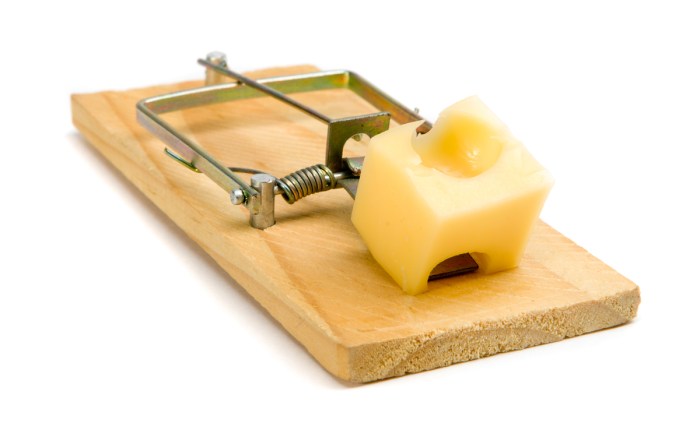
I can’t begin to describe the many fast-breaking stories emerging from the rodent control world, but I will pass on an observation that struck me as humane.  Rodent controllers use a curious phrase to describe the rat’s sensory sensibilities; apparently, the rat is directed by what they term “essential oils”, by which I take it they mean those elements in the rat’s world that are appropriate and comforting to the rat.  These essential oils are all over the ratscape, and the intrusion of foreign … oils … as introduced when plopping down the waiting jaws of the rat trap, give notice to the rat that he would be well served to stay away from the unfamiliar aroma and device.

Foiled again!

Confounded, when all else fails, the do-it-yourself rat battler can slap that bad boy in the whiskers with an assault upon the essential oils themselves.  Dipping rags in ammonia, draping the rags throughout the rat kingdom, renewing the ammonia bath for several days seems to so offend even the sulkiest of rodents that they pack up their belongings and hit the road.

MIssion accomplished.  Maybe.  We hope.

But now, the time has come to search for ammonia-stench-dot-com in the hope of allowing our own essential oils to resume their rightful place in the home we choose not to share with sloshing fat rodents.  I’m actually not anxious to get into social media conversations about odor, so if anyone has advice to offer, please feel free to jump right in.


Unclaimed Baggage

Unclaimed Baggage


It could be worse. I could be … well … I’ll leave the variety of unsavory addictions off the table and admit that this thrift shopping thing can occasionally get out of hand.  I’d like to present myself as merely frugal, but the trail of thrift stores I’ve left in my wake presents a different picture.  My dream vacation would include my favorite Junior League Shops – Michigan (Birmingham, Grosse Pointe), Pennsylvania (Ardmore, Lancaster, and the Hospital Benefit in Bryn Mawr),  Connecticut (Darien, Westport, Hartford), California (San Francisco, Claremont, Pasadena), New York (Long Island -Roslyn), Illinois (Evanston), Tennessee (Memphis), Maryland (Baltimore), and Texas (Dallas).  I’d need to stop in to see what’s happening at Keezer’s on River Street in Cambridge, slightly pricier than some but a sure thing when it comes to men’s wear.

Side note:  It is cheaper to buy a quality vintage tuxedo (and who doesn’t want a vintage tuxedo?) than to rent one.  At Keezer’s, a used tux (jacket and pants) is about $65.00.  At the Hospice Unique Boutique in Ashland, Oregon (where I volunteer), a Brooks Brothers Tuxedo will set you back about $25.00.  Similarly, touting the bargains at the HUB, a gorgeous bridal gown goes for less that $50.00.

But wait!  There’s more!

Churches (St. Alban’s  and Christ Church in D.C), Hospitals, etc. (Greenwich Hospital Auxiliary in CT, American Cancer Discovery Shops in Sunnyvale and Menlo Park, CA. St. Stephen’s in Armonk, NY), Friends of Pets (Animal Aid in Tulsa), Schools (Town School in San Francisco, Ann Arbor PTO MI) – all operate thrift stores that are NOT consignment shops, NOT junk shops, NOT grimy, stale, and high-priced.

The trick is to find a neighborhood with the right demographic; for me, the right demographic includes well dressed men whose widows clean out closets in one fell swoop.  College towns are great as profs generally dress reasonably well and apparently retire nearby and leave a full closet when they pass into the great mystery.  The St. Vincent De Paul Thrift Shop adjacent to the University of California at Santa Barbara was a gold mine; I would regularly tote home togs from Brooks Brothers, J Press, and Ralph Lauren, never spending more than $5.00 for a shirt or $12.00 for a suit.

All of which leads to the topic of today’s reflection:  The Unclaimed Baggage Store In Scottsboro, Alabama.

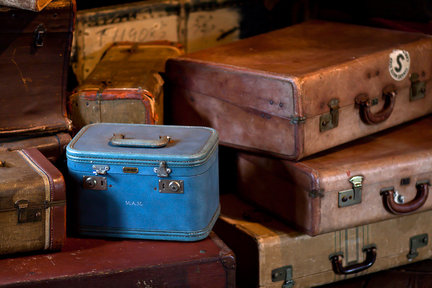
Scottsboro is a small city about forty miles from Huntsville, generally not on the beaten path for most tourists, at least until Doyle Owens began driving to airports and picking up unclaimed baggage.  Today the shop occupies more than a city block and welcomes more than a million visitors each year.  I expected to see a lot of umbrellas and rain coats, which were plentiful, and some clothing, and luggage.  I did not expect to see a mountain of electronic devices, from Ipods and headphones to laptops and amplifiers.  One room is filled with sporting goods – skis, snowshoes, skate boards, surf boards, golf clubs, tennis racquets, basketballs, bowling balls, lawn darts, catchers’ masks. The music room is a treasure trove of guitars, French horns, keyboards, drums, maracas, synthesizers, trumpets, oboes, violins, harmonicas, accordions, bagpipes (which worked out well for the guy who bought the tartan kilt in the menswear section) .

There have been some big-deal finds along the way, including a Versace gown, diamond rings, Rolex watches, moose antlers, a suit of armor, and a Vegas showgirl’s outfit.  Once a day, a customer gets to open a suitcase to see what treasures might hide beneath the pajamas and sweat shirts.  Too often, a traveller has failed to claim the bag filled with cheese from the Netherlands or bratwurst from Germany.

It’s exciting, but …

What comes to mind now, at a distance from hubbub in Scottsboro, is the cumulative distress of millions of travellers separated from cherished belongings.  At some time most of us have experienced the frenzy of baggage wars, shoved from our post at the conveyor belt by a heavier, more aggressive passenger.  Some of us have watched bags go by, round after round, hoping that ours will finally appear, only to stand alone as the belt carries a sadly wrapped carton for one more lap.  We wait for days, hoing the airline will call with good news, but, no.

Like the some cherished dreams, our suitcase fails to materialize.  It’s gone; we will never see it again.

As a teacher working on expressive writing with sophomores in high school, I set aside a ready supply of prompts, designed to bounce self-conscious writers into action.  Most called for well crafted essays; a few elicited lists.  The idea was that something on the list might be useful in writing a longer piece, but the list itself could also be an effective narrative, association and elipses suggesting the writer’s sensibility.

“What I Have Lost” usually brought significant pangs of memory:

A baseball glove

My lucky silver dollar

Trust

A letter from my father

Belief in Santa Claus, the Tooth Fairy, the political system, marriage …. and so on.


It’s a useful exercise, and it works as an antidote to writer’s block.

“Unclaimed Baggage”, however, is a prompt I did not, and do not, toss around lightly.  The two lists travel on the same journey; our stories in some ways are all about what we cling to and what we let go.  I hear a lot about letting go, and the notion appears to play a significant role in approaching confluence with the universe; it’s pretty much what the Buddha advised, and it worked for him.

He knew that the problem was attachment; from what I can tell, it still is.

Here’s the question that arrives with our unclaimed baggage prompt:  What is it exactly that is stuffed in the corner or under the tarp? Why do I continue to make room for it?  What am I hanging on to, and why am I hanging on to it?

So, the questions, it seems, begin the process of claiming.  “Yes, that’s mine, the scruffy one in the corner.”  Once seen,  we can haul it out and make some us of it, or … leave it in the corner, double up the tarp and try to forget all about it…

or, send it to Scottsboro and let someone else take it home.


What You May Not Know About Groundhog Day

What You May Not Know About Groundhog Day

Really?  Groundhog Day again?  Didn’t they do that last year?

They did, and they’ve been doing it in Punxsutawney, Pennsylvania since 1887, home of Punxsutawney Phil, the official meteorological seer,or at the very least, one of a small number of marmots licensed to predict the end of winter.  Marmot sounds impressive; ground squirrel a bit less formidable.  Our friend the groundhog (marmota monax) is also known as a woodchuck, of course, and, less frequently, as a whistle pig.

Although not a pig, this hefty rodent can weigh in at up to nine or ten pounds, which for a whistling rodent is plenty hefty.  Marmota Monax is not the largest rodent; that honor belongs to the capybara, a South American rodent closely related to the guinea pig in shape and general affect, but toting up to two hundred pounds of herbivorous contentment.  Your North American beaver is the next chunkiest rodent, a mere sylph in comparison to the capybara, but still an impressive creature weighing up to seventy pounds.

Traditional observation of Groundhog Day elevates the emergence of the prognosticating rodent as a means of determining the length of winter left to be endured.  If the groundhog sees its shadow, we’re in for a good six weeks of winter.  No shadow, spring is due in about six weeks.

So, putting the prediction to the test, the shadowy six weeks of winter from February 2nd takes us to the end of the second week of March; the unshadowed performance takes us to the middle of March.

Potatoes/potatoes, pajamas/pajamas. (Doesn’t really work in print, does it?)

There are a number of controversies surrounding the groundhog, starting with nomenclature.  Why would the same creature have six or seven names?  The mountain lion/cougar/catamount debate is largely regional; go trotting out to see what ravening herbivore has cleaned out the vegetable patch and you’ll be looking at the work of the groundhog, woodchuck, chuck, wood-shock, groundpig, whistle pig, thickwood badger, monax, moonack, weenusck, or red monk.  That’s bad enough, but its spawn may be called kits or alternatively, chucklings, which, I have to admit,  is a pretty nifty term.

These rodents are among the most effective burrowing creatures, moving as much as six hundred pounds of earth in digging out their meadow retreat.  These burrows are so soundly excavated that entire sections of field sink; the foundations of buildings have been literally undermined as the marmots slap out another burrow.  They are also a snippy rodent, rarely cohabitating in that beautifully crafted earthen home.  Despite their cheerful appearance, the groundhog/ woodchuck/whistle pig is aggressive, feisty, and generally not the sort of creature you want to engage in hand to curved claw combat.

I was prepared to leave the down-side of groundhog collecting with those observations.  The deliberations of the Linnean Society of New York in 1884, however, include a strongly worded cautionary description of the animal mounted in 1883 by those who hoped to place a bounty of ten cents on groundhogs in New Hampshire:

“Your committee finds that the woodchuck is absolutely destitute of any interesting qualities … Its body is thick and squatty, and its legs so short that its belly seems to almost touch the ground.  This is not a pleasing picture.”

On the other side, there are those who hold the … whatever … in high regard.  Its burrows are impressive, all the more commendable for including a nesting chamber, a nest that appears to have been crafted for the sweet, sweet rapture of woodchuck love, and a spy nest.  In addition, most burrows include a chamber set aside for excrement.  That same New Hampshire committee, chaired by the Hon. Charles R. Corning, and so, I suppose the Corning Committee, attempted to soften their assault on the appearance of the woodchuck by tossing a few compliments to the chunky ground squirrels:

“The woodchuck, despite its deformities both of mind and body, possesses some of the amenities of a higher civilization.  It cleans its face after the manner of the squirrels and licks its fur after the manner of the cat.”

Couldn’t leave it at that.

“Your committee is too wise, however, to be deceived by the purely superficial observance of better habits. .. The woodchuck is not only a nuisance, but a bore.”

I’d like to ask the Corning Committee just how squatty and boring a creature has to be in order to earn a ten-cent bounty.  I know several … no, I’ll leave that unsaid.

Most of us aware of Groundhog Day, if we are aware of it at all, because we have seen the movie thirty times since its release in 1993.  The project was written by Harold Ramis who also directed the film and by Danny Rubin, who wrote the short story from which the script was derived.  Rubin, the Briggs-Copeland Lecturer at Harvard, describes the inception of the story as an attempt to mess around with the question of how many lifetimes it would take for a man whose development was terminally arrested in adolescent self-centerdness to change, to evolve.  Not wanting to get into the issues surrounding the changing of history were a man to become immortal, Rubin came up with the repetition of a single day, in effect, as Rubin put it, changing eternity into a circle.

The loop has the effect of forcing the central character, Bill Murray as an insufferable TV weatherman, to look at himself as he indulges in hedonistic excess and wallows in suicidal despair.  Finally, in a moment of enlightenment, this noxious twit is transformed; he experiences something close to spiritual transcendence, becoming, in the end, a good guy.  I’ll take the message one step further, as we consider a future that has its shadowy features. Murray changes as his actions change. By acting like a good person, he becomes a good person.  To borrow a few Yiddish terms, he becomes a Mensch by performing mitzvahs.

Murray’s great in the role, maybe a bit better as rampaging jerk than as a romantic lead, but more than convincing enough to give substance to Rubin’s vision.

As we prepare to honor groundhogs large and small, squatty and trim, boring and effervescent, it’s not a bad day to chuck a thought back to the transformation of a human being.  As the film makes clear, it’s never too late to be better.


Next One Up

Next One Up

Professional football is a violent enterprise; huge men hit each other at high-speed causing grievous injuries, from concussions and broken limbs to shredded muscles and ligaments.  No matter how brutal or widespread the carnage, the show must go on, the season has to be played out, and the stakes are high.  It happens that I have known two team doctors (Lions and Seahawks) and one team dentist (Hockey’s Boston Bruins).  I can promise you that you really do not want to know how emergency medicine is practiced on the sideline; I will only tell you that 20 cc.s of fluid drained from an injured knee twice in each half is the rough equivalent of 24 ounces, about the amount in two bottles of soda.

Because injuries are expected, football teams keep a large roster on hand, and another smaller cohort on what is called the practice squad.  As bodies hit the gurney, replacements need to be conditioned and prepared to step into the middle of a game; they need to be familiar with the playbook and need to be able to face the best players on the opposing squad.

As the season nears its end, and only a few teams remain to contend for conference or league championships, the need for heroism on demand is intensified. “Next Man Up” has become the phrase that players and coaches use when questioned about the impact of a lost star.  The words are spoken with thin-lipped stoicism, spartan hardness of features; this, we know from their expression, is war.  Imagine the Roman Legion facing hordes of barbarian invaders, the first line falling, the next taking its place, then the next.  Desert?  Run  away?  We think not.  The penalty for desertion or mutiny was Decimation; one of ten convicted men beaten to death bare handed by the other nine.

OK, that’s grim.

Two other expressions linger outside of the sporting arena,  “Cowboy Up” and “Man Up”, both of which have the unfortunate aroma of unconscious or unexamined gender bias attached to their cowhide, tobacco stained, bronc busting exhortation to summon responsibility, courage, and resilience, arguably qualities possessed in equal measure by men and women  I can’t really guess what Woman Up would mean; I’m going to leave that conjecture to others.  Person Up doesn’t do much for us, but Get Human might.  In considering the lessons taken from sport, would the concept be diminshed if we were to speak of the Next One Up?

As this season has played itself out, and at least two contending teams have spoken the words in almost every press conference, Next Man Up has moved from the gridiron to the board room, and it is in that evolution that some interesting issues pop up.

It is not surprising that business enterprises long monopolized by men would turn to battle or sports to find metaphoric language for leadership; we’ve had Barons and Captains of Industry for a long time. It doesn’t take much to infer gender in looking at words such as Boss and Bossy.  Is a man ever called bossy?   Abrasive?  Nagging?  Language isn’t everything, but it reveals unconsciously held opinions, and the many articles suggesting that businesses can improve performance by adopting a Next Man Up philosophy are quick to explain the efficacy of the principle in the world of male sports.  As it is translated into leadership advice, however, a far more inclusive view of the workplace has to develop and develop quickly.

Mike Tomlin, coach of the Pittsburgh Steelers, often uses the phrase because, well,  because he had to; his team was among those most ravaged by injury.

“The more I looked at it, I saw that there’s a fine line between being a backup and being a really good player in this league. And sometimes, it’s just about being right-minded and being in the right place at the right time. When you’re at the top level of football, that No. 1 cornerback and that fifth cornerback – there’s not a lot of difference between them from an ability standpoint a lot of the times.”

Leaving the playing field behind, the principle endorses the inclusion of less experienced, less highly placed employees in positions of real responsibility.  A good manager, according to this philosophy, better make sure that a number of people new to the team  are involved in important jobs so that they are able to perform well when need of them arises.  People new to the team include people traditionally under represented in higher positions, giving them the opportunity to take on meaningful responsibility and the preparation necessary in order to become the Next One Up.

The next observation demands anther reference to the world of sport.  Without getting into the particular skill sets required at particular positions, and admitting that I may favor players from the University of Michigan from time to time, Charles Woodson and Jabrill Peppers are two impact players who play or have played both offense and defense; they can run, pass, and catch, and move from one position to the next without missing a beat.  In order for a football player to emerge as the Next Man Up, it’s necessary to let him  develop skills specific to each position.  In the larger world, that principle would suggest that cross-training, which has more than enough benefit in demonstrating what work others in the organization actually do, could also be significant in allowing talented people to move from one area of need to another.

Finally, undrafted role players driving a two-year-old Corolla value teamwork, even as they recognize that owners hop in private planes after a game without having to deal with concussions or shredded parts, and that stars lounge in a Rolls-Royce, signing endorsement deals as they leave the parking lot; top-down organizations have a tougher time engendering a spirit of shared enterprise.  If any outfit hopes to develop Next One Up principles, it had better look at what teams do.  In the first place, shared effort brings shared reward; a playoff victory or championship puts the same share of bonus money in each player’s pocket, without regard to rank or stature.  Then, the coach is not phoning in advice from Monaco; coaching takes place in the moment, on the field.  The coach has to be present, aware of each individual’s progress, and invested in allowing each one to prepare to rise up.

Football and business journals aside, I like this idea that each of us can be ready to step up when needed.  We live in contentious and dangerous times, and we’re encountering injury everywhere we look.  It’s worth asking which of us will be called upon to be the Next One Up?


Taxing My Patience

Taxing My Patience

This will be the first year in many that I do my own taxes, ostensibly with the help of an on-line preparation program that promised me step-by-step support and comfort.  I’m two days into this process, and I do not feel supported or comforted; what I feel is bamboozled.  Two days in, and I am flopping around like a frog on a skillet.  I don’t entirely blame the tax-prep program; I’m sure most end-users understand the complexities of state and federal tax codes and are up-to-date on the fine points of managing a retirement income.

I don’t and I’m not.

What I am is math phobic, easily confused, and quick to second-guess virtually every financial decision I have made in the last five decades, starting with my decision to become a teacher.  I loved my career, wouldn’t have changed it for the world, lots of great memories, fulfilling, changed lives – all that.  Sure hope that’s enough to keep us warm and cozy after I get through mangling our finances.

My wife was a teacher as well, in her case teaching math (go figure), but she’s just as allergic to this tax rigmarole as I am.  She has all the qualities a feather-headed impulsive financial daredevil such as I need to bring balance to our lives; she is thoughtful, and cautious, and deliberate, and meticulous, as I say, possessing exactly the sorts of strengths I lack, but …

This thoughtful, and cautious, and deliberate, and meticulous paragon of sensibility anticipates the impact of every mistaken entry, and, so, unpracticed in tax preparation sleight of hand, sensibly reasons that this task is better done by an expert who negotiates every curve with unshakable confidence.

I’m not and I can’t.

There it is:  “I can’t”.

How many times as teachers did we remind students that, “there is no such thing as can’t”?  Actually we never said anything like that as can’t is a verb, which it could not be if it wasn’t…  never mind.  What we did, each in our own way, was to try to find an opening or point of traction.  “Break the job down,” we’d say; “Start with what you think you can do.”  Sometimes we’d find a solid sentence in my case, or an accurate computation in her case, and build on that, asking questions that allowed the student to discover the next step and the next.

You’d think I could get out of my own way after all these years, but everywhere I turn, there I am, being myself all over the place.

The general consensus of lofty thinkers is that when separated from the even less productive statement, “I don’t want to,” “I can’t”speaks in that voice that has been with us for as long as we can remember, the voice that promises failure.  I haven’t put it into words yet, but as I write, I remember that voice chuckling as I floundered through Geometry.  I used to argue that my geometric idiocy would hardly matter in the larger world; when, I’d whine, am I ever going to be asked to find a, b, and c so that the quadrilateral is a parallelogram with an area equal to 80 square units?  Again, never, but here’s the thing:  I know in my heart that I can’t and never could.  I’ve never mastered that parallelogram; it owns me.  In the dark of night, in the hour of the wolf, it mocks me.

I believed that voice the first time I heard it and believed it for much of my life.  When the going got tough, I counted the ways things were not going to work out and began to look for the nearest exit.  In my declining years I have determined to finish the jobs I’ve started, no matter how frustrating they become.  For example, even though what seemed a simple job turned out to be a nightmare, the house has doorknobs and locks that work, except the one that is slightly off, but that’s a garage door, and I rigged things up so that if I slam the door while I kick a thick extension cord over the sill, it pretty much stays where it’s supposed to.

You’d think it might have occurred to me sooner, having been a teacher, that most challenging tasks work out  a bit better if I ask for help.  Many seemingly thorny issues cleared up quickly when I found folks who knew what they were doing, although I still can’t figure out how to attach the grass catcher to the back of the riding mower, despite hours spent with YouTube experts who flip the dang things on and off as if they are playing horseshoes.

OK, time to let that go.

With this tax thing, an easy(ish) out is at hand; experts are standing by to do taxes for me for a mere pittance, a gesture more than compensation, what amounts to more than half of what I cough up in a mortgage payment each month.   So, there is an out, but it’s expensive and painful.  And, it has the stench of defeat by parallelogram all over it.  The voice of doom is coughing for attention again as I consider wrestling with the forms I cannot yet decipher, but, you know what?  All I have to fear is fear itself, and if I can’t walk through mild panic as the tax season nears, how can I handle the truly dispiriting challenges that are sure to come my way?   And, to be completely transparent, how can I pretend to be a responsible adult, if, as the voice instructs, I expect someone else to do my work.

I may have to admit defeat at some point; my suspicion is that no matter how nobly I’ve struggled, the IRS still expects an accurately prepared return.  If I’ve exhausted every resource and battled with every form and still haven’t pulled the thing together, I’ll turn it over, and probably without regret.  I’m pretty sure I’ll learn something along the way, enough to make the job a bit easier next year and the year after.

When it comes to parallelograms, however, it’s good to remember that I have the choice to pick my battles, and the quadrilateral can get along without my help.


Don’t Ask Me

Don’t Ask Me


I constantly catch myself being myself, and it’s generally not pretty; it often appears as I recognize that once again I have been assuming that my feeling, my opinions, my agenda is at the heart of the universe’s business for the day.  So, I’m not doing very well in the humility department, although that admission is sort of humble, in a transparently self-serving way.  Life’s lessons tend to come to me at full force, jamming a heaping dose of reality down my gullet just as I muster a truly impressive and thoroughly puffed up sense of my own importance.  I know there are spiritual giants out there who engage the world with thoughtful attention and learn from observation; apparently, I need to be hit by a bus and dragged several blocks before I figure things out.

This admission comes as I prepare not to offer advice to a friend.  The stakes aren’t all that high; this isn’t a million dollar decision.  But it’s not my decision to make, and not my decision to influence.  I’m a flop at carpentry, plumbing, and real estate investment; I have owned three cars that burst into flame as I drove them.  Yesterday I put eggshells in the frying pan and dropped the eggs in garbage.   What possible advice could I offer anyone? It’s one thing for me to live with the consequences of my judgment and quite another to watch someone else contend with my advice given too freely.  And, as I think about it, I’ve ignored excellent advice for years and followed disastrous suggestions that more comfortably suited my inclinations, proving that we pretty much hear what we want to hear.

That’s my current estimation of my advice-giving capacity, but as occasions still arise in which I’m expected to offer some semblance of thoughtful reply, I did some rustling around to find examples of advice offered by people I respect.  I’m not going deep here; these are ordinary words offered simply:

I have found that my wife’s response in one of the toughest moments we have shared has served me well in every challenging situation that followed.  Her advice?

“Don’t make it worse.”

I’ll turn next to Fred Rogers.  My eldest son has recorded each of his shows and intends to show my granddaughter nothing but every episode of Mr. Rogers’ Neighborhood, a plan I enthusiastically endorse.  His advice pretty much sets the table:

“There are three ways to ultimate success:
The first way is to be kind.
The second way is to be kind.
The third way is to be kind.”

Hard to miss the point.

Apparently, Mr. Rogers is not alone.  The 14th Dalai Lama puts it squarely on the table with his opinion:

“Be kind whenever possible.  It is always possible.”

Simple.  Obvious.  Not easy.

One of my children went to a wonderful school, unconventional in many ways, humane and determined to honor the gifts students brought with them.  One of their abiding principles was an often stated maxim:

“When in doubt, go with gratitude.”

OK, I’ll up the stakes a bit now, expecting that some situations call for more complicated solutions, realizing that we are bound by ego, easily injured, easily shamed; we are inclined at times to wallow in self-loathing, delicious resentment, or righteous indignation.  There are moments in which the soft rainbow of kindness just can’t hit the ground.  The choice is almost always to pick at the festering wounds or start to heal, but in the moment, that can be a tough choice to make.  Knowing something about tough choices, Maya Angelou put it simply:

“It’s one of the greatest gifts you can give yourself, to forgive.  Forgive everybody.”

Everybody?  All those folks walking through their day making dreadful judgments about us, our wardrobe, our hair?  David Foster Wallace, who was an extremely complicated guy who wrote one of the most relentlessly complicated novels in American literature actually boiled it down fairly simply:

“You’d worry less about what people think of you if you knew how seldom they do.”

Fine. Fine.  Forgive everybody, forgive myself.  Don’t worry about what others think of us since they apparently don’t.  Kindness, gratitude.  Got it.

But how about some advice that is, you know, useful?  Assuming that we’re well on the way to becoming fully self-actualized and intermittently decent persons, how about a few nuggets just to tide us over when instinct and training fail?

I turn to Kentucky poet and author Wendell Berry, a man who knows a thing or two about people such as I, people who still have copies of TV Guide from 1962, who have preserved twenty-year-old homework assignments completed by his children, who have saved registrations of cars long since junked.  He’s got advice I really should take to heart:

“Don’t own so much clutter that you will be relieved to see your house catch fire.”

With that in mind, and determined to keep things simple, I had hoped to find one elegantly shaped and universally applicable summary to offer as a final apology for my decision to withhold offering advice myself.  It happens that my reading for several months has pretty much been limited to speculative fiction and science fiction written by women in the last decade.  I didn’t set out to cover that territory, but one novel seemed to invite the next, bringing me to the work of Mary Doria Russell, a PhD. in Biological Anthropology and author of the Sparrow series.  She’s often concerned with the largest questions, particularly about the nature of God and the character of evil, but she too has a gift for expressing thoughts with simple precision:

“When it comes down to it, I don’t have much in the way of advice to offer you, but here it is: Read to children. Vote. And never buy anything from a man who’s selling fear.”

That just about polishes off my store of available insights.  Should anything outside of these situations come up in the next few years, I have to remind you, please, don’t ask me.


Encouragement

Encouragement

When he was about six, my son found his calling in life.  “I’m going to be an Encourager,” he announced.  “People need Encouragers.”

He’s diversified a bit since then, but remains an actively encouraging person, and his insight continues to carry a lot of weight in this family.  As is true of any worthwhile practice, encouragement doesn’t always come easily, and there are a number of traps we individually, and as a family, have to avoid.  Correction, for example, does come quite easily and with weighty authority, insisting that identification of mistakes or mistaken opinions must be delivered for the good of the mistaken party, the family, and, I guess,the universe.   Advice springs to the tongue with equal velocity, with the same menu of justification, and is generally not entirely appreciated, particularly if no advice has been solicited.  Finally, although delivered with the best possible intentions and born of caution, recitation of unanticipated costs, probable embarrassment, and possible disasters can drive a stake through the heart of any proposed endeavor.

The use of the phrase, “through the heart” is deliberate, for encouragement signifies both the lending of courage, and the recognition that courage is found in the heart.  We are heartened by encouragement, disheartened by discouragement; what task could be more significant than responding to the heart of a friend’s aspirations?  It’s probably unnecessary to note that the word “aspire” derives from an old French word meaning “to breathe”; our most deeply felt aspirations are as important as breath itself.

I appreciate the good work done by Brené Brown, a writer and public speaker whose work on vulnerability, shame, and courage is unfailingly inspirational.  I particularly appreciate her contention that ordinary courage is needed to speak from the heart.

“The root of the word courage is cor—the Latin word for heart. In one of its earliest forms, the word courage had a very different definition than it does today. Courage originally meant “To speak one’s mind by telling all one’s heart.” – Brené Brown 

Encouragement gives permission to tell all one’s heart, to speak of the deepest longings, and, as Brown has made clear, to become vulnerable. I think the enduring stories are all stories in which the central character summons the courage to become fully vulnerable.  What mythologists call The Hero’s Journey, tales as curiously divergent as The Wizard of Oz and The Lord of the Rings, as The Odyssey and Star Wars: A New Hope, ask an ordinary, uninitiated, untested person to take on tasks that leave them entirely vulnerable, tasks they could not complete without a mentor or guide.

The encourager.

The journey is not well served when others simply nod and stand back; even ordinary courage needs more help than that.  Encouragement demands that we listen for the longing a friend is reluctant to speak, longing that may not emerge fully formed or well-shaped.  Telling the heart’s story is often messy and even contradictory; it emerges in incomplete sentences and with deflecting apology.  We have to work to find the longing behind the throw-away lines:

“Someday…”  “If I could only …”  “Sometimes I feel…”

Telling all one’s heart is to leap into danger; vulnerability and shame are constant watch dogs keeping us from believing that we deserve our own story, and yet, if we don’t tell our story, that story will not be told.  We need encouragers, people willing to sit with our discomfort in speaking of that which we long to do or to have.

I remember a poster that was popular for some time; for all I know, it’s still stuck on walls somewhere today.  A kitten dangles from a curtain, its claws barely holding on to the cloth.  The text reads, “Hang In There”.  I’m not a fan of hanging and don’t feel particularly  supported when I am told to “Join the club”, as if my dilemma is hardly worth noting.  We need better strategies in taking on this job of encourager unless we want to leave our friends hanging.

Fortunately, the best responses come to mind as we ask authentic questions and listen with  care.  We don’t interrupt; we don’t offer advice or correction.  Listening to someone tell all his or her heart is a great privilege.  Holding their words with care, we can ask questions that help a friend see the shape of their longing, the dimensions of their truest story, and those questions will have value because they are spoken with care.

It’s not easy, this encourager role, and it takes time to listen well, but when I think of the moments that have brought me to tears, in films or novels or life, they are almost always moments in which unexpected encouragement arrives just when the world looks most bleak.

And, it occurs to me that if a six-year-old understands that the world needs encouragers, it’s probably a job we should consider.