Pudge – First Ballot Hall of Fame?

Pudge – First Ballot Hall of Fame?

Want a break from the hurly-burly of contemporary squabbling?  Long for the historical long view and the considered opinion of reasonable men and women who share devotion to a tradition far more important than their own parochial self-interest?

Yeah, me too, but then, the Baseball Writers Association of America (BBWAA) released the names of three former players to be inducted into baseball’s Hall of Fame – Jeff Bagwell, Tim Raines, and Ivan (Pudge) Rodriguez – setting off what has come to be an annual firestorm of second-guessing and recrimination.  The issues are many and equally combustible, and, given the arcane complexities of the selection process (a snake pit into which I choose not to jump today), any outcome is bound to bring controversy.

I’ll start with Pudge, an iron-man who caught more games (2,427) than any other catcher, won thirteen golden glove awards for his stellar defensive skills, was selected as an All Star fourteen times, and was named American League Most Valuable Player in 1999.  Beyond that, Pudge retired with a batting average of .296, 311 home runs, and the most hits (2,844) and most runs scored (1,354) of any catcher.  In his  MVP season, Pudge hit 35 home runs and stole 25 bases, the first catcher to hit more than 20 home runs and steal 20 bases.

Take anybody’s roster of the greatest catchers of all time, and you’ll find ten or twelve who land on every list.  The order may change, and some fans take a longer view than others, including players from earlier days such as Gabby Hartnett, Bill Dickey, Mickey Cochrane, or Josh Gibson, but virtually everyone who follows the sport names Yogi Berra, Johnny Bench, Roy Campanella, Carlton Fisk, Gary Carter, Mike Piazza, and Pudge Rodriguez.  By all measures, he is in the top ten, and by some accounts, in the top five.

OK, you ask,where’s the controversy?

Carping is inevitable, and almost always includes a certain amount of fan fervor.  Rich Eisen, for example, highly intelligent, meticulously prepared, and uncommonly balanced sports commentator is generally above the fray until conversation includes the University of Michigan or the New York Yankees.  From my point of view, his plumping for Michigan is entirely appropriate, but as a Yankee fan, he does occasionally lose his way, as he has in proposing that Jorge Posada’s career compares favorably with Rodriguez.  Perhaps fans may not appreciate Pudge as much as writers have because he played with a number of teams (Rangers, Marlins, Tigers, Yankees, Astros, Rangers again, and Nationals).  He’ll go into the Hall as a Texas Ranger, the first position player to go in as a Ranger, but a career with the  Yankees, Red Sox, Dodgers, or Cubs  would have made him a far more highly visible star.

Then, he made it into the Hall on the first ballot, which, to some purists, is an unseemly  departure from what they consider a standard to be maintained in welcoming individuals to the company of the most elite players of all time.  The grumbling swirling around Cooperstown mostly gripes about the enshrinement of players whose careers were fine, fine, but not at the level of the first class of inductees – Ty Cobb, Babe Ruth,  Christy Mathewson,  Honus Wagner, and Walter Johnson.  After all, Cy Young didn’t make it in the first round.  Rogers Hornsby, Tris Speaker, Carl Hubbell, Mel Ott, Jimmy Foxx, Dizzy Dean, Hank Greenberg, and Duke Snider all needed several tries.  Joe DiMaggio was not a first ballot Hall of Famer.  Hartnett, Cochrane, Dickey, Campanella, and Berra missed the first round.

By the 1960’s, greatness was more quickly rewarded as Jackie Robinson, Ted Williams, Sandy Koufax, Stan Musial, Warren Spahn, Mickey Mantle, Ernie Banks, Bob Gibson, Willie Mays, Hank Aaron, Brooks Robinson, Johnny Bench, Carl Yastrzemski, Jim Palmer, Rod Carew, Tom Seaver, Reggie Jackson, Nolan Ryan, Carlton Fisk, George Brett, Paul Molitor, Wade Boggs, Cal Ripken, Rickey Henderson, Tony Gwynn, Greg Maddux, Tom Glavine, Frank Thomas, Randy Johnson, Pedro Martinez, John Smoltz, and Ken Griffey, Jr. all came in on the first ballot.

Without question exactly right, and shame on the writer who did not vote for Hornsby, DiMaggio, Campanella, Berra, et al.  Come on!

OK, then who has been left out?  Every fan has his or her own list; mine includes Sweet Lou Whitaker and Alan Trammell, the best double play combination in the history of the game (Tinker, Evers, and Chance didn’t even come close!) and Jack Morris, who, I admit, are all Detroit Tigers and so may arrive with a fan’s bias.  Edgar Martinez did his job (designated hitter) as the best pure hitter since Rod Carew and belongs in the Hall.   Exiled are Shoeless Joe Jackson and Pete Rose, of course, and, so far, Barry Bonds, Roger Clemens, each of whom has been touched with some form of scandal.

Ah, there’s the rub.  The Hall of Fame is one section of the National Baseball Hall of Fame and Museum, leaving room for the contention that the Hall is part of the story of baseball, part of the chronicle of baseball at its finest, recognizing the players who took the game to the highest level during the time they played.  Some are saints (Mathewson and Gehrig), some are sinners (Cobb and Ruth), and some got caught (Jackson, Rose, Bonds, and Clemens).  If the Hall is to be a shrine to the finest and most high-minded elements of sport, we probably have to take a second look at Cobb, who certainly murdered at least one man and who went into the stands to beat a one-handed heckler; “I don’t care if he got no feet” Cobb is reputed to have announced when criticized.  Hall of Famer Juan Marichal beat Dodger catcher John Roseboro in the head with a bat during a game; Hall of Famer Roberto Alomar spat in the face of an umpire.  Babe Ruth and Wade Boggs were not entirely gentlemanly in their treatment of women; Tim Raines would likely have made the Hall sooner if not for his involvement in a drug scandal in the 1980’s.

Exhausting!  The debates never end!

And yet, it’s what we do until we hear the clarion  cry again next month:  “Pitchers and Catchers Report for Spring Training”.  Tigers pitchers and catchers report on Valentine’s Day, the rest of the squad on February 18th, and the distracting static of life outside the lines quiets, the sound of a high fastball hitting a catcher’s mitt restores balance in the universe, and the game begins again.

Those of us who saw Pudge Rodriguez play know the voters got it right this time.  Let’s just see what smoke fills the air as the numbers for Bonds and Clemens continue to creep up among baseball writers, many of whom seem willing to forgive if not forget.


Impostor

Impostor

I might have been eleven or twelve when I picked up a book about the children who had discovered Paleolithic paintings on the wall of the Altamira cave in Cantabria, Spain.  About the same time, I’d read a book about fox-hunting from the point of view of the fox, and, in an equally unlikely impulse, picked up a book about the discovery of the Dead Sea Scrolls, uncovered by Bedouin shepherds in the West Bank of the Jordan River.

I remember absolutely none of the fine points of any of the three books and have no idea why they came to me as they did, but what remains, and with considerable impact even now, are the descriptions of being trapped in falling rubble, held down by crumbling walls of earth, in the case of the fox, hunted so expertly that the only refuge was in burrowing into soft earth.  In each instance, much attention was paid to the experience of suffocation, with particular attention to the sensation of dirt forced into one’s mouth.

There is a particular variety of panic that arrives with the realization of inevitable, inescapable, terminal entrapment.  I have feared and continue to fear many things, but the merest suggestion if entrapment sends me to ugly, labored panting.  I stay out of caves and have declined the invitation to play fox and hounds, but these jolly memories inevitably came back to me as I watched the excellent adaptation of John le Carre’s Night Manager and currently in watching Amazon’s original series, Sneaky Pete.   In both cases, the central character has to assume an identity, become an impostor, in order to avoid, well, nasty consequences.  I suppose most successful portrayals of espionage involve imposture at some level; it certainly makes watching The Americans an excruciating experience.

And yet, I can’t turn away.

So, there’s something about watching the impostor balance on the edge of discovery that remains compelling viewing, even though I have to walk out of the room from time to time, or zip through on fast forward to escape the intensity of eventual unmasking.None of which is intended as a suggestion of programs; there are a number of sites that provide much more current information, most notably David Bianculli’s excellent TV Worth Watching, and  over the years I’ve learned that my enthusiasms are not always welcomed. It does occur to me, however, that it is worth thinking for a bit about what it is about the impostor’s dilemma that captivates us (me).

The central character in Sneaky Pete assumes the identity of a long-lost grandson in order to escape the consequences of a number of unfortunate decisions.  He’s an accomplished confidence man with a gift for reading people quickly, quickly enough that he grasps tendrils of conversations, glimpses of old photos, and is able to construct just enough credibility to keep himself from discovery, so far.  Unfortunately, his grandmother, the matriarch of the family, seems to have an equally fine-tuned ability to sniff out deception, and his nemesis, a slick underworld lord played by Bryan Cranston, is also sharp enough to read a con before it is played.  Is Pete sneaky enough to whiffle his way through all of this?  Is the family all that it appears to be?  Then again, are any of us?

No need to go into that plot any further as the premise alone brings up more than enough to consider.  For a start, every family (in the case of The Night Manager, it’s a crime family) has its own codes, its own passwords, and its own secrets.  The thing about secrets is that they have power even when unacknowledged. To put it another way, when a secret is revealed, it’s rarely entirely a surprise; at some level, it has been part of the fabric of the family all along.

To further complicate the conversation, what’s the difference between kinship and family?  The genetic blueprint may be interesting, but, even in a family in which DNA is of the purest strain, aren’t there some who share an affinity and some who don’t?  Some folks are cautious, predictable, generally unlikely to chuck it all and start over somewhere else, and some chafe as each day resembles the last.

Fathers, sons, mothers, daughters, it doesn’t matter; some daughters completely understand their mothers or fathers, or siblings, and can engage with them as they are, some can’t, and the same wobbly course holds true across the range of parents and children.  Sure, particular life experiences affect relationships, but there are some sets of signals or postures, or attitudes that click with one and not with another.

What’s the difference, then, between pretending to be a long-lost member of a family and feeling like an impostor in the family in which we were raised?

Taking on the more dramatic issue and using a stagey question, are we not all players on a stage, taking cues where we can, stumbling into entrances and looking for a good line as we exit?  We can’t walk into a room full of strangers without playing a role of one kind or another.  I can imitate a congenial party guest for twenty or thirty minutes, but when the mask starts to slip, I know it’s time to find someone with whom I can be authentic, or time to go home.  OK, so low-grade panic in a room full of strangers, how much worse playing a part that depends upon my convincing someone that I am what I am not?  That I can do what I cannot?

Sources tell me that treatment centers worldwide contend with what is now known as The Impostor Syndrome, the deep-seated belief that achievement, success, position, riches, reputation – all of it – undeserved, false, fake.  Discovery is a moment away.  All will be revealed.  Beneath the constant anxiety of being discovered as an impostor is the panic I described earlier.

It may be that we are not what we seem, and then, it may be, that despite doubts and fears, we mostly are. One of the people I most admire was inducted into Phi Beta Kappa in her sophomore year at Wellesley,  recruited by the State Department, and later became a pioneer in bringing Scandinavian design to the US, introducing  Marimekko fabric, Henningsen lamps, Jacobsen chairs, and Orrefors glassware in her very successful design store, a columnist on design for the Miami Herald and the San Francisco Chronicle, and the originator of a design Foundation that still bears her name.  And yet, as the daughter of the owner of a conventional furniture store in Georgia, she felt she was an impostor.  A brilliant woman of impressive style and bearing, she felt herself a lumpy, awkward impostor.

In what may appear a divergent observation, I think the fascination kids have with dinosaurs,sharks, monsters, ghosts, and all sorts of things that go bump in the night derives from a need to master panic that arrives with encountering big, strong, dangerous things beyond our capacity to control.  As a child I think I hoped I’d be ok if I knew EVERYTHING about monsters and mummies; I don’t remember if I hoped to escape them, or impress them, but at the very least they’d know I took them seriously.

How can we turn away from sneaks like Pete, or Tom Hiddleston as Jonathan Pine in The Night Manager, Matt Damon as The Talented Mr. Ripley, Leonardo DiCaprio in Catch Me If You Can, Kevin Spacey in The Usual Suspects, Dustin Hoffman in Tootsie, Amanda Bynes in She’s The Man, or Robin Williams in Mrs. Doubtfire?

Philip and Elizabeth Jennings in The Americans?  That one makes me feel like a fox going to ground as the hunt grows nearer by the second; I can feel the dirt in my mouth.


Grace Notes

Grace Notes

In music, a grace note is a small addition, unnecessary, an embellishment.  I’m struck by what might be a larger meaning of the phrase – a note, word, or action that is graceful, in this sense, full of grace.  It isn’t easy to pin down what we mean by grace, unless we’re speaking specifically of gifts from the divine, or of physical finesse, but we intuit that something about grace is freely given, that it arrives without conditions or limitations.

I have to back into the reflection on what I think is the act of grace that inspired Barbara and Jenna Bush, sisters who grew up in the White House, to write to Malia and Sasha Obama.  I’ll come back to the Bushes and Obamas, but, given the complexity of grace, I have to retreat to an experience I can describe in order to find language that is useful in responding to the sisters.  Not surprisingly, I found it at the movies.

I watched Swing Time (1936) for the eleventh time last night.  It’s viewing comfort food for me; no matter what else is clumsy in my day, Fred Astaire and Ginger Rogers bounce me back with their first number.  Astaire has fallen for Rogers after a chance meeting, signs up for lessons at the dance studio in which she is an instructor, and pretends to be an awkward beginning student.  Rogers encourages her dance-disabled pupil, singing a lovely tune which Astaire would later record.  Written by Jerome Kern and Dorothy Fields, “Pick Yourself Up”is a charming description of resilience and grit.

“Nothing’s impossible I have found.

When my chin is on the ground,

I pick myself up,

Dust myself off, 

And start all over again.”

Their duet is more than enough to mend any fissures in my character I might have discovered in the course of the day, but it is followed by a remarkable sequence in which Astaire reveals himself as a dancer.  He’s breathtakingly adept, of course, moving with easy energy and all the elements of style that made him the model of gentlemanly elegance.  In this number, as in his best numbers, he’s also playful.  Shot in a single take, as Astaire insisted his dancing be filmed, the scene is suffused with joy.  These two dancers  may not necessarily be in love with each other, but they are in love with dancing, and they let us in on that romance.

I used the word, clumsy, earlier to describe a day with rough edges, slightly frayed, and awkward.  I’m often clumsy as well, not only physically but my interaction  with the world and the humans who inhabit it. I can’t find a description of Fred Astaire that does not include the word grace or graceful, and without going into every dance number the man performed, I’m going to argue that in watching Astaire, I have come to believe that grace derives, at least in part, from joy and generosity of spirit.

That’s the detour I had to take in order to write about Barbara, Jenna, Malia, and Sasha.  For all the talk of finding the center, mending the political fabric, coming together, as a nation we remain partisan, self-protective, clumsy.We seem to be short on both joy and generosity of spirit at the moment; I’m determined to celebrate grace when it comes around.

The Bush presidency and the Obama presidency could not be more dissimilar, in substance and in style, but the experience of being the children in the White House is an experience that these Bushes and Obamas share; we can only guess that their years as presidential children were in equal measure glamorous and terrifying.

There are some lovely moments in the Bushes’ letter. They remind Malia and Sasha of sliding down the bannister to the solarium, remembering their own laughter as they slid with the younger girls, and they remind the girls of the services done for them by people who, as the Bushes put it, “…put their lives on hold for us.”

We on the outside have heard a bit about the challenges of raising kids in a bizarre and entirely public setting, intensely scrutinized and ever aware of danger.  A school day begins as a convoy of armed security forces travel to a first period class; no public appearance is free of the memory of the Kennedy family in Dallas.  How a parent manages anything like a normal life in these circumstances is beyond me, and yet, both sets of parents managed somehow.


The distance between an ordinary childhood and that which both sets of sisters have seen is clear in the final paragraph:

You have lived through the unbelievable pressure of the White House. You have listened to harsh criticism of your parents by people who had never even met them. You stood by as your precious parents were reduced to headlines. Your parents, who put you first and who not only showed you but gave you the world. As always, they will be rooting for you as you begin your next chapter. And so will we.

Washington is chock full of speech writers and spin doctors; most of what we read is crafted and massaged so as to avoid giving offense.  I hear real people in this letter, authentic people who know what it is to have parents reduced to headlines.  Spin doctors don’t use phrases such as “people who has never even met them” or “precious parents”; these are not elegant phrases, but they are graceful because their intention is to freely give Malia and Sasha a gift.

The time for trading boastful slogans had passed, and I have never been one for slogans in any case.  What I think we need are grace notes, a few unnecessary lovely acts of generosity; this graceful letter, sisters-to-sisters, is exactly what I needed to push-off into a complicated world again.

OK, there’s work to be done and promises to keep; time to start humming:  “Pick yourself up, dust yourself off, and start all over again.”


My Spirit Animal Can Beat Your Spirit Animal

My Spirit Animal Can Beat Your Spirit Animal

I have a friend who keeps chickens.  His place is pretty high up, one of the last houses before the road to the mountain trail gives out, and he and his wife see a fair amount of wildlife on a regular basis.  When water is scarce, bears lump around the holding pond just below their fence line , elk too, deer of course.

For years they have seen a bobcat, usually at dusk.  My friend says, “It’s like he’s made of pure muscle but liquid … maybe more like the way fresh poured cement moves, you know, still liquid but almost solid.”  He shakes his head.  “It’s just always a privilege to see him.”

Last week the bobcat dug its way into the chicken coop.  Before anyone could get to the chickens, the cat had killed twenty of the twenty-seven in the coop, neatly stacking their bodies in a pile.  The crack of a rifle shot scared it off, but there isn’t much doubt that he’ll be back.

Living as far from town as they do, my friend and his wife have a complicated relationship with predators: They know that predation is both natural and necessary, and they can admire the elegant  economy with which the creatures move, but they’re fond of their chickens as well, nervous and fussy as chickens often are.

So, where do we put these complicated feelings, reverence mixed with fear, admiration and disgust?  The dilemma seems to particularly concern our relationship with the big cats.  There’s nothing wrong with Pandas or Giraffes – perfectly amusing, attractive, odd – but they don’t inspire the same sort of respect we give the cats.  Similarly, Hippos and Sharks, for example,  are dangerous, but we’re not attracted to them in the same way we favor the big cats.  Who doesn’t want a Tiger kitten?  Anyone want a baby shark?

In what may seem a digression, I have to admit that for years I’ve been intrigued by college mascots; ask me the mascot of the University of California at Davis, and I’ll spit back – Gunrock the Mustang.  It’s necessary to specify which mustang I mean because several other colleges also favor mustangs.  Musty the Mustang (Cal Poly) is slightly less evocative; Peruna, representing the  Southern Methodist University Mustangs, is a shetland pony.

Lions (Columbia, Penn State), and Tigers (Clemson, Princeton) and Bears (Baylor, UCLA) abound, but cats of some sort pretty much dominate the mascot universe.  The Wildcat is the most popular mascot, aiding universities from Northwestern in Illinois to Davidson in North Carolina, from the University of New Hampshire to the University of Arizona.

Auburn, LSU, Grambling State, University of Memphis, University of Missouri, and Colorado College pledge themselves to straight up, unadorned, unmodified Tigers; apparently it is impolitic to take liberties with tigers. When it comes to lions, and particularly mountain lions, however, there is room for considerable invention.

Penn State, for example, trots out the Nittany Lion, referring to the mountain lions that once roamed nearby Mount Nittany.  The University of Vermont is represented by the Catamount, northern New England’s mountain lion.  A Puma, another name for mountain lion,  stalks courtside at St. Joseph’s basketball games.  Washington State and the University of Houston’s Cougars are also mountain lions.  The University of Pittsburgh and Middlebury College both proudly summon the Panther, while Lafayette College in Pennsylvania consorts with the Leopard.

We all no doubt remember back in 2012 when Texas Southmost College split, with the University of Texas at Brownsville.  TSC kept what had been the combined institution’s mascot, the Scorpion, leaving Brownsville to scrape something together quickly.  UTB considered the Bull Shark, the Jaguarundi, and the Parrot, but settled on the Ocelot, joining Long Island University and Michigan’s Schoolcraft College.   That’s about it for the feline subfamily except for the Lynx (Rhodes College in Tennessee) and the Bobcat (Bates, Montana State, Ohio University, Quinnipiac, West Virginia Wesleyan, and U Cal- Merced).

Since this piece began with a bobcat in the hen-house and the mixed emotions which its appearance brings, I’m going to go back to the use of the word totem to describe a spirit being that distinguishes clans, tribes, and families.  Goofy mascot costumes on the sideline obscure a deeper tribal need to identify with and take power from an entity that possesses qualities that we long to summon in ourselves, qualities that call to us from the murky myth-making unconscious.

I’m not suggesting that we stumble along as aspiring shamans, although I do think that much of the attention given to spirituality as practiced by indigenous people does derive from the hope that there is unseen power in the natural world.  I’m talking about unarticulated myth-making.  What Jung called the collective unconscious, contemporary practitioners of depth psychology call autonomous psyche or objective psyche, the  primordial images and impulses that exist outside of our individual experience and which arrive without our having asked for them.

That’s a lot of babbling from a guy whose spirit animal is probably a vole, but on a sleepless night, a moon-soaked night, I had walked aimlessly for more than an hour, hoping to wear myself out.  Tired but still restless, I threw open the door to a meeting room, a room adjacent to a long meadow.  Moonshadows striped the room; the curtains hung like pelts.  I noticed a dark object on one of the large leather chairs and walked to it, intending to pick it up, find its owner, restore order to someone’s world.  I was almost upon it when a slight glint from the chair stopped me.  A fox curled in its own tail looked up at me, considered its options, then with quiet deliberation, unfolded itself, slid from the chair, and walked out into the meadow.

I don’t worship foxes or wear a fox mask when distressed, but what I felt in that moment was something like reverence.  It is a privilege to come upon a wild creature, to be in its company for a moment, to remember in the middle of our complicated, disjointed lives, a creature distinct and complete.

It’s also a good idea to double up the fencing around the hen-house.


laimed the chair

I don’t know why mascots stick in my brain, but they do.  I don’t think I respond to mascots as totems, spirit beings, as sacred emblems, but


Do We Need A Word For That?

Do We Need A Word For That?

My favorite niece directed me to a site offering “11 Beautiful Japanese Words That Don’t Exist in English”.  Obviously, words such as these are untranslatable, but the approximate definitions resonate with emotions that I have not been able to name.

My favorites of the eleven are:

“Monoaware” is “the pathos of things.” It is the awareness of the impermanence of all things and the gentle sadness and wistfulness at their passing.

“Shinrinyoku” (“forest bathing”) is to go deep into the woods where everything is silent and peaceful for a relaxation.

“Kintsukuroi” is the art of repairing pottery with gold or silver joining the pieces and understanding that the piece is more beautiful for having been broken.

“Wabi-sabi” refers to a way of living that focuses on finding beauty within the imperfections of life and peacefully accepting the natural cycle of growth and decay.

The pathos of things is often with me, although I can’t say that my response is always gentle sadness and wistfulness.  I am capable of a good tantrum or two as I face inevitable loss, but over the years, each loss has brought a vivid awareness of the impermanence of all things and, when the stars are aligned and my overblown sense of my own importance is at bay, an appreciation of things that won’t stay.

The eldest of our dogs is failing; she has already outlived our expectations.  We’re going to lose her, and I will weep when that happens.  I spoil her now, and spend a lot of time patting the soft fur from her eyebrows to her snout; I notice the spray of freckles at the bottom of her legs, just short of her paws.  It will hurt when she goes, and no dog can replace her, but , after a time, we’ll bring a new pup into the family, knowing we may outlive it, knowing there may be pain in loving it, and knowing it is worthwhile nevertheless.  All of it.

No word for that.

“…understanding that the piece is more beautiful for having been broken.”  This notion, too, has resonance now, as over the years I’ve seen people I love crack, break, fall apart.

When my wife and I had toddlers, we did everything we could to “childproof” our home, padding sharp corners, putting locks on cupboards.  We were eagle-eyed, at times fanatical in our protective frenzy, but our kids found ways to tumble, eat sand, tug at the cat’s tail. One of the rites of passage for a parent may be in seeing a perfect child’s first scar; “safe” is a relative term.

Life comes at us fast and occasionally hard.  We make mistakes; we make lots of mistakes.  I’m pretty sure nobody gets through without some scars.  Some of us break and don’t mend, but some of us come through with unexpected strength at the broken place; some of us have more to give for having been shattered.

No word for that either.

Maybe some experiences are simply too large to be reduced to a single word.

What Could Possibly Go Wrong?

What Could Possibly Go Wrong?

My wife’s iPhone died this week.

Not the end of the world.  Expensive to replace, disappointing, and slightly surprising, but it appears that smartphones have an actual life span as we do, and, as is true of us, some last a little longer, some give out a little sooner, and for most, the end comes without much warning.

And then, our satellite dish conked out about fifteen minutes into the college football championship, just as Clemson began to make a dent in Alabama’s defense.  I didn’t have a particular favorite in the game, and I managed to stream the game on my computer, but, again,  the interruption was unexpected, frustrating, and slightly surprising.

Things – implements, devices, televisions, cars, phones – they’re all supposed to work, and when they don’t, I feel slightly bilked.  I should know better, if only because eager salespersons tout the quality and longevity  of whatever product I am about to buy, and without missing a beat start hawking the extended warranty.

My wife and daughter frequently suggests that my “meter is broken”, that I operate with a sensibility that was already outmoded by the time I graduated from college and has only reluctantly been updated when absolutely necessary.  I do gag at the cost of things (two movie tickets and a bag of popcorn for thirty dollars?) even as I recognize that many amenities once well beyond my means and imagination are now taken for granted.  Smartphones, a global positioning system, movies on demand, digital music, robots – all the stuff of science fiction not-so-long ago.

Despite a certain crusty displeasure with the need to replace recently purchased big ticket items, there is absolutely no danger of my romanticizing older times.  Do I occasionally wish I had hung on to the 1963 Ford Falcon, black with red interior?  Uh, yeah, but I’m exhausted by the thought of parking a car weighing more than a ton without power steering.  I did not grow up in the Stone Age; we had running water and everything.  I do need to remember, however,  that the most advanced gizmo in our kitchen was a toaster in which I could prepare a Pop Tart or Eggo waffle; today, I can microwave a three-course dinner prepared by a celebrated chef.  OK, I still like Pop Tarts and Eggo waffles, but my current culinary options are dazzlingly varied. Microwavable (that’s a word?) dinners are available from notable chefs such as Wolfgang Puck, and the range of lifestyle dinners creates some very tough (and personal) choices.  Should I go for a Lean Cuisine,  join the Smart Ones, make a Healthy Choice or ditch self-care completely and opt for all Hungry Man has to offer?

Similarly, for much of my youth, I listened to a transistor radio with no headphones, saved up to buy an LP album in monophonic sound, and had a choice of three networks and a few very parochial local stations broadcasting in furry black-and-white; today, I get 250 channels, most in in High Definition and brilliant color, assuming my satellite system is operational.

Assumptions do not always work out, and the occasional solar flare or climactic inversion that causes my computer to start blinking and wheezing and my television to begin barking in Portuguese brings concern for driverless cars breezing down the highway in the near future.  A fairly mild snow flurry took out the national championship football game.

But. really, what could go wrong?

Without a briefing from the intelligence community, I can only guess at the number of faceless hackers from Russia, China, North Korea, Alabama, who read my email on a regular basis and know exactly where my personal and political convictions lie.  Of course, they also know how quickly and easily my thoughts scatter.

Where was I?

Oh, yes.  Reputable sources (ABC and my elder son) assure me that household products now have the ability to spy on us; should the NSA need to know what I’m up to, they have but to ask my television, my cable box, my dishwasher, clothes dryer, toaster, remote control, smartphones,  tablets, and computers.

I feel so betrayed.  My remote can rat me out?

Look, we crossed the line when we put down the clunky phone attached by twisted cord to a box on the wall; if we want to call anyone, anytime, anywhere, access the internet, use the Global Positioning System, send texts and email, play video games, take pictures, shoot video, listen to music, and watch a movie on a phone compact enough to fit in a pocket, it pretty much has to be smart.

How smart are these things?  Well, a modern toaster operates with more computing power than the Apollo Guidance Computer that took the first men into space.  That computer had 64Kbyte of memory and operated at about 0.043MHz.  The iPhone 7?  256 gigabytes, 2.2GHz.

Roughly much smarter.

What could possibly go wrong?

I happened to catch the last half of 2001: A Space Odyssey, the Stanley Kubrick film in which a lone space traveller hurtling toward Jupiter realizes that the HAL9000, familiarly known as Hal, operating every aspect of his journey through the universe, has become sentient, resentful, and mentally ill.  The tip off might have come with the discovery that Hal had taken it upon itself to toss an astronaut on a space walk into deep space, or when Hal cut off the life support systems of the cryogenically hibernating crew.

In either case, it was clear that something had definitely gone wrong.

Rogue robots are nothing new, but Hal’s last moments are truly disturbing.  This is a movie often entirely free of dialogue; long stretches of space time pass in which no one says anything,  perhaps because there’s not much to say when floating off into the darkness of space with a severed oxygen hose.  The longest sustained dialogue is given to Hal who pleads for its life as its memory is systematically destroyed.

Hal’s voice remains warm and calm, even when provoked, not stilted and stuttering as is so often the case with movie robots in distress.  As his memory is yanked, file by file, Hal sounds like a spurned lover desperate to avoid a break-up.  “I know you’ve been upset.”  “I can change.”  “I’m much better now.”  Relentless, the last astronaut continues to pull the elements of Hal’s being, until, at the end, his voice slowing, Hal delivers an affecting final monologue:

“I’m afraid. I’m afraid, Dave. Dave, my mind is going. I can feel it. I can feel it. My mind is going. There is no question about it. I can feel it. I can feel it. I can feel it.”

Slower and lower

“I’m a… fraid.”

Pause.

“Good afternoon, gentlemen. I am a HAL 9000 computer. I became operational at the H.A.L. plant in Urbana, Illinois on the 12th of January 1992. My instructor was Mr. Langley, and he taught me to sing a song. If you’d like to hear it I can sing it for you.”

Break my heart.

It strikes me that the only moment of comparable pathos might be in the final moments of Charly, the filmed adaptation of Flowers for Algernon, in which the central character, Charlie Gordon, intellectually disabled with an IQ of 68, undergoes experimental surgery in order to enhance his intelligence.  Following the surgery, Charlie becomes increasingly intellectually able; his IQ is tripled.  Undertaking research himself, Charlie realizes that the mouse on whom the surgery had been performed in the first stages of the experiment has begun to show signs of intellectual deterioration.  In the final third of the film, Charlie knows that he will inevitably revert to his former state.

Another heart breaker.

Knowing that my television is probably watching me as I watch it, do I have the gumption to pull its plug and hear that high-pitched final scream as it dies, pixel by pixel?  I’m not sure I do.

So, I’ll return to the couch, turn on my potential betrayer, and find something reasonably distracting as I wait for whatever it has in mind for me.

After all, What could possibly go wrong?


Good Fences / Good Neighbors?

Good Fences / Good Neighbors?

Robert Frost’s “Mending Wall” begins with the line, “Something there is that doesn’t love a wall.”  The “something” may refer to the nature of fields and pastures to shrink and swell as winters come and go; Frost describes upper boulders spilled in the sun following winter’s freeze, gaps in the wall wide enough for two people to walk abreast.  Walls inevitably need mending.  The narrator is also in touch with whatever that something is as he attempts to convince his neighbor that there is little need for a wall to separate their properties:

“He is all pine and I am apple orchard.

My apple trees will never get across

And eat the cones under his pines, I tell him.

He only says, “Good fences make good neighbors.”

Spring is the mischief in me, and I wonder

If I could put a notion in his head:

“Why do they make good neighbors? Isn’t it

Where there are cows? But here there are no cows.

Before I built a wall I’d ask to know

What I was walling in or walling out,

And to whom I was like to give offence.”


I’d like to take the time to celebrate the phrase, “Spring is the mischief in me,” and I may come back to it in writing about spring or mischief, but this piece is about fences and neighbors, so I’ll jump to the, “What I was walling in or walling out”.


I like our neighbor, Max, a genial mountain man who now and again comes down from his forested twenty acres in the Applegate River Valley to camp out on the property immediately adjacent to ours.  There is an unincorporated village of Applegate, but Max’s mountain is not near any settlement; his place is above the Big Foot trap line, above Squaw Lake.  He packs in supplies from Ruch, home of the annual paragliding “Rat Race” off Woodrat Mountain, but for the most part makes do with what he finds on the mountain.  As he explains, “It’s not a good idea to get rid of anything because you never know when you’ll need parts to make something else.”

That philosophy has served Max well in the Applegate and has been employed in his flatland property next to ours as well.  I’ve never counted up the number of vehicles in various states of decline on his property; blackberry bramble completely covers some of the older trucks, a moving van, two backhoes, and at least one RV.  It happens that I have a fascination with the jeep utility wagons made by Willys-Overland Motors in the 1950’s; Max has three of them  (maybe four?) lined up just across the wire fence on the eastern end of our pasture.  They are mostly bramble covered now, but I can still see the distinctive Willys grille and think about trying to restore one until I remember what it was like to drive a jeep with no power steering, no power brakes, and the suspension of a Conestoga wagon.  Several mid-70’s Volkswagen sedans (can’t see enough to tell which models) are also almost buried, but a Toyota HiLux pickup truck stands on its nose in a clearing next to Max’s workshop, giving us a landmark by which to guide visitors to our driveway.

“Yeah, if you see a blue truck sticking straight up just on the other side of the fence, you are in the right driveway.”

The truck is visible, as is the salute to entropy that is Max’s property, because a beetle blight killed seven of the cedars that once lined our driveway  and separated the two properties.  We hated to see the trees go, and at the time were not delighted to have a clear view of Max-land, but our dirt and gravel drive is long enough, and curves uphill enough, and time works its magic surely enough, that now we drive past the upright Toyota without giving it a second glance.

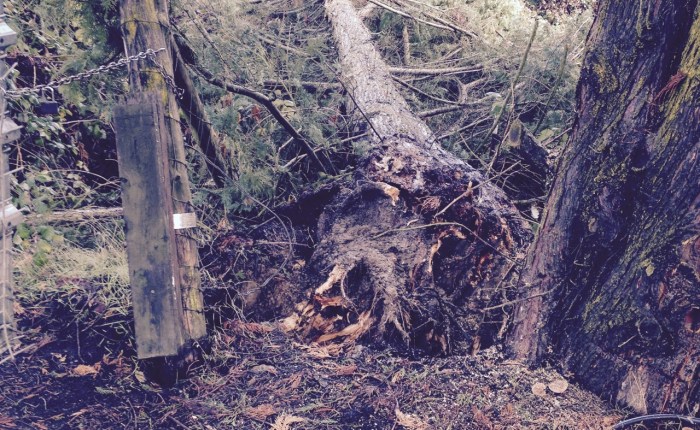
This morning we took the dogs off for a long walk, noting that the fence post supporting the gate to the pasture was leaning a bit towards Max’s yard.  We’ve had the snowstorm of the century and a solid week of rain, so we did expect some clean-up when the snow finally melted.  As we turned up the driveway on our return, however, we noticed that the gate was no longer closed.  Three footsteps later we realized that an entire stretch of fencing had been taken out by a falling cedar, fully forty feet tall.  Gate gone, fence gone, forty feet of tree had flattened all in its path from our fence line to the middle of Max’s property.

As I’ve indicated, Max is rarely home as he prefers life on his mountain, but today I found him in his workshop, explained that he now had forty feet of tree to deal with, and asked how he wanted me to proceed, assuming that I’d be calling an arborist and spending a small fortune to bring a crew with specialized equipment to the scene of the disaster.

Nah, Max grabbed a chainsaw and went to work.

When I say chainsaw, I mean the smallest, most delicate saw I had ever seen; this looked like a Fisher Price chainsaw.  Starting at the middle where the girth of the tree was roughly four feet across, Max patiently sliced the tree in half.  It had been a healthy tree, so its roots were both massive and still deep in the hillside; it was not easy to move.  Max fired up his Boss backhoe loader/plow, drove it up our drive into our pasture, tried using the bucket to nudge the roots out of the ground, then attached a chain to the roots and attempted to rock the roots loose.  I had never seen a two thousand pound backhoe lifted off the ground, but, as Max later reminded me, “no job is fun without popping a few wheelies”.

Let me pause for a moment to suggest that a neighbor in need is a neighbor with a two thousand pound backhoe loader/plow.

I was of little (no) use, juggling lengths of chain that snapped when Max attempted to pull the truck of the tree out of its place, but I tried to let Max know how much I appreciated his willingness to dive into this project.  He hopped off the gigantic machine, grabbed his tiny saw and went to work cutting the five foot wide base of the tree so that he had only to pull the weight of the roots rather than the roots and the bottom half of the tree.

I tried to give Max money to cover the cost of gas for his monster backhoe and to compensate him for the time he had spent clearing the corner of our property.

He didn’t want to take it.

“What are neighbors for?” he asked as he punched me in the shoulder.  We’ve seen Max six or seven times in the ten years we’ve had this property.  We wave and have been friendly enough, but we had made up stories about Max, about his cars, about the yard.  Until this morning, I hadn’t spent more than five minutes talking with him.  I truly met him for the first time today, and yet he quickly and generously offered neighborly assistance without being asked.

The neighbor in Frost’s poem suggests that it is distance and separation that allows neighbors to remain civil, but Frost maintains that something there is that doesn’t love walls.

“I’d ask to know

What I was walling in or walling out”

Until the fence went down, we had been walling out a person I am honored to know.  Humbled and grateful, I’ve got it in mind to be a better neighbor.

Uh, 2016?

Uh, 2016?

Remember the Year 2K?  The Millennial anniversary that signaled the end of life as we knew it?  Unless I missed a memo, we ducked the digital meltdown and managed to get on with the familiar triumphs and trials almost as if the calendar was a convenient human invention rather than a playbook for the globe.

Having slipped by that one, we had to contend with December 21, 2012, which, as we knew all too well, was the date identified in the MesoAmerican Long Count Calendar as the start of the New Age.  Scholars steeped in the history of the Mayans assured us that they had found no accounts of doomsday predictions, and that the presumed collision with the planet Nibiru was not imminent.  Equally unlikely, they suggested, was the geomagnetic reversal (polar shift) that would set off an explosion roughly equal to that of one hundred million atomic bombs.

The temptation to catastrophize is always with us, and the events of the past year may, in fact, have consequences that turn out to be not-so-great, but my powers of prediction have turned out to be unreliable, and investment in prophecies that never materialize has not brought me much satisfaction.  All of that now being said, it seems right and proper to take a look at some of the signal events of the past year, not to give them more weight than they deserve, but to remind ourselves of the road we have travelled together.

2016 brought discussion of “fake news” and of viral accounts that were entirely manufactured, particularly those that were disseminated via Facebook.  The two runners-up in this year’s tally of Facebook shares are impressively vivid: ” Cinnamon Roll Can Explodes Inside Man’s Butt In Shoplifting Incident” and “Morgue Worker Arrested After Giving Birth To Dead Man’s Baby”.  The most shared story of the year, however, must have resonated with disaffected employees everywhere; 1,765,000 people passed this one along: ” Woman Arrested For Defecating On Boss’ Desk After Winning The Lottery”.

Wish fulfillment?  Magical thinking?  It’s hard to prepare an informed citizenry for the exercise of democracy when we can no longer trust the news our friends pass along.  And, by the way, the alleged Cinnamon Roll Can explosion would certainly move way past “incident” for any witnesses who happened to be waiting in line when the device deployed.

Real news, however, is stranger than fake, as is exemplified by the report issued by the Taunton, Massachusetts Fire Department, indicating that an arsonist attempted to use Cheetos as an accelerant in setting his ex-girlfriend’s house aflame.

The annual publication of the Darwin Awards celebrates the culling of the human gene pool as those most likely to reproduce the next generation of stunningly clueless mortals make mind-rattling and occasionally fatal choices, choices that suggest that they are unclear on a concept.  More than half of the awards have been given to criminals who, in the heat of the moment, have forgotten some of the central elements necessary to a successful crime, but 2016 was the year in which ordinary folks moved into consideration for the top prizes.  Both nominees failed to survive what must have seemed a perfectly reasonable impulse.  The first attempted to take a “selfie” with a crocodile; the second attempted the same photo op with two elephants in the wild.

2016 was the year of rampaging “killer clowns” as claims of abductions by clowns came from virtually every state in the union.  To date, no actual criminal clown activity has been substantiated, but schools and organizations did shut down in response to clown terror.  Urban myths spring fully formed, and this one took off quickly, not only prompting parents to form “clown vigilante” packs, but compelling “pro-clown” groups to march under the banner, “Clown Lives Matter”.

In 2016, the world of wanna-be-wizarding was rocked by J.K. Rowling’s disclosure that one of the students attending Hogwarts, Dean Thomas, had originally been named “Gary”.   Visitors to Pottermore – the digital heart of the Wizarding World took to the twittersphere to wonder at the meaning of the change of name.  Apparently Rowling had known a boy named Gary.  That’s it.  That’s all there is.  Gary.  The mind leaps, of course, to consider the other sorts of names that might have been been enrolled at Hogwarts had Harry, Hermione, and Neville not made the cut.  Chad Potter and the Sorcerer’s Stone, featuring  Chad’s loyal pals, Trixie and Stu.

The year that was brought controversy aplenty.  There was considerable flap over the sudden popularity of Lacroix Sparkling water, with particular concern that movers and shakers in Hollywood had adopted the fizzy stuff as the “insider” beverage of the year, hijacking what had been a down-to-earth product of the G. Heileman Brewing Company of La Crosse, Wisconsin and changing the pronunciation from “La Croy” to “Lah Crwah”.  Was the “French” pronunciation merely an affectation?  Hah!  Consider these among the TWENTY flavors of sparkling water now available:  Pamplemousse, Pomme-baya, Cerise limon, Pina Fraise, LaCola, and Mure pepino.  Zut Alors!

Finally, Pokemon Go was touted as the answer to the sedentary habits of gamers as the mobile application employed GPS in order to propel players through the “real” world, encouraging physical activity.  Maybe, but when players were directed to capture virtual creatures at the Auschwitz-Birkenau State Museum, The United States Holocaust Museum, and the Hiroshima Peace Memorial Park, when players were directed to trap creatures on the railroad tracks in Holland, when Bosnian players stepped into mine fields, when Japan reported seventy-nine Pokemon Go related auto accidents, when a stabbing victim in Forest Grove, Oregon refused treatment so that he could continue his hunt, when a boyfriend said, “Catch ’em all” instead of “I love you” when dropping off his girlfriend, we had to wonder.

And, just to send the old year off with proper fanfare, let’s remember that in 2016 we treated our celebrities well.  The Forbes list of Highest Paid Celebrities has a few surprises, but I’m certain we all agree that every penny is well deserved.  Leading the tally, Taylor Swift hauled down $170,000,000 last year, Dr. Phil McGraw counseled his way to $88,000,000 (How’s THAT working for you?), and Kevin Hart came in at $87,500,000.  Howard Stern will have to get by with $87,000,000.  Madonna still cashes a hefty check, coming in at $76,500,000 while the lovely and talented Rush Limbaugh tops that with $79,000,000.  Some surprises might include Kim Kardashian at $51,000,000 and Judy Scheindlin (Judge Judy) at $47,000,000.  I’m going to assume it’s residual income that brought Jerry Seinfeld another $43,500,000 last year, but how did virtually retired Tiger Woods bag $45,500,000?  The universe is now finally in balance,however, as supermodel Giselle Bundchen earned a mere $30,500,000 while hubby Tom Brady pulled down $44,000,000.

No room for resentment here.  I wish them a happy new year and pass on this urgent advice to the rest of us. Put down Pokemon Go, don’t take selfies with a crocodile, and if you win the lottery, steer clear of your boss’ desk.


Snow

Snow

“The Moon on the breast of the new-fallen snow…”

We don’t get much snow in this valley.  The passes are often socked in, and the mountain pines are flocked for much of the winter, but down here we are accustomed  to only a few dustings each winter, nothing awkward or inconvenient, a bit of accent snow to heighten the effect of holiday lights.  Novelty snow.  Window dressing.

Yesterday, however, we found ourselves inside a snow globe.  Apparently the local weather team was equally surprised by the appearance of snow, by the weight of snow, and by the generous and ongoing delivery of snow.  Attempting to recover the appearance of prognosticating expertise, they have been quick to announce that today’s snowfall has not eclipsed the record set in 1919.  So, no big deal; it’s only been almost a century since anything like this snow has settled here.

I have a friend who happens to be an Eskimo.  He was raised in Oregon but speaks the Yupik language, and so, has an opinion on the perennial linguistic squabble that bedevils academic anthropologists.  Do the Eskimo-Aleuts have more than a hundred words for snow?

Don’t expect a simple answer to what turns out to be a complicated question.  Of course, he argues, people who live and work in a northern climate are likely to have words specific to their immediate experience of their world in the same way that city-dwellers have all sorts of terms that country folk do not need.  Any Angelino is happy to tell you that taking the 10 or the 60 is brutal at rush hour, but the 101 can be carmagedden from the 134 to the 118 0r 126.  His short(ish) answer is that while snow falls in several varieties, it is the relationship of snow to all other elements and actors that matters.  Gradations of wind, temperature, sunlight, cloud cover, all affect snow, no matter how crystalline or granular it happens to have been at the point of precipitation.  Toss a person, a family, a tribe out there, and the relationships between observer and event become complex.

In the morning, I took the dogs into snow so deep that the smallest of the border collies had to leap from pocket of snow to pocket of snow in order to stay up with the rest of the pack.  Our largest and furriest, often miserable in mid-summer, settled into a drifted bank and sat contentedly watching the others frolic.  Finally, exhausted by having done some leaping myself, and very cold, I called the other dogs to the kitchen and delivered the expected biscuits.  Our frosty fur bag wouldn’t budge; the world suddenly made sense to him.

Later in the day, I approached snow-related chores, attempting to free a car so that we might pack in some supplies and get my daughter to the plane she needed to catch that evening.  I don’t own a snow shovel.  I have a pitchfork,and a chain saw, neither of which was of any use.  I had a snow shovel, and a toboggan, when we moved from Michigan in 1989, two of the many objects I have cast aside in moving from region to region.  I knew I would need them; why, oh why, did I listen to the voices of “reason”?  This is exactly why I haven’t discarded the ventriloquist dummy and the LP Christmas albums.  Who knows when they will be needed?

I’ll admit that my feelings about snow were altered as I faced the challenge of freeing the car.  I wasn’t annoyed, exactly, but let’s just say, less appreciative, as the-second-worst-snowfall-since-1919 filled my boots.  An ill-spent youth in Connecticut had taught me how to gently rock a car from tire-spinning stuckness to a semblance of traction, so I did manage to get to the store, and I did manage to walk my daughter’s luggage to the end of the long drive, and I did manage to get her to the airport, which is a journey of sadness for me as I hate to see her leave, but which is also necessary to her taking her place in the world as a competent and impressive young woman.

Mission accomplished, daughter safely delivered, I entered into the next stage of this complicated relationship with the elements.  As I rocked the car from its parking spot, I became aware that as daylight had faded, softly puffed snow had turned to ice.  I had been caught in an ice storm outside Portland last winter, terrified to find that I could not control the car and aware that I was not alone in careening across the highway .  I slid to the first exit and spent the night at a motel, hoping for a melt in the morning.  This region doesn’t deal with extremes easily; no crews plow or sand the roads.  Last night, I drove slowly, noting the cars already abandoned off the edge of the highway, slightly skimming sideways on the last leg as I took our dark country road, tapping my brakes until I docked at the now dark end of the drive, under fanned pine boughs still heavy with snow.

As I walked toward the house, however, I left the trees and stood in the light of a first quarter moon.  Moonshadow stretched from the trees, but the snow covering the orchard and the adjacent pasture was  unbroken and glowing.  Had the moon been full, that snowscape might have been more sharply gleaming, but in quarter light, I could appreciate Clement Moore’s figurative moon on the breast of new-fallen snow, not giving the lustre of midday to objects below, but softening fences, bushes, trees, the pasture shed.

Today the trees have shed much of their snow and are again green against a bright blue sky.  Deep snow has now been pocked with dog play and the oddly straight tracks of deer walking head to tail, scrambled slightly on either side of fences as the deer spring, then straightened and precise as they resume their ordered march.  Some small beast has made a home in the bramble at the south end of the larger pasture, having dug a path under that fence; the piled snow is matted now, so we can see where the skunk or woodchuck likes to sleep.

Tomorrow’s snow will be different; I won’t have a word for snow that has melted a bit, moved with the wind, refrozen, and ended up near a short tree.  It won’t come into being until I see it after all, and I may be pleased to spend another day snowbound in our cozy house, or I may be cabin crazed and desperate to find more coffee at Trader Joe’s.  Snow and I will meet again and we’ll figure things out.


Living On The Edge … Of Paradise

Living On The Edge … Of Paradise

The temperature has been dropping over the past few days; rumors of real snow abound, and travel plans through the mountain passes have to include snow tires or chains.  I live in the Rogue Valley in Southern Oregon; the hills on both sides of the valley are forested, green until November, then flocked with snow until May.  The higher peaks don’t melt until the middle of July.

I walked across a parking lot yesterday morning, forgot about the errands I had planned, and stood looking to the south and north, grateful again to live each day against a spectacular backdrop.  People who grew up here describe the climate as “pear friendly”, the growing season is long, and sunshine and water arrive as the trees have need of them.  Summer days are long and occasionally very hot up here, but each of the seasons brings dramatic lightscapes and plenty of interesting weather.

My days, for the most part, are spent in Ashland, a small city of about twenty-five thousand people.  Ashland is the home of the Oregon Shakespeare Festival, an ambitious repertory theater company which produces plays in three separate theaters  from March until November.  In the course of a decade, the entire canon of Shakespeare’s work hits the stages, but Broadway musicals, original work commissioned by the Festival, Restoration comedies, French farce, and reimagined classical works will all have a place.  Southern Oregon University is here as well, and coffee shops, restaurants, bookstores, horse farms, and orchards.  People move here, mostly from California, but from other parts of the West as well.  Locals put up with us; we admire the locals.

I’m lucky to be here, but I don’t live in Ashland.  I live in Phoenix, a village belonging to greater Medford.  We have a small home, fenced acreage, no near neighbors, and long views in every direction.  Home prices in Ashland are higher, and nobody I know drives to Phoenix for the restaurants or coffee shops, but I love the play of light in our part of the valley, and my fifteen minute drive to the south end of Ashland takes me by the loveliest panorama of mountains, a view Ashlanders don’t ordinarily see.

We moved here from Carpinteria, California, an equally small town, south of Santa Barbara, the American Riviera, packed with celebrities and tanned wealth of every sort.  We didn’t live in Santa Barbara, but in my fifteen minute drive to a Santa Barbara, I drove next to the Pacific and saw rainbows over the red roofs of the city.  My kids went to school in Santa Barbara; we shopped in Santa Barbara, found coffee shops in Santa Barbara, but drove home to a house in a less celebrated small town, adjacent to the hills of the Los Padres Forest, on a mesa, overlooking the Pacific. We enjoyed the same breezes that cool Santa Barbara in the summer and the same sunshine that warms it in the winter, but friendly Susan from the town’s bank called us when anything odd turned up on our debit card.

This pattern of living near but not in extraordinarily advantaged places began in childhood.  I grew up in Woodville, Connecticut, a community so small it can’t properly be called a village, much less a town.  As a non-census community, there has never been an estimate of population, but my guess is that the thirty or so households probably hold about a hundred people.  Woodville is one of five communities within the town of Washington, Connecticut, a large township with low population density. Today the population of the entire township (Washington Depot, Washington Green, New Preston, Marbledale, and Woodville) is about three thousand, five hundred, up about a thousand from what it was when I was in school.  Washington is one of the two or three loveliest towns in Connecticut; stately Georgian and Greek Revival houses flank the Green, and manicured estates follow the sweep of the rolling Litchfield Hills, the last extension of the southern Berkshire mountains.

Woodville is far from manicured; the truck route from Danbury to Torrington ran through Woodville, but there are few distinctive features to separate the stretch through Woodville from similarly undeveloped wooded country anywhere north of New Milford and south of Litchfield.  Long gone are The Armory (guns and knives) and Grandpa Snazzy’s Cabin, a tiny store that sold candy, sodas, and Hostess pastries, and which held the county’s only pinball machines.  My brother’s pottery (Wolff Pottery) was a landmark in later years, but in my youth, the building was still a mule barn.

Picture postcard Washington inspired the Gilmore Girls’ Star Hollow, and the famed Mayflower Inn has long welcomed guests from around the world.  The “commercial” area of  the town, known as Washington Depot consisted of the Hickory Stick Bookstore and Park’s Drugstore, a hardware store (The Washington Supply), a small market, the post office, the town hall, an art gallery, and a bank.  Marbledale had a grocery store, New Preston a package store, a grocery, a pharmacy, and a post office.  The town library, a smaller Park’s drugstore, the Congregational and Episcopal churches, and the Gunnery, a boarding school were on the Green.

I’m pretty sure the folks who live on the Green or on one of the expansive horse properties have no idea that there is a Woodville; not many Georgian or Greek Revival homes on the truck route.  On the other hand, main road aside, I was surrounded by pine forest and could easily walk to an unpaved road that followed the Shepaug River, branching off to meet Sabaday Lane, as horsey a lane as one can imagine and one that leads eventually to the top of Washington Green.  In the winter, when a cold rain was followed by a sudden drop in temperature, I could skate on that dirt road; in the summer, I could prop my bike at the trunk of a pine tree and walk down the bank into one of the pools made as the river dropped into a bend.

Years later, my wife and I were married in that post card church on the Green and celebrated by taking our tiny wedding party, including our dog, to the Mayflower Inn.  I have been tempted at times to feel sorry for myself as an outsider, far out at the fringe of gracious living, but the truth is that I have been fortunate from the start, lucky to find myself in extraordinary settings, delighting in the gifts that each season has to offer.

I spent much of this morning in the pasture with our four dogs.  Snow has been falling since before dawn; the dogs’ tracks fill quickly.  Despite the onset of winter, Blackberry tendrils have been throwing themselves far from the fences; today they are covered with snow, weighed down, far less likely to spring at me as I lop off new runners with a hedge trimmer large enough to fit a Norse god’s fists.  When the snows melt, I’ll gather up the piles of blackberry bramble and toss them on the burn pile.  For now, they sit snow covered, white mounds marking the fence line.