I Got Your Pronunciation Right Here… Waiting For You In Cholmondeley

I Got Your Pronunciation Right Here… Waiting For You In Cholmondeley

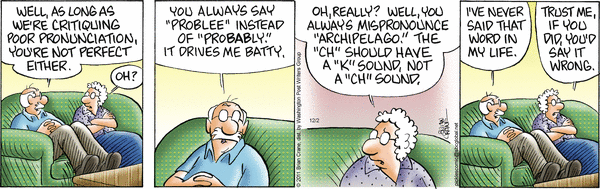
archipelago


A current political figure was recently roasted alive while appearing in Reno, Nevada, instructing a crowd of Nevadans that they incorrectly mispronounced the name of their state.  “Nuh- Vaahh – Dah”, he intoned, while an increasingly roiled crowd rejoined with active contempt, “Ne – Vah – Da”.

As a clueless singer once warbled, not understanding the fun of Cole Porter’s Lyrics, “You say potato, I say potato.  You say tomato,  I say tomato.  Potato, potato, tomato, tomato.  Let’s call the whole thing off.”

Pronunciation can get tricky and occasionally regional, as in the case of Nevada, Colorado, and Moscow, the location of the University of Idaho..  There is no “cow” in Moscow.

Just a bit farther northwest of Moscow, the largest city between Seattle and Minneapolis, Spokane, Washington is pronounced “Spo- Can” not “Spo- Cane”.  California offers the elegant San Diego oceanfront community, La Jolla, which is not “La Joll – A”, but “Lah- Hoya”, and the town used as the setting for Lost Horizans and countless western films, Ojai, is “Oh- Hi”, not “O-Jie”.

British place-names are notoriously idiosyncratic, defying all laws of reason and reasonablity.  The three that pop up fairly frequently are Magdalen (one of Oxford’s colleges), Marylebone (Sherlock Holmes’ neighborhood in London), and Cholmondeley (castle and garden in Cheshire).  So, Magdalen = Mawd-lin, Marylebone = Mar-Lee-bone, and Cholmondeley = Chumly.

As you had no doubt guessed.

That out of the way, let’s get to the meat and potatoes of this piece, no matter how you pronounce (or spell) potatoes.  I’m a self-confessed Snoot, particular about words, but it’s tough to know exactly how to pronounce words until the words are heard spoken aloud.  For example, we’ve swiped words from the French without permission or an instructional manual, so who really know what an American is supposed to do with “foyer”, “oeuvre”, or “haute couture”.  All sorts of words come leaping into common use from medicine, law, technology, and government as well, adding le mot juste (see?) but leaving us again vulnerable to Snoot shaming.

For many of us, it happens in our first semester at the Wow-You-Are-A-Smart-Coookie college of our choice.  We’ve done the reading; we’ve read the critical articles about the reading.  We have points aching to be spouted, the sorts of points that immediately establish a student as a force to be reckoned with and a potential academic luminary. We speak with cheerful force, looking about to see which heads nod in stunned admission of out brilliance, until,  from across the aisle or across the seminar table we see a languid  wave of forbearance. “I’m sure,” the quietly assured world traveller instructs us, “you mean to say …”, and we burn in silent shame, determined never to share an opinion in public again.

I read widely and a lot.  I read British mysteries, contemporary political journals, classic works of world literature, and countless biographies.  I knew words, but at second-hand.  Nobody I knew actually used words such as “hegemony”, “consummate” (the adjective, not the verb) , or “insouciant”.  Oddly, it never occurred to me that the words as I heard them in my head might not be correct.

Contextual reading had provided meaning, in most instances.  I could tell that consummate horsemanship meant really good at riding horses, and I sounded it out (in the brain) as “con-soo- mutt” whereas the cognoscenti used the pronunciation, “Kuh-n-suh-mitt”; down for the count with that one in Comp Lit 101.

Every slick historian I encountered in preparing for the freshman seminar in Comp Civ used the word “hegemony” to mean dominant power.  Happily I weighed in touting a nation’s “Hedge-a-mony”.  Hah!  “Do you mean “Hi-jem-uh-nee”?  Just shoot me.

I’m not even going to try to remember how I mangled “insouciant”.  Let’s just agree that my first year was essentially mangled beyond repair sometime before the second week of classes.

OK, there was one more humiliation waiting for this pretentious college freshman.  I had received a letter from my step-mother, asking how I had become so “hirsute”, which, of course, I took to mean spectacularly intelligent.  Made sense at the time.

I could have looked it up, but come on!  Why belabor the immediately obvious?  Had I one shred of humility or impulse toward self-preservation, I would have found out that hirsute means “hairy” or “shaggy” and was my stepmother’s way of suggesting I needed a haircut.

But, no.

Rebounding as only the young poseur could, I returned for the second semester with renewed chutzpah (don’t sound that out – separate post on Yiddish usage coming soon) and tossed the word pointedly into a heated discussion on absurdist drama.  “I don’t think Pirandello,” I bleated, “is as hirsute as the rest of you seem to feel.”

Yeah.

I survived the class because the prof thought I was being absurdist rather than knuckleheaded.  Points for me!

I confess that despite my comeuppances I am subject to involuntary Snootic response to some routinely mispronounced words, and, in the hope of saving the reader from the sort of pain I have brought upon myself – here they are:

Arc-tic not Ar-tic

Nuc-lee-ur not Nuc-yoo-lar

Ess-presso not Ex-presso

Lam- baste not Lam-bast

Cav-al-ree not Cal-va-ree (unless describing Biblical location)

Champ-at-the-bit not Chomp-at-the-bit

Or-i -ent not Or-i-ent-tate  – so dis-or-i-ented not dis-or-i-en-tated

And in a final burst of unsolicited Snootery –

To be objective is to be disinterested … to not give a rip is to be uninterested.  A referee should be disinterested but not uninterested.

A cache is a hiding place … cachet is superior status.  Gnomes may have some cachet as they maintain a cache of gold and jewels

Tenet is a belief held as true – a tenant rents an apartment.  ‘Never lose your deposit’, the tenet of most tenants.

Prostrate means face down – prostate is a gland near the bladder in males.  An exploding prostate caused the banker to fall prostrate on the gravel.

Tact describes a fine sense of what is appropriate – a tack is a sharp pin.  The diplomat showed little tact in using a tack to display offensive pictures of the dictator’s cat.

Libel describes defamation – liable can mean legally responsible or susceptible.  A journalist is liable when the victim of an untrue allegation alleges libel in the article.

A reader pores over material – an eater pouts milk on cereal – Poor Patti pores over her pores while pouring pears.

Averse means opposed to – adverse means unfavorable.  I am averse to adverse circumstances.

Something discrete is distinct – something discreet avoids attention.  Lazlo was discreet in identifying only six discrete instances of unlawful assault.

As a friend used to say, these are fun-facts to know and trade.  Pass them on, or file them away.

Forewarned is forearmed, but remember that to be forearmed is also to be smacked by a hulking attacker’s lower arm.

Maybe you don’t need to pass that along.


First Car Friday.  

First Car Friday.  


Every once in a while, I hear an idea that immediately fires the imagination and jump starts a trace of memory commanding enough to reach the surface.  I had not expected to find that sort of inspiration in the ordinary, every day work one of my children has been doing for about a year.  My liberally educated and very savvy son works as a social media consultant to a consortium of automobile dealerships, maintaining their websites, yelping as needed, relentlessly tweeting, and blogging, all efforts intended to build the prospective car buying public into a frenzy of anticipation as new models replace the old and as old models are in need of adoption.

Think about that for a moment.  He sits down every morning and writes about cars all day long, not the sort of subject that leaves room for much frivolity, wordplay, or invention, and yet, against all odds, he comes up with at least two or three concepts per day  capable of grabbing even the least motivated potential customer.  In the course of the year he has become familiar with makes and models, emerging trends, classic cars of the past, concept cars, muscle cars, electric cars, cars that float, cars that run on peanut oil,  cars modified to allow seven-foot NBA stars to drive from the back seat, cars that seat two, four, six, eight, twelve, and cars that never rust.

And the stories … cats in cars, soldiers in cars,  new mothers in cars, Ultimate Fighting champs in cars, adopted children in cars, holiday dinners in cars, proposals in cars, softball teams in cars, presidents in cars, zombies in cars, Girl Scouts in cars, stars in cars, tsars in cars … more heart-rending stories than a season of Oprah in cars.

And, in a fit of inspiration, First Car Friday.

Appealing to a broad audience, he threw open the gates of memory once a week.  Readers were invited to write in with a description of the first car they ever drove or owned.

Genius!  It’s not a subject that demands universal attention, but for those of us who have had a long-term meaningful relationship with a car, and you know who you are, he might as well have asked broken-hearted lovers to wallow in the most maudlin reminiscences of lost romance.

I intended to jump in with a rhapsodic description of the 1949 Willy’s Jeepster I drove for years both before and after the age at which a license might have been issued in the State of Connecticut.  I learned to drive by driving, first a tractor, then a truck, then the Jeepster, back when most enterprises were more casual.  And by casual, I mean driving a car that had no windows, no radio, and a heater that was essentially a hole in the floor.  Well, there actually were openings that could be called windows but no glass.  If the weather turned rugged, I could snap heavy plastic sheets into the frame of the doors and hope the hole in the floor heated quickly.  Rain and snow were challenging as the jeep’s wipers would not operate when the car accelerated, a function reportedly necessary to driving.

Late in the Jeepster’s life, somewhere around 1963, we tried to improve the fuel economy and performance by dropping medicinal balls into the gas tank.  We had been assured by an advertisement that these magical beans would add years to the life of the car.

They didn’t.

I don’t actually know what happened to the black Jeepster, one of two Jeepsters we owned.  Cars seemed to appear and disappear willy-nilly for a while.  A Plymouth Valiant with push-button transmission disappeared quickly, very quickly.  Volkswagen bugs, Karman Ghias, a Studebaker station wagon, a Ford Falcon, a Peugeot station wagon all pulled up at some point before I moved reluctantly on to quasi-adulthood and bought my first new car, a yellow Karman Ghia, then a Volkswagen camper, then another Karman Ghia, then a rusted-out BMW, then a Honda hatchback, then three Buck Le Sabres – two of which were stolen, one of which dropped off its axle on the way to The Empire Strikes Back – a Honda wagon, the first of three Volvos, a Honda civic, a Mazda hatchback, a Buick Skylark, a Volvo wagon, a Dodge conversion van, another Volvo, a Ford Taurus, three Plymouth Voyagers, a Honda Odyssey, and a Honda Accord.

See?  That’s what happens when you ask some of us about cars.

Observing the warmth of memory that enfolded me, the sweet, sad comfort in bringing old friends to mind (except the Honda and two Volvos that burst into flames and the Buick recovered from thieves who had left shreds of octopus in the back seat), I wondered if there were comparable exercises that might drag one down the dusty corridors of memory with equal satisfaction.

Sticking with the provocation  of “Firsts”, I’ve come up with three possibilities, to be tested as this post is read and considered.

First Pets?  First Job?  First Celebrity crush?

Surely the floodgates open as we remember that first pets, in my case a bulldog with the AKC name of Bernie’s Leatherneck Dan, known to us as Muscles.  He went the way of the Jeepster and as quickly as the Valiant.

There weren’t many jobs other than farming to be had in my world, and I did spend summers mowing and baling, picking shards of hay from my arms, legs, and neck.  My first “formal” job was peddling ( I can’t say selling) Fuller Brushes door-to-door, following by an equally unsuccsessful door-to-door career with the Collier’s Encyclopedia, which I could actually give away, if the fortunate recipient of my bounty bought the annual supplement year-after-year.  Very uplifting work.

As to celebrity crush?  No contest!

I saw Doris Day in By the Light of the Silvery Moon in 1953.  I was seven and on my first date, with Patty Gilbert, a classmate at the New Preston Elementary School (just a friend).  I liked Patty just fine, but Doris Day could sing, seemed really kind, smart, and spunky.  Since then, I’m now realizing, kind,smart, and spunky continued to pretty much set the standard from that point on.

First cars, first pets, first jobs, first celebrity crush – trot out one of these in an awkward moment of conversational impasse and see what you get.  If that doesn’t get things going, you are in a closed space with a creature with no soul … just saying.


Guess Who’s Coming To Dinner?

Guess Who’s Coming To Dinner?

My daughter has a gift for asking questions that are simultaneously amusing and provocative.  I won’t go into the full array, but I will confess that each one has caused me to think about myself and the world in very interesting and occasionally liberating ways.

Yesterday’s question was a variation of the “If you could invite anyone from anywhere in history to dinner, whom would you invite?”  Always good for conjecture, and indicative of the sort of host one might presume to be.

I love wit and loosely bridled merriment, so I’d be inclined to stack the list with pleasant souls and sparkling conversationalists.  The problem, of course, is that you won’t know which Abe Lincoln, Mark Twain, or Winston Churchill is going to show up; you might get the wryly humorous Lincoln or Twain, or their darker, despondent selves.  If Churchill has a snoot full when he arrives, buckle up your seat belts – it’s going to be a bumpy ride!

Similarly,  in the provocative mode, were I to seat Jesus next to Pat Robertson, what would they have to talk about?

Yesterday, however, my daughter challenged me to pick a movie whose cast would provide the best dinner table; she went one step further, adding that it could include anyone, living or dead.  I sputtered intelligently trying to obscure my pitiable response, then admitted that I would need quite a lot of time to work things out.  The same sorts of delicious or disastrous possibilities struck me immediately.

Based on his performance in The Wicker Man alone, I would love to see Nicholas Cage in confinement, but not exclusively by himself, as it might be more intense that I could handle at the dinner table.  I could choose Con Air, which would net me Nicholas Cage, John Cusack, and John Malkovich, or The Rock, bringing Cage and Sean Connery.  Cusack strikes me as affable and clever; Malkovich is every bit as fascinating as Cage, and probably as dangerous.  After all, it was Malkovich who said, “Some directors expect you to do everything; write, be producer, psychiatrist. Some just want you to die in a tragic accident during the shooting so they can get the insurance.”  So, there’s that.

Sean Connery, on the other hand … uh, better not use that phrase.  When interviewed, Connery boasted, “An open-handed slap is justified – if all other alternatives fail and there has been plenty of warning. If a woman is a bitch, or hysterical, or bloody-minded continually, then I’d do it.”  Not cool.

OK, so no Cage, Malkovich, or Connery.

The next ploy was to look at the films I’ve seen over and over, assuming the cast would make great company.  I am reluctant to share the list of films I have seen most often because there are some that are simply accidents of circumstance, including:

The 1960 version of The Time Machine, starring Rod Taylor, Alan Young, Yvette Mimieux, Sebastian Cabot, directed by George Pal – fifteen screenings at the USO in Charleston, South Carolina and aboard the USS Sellers DDG 11.  It was literally the only entertainment both ashore and on ship.  Maybe the conditions under which I lived my “life” colored my judgment, but it wasn’t half bad.  Did it get better with repetition?  Let’s put it this way; I’ve only seen it twice since then.  Yvette Mimieux was hot stuff in 1960 and Alan Young was abut to burst into the entertainment firmament with his role as Wilbur Post, straight man to Mr. Ed, the talking horse.  Rod Taylor was the box office draw, a less moody hunk than Rock Hudson, at his best in The Birds, to which I will refer before we’re done here.

Mighty Joe Young, made in 1949 as a follow-up to RKO’s blockbuster, King Kong.  Like King Kong, The Most Dangerous Game, and Top Hat, Mighty Joe Young was featured on WOR’s Million Dollar Movie, shown at least twice every day for a week and twice each afternoon on weekends before the evening shows. Kong scared the popcorn out of me, but Mighty Joe was a heartbreaker. I actually saw at least twenty films twice a day for a week, but Joe was the only one I watched through the ten times during the week and another six during the weekend; I think I had the flu, explaining why it all seems to float in delirium.

I did my graduate work on the films of Alfred Hitchcock, screening the same films again and again, which pulls Notorious, Shadow of a Doubt, North by Northwest, Psycho, The Birds, Marnie, and Frenzy into the top tally.  Notorious is a gem and a tempting choice because it gives me Cary Grant and Ingrid Bergman, both pretty intriguing people, but that’s just two, a dinner more intimate than I could manage.

By choice I have watched White Christmas at least sixty times and plan to watch it again this year.  I love the film, but Danny Kaye is the only star I have any interest in.  Sorry, Bing.  Bing also puts the kibosh on all the Road movies, which is a shame, because Bob Hope was quick witted and genial.  I’ve also seen Singin’ In The Rain many, many times, and always get a huge kick out of almost every scene, but it’s not a cast to spend an evening with, in the same way that Some Like It Hot is fabulous but promises an evening with Tony Curtis as well as with Marilyn Monroe, Jack Lemon, and Joe E. Brown.

No Tony Curtis.

It came down to this: Since I can’t get Mel Brooks and Robin Williams in the same cast, I hadda go with an ensemble, leaving me to choose between:

Ocean’s Eleven (both versions)

1960 – Frank Sinatra, Dean Martin, Sammy Davis, Jr., Joey Bishop, Angie Dickinson, Peter Lawford

2001 – George Clooney, Matt Damon, Andy Garcia, Julia Roberts, Casey Affleck, Elliot Gould, Bernie Mac, Carl Reiner, Don Cheadle

The Italian Job (both  versions) 1969 – Michael Caine, Noel Coward, Benny Hill

2003- Mark Wahlberg, Charlize Theron, Edward Norton, Jason Staham, Donald Sutherland

The Royal Tennenbaums – Danny Glover, Gene Hackman, Anjelica Houston, Bill Murray, Gwyneth Paltrow, Ben Stiller, Luke Wilson, Owen Wilson, Alec Baldwin (narrator)

The Grand Budapest Hotel – Ralph Fiennes, F. Murray Abraham, Adrien Brody, Wilem Dafoe, Jeff Goldblum, Harvey Keitel, Jude Law, Bill Murray, Edward Norton, Jason Schwartzman, Tilda Swinton, Owen Wilson

Tough choices, although the idea of sitting with Ralph Fiennes, Harvey Keitel, Wilem Dafoe, and Edward Norton is pretty heady stuff.

I haven’t cast my vote yet, in part because all these choices are appealing, but also because I can’t get over the Mel Brooks or Robin Williams table,and because the best raconteur at any table was Orson Welles, and because I want to see how large Tom Hardy’s neck really is, and because Kevin Spacey does impressions, and because I’m kind of obsessed with Keanu Reeves, and because, in the end, I need to see LA Confidential one more time to see what that cast might do at my dinner party, and because I also love Soapdish, and because Tropic Thunder does not get the respect it deserves, and because Magnolia never gets enough consideration, and because The Talented Mr. Ripley is the creepiest role Matt Damon ever played, and because nobody sees Tapeheads, and because I forgot about Kevin Kline, Meryl Streep, and Judy Dench.

This is how my daughter takes my brain hostage, and for that I am ever grateful.


Totally Gruntled And Funct

Totally Gruntled And Funct

When my eldest son was in middle school, we found a vintage copy of Willard Espy’s Words At Play at the bottom of a pile of dusty books that had survived the 1970’s, long neglect,  and a hard life in unopened cartons across four moves .  The book  was chock full of acronyms, epigrams, spoonerisms, malapropisms, limericks, palindromes, riddles, puns, and poetry at play.

Things palindromic were of particular interest, from the simplest, “Madam, I’m Adam” to “A man, a plan, Panama,” and finally to “Marge let a moody baby doom a telegram”.  The idea of a computer program creating a sentence which can be read from front to back or back to front playing homage to “madam I’m Adam”, did not occur to us then, but the Director of Research at Google came up with one that has now expanded to 17,826 words.   “It begins with ““A man, a plan, a cameo, Zena, Bird, Mocha, Prowel, a rave, Uganda … and ends with “a wadna, Guevara, Lew, Orpah, Comdr, Ibanez, OEM, a canal, Panama!”  Probably more than any of us need to read.

The book became a nightly treat and may be at the root of my fascination with all things silly; it certainly gave me more than enough incentive to continue the hunt for oddities of language in everyday life (See postings : “Sang Froid, Schadenfreude, and Double Entendre”, Aug. 19, “Every Tom, Dick, and Harry”, July 21, “Words We Should Use And Words We Should Not”, May 26, “I’m Like Uh …”, April 29, and  “I Am Too Much A Snoot”, April 13.)

Espy was a wordsmith with a sense of the absurd and the gumption needed to track down odd words and odd uses of words; in his day, Espy was favorably compared to W. S. Sullivan, Ogden Nash, and Cole Porter.  Neither of us had realized that playing with words could be a vocation as well as an amusing habit that annoyed many people. In fact, the word vocation derives from the Latin vocatio”, a call or summons.  Espy put it more elegantly, ” words choose their lovers arbitrarily.”

Some are called to words more violently than others.  I once had a roommate who was offended that a teacher, “used so many words”; I didn’t know what to say without exhausting his daily quota.  On the other end of the spectrum, my cartoon  hero, Foghorn J. Leghorn, the bombastic rooster patrolling the Loony Tunes henhouse, always had a way with words, usually punctuated by his trademark space keeper, “I say … I say”.

After an accident has befallen him.  “Fortunately, I say, fortunately, I always carry a spare set of feather.”  Observing the vain attempts of a dog to win a battle of wits.  “I say, boy, you cover about as much territory as a flapper’s skirt, I say skirt.”  “I say, I say, that dog’s busier than a centipede, I say centipede, at a toe counting contest.”  The clarity of a Leghorn simile is perhaps best expressed in this oft repeated line from “Weasel While You Work”, “The snow, I say the snow, is so deep, you have to jack up the cows to milk ’em, I say milk ’em.”

All of the above is to prepare the reader for this week’s immersion in the nonsense that arrives with any examination of the words we use.

Let’s start with an obvious conundrum.  Why do flammable and inflammable mean the same thing?  All the other “in” words basically push the listener toward an opposite.  Insensitive is not sensitive; inert is not ert.

Wait.  There we go, exactly as I feared.  We’ve stumbled into the land of where-the-heck-does-that-come-from and why-does-it-continue-to-afflict-us?

It takes some digging, but the word inert is a composite of “in”, without or not, and “ars” or “artis”, as dinged by the French (zut) as “erte”, all meaning skill.  Which still leaves room for wonderment as “skill” is replaced by “energy” or “power” in the most common use of the word “inert”.

And so, the door is opened for the tsunami of words that have clear meaning with what seems a negative prefix (even when the word is not a negative word) but no meaning without the prefix.

disGRUNTLED, for example, is puzzling; disGUSTINGis not.

Though we don’t immediately think of “gustation” , the act of tasting, when the word “disgusting” is used, there’s little to confound us upon reflection.  Disgruntled, on the other hand, offers the possibility of “gruntled” or “gruntling”, which is a pleasure not to be ignored; it is a usage frequently appearing in the work of P.G. Wodehouse as Bertie Wooster is fond of describing the degree of gruntlement his companions have exhibited.

But, alas, the truth is less lovely, as is often the case.  We are accustomed to thinking of the prefix “dis” as meaning ‘opposite of’, whereas at one time it might also have meant “exceedingly” or “powerfully”.  So we’re off to a reasonable beginning here.  Then, the trick is to remember that it was once a practice to add “le” to a noun in order to make it a verb, as in “start” and “startle” or “spark” and “sparkle” .  Thus, “grunt”, generally an expression of displeasure is made into the verb “gruntle”, then amplified with the “dis” to express a great deal of displeasure.

The problem, of course, is that my “mind” immediately turns to “cat” and “cattle”, “rat” and “rattle”, “sad” and “saddle”, “tack” and “tackle”, “rank” and “rankle”, and on into a sleepless night.

Today, I am sorry to say, we no longer even go to that effort; we just take a noun and verb it.  “Interface” was a highly regarded verb for a short period; my hope is that it has gone back to its original happy state as a noun.  The obvious contemporary verbed nouns are “to google”, “to friend”, “to text”.  Don’t even think about it, do we?

As the title of this piece suggests, we still have to deal with “defunct”, as in “all over, dead-as-a-doornail,  finito,  kaput, fertig, really-most-sincerely-dead”.  We are troubled, n’est ce pas, with this funct business?  And yet, we sense that in this case, the “de” really does mean “not”, leaving us to work on the rest.

I know, you go to functional, as one might, but, you see, that inevitably takes us back to, “full of funct”, and dysfunctional then seeming to imply a paucity of funct.  We have to trek back to Latin once again for a word that was odd even in its day,  “functus” the past participle of “fungi” , to perform, to live”.

Ah hah!  The game is afoot.  “De-functusi”, “not perform, not move, not alive”.

Fans of functus/ fungi will immediately leap to an understanding of the word “fungible”, “to replace or to be interchangeable”… see, can “perform” as as the other?

Maybe not.

I’m grateful to  Willard Espy for his willingness to have fun with words and for his tacit encouragement of those of us who just like to horse around with language.

No “neigh” sayers out there?


Wait! Didn’t You Used To Be …

Wait!  Didn’t You Used To Be …

I just received a note from a friend who plans to attend hs 50th reunion at the boarding school we both attended.  I graduated a few years earlier than he, so I have already  missed that milestone, pleading distance, poverty, and committment to my responsibilities at home.

All of which was true… and yet.

Reunions are weird.

I guess they were slightly less weird when I was ten or twenty years out of college and still felt like a genially irresponsible, unformed energetic wunderkind.  At that point most of us still defined ourselves in terms of possibility, and familiar conditions and assumptions were still in place.  I had a reasonably thick head of hair, I could sit and stand without much grunting, and I was able to squeeze into the pair of pants I had been saving for the reunion without losing circulation in my legs.  I had been in touch with some classmates and looked forward to seeing how they had travelled life’s bumpy road.  Was I an unmitigated success?  Not yet, but the path still seemed clear.

At thirty years out, life had had its way with most of us.

We arrived with wives, or second wives, or with partners, or alone.  Some of us were in recovery; some of us were active in addiction or alcoholism.  A few had sent children on to our college; a few of us were terrified that our children had lost their way.  The most glittering stories of success were not necessarily those we had thought of as golden children; the most devastating failures seemed to have landed randomly.  Some of our number had died; a good number returned to campus having survived divorce, heart attack, stroke, cancer, and tragedy.

We were all looking back at fifty and wondering how many of us would not be back for the next reunion.

It was in this milestone year that I began to feel like one of the Lost Boys meeting the Pan who had aged.  If I squinted and concentrated on one feature, I could see the boy I knew as an awkward eighteen year old from West Virginia hiding in the sleek Dallas executive.  Overwhelmed by our transformations, I stood partially hidden in the college bookstore, site of reunion registration, trying to see if I could find something of myself in those returning from my era.

Some had aged well; they moved with brisk purpose, smiled easily, and fell back into familiar give and take with friends who seemed to have shared vacations in Sun Valley, Nantucket, Belize.  They stood in the Christmas card stance, wife and kids in tow, shining, careless, beautiful.

Others wore every year with grim determination, gray people, tight-lipped, deliberate, pausing before stepping to the curb, patting a hip pocket to make sure a wallet was secure.  Those with wives pointed to buildings and landscapes, offering a curt travelogue memory by memory.  Portly balding husbands bought ball caps, preening a bit, perhaps looking as I did for the trace of themselves that remained.

In my time, the college offered local boys scholarships, tugging them out of the small worlds in which they had prospered.  These had begun their time on campus with hesitant shyness, unfamiliar with the conventions of small college social niceties.  As they shone in the classroom or on fields, they  relaxed, found friendship, and claimed the place as their own.  Their families had applauded too loudly when their names were called at graduation; they turned quickly, willing their families invisible. Many had thickened in the years since graduation, arriving with wives suspicious of this precious place.  They appeared lost once again, looking about themselves as if to wonder who the person was who had once walked this campus so assuredly.  They struck up conversations with teammates, quickly exhausting memories of Saturday afternoons in October when all seemed possible.  Standing then, they clumsily disengaged, assuring each other that they would certainly call the next time they got to San Francisco.

I left early.

Last spring, however, the a cappella group I had started as a sophomore celebrated a 50th anniversary.  Over the years, many in my generation had lived relatively near each other, celebrating New Year’s Eve by landing with family at the home of one of the singers, almost all of whom lived on the East Coast.  They sang some of the old songs, particularly the ones that had been included on the albums; the less polished numbers were harder to recall.  Decade by decade the tradition of a cappella singing had been kept alive as newly auditioned recruits replaced the older groups, allowing us at the 25, 30, and 40  year marks to stage concerts in which current students, recent graduates, and vintage relics from the early days joined together to sing the songs we had learned in common.

Healthy competition among the decades inspired us to master new music as well, learning our parts at a distance, at first with cassettes, then with CDs, and then with mp3s.  The ramp-up to the 50th pulled most of us back into the group’s orbit, even those of us whose journey had taken us far from our roots.  I had recently retired, had no meaningful commitments to speak of, and missed both camaraderie and music.  Yes, distance was still an issue; travel from Oregon always involved several stops and at least a day in travel each way.

But singing our signature songs with close to a hundred men, some of whom are eighteen year old freshmen and one at least a seventy-three year old graduate, is magical, and 50th anniversaries only come around once.  Pushing my reunion allergy aside, I booked the flight and started to learn the baritone part to three songs that were entirely new to me.

Here’s the thing.  The nervous energy surrounding the preparation for the concert, and the shared risk taken on by, well, all of us, made the days on campus entirely purposeful. This was a celebration and authentic, not a reunion, which is, by its very nature, contrived.

A reunion calls each individual to the individual experience; we slip into the selves that we were, or we desert the selves that we were.  We compete, measure ourselves against our classmates; we covet or pity.  Friendships restored once a decade wear thin.

I had missed the particular pleasure I found in rehearsals, joking when we slipped off-key and puffing with pride when we pulled a new piece into shape, a friend of fifty years on my left, a recent grad on my right – just about as good as it gets.

The concert went well enough.  Some of the decade groups were remarkably good; ours was not.  The first number was solid, but we coughed up a hairball on one of our standards and limped through the last piece with enough dignity to leave the stage with some vestige of honor.  We sat and listened and saw our legacy before us.  Just about as good as it gets.

I’ll go to the next reunion, my class’ 50th in 2018, assuming I’m around and able.  There’s a chance I’ll hide in the bookstore for a while, but I’m eager to find out how other lives have gone.

When I was young, I’d be dragged here and there and always asked the same question:  “Will kids my age be there?”

Chances are, most of the folks at my 50th will be my age.


kksfw1636mfa


Confessions Of An Oil Change Initiate

Confessions Of An Oil Change Initiate

Think of something you have never done, actually never dreamed of doing – not some holiday antic, adventurous get-away, frivolous whim kind of thing.  No, think of something daunting, formidable, down-right intimidating.

Got it?

Where to begin?  Well, let’s eliminate asking for help right at the start.  No matter what you’ve chosen not to do for a lifetime, it is probably a fairly regular undertaking for all sorts of people.  Regular folks up and down the street have performed whatever task it is you have at hand, finding it laughably simple and hardly worth mentioning.

When I was younger and willing to put gasoline in my mouth, I had to siphon gas from one car into another.  By “had to”, I mean had better before I was caught having driven far further than I was allowed to drive.  It is possible that I did not yet have my license to drive.  It is pretty certain that I did not have my license to drive. So, immediate action had to be taken.

Not having siphoned before, and in the company of one of my lower companions who made a practice of siphoning at every opportunity, I looked to him for help.  He looked at me with wonder and contempt.

“Just suck until the gas starts to flow, then put the hose in the other tank.”

I could do suction, it turned out, but the transfer turned out to be more awkward than my former friend had indicated.  In any case, experienced thus in the unexpected art of gargling gasoline, it was a far easier job the next time, and the times after that.  No need to go into the circumstances requiring subsequent applications of this practice.

I’m on my own these days, not that I don’t have friends, but having seen the catalog of my incompetence on a pal’s face, I have learned not to broadcast the full range of skills never acquired.  Which is a shame, because the only recourse then is to dig up one of the instructional videos on YouTube, and that’s really the subject of today’s sermon.

Those more familiar with the range of expertise appearing on these how-to lessons are surely more wary than I was, and although no imbibing of gasoline took place, let’s just say that my first attempt to change the oil in my riding mower turned out to be unfortunate.

Before I detail the deceptions these so-called experts practiced upon me and the garage floor, I do want to confess that in my blessedly short career aboard a guided missile destroyer in the service of the US Navy, I was a Machinist’s Mate Third Class. I had gone through Basic Propulsion and Engineering, Advanced Propulsion and Engineering, Thermodynamics, and had begun instruction in the maintenance of nuclear reactors when I flunked a vision test and was assigned to the USS Sellers, DDG 11, waiting for me in Charleston, South Carolina.  Despite hours spent understanding the concepts behind the operation of steam-powered engines, I had not actually seen one.

What to do?  Let me remind you that this vessel carried guided missiles.  I was pretty sure the ship, the Navy, and the civilized world would not be well served by any inadvertent jumbling I did with super-heated steam under pressure, so I volunteered for every vile duty nobody else wanted to take on.  I scraped paint, pumped bilges, stood watch every night, and avoided the engine room throughout my tour.  Gratefully discharged, I vowed never to put myself in a position in which my lack of experience could do damage to unsuspecting things and people.

And then … we moved to southern Oregon, settled into country life, and inevitably found that if I tried to mow our acreage by hand, my life in retirement would be nasty, brutish, and short.  We found a local hardware store that carried all the power tools and vehicles we needed to maintain the place, listened carefully to the instructions given us by the cheerful sales folks, tucked the manuals into folders near the machines, bought the necessary fluids, and began our new lives confident in our ability to keep the place tidy.

The first year passed uneventfully, but in the normal cycle of maintenance, the time came to change the oil in the Husqvarna riding mower, by now my favorite possession and mode of transport.  I stopped back at the hardware store, checked in with the cheerful salesman that  sold me the mower, and, prepared for ritual shaming, asked how the process should be carried out.  Without a single disparaging glance, the guy got right to it, demonstrating on one of the floor models.  Zip, zap, zoom, caps were pulled, plugs were pulled, filters slid, and the job was done.

Again, theoretically.

Back home, I rehearsed the procedure, assembled all the devices I thought necessary, attached the hose leading to the collecting pan,and pulled the first plug.

Nothing.

I love my machine and I love my garage; I wanted no harm to come to either.  I did what any incompetent would do, I went to YouTube.  Thirty or forty videos appeared as possible modes of instruction.  Overwhelming.  Not knowing any better, I picked one with the word “easy” in the title.  And that’s when I discovered what I should have known from every other life experience:

People who know how to do what you need to know how to do assume that any sentient creature understands the basic principles that surely need not be articulated.

I saw my first expert reach below the engine, twist something, pull something, then chortle with pleasure at the ease with which his container was neatly filling with used oil.  The next three experts were equally off-handed in starting the flow of used oil into the container.

These experts, by the way, are all the same guy.  They come from different parts of the country, speak with different accents, but aside from that, they all approach this sort of lesson with the same smarmy self-satisfaction.

“I can do this in my sleep!  What’s your problem?”

My problem was that, no matter how many videos I searched, one key piece of information eluded me.  I understood the whole schmeer, from the cleansing of the various points of intake to the final thoughtful disposal of the oil.  What I did not understand was how to twist, push, and pull the plug at the bottom of the oil tank so that the well-directed flow of used oil landed in my oil pan.

I should have driven back out to the hardware store, admitted my failings, and watched the human perform the trick I could not master.

What I did was to keep at it for about an hour until I twisted the plug just a bit too far.

I had never knelt in a pool of used oil until today.  It’s not an experience I want to repeat, and whatever skills I acquired in the mopping up of the spill I will be happy to forget.  My neatly stacked implements disappeared first, then the manuals lying near at hand.  I watched the tide reach my knees and despaired.

Here’s a digression that came immediately to mind in that moment.  My favorite baseball broadcaster as a kid was Red Barber, who worked the Dodger and then the Yankee games.  He had a sweet southern accent and a gift for colorful metaphor, and, he later revealed in an interview that he never swore, under any circumstance.  His thinking was that he feared that in a moment of excitement, he might let an expletive fly.  Today, announcers might not be so punctilious, but Barber was, and given the Mazerowski home run in 1960, I’m sure we were both glad he was.

I’m not as routinely careful, but I get the idea, and happily did not let loose when the oil hit the garage floor.  The garage and driveway share a fence with the neighbors’riding arena; I never know who is likely to be out there.  Fortunately, no bodily functions or other vulgarisms were spewed at the moment of crisis, and for that small moment of grace, I am grateful.

Ah, but I  am left with the certainty that help is not always at hand, and I’d better get myself caught up as quickly as I can before I have to lubricate the chain on my chainsaw.


Blackberries – Caught In A Bad Romance

Blackberries – Caught In  A Bad Romance

I set out to write about the distinction between a small farm, which is what I like to call our place, and what is simply a home adjacent to acres of landscaping that demand attention, come rain or come shine.

In defense of the designation as farm is the observation that I can look out of any window and see meadows and fields; horses move into the picture on a regular basis, and leave prodigious piles of processed grazing in our meadow.  My day often begins with grabbing a pitchfork (see!) and pitching manure into a cart before the dog claim the delicacies for their own.  I have a riding mower that I call a tractor, a limb trimmer, and a chain saw, and, if I could call them to testify, our four dogs have stated that they prefer to be called a herd rather than a pack.

Sounds sort of farmish.

But, in all candor, I thought, we don’t actually raise anything, and farms are pretty much all about actually bringing things into being,  then seeing to the tending, cultivating, shearing, milking, harvesting and such.

We have done some cultivating, tending, and harvesting, but in a recreational, isn’t-southern Oregon-fabulous kind of way, so not much support for the farm tag there.  It’s awkward because I had lovely signs made up before we moved to Oregon featuring the silhouette of a border collie above the property’s presumptive name – Storybook Farm.

Head down, I prepared to order a more restrained version of the original concept; perhaps something like “Storybook Place With A Long Unpaved Driveway” .  Depressed, I sank a bit lower and noticed a new scar on my calf (lower leg, not Holstein).  It had gone unobserved because both legs, both arms, and most of my clothing have been sliced by blackberry thorns, and the profound and extremely painful slicing has become so common, so expected, in the ordinary course of a day that it no longer registers as an outrage.

I say scar, and the reader imagines a thin line of slightly reddened mark, perhaps the sort of trace left by a fine point pen..

Au contraire.

Oregon summers are hot, so I wore shorts to a picnic last week, thinking nothing of the marred flesh I exposed.  My host pointed to a leg asking what I had done to myself, fearing, I think, that self-mutilation had accompanied me into retirement.  Not understanding his concern, I shrugged uncertainly.  He pointed and said, “Looks like you got trapped with a bobcat in a phone booth.”

Close enough.

Blackberry vines grow overnight, while we sleep, curling and coiling, shooting green runners from otherwise innocent trees and shrubs, pushing their way into spaces I had thought unassailable.  Left unwatched, they join other tendrils, forming walls of thorn.  I had thought the forest of thorns surrounding Sleeping Beauty was simply fairy tale exaggeration; not so.  If Beauty (that can’t be her name, can it?) stretched out anywhere on this property, she would be thorned in by sunset.

Yeah.  It’s impressive.

Ah, but it’s also testimony to the fact that we DO raise a crop here on this farm.  Yep, I manage acres of blackberry incursion on a daily basis.  Not farm enough for you?  Listen, Cows are milked twice a day.  Twice a day?  Hah!  I’m out there hours at a time, cutting back pulsing waves of blackberry vines. Why don’t I just plant them where I want them, you ask.  They plant themselves, and their roots descend to the what the agronomists at Oregon State (Go, Beavers!) call the layer below the rigid lithosphere, a zone of asphalt-like consistency called the Asthenosphere.

Asphalt like, and they sink in their botanical fangs so deep that mortal efforts cannot uproot them.

But, and this is the essential point, the blackberries themselves are delicious, decidedly more delicious than berries ordinary folks find at even the most rigorously fresh of fresh fruit stands.  We don’t have them for long; when we water the cultivated bushes in a warm summer such as the last few, we can expect the first really tasty berries to emerge in the final weeks of July.  By the end of August, we’re making do with berries that are less full and less sweet.

Picking blackberries is not for the faint of heart, although all four of the dogs have developed methods of plucking the low hanging fruit.  The youngest dog routinely ends up with a train of thorns caught in his feathery tail.  His mother, a more cautious harvester, however, stands on what for a dog must be tip-toe, snipping the fattest berries slowly and with a delicacy she does not exhibit in any other endeavor.

Tastes differ, and Mary often returns from a berry harvest with berries that are smaller, more firm, and likely to be less sweet.  I, the more discerning picker, look for the fattest, berries that are not simply black, but a deep ebony, with a slight shine near the stem.  In fact, my berries gleam.

Mary loves to see her berries end up in cobblers and tarts, where the zesty tang of the berry compliments the sweetness of the encompassing goop. Goop is a word we farm people use to describe the stuff that ends up in cobblers and tarts, besides the berries, peaches, or apples.  I will admit that hers are the superior accompanying berries.

Mine stand by themselves.

I eat the berries singly, holding each one to the light, admiring the sheen, anticipating the burst of flavor I am about to enjoy.  The first two go quickly; the rest are savored.  From my point of view, the fatter the berry the better, although that preference has cost me more than one white t shirt as a grotesquely bulging berry explodes in my fingers.  Tastes pretty good in clean up, but will not come out in the wash.

The days are shortening now, and it’s almost time for my least favorite task of the year.  In October, I’ll put on my Hasmat gear, grab the limb trimmer, and try to bring the most aggressively over-grown banks of thorns back from wild sovereignty of our fields.  Last year I thought a standard string trimmer would do the job, but the diabolical runners tangle themselves in the head of the trimmer before I can trim the first bush.  So this year I’m breaking out the big gun, a twelve pound trimming blade that cuts through tree limbs.

Hah!

That done, my thoughts turn to the twelve-foot ladder leaning against an apple tree that needs some major surgery, then to the fertilizer, then to the rototiller.

Just another year at Storybook Farm.


Dear Readers – Why I Won’t Be Ranting About Politics

Dear Readers – Why I Won’t Be Ranting About Politics

Time to shift the tone.  From this point on, I intend to write in a lighter mode, playful at times, reflective perhaps, but avoiding rabid partisanship.

We have a ton of responsible journalists covering every topic I might take on, with much more perspective than I  have, caught as I am in my own world view and political biases.  They write well and are accountable for what they write.

It all comes down to this:  I’m just one more amateur assuming the mantle of punditry.  That’s right, “punditry” – go ahead, look it up.

I subscribe to The Nation, The Washington Post, and Time Magazine and watch MSNBC far more frequently than is good for me.  My capacity for outrage remains unlimited, but there’s no need for me to be the caretaker of public opinion.  Joe Klein’s columns pretty much cover everything that I’ve been thinking with much more balanced insight.

And, it’s probably not great for me to wax apoplectic day after day.  I was no cover boy before I started this blog, but bulging eyes and pulsing veins indicate a serious over-involvement in current affairs.  I’m down to two cups of half-caff a day, I eat a Paleo diet, and volunteer for Ashland Hospice.

Sounds healthy, yes?

Watch this space for flights of whimsy and low-key ruminations, which, by the way, is a word that actually derives from the advantage that ruminants have in fermenting plant-based foods in a specialized stomach, essentially advertising that I’ll be chewing over some things in the weeks ahead.

Enough.  Check in next time.

Vote for Hillary.


Just Listen

Just Listen

She had to see before she could hear.

Alison Guernsey is a teacher in a K-8 school in which numbers of kids simply stopped coming to school, some for considerable lengths of time.  Guernsey was saddened by the serial absences and the impact they had on her classroom and on the school.  Not surprisingly, she felt she had failed, or the system had failed, or the world had failed; she was overwhelmed by a problem she could not conceptualize.

She was puzzled.  Guernsey knew her students were happy at school; they had friendships that were disrupted by absence, and they missed significant special events.  Their absence did not make sense.  Finally, summoning her courage, Alison Guernsey went to her students’ homes to see if she could do anything to turn the situation around.  She persisted in asking the same questions and listening carefully, sticking with her visits long enough to build trust with her kids and their parents.

She found out that the children she taught often had no clean clothes.

More than 90% of the children in the David Weir Preparatory Academy, in Fairflield, California, east of San Francisco, are on the free and reduced lunch programs.  Parents described the choices they had to make on a monthly basis, all that had to be sacrificed in order to meet the rent or pay for medicine.  Some reported that they had a washer and dryer, but their electricity had been turned off for  weeks at a time.  Guernsey knew that she saw disadvantaged children every day, but saw more as she asked and asked again.  Many of the children were transient, living in motels week to week; others lived in cars.  Parents did the wash when they could, but were embarrassed to send a child to school in dirty clothing, and children were mortified to be seen in dirty clothing.

Rather than throw up her hands in frustration, Guernsey returned to her school and installed a washing machine and dryer; she provided detergent, laundry bags, and fabric softener.  Children who had missed many school days were told their clothes would be washed while they were in class.  Volunteers arrived every day to help do the laundry.  Alison Guernsey’s hope was that this initiative might help attendance a bit; in the first month, attendance was up by 90%.

The success of the program brought the interest of Whirlpool, which now supports a program called Care Counts, providing washers and dryers to schools.  In the first year, Whirlpool assisted seventeen schools in two districts, hiking their attendance by 93%; the program is expanding to meet the needs of schools in other regions.

Alison Guernsey’s story is inspiring, and Whirlpool’s sponsorship is encouraging, but what struck me as most important about the story was that Alison Guernsey was willing to listen.  She is a remarkable teacher, fully invested in the lives of the children she teaches, and she stepped into those lives.  She put aside her disappointment and frustration, and sat with parents who had never been asked what their children were going through.

Asking matters.  Listening matters.  Most of us are told what we need, what we think, what we should do.  We are rarely asked … anything.  Those of us sitting at a table using a computer are the lucky ones; if we live our lives feeling unseen, imagine the lives of those we cannot see.

Alison Guernsey asked and listened, but first she had to see, and she saw what most of don’t.

Homeless people are the fastest growing demographic in this country.  Almost fifty million people in the U.S. live below the poverty level, although it is difficult to collect accurate statistics on a population in motion and unlikely to appear in an ordinary head count.  One child in five lives below the poverty line.  Estimates put the number of homeless children at about three million, again recognizing that figures are as unstable as the population.  In addition to those homeless in the company of a parent or relative, twenty-five percent of children in foster care end up homeless.  Almost half of the homeless population is under the age of eighteen.  In addition, sixteen million children live in situations in which access to food is precarious.  Just to up the stakes a bit, in some studies it has been found that homeless children experience developmental delay and suffer from depression and anxiety.

So, when teachers, people, like Alison Guernsey step out of the sheltered world, look hard at the children they meet, ask authentic questions, and listen, they help us see children who need help.

The rest is up to us.


Can’t Every Day Be Halloween?

Can’t Every Day Be Halloween?

I know.  Halloween is still a month away, despite the plethora of pumpkin based products now chillingly displayed at our local Trader Joe’s.  There are currently thirty-five pumpkin items on the shelf this minute – pumpkin soap, pumpkin cream cheese muffins, pumpkin croissants, pumpkin dog treats, pumpkin ravioli, pumpkin butter) now chillingly displayed at our local Trader Joe’s

In retail world, of course, shelves have to be stocked, ads have to appear, inventory has to move, and all of that takes preparation and time, but still – Back-To-School in July?  The graduation cards have hardly been mailed, brides are still on honeymoons,  are still busting out all over.  School begins, notebooks and lunch boxes go on deep discount, and Halloween costumes hit the racks.

My kids have moved on to family and career, but memory, my wife might say, trauma, persists.  We weren’t among the most ambitious or obsessive costumers, but we did encourage extensive conversations about costume and assiduously began the gathering of the necessary glitter, fur, fangs, mermaid tails, capes, more fangs, blood, pitchforks, halos, plumbing gear (Mario), shells (Ninja Turtles), hair( Princess Leia) and , inevitably, swords, nunchucks, bazookas, and throwing stars.

No problem there.

The problem that emerged each October as surely as night follows day was in the ever-shifting “final” choice of costume, a rolling tide of crises that flowed but never ebbed, sparked by school parades, tricking and treating at the mall, tricking and treating on main street, and the final, authentic tricking and treating on All Hallow’s Eve.

What’s a kid to do?  Wear the SAME costume on each outing?

For the first furious years, we panicked, stonewalled, improvised, and improvised.  As the annual autumnal meltdowns became as familiar as the scent of milk left too long in the lunchbox, we learned to anticipate change, maintaining unflappable equanimity even as Aladdin morphed into Batman.

How hard is it to make a cowl and find black pajamas?  Drag another cape from the cupboard.

Distance brings, well,distance, and now, without kids amping up in early September, the season now seems smaller, shrunken.  We’re growing pumpkins,so there’s that, and I did buy the croissants and pumpkin chowder. Still, it’s almost October.

I’m not a slave to tradition, and I certainly understand the need to grow beyond the conventions of years gone by.  Just because I have an inflatable vampire stored in the garage, just because the vampire is an Inflatable Tigger with fangs and a cape, just because it’s awesome, no need to drag it out this year.  We’re well off the beaten path; anyone who shows up in a mask on Halloween will end up doing ten-to-life in Folsom.  Passing cars can’t even see the house, much less the inflated Tiger.

Yeah.  So.  Tigger in a box.  Just sitting there, month after month.

It’s not just that he’s Tigger; he’s got a goofy not-very-menacing grin and a roguishly insouciant tousled cape.  And fangs. He’s inflated, but not heavy, so he wobbles in the best of circumstances and tips sideways when the wind blows, which actually makes him slightly disturbing, as he appears to be skulking, as much as anything large black and orange can skulk.

My wife is a breathtakingly levelheaded girl, to borrow a phrase from Salinger, possessing the quality I both admire and see as a necessary corrective to my own decidedly non-level decision-making.  She’s not wrong, (my daughter reminds me that’s not the same as saying she’s right) in thinking a tiger on the porch is unseemly in this country setting.  She’s also a breathtakingly compassionate girl, recognizing that I don’t handle the empty nest all that well around holidays, pretty much closing her eyes and ignoring the bobbing inflatable unless it bobs into her path, at which point she swats it aside without rancor.

Compromise is good, and I’m able to contain myself until the middle of October; that’s thoroughly reasonable.  On October 15, however, sunrise will reveal a tiger, once bitten, holding down the porch until all contending spirits have been laid to rest.