From the Tables Down At Mory’s – More About Fictional Yale Characters Than Anyone Needs To Know

From the Tables Down At Mory’s – More About Fictional Yale Characters Than Anyone Needs To Know

From A Whiff of Murder: A Mystery with a Twist of History

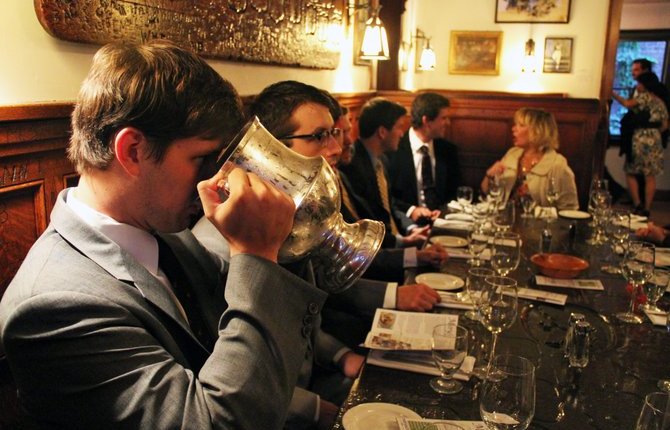
There is some distance between the intentions of Yale’s founders – religious men, mostly graduates of Harvard College – who hoped to train ministers grounded in the principles of the Puritan faith, from which more liberal thinkers in Massachusetts had strayed, and the free drinking members of the Class of 1863 who stumbled into (and out of) Moriarty’s Saloon.  This ale house attracted a rowdy band of students who quickly established “Mory’s” as Yale’s favorite watering hole.  Over the next century, Mory’s became so closely identified with the college and so much a part of the tradition of a cappella singing at Yale that the tavern and the institution became one.

Established as The Collegiate School of Connecticut in 1701, Yale became Yale with the donation of nine bales of goods from its first benefactor, Elihu Yale of the East India Company.  Thus, was Yale established and thus was born the commonly applied nickname – “the sons of Eli”.  Moved to New Haven from Saybrook in 1728, Yale College was the first and only college in Connecticut until the founding of Trinity College in Hartford in 1823.  

By the end of the 18th Century, Yale’s students were required to take Hebrew, Greek, and Latin in order to more effectively study the Bible.  As the influence of German universities crept into American education in the 19th Century, the curriculum broadened.  And, as an agrarian nation became industrialized, the composition and mission of the college changed as well. From preparing the sons of the landed gentry in Connecticut in its first years, Yale increasingly called the sons of industrial and commercial wealth from across the nation. After the Civil War, a new baronial class sprang from steel, railroads, lumber, oil; the newly established private banking houses made finance itself an industry.  The sons of these barons and magnates, raised in sprawling estates above or beside the gritty factory towns, were sent to the newly minted boarding schools (Saint Paul’s, Saint George’s, Saint Mark’s, Middlesex, Groton, Hotchkiss, Choate) and to the older academies (Phillips Andover, Phillips Exeter, Deerfield, and Lawrenceville) before they entered a world of splendid ease in the colleges waiting to welcome them.  

pierpontdavenport

By the late 1800s, Yale was established as one of the nation’s premier institutions of higher education.  Unlike Harvard and Princeton, both of which were somewhat regional in their population – Harvard drawing predominantly from Massachusetts and New England; Princeton from the Middle Atlantic states and the South – by the second half of the 19th Century, Yale enrolled as many students from New York as from New England and as many from the South and Midwest as from New York.

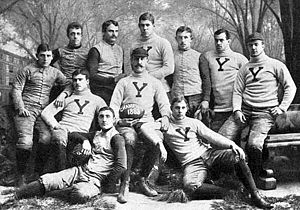
By 1900, approximately 20% of an entering class were sons of Yale graduates, and almost 70% matriculated from private schools.  Public school graduates came from well-established high schools in Greenwich, Shady Side, Merion, Lake Forest, Shaker Heights, Grosse Pointe, Edina, Lexington, or San Francisco.  Yale was almost entirely white and overwhelmingly Protestant.  The proportion of Jewish students was limited to fewer than 10% of any class, and the number of Italian Catholics even smaller.  No black students were admitted to the undergraduate college at the turn of that century, although Yale was the first of the Ivy League universities to grant a medical degree to an African American doctor.
300px-Yale1888

The experience of the undergraduate in the first decades of the Twentieth Century was celebrated in popular literature of the day, and the experience of the Yale undergraduate was peculiarly well imagined.  An article in the June 1961 edition of American Heritage Magazine reflects upon the extraordinary career of Gilbert Patten who, under the pseudonym of Bert L. Standish, produced a novel each week for twenty years, more than nine hundred stories in all, describing the career of Yale’s most prodigious fictional hero – Frank Merriwell.

7409-93272681-jpeg

It took a dozen early novels, set at the “first-rate” and fictional boarding school, Farday Academy, to prepare Frank for the extraordinary career he was to enjoy over the next twenty years at Yale.  The series took on real momentum with the publication of Frank Merriwell at Yale, introducing readers to a hero of consistently high moral standards, unthinkable athletic prowess, and impossible good looks.

Upon his first meeting with the company of gentleman scholars and athletes in New Haven, Merriwell made an immediate and vivid impression:

“He never drinks. That’s how he keeps himself in such fine condition all the time. He will not smoke, either, and he takes his exercise regularly. He is really a remarkable freshie.”

The author of the American Heritage piece, Stewart Holbrook, described the legacy of the series on generations of sports writers:

“Sports writers, when faced with reporting a last-minute home run in the ninth inning, or a long run down the field in the fourth quarter, often referred to this providential stroke as a “Frank Merriwell finish.” This was in an era when the only football, of course, was college football. And if you don’t happen to know where Frank went to college, it was Yale. One of Merriwell’s unforgettable lines went into history:

“You are a cheap cad,” Frank told the overdressed Harvard bully.

Many of the more than nine hundred Merriwell stories, it must be recorded sadly, libeled the illustrious university in Cambridge, Massachusetts.”

Which of the crimes was the greater, one wonders – bullying or being overdressed in Cambridge?

Sports writers may have adopted some of the overblown rhetoric of Standish’s gridiron dramas, but the far greater impact was on millions of boys who grew to manhood idolizing the clean-cut fair play of handsome Frank Merriwell.

A recent edition of The Yale Alumni Magazine took some pleasure in celebrating, “The Ten Greatest Yalies Who Never Were,” including Merriwell, Dink Stover, Tom Buchanan (Gatsby’s rival), Michael Doonesbury, Sherman McCoy (Bonfire of the Vanities), Niles Crane (Frazier’s brother), and C. Montgomery Burns ‘14 (Sometime employer of Homer Simpson).

In describing Merriwell, The YAM proposed this curious tribute:

“In the days when the phrase “Yale man” conjured up an image of a solid, athletic fellow who played fair and came from a good family, Frank Merriwell was an ideal for many American boys—an unequivocal paragon of virtue who had, as one reviewer put it, “a body like Tarzan’s and a head like Einstein’s.

Frank Merriwell did not confine his heroics to the novel.  He appeared in a comic strip, on radio, and in a film series produced by Universal Studios in the 1930s.  

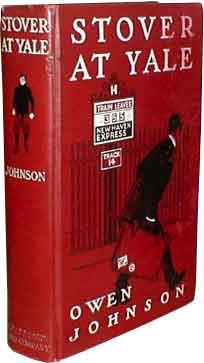
Before Frank Merriwell had finished his illustrious career at the fictional Fardale Academy, however, an earlier hero, John Humperdink (“Dink”) Stover, the hero of Owen Johnson’s “Lawrenceville Stories” and Dink Stover at Yale, left Lawrenceville School for New Haven.
stover_at_yale_book_cover_image (1)

Across the quiet reaches of the Common he went slowly, incredibly, toward these strange shapes in brick and stone. The evening mist had settled. They were things undefined and mysterious, things as real as the things of his dreams. He passed on through the portals of Phelps Hall, hearing above his head for the first time the echoes of his own footsteps against the resounding vault.

Behind him remained the city, suddenly hushed. He was on the campus, the Brick Row at his left; in the distance the crowded line of the fence, the fence where he later should sit in joyful conclave. Somewhere there in the great protecting embrace of these walls were the friends that should be his, that should pass with him through those wonderful years of happiness and good fellowship that were coming.

“And this is it — this is Yale,” he said reverently, with a little tightening of the breath.

They had begun at last — the happy, care-free years that every one proclaimed. Four glorious years, good times, good fellows, and a free and open fight to be among the leaders and leave a name on the roll of fame. Only four years, and then the world with its perplexities and grinding trials.

“Four years,” he said softly. “The best, the happiest I’ll ever know! Nothing will ever be like them — nothing!”

However idealized, Dink Stover’s Yale was more realistically presented, perhaps because Johnson had actually attended the college (as he had actually attended Lawrenceville). From the outset, Stover’s career is filled with richer complexity than the Tip Top Weekly could sustain.  

There are some snakes in this Eden, as Dink Stover finds upon boarding the train for New Haven.  A couple of over-bred and clearly entitled socialites (Andover and Hotchkiss) have begun sizing up the entering class and considering the prospects for the Bulldog football team:

“There’s a couple of fellows from Lawrenceville coming up,” said a voice from a seat behind him. “McCarthy and Stover, they say, are quite wonders.

”I’ve heard of Stover; end, wasn’t he?”

“Yes, and the team’s going to need ends badly.”

Charismatic and athletic, Stover is also intelligent, sensitive, and democratic.  His early friendship at Yale is not with the Andover and Hotchkiss boys but with Tom Regan, a plainspoken man of twenty-two who had fought his way to Yale from a working class background in Iowa.  Like many who arrived at Yale from schools other than the “feeder” boarding schools, Regan has taken an entrance examination in order to win a place at Yale.  It took him six tries to pass, but pass he has.

Moved by Regan’s obvious pride in having earned a chance to enter Yale, Stover offers his untutored opinion.

“It’s a pretty fine college,” said Stover, with a new thrill.  “It’s the one place where money makes no difference…where you stand for what you are.”

Regan turned to him.

“I’ve fought to get here, and I’ll have a fight to stay. It means something to me.”

In short order, Stover finds himself contending with a social system which excludes people such as Tom Regan.  From the start, the well-connected freshmen are consumed with plotting the strategies by which they might win a place in one of the exclusive senior societies.  A place on the football eleven or as an oarsman ensures consideration for one of the better sophomore societies as does “heeling” the literary magazine or newspaper.   

What do you know about the society system here?” said Le Baron abruptly.

Why, I know — there are three senior societies: Skull and Bones, Keys, Wolf’s-Head — but I guess that’s all I do know.”

1283b411f8c9a288c048d81127dc35cd

You’ll hear a good deal of talk inside the college, and out of it, too, about the system. It has its faults. But it’s the best system there is, and it makes Yale what it is to-day. It makes fellows get out and work; it gives them ambitions, stops loafing and going to seed, and keeps a pretty good, clean, temperate atmosphere about the place.”

“I know nothing at all about it,” said Stover, perplexed.

“The seniors have fifteen in each; they give out their elections end of junior year, end of May. That’s what we’re all working for.”

“Already?” said Stover involuntarily.

“There are fellows in your class,” said Le Baron, “who’ve been working all summer, so as to get ahead in the competition for the Lit or the Record or to make leader of the glee club — fellows, of course, who know”

“But that’s three years off.”

” Yes, it’s three years off,” said Le Baron quietly, “Then there are the junior fraternities; but they’re large, and at present don’t count much, except you have to make them. Then there are what are called sophomore societies.” He hesitated a moment. “They are very important.”

Do you belong? ” asked Stover innocently.

“Yes,” said Le Baron, after another hesitation. “Of course, we don’t discuss our societies here. Others will tell you about them. But here’s where your first test will come in.”

There are other voices in the class, levelers who feel the secret societies undermine all that Yale might offer.  Gimbel, a “troublemaker” even at Andover suggests that the membership in the sophomore societies threatens the entire college:

“Stover, it’s a bigger thing than just the peace of mind of our class.”

“But what is your objection to us?” said Stover.

“My objection is that just that class feeling and harmony you spoke of your societies have already destroyed.”

“In what way?”

“Because you break in and take little groups out of the body of the class and herd together.”

“You exaggerate.”

“Oh, no, I don’t; and you’ll see it more next, year. You’ve formed your crowd, and you’ll stick together and you’ll all do everything you can to help each other along. That’s natural. But don’t come and say to me that we fellows are dividing the class.”

“Rats, Gimbel! Just because I’m in a soph isn’t going to make any difference with the men I see.”

“You think so?” said Gimbel, looking at him with real curiosity.

“You bet it won’t.”

“Wait and see.”

skull_bones05_01

In the end, Dink stands against the secret societies, championing friends like Gimbel who read and think.  It is without irony that Johnson suggests that Stover’s virtue is rewarded, of course, when he is tapped as the last man by Skull and Bones.

The Yale of Skull and Bones, sophomore societies, pitched battles between classes , competitions in oration, and championship football is the Yale that gave birth to the Whiffenpoofs.  

By the end of 1909, a select group of voices had tumbled from the ranks of the Glee Club and into Mory’s Saloon.  Their numbers would swell and would include some of Yale’s most illustrious graduates.  By the 1930s, a tapped class at Skull and Bones was incomplete without at least one Whiffenpoof.
The Day I Lost My Faith In All Things Good and Beautiful

The Day I Lost My Faith In All Things Good and Beautiful

Suspension of disbelief – the willingness to suspend one’s critical faculties and believe the unbelievable, sacrificing logic for the sake of enjoyment. But, what if one has no critical faculties?  If there is no sacrifice of logic?  What if BELIEF is at the heart of engagement, and the stakes become so high that enjoyment  is off the table?

In the world of professional wrestling, the term “kayfabe” is used to describe the elaborate stratagem by which a narrative of primal battle – good vs evil, clean vs dirty, athlete vs thug, hero vs villain – is developed and maintained.  I’m an adult now  and capable of seeing professional wrestling as it is, recognizing it as a peculiarly American kabuki, choreographed, often sadly absurd, with predetermined and specifically scripted outcomes.

Now I know.

August 24, 1960 – Bridgeport, Connecticut

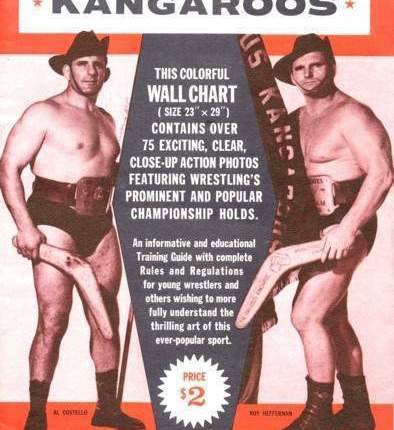
The match held in the Bridgeport’s Armory was what was called a House Show, not televised.  I don’t mean not televised nationally; I mean not televised at all.  I was confused, of course, because the main event was a second defense of the WWWF tag team Championship, pitting Red and Lou Bastien against the filthiest of competitors, the Fabulous Kangaroos, rancid thugs from the Outback, “managed” by Wild Red Berry, a former wrestler and boxer, notorious for dirty tricks and unscrupulous methods of prying victory from the jaws of defeat.  Berry would later “manage” Killer Kowalski,and his tag team partner,  Gorilla Monsoon, speaking for the behemoth, ostensibly a mute from Manchuria (kayfabe)..

As one might guess, the Bridgeport Armory was not Madison Square Garden, the venue for most televised major matches.  At the Garden, rising stars such as Bobo Brazil and Nature Boy Buddy Rogers grunted their way through the undercard as established champs, Vern Gagne, Nick Bockwinkel, Argentina Rocca, Bruno Sammartino, Dick the Bruiser, Hard Boiled Haggerty,  Killer Kowalski, and Haystacks Calhoun enjoyed the limelight. In Bridgeport, Sailor Art Thomas and Bruno Sammartino were the headline singles match, and the third in a series of grudge matches between the Kangaroos and the Bastien Brothers was the top of the card.

Look, I am aware that puerile admiration of large sweating men is not the most appealing of subjects, and I am almost certain that few readers will care to track the history of professional wrestling much farther, if any tracking has actually happened thus far.  My hope is that you can stick with me long enough to understand the depth of betrayal I experienced, not as a foolish fan of wrestling, but as a citizen of a great republic.

I grew up in the northwest corner of Connecticut in the 1950’s, surrounded by farms and forests.  I saw other children at school, but had no playmates.  My parents  and their friends were artists, writers, academics, and musicians, fully engaged in creative endeavors, simply unavailable when a boy such as I, consumed by passion for all sports, begged to be taken to a baseball or football game.  I read Sports Illustrated and Sport Magazine from cover to cover, Baseball Digest, the Street and Smith pre-season guides, novels by John R. Tunis (The Kid from Tomkinsville, The Kid Comes Back, The Iron Duke, The Duke Decides),  The Chip Hilton series, the Bronc Burnett Series, The Fireside Book of Baseball.  My room was festooned with college football pennants and a striking set of prints by Robert Riger, distributed by Shell.  My NY Football Giants heroes were all around me – Sam Huff, Dick Modzelewski, Frank Gifford, Kyle Rote, Alex Webster, Rosie Brown, Charlie Conerly.

But I knew I’d never see a real game.

Through a tangled series of events, an elderly refugee from Germany became our housekeeper.  She may have kept house in some extraordinarily loose definition of the term, but she did settle in daily for marathon binging in front of our television, limited though viewing options were.  Queen for a Day was a particular favorite in the afternoon, but the evening was set aside for, you guessed it, professional wrestling, broadcast on the now-defunct Dumont Broadcasting System.

I learned at the knee of an expert.  Enamored of Gorgeous George, an extravagantly coiffed and wardrobed psychopath, a 300 pound vicious Liberace, Mrs. Orschler screamed in German at those who threatened him.  I came to appreciate the athletes, Vern Gagne, who had been a medal winning amateur wrestler and Italian/Argentine Antonino Rocca, a gifted gymnast, prone to flying from the top of the ropes, summer saulting his victim into the “Argentine Back Breaker”, a complicated half-nelson.

And, she would take me to matches in New Haven and Bridgeport.

I had other heroes, of course.  I knew the stats of every New York Yankee (Yogi Berra, Bill Skowron, Clete Boyer, Andy Carey, Gil McDougald, Bobby Richardson, Tony Kubek, Elston Howard, Hank Bauer, Enos Slaughter, Mickey Mantle, Whitey Ford, Ryne Duren, Don Larson, Bobby Shantz, Bob Turley), admired Bob Cousy, Gordie Howe, Maurice “Rocket” Richard, his smaller brother Henri “Pocket Rocket” Richard,  Jim Brown, and Otto Graham, but the only heroes I had actually seen in person were Red and Lou Bastien, the Bastien Brothers.  They were true athletes, flying from one corner of the ring to the other, leaping from the ropes, flipping and cartwheeling, tagging each other into the ring wth what I could only call inspiration.  No, genius!

In the tumult that was professional wrestling, amidst the low life cheaters and cads, they were decent and honorable, courageous, generous, and … and I believed with all my heart that they were as they seemed, men of dignity and skill, fighting cleanly for their place at the top of their profession.

The Kangaroos stood for all that was vile, in wrestling and in sport.There were other heels, of course, louts who applied the forbidden choke hold, or who secreted some dangerous object in their trunks, an iron bar, say, with which to club a more able opponent to the mat. The Kangaroos resorted to all these and more, dragging chairs into the ring, slamming their victims into tables at ringside, even producing shards of glass from a hidden pocket, opening a gash over the eye of one of their betters.

They tagged illegally.

I know, compared to slicing and smashing, improper tagging out seems relatively benign, but it struck at the core of my sense of fair play.  What’s left to hold the universe together if tag teams don’t tag as they should?

All of that aside, Wild Red Berry also contributed to their crimes, frequently holding an opponent immobile while a Kangaroo punched (illegally), or throwing dangerous objects into the ring.  Terrible stuff.

The Bastien Brothers had defeated the Kangaroos in a title bout in New Haven in April, then lost the belt to them in June, in Washington, D.C.  Rematch in BRIDGEPORT, and with  no assigned seats (barely seats anyway); I could almost literally be in the Bastiens’ corner.

I cannot bear to relive the match in detail  The Bastiens fought nobly, cleanly, winning the first fall.  They had the Kangaroos well in hand, seemed about to end the match early, when an illegal tag (see?) brought both Kangaroos into the ring against a single Bastien.  My faith in a benign universe not yet violated, I quivered at the edge of the ring as the third and final round began.  After a few moments of unremarkable pulling and tugging on the part of both teams, Wild Red Berry snuck into the action, dragging a chair.  Lou Bastien had Australian Al Costello in a submission hold; the Kangaroo was attempting to tap out when his partner, Roy Heffernan (illegally) leapt into the ring and punched Lou in the throat (illegal).  Red, seeing his partner fall, started to clear the ropes only to be driven to the floor by impact of a swung chair.  Lou, gasping was held down by both Kangaroos and pinned (illegal), and Red lay in what I assumed was a terminal coma.

Disappointing.  Disturbing.  Quasi-Traumatic.  But this debacle was not the cause of my loss of faith in all things good and beautiful.  No, that would come two days later.  I was inconsolable and furious.  The more I considered the many wrongs done to my heroes, the more determined I was to set things right.

I was twelve years old.  I had no money, no friends, no influence, but I lived in America, the land of Lincoln and Roosevelt; justice would be served!

I borrowed two dollars against my allowance and composed a telegram to the highest office in the land.

“Dear President Eisenhower.  A great wrong has been done to the Bastien Brothers.  Only you can bring justice to the true tag team champions of the world.  In the name of all that makes America great, I call upon you to repair this outrage.”

August turned to September.  Not a note, not a letter, no telegram, no phone call, and, from what I could gather, NOTHING had been done.  I knew Eisenhower was in the last months of his presidency, but come on; with great power comes great responsibility.

Kennedy won the election in November, and the burden of leadership of the world’s most powerful nation slipped almost seamlessly from Ike to JFK.  It seemed unlikely that Eisenhower had passed my telegram on to his successor; it wouldn’t have taken much time to have a quick conversation in passing, but, I guessed other issues might hsve elbowed my plea aside.

I vote, and I do feel a sense of responsibility to stay abreast of current affairs so as to remain part of an informed citizenry, but, at some level, I know that justice is not always served, virtue is not always rewarded, evil can win out over the good and true. In the course of a lifetime,of course,  I’d be disappointed again and often.  Only two months later, at the start of my ninth grade year, Bill Mazeroski would hit the only seventh game walk-off home run to give the Pirates the World Series victory over my Yankees. I was crushed; for the next eight months, I had to listen to the braying of the boorish Pirate fan with whom I shared a dormitory common room.  Disappointing, sure, but a loss delivered within the rules of the game.  The rules of the game.  As weeks without a response from the White House stretched into months, I realized that I had lost my belief in the transformative power of sport and my faith in the rule of law.  It was only a short step to the cynicism that stained my world view throughout the late 1960’s, for what is a cynic but an idealist who has been crushed by the weight of the real?

I try to remember the idealism with which I sent that telegram.  I like that deluded, hopeful kid, worked up enough  to expect a nation to protect decency and honor.  Sure, the match was  a sham, and my outrage was misplaced, but as I think of how betrayed I felt, over what was and is a trivial moment, I can summon appropriate determination to take on the real and larger  wrongs in a complicated world.

I am but one, but I am one, and I’m saving my allowance for some truly beefy telegrams.


Zen and the Art of Shaving

Zen and the Art of Shaving

“And what impels him to repeat this process at every single lesson, and, with the same remorseless insistence, to make his pupils copy it without the least alteration? He sticks to this traditional custom because he knows from experience that the preparations for working put him simultaneously in the right frame of mind for creating. The meditative repose in which he performs them gives him that vital loosening and equability of all his powers, that collectedness and presence of mind, without which no right work can be done.”

Eugen Herrigel – Zen and the Art of Archery

I am a creature of habit, I admit; there are those in my family who might suggest that I am a slave to habit, but they fail to understand that the collectedness and presence of mind with which I enter the day is due almost entirely to the rites and rituals with which I begin the day.

I have been shaving for many, many years, but spent the first thirty with no regard for the manner with which I scraped away my daily stubble.  Tedious necessity, I thought, shaking my can of aerosol shaving cream and picking up the flimsy disposable razor.  I had long since abandoned electric shavers as they failed to provide smoothness of cheek, and they made too much noise early in my day.  So, I shaved “wet” with little appreciation of the varieties of apparati available to the discerning shaver.

(N.B.  Grammarians drop gloves over the use of “apparati” as the plural of apparatus.  It’s an odd locution, I know, but, really, any more affected than “campi” to describe more than one campus or “auditoria” in speaking of more than one auditorium?  “Sanitaria”?  If one wild excess is a rumpus, are several “rumpi”?)

Back to shaving.

As a lad, I was taken with Burma Shave’s  tortured rhymes placed on billboards across the nation.  Actually, the doggerel verses were placed on small boards separated by some distance, so that the auto approaching them read the first line, then the second, then the third, and had to wait a bit for the fourth.

Shaving brushes

You’ll soon see ’em

On the shelf

In some Museum

Had to admire the wit and waggery, so used Burma Shave until I became environmentally awake, then scraped away with whatever soapy substance I could find at the local pharmacy.

Emotionally unattached to the standard soaps and devices, I knew I had to cast a wider net. Eager as I was to remain unsullied by website surfing, I nonetheless searched for more satisfactory shaving soaps, buying a ceramic shaving mug and the first of many shaving brushes on-line.  I was still a perfunctory shaver, glad enough to find relatively pleasant shaving soaps, but unmoved by the experience of shaving.  Just a job.  Get it done.  And then …

I stumbled across the line of shaving creams produced by Taylor of Old Bond Street.  Jeremiah Taylor founded the company in 1854, during the reign of Queen Victoria, determined to reflect British understated style and  elegance. I took the plunge, ordering the Eton College College Collection Gentleman’s Shaving Cream Bowl, first produced when Taylor of Bond Street became the official barber of Eton College.  The description of the substance was simply irresistible.

“A beautiful masculine fragrance with dominant citrus lemon notes combined with fruity citrus notes of orange and mandarin. All this is blended with gentle floral notes that rest on a base of warm patchouli. Contains Lemon oil and Patchouli oil.”

All true and the smoothest shave I had ever experienced, but was I satisfied?  No, not by a whisker!  A shaving cream this delicious demanded a far better brush than the hand-me-down I had found at the bottom of a bureau drawer.  Over the years, I found I preferred the Infinity Silvertex Shaving Brush by Kent.  Badgers breathe more easily as this is a synthetic bristle brush, which dries more handsomely than the badger brush, but I have learned that every face and every shaver is different.

Brush in place, Eton College cream almost done, I took a leap of faith and tried the rest of the Taylor line.  Again, each cream has a personality and each sends the shaver into the day with a different sort of embrace.  Eton College Cream is the heart of my shaving routine; I order it as the first in my rotation of three, substituting a few other favorites in turn.

Mr. Taylor’s Cream has (A fresh fougere accord with herbaceous top notes of lavender, bergamot, green notes resting on a heart with geranium and soft green fern.)  I must have missed the herbacious top notes; Mr. Taylor is not in my cream rotation.

Sandalwood (top notes of geranium, lavender, rosemary and liquid amber supported by a heart of carnation, fern and orange blossom resting on a sumptuous base of patchouli, sandalwood, vetivert, powdery musk and rock rose) was perfectly fine, but not a top choice.

The St. James Collection (A fresh masculine fougere opening with bergamot and mandarin intertwined with citrus ozone notes supported by a fruity floral heart resting on a woody amber base) is fresh and somewhat smoother as it lathers, winning a spot in the rotation.

Jermyn Street Shaving Cream Bowl for Sensitive Skin is allergin free and remarkably soothing.  It, too, has a place on the shelf.

My favorite, Grapefruit Shaving Cream, however, is an oddity, hardly recognizable as part of the Bond Street Collections.  In fact, only a true believer can find the product on the Taylor of Old Bond Street site, and there is little of the romance in the prosaic description ( Invigorating Grapefruit Shaving cream creates a uniquely smooth and creamy lather while protecting and moisturising the skin to give a better shave.)  Ho Hum, and yet … neck and neck (as it were) with Eton College, in part because it makes the bathroom smell delicious throughout the day, and in part because it brings just a soupcon of zest to the shaving adventure.

I’m less fussy about razors, pretty much sticking with those that have the heft and balance to allow the elaborate choreography of my three-zone shaving.  My current safety razor is the Merkur, standard length.  I have done considerable comparison of blades, however, going so far as to order blades sharpened by nameless blade mechanics in Bangkok before settling on Astra Superior Platinum Double Edge Razor Blades, made in Russia.  I bought 100 blades three years ago and have thirty five left; they remain sharp for more than a month’s daily shaving.  Of course, I also use one of Harry’s fifteen dollar razors and their cartridge blades ($2.00 each) for the final pass, expecting each cartridge to last  about a month-and-a-half.  I’d buy Harry’s products even if the blades were less impressive; they have the most handsome packaging in the retail shaving world.

Products aside, the real value of the morning’s routine is in sinking into each stage of preparation and application.  Many experts suggest showering before shaving; my brother shaves WHILE shaving.  I don’t like the hot towel wrap (claustrophobic), but I do use two steaming hand towels and a brush that has been sitting in steaming water. A quick swirl brings cream to brush, circular massage, lather to cheeks.  Swipe once chin, next upper lip.  Shave with the grain, cheeks, lather and shave against the grain, neck , lather and shave from left to right on the chin.

No need for moisturizers or lotions; I’ll have the trace scent of the shaving cream with me, even after I shower, and no chance of dryness through the day.

Is this Ikebana, the Tea Ceremony, or the Japanese Bathing Ritual?  Probably not, but at least it is not seppuku.  I should note, however, that I keep an alum block on the presentation towel where lie the razors and  the brush.  The more commonly used styptic stick is a flimsy and less effective corrective to a loss of concentration.  It is the concentration, after all, that brings collectedness and presence of mind, the zen of shaving.


Pat Summit’s legacy and the state of women’s sports

Pat Summit’s legacy and the state of women’s sports

Pat Summit died this week at the age of 64 after a long fight with Alzheimer’s Disease.  She began her career as a college athlete before the introduction of Title IX, playing for the University of Tennessee – Martin and on the first Olympic Women’s basketball team.  As a coach, primarily at the University of Tennessee, Pat Summitt won 1,098 games, eight national championships, and an Olympic gold medal in 2004.  She was inducted into the Naismith Basketball Hall of Fame, named the Basketball Coach of the Century in 2000, received the Presidential Medal of Freedom in 2012 and the Arthur Ashe Courage Award in the same year.

She never had a losing season.

Pat Summitt was tough and bred toughness in her players.  Many of them pay tribute to her on this excellent overview of her career:   http://espn.go.com/core/womens-basketball/

For those of us who watched the Lady Vols play basketball at the highest level, watched Tennessee battle powerful Louisiana Tech and Baylor, and begin a heated rivalry with the University of Connecticut teams coached by Geno Auriemma (Auriemma’s U Conn Huskies have won a combined 108 games with no losses since 2013) , women’s basketball seemed about to explode as one of America’s most-watched sports.  At roughly the same time, America fell in love with Mia Hamm and Brandi Chastain, and later with the current US National Soccer Team, faithfully watching every game of the Women’s World Cup and lining up for subsequent practice matches and exhibitions.

At some point, I’ll indulge in a rant about the importance of Title IX in the evolution of modern athletics; let’s just remember that, facing violent opposition by the men who held control of the event, Katherine Switzer was the first woman to finish the Boston Marathon in 1967, having entered under the name, K.V. Switzer, and that she was attacked on course by a race official who tried to rip the number off her jersey.  1967!  Before Title IX, the principle athletic activities for girls in high school were cheerleading and square dancing.  As a college athlete before Title IX, Pat Summit remembered playing three games in a row at Tennessee Tech in the same sweaty uniforms; they had no money for a change of clothes.  Female Olympic swimming and track athletes came from AAU clubs and associations, not from high school and college programs.

Today’s rant, however, is about the relative insolvency of women’s professional sports in the United States.  The top ranked player in the LGPA, Lydia Ko, pulled down $1,816,738.00 in 2015.  Jordan Spieth, the top PGA golfer in that year, hauled away $53,400,00.00 million in prize money and endorsements.  Serena Williams is the most successful female athlete by far; Williams ranks 40th in the Forbes list of wealthiest athletes with an income of $28,900,00 in 2015.  Who is ahead of her?  Well, Tiger Woods pulled down more than 45 million last year, Joe Flacco more than 44 million.  Tennis player, Kei Nishikori earned more than 33 million.

And tennis and golf are the two most well established of women’s sports.

All of this arrives with my disappointment that so few people are watching top level basketball played in the WNBA, and, that, outside of Portland and Seattle, an equally small number are watching NWSL soccer.

The Portland Thorns lead the league, five points ahead of Chicago and ten ahead of arch-rival Seattle; Portland has five of the national team on their roster, including Meghan Klingenberg, Lindsey Horan, Allie Long, Emily Sonnet, and Tobin Heath.  Everyone’s favorite goal scoring machine, Carly Lloyd plays for the Houston Dash; Hope Solo is goalkeeper for the Seattle Reign.

Meanwhile, the three dominant players on U Conn’s undefeated team, Brianna Stewart (Seattle Storm), Moriah Jefferson (San Antonio Storm), and Morgan Tuck (Connecticut Sun) were the first three picks in the WNBA draft, and the level of play in the WNBA continues to be impressive at both ends of the court.  Ball movement, sharpshooting, and great defense are impressive, as they are in the women’s collegiate game.  Guards Diana Taurasi, Elene Delle Donne (also a dominant forward), and Skylar Diggins direct beautifully choreographed offense, leading fast breaks and passing with sharp accuracy. Forward Maya Moore is Taurasi’s equal on the floor, an outrageously effective shooter, and Candace Parker is still a tough competitor. (Make sure you hear her tribute to her coach,Pat Summitt).   Right now, Brittney Griner is the most respected center in the league, but Briana Stewart is on the way.

Until the Golden State Warriors developed an elegant offense based on ball movement and precise shooting, I pretty much watched only the last two or three minutes of games in the NBA.  Despite a life-long interest in soccer, I tune in and out of most men’s games.  I’m a Tigers fan and watch those games in their entirety (when they get some air time), but drift and out of most other MLB games until the playoffs.  Novak Djokovic is a freak of nature; I’ll watch him play anyone.  I won’t watch most men’s matches with the same fascination.  College football?  NFL?  Red Wings hockey?  Can’t tear me away from the screen, and …

I like watching women’s sports at the highest level.  There is no greater drama at the moment than Serena’s quest for another Grand Slam title, which would tie her with Steffi Graf.  She has a raft of younger rivals, all playing with focus and grit in order to match her power and will.  Pretty great tennis, and the number of young American players starting to climb makes every tournament interesting, no matter who ends up in the final pairing. Women’s soccer makes sense to me as the men’s version does not, perhaps because I am allergic to flopping and endlessly unproductive runs.  I watch the NCAA softball world series because the laws of physics do not permit at least of the three pitches that seem to operate by remote control.

The good news is that with the arrival of the Summer Olympic Games, swimmers, divers, gymnasts, runners, jumpers, rowers, archers, cyclists, volleyball players, equestrians, weightlifters, and rugby will join women playing tennis and soccer.  My only regret is that most Americans will not see the dominant softball players who so overpowered all competition that the game has been removed from the Olympic line-up; maybe in 2028?


BREXIT, Global Environmental Disaster, Nativism, Income Inequality, Post-Industrial Economy, and the Death of Capitalism

BREXIT, Global Environmental Disaster, Nativism, Income Inequality, Post-Industrial Economy, and the Death of Capitalism

I’m overwhelmed.

I intend to write a short and admiring response to Rana Foroohar’s Makers and Takers and to her contention that American (and global) business has given way to speculative financialization (i.e. taking / not making), but the sheer volume of critical and inescapable SOLVE-ME-RIGHT-NOW crises has reduced me to near catatonia.

Please consider these realities:  Quite aside from climate change, the disappearance of species, the certainty of wildfires, hurricanes, and melting glaciers (better hurry – Glacier National Park is almost out of glaciers, and one prognosticator advises that with sustained drought, Yosemite will look like Joshua Tree), aside from this apocolyptic global crisis, we have more than enough local issues to keep us nervous for quite a while.  Wells in California have gone dry, the Colorado River no longer runs its full length, Phoenix and Las Vegas face some long-postponed issues of water scarcity, Oklahoma now has more earthquakes than California, thanks to extensive drilling, the City of Flint, Michigan still depends on bottled water, and children there have been irrevocably damaged by lead poisoning, and parts of the Louisiana Gulf coastline have already disappeared.  Of course, it could be worse.  In the Middle East, the Dead Sea is shrinking by the hour, vanishing into a giant sink hole.

Not enough?  Homeless men, women, and children clog the streets; more than twenty percent of all children in the U.S. live in poverty.  Schools and prisons have become warehouses, holding pens for the American underclass, much of which is made of people of color.  Renewable resources are increasingly not renewable, what was once a middle class has largely disappeared, the number of working poor increases annually, millions of refugees live in desperation, some streaming into Europe, some into the United States (51% of whom are children fleeing gang and cartel violence), Russia is rattling sabers in the Middle East and China in the South China Sea.  Oh, and North Korea has nukes.

So, the European Union is under siege, as is NATO and the United Nations, nativists are contending for power in Austria, France, and Britain, and a reality tv star has hijacked the Republican Party as millions of Americans have had enough.  No new jobs, growing mountains of debt, and little in the way of encouraging growth in any sector but cosmetic surgery.

As far as I can recall,  I was not notified when the decisons were made to abandon every certainty I had embraced throughout a reasonably long and happy life.  I am pretty sure I would have noticed if a note had been slipped under my door promising that a free-market economy, liberal democracy, good jobs, clean air and water, multitude of animals, forests and icebergs, well-paved roads, national pride, effective government, and public civility would all be on the brink of extinction by the time I became a grandfather.

OK, I came of age in the tumultuous ’60s , when the promise of a better world was not only conceivable, but set to music. It had a beat; you could dance to it, and dance we did.  Maybe we should have danced less and done the grunt work necessary to shaping the future as we imagined it, but the brightness of the future was so patently obvious; in the simplest of terms, all we needed was more of everything.  More people, more money, more channels, more celebrities, more kinds of food, more technology, more medicine, more power.

Apparently, we all missed the memo.  “Today is the tomorrow you should have worried about yesterday.”

Well, we didn’t worry enough, perhaps because for some time we were cowering under desks waiting for the next nuclear holocaust, or because a bit later things seemed to be going so delightfully well.  Who or what is to blame for our current undeniably bleak prospects?  I would love to pin it all on those who do not share my political or spiritual convictions, but the truth is probably in the shabby admission that we have been greedy.

“Greed is Good.”  Gordon Gekko’s anthem to excess in 1987’s Wall Street rang down through the subsequent decades, and, even when we really did know better, there was something exhilarating about the cunning and craft of mergers, acquisitions, and booming markets.  Sure, we used terms such as “Barbarians at the Gate” to describe corporate raiders turning leveraged buy-outs into huge personal fortunes, but we secretly thought corporations could use some shaking up, and, after all, is not the accumulation of 4.8 billion dollars (Henry Kravis) the real stuff of an American Dream?  How does an ordinary Joe get in on the action?  Play the market, sure, but in the 2000’s the fast money seemed to be in Real Estate.  Need a loan?  No Problem.  No collateral?  No problem.  You can turn this house around tomorrow, buy two more, and join the parade.  The big banks and investment houses leapt at the chance to play with pensions; the elevator seemed to go only up and up and up.

Then the economy went into the toilet.  Not so much fun anymore.  Well, actually, we loved that decade’s worth of hyper-speculation in which debt became the most significant American commodity; the market had gone berzerk, and paper fortunes puffed us up mightily.  Then the bubble began to sag in 2006, got saggier in 2007, and totally went flat by 2008.

Michael Lewis had the chutzpah to think that he, a mere financial reporter, could untangle the complexities of the most debilitating collapse of Wall Street since the Great Depression; he not only figured it out but told the story with such clarity that had a six year-old read the book in 2005, he could have seen the collapse coming.  The Big Short sold well as a non-fiction expose, and the film version was equally well received.

Huh. Let’s think about that.  Audiences were charmed to see hedge fund managers make personal fortunes by betting against the market.  Sure, it was fun to see the big houses take it in the shorts, knowing that Lehman Brothers went bankrupt with something like 600 billion in assets, but preventing the next depression  brought even more swollen federal debt and virtually no reform of the structure of American (or global) financial machinery.

makers_and_takers_final

And that’s where I have to go next, having recently read Makers and Takers : The Rise of Finance and the Fall of American Business.  The central premise of Rana Foroohar’s investigation of contemporary economics is so much worse than I had expected.  Foroohar’s well documented assertion is that we learned nothing from the last global melt-down, did nothing to prevent other speculative bubbles, and, in fact have failed to see that the business of America is no longer business but financialization.

The book opens with a description of Apple’s CEO, Tim Cook’s most notable initiative in 2013 – borrowing $17, 000,000,000 in order to buy … stock in Apple.  Apple could have been seen as quite comfortable, holding roughly 145 billion dollars in various safely held accounts (hello, Panama Papers/ good bye taxes paid to the U.S.), and another roughly 3 billion streaming in EACH MONTH.  You and I might be cautious in borrowing 17 billion dollars, but Apple gets its money at a rate far lower than we mortals.  OK, you say.  Sure,  that’s a lot of cash, but it costs big money to open new frontiers in technology.  Hmmmm.  are we talking about the Apple watch?  Oh, that’s right.  Nothing new from Apple in a while.

The 17 billion in repurchased stock created some hefty dividends and drove the price pf the stock higher, even though nothing new had been released into the market.  So, what does Apple make these days?  Paper fortunes for its largest stockholders (including Tim Cook).

In microcosm, that deal is what American capitalism looks like these days.  Big money is in finance, essentially in speculation.  It doesn’t take much deliberation to see that speculation has two notable disadvantages in the operation of a national (or global) economy.  In the first place, obviously, nothing is created, fabricated, produced, grown, distributed, or sold.  And, as a consequence, speculation does not create jobs or increase the financial well being of any but those who speculate successfully.  There can be no “trickle-down”, especially if assets are hidden outside the country and invisible to taxation.

I am a bear of very little brain when it comes to issues of finance, but I found myself moved and surprised in hearing Hillary Clinton speak to coal miners in West Virginia.  She told the truth: The jobs aren’t coming back.  West Virginia’s economy is obsolete, and no amount of politically motivated posturing is going to fix their economy.

I would never counsel politicians to speak the truth in an election year; voters don’t want to know how little an elected official can actually do.  I give Hillary a lot of credit for dropping the candidate’s mask long enough to see a real human across the table; that goes a long way toward starting a real conversation about banks and corporations “too big to fail”.

My grandchildren may not be able to see stars in the sky (hope they won’t miss tigers, polar bears, and most of Louisiana), but there is still time to address the ravages of piratical financial speculation in order to begin the process of rebuilding roads, bridges, dams, schools, and trust.  There is still time to remember how to make rather than take.