Trump Agrees to Eliminate Nouns and Verbs … Only Descriptors and Injunctions

Trump Agrees to Eliminate Nouns and Verbs … Only Descriptors and Injunctions

After lengthy consultation with his campaign staffers and conspiracy theorist, Alex Jones, candidate Donald Trump has determined to provide more concentrated and efficient policy statements by simply responding to questions with adjectives, adverbs, and injunctions.

“We killed ’em in the forum with adjectives!  Decimated, remember “decimated”?  That’s such a big word!”  This observation by a highly placed staffer in the Trump campaign organization is at the heart of the repurposed syntax of a candidate with big ideas to present to the American people in the few weeks left before the election.

How would this initiative work?

Although Mike Pence, candidate for Vice President, felt it might not have the ring of a truly Reagan-esque performance, Jones supplied the following scenario as most plausible, :

A lingering shot of Hillary Clinton’s portable bed and wheelchair back stage, at the ready to carry the Democratic candidate back to the pod from which the Lizard Overlords have released her as part of the scheme to claim Planet Earth, as the faked Sandy Hook shootings, faked moon landing, faked Oklahoma City bombings, and faked 9/11 have not yet brought an unsuspecting public to its knees.

A hand-picked interviewer (Ann Coulter?) tosses a single name at Trump who then is free to pack more invective per minute than is currently possible.

Hillary?

“Sexist, very sexist.  Believe me, sad really, very sexist.  Really.”

“Not well. Sick really.  Believe me,messy.  Sick, very sick. Sickening really.  True.  Sad but true.  Sad really.  Very ill”

“Listen, lying.   Criminal, really.  Probably criminal. Believe me, terrible.  Criminal, lying.  Disastrous.  Disasterous!  Horrible. Truly horrible. Criminal.”

America’s military?

Decimated.  Decimated.  Truly decimated.  Horrible, really.  Dangerous.  Believe me, useless.”

His Plan to Defeat Isis?

“Huge, very huge.  Stunning, believe me, stunning.  Secret, actually secret. Top level secret. Unexpected.  Shocking, actually shocking.  So unexpected.  Believe me, so shocking.”

His Plan to Make America Great Again?

“Great.  Really great.  So good.  Listen, better.  Actually, so much better, probably truly great.  Fantastic, actually. Truly, truly fantastic.”

Critics may complain that Trump’s pronouncements continue to lack specificity, but the campaign feels the new initiative packs a punch and drives home the candidate’s extraordinary insight and energy.


A Well Read Childhood

A Well Read Childhood

Recently I happened to be at the table with my brother and his family.  His daughter is an author-illustrator who had shared with me four projects that will become indelible memories for children of the next generation, my nephew is a rabid fan of fantasy, science fiction, and twisty humor.  My sister-in-law reads everything, but holds a special fondness for Jane Austen and all things Austen.  My brother is a potter, a craftsman who thinks deeply about the books he meets, almost always allowing me to see something in a book that I had missed entirely.  They are all fascinating minds

They had allowed me to gulp down Harry Potter and the Cursed Child, a pleasure that brought to mind the other books that had meant so much to me at various points in my younger life.  So, I asked the question, “What was your favorite book as you grew up?”, and the next two hours flew by.

These are quite distinctive personalities, this bunch; I number my quirks among the company of these idiosyncratic readers, and regret to report that we have a tendency to range pretty far afield in our tastes.  I’d like to offer the single most firmly held attachment, but the celebration of one book (or series) seemed to set off a string of accolades for another.  Consider this range:  Little Women, The Heart of a Dog, Nobody’s Girl, Captain’s Courageous, Five Children and It, Good Omens, The Mixed Up Files of Mrs. Basil E. Frankweiler, The Story of Dr. Doolittle, The Oz books, Smokey the Cow Horse, The Secret Garden, the Narnia series, The Fireside Book of Baseball.  In later years, we found we shared one favorite, Carry On Jeeves (actually, all the Jeeves and Wooster stories and novels… oh, and the Rumpole of the Bailey series… Austen, of course, and J.K. Rowling.)

Some time ago I did some research on what was standard fare for middle school readers at the start of the Twentieth Century.  The results were … interesting.

Most popular books at the turn of the Century, say 1908?

Harold, Last of the Saxon Kings – Edward Bulwer Lytton, Courtship of Miles Standish – Henry Wadsworth Longfellow. Gold Bug – Edgar Allen Poe, Captains Courageous -Rudyard Kipling, The Spy – James Fennimore Cooper, Treasure Island – Robert Louis Stevenson, Lobo, Rag, and Vixen – Ernest Thompson Seton, Adventures of a Deerslayer – James Fennimore Cooper, and Evangaline – Henry Wadsworth Longfellow

If any of those novels were offered to students today, they would be placed at the 10th or 11th grade reading level, leading me to hope that books of comparable complexity and challenge still attract the readers clustered at the younger end of the mix of the Young Adult cohort.

Recently, the College Board published a list of books recommended as summer reading in order to build and maintain fluency, develop critical reading skills, and enhance vocabulary.  The lexile level to which students in grade six and seven are encouraged to read ranges from 950 to 1090.

As a point of comparison, here are the lexile scores for three of the most popular YA novels:

John  Green – The Fault in Our Stars          850 l

Suzanne Collins – The Hunger Games       810l

Veronica Roth – Divergent                           700l

Here are books that fit the bill in terms of lexile difficulty for sixth and seventh graders.

J.K. Rowling – Harry Potter and the Chamber of Secrets

Harry Potter and the Order of the Phoenix

Harry Potter and the Half-Blood Prince

 Harry Potter and the Deathly Hallows

Charles Dickens – Oliver Twist

Charles Dickens – David Copperfield

J.R.R. Tolkien – Return of the King

Philip Pullman – The Golden Compass/ The Subtle Knife / The Amber Spyglass

Ray Bradbury – Dandelion Wine

Daniel Keyes – Flowers for Algernon

Tom Clancy – Clear and Present Danger

Scott Momaday – House Made of Dawn

Michael Creighton – Congo

Mark Twain – A Connecticut Yankee in King Arthur’s Court

Bram Stoker – Dracula

Robert Louis Stevenson – Kidnapped 

Steven King- The Stand

George Orwell – 1984

Wilde – The Picture of Dorian Gray

H.G. Wells –The Invisible Man

T.H. White – The Once and Future King

Rudyard Kipling – Kim


As I write, the light has softened, a few trees are starting to turn, a pumpkin actually emerges from the undergrowth in the garden, and things have cooled enough to tempt me to sprawl on the deck with one of the books from the pile by my  bed.  It’s an awfully good way to spend one of the first afternoons in the fall on our little farm in southern Oregon.


Measuring Ahnold In Every Way

Measuring Ahnold In Every Way


My daughter grew up in California at a time in which the state and the governor seemed to be in a perpetual state of crisis; Gray Davis was recalled and removed within months of the start of his second term.  Then, the improbable candidacy of Arnold Schwarzenegger quickly went from dubious prospect to inauguration followed by a solid two terms as Governor of California, leading her to belive that Schwarzenegger completely measured up as highest office holder in the state.

I did some measuring myself, back in 1977 when I met Schwarzenegger and had the opportunity to run a tape measure around his neck, not a feat I’d try again, and a little daunting even in retrospect.  This once-in-a-lifetime opportunity arose as Schwartzenegger appeared at the unofficial premiere of the film that was to set him on the road to stardom.  Through an odd set of circumstances, I was involved in the arrangement of that event and complied with the star’s command, “Go ahead.  Measure my neck.”

The film was Pumping Iron, a docudrama produced by George Butler, based on the essay, “Pumping Iron” by Charles Gaines.  It was the first film to feature Arnold Schwarzenegger, then known as an Austrian bodybuilder who had captured the title of Mr. Universe in 1966, Mr. Olympia in 1969, and whose sculpted physique virtually owned international bodybuilding throughout the 1970’s.  He’d had bit parts in two movies, one of which, Stay Hungry, had something of a cult following because of Schwarzenegger’s role.  Pumping Iron was released in  January of 1977 and was a commercial success, kick starting Schwarzenegger’s career in film and accelerating the development of franchised exercise and fitness gyms.

Buzz about Gaines’ article had grabbed the attention of Dino de Laurentiis who was looking for a project for his daughter.  By the time Arnold and I met face to neck, he had been cast as Conan the Barbarian, a role that established him as the premiere piece of beefcake in Hollywood, a position previously held by the relatively ordinary muscular giant, Steve Reeves.  Beefcake, by the way, was the term used to describe hunky guys in Hollywood fan magazines; Betty Grable and Marilyn Monroe, on the other hand, were pin-up girls, and their photos were known as cheesecake.  Beef, cheese …no Vegan terminology in those days.

In any case, it happened that in those years I ran the Berkshire Film Society in Sheffield, Massachusetts, a very small association attempting to bring classic and experimental films to south Berkshire County.  Our theater was musty and cramped, our equipment was primitive, and our budget was exhausted.  I got a call from the far snappier film society in Salisbury, Connecticut, a near neighbor, asking if I’d like to join in hosting Charles Gaines, Schwarzenegger, and the as-yet-unreleased film, Pumping Iron.

I jumped at the chance for a number of reasons.  Two of the most stalwart members of my small cadre lived just outside of Salisbury and had been hoping we might find a way to connect the two groups.  The only celebrity in my bunch was Terry Southern, author of Dr. Strangelove and Candy, and a wickedly funny man (I do mean wicked) who shared with me an odd appreciation of the competitive world of bodybuilding.  We had both read the Gaines articles, seen Butler’s photos illustrating the essay, and thought the film would be a hoot.

The Salisbury Film Society booked the auditorium of Hotchkiss School in Lakeville, opened the screening to the public, and invited Hotchkiss students to attend as well. My job was to bring in an audience from southwestern Massachusetts, fairly easy to do as I also had an early morning radio show on the only station available in that corner of the state, and, more importantly, there is nothing to do at night in southwestern Massachusetts when the temperature drops below zero.

The auditorium was packed; as a fund-raiser it was a clear triumph.  The film was far better than I had expected, a great documentary about the competitive world of bodybuilding as well as a compelling drama featuring the self-assured prankster, Schwarzenegger, and his aspiring rival, hearing impaired and self-doubting Lou Ferrigno, later a slab of beefcake himself as the TV incarnation of the Incredible Hulk.

Ferrigno did not attend the screening, but Schwarzenegger was in rare form.  He had been at the top of his career for a decade and was eager to move into whatever niche Hollywood could find for him.  He had just found out that the Conan project had been green-lighted, Oliver Stone had been hired to write the script, and James Earl Jones had been cast as Thulma Doom, the fiend who had killed Conan’s parents.  It took another two years to get the project off the ground and into production in Spain; by that time, John Milius as director had re-written the Stone script, toughening the action to give Schwartzenegger more room to flex his personality.

That evening, in the question-and-answer part of the program, I asked if Schwarzenegger hoped to win a part in a film in which he wouldn’t have to take off his shirt.  I know, what the hell was I thinking?  With great restraint and good humor, Schwartzenegger took off his jacket and made a gesture as if he were about to un button his shirt.

The next question came from a student in the audience, asking how his physical features had changed since he had stopped training for competition.  There was considerable back and forth about various body features, dialogue that Schwarzenegger seemed to enjoy.

To be clear, he was still huge.

He wore a suit that allowed him to look something like a mortal, but when he took off his jacket and rolled up his sleeves, the masquerade was over.  At the top of his game as a competitor, Schwarzenegger weighed about 245 pounds.  He was 6 feet 2 inches tall, and every limb had been developed for perfect symmetry.  A champion can’t have huge arms and skinny legs; everything has to be in perfect proportion, and he had been termed the most perfectly developed human for years.

Arnold Schwarzenegger could not have been more cordial in describing his training  routine and the resultant physical features; he thought of himself as a sculptor, working in his own medium.  His weight that evening was 235 pounds.  He had a 32 inch waist, his chest when expanded measured 57 inches.  I’m going to stop there to suggest that his chest was about the length of a kid just under five feet tall.  His thighs were 28 inches around, both of them, again about the size of a sixteen year old’s waist.  He tapered down to a mere 19 inches at the calf (more than a foot and a half), and his bicep when flexed was 20 inches in circumference.  The next time you see an AYSO team playing soccer, the ball they kick is only slightly larger than Arnold’s arm.

And so, it came to the neck.  Because I had been affronting enough to question the star’s career path, he beckoned me to the front of the auditorium, handed me a tape measure, and said, Go ahead.  Measure my neck.”

I was 5 foot 8 1/2 inches tall.  I had to ask Arnold to lean a bit so that I coud operate the tape.  I don’t know what I expected.  2 feet?  22 inches?  At that time, Arnold Schwarzenegger had a neck that measured only slightly more than 18 inches. As in all other things, in perfect proportion with the rest of his physique.

I was completely charmed by Schwarzenegger that night and have since seen him in almost everything he’s made.  We all have favorite roles, of course, and mine tend to fall into three categories.

Against all odds, he has a lively and gentle sense of humor, a quality best expressed in some of the lighter roles, such as Jingle All the Way, Junior, Twins, and to some extent Kindergarten Cop.  That film generated two of my favorite Schwarzenegger lines, delivered with that signature Austrian accent.  “Who is your daddy, and what does he do?” , and his querulous response to the child who fears he has a tumor, ” That is not a too-mah!”

Schwarzenegger became an action superstar fairly quickly, frequently appearing as the leader of an elite military or para-military crew facing overwhelming odds or as a sleuth on his own, facing overwhelming odds.  My favorites of these many films include Commando, in which his character’s survival skills are so advanced that he can smell invaders before they appear, and Total Recall, an adaptation of a Philip K. Dick Sci Fi adventure in which a special effects moment makes it seem that his head expands and explodes as he exposed to the atmosphere on Mars.  Critics had fun at his expense when Schwarzenegger was cast as a robot in the Terminator series (“Schwarzenegger a robot – now that’s type casting!”), but he made us feel for the machine.

Batman and Robin stands alone in the Schwarzenegger oeuvre.  I’m a fan of director Joel Schumacher, and the cast for the film was fantastic.  George Clooney was Bruce Wayne/ Batman, and Schwarzenegger played his nemesis, Dr. Victor Fries, a Noble Prize winning molecular biologist whose body was altered as he tried to freeze his terminally ill wife.  Fries, damaged physically and psychically,  can only live in a suit that keeps him at a sub-zero temperature, thus becoming Mr. Freeze.

It’s a goofy sidestep in the cinematic history of Batman, a bit more like the early tv show than the Dark Knights.  Chris O’Donnell is Robin, kind of a bat bro, eager to break out of the bat-shadow.  Alicia Silverstone, fresh from Clueless, is Batgirl, not only a crime fighter in the making but niece of the Bat Butler, Alfred, played by the brilliant English character actor, Michael Gough.  Schumacher brought another contemporary trope to the film, casting Uma Thurman as an eco-terrorist, resentful that a chemical mishap has caused her blood to turn to aloe, her skin to chlorophyl, and her lips to a toxin that goes unnamed.

Mr. Freeze steals the show, I think, with puns that live eternal in the hearts of Schwarzenegger fans.  “Alright, everyone.  Chill!”, “I’m afraid my condition has left me cold to your pleas for mercy”,  “The Ice Man cometh”, and “Let’s kick some ice!

From time to time I recall my up-close-and personal with the future Mr. Freeze and Governor of California, wishing I had not been so snarky in challenging his acting skills.  He’s measured up and built a career, several careers, that would be the envy of any aspiring actor.

And … I’m pretty sure he could still crush me like a grape.


Fan, Fanatic, Fantastic

Fan, Fanatic, Fantastic

I live on a beautiful small farm in southern Oregon; there are jobs to do every day of the year, and my list of postponed projects is long. I don’t care to describe the condition of the lawn, the shrubs, the trees; pears are hitting the ground as I write, left to rot uneaten.  As far as I know, my wife and children are safe and doing … things, but I have not left the couch long enough to swear to anything.  It’s eight o’clock on Saturday morning. My game is not on for two hours, but I need to see the pre-game warm up, the expert breakdown of strength and weaknesses of the opposing team,, the locker room chatter.  I’ll record the game, of course, so I can watch it again during the course of the week, unless the unthinkable happens.

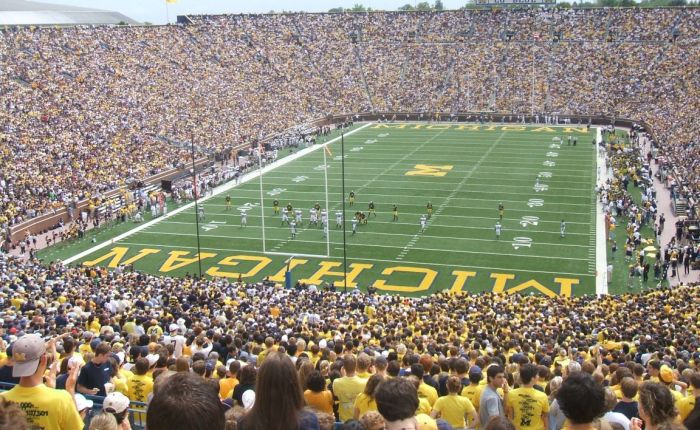
I have been waiting for Michigan football to return since January.  I’m wearing my lucky Michigan shirt, khaki pants (Michigan’s coach Jim Harbaugh wears khaki pants on the sideline), and a Michigan hat I should have retired long,long ago.

OK, I went to Kenyon, a grand place, bastion of the liberal arts, rich with tradition and spirit, holder of record numbers of consecutive NCAA championships in swimming.  Well and good, Go, Lords, great college experience.

But Michigan!

I lived near Ann Arbor after graduation, returned a decade later to work near Detroit, and took the opportunity in each Michigan iteration to get to Michigan Stadium (The Big House), then holding a mere 105,000 rabid Michigan fans.  I suppose the closest analog to watching a game in the Big House might be catching the spirit in a revival tent, a tent holding 105,000 similarly frothing faithful believers.  The usual collegiate high jinx probably takes place near the end zone, where students are packed together without regard for the sanctity of personal space, but Michigan fans are serious about football, really serious about football.  No beach balls bounce through the crowd; don’t look for”the wave”, or a “kiss cam” between plays.

I know.  We live in perilous times, serious matters loom, the world is very much with me. In the big picture, as glaciers melt and polar bears become homeless, football doesn’t matter very much.  And yet.

The game today is against Hawaii, not a conference game, pretty much a warm up for a talented Michigan team, but it’s the first game of the season, and I am giddy with anticipation.  There have been down days, of course, including the heart shattering loss to Michigan State last season, a game torn from the jaws of victory in the last seconds .  It hasn’t been easy to be a fan for a while.  Michigan is only now starting to recover from a decade of mediocrity, but a new coach and a great recruiting season seems to have restored the Wolverines to full ferocity.

I’m not alone in taking college football seriously  .  I’ve seen Auburn and Alabama fans come to blows, in the stands and at a gas station in Huntsville, Alabama.  A good friend flew to Dublin to see Notre Dame play Navy; he didn’t go to either school, wasn’t in the Navy, and isn’t Irish.

I’ve been visiting my son in Portland for years.  You know, Portland – hipster capital of North America, major city with a socialist mayor, home of the World Naked Bike Ride, “As Bare As You Dare”.  I sensed the ground starting to shake in 2010, when the Portland Beavers, a minor league baseball team, lost its stadium to the newly arrived MLS team, the Portland Timbers.  Good bye, Beavers; good luck in Texas as the El Paso Chihuahuas.

Timber fever broke out in Portland even as the Beavers packed up.  How rabid are Timbers fans?   Every game since the first in 2011 has been sold out; there are currently 13,000 fans on the wait list for season tickets.  Portland first claimed the title, “Soccer City” back in 1975, when the Timbers joined the old National Soccer League, drawing more than 30,000 fans to a quarterfinal game vs the Seattle Sounders.  That rivalry remains intense, and the otherwise laid back Pacific Northwest loses all traces of sanity when Timbers meet Sounders, at home or away.  A point of particular contention for Timbers fans is Seattle’s claim as the most successful soccer city in the U.S.  The Sounders play in CenturyLink Field, home to the Seattle Sea Hawks, a venue large enough to seat more than 67,000 fans.  Seattle’s TV revenues are greater, all the more impressive in that Seattle shares the market with the Seattle Sea Hawks and the Seattle Mariners, but …

The nod has to go to Portland, however, as the women’s team, the Portland Thorns (Portland is the Rose City), is not only the most successful team in the National Women’s Soccer League, but the most popular in the nation by far, routinely attracting close to 20,000 fans, even when some of their stars were absent, playing for the National Team.

Finally, as mascots certainly count in comparing franchises, Portland alone has Timber Joey, an unapologetic logger, saw in hand.  When the Timbers score, Joey grabs a chainsaw and cuts a huge slice from a giant log in the end zone.

Seriously.  What does Seattle’s mascot do?

Oh, wait.  They don’t have one.

Apparently retired, Sammy the Sounder, a pudgy Orca, now kicks back, fins up on an ottoman, watching his team from a senior community in the Aleutian Islands.*

* Probably not true.

That’s the sort of slightly snarky attack  that makes rivalries so much fun.

Timbers – Sounders

Michigan – Ohio State

Army – Navy

Gryffindor – Slytherin

These are tribal rivalries that go beyond personalities and territory. Some fans are born into traditions and tribes, some have tribes thrust upon them, and some are chosen, as Michigan chose me, on a Saturday in October, in the Big House.

Maize and Blue, Hail to the Victors, and “Who’s Got It Better Than Us” – It’s great to be a wolverine.


Out of my League – The Young Adult Novel

Out of my League – The Young Adult Novel

I had a great conversation with friends recently, wallowing in memories of the books we had loved as children.  Life was simpler then, of course, and we were called “kids” until somewhere in our mid-thirties.  The designation “young adult” happened when I wasn’t looking, and I’m still confused about where the lines are drawn.  It’s an issue for me because publishing houses and agents aren’t interested in the sort of meandering, self-indulgent froth that I write with such ease; apparently, they want a some sort of plot aimed at a young adult market, which I would be happy to provide had I the sense of what sort of audience I write for.

I thought I had a handle on it as a parent when my kids moved from the Berenstain Bears, to Tales of a Fourth Grade Nothing and Matilda, took a deep breath and dove into Harry Potter; I watched them happily spin off into other worlds of class-room romance and wizardry, but then the Twilight thing happened, and Looking for Alaska, and all bets were off.

It doesn’t help that John  Green is a one-man young adult machine, churning out compelling teen dramas with the regularity of a Nora Roberts or Steven King.  Four of his books are currently on the NY Times Best Seller list; both Looking for Alaska and The Fault in Our Stars have hogged a place for 141 weeks, an achievement made more impressive as his first novel, Looking for Alaska appeared in 2005 and broke into the best seller list in 2012, from which perch it has not been knocked.  Alaska is not a place but a character, larger than life, a free spirit, a significant influence on the coming of age of the central character.  I love stories set in boarding schools, but things get steamy in this novel, at first when our hero hooks up with a girl who offers oral sex and later when he and Alaska connect.

“Our tongues dancing back and forth in each other’s mouth until there was no her mouth and my mouth but only our mouths intertwined. She tasted like cigarettes and Mountain Dew and wine and Chap Stick. Her hand came to my face and I felt her soft fingers tracing the line of my jaw.”

Eeep!

It happened that as a member of the admissions committee at the schools at which I’ve taught, the question of favorite books came up in almost every interview. When Looking for Alaska began to emerge as a fairly commonly read book, I thought I’d better grab a copy, and quickly learned to move the conversation along by attending to the impact Alaska’s death (spoiler alert) has on the main character rather than celebrating the many pranks inflicted in a school setting or the various physical relationships.

Over the years, conversations about books taught me about the fictive world in which students I would teach spent their time.  In about 1985, Enders Game by Orson Scott Card began to appear in interviews with boys, Lois Lowry’s Number the Stars with girls.  A few years later, Lowry’s The Giver took top honors for both.  Meanwhile, 7th and 8th grade kids continued to read novels that were not considered YA at the time, but might be today:  Catcher in the Rye, To Kill a Mockingbird, A Separate Peace, Lord of the Flies.  And from the publication of Harry Potter and the Philosopher’s Stone (U.K.) in 1997, any interview had to include some conversation about Hogwarts and owls.

So far, pretty much so good; at the very least, I had enough wit or memory to sort out the attraction of each.  The Princess Diaries, published in 2000, for example, seemed very much in keeping with the sorts of pleasantly unrealistic wish-fulfilling novels that had comforted generations of readers.  Discomfort with a world careening out of control brought the various dystopian series, Hunger Games, Divergent, and The Maze Runner.

Twilight, however, unleashed vampire fantasy in 2005, followed by werewolf fantasy and fantasies carrying readers to various academies and schools where vampires, werewolves, and other dark creatures studied and played sports, occasionally dating, when not engaged in rending flesh, draining the unwary, and fighting against their own most carnal (in the “meat” sense of the word) desires.

Ok, back to business.

My favorite books were about sports.  I loved all sorts of sport books, fictive and encyclopedic, but had a particular fondness for stories about kids (like me, in my dreams) who overcame daunting obstacles and became the greatest baseball players ever.  I read the John R. Tunis books over and over, relishing Rookie of the Year, The Kid From Tompkinsville, The Keystone Kids, The Kid Comes Back, Highpockets, Young Razzle, books that may have slipped from the pantheon of literature for young readers.

So, writing about what I loved to read, I set out to write a book about a kid who has to work his way on to the baseball team upon moving to a new town.  The only “wrinkle” I had built in was the difficulty this kid had dealing with a grandfather who had played in the major leagues and who held him to a pretty tough standard to meet.

Pretty thin.

So, I did what any resourceful father would do … I asked my daughter what elements had to be in place in any self-respecting YA novel.  In a matter of moments, she had given me more, much more, drama than I could possibly have imagined, and not just drama but twisty drama capable of darkening any narrative landscape  .  I sat taking notes, grateful, but finally had to ask where she had found the touchstones she had given me.

Teen Wolf.

I won’t go into the entire Teen Wolf universe, but it has a tangential plot line having to do with lacrosse, so is close enough for my project.  I will pass on the tropes that work across  genres so that any readers wishing to take a shot at the YA world might have a head start.

What is absolutely necessary?

A Teen Crush – one of the pair is out of the league of the other, or mismatched in some significant way … until true beauty/character is revealed and romance ensues.  In a novel of some length, misunderstanding can bring a rift, finally healed as truth somehow wiggles through, or not.

An Outsider – could be the central character, or the central character’s best friend, or the central character’s romantic interest, or the central character’s mentor/parent.  This is rich soil as the alienation can derive from virtually any circumstance, from poverty to ethnic origin.  Religion can intrude in some circumstances as can strongly held political beliefs (Dad is a skinhead, Mom joins a cult?)

Physical Issue – this issue or sets of issues can range from the relatively minor (acne, voice changing, hair color) to any disorder an author can imagine.  Issues concerning weight issues and body image abound (not so much in Teen Wolf or my book), and obsessive compulsive disorders ( Kissing Doorknobs) seem to be popping up more frequently in  the most recent cycle. I might have anticipated the narrative pull of some problems, but had not considered red hair, freckles, or braces as impediments to well-being.

Serious Family Issue – again, the opportunities are endless.  Parents alienated from children, children alienated from parents, alcoholic parent/guardian/relative, missing parent/guardian, disturbed sibling (anything from drug addiction to arson), missing sibling, and the most common of all …

Death, Impending Death, Illness – This is prime John Green territory, so an author has to tread carefully in order not to seem gratuitously tossing lives around in order to pander to pathos seekers.  I am told that the story works more satisfactorily if the designated patient/corpse is brave, cheerful, and spiritually sound.  It also apparently helps if the dear or near departed has a  message that allows the central character to come of age a bit more gracefully.

Finally, and this seem fairly obvious … The Secret.

In Teen Wolf the secret, clearly, is that the kid is a wolf.  Not much of a secret, really, given the title of the show, but season after season, most of the people with whom this kid contends think his behavior is odd at times, but do not question the  matted fur and blood on his pajamas.  How many secrets, you ask, can possibly appear in any single life?  According to my sources (source), the possibilities are infinite.

Alcohol, drugs, incest, fabricated family, adoption, desertion, disease, allergy, psychopathology, any number of terrible acts seemingly buried in the past, from infants left in public bathrooms to bank robberies and murder.  Twins are separated, a twin is absorbed in utero, twins change places, one twin needs the lung of the other twin, both twins like the same boy/girl.  Against all expectation, some notably difficult situations have been effectively explored in YA novels in which the central character is gay, bisexual, lesbian, or transgender.

My guy wants to play baseball.  His grandfather can be a jerk, but believes in his ability and offers some sage advice when he remembers that times may have changed since his own young days as a player.  That’s about all I’ve got so far, but I do like writing about sports.

Here’s how the book opens – I haven’t shown this to my daughter because it seems creaky, almost right out of The Kid Comes Back.  Looking at it now, I think I need to cue up another episode of Teen Wolf.

The first pitch was inside, a curve that moved in on the hands of the batter, forcing him to duck out of the box.  The third baseman relaxed, straightened up, shook his arms, then dropped back into a crouch, weight on his toes, arms extended, glove hand slightly ahead of his left.  As the next pitch left the pitcher’s hand, the batter shifted his weight, lifted his left leg and took a hard cut at the ball.

As he connected,  the third baseman had already begun to move to his right, edging toward the bag and moving in toward the batter.  He had guessed correctly; with a full swing, the batter laced a hard hit drive down the third base line.  Taking the ball on the first hop, the third baseman pivoted as the ball struck the middle of his glove, turning toward first base even as he pulled the ball loose with his throwing hand and rifled a throw to the tall first baseman stretching toward third base.

The ball slapped into the first baseman’s mitt a split second before the batter reached the bag.  The umpire threw his arm in the air,  “Yer out!” as the runner took the turn and walked back to his team’s bench.

Everyone knows the best players play down the middle of the field: catcher, pitcher, shortstop, centerfield.  That’s where the action is, and every real ballplayer wants to field the ball.  Outfielders see some action against a team that hits well; second basemen can turn a double play.

Third base is the toughest position in the game, Clint thought.  Fewer balls came his way, and it took effort to stay focused on every pitch, but when they came, they came hard.  He had wanted to play shortstop, of course, but he was the new kid in school and the new guy on the team, only a freshman, and senior Harry Lee had played shortstop on the Sinclair High School team that had gone to district competition the year before.

Clint glanced over at Harry, taking his eye off the pitcher for a second.  Harry was rocking back on his heels, slapping his glove and shouting.  “You got him, Brace.  You got him.  No hitter.  No hitter.”

Clint’s grandfather called that kind of noise, “chatter”, intended to get under the skin of a player with “rabbit ears”.  It annoyed Clint, who liked to focus, in the field or at bat, but he never took it personally and rarely let it affect him.  If he was being honest. Clint thought, Harry’s yammering probably seemed stupid because Clint wanted to play shortstop and wanted to be the go-to guy on the team.

Fat chance, he thought.  New kids never got a break, especially when everybody else had been in the same classroom since birth, it seemed.  They all had nicknames for each other, and they all hung out at each others’ houses.  Nobody had asked him to join in or where he lived, which was probably a good thing, since they’d find out that his mom seemed to have lost her sense of humor somewhere around Kalamazoo, and that his grandfather used to be a ballplayer.
Things were tough enough without that.