On Broadway

On Broadway

New Yorkers have long known that the current generation of Broadway production is all about revivals and musical adaptations of successful films.  Rogers, Hammerstein, Hart, Porter, Coward, Berlin – the hills are alive with the sound of recycling.  Yes, an original production appears from time to time, but for every Hamilton there are three Hello Dollys and a pair of Showboats.  Need something more current? Tap those toes to Groundhog Day The Musical, Legally Blonde The Musical, Shrek The Musical, Waitress The Musical, Sunset Boulevard The Musical, and Amelie The Musical.

Really?  Amelie?

An unusual opportunity has come my way as my wife went to school with a producer constantly on the lookout for the next bright Broadway bound idea.  I see every production here in Southern Oregon; she’s asked me to pass on any new work that might do well in the Big Apple.  She has said she needs gripping contemporary dramas, new voices, fresh ideas; I beg to differ.

I’ve sent her my slate of hot prospects, any one of which could be bouncing its way as the centerpiece of next year’s Macy’s Thanksgiving Parade, a once-proud celebration of music and spectacle culminating with the arrival of Santa and Mrs. Claus, now devolved into Broadway’s version of product placement.

Mr. Ed The Musical

The Great White Way has long hoped for a bit of equine humor with a dry twist.   Mr. Ed, the astounding American Pharoah, displays a shaky baritone warbling the familiar “A Horse Is A Horse Of Course, Of Course” but who cares?   Ed’s manipulation of his ostensible owner,  Wilbur Post (“Hay, Wilbur”), darkens the show with Gone Girl gaslighting,  setting Louis Black as Wilbur up as an ineffectual and psychologically disordered stooge (“What’s The Matter, Wilbur?”).

The Bachelor The Musical

Roses for everyone!  Twenty high-strung, conniving, emotionally wounded women provide an unmatched chorus of voices on the show’s title song.  Lyricist Chuck Palahniuk’s deft patter ( Total Heartbreak Never Ends/  No Skank Here Was Making Friends.  Although Corinne Opened Up To You/  You Didn’t Need To Bonk The Shrew.) elevates the pedestrian script.  Daniel Baldwin’s off-handed portrayal of the show’s host is completely incomprehensible.  Lindsay Lohan’s desperate also-ran Bachelorette is both compelling and truly disturbing.

Talent Round Up Day The Musical

This clumsy pandering to nostalgia-bound Boomers plumps an ersatz Annette, Darlene, and Clubmaster, Jimmy, in a noxious triangle set against a ripped-off Chorus Line musical confession.  Fresh faced Eric Von Detten (Brink) almost saves the last act as Cubby, the driven drummer whose frantic timpani solo brings this mess to life for a fleeting moment.

The Newlywed Game The Musical

From the signature game show anthem to the disturbing “Where’s The Strangest Place You’ve Made Whoopie”, this challenging and thoughtful examination of the early years of marriage raises questions perhaps better left unanswered, particularly in the awkward duet, “I Thought You Liked That”.  Johnny Depp is miscast as provocateur Bob Eubanks, but the rest of the cast carries the day.  Dakota Fanning as the wrong girl married to the wrong guy breaks hearts nightly at the Orpheum.


The Rifleman The Musical

Sensing a shift as older generations take their leave, the NRA commissioned this faux-western musical in the hope of bringing an iconic and well armed figure back from TVLand obscurity.  Against all odds it works.  Lin-Manuel Miranda holds the audience hostage with the stirring “I’ve Got My Sights On You”.  Bernadette Peters as the Rifleman’s nemesis, Shotgun Polly, rocks. “My Cold Dead Hands” in a delightful dream sequence set in the Arlington Cemetery.

Hogan’s Heroes The Musical

Never has a prisoner-of-war camp been more lively!   Matthew Broderick is the wily Hogan routinely outsmarting Neil Patrick Harris’  rigidly obtuse Colonel Wilhelm Klink.  Harris’ dimwitted Junker Kommandant does most of the musical heavy lifting, leaving to Broderick fast paced-bamboozling with Seth Rogan’s Sergeant Hans Schultz (“I Know Nussing!”).  Hyper-hormoned French detainee, Louis LeBeau (Zak Efron channelling Maurice Chevalier) and zaftig camp follower Megan Hilty romp through the raucous “What’s A Latrine For If Not For Love?”

Leave It To Beaver The Musical

Hugh Jackman is Ward, Kristin Chenoweth, June, and delightfully miscast Martin Short the Beaver.  This airy farce is reminiscent of the most artfully choreographed French comedies as indiscrete couples in flagrante delicto narrowly escape exposure.   Wally (Taylor Lautner) stolidly juggles his three girlfriends while keeping the aroused Eddie Haskell (Jesse Eisenberg) on a short leash and away from June.  Short’s Beaver whines charmingly, particularly in his rendition of “Miss Landers, You Are So Hot”.  Chenoweth is one of Broadway’s signature voices, never better when chiding her distracted husband, “Ward, You Have To Talk To The Beaver”.


Taking Parenting Personally

Taking Parenting Personally

From time to time I wonder how my children survived this parent.

My kids turned out fine.  Better than fine.  By any objective assessment, they are superb people – smart, funny, kind, responsible, honest, resourceful, and compassionate.  In fact, if I had to draw attention to anything approaching a failing it might be that they are, all three, perhaps a bit too generously compassionate at times.

I can live with that.

Nature?  Nurture?

Here’s what I know with certainty: All three children were absolutely themselves from the first moment I met them. My wife and I probably had some impact upon their developing character, a somewhat uncertain supposition given the amusement with which my children have observed my attempts to pass on the wisdom I have acquired along life’s bumpy path.  My wife is a unfailingly practical person, connected to all those elements that make up what they call the “real world”, whereas I tend to operate in blissful ignorance of how things actually manifest, preferring my own rosy imagined planetary home.  They probably picked up something from both of us; we hope it was our best.

Sure, school and friends, fads and fashions occasionally appeared to have influenced them to some slight degree, but each slipped into the assumed persona, found it wanting, and returned to true north almost immediately.  Each of the three has differing enthusiasms and quirks, but in terms of character, each is solid in the same way.

Which is a good thing because as a parent I missed some important cues, operated with faulty judgment, and let them down in ways that ought to have darkened their path.  I’m not brave enough to describe the worst of my failures, but I know my deformities of character caused collateral damage at significant points in their childhood.

My intention had been to present a list of observations that might inform good parenting, but it has become increasingly clear to me that only one is necessary:

Don’t take things personally.

Yes, parenting is a serious enterprise, and there is no doubt that we invest a great deal of our abilities and our predilections in the raising of our children.  The stakes are high, and there’s no escaping the emotional tangle as kids make their way to adulthood.  No matter how we try to separate our hopes from theirs, we want what we want for them.  Some days we can keep our notions of what their future should bring at bay; some days we don’t do so well.

We’re attached, and that’s a good thing, even when it gets awkward.

But … attachment can bring some fuzziness of perspective.  I choose not to document every misstep I have taken as a parent, in part because I’m sure I’m still making them, but there are three that haunt me because in taking a child’s behavior personally, I did damage when they most needed support.

My son and I can laugh about it now, but when he was eight or nine, I took him to the video store (remember those?) to pick any video he wanted.  Any video!  What a great dad!  What a generous and giving dad!

Just pick one, I said.  The minutes went by.

Ready to pick one?  Ok, let’s just pick one.  Hey, we have to move along.  Want to pick one?  Yo, “tempus fugit”, pick one.  What is the matter with you?   PICK ONE!

I snapped.

Flawed, self-obsessed fathead that I am, I snapped.  I took it personally.  Obviously, my rancid wretch of a son had no concept of gratitude.  This was not a trip I wanted to take.  This was for HIM.  My so-called parents never….  When I was a kid …. Come on!

Look, there were tons of family of origin crap not yet resolved that fueled this huff-fest, and it’s part of the reason I knew I had some work to do, but nonetheless, I admit I raged.

Rigid with fury I swept him up, angrily strode to the car, tossed him into his seat, buckled his seat-belt, revved the engine with terminal prejudice, and squealed out of the parking lot.  All of that was reprehensible, but I added insult to injury by calling him a name that came to me from the dark side.

How bad was it?  I’ll leave it to you to decide.

I think I said “Toe faced vermin”.  He maintains that I said “Toad face vermin.”

Either way, I’m ashamed as I write and should be, but the worst was yet to come.

Why had my son not picked his video?  Because as a shorter human, his field of vision did not include the family favorite section; all that he could see were the salacious covers of R-Rated videos.  Porky’s.  Hard Bodies.  Revenge of the Nerds.

He was embarrassed, and I took it personally.  Thank God my son is made of better stuff than I.  There is no way to undo my terrible judgment, but he’s forgiving, moderately amused at my idiocy and my distress.

I failed to recognize depression in two of my children, chiding them for failing to share my excitement for one activity or another.  They spent too much time in their room, too much time in bed, too little time chatting with us.  I knew that school days had not been particularly joyful, but I had no idea how saddened they were in not having friends, in not being recognized.

They were in pain, and I missed it.  I don’t think I ever said, “Get over yourself”, the vermin line still rang in my ears, but that’s what I wanted to shout.  “Come on.  You have so many advantages in life.  So much to be grateful for”, which, as I look back on it, was essentially born of my narcissistic belief that their sadness was somehow a commentary on my worth as a parent.  Hadn’t I done enough?  Hadn’t I provided enough?

“What am I doing wrong” – about as obtuse and self-absorbed a question as I can recall.

My children were sensitive, intelligent, and often anxious.  How did I miss the paralysing effect of anxiety? I am no stranger to social anxiety myself; if I could go through life without having to speak with anyone outside of family on the phone, I’d be delighted.  I hate heading into unfamiliar circumstances; I’m terrible at small talk, and uncomfortable in almost any new social setting.  I fret and fumble and often wish I could just stay in bed.

But, when my kids did not want to go to a play, or the circus, or the ballgame, or on road trips, when they didn’t want to watch a great tv show, read a great book, of course, I took it personally, frustrated that they missed out on things I was sure would bring them pleasure.  They weren’t so sure and told me so, but I didn’t listen to their anxiety; I only saw them miss opportunities I hadn’t had as a child and thought they should grab.

I’m guessing I’m not the only father who fell into parenting with a set of beliefs about the way kids should be, who too frequently felt judged as a parent, who forgot how confusing and uncertain childhood is for much of the time.  I’m pretty sure I’m not alone in having regrets.

I wish I had been a steadier, more consistently affirming, more readily understanding father.  I do. That’s what I can take personally.


The Incredible Dr. Pol

The Incredible Dr. Pol

I’ll admit that over the years television has let me down, taught me some tough lessons.  No, Mr. Ed could not really speak, and apparently the MASH unit ostensibly operating in Korea was actually filming near Malibu, and Cosby … well, you know.

Having already documented my attachment to and fondness for Survivor, I’ve clearly fed beyond the pasture, consuming my share of Reality TV, and, although this is not the time to rail against most scripted television (Thank God for Madame Secretary and This is Us), I find myself much more inclined to wallow in someone else’s televised home renovation; it’s far less costly than  taking on any of the long-postponed projects around my place and rarely means we lose a bathroom for a month.  And, there are some remarkably accomplished people out there who doing remarkable things.  Chefs battling, designers designing, dancers dancing, singers singing – I’ll take them all.

Absorbing and impressive display of talent almost certainly free of bloodshed.

Against all odds, however, my wife and I choose to eat dinner while watching The Incredible Dr. Pol, now in its eleventh season.  How we missed this show for the first ten seasons I cannot fathom.  It’s the highest rated show on Nat Geo Wild, one of the most successful non-scripted shows in the cable universe.  It’s not as though we haven’t travelled in the same circles all along.  we’ve watched saddle repair, rodeo roping, and This Week in Agribusiness on RFD TV, My Cat From Hell on Animal Planet, and The Forest of the Lynx on PBS; how did we miss all ten previous seasons of Dr. Pol?

So, we have a lot of catching up to do, which does not explain why we watch this show at dinnertime.

Dr. Jan Pol is a Dutch-American vet working in central Michigan.  His practice includes a variety of large animals, cows, horses, alpacas, an occasional zebra, and all of the ordinary small animals.  Yes, he trims nails and feathers of macaws.  Sure, he deals with depressed bearded dragons.  Got a listless goat?  Bring it on.  Week-in and week-out, Dr. Pol’s office is awash with pet owners holding pups for first shots, cats needing a worming on the spot, and peafowls with a nasty beak infection.  The doc and his team spend easily as much of their time in the field, pulling calves from cows stuck in delivery, castrating llamas, not-so-gently piercing a bull’s nose.

All of which is surprisingly fascinating.  One would think that if you had seen one rowdy male castrated, you’d probably not have to witness that again, and yet, there are so many curious differences, so many.  The team of vets deal with emergencies large and small, horses with abscessed hooves, goats with polio, cows that have fallen and can’t get up, cats that refuse to eat, dogs hit by cars.  Some procedures take place in the vets’ operating rooms, others in a muddy field or in the back of a pick up truck.

My wife and I love animals, and in a year of some dislocation and angst find our faith in humanity has been restored by the care and respect with which animals of all sorts are cared for by the doctors and their staff.  We identify with the pet owners, of course, and worry with them and grieve with them, but are equally moved by the distress a farmer feels for a heifer as she labors or for a horse as it nears its last days.   Farming is tough, and farming in central Michigan is not for the faint of heart.  Farmers with little formal education, not much in the way of sophisticated banter, good natured relatively uncomplicated men and women, talk about their animals with simple affection.

Jan Pol is a veterinary savant, capable of intuiting on-the-spot diagnostic insights based on years of hands-on experience with all sorts and conditions of creatures.  By hands-on, I mean hands-in, more often than not.  Whereas we had once been unnerved at the thought of slipping on a long pair of plastic gloves in order to invade a horse’s rectum, it now seems all in a day’s work.  I’ll admit we don’t get the full effect of nursing a bloated cow into belching trapped gas, and I suspect the smells of the farmyard might be tough to ignore, but plunging in to grab an unborn calf’s hooves, dragging the just born to its full length into a bed of straw, rubbing it until it yowls and stumbles to its feet and finds its mother, remains a remarkable accomplishment, even if we witness it every night as the microwave pings.  The frequency with which Dr. Pol or Dr. Brenda or Dr. Emily arrive with chains to pull the trapped calf from its mother , however, does cause us to wonder how many cows survive birthing.

Part of the attraction of the show for us is that Dr. Pol and his staff are authentically invested in every interaction.  Yes, they are pros, and yes, the sorts of tasks they perform are tasks they have performed for years, but there is nothing pro forma or unfeeling in their approach to the six year-old whose guinea pig is failing or the rancher whose horse’s teeth have to be filed.  4H kids raising pigs to be shown at the State Fair get as much attention as the owners of a huge dairy farm.

We started late.  The Dr. Pol we first met is seventy-two years old, slowing down slightly, but still vaulting fences to escape a maddened bull, still gamely shoving a prolapsed uterus back into place with little help from an understandably inconvenienced cow.  He is a hard-working man who wears the world like a loose garment, finding good humor in almost every encounter, encouraging owners and animals.

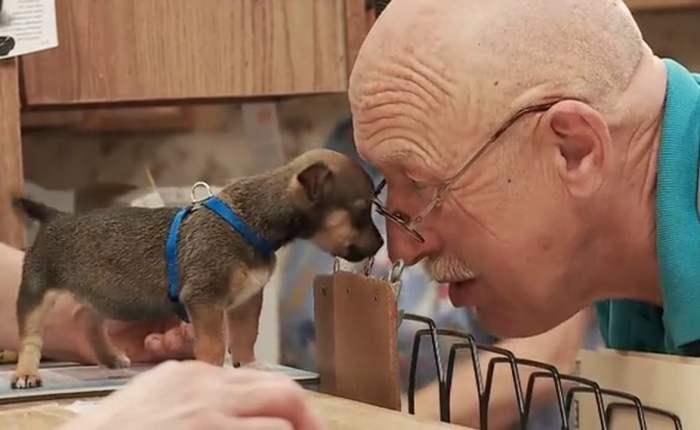
In a way, we are watching an extended love story.  Pol meets an abandoned Newfoundland dog, takes its face in his hands, holds it in his gaze, and adores it.  He’s a realist and often makes pragmatic decisions about treating animals, but he respects each one.  He pushes his glasses up, moves close, and meets each animal as a friend, even when the work to be done will not be pleasant.  On those occasions when he or his team have to put an animal down, it is done with profound respect and gentle care.  He is an energetic, strong man, but his shoulders slump as he walks from the side of animal he has lost.

Then, as the next patient arrives, his smile returns and the work begins again.

The other vets are equally impressive, if slightly less charismatic.  Dr. Brenda answers every call with solid good sense and unfailing willingness to do whatever it takes to save her patient.  Of the three, she seems to be most frequently making the house calls that bring the possibility of being trampled.  Our only question is why strapping farm hands are willing to let Dr. Brenda wrestle a boar to the ground by herself, syringe in one hand, and boar in the other; come on, fellas.  Dr. Emily was clearly a good student and a knowledgable vet who has learned the rough and tumble of large animal veterinary care from a mentoring Dr. Pol.  Is she as willing as the others to work in the muck?  Apparently, as she wrestles still-born calves to the hay well into her own pregnancy.

We have made this show a regular part of our dinner routine because it is real and predictably straightforward.  The election and its aftermath left us battered and bruised, in part because every story we watched arrived with sound and fury and the full force of political conviction, carrying hopes we may have endorsed, but so weighted with certainty that when the votes were counted, we felt bamboozled.  The reporters for the news outlets we admired were sincere and meant well, but we can no longer hear their accounts without seeing the filter through which it is presented.

Dr. Pol is what he is, an unassuming, hard-working man willing to put his hands, well, anywhere.  He works with creatures great and small for owners who love their animals.  Some probably share none of our political beliefs, but we can see them at their best, hoping Dr. Pol can find a way to keep a loved animal alive.

Time to get out the TV trays.


Forgive Me?

Forgive Me?
I seem to ask for forgiveness quite a lot these days.  I continue to err, of course, and maintain a high degree of self-certainty which has never served me well, no matter how convenient it appears in the moment, but the frequency with which I petition for pardon has definitely increased.  It’s entirely possible that I’m becoming more bull-headed and piling up obvious glitches in personal relationships , but I think I’m also more aware of the damage that I do in recognizing one of my many missteps and yet leaving an apology unextended.

So, forgive me. … but there is a world of difference in asking for forgiveness and expecting forgiveness, a gap between “forgive me” and “forgive me?”, between expectation and apology.

Consider the very familiar “This Is Just To Say” by William Carlos Williams, an imagist poem, or a found poem, or an a-tonal poem, or a fairly meager apology.  I can’t imagine offering an apology with a preface, “This is just to say …  I borrowed your car, wrecked it,  and left it in  New Jersey.  Forgive me,” but perhaps craft mitigates injury.
I have eaten
the plums
that were in
the icebox
and which
you were probably
saving
for breakfast
Forgive me
they were delicious
so sweet
and so cold
William’s poem leaves much to the imagination; we can’t know if the tone is meant to be playful, profound, apologetic, deflective, or informative.  Nonetheless, we can walk away with the conviction that the person swiping the plums has asked for forgiveness, no?
 But no.  “Forgive me; they were delicious” is a statement, at best an explanation.  “Yes, I took the plums, but you may be obliged to overlook my insensitivity to your needs in that I found them delicious.”  Not much of an apology.
And about apology.
A shuffle of archived episodes of This American Life brought me to an episode I think about four or five times a week, “Apology Line”.  Here’s the description of the episode as presented by Ira Glass when the episode was rebroadcast in 1997.

” Each week on our program, of course, we choose some theme, bring you a variety of different kinds of stories on that theme. Today’s program, apologies. Stories of people struggling to apologize against some difficult odds. We’ve arrived act two of our show…, “Dial S for Sorry.”

In 1980, a New Yorker named Allan Bridge set up a telephone line that he called The Apology Line. And the way it worked was that you could call and confess to anything you wanted and you’d be recorded. Or you could call and you could listen to other people’s confessions. And over time– this is all pre-internet days. Over time, the whole thing turned into this little community of confession. People recorded messages responding to each other’s apologies. Mr. Apology, Allan Bridge, would leave messages responding to messages himself. Or sometimes he would call callers off the line and talk to them.”

Some of the apologies are fairly innocuous, some are appalling, and some are devastating.  A caller lists the various violent and dangerous acts he has perpetrated on teachers, schools, governmental buildings, and individuals.  The shift to a slightly higher degree of injury (fire bombings) is delivered with little inflection.  The call ends on this note:

“I’m sorry for the way I’m calling right now. I’m calling by way of a phony credit card. I’m sorry for harassing the teacher in school. I feel bad about it. I’d like to have a new lease on life.

What else? I’m sorry for just harassing a lot of people. For causing pain to my family. I felt so sad I was sick. I was sick by it. That’s all I have to say. So long.”

A runaway checks in:

Hi, I’m a runaway and all I want to say is that I’m kind of sorry that I left. See, I’m 15 and I saw your number in the newspaper. When I saw it, I had to call because I mean, you walk around on the streets all day long just looking for someone that just might say, hey, want a place to go? Come with me. They’ll give you food and everything. And they won’t ask or anything back. That’s all I want. I guess I take up too much time on the tape. But I just got to talk.

A phone call allows a surviving son to admit that he extorted payment from his dying mother, charging her $5.00 for a glass of water, $10.00 for a sandwich.

The call that caused me to pull my car to the side of the road came from a man whose confession was coldly lacking in affect.

“I’ve never told anyone this except my shrink. I accidentally killed my younger sister when I was a very small child and it’s haunted me all my life because I didn’t really mean it. It was just a game to me and I was really too young to realize what I was doing. And I was putting her head inside a plastic garbage bag and putting a rubber band around her neck just to see her face turn blue. I guess it was a lot of fun and I didn’t mean anything bad to happen. But I guess I didn’t realize what would happen if I did this too long and she suffocated. I hid the plastic bag and I went out of the house. My parents weren’t home. And they never found out. They thought it was crib death. They never found out I did it.

I’ve never been able to tell them. I think it would hurt them worse than losing her to find out that I did it. I kind of wish my parents could hear this tape, but I guess they never will.”

I guess it was a lot of fun.

Let’s be clear.  That’s NOT an apology.

While there is value in confession, even the sort of anonymous confessions made on the Apology Line, an apology begins with the understanding that harm has been done, moves quickly to the assumption of responsibility, and then to an expression of regret, followed by an open-ended willingness to do what is necessary to make the situation right.

It’s human nature to hope that an apology will bring forgiveness, and it may, but an apology offered in exchange for forgiveness is essentially a transaction, hoping words are currency.  They aren’t.

I had to learn that my version of apology was often simply an excuse.  “I’m sorry, but that guy on the bus who stood on my toe made me so mad that I snapped at you.” That’s not an apology; it’s a defense of my behavior.

I was also the master of other equally bad apologies.

For example, I have learned that  adding the word “if” turns the responsibility for  injury back on the person I’ve injured.  “I’m sorry IF you took it that way.”    Uh, obviously my remark was taken as I intended it; I just hoped I could duck out of responsibility for it.

I could be even more offensively weaselish.  “Ok, I’m sorry I didn’t show up, but YOU are the one who wanted me to clean up the garage.” The unfinished end of the sentence is, “so it’s your fault.”

It’s a slightly more authentic apology when statements of regret bump into boundaries.  “I’m sorry I barked at you, but you kept leaning into me while I was trying to explain.”  I’m rarely healthy enough to say.  I’m sorry I barked at you.  I’m still trying to figure out how to express  myself when I’m uncomfortable.”

I may not be alone in not  wishing to be held accountable for my actions, but I think  I developed some advanced skill in pulling myself out of contact as consequences drew near.   I know I’m still withholding when I apologize so generally or so abstractly that there is no texture or weight to my apology.  The worst is flippant.  “Sorry about that.”  Only slightly better is, “I’m sorry for whatever it is that I’ve done. ” Marginally better?  “I’m sorry for everything.”  The shield is in place even as the words are  said.

I have had to learn that an apology demands clarity.  “I’m sorry I pouted and slammed dishes rather than talking about what was on my mind.”

The final level of apology has to do with contrition, authentic regret or remorse coupled with determination not to repeat the hurtful behavior.  In some cases, an authentic apology demands a next question.  “What can I do to make this situation better?”

It all comes down to this, if an amends is worth making, and they almost always are, authenticity, integrity, demands investment:  “I’m all in.  No matter what the outcome, I come to you to take responsibility for what I said, or did, or didn’t do.  Against all odds, and with no expectation, I ask you to consider forgiving me.”

Oh, and by the way, I bought more plums, so sweet and so cold.


That’s Baseball

That’s Baseball

Poets celebrate baseball’s clean geometry, the sharp contrast of lush green outfield and dusty red base paths.  They may have missed the transition from the languid serenity of games past to open warfare as new rivalries empty bench after bench.  Tigers now loathe the Twins, Jay hate the Braves.  Red Sox vs Yankees?  Hardly a blip on the screen.

Lets take Oriole’s Manny Machado sliding into second spikes high, carving beloved Red Sox second baseman Dustin Pedroia’s leg into Salisbury steak.  It happens; that’s baseball.  Then, two days later, the Sox’ pitcher, Matt Barnes either lost control of a fastball high and inside, or threw at Machado’s head.  Again, it happens.  Again, that’s baseball.

That last paragraph is mildly factual and intentionally provocative because the situation between Pedroia, Machado, and Barnes, the Orioles and the Red Sox represents the curious and oddly anachronistic nature of the game while also revealing quite a lot about its contemporary nuances.  It’s tempting to idealize baseball, quoting George Will, “Baseball is Heaven’s gift to mortals”, or, letting oneself become completely rhapsodic, quoting James Earl Jones’ great speech in Field of Dreams:

The memories will be so thick they’ll have to brush them away from their faces. People will come Ray. The one constant through all the years, Ray, has been baseball. America has rolled by like an army of steamrollers. It has been erased like a blackboard, rebuilt and erased again. But baseball has marked the time. This field, this game: it’s a part of our past, Ray. It reminds us of all that once was good and that could be again. Oh…people will come Ray. People will most definitely come.”


He was not wrong, but baseball is also red in tooth and claw, more than a game to the men who take it up as a profession.  There is much on the line every time a player takes the field; every play is attached to the statistics that measure his value, every play could end his career.  Two teams face each other with the legacy of hard feelings barely contained in their last meeting.  These two teams are the Red Sox or the Orioles, but they are also made up of men who have worked for years to develop skills that set them apart from other men, skills that include all the elements the fan sees from the stands and some that only players see.  The smallest fissure, the slightest crack allows one player an edge over another; weakness or cowardice is immediately sensed and parlayed into advantage.  One game is played out inning-by-inning and recorded on the scoreboard; the other, a complicated and shifting balance of power goes largely undocumented.

Beanballs, brushbacks, hard tagging, taunting, posing, running up a score, coming into a base with spokes flashing are all part of the dubious cotillion players call respect.  Enter Machado and Pedroia.

Let’s begin with Pedroia.  He is more than an excellent ballplayer, although he is that in spades.  Pedroia was Rookie of the Year in 2007, American League MVP in 2008, only the third player in history to win those honors back-to-back.  An All Star, Golden Glove, Silver Bat, Defensive Player of the Year, and perennial nominee for the Heart and Hustle Award, Pedroia is also the last active member of the Red Sox team that broke the “Curse of the Bambino”, the Red Sox team that won the World Series in 2004 and again in 2007, his rookie year.  For all of that, Dustin Pedroia, capable, steady, and consistent was the nice kid among a phalanx of very large personalities who were pleased to refer to themselves as a band of idiots.  That charmed team was loose and confident, eminently skilled but gifted with a goofy resilience that allowed them to come back from a three game deficit in the ALCS in 2004, finally pushing the New York Yankees from their pedestal.  With the exception of a single year plagued by injury, Pedroia has been a star; in the past four years, he has become the clubhouse leader and the face of the Red Sox.  At this point in his career, the closest comparison to Pedroia in terms of the respect with which he is held would be would be the Yankee’s “Captain”, Derek Jeter.

And Machado?  In the first place, he’s really good, an All-Star third baseman and shortstop, the best fielding third baseman for the Orioles since Brooks Robinson, which is to say the best since divinity touched earth and played the hot corner.  The guy can hit too; in his second year in the majors, Machado tied Ty Cobb’s record, having racked up 40 multi-hit games before the age of 21 and is always capable of boosting a ball four hundred and fifty feet to the upper decks above center field.  Phenomenal fielder and way above average hitter, Machado should be a lock for a Hall of Fame career … if he can avoid a third surgery on his knees.  He went under the knife after dislocating his left knee in 2013 and his right knee in 2014.

And, he may have a problem with anger management.

Returning to the Orioles in 2014 after that first surgery,  Machado had two terrible, very bad days in games against the Oakland A’s.  Attempting to reach third base, Machado was tagged with some vigor by third baseman, Josh Donaldson, and responded verbally with some lack of discretion.  Already miffed (not a baseball term), Machado took exception to Donaldson’s tag with such animation that the benches cleared and uncomplimentary exchanges between the teams ensued.  Then, when Machado came up in the eighth inning, pitcher Wi-Yin Chen blew him back from the plate with a pitch that would have caught him in the chest.

The next day, in the spirit of temperance, Machado hit the A’s catcher, Derek Norris, in the head with his backswing.  Baseball being baseball, pitcher Fernando Abad threw twice at Machado’s recently repaired knee; Machado’s response was to throw his bat at Donaldson, and the benches met again.

So, he may be a hot head.  But … I’m not sure he’s a jerk.  The slide into Pedroia looks bad, to be sure, but it doesn’t look intentional.  Machado’s behavior as he connected with Pedroia, quickly trying to hold him up, doesn’t look mean-spirited, and a review of the action indicates that Machado began the slide late, awkwardly, and always aware of the damage that could be done to his knees, may have been trying to avoid jamming his leg into the bag.

It’s possible.

Most of the furor about the incident has followed Barnes’ almost lobotomizing Machado in retaliation for the injury done to Pedroia and Pedroia’s unusual charity toward Machado.  Managers, players, and sports hosts have almost uniformly defended Barnes’ action as part of the unwritten code of baseball.  In its most polished form, the sentiment argues that teammates stand up for each other.  In practice, it generally means that pitchers throw at batters in response to any number of perceived provocations.

“You hit our guy; we hit your guy” is at least rough justice.  Primitive but understandable.  “You pose after hitting a home run; our guy throws at your head”?  Not so noble.  “You flip your bat?  Time to straighten you out.”  “You’re a promising rookie.  Time to bring you down to earth – literally”.  Equally regrettable.

Any other unwritten rules that can earn you a Spaulding in the ear?  Well, don’t step on the pitcher’s mound; that’s likely to rile a pitcher who considers it his turf.  By the same token, don’t show disrespect for the pitcher by stepping into the batter’s box while the pitcher is warming up.  Almost any behavior that casts aspersion on the pitcher, the pitcher’s character, the pitcher’s ability, the pitcher’s moustache is likely to result in a retributive delivery from the aggrieved hurler.

And, lest it go unmentioned, that ball is travelling at more than ninety miles an hour.

My son and I visited the Louisville Slugger museum and factory, walking past the hundred and twenty-foot replica of Babe Ruth’s bat in order to see how bats are made and to gawk at the bats hefted by our idols.  The trip would have been more than worthwhile had it only included a long look at the bat used by Joe DiMaggio in his 56 game hit streak, but it also offered the opportunity to stand in a simulated batter’s box so as to see what a hundred mile an hour pitch would look like coming at us.  A replica of Randy Johnson, six feet and ten inches of pitching fury, launched the pitch as we stood in.

There’s not much to say after an experience such as that; I don’t know how to put whimpering, slack-jawed terror into words.  The possibility of being hit, and perhaps hit again is one of the many factors that have prevented me from acting on my boyhood dream of playing in the Big Leagues.  In his excellent account of the story behind baseball stories, I’m Fascinated by Sacrifice Flies: Inside the Game We All Love, Tim Kurkjian recalls interviews with players who have been “beaned”; they are terrified and traumatized, but some return and step in anyway.  Unbelievable.

As far as I can tell, Craig Biggio holds the unwanted record of most frequently hit in the course of a season, having been dinged thirty-four times in 1977.  Over the course of his career, Biggio was hit by a pitched ball two hundred and eighty-five times which may have something to do with the way his plaque in the Baseball Hall of Fame describes him  Characterized as a “gritty spark plug who ignited the Astros offense for twenty seasons,” Biggio crowded the plate, daring pitchers to try to brush him back, which they obviously did several hundred times.  He never picked a fight or charged the mound, leaving it to his own pitchers to even the score when it was clear that turnabout was needed.

That’s what some players and fans consider an essential part of baseball, grit and retaliation.  Get hit with a pitch?  Don’t rub it. Wait for your pitcher to hit one of theirs.

I think the stakes are too high and an adjustment has to be made before someone gets killed.  Bench clearing brawls, hurrah.  The more the merrier. Assault with deadly weapons?  Can we talk?

Maybe in a time in which a high school sophomore throws at 93 miles per hour, the time has come to remember Ray Chapman, beaned by Carl Mays in 1920, dead the day after he was struck.  Or Dickie Thorn, struck in the face in 1984, orbital bone shattered, partially blinded.  Or rising Red Sox star Tony Conigliaro, slammed in the face, fracturing his cheekbone and causing his vision to so deteriorate that he was done at the age of 26.  Or Mike Jorgensen, whose seizures after being hit in the face almost killed him.  Or Hall of Famer Mickey Cochrane, after whom Mickey Mantle was named, skull shattered, knocked unconscious, essentially in a coma for ten days.  Or Hall of Famer Kirby Puckett, virtually blinded when struck by a fastball to the face.

Barnes’ bean ball missed Machado’s head by millimeters, hitting his bat behind his head. Let’s just consider ourselves lucky and hope players and managers can move beyond retaliatory combat.


The Cleveland Browns Are On The Clock

The Cleveland Browns Are On The Clock

It’s almost over, and I think I’ll make it out of NFL Draft Week alive.

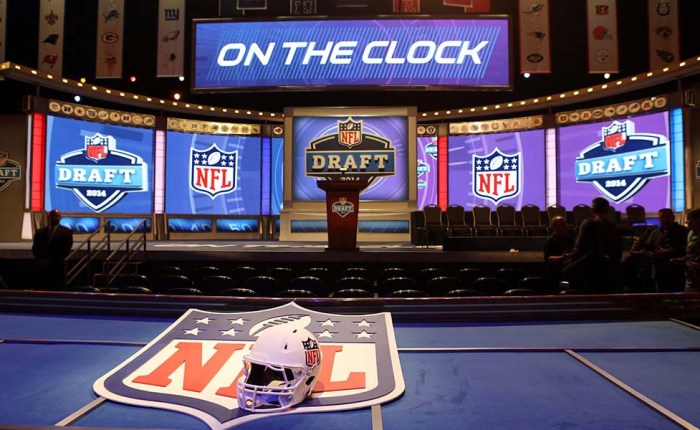
Seventy-five THOUSAND football fans stood outdoors in Philadelphia last night to witness the selection of the most highly regarded college football players by NFL teams eager to concuss them.  Worst teams pick first, which sounds absolutely fair until we notice that the same worst teams seem to get the same slots in the lottery.  Well, it’s actually the same team, the Cleveland Browns, feeding off the bottom year in and year out.  Browns fans, and they do exist, were on pins and needles until the first selection was announced as the front office has picked non-functioning quarterbacks with stunning regularity.

Why do I hover over the Brown’s pick?

A.  Because it doesn’t matter – the Browns will be awful.

B.  Because there were no other real issues.

C.  Because in delivering the announcement of the selection, universally despised Commissioner of the NFL, Roger Goodell, faced the full-throated disapprobation of seventy-five thousand haters.  Full-throated hating is what Philadelphia does best, and viewers were not disappointed.  Goodell appeared unimpressed with their efforts, however, perhaps because he pulls down thirty-four MILLION dollars a year.

The draft provided no drama or gripping tension, and yet, we have had three weeks of non-stop prognostication from “experts” who have analyzed every vertical leap, every second shaved in the forty yard dash, every misdemeanor and felony.  The human bobble-head, NFL Draft Guru, ESPN’s Mel Kiper, had grappled with every possible contingency, assuring everyone within the sound of his voice that he absolutely with complete certainty and aggressive assurance knew precisely which players would be chosen by which teams and in which order.

I may be flying in the face of long-held convictions, but my experience has been that weather forecasts, economic forecasts, palm readings, burnt entrails, and recent Presidential polls have all performed with about the same level of success.

So, last year Kiper landed about twenty-two percent of his predictions.  How did Nostradraftsmus do this year?  Let’s just take the first ten to keep computation simple.

Team                         Kiper                                                      Actual

Browns                     Mitch Trubisky QB                               Myles Garrett DE

Bears                         Solomon Thomas  DE                          Mitch Trubisky  QB – moved up

49ers                          Myles Garrett DE                                 Solomon Thomas DE

Jaguars                       Leonard Fournette RB                       Leonard Fournette  RB

Titans                         Jamal Adams S                                     Corey Davis  WR

Jets                              O.J. Howard  TE                                    Jamal Adams S

Chargers                    Deshaun Watson  QB                           Mike Williams  WR

Panthers                    Christian McCaffrey  RB                      Christian McCaffrey  RB

Bengals                       Jonathan Allen DL                                 John Ross WR

Chiefs                          Evan Engram  TE                                   Patrick Mahomes QB – traded

So, twenty percent, which is to say, he correctly guessed that the two running backs would go to the teams needing running backs in the order in which running backs were evaluated.  What he, and the entire gaggle of pundits, forgot is the NFL’s fondness for offense and the passing game in particular.  Lots of talk this year about a weak quarterback class, an insanely strong group of defensive players, and the idiocy of drafting running backs in the first round.  Less talk about the first ten turning out to include two quarterbacks, three wide receivers, and two running backs.

Are there moments of grace beyond the greeting given Commissioner Goodell on EVERY announcement?  Well, despite anchor Trey Wingo’s unfortunate confusion of Sasquatch with Chewbacca, we were spared the nasal wit of long-time host, Chris Berman, whose fondness for punning nicknames was legendary.  He, after all,  came up with Sammy “Say It Ain’t” Sosa, Mike “Pepperoni” Piazza, Miguel “Tejada They Come, Tejada They Fall” and his finest (?), Chuck “New Kids on the” Knoblauch.  There is no doubt we would have been treated to his wry dubbing of the Houston Texan’s pick at quarterback, Deshaun “Elementary My Dear” Watson.

Enough for now.   The Lions are on the clock.


Good Intentions …

Good Intentions …

“The road to Hell is paved with good intentions.”

I’d like to say that this old saw is unfamiliar to me, but I’ve heard it many, many times and usually when the defense of my inaction has fallen short again.  It’s an old phrase, occasionally attributed to Saint Bernard of Clairvaux, first appearing as  “L’enfer est plein de bonnes volontés ou désirs” – which translates as, “Hell is full of good wishes or desires.”  Pretty much the same idea, and I’ll give a tip of the cowl to Saint Bernard, although he lived, worked, and spoke in the 12th Century, at which point I’m guessing his French didn’t look much like the sleek sentence above and his recorded utterances were much more likely to be delivered in Latin.

C’est comme ca que ca va- “That’s the way it goes.”

I think we have to admit that the idea has been with us ever since the first human meant to do something, forgot or weasled out, and then tried to explain away an unfortunate outcome by arguing that his intentions were solid gold.  Folk wisdom reminds us that, roads go unpaved, gardens go untended, friendships fall away, apologies are never delivered, but rarely points out the harm done to the self in failing to follow through on the actions we intend to carry out.  Not only do we travel rough roads, miss out on mid-summer tomatoes, lose friendships that might have sustained us, we chip away at our integrity just a bit with each intention left undone.

By integrity I mean the congruence of who we are and what we do.  That turns out to be more important than we might think because, in the end or along the way, we are what we do.  Our character is defined by our actions.

I may not be alone in wishing that I might be judged by my intentions but judge those around me by their actions.  Apparently it doesn’t work that way.  One size fits all.

All of that said, things don’t always work out, no matter how genuinely our intentions and actions are expressed.  Christmas gifts don’t fit, we’re jostled and spill a drink on the bride while making a toast, the weather turns cataclysmic, the hotel loses a reservation.  Stuff happens.  I guess I’m coming to the conclusion that character is about intention in action but not necessarily about outcome.  Apologies may not be accepted.  A phone call to an old friend may not lead to reunion.  The blinking tomatoes may explode on the vine again this year.

Robert Southey, 19th Century Poet Laureate wrote an exceedingly odd essay presenting exchanges between himself and the ghost of Sir Thomas More, Colloquies on Society, in which he observed, ” It has been more wittily than charitably said that hell is paved with good intentions; they have their place in heaven also.”

I like to believe that some intentions have a long shelf life, and, treating myself with some charity, I can still pull them out and follow through.  So, please excuse me.  I have some phone calls to make.


Behind The Scenes …

Lots of chores this weekend.  Nothing unusual about that; meadows always need mowing, blackberry tendrils always need pulling.  I don’t mind donning my protective ear gear, very snappy red and orange sound muffs, my sporty straw hat, and shoes that should no longer appear in the light of day.  I don’t mind wiping down the riding mower, making sure no matted clumps of cut grass have caught in the blades.  Gassed up and with oil freshly changed, its engine roaring with satisfactory growl, the machine begins its work.  With each sweep from one end of the meadow to the other, I leave a trail of closely mowed clover, an evolving zen garden inviting meditative contemplation of deep thoughts.

Very satisfactory, but just the start of the real job at hand.

My wife trains and photographs dogs.  She trains dogs of all sizes and temperaments to any number of purposes, from the first simple elements of obedience to the specialized skill set necessary to success in agility competition.  Her clients include large dogs that lump through their exercises, small dogs in perpetual motion, and sundry irregularly sized and shaped dogs including my favorite, Princess Mango, a pit mix that loves her work in  agility so much that she howls when it’s time to pack up and head home.  We’ve transformed an orchard into our year-round all-purpose training facility and a small meadow into a grass agility field, and both are included in the weekly sprucing up.

And … then we move along to the photographic side of the enterprise.  You have probably seen my wife’s work as her photographs appear in dog calendars trotted out in November as the holidays and a new year approach. Grandma loves her Shih Tsu?  You’ll have to choose between the Shih Tsu calendar and the Shih Tsu Puppy calendar.  Shiba Inus?  Bernese Mountain Dogs?  Portuguese Water Dogs?  My wife has posed and prodded virtually every breed into drool-free calendar portraits.  Newfoundlands and Dogs de Bordeaux?  OK, maybe a little drool.

Here’s the thing about calendars:  They are generally associated with, you know, months.  In order to have a reasonable array of options for the publishers, my wife has to engineer settings and backdrops that reflect the seasons, which means that we often have to reconfigure some portion of our property so as to suggest autumn or spring, Christmas or the 4th of July.  It takes a pro to set things up so that a relatively unimpressive corner of the yard takes on the aspect of a manorial estate, as she hopes will be suggested in the portrait at the top of this article.  Just to be clear, we do not live on a manorial estate.  We have a few acres of rough meadow grass and a lawn that is occasionally uniform in color but more frequently a patchwork of dark green, pea green, and puzzling splashes of yellow.  So, my wife has to do some inventive repurposing of our property in order to provide a background appropriate to the sorts of photos she needs, which means that as leaves fall or shrubs and gardens blossom, my wife looks at the area with a photographer’s eye, gauging the possibility of both vertical and horizontal shots.  In both cases, any distracting or unfortunate element in that composition has to be shaped or eliminated, which is why we spent Sunday afternoon transforming a dandelion patch into green carpet so that Cavalier King Charles Spaniels could pose in regal serenity in front of the Japanese Maple.

The setting now pristine, she now faces the greater challenge of convincing dogs to sit reasonably still and refrain from actions that are perfectly natural but unseemly in portraiture so as to generally comport themselves as exceptional examples of their breed.  Some dogs were born to pose; some dogs lick themselves robustly just as the shutter clicks.  Francis, a dachshund whose posture was unfailingly aristocratic, struck his pose with no coaxing; he loved the camera and the camera loved him.  On the other end of the spectrum, Daisy Mae, a rescued pit bull once used as bait in a dog fighting ring, was spectacularly relaxed, perfectly happy to be held upside down, willing to be dressed in costumes, delighted to be asked to pose again and again.

I’m awfully proud of the work my wife does, and I’m not alone in thinking she is one of the best photographers in her field as well as an exceptional trainer and teacher.  I love the calendars, of course, but those who know my wife will find it no surprise to learn that she absolutely understands the special place that dogs can hold in their owners’ hearts, often sensing that as a dog ages and starts to fail, a last portrait of the dog with its owner may be an important way of honoring the love a dog has given over the years.

About a week ago she took a photo of our eldest dog, Jinx, the border collie that we thought we had lost last winter, a dog who after having been trapped in icy water for hours on the coldest night in December, moves stiffly and uncertainly.  She has lost her hearing almost entirely and is easily startled as her vision has failed as well.  She is happiest sleeping on a rug near us and will follow us until we settle then drops at our side. There was no sculpting of backdrop for this picture; my wife saw Jinx at my feet and snapped off a shot before I noticed and looked up.

I don’t always see the gifts given me, and I can lose sight of what remains important, but I won’t forget what that picture represents.

ptr8696mfa


.


Pear Blossom Time in Oregon

Pear Blossom Time in Oregon

Washington, D.C. has its cherry blossom festival; Portland and Texas do roses.  There’s a Hempfest in Seattle, and I’m always stunned by the profusion of color at the Tulip Festival in Holland, Michigan.  I’ve been to the Pumpkin Festival in Circleville, Ohio and the Garlic Festival in Gilroy, California.  Gourmands are sure to find the Banana Split Festival in Wilmington, Ohio and the Buffalo Wing Festival in … yeah, Buffalo.  For almost twenty years, our family marked the arrival of autumn (such as it was) in Carpinteria, California with the annual Avocado Festival, offering fun, frolic, and the world’s largest guacamole pit.

My corner of the world these days, Oregon’s Rogue Valley, is known for pears.  The most celebrated source of mail ordered holiday gift pears is Harry and David Holdings, Inc. whose corporate offices remain in Medford, Oregon although its parent organization, 1-800 Flowers.com exists somewhere in the digi-verse with offices in Carle Place, New York.  Harry and David may be the best known, perhaps only known, pear outfit, but this valley is chock-a-block with pear people and pear orchards, many of which bring pears to table through a variety of outlets.  More than 7000 tons a year are picked by suppliers to Harry and David.

I am probably biased in my appreciation of the pear, surrounded as we are by orchards watered by Bear Creek, but pears are constantly in the news.  Stop by Men’s Fitness, for example, to read The New Super Fruit”, a rhapsodic paean to pears as snack and workout recovery food.  Cooking Light touts pears slathered with almond butter as the snack of the future.  Nutritionists, bodybuilders, doctors, chefs – all jump on the pear wagon as a grateful nation learns there’s something better than an apple a day.  Pears are among the fruits highest in fiber, contain folate and boron, calcium, manganese, potassium, and copper, as well as Vitamins C, K, B2, and B3.

All of which amplifies the primacy of pears in southern Oregon and the significance of the Pear Blossom Festival held in Medford in early in April.  The Festival has grown in recent years to include a parade attracting almost 30,000 visitors and more than 150 entries, the Pear a Fare, the Smudge Pot Tour, a celebration of artisan food and wine in a valley boasting a number of highly regarded vineyards, the Pedals and Pears bicycle race, and the Pear Blossom Golf Tournament.

The festival’s most storied event, however, is the Pear Blossom Run, first organized in 1977, won that year by Frank Shorter, Olympic Gold Medalist.  The Pear Blossom Run was the first race in Oregon to have a limited field, attracting 750 runners in 1978 and quickly became one of the most successful races in the Northwest.  Today’s festival offers a highly competitive ten-mile race, a 5K race benefiting the Rogue Valley Medical Center, a wheelchair division, and 1 and 2  mile fun runs.  More than 5000 runners in all take to the roads including premiere runners from across the nation.

The difference between this festival and some of the others is that while garlic is pretty much always a part of the Gilroy experience, essentially an inescapable part of landing anywhere within twenty miles of Gilroy, and while Carpinteria is pretty much decked with avocados throughout the year, there haven’t been many blossoms in the Rogue Valley since the end of October.  Yes, we have evergreen forests of conspicuous beauty and solemnity, and yes, we have mountain peaks glistening with fresh snowfall even into April, but the daily experience of driving to and from any point on the valley floor has presented great tracts of agricultural land swathed in gray and brown.

Pear blossoms are more subtle than the rampant reds, pinks, and purples popping at roughly the same time from assorted fruit trees and bushes.  They might be lost in the general frenzy of April bloom were it not for their number and concentration.  A good-sized orchard presents row after row of pear trees, disappearing into the horizon.  As we have many good sized orchards and a few gargantuan orchards, the cumulative effect of moving past rank after rank of pear trees in blossom is the impression of being swaddled in an enormous, puffy blanket of variegated white and green.

Then, there are the pears to come.  Not for a few months, of course, but the promise of pears is enough for now.  Pears are generous fruits; they ripen off the tree and stand up exceedingly well to refrigeration.  Unlike their cousins, the apples, the relative sweetness of an individual pear is markedly different when eaten at various stages of ripeness.  The most obvious example is the Comice pear, sweet and crisp when first ripe and sloppily juicy and, to my taste, unseemingly sweet when allowed to ripen fully.  Harry and David call this pear The Royal Riviera, and it is the jewel in the pear giant’s diadem.  Most gift boxes present a Comice crisp and ready to eat at Thanksgiving, sweet, quite a bit juicier at Christmas, and still ripe but ready to liquefy by the middle of January, unless the recipient gives the pear some time-out in the fridge.

Although we see only a few varieties here in the Rogue Valley, there are more than 3000 grown around the world, some of which came with the Pilgrims to the Massachusetts Bay Colony and were planted by 1620.

Your grocery store is most likely to offer Bartlett pears, which is a piece of good luck as most varieties do not change color as they ripen whereas the Bartlett is green when newly picked and increasingly yellow as it ripens.  Those who like a crisp pear that is not over-sweet pick the green Bartlett.  Fanciers of a faceful of sweet juice wait until the Bartlett has yellowed.  Another relatively commonly available pear, the Anjou, green or red, keeps its hue throughout its lifespan, remaining fairly crisp and only moderately more sweet as it ages.

Pear blossoms don’t last long; lovely and ephemeral, they are gone by the end of the second week of April.  As we drive the back roads, vineyards are still strung with ropy brown cords, but pear orchards are greening and starting the work of growing fruit to be picked by the middle of a hot Oregon summer.  The Pear Blossom Festival is a celebration of beauty marking the eager anticipation of another bountiful season of pears.

Promise made.  Promise kept.


In Other Words…

In Other Words…

I have a friend with one eye; he wears a plaid eyepatch, not at all piratical.  He has grown weary of the question: “How did you lose your eye?”   He responds, “I didn’t lose it; I know exactly where it is.”  So, unable to wear an artificial eye fashioned for him by a well-meaning doctor, he had the fake one mounted on a chain around his neck and simply points at it when aggrieved.

In this case, “lose your eye” is a euphemism for “what happened to your face”; a somewhat more direct question. “When did your eye pop out?”is palpably blunt.  So is the more technical, “I see you have been through a process of enucleation.”  Once you enter into a conversation about missing eyes with a person missing one or more eyes, it really doesn’t much matter how you phrase things; no amount of gentle language redirects attention from the missing orb(s).

If you want or need to know, you might as well just ask what happened to his eye.

Euphemisms do serve a purpose in ordinary discourse.  There is some delicacy, in the use of  “currently between jobs” and “letting someone go” instead of “unemployed” and “fired”.  The meaning is still clear, but softened by the speaker’s hope that the conversation might go somewhere other than joblessness.

Today’s exercise is all about saying what we mean without entirely saying what we mean, in other words, with euphemism.  Exactly.  In other words.

My friend’s glass eye aside, I have nothing against euphemisms; they can be quite handy.  In fact, at their best,  euphemisms demonstrate sensitivity to language and audience; we use euphemism when we guess that a more raw, undecorated expression might give offense.  It is important to remember, however, that euphemisms come into play in situations in which WE might be embarrassed; nobody is going to be injured if we ask the way to the bathroom (already slightly euphemistic in that we’re probably not looking to take a bath), but we ask the way to the rest-room, one more euphemistic degree removed from the toilet.  We avoid the direct, blunt, purely factual in order to put a slightly prettier spin on the situation.

It’s not surprising that death and bodily functions are the subjects that have racked up the most euphemistic invention; any one of these can be wince-worthy if addressed indelicately. Look, both are eminently natural and virtually inevitable, so what’s our problem?  I suspect we have different sorts of problems with each; our culture encourages some hefty magical thinking across the board, however, essentially hoping that things unsaid are unobserved, or, in the case of death, avoided.

Yup, against my wishes it appears that I’m almost certain to die (almost?  hedging, hedging…).  Is the prospect more easily accepted if I think I’m going to pass away?  Uh, no thanks.  Shuffle off this  mortal coil, push up daisies, head to the last round-up, take a dirt nap?  Still not giggling.  I’m certainly not looking forward to biting the big one, kicking the bucket, counting worms, cashing in my chips, or croaking.

At least croaking has some basis in physiology.  Sleeping with the fishes?  Not unless I cross a mob boss, in which case, I might with equal probability wear a cement bathing suit and would not simply check out (supermarket finale?), I would be rubbed out, erased, clipped, iced, whacked. or snuffed.

So, let’s assume I am whacked or clipped or snubbed or rubbed out. At that point I would become a stiff, the remains, the dearly departed, the corpus delicti, or cold meat.

When it comes to bodily functions, we appear to be euphemistically challenged.

The weight of cultural approbation of urination, a reasonably necessary practice for almost all of us, is revealed in euphemistic arrested development.  Straight from the nursery we get having to go potty,  winky tink, visit the little girls’ room, tinkle, wee wee, piddle.  The less juvenile phrases seem curiously elaborate: take a leak, drain the dragon,  see a man about a horse (or dog).  Briticisms, however, seem to lend authority to every necessity, allowing us happily to visit the loo while the adventurer can pop off for a quick slash.

Perhaps the richest trove of terrifying euphemisms is to be found in examining affairs of state.  No need to recommend torture, simply ask for enhanced interrogation methods. It’s tough to make a statement in the wider world without incurring collateral damage, by which we mean death or dismemberment.  That may be a bit harsh; perhaps it would be more correct to say when threatened, we need to neutralize opponents, to disappear them.  Explanations abound although some may fall into the category of alternative facts.

Each of us carries a supply of euphemisms for all occasions, and I remain grateful for those that have served me well over many years of evasion and dissembling.  How else might I have suggested a colleague’s intellectual limitations without reminding friends that he was one sandwich short of a picnic?  How could I explain my employment situation without suggesting that I was between jobs after having been dehired or let go? I’d be at a loss if I had to explain the great deal on a television set without explaining that it fell off the back of a truck.  As one forced to diet from time to time, I have been on occasion generously proportioned, husky, no slenderella, a natural body type, robust, portly, a man of substance, hefty, and big-boned.  I may even have sported a set of love handles.

We speak more plainly, I think, than we did a generation or two ago.  At the very least, we can use the word pregnant without embarrassment, no need to talk about a bun in the oven.  Then, when a child is born, we need not describe the event as a visit from the stork.  Glad we got over being uncomfortable talking about the birds and the bees!