Love Anyway

Love Anyway

Charlie’s cat died last week.  All systems failed, and Charlie had to make the tough decision in the vet’s office, holding the cat as the end came.  Charlie lives alone, now. He talks about coming home to an empty apartment and feeling as if the light has been sucked from the universe.  It was an elderly cat, frail and disabled, and yet, of course, when the time came, Charlie was undone.

I drove a large and elderly dog from Massachusetts to Alabama.  We stopped only to let him wobble from the car, sniff some grass, do his stuff, and when he looked up expectantly, I picked him up and set him on his favorite blanket in the back seat.  I was determined to get him to our new home; I couldn’t let him die on the road. Hopper was an All American dog, probably German shepherd mixed with border collie, rangy and distinguished by a spattering of spots which made him look like a miniature Holstein with a lolling tongue.  I fell in love with him while courting my wife; they were a bonded pair, but they let me and my son into the pack. Over the years, I came to love all of them more profoundly, even as I knew that Hopper’s time would likely come well before mine.

He lived large, bounding beyond the pathetic boundaries we set, occasionally doing his own courting until we finally had him neutered.  His roaming decreased and he settled into life with his enlarged family. In the last few years he began to have seizures, scary, but not debilitating.  We came to recognize the signs and protected him as best we could, putting his blanket and pillows under his head, holding him. I held him in my arms too at the end, when a kind veterinarian came to our home, allowing Hopper to stay in his own bed.  That was more than twenty-five years ago, and I still remember the feel of the good dog nestled against my chest

We’ve loved other dogs: a goofy German shepherd, an Australian shepherd with a sweet face and a fondness for cake, a border collie who could run like a typhoon but who as a therapy dog happily settled into the embrace of kids with terminal illnesses.  For several years we had a pack of four, matriarch Jinx, oddly humorous Satch, somewhat needy Rogue, and the then newest pup, Banner, all border collies. They started out in California, but moved with us to Southern Oregon, where they quickly found active games in the meadow behind our new home.  

Satch is in Massachusetts, a dorm dog working with our daughter in a boarding school.  He spends the summer here, but loves shambling amid kids away from home, leaning in, allowing them to sink their hands into his deep soft coat.  Rogue and Banner are good company for each other, although Rogue has been hard on her little body, running hard for a lifetime, and is now stiff and often aching. Recently we’ve seen her fall and faint when running hard; we have learned that she is dealing with cardiomyopathy, an enlarged heart. 

We almost lost Jinx, deaf and almost blind, who wandered from home on the coldest night of the year, becoming trapped in a frozen pool overnight.  She was in a coma when we found her. We wrapped her in layers of blankets and held her in a small room filled with space heaters. She was entirely immobile and unresponsive.  When my son arrived, he asked if she was going to make it. Hearing his voice, she lifted her head.

She lived for another year.  Once again, I held a dog I loved in my arms as she died.

Time has passed.  I still grieve and miss Jinx every day.  

We can’t replace Jinx, or Hopper, or Maus, or Fax, or Blitz.  I’ll be devastated when we lose Rogue; there will be no replacing her.  And so, you might ask, why is a new puppy chewing on something that looks like my slipper as I write?  

Why, knowing what’s coming, do I love the next dog, and the next? 

The answer is simply because I can’t imagine not loving dogs.  My daughter has correctly identified my dilemma as I walk down the street and encounter a schnauzer, or a Boston terrier, or a dog of no particular pedigree with a large block head and bright eyes.  

“Must pat dog”.  

Which turns out to be a very good thing as my wife is even more devoted to a dog-rich life.  The newest dog, Gem, a four-month-old border collie, black and white, strikingly similar to Jinx as a pup, is adventurous and affectionate, less needy than one of her packmates, a very nice addition to the family.  She spends much of her day with or near us, often lounging in a very large, tall pen in what was once a family room. The house is full of dog fur. We no longer vacuum as fur clogs the machine, but sweep daily, guiding growing balls of fluff into heaps that can be scooped up and tossed out.  Days are ordered around care and feeding, and we don’t take vacations far from home.  

I’ll outlive some dogs, and some will outlive me.  There’s pain and loss and regret, but love as I know it is about signing on without reservation, even when the stakes are high.  I miss the good dogs we’ve lost but can’t imagine missing out on one day with them.

I know how Charlie feels in his empty apartment; he plans to visit the shelter this week to see which cat needs to be his next cat.  He’ll love that cat too, anyway.

The big questions remain unanswered; we can’t know who will be the next to go. In the meantime, there are dogs to be scruffled and cats to be pampered, and that sounds good enough to me.

Time To Order THE TOSU Sweatshirt

Time To Order THE TOSU Sweatshirt

Bitter Buckeyes are reeling.  

The U.S. Patent and Trademark Office has denied Ohio State University’s petition to trademark the word “The” as in, “The Ohio State University” (pronounced Thee Ohio State University) , contending that the word” the” is critical to much of the university’s merchandising all sorts of athletic gear and commemorative souvenirs.  Unwary shoppers, the Patent Office was told, could mistake a sweatshirt from Ohio University or Miami University of Ohio for the genuine and more celebrated Ohio State brand, which does cast some shade on Buckeye Nation as one might assume that a fan knows the difference between teams even if their names contain many similar letters.  Michigan/Michigan State, Colorado/Colorado State … not a lot of their fans out there proudly flying the wrong flag.

 There are some interesting questions raised by the university’s claim to ownership, however, and those conversations may bring us to a higher plane of linguistic sensitivity.  And, it should be noted, there may be opportunities to suggest that although there may be method in Ohio State’s application, yet there is madness in’t. So, let’s press on.

We’ll get terribly confused in trying to speak about the not-yet-trademarked word and the word we have been tossing around for centuries, primarily because t-h-e  means different things to differing people. Henceforth, in order to avoid confusion, the word as used by the university will be emboldened (THE) to identify its distance from its more commonly used, and apparently, commonly owned cousin, the functional word.

The is a good word, a darned good word.  We use it all the time, hardly noticing its graceful utility, just tossing it around as if we owned it.   Maybe we’ve taken it for granted, assumed it would always be there when we needed it. Without it, we seem impetuous, imperious, reductive.  Declaration of Independence. Gettysburg Address. 

The (see?) evolution of Ohio State’s fixation on the word, its determination to achieve exclusive ownership of the word THE,  begins with its position in the state’s birth order.  Ohio University in Athens was founded in 1804. The two landmark liberal arts colleges in the State of Ohio, Kenyon and Oberlin, were founded in 1824 and 1833 respectively.  THE Ohio State University was founded in 1870 as Ohio Agricultural and Mechanical College, taking the name The Ohio State University in 1870 when then Governor Rutheford B. Hayes, a graduate of Kenyon, authorized the development of a comprehensive university.

THE University of Michigan, founded in 1817, THE University of Virginia, founded in 1819, and THE University of Pennsylvania, founded in 1740, might have jumped into the fray, were the fray not an exercise in absurdity.  Virginia is secure enough to hang around without assuring its celebrants that it is the University of Virginia even though THE College of William and Mary, equally funded by the Commonwealth of Virginia  is conspicuously older, founded in 1693. In tribute to THE Ohio State University’s initiative, THE University of Michigan has offered to trademark the word OF.

Lest a wary Buckeye dither over other attributes claimed by the university, be assured that applications for trademark protection of the names URBAN MEYER and WOODY HAYES are also under consideration.  The resources of a gigantic enterprise such as THE Ohio State University demands specialized sets of skill, so it should come as no surprise that the Urban Meyer registration was handled by Ohio State’s Director of Trademark and Licensing Services, Rick Van Brimmer.  Van Brimmer is not simply keeping an eye on names and articles; he’s currently working on trademarking The Oval, The Shoe, and OSU.  Already trademarked are Brutus Buckeye, Script Ohio, Gold Pants, and Block O, the Buckeye Stripe, the helmet leaf, and their home and away uniforms, 

The OSU issue is a bit tricky in that Oklahoma State University and Oregon State University suggest that their claim on the initials is as legitimate as Ohio State’s.  At the moment, the trademark is licensed on a state by state, i.e. regional, basis. The greater complication, an innocent observer might note, is that by registering THE, Ohio’s state university should actually be represented as TOSU.  Please call Van Brimmer at home to raise that point.

Trademarking and licensing belong in the nether reaches of marketing and finance, areas not commonly discussed in polite society.  TOSU is not alone in having grasped the importance of keeping a stranglehold on an asset that might become commercially viable.  Verizon holds a trademark on the scent they pump into their retail stores. “Flowery Musk Scent” sets the Verizon experience apart from others and must be protected.  Tiffany Blue is a protected color, as is T-Mobile Magenta, Barbie Pink, and Wiffleball Bat Yellow.  

As Kurt Vonnegut, a Midwesterner with an eye for the absurd might have said in encountering the trademark that UPS holds on its shade of brown, “So it goes.”

And the prize for Inconceivable Arrogance goes to …

And the prize for Inconceivable Arrogance goes to …

Ah, Autumn!  Leaves are falling, footballs are sailing, and the mascots no longer smell like mothballs.  Bright college years with pleasures rife, the shortest, gladdest years of life – what better Saturday afternoon than sitting in the stands amid the pomp and pageantry of Division I football?  The band is pumping out the fight songs; the cheerfolk are tumbling and screaming. A rumble as the first players burst from the tunnel, then a roar as they stampede, more than a hundred superbly conditioned young men, moving as one, a blur of helmeted color.

Sweet, Jesus.  All’s right with the world!

Except that this is Tuscaloosa, Alabama.  It’s 92 degrees in the shade at 3 PM as the Aggies of New Mexico State scurry to the sideline, rushing like a man pulled from a brothel into church, aware at a cellular level that they don’t belong and will soon face the wrath of an unforgiving God.  Their mascot, Pistol Pete, twirls a pair of unloaded six guns in front of the four or five New Mexico Tech rooters.  

Pistol Pete is one of the few mascots drawn from the pages of history.  Frank Boardman “PIstol Pete” Eaton, born in Hartford, Connecticut, was a scout, indian fighter, and cowboy, famous for his skill as a gunman and for his relentless pursuit of the men who killed his father.  Eaton’s ability to kill people was much admired, and over the course of several decades, his mustached likeness was trotted out as the embodiment of all things admired in the Old West. Think of a young(er) Tom Selleck.  In any case, students at what was then known as Oklahoma A and M, now Oklahoma State, petitioned the administration for a change of mascot, aware that their claim to be the Princeton of the Prairie hardly entitled them to joint custody of the tiger as a mascot.  As the former New Mexico College of Agriculture and Mechanic Arts in Las Cruces, New Mexico took its place in Division I football, it too had need of an inspirational figurehead, adopting Pistol Pete as their own.

Except that he wasn’t.  At the outset, in the 1950’s, NMSU paid Oklahoma State a royalty of ten dollars a year for the logo and mascot.  Times changed, conversation between the two institutions of higher learning grew testy, and in 2005, New Mexico State folded, changing the mascot’s name to “Lasso Larry”, arming him with a coiled rope.  Outraged students asked, “Who brings a lasso to a gunfight?”, a not unreasonable question if athletic competition is seen as war, and Pistol Pete returned to the sidelines, prompting OSU to sue NMSU.  

That suit settled  (NMSU can only sell 3000 articles featuring the cowboy and the royalty is to be paid in perpetuity), It’s September 7th in Tuscaloosa, the temperature is rising, and Alabama’s Crimson Tide sweeps onto the field accompanied by their mascot, Big Al, a rumpled but enthusiastic grey elephant.  ‘’Bama’s team numbers something above one hundred and five players, eighty five of whom are on scholarship. Of that number, twenty seven of the newest players, recent recruits, arrived as four or five star recruits, giving Big Al something to cheer about and placing Alabama at the top of the 2019 recruiting classes.  NMSU’s class is made of two and three star recruits, placing them at spot number one hundred and twenty in the recruiting sweepstakes.  

Alabama’s Bryant-Denny Stadium is named after a former president of the university, Denny, and a former coach, Paul “Bear” Bryant.  The stadium is the seventh largest stadium in the world, welcoming almost one hundred and two thousand loyal ‘Bama Boosters to its seats.  Naturally, the scramble for seats is ongoing, and students line up for their season passes, plunking down one hundred and thirty five dollars for the season, a bargain to be sure.  Individual game prices vary. The NMSU student ticket price is twenty dollars if purchased separately; tickets to the LSU game go for one hundred and twenty. A season pass now looks like a heck of a bargain.  Good times in Tuscaloosa!

Except that the temperature is rising, humidity is woolen, classes don’t begin for another two weeks,and the Tide has pasted sixty two points on New Mexico State, the designated early season punching bag. Apparently believing they have some agency in their lives, students stick with it through the first half and retreat to cooler options in the second half, leaving a bare patch in the stadium’s flanks.

Sensible, you say.  Understandable.

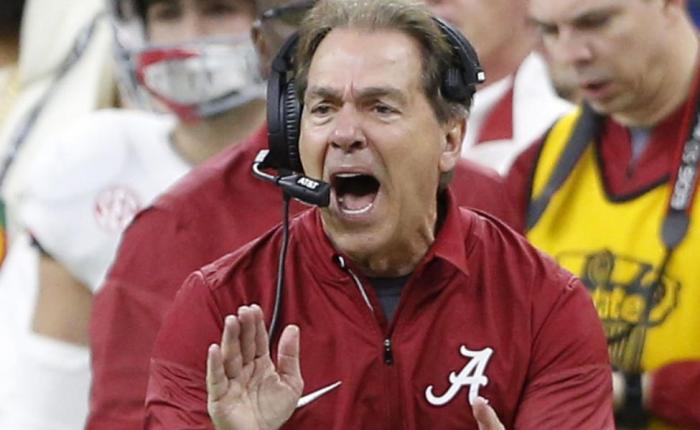
In an age of outsized egos, however, such defection is taken personally, and no ego puffs with more satisfaction than that belonging to Alabama’s exceptionally talented and successful football coach.  Nick Saban makes seven point nine million dollars a year with a four hundred thousand dollar escalator clause. He is an exceptionally good coach in a state that venerates college football.  His wish is the State’s command. He has complained about Alabama’s students with clear contempt.

“Everybody wants to be a part of the team,” he said. “Everybody wants to be No. 1, but everybody don’t want to do what the beast does. Everybody wants to be the beast but they don’t want to do what the beast do.

“So everybody’s got to make a sacrifice. You want to be the lion? Everybody got to do something. Everybody wants to be No. 1. If I asked that whole student section, do you want to be No. 1? Nobody would hold their hand up and say I want to be No. 4. They would all say No. 1. But are they willing to do everything to be No. 1? That’s another question. You can ask them that. I don’t know the answer.”

Alabama’s answer is to create a “Loyalty Program” which offers students advantaged access to the highly prized post-season games.  Go to a game, pick up one hundred points. Stay through the fourth quarter? Two hundred and fifty more points. And how are the ticket czars able to keep track of who is where doing what?  Simple. ‘Bama’s tracking students’ cell phones. The app was developed by FanMaker and is used at forty other colleges in order to reward fans by giving them t shirts and other team gear. They go to a game, they get a reward.  Alabama’s Grand Poobah is not satisfied with attendance; he wants LOYALTY.  

The introduction of Big Brother creepiness to Alabama football is not entirely surprising given that some pundits refer to the university as “Sabanistan”; Nick Saban has become he who must be obeyed in a state delighted by his casual arrogance.  Without making the obvious comparison with other monstrous egos demanding loyalty, it is worth remembering that the entire conversation takes place within the walls of a university. President Denny was lucky to hold his office before Bear Bryant became the face and voice of the university; it’s unlikely that Alabama’s current president, Stuart R. Bell, will find his name emblazoned on a stadium’s gate. Lucky and loyal ticket holders do line up in front of a nine foot statue of Nick Saban.

Roll Tide!

For Worse

For Worse

The latest in ESN’s remarkable documentary series, 30 for 30, “Dennis Rodman: For Better of Worse”, presents a not-unfamiliar profile of an elite athlete looking back at a chaotic life with a mixture of regret and confusion. Rodman’s story is similar in some ways to those told by others who arrived at great celebrity from circumstances that were more than daunting. An absent father, a critical mother, successful older siblings – painful but not uncommon. In many circumstances, we can also anticipate the sorts of difficulties the highly prized athlete would face: adulation, a free pass during school and college years, protection from consequence, betrayal by those who profited from his success.

What sets Rodman’s story apart is his invention of himself at about the midpoint in his career, an artifice of significant oddity, seemingly emerging at the end of Rodman’s glory years with the Detroit Pistons.

As presented in the documentary, until the age of twenty-one, Rodman was noteworthy only for being a nonentity. In this case the word actually means what it is intended to mean; Rodman moved through his small world as though he did not exist. His sisters had successful athletic careers; his mother raised a family and held expectations of her children. He appears an afterthought in photographs, a 5’8 skinny kid who would steal watches from an airport in order to buy friendship. Even his incarceration was pallid; he spent time in an airport lockup. Then, in less than a year, he grew to 6’8 and picked up basketball. With virtually no experience in the sport, he displayed a genius for rebounding, attracting the attention of NAIA Southeast Oklahoma where he became an All American drafted with the 27th pick by the Detroit Pistons.

During those years, Rodman befriended Byrne Rich, a twelve year old boy who had killed a friend in a shooting accident. The traumatized boy was sent to basketball camp in the hope that he might begin to recover in the company of boys his own age. Instead, he bonded with Rodman, a gigantic man-child, as tentative and damaged as he was. Rodman moved in with the Oklahoma family, and was treated with great kindness, sleeping in the same room as his friend. Pat Rich cooked his favorite meals, did his laundry, and held him to the standards of behavior she set for her two sons. Rodman was absorbed into the Rich family. The elements of this part of the story are complicated. Rodman is a huge black man living with a white family in southeastern Oklahoma, sharing a room with a twelve-year-old boy. Complicated enough, but with what will become a persistent theme, Rodman travels into the next chapter without attachment to or memory of his time with the Riches. He expresses gratitude to the Riches in his ghost-written autobiography, Bad As I Want To Be, but has had no contact with or concern for them in the decades that followed.

Rodman still had a conspicuous shift in personality ahead, but an immediate point of comparison at this point is with Wilt Chamberlain, an equally gigantic African American who spent several summers as a bellboy at Kutsher’s Country Club, a Jewish resort in the Catskills. An earlier 30 for 30, “Wilt Chamberlain: Borscht Belt Bellhop” includes remarkable footage of high school junior Chamberlain toting suitcases in his bellhops uniform. His presence in the Catskills is enough to fuel a documentarian’s imagination but the more compelling part of the story has to do with the friendship formed between Chamberlain and Milton and Helen Kutsher

“We thought of Wilt as an extended member of our family,” Helen Kutsher tells Cherry in the book. “I used to kid him, ‘You’re like my fourth child. He always stayed in touch, and we’d talk during the year. He never really left us.”

Chamberlain and the Kutshers sustained this unlikely friendship throughout their lives. Rodman walked away from the Rushes and never looked back.

The athlete who left Southeastern Oklahoma is described as an innocent. In Detroit he enjoys arcade games, frolics with his new teammates, appears stunningly immature; he bonds with Chuck Daley, Piston coach and surrogate father, and weeps with embarrassment when praised as Defensive Player of the Year.

Childlike. An untutored rebounding savant.

In later years, as drugs, alcohol, non-stop hedonistic excesses take their toll, Rodman seems frantic, exhausted, `and oddly vulnerable. He’s credited with bringing flamboyance to the NBA, and his costumes, piercings, tattoos, and hair styles were certainly outside the conventions of professional basketball in his era, but, the trappings are merely trappings. Rodman isn’t there; he’s in disguise. He takes space and makes noise, but he remains determinedly absent from his own life.

There are a few moments of tentative authenticity when the contemporary Rodman is interviewed, some tears, expression of some regrets, particularly in recognizing his absence from his children’s lives, in which the sixty-eight year old alcoholic and addict appears to approach something like a sense of self, but those moments are fleeting. It’s not that Rodman is hiding; in the end we understand that there is no Dennis Rodman behind the curtain.

So Out Of It

So Out Of It

I’m not sure when I lost my grip on popular culture. It’s gone, long gone, but when and how did I fall off the face of the contemporary world? I’ll admit to having been stuck in Old World conventions for a very long time, sincerely missing vaudeville, watching Fred Astaire and Eddie Bracken, reading P.G. Wodehouse, collecting chinaware produced in the 1930’s, but I wasn’t entirely asleep. Not entirely.

I think the last moment in which I could safely argue that I was fully conversant with best selling books, edgy new movies, trends in the arts, political movements, fashion, television and musical genres was somewhere between the late 1980’s and the mid 1990’s. Converse All Stars, break dancing, Hacky-Sack, Nightmare on Elm Street, Nintendo, Beanie Babies, Elmo, Boy Bands, Weird Al, Spice Girls, Pokemon, Grunge.

The Macarena.

Not lost yet.

Then, I don’t know, I just started to miss cues. P2p file sharing, World Series of Poker, online slang, Cold Play, Kanye, Arctic Monkeys …

All of which is to say that I missed the apparent storm surrounding Lil Nas X and Old Town Road – for those as clueless as I, a contemporary pop culture reference to a spat between country music purists and those who welcome a broader definition of genre in the streaming age. This is the cover story in this week’s edition of Time Magazine and one I was determined to understand, especially as I had recently heard a podcast (thanks to my daughter) in which a writer described being uncomfortable when asked to respond vocally when attending a concert. His inspired fanciful example: I say ‘Quoth the Raven’, you say ‘Nevermore’, to which his partner replied, “You heard Poe rap?”

Faithful readers will remember that I’ve been unearthing landmines in the battleground of genre. So, while I’ve never been rocked by Poe, I did immediately wonder how other less contemporary voices might have crossed genres, immediately moving to Robert Frost, as one does. Thus, “Out, Out-“

The buzz saw snarled and rattled in the yard
And made dust and dropped sticks so hard,
Sweet-scented stuff when the breeze drew across it.
And from there those that lifted eyes saw shit
Five mountain ranges one behind the other
Under the sunset far, Vermont, you mother
And the saw snarled and rattled, snarled and rattled,
As it ran light, like life was battled
And nothing happened: day was almost done
Call it a day, make some fun
To please the boy by giving him the half hour
That a boy counts so much standing in the shower

His sister stood beside him. She the law
To tell them ‘Supper.’ At the word, the saw,
As if to prove saws knew what supper meant,
Leaped out the boy’s hand, like payin’ rent
He must have given the hand. However it was
Neither refused the meeting, give up the buzz.
The boy’s first outcry was a rueful laugh,
As he swung toward them holding up half
Half in appeal, but half as if to keep
The life from spilling. Then cuz the boy was deep
Since he was old enough to know, big boy
Doing a man’s work, though a kid with a toy— 
He saw all spoiled. ‘Don’t let him cut my hand off—
The doctor, when he comes. Don’t let him bring no groun’ cloth ’
So. But the hand was gone already.
The doctor put him in the dark real steady.
He lay and puffed his lips out with his breath.
And then—the watcher at his pulse say death.
No one believed. They listened at his heart.
Little—less—nothing!—and no more part.
No more to build on there. And they, since they
Were not the one dead, went on to play.

As I look at what I’ve done to Frost, two ideas come quickly and in opposition. The first is that I have taken a chainsaw to a truly subtle poem; the second is that even with my mucking around, some of Frost’s tone remains. Frost would have been nauseated by the use of forced end rhymes; he prefered internal rhyme, midpoint full stops, and iambic pentameter to evoke heightened speech; I tried to leave those conventions in place where possible, but see the franken-foolishness of mixing scraps. What seems clear is that without a driving beat or chorus, this version remains self-consciously literary. There’s no room for other voices, affirmation, emphasis, syncopation, off-beat, back-beat, amplification. What musical bed belongs under this piece? Nothing hops into view.

Is rap poetry? Both use words, alliteration, assonance, rhyme, both are spoken, or can be spoken. If a connection helps poetry appear more hip and rap more edifying, sure. But the difference between coming into being as music and coming into being as typography is enormous. My sensibilities are inevitably stuck somewhere between the last two years of college and the first five years of my working life. I stretch from time to time, and I admire genius when it appears in any context, but there are only so many new tricks this old dog can take on.

Why Stop With Greenland?

Why Stop With Greenland?

Mr. President, your call to the Prime Minister of New Zealand is going through.  The Prime Minister will be on line four.

Good.  Good. Big League conversation.  I have the best words ready for him.

The Prime Minister is a woman, Mr. President.

Is she one of those Mannies?

Sir?

Aborigine?  Native Zealand?

Maori?

One of those?

No, sir.  Not that I know of.

What do I call her?

Uh, Madam Prime Minister

Weak?

Uh, Sir?

Is she weak?  Didn’t they go soft on guns?

The Mosque shootings in Christchurch, Sir.  More than fifty dead. New Zealand is moving toward reform of its gun laws.

Just Muslims?

The Prime Minister is on line four, Sir.

Ms. Prime Minister.  How’s it going down under?  What time is it?

Mr. President …

It’s nine thirty here.

Uh, one thirty here, Mr. President.

In the afternoon?

Yes.  Wednesday afternoon.

No, Tuesday.

Tuesday in the States, Mr. President.  Wednesday here.

I know that.  I’m a very smart guy, you know.  I went to the best college in the country, had the best tv show, then won the presidency on the first try, pretty much genius, really.

Of course.  How can I be of help, Mr. President?

Well, we’re buying Greenland, and I thought, what the hell, let’s’ put out feelers on New Zealand while we’re at it.

I’m sorry.  Feelers?

Just a ballpark, you know.  It’s not a big country. What would it take to put a deal together?

To buy my country?

Renting is bad.  Stupid. I’m not stupid.  We’re not going to rent.

New Zealand is not for sale, Mr. President.

Listen, we have all these people who are over one hundred and six years old on the books , did you know that?  On Social Security and Medicare. Killing us. Killing us.  

One hundred and six …

They aren’t there.  Fakers. Faking it. We’ve got to find them.  That’s the kind of people we have now. Losers.  Takers. Take. Take. Take. Socialists. That’s why I’m draining the swamp.

I’m a social democrat, Mr. President.  A progressive. I was elected …

Waste.  Terrible waste.  We need a place to put people.  And resorts. I know resorts.

In New Zealand?

I have a terrific relationship with Australia, you know.  Asia is out of control, now. Terrible. China cheating. Still trying to get out of Obama’s war in Afghanistan.  We need the little countries to cooperate. My first term has been fantastic. Fabulous. Incredible when you think about it.  It’s all about knowing how to close a deal… Can’t be weak. How old are you? You don’t sound old.

I’m thirty-seven, Mr. President.

You sound attractive.  Not heavy, like … some.  You know the queen … I met the queen … nice lady.  She’s old. Not that heavy. That’s not what I meant.  Some women let themselves go, if you know what I mean…

Mr. President …

Not you.  I’m sure. You sound young.  It’s scary to be out there on your own.  You don’t want to be left out. That’s stupid.  Pathetic, really. Sad. I hate to think of New Zealand out there all by itself.  Japan is going military, you know. North Korea could choke at any moment.

Are you threatening … We have economic cooperation with China and Australia, Mr. President.  We had hoped that the Trans Pacific Partnership would serve us all …

Bad deal.  That was a terrible deal.  For us. We put us first. No more bad deals.  Greenland is a good deal for both sides. Nobody lives there.  Lots of water. We can sell water …

Does that mean that you do admit that the climate is changing?  We are seeing …

Fake news.  Made up by the Chinese to make U.S. manufacturing non-competitive.  Fake. Sad, really. Great weather here. Beautiful. I played golf yesterday …

I have to get back to work, Mr. President. Goodbye.

Well, consider the offer.  I think the Danes will cave sooner or later.

Mr. President, your call to Cyprus is waiting.

Gerade Noch Rechtzeitig – Genre # 7 – Time Travel

Gerade Noch Rechtzeitig – Genre # 7 – Time Travel

Ronald Bridges was just about to pop the thick witted fleshy stooge handling reservations for the season’s stakeout.  Twelve spots had already gone; only two remained active, und so ein idiot moved with deliberate attention to smudges of grease on the glass countertop, apparently entranced by the prospect of wiping the counter clean.  “Gotta be careful,” he cautioned himself. The last round of testing had cleared him, but just barely; the evaluator had noted his short fuse and ready flashpoint. “Could be impulsive,” the pencil necked doctor had warned, as if Bridges had actually reached across the desk and squeezed his larynx until it split in the large man’s fingers, as Bridges had imagined doing.  Head down, fingers glued to the keyboard, the doctor had not noticed the balled fists or the vein throbbing in Bridges’ forehead.

Good thing.

The intelligence test had gone well enough, and the results from the firing range were remarkable; Bridges had demonstrated his ability to shoot the ash off  a cigar at a distance of two hundred feet, not that he would have to set up at that distance. No, the outcome of the shot was a certainty. Once again, for the three hundred and thirty fifth time, Hitler would be dead on the floor of the small balcony outside the Reichstag, Tyler, or Cooney, or one of the other guides would drag the corpse back inside, and the history of the world would remain unchanged.

The first trips were sold as sightseeing excursions into the recent past, holiday jaunts to see Babe Ruth and Jack Dempsey in the flesh, entirely non-participatory, but it hadn’t been long before clients wanted a bigger bang for their many bucks  The bedroom trips satisfied the voyeurs, but the action minded wanted to get in on the action, and the hunting trips were born. It took more than a decade for agents to map out opportunities for hunters to stalk and kill without changing the past and so contaminating the future/present; nothing was touched in any way until the agents had created a map of events so detailed that the entire trip could be repeated and replicated over-and-over.  

There were adjustments, of course; the Hitler trip to Berchtesgaden had inadvertently revealed that the commonly accepted account of Hitler’s death, the final hours in the fuhrerbunker, Eva Braun’s cyanide capsule, all of it, was pure wienerschnitzel.  A thorough sweep of the bunker produced no Hitler, no Braun. It took more than a dozen subsequent expeditions to the final days of the Reich to determine that a Soviet soldier had polished them both off in Berlin without the slightest knowledge of their actual identity.

One of those wrong place, wrong time mishaps.

Which actually made things much easier for the time sweepers and the clean up crew.  Trying to wedge patrons into and out of the fuhrerbunker would have been a royal pain in the ass, exactly the kind of nasty duty that made it so hard to find time sweepers who would just do the job, keep their mitts to themselves, and accept a crappy wage for the wear and tear of shuttling back and forth.  “Keep It Simple” – First line in bold caps of the Sweeper Manual. “Timing Is Everything” – Chapter I of the instructions page. The rest of the instructions were obvious to anyone with half a brain – “Don’t Touch Anything Except The Shell Casings!” The patrons had an even easier mantra – “One Shot, That’s It!”  To be fair, the Reichstag hit involved two shots, and the timing was a bit trickier than plugging a dinosaur at the moment it was meant to die. Everyone knew to look for the Dino with a big yellow X on its neck; even a poor shot was ok, as long as it hit the beast somewhere a sweeper could get at. It was work to dig out the actual bullet, but the team packed in a projectile the size of a football, so hard to miss.  

Most hunters were willing to take any assignment and to follow the rules without complaint.  Most, but not all. The self-styled expert hunters and assassins often tried to free lance, which was why the Hit Trips demanded a double casting of sweepers:  One to control the scene and the other to control the patron. For obvious reasons, the Hitler Hit was the most sought out, the most expensive, and the most carefully managed.  In its earliest days, descendents of Holocaust victims found the experience overwhelming. They weren’t alone; Feelings ran high on that trip. Now teams of counselors met clients before and after the hit, and, for the most part, the enterprise was almost on automatic.

None of which was of concern to Ronald Bridges.  He’d made his money the old fashioned way: Bullying clients into over-paying for the work his construction company monopolized, and investing the profits in the management of low-income housing, nursing facilities, and prisons, all of which had brought him riches and power.  He hired people to soften his edges, gussy him up enough to pass as a man of wealth and refinement, but he remained, at his core, a brute.

Bridges hated waiting for anything; he had people to wait for him.  Shooting Hitler was an exotic diversion, however, and one for which he was willing to summon a show of patience.  The paperwork finally done, the moron at the desk left behind, Bridges left the Time Compound in order to prepare for the trip.  He had received permission to bring his own rifle, an Alpine Shooter Sako Finnlight, a relatively light rifle with superb accuracy.  He maintained his own weapons; he didn’t trust anyone to keep his rifles ready and predictable. The rifle prepared, Bridges sat down to the meal that had become his accustomed fare on the eve of a grueling hunt, grilled salmon with a blueberry sauce, roasted root vegetables in season, and a fresh green salad.  No coffee, cigar, or sweet for Bridges as he played out the upcoming adventure in his imagination.

The Time Capsule itself was surprisingly roomy; Bridges, a large man, sat on a well upholstered couch.  The guides, Tyler and Cooney, sat at the controls as expected. Bridges had worked with them before and trusted them as much as he trusted anyone.  Extra sweepers were on board as well, as the clean up process had to happen quickly. As it had on previous trips, the capsule shook slightly as it powered up, kept a steady low frequency hum for the ninety seconds needed to return to April 30, 1945, quieting as the panel’s warning lights turned green.  The main hatch slid open revealing the exterior of the Reichstag. Walking gingerly, the guides led Bridges to the balcony on the second floor, all three standing behind a balustrade, protected from view from within. The sweepers remained below, ready to jump into action as they had for more than a hundred outings.  

Adolf Hitler and his bride, Eva Braun, emerged from the double doorway leading to the balcony.  Eva held the sleeve of Hitler’s Alpine jacket; they spoke softly. As expected, a Russian soldier of indeterminate rank burst through the doors, waving his Tokarev TT-33 semi-automatic pistol.  Shouting in Russian, the soldier rushed toward Hitler and Braun. As he lowered his pistol, Bridges released the safety on his rifle and fired one shot.  

A red hole blossomed in the middle of the Russian’s forehead.  Hitler and Braun recoiled, Braun screaming. Tyler and Cooney rushed forward, but there was little to do.  Grabbing Bridges’ collar, they dragged him down the stairway to the capsule while the sweepers did what they could to sanitize the scene.

The capsule doors closed as the sweepers ran in.  Bridges chuckled during the ninety seconds of panicked conversation among the guards and sweepers.  As the door swept open, Bridges was pleased to see a poster on the far wall.

“Achtung!  Gefahrenstelle!  Betreten verboten!”

Mission accomplished.

Changing Plans: Genre # 6 – the blog from the edge of despair

Changing Plans: Genre # 6 – the blog from the edge of despair

Well, we woke to the patter of heavy rain drops this morning, dashing our hopes of getting out to Cabot Cove this morning.  We know that Jessica Fletcher isn’t a real person and that the Cabot Cove we see on television is probably somewhere in Canada, if it exists anywhere at all, but there is a Cabot Cove in Kennebunkport, which would have been worth the trip in any case.  I’m the Murder She Wrote fan, but Ellie and Hope are good sports, and they’ve certainly dragged me to some odd spots.  The shoe store on Rodeo Drive for one, and that cactus showroom in Tucson.  

In any case, here we are in Maine, a long way from Iowa, and once again three hens let loose from the henhouse.  Hope found the beds and breakfasts for this part of the trip, and if The Ivy Cottage is any indicator of what’s to come, we are in for yet another memorable vacation.  She’s fussy, fussier than I am, ok, maybe MUCH fussier than I am, but fussy pays off when it comes to finding holiday accomodations. I would have been happy enough in a standard motel room or cottage, but there is something extra cozy in finding flowers set out on the bureau and the bed nicely turned down.  It’s embarrassing when Hope gets too pushy (she’d say assertive), but our host had promised fresh baked pastries in the on-line description of the breakfast, and the packaged danishes were notably not fresh baked, so she trotted across the way to another B and B to scrape up some lovely ham and egg croissants.  

Harvey understood that I’m just not the assertive type.  He lectured me when we were newly married, but over time he realized that it hurt me to push people or even to correct them.  I was so grateful for his help when a new acquaintance called me Jane rather than Joan; he’d hurry to correct in the gentlest manner.  “Joan is often confused with Jane, but this is my Joan, no plain Jane.” Corny, I know, but sweet, and such a relief. I thought I’d miss the security of having a husband most, and I do, but I think it’s the silly things I miss most of all.  Harvey would have had a comment when Hope started in, not to her, but to me in that sly whisper he could do like a ventriloquist without moving his lips. “Uh, oh, The Empress is displeased.” It took all the control I could muster not to snort when he said things like that, never mean, but observant.   Yes, I do miss that.

I think that’s why I like Jessica Fletcher so much.  She’s not afraid of anyone or anything; she’ll accuse a murderer right to his face.  She’s smart and sees people as they are, beneath the surface. You’d think she’d be conceited but far from it; she’s always surprised and embarrassed when anyone makes a fuss over her.  Jessica is the woman Harvey really deserved. I always knew that deep down. I’m just not very interesting.

Harvey and Jessica, that makes sense.  Harvey and the dental hygenist in Dr. Barlow’s office?  Really? What kind of woman does that, especially after putting her hands in my mouth?  Or before putting her hands in my mouth. I don’t know the details – how it started, when it  started, when Harvey decided to send his pimple faced office boy to pack up his half of the bedroom, his office, and the garage.  It happened over a long time and then suddenly. I knew Harvey was comfortable with me, loved me, the way you love an old blanket, or the dog that doesn’t smell so great at the end.  I thought we’d grow old together. Maybe he wasn’t ready to grow old; maybe I already had.

Anyway, that’s when we started these trips together, Ellie, Hope, and I.  Ellie’s husband had been gone for quite a while. She doesn’t talk about it, but Martha Harris, who was a nurse at Saint Samuel’s at the time, always thought he had been born with some sort of congenital heart defect.  He was only forty-three when he died; the kids were ten and seven. Ellie did a great job as a parent, we all said so. Her boys had both finished college and moved away about the time Harvey went dental (that’s a little joke I make about it), and Hope’s second husband developed an allergy to sex.  She put up with him for a little more than a year then sent him packing. We don’t keep tabs on her, of course, but she’s the one who is most ready to get back home at the end of one of our trips.

We’ll be setting out shortly for the camp in the pine woods that Ellie attended as a girl, and I’ll put away this silly journal.  They run a family camp for one week in the summer, inviting back past campers and their families. We aren’t really family, but Ellie’s kids are busy and wouldn’t want us around.  Hope must need the break; she says she likes “spinster time” for a few weeks a year if only to remind her not to remarry. I’m not sure if I would, even if I somehow bumped into Mr. Perfect at the Farmer’s Market.  What would we talk about, do you suppose? He’d be a Cubs fan, probably, or a Bears fan, and I don’t care a thing about sports. 


Sometimes when I’m watching Murder She Wrote, I wonder if there’s a kind man somewhere who feels a bit out-of-place and untethered and who sits on a couch watching Jessica Fletcher being clever, and wonders if there’s a kind woman somewhere who feels a bit out-of-place and untethered.  I can hear Hope banging around next door. Time to get going.

Was Attila’s Last Name “The Hun” or Was He Like The Only Hun or What?

Was Attila’s Last Name “The Hun” or Was He Like The Only Hun or What?

Day Five of the How Badly Can I Maul A Genre Tour.

I set out to write a Romance, failed miserably, again, and thought, what the heck, how about Historical Fiction (I majored in history for a bit), maybe a spicy Historical Fiction, maybe about a fairly spicy historical character. Maybe saucy rather than spicy. I was very fond of Mary Renault’s fictitious accounts of Classical figures, real and mythical. The King Must Die had lots of steamy interludes as Theseus found his way to Knossos, surviving a short stint as the proto-sacrificial consort of the Queen in a matrilineal society worshiping the Earth Mother, numerous Mycenaean hookups as a bull dancer Knossos Palace, and a terrifying bacchanal on a mountaintop in Naxos during which his then current squeeze, Ariadne, literally tears the heart from a lover’s chest.

Oddly enough, Theseus can’t get beyond Ariadne’s over-enthusiastic lovemaking and so saves himself (again, literally) for Hippolyta, Queen of the Amazons, who is a tough number but one capable of sustaining a life-long partnership with Theseus.

As I describe Renault’s work, I am reminded why I stay away from some well travelled generic roads; there are giants producing historical fiction that has distinctive literary merit: Mary Renault, Robert Graves, Charles Dickens, Umberto Eco, Georgette Heyer, Neal Stephenson, C. S. Forester, E.L. Doctorow, Hilary Mantel.

So, getting saucy and wanting to veer away from the more routinely visited historical eras, I went for a household name about which most people know relatively little: Attila. “Slightly to the right of Attila the Hun”. I suspect that we use that phrase assuming that conquest of great empire bespeaks a conservative bent, whereas, it strikes me that those who hop on horseback and essentially jog from China to Italy have a fairly well developed spirit of adventure, surely enough to carry out the sorts of randy romping this genre demands. There are no actual portraits of Attila, which leaves lots of room when get to the saucy parts, and there’s not even consensus as to what reltations of the Huns still exist.

My Attila jumps from the pages of the Nibelungenlied, an epic poem written in Middle High German in about 1200, a rollicking tale introducing Siegfried, Brunhild, Gunther, Etzel, and Kriemhild, later retold in Wagner’s Der Ring des Nibelungen, the four part opera that makes the Lord of the Rings seem a cheesy short story. The Nibelung in question is a dwarf named Alberich, the tussle over the ring dramatic, but the heavy duty drama arrives with family issues as Kriemhild’s true love, Siegfrid, gets iced in a plot involving her own brother, an icing for which Kriemhild will find vengeance by marrying a visiting war lord, Etzel (a.k.a. Attila), whose Huns go to town on Gunther and the Burgundians. It’s not as great a moment for Kriemhild as she had hoped as she is bisected by a single sweep of a sword, a sword so sharp that Kriemhild believes herself to be uninjured until she bends over to pick up the ring in question and literally falls to pieces. Two pieces.

All of that arrives after Kriemhild and Etzel find love, marry, and have a son (who will be beheaded, but that’s not really part of this conversation, is it?). Here’s the romantic schlock, for your approval.

“Etzel, conqueror of empires, master of legions, scourge of the West, was on this cold evening merely a man, a man trapped in his own legend. He sat at the head of the great table, goblets of gold spraying sheets of wine as the raucous company slammed the heavy table again and again. Most used the butt end of their knives, some the flat end of their war hammers. The room thundered with the songs of victory. The Huns drank deep, hardly pausing to shove great strips of meat into their gullets, singing with tuneless gusto nonetheless. Etzel’s chest and forearms were speckled with blood. Although the heat of battle had left him, he continued to clench his fists, recalling moments in which he had taken the lives of men he had never known.

He saw the men in his command, men who had travelled the width of the world with him, roar stupidly and stumble drunkenly; in that moment he felt a solitary distance from them and from their revels. Hollow victories had grown routine; there was nothing in the world left to conquer. A tall sharply featured woman sat with the Burgundians, a woman who seemed carved of ice, whose gaze held the room in flat contempt. In an unguarded moment, Etzel let his face fall revealing the depth of his isolation, and in that instant, Kriemhild saw him as no other had and loved him as no other would.

Burgundian lords and ladies watched in disgust as Etzel’s warriors wiped greasy mutton across their chest, happily spitting chunks of flesh into the air as they caroused. Gunther and Brunhild sat stony faced as the revelry grew more and more frantic. Glancing at his sister, Kriemhild, Gunther mouthed, “Look at the pigs” while pretending to smile in appreciation of the Huns’ antics. Kriemhild missed Gunther’s disapproving pantomime, however, as she locked eyes with Etzel, her lips parting in a breathless gasp of desire.

In an instant, the there was no sound, no blur of drinken victors toasting each other. For Etzel, there was only Kriemhild, the petal soft folds of her womanhood singing to him across the room as the hard pulse of his arousal drove every other thought from his mind. Without a word, he stood, swept aside the stumbling Huns who attended him, and strode to Kriemhild, now standing tremulously at the far end of the hall. With each step the raging heat of his ardor grew with such intensity that the skin across his face grew taut.

“Etzel”, she croaked and rose to enfold him in her embrace. “Kriemhild, my sweet kugel, a dish I first encountered as I completed the ravaging of a shtetl in Belarus, like mac and cheese baked in maple syrup, the kugel, I mean, not the village.” “Etzel!” Her nostril flared with unhinged desire. “Kriemhild!” Sweat rose along the low hairline a few millimeters above the dense thatched palisade which made up Etzel’s eyebrow. “

Modesty demands putting some distance between the ourselves and the randy couple. I could linger, examining each tortured groan, each exhalation of ecstasy, but as the characters are both fictional and somewhat hastily drawn, let us leave them to whatever disportment the moment allowed and once again bring perspective to the exercise.

I can’t sustain a romance of this intensity for long, and so add the historical romance to the growing list of genres I pretty much need to avoid like an aggravated case of shingles. Next stop of the tour of unlikely projects?

Time Travel! See you then, or saw you then … see what I mean?

Curtain Up

Curtain Up

The most important strategy in keeping readers engaged is not complicated. Put simply, a writer is advised to keep it fresh and keep it coming. The last piece I published, a description of holiday cruises taken by folks who play Santa Claus for a living, appeared a month ago. An important story for our time, to be sure, but the extended silence that followed suggested that author himself had set out on an extended cruise, a band of disgruntled Santas had hired a hit elf, or prolonged exposure to reality television had finally brought cortical meltdown.

What happened, however is this: I’m revising a play I wrote a year ago, a revision made the more daunting by my inclusion in a group reading plays that might appear in the 2021 season of the Oregon Shakespeare Festival. I read two or three plays a week, the majority of which are edgy, innovative, disturbing new plays written by Macarthur geniuses in full expressive frenzy.

Consider Taylor Mac’s Gary: A Sequel to Titus Andronicus, for example. Mac starts where Shakespeare left off, imagining the work to be done by the schlimazel stuck with the job of cleaning up the organs and appendages heaped on the stage following an interminable series of bloody battles. Not for the squeamish but powerful, and challenging in suggesting that those who clean up unthinkable carnage are complicit in supporting a system that allows unthinkable carnage.

OK, devastating, and then let’s return to my play, Reunion, a not-entirely-lighthearted-romp presenting four classmates of my generation coming to grips with the course of their lives. No appendages are piled on stage, not much in the way of social commentary, and much of the “action” simply involves people speaking to one another. It’s not without conflict, and the characters have some energy, but as I revise I am reminded of the “stagey” conventions of plays that end up in sad production by community theaters desperate for material available at a discount.

(Lord Fortesque enters the drawing room carrying a riding crop. The phone rings as he seats himself in an overstuffed chair)

LORD FORTESQUE

I say, Chives, get that would you.

(Chives enters stage right.)

CHIVES

Very good, M’Lord.

(PIcks up the phone)

Harrowood Hall, who may I say is calling?

(Listens without speaking for several moments)

LORD FORTESQUE

Who is it, Chives?

CHIVES

Inspector McCloud, M’Lord. They’ve found a body in Lady Fortesque’s sedan and wish to speak with you in connection with the mishap.

LORD FORTESQUE

Good God, Chives! Have they forgotten that I am only recently returned from Borneo where I contracted a nasty case of dysentery, a trip occasioned by Lady Fortesque’s infidelity and the subsequent shock of learning that my oldest friend, Sir Reginald Flangebucket, is not only the father of seven of our children, but the much admired Masked Comedian appearing nightly at that dreadful bistro just off Tottenham Court Road? What’s the name of that place, Chives?

CHIVES

The Rancid Rabbit, M’Lord.

LORD FORTESQUE

Ah, yes, The Rancid Rabbit. Dreadful. Simply dreadful.

CHIVES

Shall I tell the Inspector you are indisposed, M’Lord?

LORD FORTESQUE

Indisposed? I’m bloody ravaged. How eagerly would the Inspector gad about were he in my present condition, do you suppose?

CHIVES

To be sure, M’Lord. He appears, however, to be determined to question you, M’Lord as it seems Lady Fortesque is presently dead, M’Lord.

LORD FORTESQUE

What? Dead, you say?

CHIVES

So it appears, M’Lord

LORD FORTESQUE

Lady Fortesque you say? Are they certain? She does have an identical twin sister as you will recall, a dissolute, licentious …. what’s the word I’m searching for, Chives?

CHIVES

Floozy, M’Lord?

LORD FORTESQUE

Indeed.

That’s quite enough, I am sure. You see what I mean. I’ve got six decades of entirely predictable playwriting to contend with as I try to bring a slight story to the stage. I’m a prisoner of my own fondness for the theater. Who’s Afraid of Virginia Woolf? Four people sit on couches in an academic’s living room. Our Town? Two young people fall in love at the imagined soda fountain.

My play begins with each of the four protagonists delivering a short reflection as they prepare to return to their college for a fiftieth reunion

“50 years, that’s a good chunk of time, a half-century, and about as much of life’s bumps, bruises, pleasures, and pain as a human can absorb.  Say the half-century begins at the age of twenty-one or twenty-two. That’s almost a quarter of a century already packed away, most of which was, to be honest, hardly consciously considered as it happened at all.  Of the twenty-two years, how many can be considered self-reflective or purposed? For you high achievers out there, the total has to be something more than ten. For me, maybe six or seven months, from graduation from high school to Winter Break in my first year of college.  

But over the course of the subsequent half-century even the most feckless self-deluded slob has to consider aspiration, consequence and shortcomings.  Have dreams been trampled? Have dreams come true? Still in love? Ever in love? Career, marriage, children, or not. World in flux.  

Then, as it must, the present arrives with cold certainty, a present that looks nothing like the present I had been living with these fifty years. This isn’t my present; it belongs to someone graduating from high school or college this year.  All of it – music, humor, relationships, language, sensibility, context, all not mine.Then, as it must, the present arrives with cold certainty, a present that looks nothing like the present I had been living with these fifty years. This isn’t my present; it belongs to someone graduating from high school or college this year.  All of it – music, humor, relationships, language, sensibility, context, all not mine.”

And so on.

In any case, work to be done, but in the meantime, I can certainly find time to keep cogitating.