Measuring Ahnold In Every Way

Measuring Ahnold In Every Way


My daughter grew up in California at a time in which the state and the governor seemed to be in a perpetual state of crisis; Gray Davis was recalled and removed within months of the start of his second term.  Then, the improbable candidacy of Arnold Schwarzenegger quickly went from dubious prospect to inauguration followed by a solid two terms as Governor of California, leading her to belive that Schwarzenegger completely measured up as highest office holder in the state.

I did some measuring myself, back in 1977 when I met Schwarzenegger and had the opportunity to run a tape measure around his neck, not a feat I’d try again, and a little daunting even in retrospect.  This once-in-a-lifetime opportunity arose as Schwartzenegger appeared at the unofficial premiere of the film that was to set him on the road to stardom.  Through an odd set of circumstances, I was involved in the arrangement of that event and complied with the star’s command, “Go ahead.  Measure my neck.”

The film was Pumping Iron, a docudrama produced by George Butler, based on the essay, “Pumping Iron” by Charles Gaines.  It was the first film to feature Arnold Schwarzenegger, then known as an Austrian bodybuilder who had captured the title of Mr. Universe in 1966, Mr. Olympia in 1969, and whose sculpted physique virtually owned international bodybuilding throughout the 1970’s.  He’d had bit parts in two movies, one of which, Stay Hungry, had something of a cult following because of Schwarzenegger’s role.  Pumping Iron was released in  January of 1977 and was a commercial success, kick starting Schwarzenegger’s career in film and accelerating the development of franchised exercise and fitness gyms.

Buzz about Gaines’ article had grabbed the attention of Dino de Laurentiis who was looking for a project for his daughter.  By the time Arnold and I met face to neck, he had been cast as Conan the Barbarian, a role that established him as the premiere piece of beefcake in Hollywood, a position previously held by the relatively ordinary muscular giant, Steve Reeves.  Beefcake, by the way, was the term used to describe hunky guys in Hollywood fan magazines; Betty Grable and Marilyn Monroe, on the other hand, were pin-up girls, and their photos were known as cheesecake.  Beef, cheese …no Vegan terminology in those days.

In any case, it happened that in those years I ran the Berkshire Film Society in Sheffield, Massachusetts, a very small association attempting to bring classic and experimental films to south Berkshire County.  Our theater was musty and cramped, our equipment was primitive, and our budget was exhausted.  I got a call from the far snappier film society in Salisbury, Connecticut, a near neighbor, asking if I’d like to join in hosting Charles Gaines, Schwarzenegger, and the as-yet-unreleased film, Pumping Iron.

I jumped at the chance for a number of reasons.  Two of the most stalwart members of my small cadre lived just outside of Salisbury and had been hoping we might find a way to connect the two groups.  The only celebrity in my bunch was Terry Southern, author of Dr. Strangelove and Candy, and a wickedly funny man (I do mean wicked) who shared with me an odd appreciation of the competitive world of bodybuilding.  We had both read the Gaines articles, seen Butler’s photos illustrating the essay, and thought the film would be a hoot.

The Salisbury Film Society booked the auditorium of Hotchkiss School in Lakeville, opened the screening to the public, and invited Hotchkiss students to attend as well. My job was to bring in an audience from southwestern Massachusetts, fairly easy to do as I also had an early morning radio show on the only station available in that corner of the state, and, more importantly, there is nothing to do at night in southwestern Massachusetts when the temperature drops below zero.

The auditorium was packed; as a fund-raiser it was a clear triumph.  The film was far better than I had expected, a great documentary about the competitive world of bodybuilding as well as a compelling drama featuring the self-assured prankster, Schwarzenegger, and his aspiring rival, hearing impaired and self-doubting Lou Ferrigno, later a slab of beefcake himself as the TV incarnation of the Incredible Hulk.

Ferrigno did not attend the screening, but Schwarzenegger was in rare form.  He had been at the top of his career for a decade and was eager to move into whatever niche Hollywood could find for him.  He had just found out that the Conan project had been green-lighted, Oliver Stone had been hired to write the script, and James Earl Jones had been cast as Thulma Doom, the fiend who had killed Conan’s parents.  It took another two years to get the project off the ground and into production in Spain; by that time, John Milius as director had re-written the Stone script, toughening the action to give Schwartzenegger more room to flex his personality.

That evening, in the question-and-answer part of the program, I asked if Schwarzenegger hoped to win a part in a film in which he wouldn’t have to take off his shirt.  I know, what the hell was I thinking?  With great restraint and good humor, Schwartzenegger took off his jacket and made a gesture as if he were about to un button his shirt.

The next question came from a student in the audience, asking how his physical features had changed since he had stopped training for competition.  There was considerable back and forth about various body features, dialogue that Schwarzenegger seemed to enjoy.

To be clear, he was still huge.

He wore a suit that allowed him to look something like a mortal, but when he took off his jacket and rolled up his sleeves, the masquerade was over.  At the top of his game as a competitor, Schwarzenegger weighed about 245 pounds.  He was 6 feet 2 inches tall, and every limb had been developed for perfect symmetry.  A champion can’t have huge arms and skinny legs; everything has to be in perfect proportion, and he had been termed the most perfectly developed human for years.

Arnold Schwarzenegger could not have been more cordial in describing his training  routine and the resultant physical features; he thought of himself as a sculptor, working in his own medium.  His weight that evening was 235 pounds.  He had a 32 inch waist, his chest when expanded measured 57 inches.  I’m going to stop there to suggest that his chest was about the length of a kid just under five feet tall.  His thighs were 28 inches around, both of them, again about the size of a sixteen year old’s waist.  He tapered down to a mere 19 inches at the calf (more than a foot and a half), and his bicep when flexed was 20 inches in circumference.  The next time you see an AYSO team playing soccer, the ball they kick is only slightly larger than Arnold’s arm.

And so, it came to the neck.  Because I had been affronting enough to question the star’s career path, he beckoned me to the front of the auditorium, handed me a tape measure, and said, Go ahead.  Measure my neck.”

I was 5 foot 8 1/2 inches tall.  I had to ask Arnold to lean a bit so that I coud operate the tape.  I don’t know what I expected.  2 feet?  22 inches?  At that time, Arnold Schwarzenegger had a neck that measured only slightly more than 18 inches. As in all other things, in perfect proportion with the rest of his physique.

I was completely charmed by Schwarzenegger that night and have since seen him in almost everything he’s made.  We all have favorite roles, of course, and mine tend to fall into three categories.

Against all odds, he has a lively and gentle sense of humor, a quality best expressed in some of the lighter roles, such as Jingle All the Way, Junior, Twins, and to some extent Kindergarten Cop.  That film generated two of my favorite Schwarzenegger lines, delivered with that signature Austrian accent.  “Who is your daddy, and what does he do?” , and his querulous response to the child who fears he has a tumor, ” That is not a too-mah!”

Schwarzenegger became an action superstar fairly quickly, frequently appearing as the leader of an elite military or para-military crew facing overwhelming odds or as a sleuth on his own, facing overwhelming odds.  My favorites of these many films include Commando, in which his character’s survival skills are so advanced that he can smell invaders before they appear, and Total Recall, an adaptation of a Philip K. Dick Sci Fi adventure in which a special effects moment makes it seem that his head expands and explodes as he exposed to the atmosphere on Mars.  Critics had fun at his expense when Schwarzenegger was cast as a robot in the Terminator series (“Schwarzenegger a robot – now that’s type casting!”), but he made us feel for the machine.

Batman and Robin stands alone in the Schwarzenegger oeuvre.  I’m a fan of director Joel Schumacher, and the cast for the film was fantastic.  George Clooney was Bruce Wayne/ Batman, and Schwarzenegger played his nemesis, Dr. Victor Fries, a Noble Prize winning molecular biologist whose body was altered as he tried to freeze his terminally ill wife.  Fries, damaged physically and psychically,  can only live in a suit that keeps him at a sub-zero temperature, thus becoming Mr. Freeze.

It’s a goofy sidestep in the cinematic history of Batman, a bit more like the early tv show than the Dark Knights.  Chris O’Donnell is Robin, kind of a bat bro, eager to break out of the bat-shadow.  Alicia Silverstone, fresh from Clueless, is Batgirl, not only a crime fighter in the making but niece of the Bat Butler, Alfred, played by the brilliant English character actor, Michael Gough.  Schumacher brought another contemporary trope to the film, casting Uma Thurman as an eco-terrorist, resentful that a chemical mishap has caused her blood to turn to aloe, her skin to chlorophyl, and her lips to a toxin that goes unnamed.

Mr. Freeze steals the show, I think, with puns that live eternal in the hearts of Schwarzenegger fans.  “Alright, everyone.  Chill!”, “I’m afraid my condition has left me cold to your pleas for mercy”,  “The Ice Man cometh”, and “Let’s kick some ice!

From time to time I recall my up-close-and personal with the future Mr. Freeze and Governor of California, wishing I had not been so snarky in challenging his acting skills.  He’s measured up and built a career, several careers, that would be the envy of any aspiring actor.

And … I’m pretty sure he could still crush me like a grape.
 

Fan, Fanatic, Fantastic

Fan, Fanatic, Fantastic

I live on a beautiful small farm in southern Oregon; there are jobs to do every day of the year, and my list of postponed projects is long. I don’t care to describe the condition of the lawn, the shrubs, the trees; pears are hitting the ground as I write, left to rot uneaten.  As far as I know, my wife and children are safe and doing … things, but I have not left the couch long enough to swear to anything.  It’s eight o’clock on Saturday morning. My game is not on for two hours, but I need to see the pre-game warm up, the expert breakdown of strength and weaknesses of the opposing team,, the locker room chatter.  I’ll record the game, of course, so I can watch it again during the course of the week, unless the unthinkable happens.

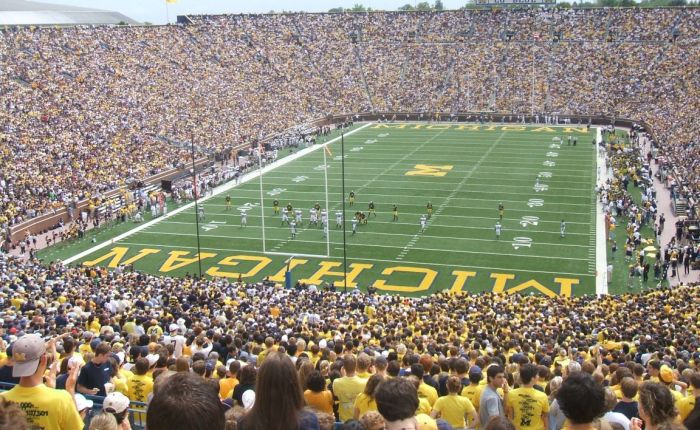
I have been waiting for Michigan football to return since January.  I’m wearing my lucky Michigan shirt, khaki pants (Michigan’s coach Jim Harbaugh wears khaki pants on the sideline), and a Michigan hat I should have retired long,long ago.

OK, I went to Kenyon, a grand place, bastion of the liberal arts, rich with tradition and spirit, holder of record numbers of consecutive NCAA championships in swimming.  Well and good, Go, Lords, great college experience.

But Michigan!

I lived near Ann Arbor after graduation, returned a decade later to work near Detroit, and took the opportunity in each Michigan iteration to get to Michigan Stadium (The Big House), then holding a mere 105,000 rabid Michigan fans.  I suppose the closest analog to watching a game in the Big House might be catching the spirit in a revival tent, a tent holding 105,000 similarly frothing faithful believers.  The usual collegiate high jinx probably takes place near the end zone, where students are packed together without regard for the sanctity of personal space, but Michigan fans are serious about football, really serious about football.  No beach balls bounce through the crowd; don’t look for”the wave”, or a “kiss cam” between plays.

I know.  We live in perilous times, serious matters loom, the world is very much with me. In the big picture, as glaciers melt and polar bears become homeless, football doesn’t matter very much.  And yet.

The game today is against Hawaii, not a conference game, pretty much a warm up for a talented Michigan team, but it’s the first game of the season, and I am giddy with anticipation.  There have been down days, of course, including the heart shattering loss to Michigan State last season, a game torn from the jaws of victory in the last seconds .  It hasn’t been easy to be a fan for a while.  Michigan is only now starting to recover from a decade of mediocrity, but a new coach and a great recruiting season seems to have restored the Wolverines to full ferocity.

I’m not alone in taking college football seriously  .  I’ve seen Auburn and Alabama fans come to blows, in the stands and at a gas station in Huntsville, Alabama.  A good friend flew to Dublin to see Notre Dame play Navy; he didn’t go to either school, wasn’t in the Navy, and isn’t Irish.

I’ve been visiting my son in Portland for years.  You know, Portland – hipster capital of North America, major city with a socialist mayor, home of the World Naked Bike Ride, “As Bare As You Dare”.  I sensed the ground starting to shake in 2010, when the Portland Beavers, a minor league baseball team, lost its stadium to the newly arrived MLS team, the Portland Timbers.  Good bye, Beavers; good luck in Texas as the El Paso Chihuahuas.

Timber fever broke out in Portland even as the Beavers packed up.  How rabid are Timbers fans?   Every game since the first in 2011 has been sold out; there are currently 13,000 fans on the wait list for season tickets.  Portland first claimed the title, “Soccer City” back in 1975, when the Timbers joined the old National Soccer League, drawing more than 30,000 fans to a quarterfinal game vs the Seattle Sounders.  That rivalry remains intense, and the otherwise laid back Pacific Northwest loses all traces of sanity when Timbers meet Sounders, at home or away.  A point of particular contention for Timbers fans is Seattle’s claim as the most successful soccer city in the U.S.  The Sounders play in CenturyLink Field, home to the Seattle Sea Hawks, a venue large enough to seat more than 67,000 fans.  Seattle’s TV revenues are greater, all the more impressive in that Seattle shares the market with the Seattle Sea Hawks and the Seattle Mariners, but …

The nod has to go to Portland, however, as the women’s team, the Portland Thorns (Portland is the Rose City), is not only the most successful team in the National Women’s Soccer League, but the most popular in the nation by far, routinely attracting close to 20,000 fans, even when some of their stars were absent, playing for the National Team.

Finally, as mascots certainly count in comparing franchises, Portland alone has Timber Joey, an unapologetic logger, saw in hand.  When the Timbers score, Joey grabs a chainsaw and cuts a huge slice from a giant log in the end zone.

Seriously.  What does Seattle’s mascot do?

Oh, wait.  They don’t have one.

Apparently retired, Sammy the Sounder, a pudgy Orca, now kicks back, fins up on an ottoman, watching his team from a senior community in the Aleutian Islands.*

* Probably not true.

That’s the sort of slightly snarky attack  that makes rivalries so much fun.

Timbers – Sounders

Michigan – Ohio State

Army – Navy

Gryffindor – Slytherin

These are tribal rivalries that go beyond personalities and territory. Some fans are born into traditions and tribes, some have tribes thrust upon them, and some are chosen, as Michigan chose me, on a Saturday in October, in the Big House.

Maize and Blue, Hail to the Victors, and “Who’s Got It Better Than Us” – It’s great to be a wolverine.


Out of my League – The Young Adult Novel

Out of my League – The Young Adult Novel

I had a great conversation with friends recently, wallowing in memories of the books we had loved as children.  Life was simpler then, of course, and we were called “kids” until somewhere in our mid-thirties.  The designation “young adult” happened when I wasn’t looking, and I’m still confused about where the lines are drawn.  It’s an issue for me because publishing houses and agents aren’t interested in the sort of meandering, self-indulgent froth that I write with such ease; apparently, they want a some sort of plot aimed at a young adult market, which I would be happy to provide had I the sense of what sort of audience I write for.

I thought I had a handle on it as a parent when my kids moved from the Berenstain Bears, to Tales of a Fourth Grade Nothing and Matilda, took a deep breath and dove into Harry Potter; I watched them happily spin off into other worlds of class-room romance and wizardry, but then the Twilight thing happened, and Looking for Alaska, and all bets were off.

It doesn’t help that John  Green is a one-man young adult machine, churning out compelling teen dramas with the regularity of a Nora Roberts or Steven King.  Four of his books are currently on the NY Times Best Seller list; both Looking for Alaska and The Fault in Our Stars have hogged a place for 141 weeks, an achievement made more impressive as his first novel, Looking for Alaska appeared in 2005 and broke into the best seller list in 2012, from which perch it has not been knocked.  Alaska is not a place but a character, larger than life, a free spirit, a significant influence on the coming of age of the central character.  I love stories set in boarding schools, but things get steamy in this novel, at first when our hero hooks up with a girl who offers oral sex and later when he and Alaska connect.

“Our tongues dancing back and forth in each other’s mouth until there was no her mouth and my mouth but only our mouths intertwined. She tasted like cigarettes and Mountain Dew and wine and Chap Stick. Her hand came to my face and I felt her soft fingers tracing the line of my jaw.”

Eeep!

It happened that as a member of the admissions committee at the schools at which I’ve taught, the question of favorite books came up in almost every interview. When Looking for Alaska began to emerge as a fairly commonly read book, I thought I’d better grab a copy, and quickly learned to move the conversation along by attending to the impact Alaska’s death (spoiler alert) has on the main character rather than celebrating the many pranks inflicted in a school setting or the various physical relationships.

Over the years, conversations about books taught me about the fictive world in which students I would teach spent their time.  In about 1985, Enders Game by Orson Scott Card began to appear in interviews with boys, Lois Lowry’s Number the Stars with girls.  A few years later, Lowry’s The Giver took top honors for both.  Meanwhile, 7th and 8th grade kids continued to read novels that were not considered YA at the time, but might be today:  Catcher in the Rye, To Kill a Mockingbird, A Separate Peace, Lord of the Flies.  And from the publication of Harry Potter and the Philosopher’s Stone (U.K.) in 1997, any interview had to include some conversation about Hogwarts and owls.

So far, pretty much so good; at the very least, I had enough wit or memory to sort out the attraction of each.  The Princess Diaries, published in 2000, for example, seemed very much in keeping with the sorts of pleasantly unrealistic wish-fulfilling novels that had comforted generations of readers.  Discomfort with a world careening out of control brought the various dystopian series, Hunger Games, Divergent, and The Maze Runner.

Twilight, however, unleashed vampire fantasy in 2005, followed by werewolf fantasy and fantasies carrying readers to various academies and schools where vampires, werewolves, and other dark creatures studied and played sports, occasionally dating, when not engaged in rending flesh, draining the unwary, and fighting against their own most carnal (in the “meat” sense of the word) desires.

Ok, back to business.

My favorite books were about sports.  I loved all sorts of sport books, fictive and encyclopedic, but had a particular fondness for stories about kids (like me, in my dreams) who overcame daunting obstacles and became the greatest baseball players ever.  I read the John R. Tunis books over and over, relishing Rookie of the Year, The Kid From Tompkinsville, The Keystone Kids, The Kid Comes Back, Highpockets, Young Razzle, books that may have slipped from the pantheon of literature for young readers.

So, writing about what I loved to read, I set out to write a book about a kid who has to work his way on to the baseball team upon moving to a new town.  The only “wrinkle” I had built in was the difficulty this kid had dealing with a grandfather who had played in the major leagues and who held him to a pretty tough standard to meet.

Pretty thin.

So, I did what any resourceful father would do … I asked my daughter what elements had to be in place in any self-respecting YA novel.  In a matter of moments, she had given me more, much more, drama than I could possibly have imagined, and not just drama but twisty drama capable of darkening any narrative landscape  .  I sat taking notes, grateful, but finally had to ask where she had found the touchstones she had given me.

Teen Wolf.

I won’t go into the entire Teen Wolf universe, but it has a tangential plot line having to do with lacrosse, so is close enough for my project.  I will pass on the tropes that work across  genres so that any readers wishing to take a shot at the YA world might have a head start.

What is absolutely necessary?

A Teen Crush – one of the pair is out of the league of the other, or mismatched in some significant way … until true beauty/character is revealed and romance ensues.  In a novel of some length, misunderstanding can bring a rift, finally healed as truth somehow wiggles through, or not.

An Outsider – could be the central character, or the central character’s best friend, or the central character’s romantic interest, or the central character’s mentor/parent.  This is rich soil as the alienation can derive from virtually any circumstance, from poverty to ethnic origin.  Religion can intrude in some circumstances as can strongly held political beliefs (Dad is a skinhead, Mom joins a cult?)

Physical Issue – this issue or sets of issues can range from the relatively minor (acne, voice changing, hair color) to any disorder an author can imagine.  Issues concerning weight issues and body image abound (not so much in Teen Wolf or my book), and obsessive compulsive disorders ( Kissing Doorknobs) seem to be popping up more frequently in  the most recent cycle. I might have anticipated the narrative pull of some problems, but had not considered red hair, freckles, or braces as impediments to well-being.

Serious Family Issue – again, the opportunities are endless.  Parents alienated from children, children alienated from parents, alcoholic parent/guardian/relative, missing parent/guardian, disturbed sibling (anything from drug addiction to arson), missing sibling, and the most common of all …

Death, Impending Death, Illness – This is prime John Green territory, so an author has to tread carefully in order not to seem gratuitously tossing lives around in order to pander to pathos seekers.  I am told that the story works more satisfactorily if the designated patient/corpse is brave, cheerful, and spiritually sound.  It also apparently helps if the dear or near departed has a  message that allows the central character to come of age a bit more gracefully.

Finally, and this seem fairly obvious … The Secret.

In Teen Wolf the secret, clearly, is that the kid is a wolf.  Not much of a secret, really, given the title of the show, but season after season, most of the people with whom this kid contends think his behavior is odd at times, but do not question the  matted fur and blood on his pajamas.  How many secrets, you ask, can possibly appear in any single life?  According to my sources (source), the possibilities are infinite.

Alcohol, drugs, incest, fabricated family, adoption, desertion, disease, allergy, psychopathology, any number of terrible acts seemingly buried in the past, from infants left in public bathrooms to bank robberies and murder.  Twins are separated, a twin is absorbed in utero, twins change places, one twin needs the lung of the other twin, both twins like the same boy/girl.  Against all expectation, some notably difficult situations have been effectively explored in YA novels in which the central character is gay, bisexual, lesbian, or transgender.

My guy wants to play baseball.  His grandfather can be a jerk, but believes in his ability and offers some sage advice when he remembers that times may have changed since his own young days as a player.  That’s about all I’ve got so far, but I do like writing about sports.

Here’s how the book opens – I haven’t shown this to my daughter because it seems creaky, almost right out of The Kid Comes Back.  Looking at it now, I think I need to cue up another episode of Teen Wolf.

The first pitch was inside, a curve that moved in on the hands of the batter, forcing him to duck out of the box.  The third baseman relaxed, straightened up, shook his arms, then dropped back into a crouch, weight on his toes, arms extended, glove hand slightly ahead of his left.  As the next pitch left the pitcher’s hand, the batter shifted his weight, lifted his left leg and took a hard cut at the ball.

As he connected,  the third baseman had already begun to move to his right, edging toward the bag and moving in toward the batter.  He had guessed correctly; with a full swing, the batter laced a hard hit drive down the third base line.  Taking the ball on the first hop, the third baseman pivoted as the ball struck the middle of his glove, turning toward first base even as he pulled the ball loose with his throwing hand and rifled a throw to the tall first baseman stretching toward third base.

The ball slapped into the first baseman’s mitt a split second before the batter reached the bag.  The umpire threw his arm in the air,  “Yer out!” as the runner took the turn and walked back to his team’s bench.

Everyone knows the best players play down the middle of the field: catcher, pitcher, shortstop, centerfield.  That’s where the action is, and every real ballplayer wants to field the ball.  Outfielders see some action against a team that hits well; second basemen can turn a double play.

Third base is the toughest position in the game, Clint thought.  Fewer balls came his way, and it took effort to stay focused on every pitch, but when they came, they came hard.  He had wanted to play shortstop, of course, but he was the new kid in school and the new guy on the team, only a freshman, and senior Harry Lee had played shortstop on the Sinclair High School team that had gone to district competition the year before.

Clint glanced over at Harry, taking his eye off the pitcher for a second.  Harry was rocking back on his heels, slapping his glove and shouting.  “You got him, Brace.  You got him.  No hitter.  No hitter.”

Clint’s grandfather called that kind of noise, “chatter”, intended to get under the skin of a player with “rabbit ears”.  It annoyed Clint, who liked to focus, in the field or at bat, but he never took it personally and rarely let it affect him.  If he was being honest. Clint thought, Harry’s yammering probably seemed stupid because Clint wanted to play shortstop and wanted to be the go-to guy on the team.

Fat chance, he thought.  New kids never got a break, especially when everybody else had been in the same classroom since birth, it seemed.  They all had nicknames for each other, and they all hung out at each others’ houses.  Nobody had asked him to join in or where he lived, which was probably a good thing, since they’d find out that his mom seemed to have lost her sense of humor somewhere around Kalamazoo, and that his grandfather used to be a ballplayer.
Things were tough enough without that.


Help! I’m Stuck On Zillow And Can’t Get Out

Help!  I’m Stuck On Zillow And Can’t Get Out

I have a house.  I like it a lot, probably wouldn’t sell it even if somehow the market here in Oregon bounced way past the price we paid, which, by the way, was at the absolute top of the housing bubble.  My track record is impressive:  Bought four houses, lost money on every single one.  I offer myself as the single best hedge against poor investments; if I’m in, it’s time for you to get out.

All of that aside. there was a moment several years ago when we thought about moving maybe try to find a place a little closer to kids and grandkid, maybe near Portland or Salem, maybe McMinnville.  Southern Oregon is green and rivers run wild, but we are more than five hours away from city life and literally trapped in the Rogue Valley when ice and snow block the passes.

The real estate aggregators had not been available when we bought our last house; to be completely candid, the internet was not available when we bought our last house. I heard about Zillow on NPR, figured it had to be a reasonable place to start a search, and fell into a rabbit hole from which I am now only starting to emerge.

Part of the problem is that I like to buy houses, except for the buying part.  I like nosing around, peeking into storerooms, scaling creaking ladders to an attic that last saw daylight in 1956, dropping into basements that smell like backed up urinals at a deserted truck stop in Arkansas.  Ok, basement are a lot less interesting.

Part of the pleasure I find is in seeing the “bones” of a house, how it has functioned and imagining what the place might look like with a deck, or a porch, or a second story.  I’m not alone, obviously; the Home and Garden Network sucks millions of us into flipping and flopping, fixing up, tearing down, and totally financing make-overs, and I confess to watching the same house brought to bare studs over and over, if only to calculate just how far into bankruptcy I would have to go in order to add the office/sauna off the garage.

I can still remember houses that I’ve shopped years ago.  A yellow house in Millbrook, New York, had the playroom I had always wanted to have as a child.  A sleek mid-modern in Grosse Pointe, Michigan was as close to a Frank Lloyd Wright house as any I could have conceivably owned.  A smallish, tidy house on a golf course in Aroyo Grande was completely  unsuitable in every way but had a bathroom to make a Roman Senator weep with delight.

I go to Open Houses without any intention of buying, just nosing around one more time.  Yes, I am that guy.

So, when the digital universe offered me virtual snooping into houses of every size, in any location, sorted by price, acreage, bedrooms, baths, proximity to restaurants, my heart fluttered just a bit, and I entered the Zillowverse.

The virulence of the addiction varies as events in the real world press upon me, but I manage to check in on at least one or two properties a week as I entertain thoughts of living near my daughter in Massachusetts or wonder what it would take to find a weekend home near Ann Arbor during the football season.  To be clear, I can afford neither prospect, but the search continues.

Cautiously, recognizing that others may be as vulnerable as I have been, I present my most recent set of search-swamps, set off by a lingering wish that I had held on to the house we once owned in Wellfleet, Massachusetts, a lyrically inappropriate place to live year-round and absolute folly in terms of any of the activities I most want to pursue.

Our old house seems to be Zillowestimated at about $300,000.00, a figure which at one time would have had me roiling in envy as I sold the house for considerably less.  But, a friend who is a realtor advised me that the Zillow Estimate could be off by as much as 60%.  So, armed with that consoling piece of information, I soldiered on, taking the highly questionable amount suggested as the cost of the Wellfleet house and applied it to a search for a comparable home near Ann Arbor, just to see, you know, not to actually buy or anything.

Good news!  I was given approximately 742 houses in or near Ann Arbor that might suit my search.  Using the rest of the search criteria, I was able to whittle that down to 48, any one of which would suit me, except for small issues easily remedied by a few calls to contractors.

So, off I go to a separate site, comparing the cost of construction per square feet in Ann Arbor to that in Oregon.

Heartbreaking realization!  Construction costs are more painfully expensive in Michigan, leaving me no choice but to look for homes near Eugene, where the Ducks might conceivably play Michigan or Michigan State at some time in the next two or three decades.

Hours of life dutifully tossed into the slag heap of house hunting finally wear me down.  I close the computer, check the time, and kick myself again, wishing I could find a real estate twelve step program to help me kick the habit.

I’ve stopped the automatic alerting of great deals in suburban Portland and ended the connection with Salem and McMinnville.  One day at a time, I’ll find a way out.

Still watching Fixer Upper, however.  Starting to think life in Waco might be pretty sweet.  Better call my sponsor.


A Chicken For All Seasons – Fond Farewell To America’s Best Mascot

A Chicken For All Seasons – Fond Farewell To America’s Best Mascot

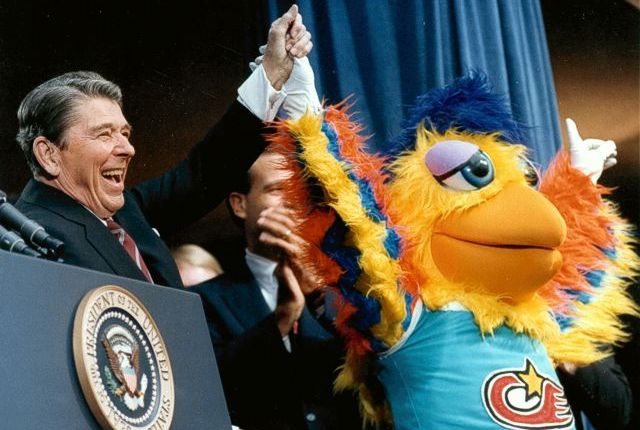
After more than 5000 performances, 510 in a row for the San Diego Padres, Ted Giannoulas is hanging up his beak.  Giannoulas first put on the feathers in 1974 as a stunt sponsored by a San Diego radio station; his first gig was handing out Easter eggs to kids at the San Diego Zoo.  From that humble beginning Giannoulas created a mascot that has earned a spot in the pantheon of great mascots, to many observers, the greatest mascot of all time.  Baseball fans in San Diego count The Chicken as their own, and his work with the Padres established him as the capon crusader, but almost from the start, he also supported the Clippers who then played in San Diego.

The San Diego Chicken evolved into the Famous Chicken when Giannoulas fled the coop, taking his show on the road.  At this point, he’s flown more than a million miles, and, boy, are his arms tired.

As a student and sports fan at San Diego State, Ted Giannoulas wanted to bring fans of all ages a way to enjoy a game, particularly during the “down” moments, between innings or before the first pitch.  Mascoting is a rare art; few are able to bring a costumed character truly to life.  Ted Giannoulas was a star from the start, almost immediately winning the hearts and minds of San Diego’s fans.  So devoted were San Diegans to Giannoulas’ Chicken that they massed in protest when KGB radio fired Giannoulas in 1979.  In what must have been a virtual barbecue, fans loudly booed the replacement pullet, driving him to defeat and obscurity.

Once restored to his rightful place in the pecking order of mascots, Giannoulas kicked his performance into an even higher level of confrontive gymnastics.  In describing his oeuvre, Ted Giannoulas is quick to assure his fans that he has been the only performer in that suit since his restoration in 1979.  He admits that he can no longer do the splits as he once did as a spring chicken, but says he stills starts down until he collapses, adding yet another piece of schtick to the aging chicken’s routine.

I’ve seen The Famous Chicken in ballparks from coast to coast, and have had the particular pleasure of seeing Giannoulas take on other mascots in almost every setting; they simply do not have a chance.  With his customary brio, The Chicken approaches his foe with a deliberate and challenging heavy step.  A flick of the wing invites battle:  Bring It On, Lehigh Valley Pig Iron!  Whatcha Got, Modesto Nuts?  Hey, Topeka Train Robbers, I Gotta Whole Lotta Sumpin’ For You!

I lived in Huntsville, Alabama, home of the Huntsville Stars, during Michael Jordan’s break from basketball.  When he and the Birmingham Barons came to town, it was on, even though the teams’ mascots were unprepossessing.  Their lame mascot, “Babe Ruff” looked like a Pound Puppy on Welfare.  The Stars weren’t much better; “Homer, the Pole Cat” was as significantly shabby.  At that time, the Stars were the A’s Double A franchise in the Southern League having recently sent Jose Canseco up to the majors after an MVP season in Huntsville.  Jordan was the main attraction, of course, and the games were sold out, but the mascot battle paled next to the stunning display of Jordan’s largesse in providing his team a luxury bus so they could travel in comfort and style during the steamy southern summer.  The bus cost Jordan $350,000.00 and can be yours at auction with an opening price of $20,000.00.  At the time, however, it was a thing of wonder, and many fans missed the first innings walking around the bus in the parking lot.

In  addition to the Barons, the League did present some notable franchises and notable mascots.  The Tennessee Smokies had colorful mascots, Homer, Slugger, and Diamond (really); The three bear”ish” things were actually more garish than colorful, kelly green, navy blue, and mango.  The Montgomery Biscuits, however, provided built-in drama.  Monty the Biscuit was chased by Big Mo a biscuit-hungry … thing.  The big news from Montgomery is that, while Mo stays, Monty has been replaced by a miniature pot-belly pig entitled, The Duchess of Pork.

The Chicken was henpecked in court following a series of ill-advised match-ups, one of which I was privileged to witness.  My kids had been entranced by Barney, the much beloved (by them) purple dinosaur, but fortunately had just outgrown their allegiance as we attended our last game in Huntsville.  The Memphis Chicks were in transition, finishing their relationship with the Royals and just about to become an affiliate of the soon-to-be defuncted Expos.  As a result, their mascot was AWOL, and a good thing too, as Blooper,  had been designed when the Chicks were the Chickasaws (nice).  As noted, Homer the Polecat was not an impressive specimen, so spent most of the game walking through the crowd, looking for some sort of validation.  The main event, therefore, was a tussle between something that looked an awful lot like Barney and The Famous Chicken.

It probably goes without saying that Barney took a beating from one side of the diamond to the other.  My kids still talk about the chicken scissor kick that propelled Barney into the Chicks’ dugout.  Whoever was in the Purple suit did a good job of feigning injury, although I’m pretty sure I heard him pleading, “No mas, no mas”.

What do I say to a chicken that is one of my children’s happiest memories?

Thank you, Ted Giannoulas, and I hope you’ve put away a nest egg commensurate with your contribution to the great game of baseball.


Trump’s Endgame May Be Much Worse Than We Imagined

Trump’s Endgame May Be Much Worse Than We Imagined

The appointment of Stephen K. Bannon, Chairman of the Breitbart News website represents a disturbing decision by Donald Trump, who has “advisors” but whose campaign is all about him, as all his efforts are.  Bannon and Breitbart send a strong signal, to the Republican Party and to Trump’s faithful.

No more Mr. Mainstream.

A Breitbart Trump is a Trump thrusting a middle finger to the Party functionaries who have begged him to moderate, modulate, seek support from the center.  This Trump is kicking over the last barrier ordinary political strategy that might have restrained him.  Pundits wish there was more obvious strategic impact in the choices the Trump team has made; this campaign just doesn’t make sense to them.

Because they have their eyes on the electoral count in November.

It’s not about that for Trump anymore.

Donald Trump is narcissistic but he isn’t stupid; he knows what the numbers portend.  He is going to lose this election; he knows it, and he is not going to lose gracefully.  Every decision since the foot-in-mouth disaster of the weeks following the Democratic National Convention is about building the “I was robbed” narrative.  The campaigns were rigged, the conventions were rigged, the election is rigged.”

Where does a man such as Donald Trump go after the votes have been cast?  He’s had the full attention of the nation  and the world for a year, and he is not likely to step aside and allow Hillary Rodham Clinton get the attention she actually deserves.

To use an unlovely image, someone is going to piss in the punchbowl; in fact, there may be a whole lot of people lining up to add their own measure of contempt to the exercise of voting in a representative Republic.  Trump advisor, Roger Stone, has used the word “bloodbath” to describe the response of an outraged public if Trump is cheated of his victory, but the Breitbart folks have language of their own that it would be wise to consider.

We have weeks of campaign reporting ahead, poll watches and predictions regarding electoral vote; we will be stunned if Hillary Rodham Clinton is not elected President of the United States, but none of that has anything to do with the climate of free-form ugliness of spirit and provocation to violence that Trump’s campaign will unleash.

Unleash is the right term.  He has created a beast, hungry for vindication and unwilling to return to a polite resumption of business as usual.  We have reason to fear that the outcry will not simply be frustrated rhetoric, but a call to violence.  This losing candidate just may cry havoc and let loose the dogs of war!


You, Sir, Are The Greatest Athlete In The World – From Jim Thorpe to Ashton Eaton

You, Sir, Are The Greatest Athlete In The World – From Jim Thorpe to Ashton Eaton

In 1912, King Gustav of Sweden handed a prize to Jim Thorpe, winner of the decathlon, declaring,  “You, sir, are the greatest athlete in the world”,  to which Thorpe is reputed to have said, “Thanks, King.

Thorpe was an extraordinary athlete.  In the Olympic Games Thorpe competed in the high jump, the long jump, the pentathlon in which he also won the gold, and the decathlon.  He ran the 100 yard dash in 10 seconds flat, and the mile in 4:35.  His long jump record was 23 feet, six inches; his best in the high jump, six feet, five inches.

And those were perhaps the least of his attributes.  Thorpe had emerged as a prodigy upon entering Carlisle Indian Industrial School in  Pennsylvania as a sixteen year old Sac and Fox Indian from Oklahoma.  Legend has it that in 1907, Thorpe walked by the school’s track, saw students practicing the high jump, and cleared five feet, nine inches in his street clothes.  By 1912, he had became Carlisle’s best track athlete, played lacrosse and baseball, and competitive ballroom dancing, winning the intercollegiate ballroom dancing championship.

He was also pretty good at football, starring as a running back, defensive back, and kicker; by pretty good, I mean the best player of his time, stunning a powerful nationally ranked Harvard team in a  major upset, and devastating Army by reeling off a 92 yard run that was called back and following it up on the next carry with a 97 yard touchdown romp.   Carlisle won the national championship and Thorpe was named an All-American in his junior and senior years.

Football was his first love, but his coach, Pop Warner, was also his  track coach, and it was Warner who convinced Thorpe to begin training for the Olympics.  Competing in several events with shoes he had found in a trash bin after his own shoes had been stolen, Thorpe commanded the attention of the world and returned to the U.S. honored by a ticker tape parade down Broadway.

Within months, however, the International Olympic Committee discovered that Thorpe had been paid to play baseball during the previous summer.  They stripped him of his medals, declaring that he had lost his amateur status.  Now branded a professional, Thorpe accepted a contract with the New York Giants, playing major league baseball within months of having won the decathlon.  Thorpe would continue to play baseball until 1922, but he jumped at the chance to play football once again, eventually playing for the Canton Bulldogs , one of the strongest professional teams in the pre-NFL era.

Jim Thorpe won a place in the Football Hall of Fame, the College Football Hall of Fame, the Olympic Hall of Fame, and the National Track and Field Hall of Fame; his Olympic medals were eventually returned to him.  It hasn’t been easy to follow Thorpe; he was named one of the top three athletes in the 20th Century (Babe Ruth and Michael Jordan make pretty good company).

The  winner of the 2016 Olympic decathlon, Ashton Eaton, is a double gold decathelete, sunny, generous, and entirely representative of the spirit of the Olympics.  Does he climb into the pantheon after his second Olympic victory?  Probably not, although he has found a place on my shelf of athletes I respect.

Part of the issue, I think, is in the way the decathlon is televised, or in this case, not televised.  We checked in with Eaton at a few points along the way, kept track of his Canadian wife, also an Olympian athlete, winner of the bronze medal in the heptathlon,  and watched the entirety of the 1500, the final test of the decathletes, but we did not have the opportunity to see one of the rarest of all athletic undertaking with anything like the attention the drama deserved.  Commentators seemed assured that Eaton would win again, gave us about eight minutes of mild uncertainty, and went back to Eaton, his mom, and his wife, Brianne Theisen Eaton.

What makes a decathlete so extraordinary?  Why do we assign them the tag of greatest athlete in the world?

Imagine a race horse, maybe not the fastest in the world, but among the top hundred fastest, who climbs trees, tosses boulders, plays darts, and skis.  Over the course of two days.  Against other equally able equines.

The events that make up the decathlon starts with a sprint, the 100 meter dash, then moves to the sand pit for the long jump, to the field for the shot put, back to the high jump, and finishes the day with a 400 meter race.

Day Two  The decathletes warm up with the 110 meter hurdles.  Hurdlers at this level have a fairly specific skill set, combining a sprint with the clearing of hurdles that are about 42 inches high.  Hurdlers do not generally sprint or run distance races; I’m just about a thousand percent sure that they don’t put the shot or sail into the high jump.

OK, hurdles hurdled.  Next up is the flipping, hurling, throwing, spinning of the discus.  Again, not for everyone.  In the first place, the discus is described as a lenticular disc weighing about four and a half pounds; in the second place, the thrower has to spin anti-clockwise in order to get this lenticular disc up and away.    Think about that for a few moments; try an anti-clockwise spin and see in which direction you end up.

Same day, few minutes later they jog to the pole vault where the decathlete runs with a pole that can be as long as seventeen feet.  I say run, because the key to vaulting is in the speed of the approach (well, and the sheer guts it takes to hang on while a bending pole carries you the the height of a second story building).  I’m no physicist, but I have been assured that the trick of the pole vault is to translate energy (1/2 x mass x speed) to vertical propulsion (mass x height x gravity ) or something.  In any case, pole vaulters, too, are a special breed.

Surely, you say, that is enough.  Let them go, for God’s sake, let them go.

Ah, no.  Having vaulted several stories, the athletes then repair to the tossing of the javelin.  There’s no way around it; a javelin is a spear.  This spear, however, is about eight feet long.  Eaton, who is not a javelin specialist, chucked the eight foot long spear a distance of roughly 200 feet, about what I hit with my driver on a very good day.

As has been the case in every interesting Olympic decathlon, victory depended on performance in the 1500 meter run, and it was in that race that Eaton pulled ahead for good and secured his second gold medal.  It’s just a race, slightly less than a mile.  Decathletes, however, describe it as torture, not because the stakes are high, but because they have spent about 36 hours in athletic competition at the highest level, and things are starting to cramp and fall off.

So, as I say, there is more than enough drama in any decathlon to absorb the attention of the world.  Ashton Eaton, who is both handsome and fashioned with the physiognomy of a real mortal, will smile at us from a box of Wheaties, and I will be happy to see him.

When it comes to heroes, I’m embarrassed to admit, my clock stopped in 1952.  I was six, and Bob Mathias won the decathlon for the second time, at the age of 21.  He had won the decathlon at the 1948 games in London, taking time off from high school to start training in ten events, eight of which he had never seen performed until his track coach suggested that he might want to give it a try.  He said goodbye to his pals, gave up his job loading sacks of sulfur into crop dusting planes in Visalia, and at the age of 17, took a flight to London, where his lack of expertise in the shot put was so unfortunate that he nearly fouled out of the event; he had learned how to pole vault out of a manual.   A quick study, Mathias plugged along, staying in contention until the discus toss, an event he knew very well.  Rain pelted London on the second day of the decathlon, pushing the events so far into the early evening that cars had to be brought in so as to provide illumination for the javelin area.  Rain continued, darkness was thick by the time the athletes set off on the 1500 meter race.  Mathias finished not knowing how he had done, but by the next morning he was crowned the winner of the 1948 Olympic decathlon.  Reporters asked Matthias what he intended to do to celebrate the victory.  “I guess I’ll start shaving,” he said.

Pretty good story, but it doesn’t stop there.

My favorite chapter happens in the fall of 1948.  Bob Mathias, decathlon champion, decides he wants to go to Stanford.  He had attended Tulare High School, and his preparation had not been up to Stanford’s standards, so Mathias enrolled at Kiskimentas Springs Prep in Saltsburg, Pennsylvania.  Now known simply as Kiski, the school provided Mathias with a good academic foundation and allowed him to continue to participate in the sports he loved.

In a prominent place on my bookshelves is the Kiski yearbook for the year 1949.  Bob gets the sort of senior write up any nice kid from California might earn in a goofy yearbook – good guy, played football, helped the track team.

Helped the track team?  He’d just won the Sullivan Award as the best athlete in the country, beating out some pretty good college athletes.  Among the runners-up were Norm van Brocklin of Oregon, Doak Walker of SMU, and Jackie Jensen who played both football and baseball at Cal.

I like to imagine what it felt like for the kid from Hill, or Peddie, or Mercersburg  who lined up next to the Olympic gold  medal winner on a frosty April day in central Pennsylvania.  Once again, Mathias is mentioned among the members of the track team.  “In the first meet of the year, Kiski was edged out by a good Central Catholic High School team, 60 -65. ..Mathias was first in high hurdles… took the shot put …won the discus …”  I sense some real restraint by the Kiski coach; the winning vault in that meet was 10 feet, 6 inches, and Mathias had already cleared 12 feet.

It’s hard to remember that there had not been an Olympic Game since the Third Reich had welcomed Jesse Owens to Germany.  As the first Olympic champion in more than a decade, Mathias stayed out of the limelight, quickly shedding the mantle of celebrity to slog through math and chemistry in Saltsburg, PA.  Upon entering Stanford, he decided to concentrate on track and field, giving up football and basketball.  Pigskin fever at Stanford was building, but Mathias held out for two years, directing his efforts toward setting the world record in the decathlon in 1950.  In his last two years, Mathias played fullback, returning a 97 yard punt by Frank Gifford of USC and taking Stanford to the Rose Bowl in January of 1952.

Then, he was off to Helsinki, another set of Olympic Games, another gold, another world record.  Once again  returning as a global hero, Mathias quietly finished up at Stanford, turned down a bid from the Washington Redskins to play in the NFL, and served as a captain in the U.S. Marines before taking up a life as an actor, the director of the U.S. Olympic Training Center, and from 1967, serving four terms as a member of the House of Representatives, a congressman representing the San Joaquin Valley District in California.

The U.S. has produced remarkable athletes, including twelve gold medal winners of the decathlon, from Jim Thorpe to Ashton Eaton.  My hope is that the Tokyo Olympic Games will allow us to see the struggle, event by event, as the greatest athletes in the world contend for the gold in 2020.


Sangfroid, Schadenfreude, and Double Entendre

Sangfroid, Schadenfreude, and Double Entendre

I have a friend who uses the word schadenfreude fairly regularly in ordinary conversation.  He is something of a word-smith, likely to pitch a new metaphor my way at the least provocation, but I find myself surprised each time he so evocatively describes the pleasure that people take in the misfortune of others.  It got me thinking about other words that communicate states of being that English cannot so effectively describe.

I started with sangfroid, primarily because it is so egregiously mispronounced by folks who think the word is sounded as if Freud sang.  OK, we have phrases such as “cool as a cucumber” (?!?) and “cool, calm, and collected”, but the closest analog in terms of translation might be “cold blooded”.  Sangfroid, however, carries a sense of self-possessed calm surprising in the moment described, not so much heartless, or even cool, but unflapped and competent.

Sticking with phrases taken from the French, double entendre has no real competition among lame English substitutes.  “Double meaning”?  Hah!  “Suggestive”?  Nah.

De rigueur for example.  Necessary obligation?  Set of expectations?  Uncompromising etiquette?

But consider this contemporary critical piece.  I cannot acknowledge the author of this quotation found on Quotes Codex, but it does pull our attention away from affairs of state and dinner at the embassy

“I don’t watch reality TV much, but sometimes I’ll be on the E! channel and see that show “Total Divas” about female wrestlers.  It’s like fake t___s are de rigueur.  Nose jobs are de rigueur.  Exaggerated a___s are de rigueur.  Twerking is de rigueur.”

Point taken.  And, in an unexpected insight, “twerking” may well be a word that communicates much more than any translated single word might attempt.

The list of French phrases that animate our conversations is rich with equally powerful locutions, but the remaining untranslatable, I think, is roman-a-clef, literally, “novel with a key”.  Exactly.

So, here’s a purposefully clumsy description of the genre:

Say everyone knows that the novel, The Election of Ronald Frump is fictitious, but also knows that the fiction overlays accounts of real people and real settings.

Yeah.

The novel is a novel, but the people and events are real … but not.

Doesn’t help, does it?

In any case, try getting through any serious discussion without making use of:

Tete-a-tete, au courant, raison d’être, nouveau riche, laissez-faire, joie de vivre, femme fatale.

As a reader of mannered British mysteries, many of which involve bright young men just down from Oxford, most of whom could not dress themselves without the assistant of a valet, I encountered a phrase that seemed to indicate an unwillingness to engage, or an inability to enter into a fray, or something.  Inexplicable but happily, the phrase turned up in a novel by Lawrence Block, The Burglar Who Liked to Quote Kipling.

“With the alarm hors de combat, I turned my attention to the thick oak door, an hors of a different color.”

So, terrible pun aside, hors de combat is not simply broken or unavailable, but “out of the fight” with a suggestion that there is no question of cowardice or unwillingness on the part of the non-combatant. Unfortunately it also brings to mind – “Do you like Kipling?”  “I don’t know.  I’ve never Kippled.”

My schadenfreude pal presses me to find phrases in German with equal impact.  Quite a challenge for a number of reasons.  WWI and WWII spring to mind, but the greater impediment, Ich denke, is that many of us have difficulty with uvulars and pharyngeals, sounds made by jamming the tongue against the back of the throat.  Schadenfreude isn’t bad, but take a shot at schilttsschuhlaufen, ice skating or streichholzschachtelchen, small match box.

I lived near Zürich for three years, attempting to learn both hochdeutche (high German as spoken in universities in Germany) and Schweizerdeutsch (Swiss German, which, by the way, varies from canton to canton).

In hochdeutsche, a cheesecake (simple enough) is kasekuchen (I have no umlauts available, so take a guess).  Again, simple enough,really.  Kase – cheese / kuchen – cake.

In Schweizerdeutsch, the same object is eins chas-chuechli, and every single syllable is way back there by the uvula, I promise.

Ja, naturlich/ Yo natuurlich.  Time to trot out at least a few standby words or phrases in German.

Let’s take food off the table; no surprise to Wiener Schnitzel, obviously schnitzel (cutlet) as it is prepared in Vienna (Wien).  The one curious mix-up for travelers, however, is that a doughnut (without a hole) is a Berliner, as is a person who lives in Berlin.   Kennedy’s speech in 1963, “Ich bin ein Berliner” was directed toward the city, not the pastry.

Schmaltz, a word used in English to convey sentimentality, is the German word for lard.  So, there’s that.

Doppelganger works beautifully to express not simply a double, but the presence of one life form precisely identical to another.

Gesundheit (a state of healthiness) speaks for itself.

Dollar, from the German thaler, silver coin mined in Bohemia.

Hinterland, blitz, wunderkind, kaffeklatch, Gestalt, dachshund, Volkswagon, kindergarten, kaput, nix – all obvious.

But there are at least four words that are irreplaceable in any language.

When affected by ennui or a malaise (SO FRENCH), we may be subject to weltschmertz, literally, “world pain”, occasionally described as the painful state of knowing that much that exists in the mind cannot exist in the real world.

Or, being bummed.

As a teacher, I often brought books to the classroom that described the coming-of-age of an adolescent on the brink of adulthood.  In German, elegantly, that is a bildungsroman, a novel of formation.  Really no substitute.

I first met the phrase, realpolitik, when studying the machinations of Otto von Bismarck, a cunning and dangerously pragmatic manipulator of contending forces.  The word came up again, surprisingly, during Richard Nixon’s presidency, when the United States established a détente (SO FRENCH) with China.  Nixon’s Secretary of State, Henry Kissinger, was eminently pragmatic and determined to grab advantage in the great game of diplomacy.   Again, the terms pragmatically political or realistically political don’t come close.

Caught in a perplexing maelstrom (a famous whirlpool off Norway), you may feel the effect of sturm und  drang, which is used to mean, “storm and stress”, but more evocatively translates as “storm and urge”.  It’s hard to think of a more devastating state of being than being simultaneously tossed by storms of emotion and urges that cannot be satisfied.  Ach du lieber! (Oh! My dear!)

Enough.  Genug. Assez.


We Still Need Hatewatch And The Southern Poverty Law Center

We Still Need Hatewatch And The Southern Poverty Law Center

I live in southern Oregon.  You know, Oregon – liberal state on the liberal west coast?

Even better, I live near Ashland, site of the Oregon Shakespeare Festival and Southern Oregon University, a notably tolerant, relatively diverse town (for Oregon), more inclined to active progressivism than sleepy liberalism.

And yet … this spring one of the Shakespeare Festival’s most accomplished actors, Christiana Clark,  a superbly talented Black woman,was accosted by an angry racist on the street in Ashland’s “Railroad District”, a leafy area sprinkled with upscale boutiques and an ambitious coffee emporium.  Clark is appearing as Horatio in Hamlet this season, has had leads in Much Ado About Nothing and A Midsummer Night’s Dream among other main stage productions, accomplishments that meant nothing to the white supremacist who stopped her on the street and screamed, “It’s still an Oregon law, I could kill a black person and be out of jail in a day and a half. Look it up. The KKK is alive and well here.”

Well, his legal expertise is deficient, but the Klan and other white supremacist groups  are alive and well, in Oregon and across the nation.  Portland may have had a socialist mayor in recent years and hipsters may abound, but the state and the city were founded as a white homeland; exclusion laws passed in 1849 were intended to keep Black Americans out of the territory.  Oregon was the only territory in the union to be admitted as a state with an exclusion law, but Klansman have had their way in many other states that pride themselves on their distinguished history.

Founded in 1971, The Southern Poverty Law Center was founded by lawyers Morris Dees and Joseph Levin, offering pro bono legal representation in civil rights cases intended to destroy institutions funding the KKK.  Dees was the son of a sharecropper who worked his way through the University of Alabama Law School and established a marketing firm with Millard Fuller who went on to establish Habitat for Humanity.  The sale of the firm provided Dees with the seed money needed to establish the Law Center.  Julian Bond was President of the Board from 1971 to 1979, during which time, Dees and Levin went after the Ku Klux Klan by representing the families of victims of hate crimes.  Records of those years were destroyed when the center was firebombed in 1981.   In  those troubled times, Dees and the Southern Poverty Law Center established Project Klanwatch, an attempt to identify Klan organizations across the country.  In the course of the next decade, the SPLC broadened its scope, creating Hatewatch which monitors the activity of extremist right-wing groups, presenting their findings in The Intelligence Report.

Starting at the top in the courtroom, Dees took on the United Klans of America.

The United Klans of America operated out of their headquarters in the Anglo-Saxon Club outside Tuscaloosa, Alabama.  Led by Imperial Wizard, Robert Shelton, the United Klans of America was tied to the bombing of the 16th Street Baptist Church in Birmingham, the murder of Viola Liuzzo in Selma, and the lynching of Michael Donald in Mobile.  Representing Donald’s mother, Dees won a seven million dollar settlement against the United Klans, bankrupting the organization; all funds collected in their settlement went to Donald’s family..  The SPLC then went after Tom Metzger’s White Aryan Resistance, winning a twelve million dollar suit and after the Aryan Nations, winning a six-and-a-half million dollar suit, bankrupting both organizations.

A brief survey of the SPLC’s signature court cases gives some idea of the scope of racist, supremacist  violence in the United States.  They represented Vietnamese fishermen working in Galveston Bay who had been terrorized by sniper fire and boat burnings initiated by the Texas Emergency Reserve, an offshoot of the Klan.  The SPLC won an injunction against the group and shut their para-military training camp.   The next case was in North Carolina where the Carolina Knights of the Ku Klux Klan were prevented from terrorising Black neighborhoods.  Grand Dragon, Frazier Glenn Miller, Jr. then morphed his followers into the White Patriot Party, which broadened its aim to include undertaking a war against Jews.

The twelve million dollar victory over Tom Metzger and his East Side White Pride and White Aryan Resistance  followed the beating and killing of an Ethiopian student in Portland.  In Florida, the SPLC took on “The Church of the Creator”, an Aryan group preaching RAHOWA, racial holy war, after the murder of a Black veteran of the Gulf War.

Moving to South Carolina, the SPLC won a thirty million dollar settlement against the Christian Knights of the Ku Klux Klan and the Invisible Empire, Inc.  In 2000, death threats against Dees multiplied as he and the SPLC took on the Aryan Nation, dismantling their training compound now donated to North Idaho College as a “peace park”.

Although suits have been brought against supremacist groups in Texas, Kentucky, Mississippi, Montana, and Idaho, extremist hate groups can be found in almost every corner of the country.  The SPLC began a program called Teaching Tolerance which offers workshops, classes, films, and teaching kits and followed up with the establishment of Hatewatch, which reports hate crimes and organizations planning hate crimes.  One aspect of Hatewatch is the Hate Map, now following eight hundred and ninety-two groups, including one in Ashland, Oregon.

Much was made of David Duke’s endorsement of Donald Trump and Trump’s seeming unwillingness to disavow the supremacist, but the campaign has done much more to agitate extremists on the right, many of whom have become vocal in their hatred of laws protecting the rights of LGBT citizens, Muslims, immigrants, Mexicans, Hispanics, Asians, and Jews.

Retired Lt. Gen. Michael Flynn, one of the men considered for the office of Vice President and an ardent Trump supporter responded to the allegation that Russia was the source of leaked DNC emails in a re-tweet that he quickly removed.

“The corrupt Democratic machine will do and say anything to get #NeverHillary into power. This is a new low,” he tweeted, sharing a link to a tweet from a user named Saint Bibiana (@30PiecesofAG_) who wrote “>Cnn implicated. ‘The USSR is to blame!’ … Not anymore, Jews. Not anymore.”

I hope to God that the results in the general election in November do not set off what Trump advisor, Roger Stone, has called a “bloodbath”, but I do expect that reconciliation this time may be a difficult task.  In times such as these we need to work together to support organizations such as the Southern Poverty Law Center.


Where Do Olympians Come From?

Where Do Olympians Come From?

Let’s just start with Stanford.

Stanford has had an Olympian in the games since the 4th Olympiad, the 1908 Olympics in London, and a Stanford graduate on the medal stand in every Olympics since first winning a medal in 1914.  Up to the start of this Olympic cycle in Rio, Stanford athletes had won a total of 280 medals.  Kaitie Ledecky will add another four gold medals by herself.  In the 1996 Atlanta games, Stanford won more medals than all but three nations, more than China, France, and Great Britain.

That’s impressive.  More than impressive.  Stunning.

At the start of this year’s games, however, Stanford ranked 2nd in medal tally behind USC (288).  UCLA (230) had been in the second spot, but now lags behind Trojans and the Cardinal.  Stanford has now added another 17 medals (9 gold), bringing their medal total to 297 while USC has added another 7 medals to push their total to 295, leaving Stanford in the lead, at least until competition in track and field is in the count.

Cal Berkeley was 4th with 185 medals, but their dominant swimming program sent a number of Berkeley Golden Bears to Rio, where they have racked up 12 gold, 4 silver, 4 bronze a full week before the end of the games.

In the fifth spot, the University of Michigan with 134 and counting, remembering that Michael Phelps was a swimming Wolverine in preparation for the 2008 Olympics.

The University of Texas, Harvard, Florida, Yale, and Ohio State round out the top ten.  Texas, Florida, and Ohio State are far more likely than Yale and Harvard to pump out current Olympians, but Harvard still has 9 Olympians competing this year and Yale 8.

Texas sends 22 athletes to the games, one of whom, Kevin Durant, is likely to add to the Texas medal count, while Florida packed 30 competitors off to Rio.   Ohio State is not likely to jump too dramatically in medal count, as they are sending twelve Buckeyes to the Rio games.

Harvard’s 10 and Yale’s 8, however, do reveal a particular slice of Olympic competition.  The Harvard contingent includes 6 rowers, men and women, a fencer, a shot putter, and a wrestler.  The rowers represent the U.S., South Africa, and Bermuda.  The shot putter is Nigerian, and the wrestler hails from Uzbekistan.  Yale’s athletes provide a similar profile.  Three Elis row, two for the U.S.and one for Canada.  Three more are sailors, joined by a fencer (Brazil) and one lone track athlete.

Other significant entries?  The University of Georgia is sending 11 athletes, but so is Princeton.  Tigers will be competing in rowing, field hockey, and steeplechase.  Dartmouth is represented by 9 athletes, in track, cycling, rowing, javelin, rugby, and dressage.  The Big Green represent the U.S, Korea, Greece, and Canada.

It’s not surprising that the University of Washington is sending 11 athletes, many of whom will row as they have for the Huskies’ championship program in crew.  The University of Oregon in Eugene is a haven for runners, and the 12 Ducks will take the track in a number of events.

Equally unsurprising are the number of women who played soccer for the University of North Carolina and now have a place on the national team; UNC has 13 Tar Heels in Rio.

Less widely known but widely respected, the volleyball program for men and women at Penn State has dominated national competition and sends many of its best to the Olympics as 13 Nittany Lions land in Brazil.  The University of Connecticut’s absolute dominance of women’s basketball is clear in the selection of the women’s coach, Geno Auriemma, and stars Sue Bird, Maya Moore, Breanna Stewart, Diana Taurasi, and Tina Charles.  Other Huskies will compete in field hockey, track, and soccer.

Small colleges also add diversity to the mix.  Williams’ swimmer Faye Sultan will compete under the Olympic flag rather than the Kuwaiti flag as she did in 2012.  Amherst’s Michael Hixon won a silver medal in synchronized diving in Rio, and Middlebury sends three panthers to Brazil, two cyclists and a marathon runner.