“Sing in me,Muse, and through me tell the story of that man, skilled in all ways of contending, the wanderer, harried for years on end, after he plundered the stronghold on the proud Height of Troy.”
The Odyssey translated by Robert Fitzgerald
Few of us who love The Odyssey imagined public debate about the merits of any translation, and even fewer might have guessed that a translator could emerge as a figure of controversy. Emily Wilson has taken issue with Christopher Nolan’s epic, a blockbuster stuffed with celebrities and filmed on a gargantuan scale in the IMAX format, observing that the Odysseus in Nolan’s film is hardly a complicated man. Her response to Nolan’s script is straightforward:
“We need to have a protagonist with detailed, believable motivation… But these desires seem stripped from Odysseus. He doesn’t seem to want food. He doesn’t seem to want sex. What does he want?”
I haven’t read Wilson’s Odyssey yet, but I’m inclined to wallow in the translation that continues to delight and inspire me. My delight with Fitzgerald’s translation arrived as I set out to teach The Odyssey to high school sophomores, preparing to lumber through one of the translations I’d met as a student, anticipating weeks of dusty explication, a slog through a cultural landmine, a tough read for most of the kids I taught. I read that first sentence and was hooked. Sure, there were still a ton of names, places, gods and Hellenic practices that would need introduction and clarification, but there was something beautiful, or witty, or inspiring, or terrifying in each Book.
It’s interesting to observe that for a moment The Odyssey is a cultural touchstone, perhaps with the same half-life as Gladiator, Ben-Hur, or Braveheart, a spectacle and epic, slightly less successful than the tenth feature length film featuring Spiderman, but a fairly hot topic on public radio. I’m interested in the journey, not particularly in the cinematic set-pieces, less with the Cyclopes, Scylla, and Charybdis, Sirens and Lotus Eaters, the flesh rending Laestrygoniana, and more in the challenge Odysseus faces in restoring his marriage, his relationship with his son and his father, his country. He is the hero of his journey, but a very modern hero, contending with trial and loss, as Fitzgerald puts it, clever and damaged, deceptive, incomplete and often, literally, at sea.
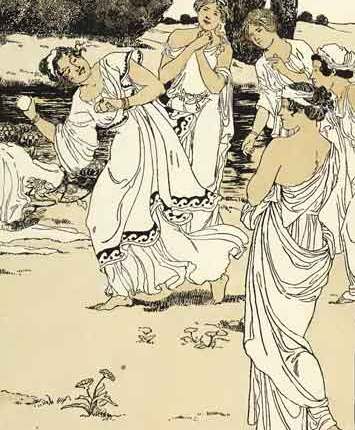
My days in the classroom are over, and my job today is celebration rather than instruction, so I’ll tout Fitzgerald’s wit in Book VI, “The Princess at the River”. I’m assuming that Nolan’s Odyssey abandons the structure of the epic, dragging Odysseus from Calypso’s Island straight to Ithaka, whereas Homer washes Odysseus up on the rocky coast of Skheria where he will meet Nausikaa, daughter of King Alkinoos and Queen Arete, find extraordinary hospitality, finally reveal his true identity, and narrate the details of his trials (essentially the movie) before being dropped off at home (finally) at dawn. The chapters which take place on Skheria among the people known as the Phaiakians demonstrate the Greek virtue of Xenia, the quality of “guest-friendship”, generosity, and reciprocity. Let’s assume for a moment that any stranger might be a god or goddess in disguise; it’s a good idea then, to welcome a stranger with grace, and so, the Phaiakians show Odysseus remarkable kindness.
The encounter begins as Odusseus is literally washed up in the reeds, and he is not in great shape. He’s naked, for one thing, and bloated, and brine stained, and generally a mess. Athena’s had a plan, of course, all along, and has arranged for the Princess Nausikaa to frolic with her handmaids on the shore, waking Odysseus from his stupor. “Skilled in all ways of contending,” maybe, but he’s a naked full-grown man, and she’s a young woman of the upper class. Fitzgerald paints an alarming picture:
“He pushed aside the bushes, breaking off
with his great hand a single branch of olive,
whose leaves might shield him in his nakedness;
so came out rustling, like a mountain lion,
rain-drenched, wind-buffeted, but in his might, at ease,
with burning eyes – who prowls among the herds
or flocks, or after game, his hungry belly
taking him near stout homesteads for his prey.
Odysseus had this look in his rough skin
advancing on girls with pretty braids;
and he was driven on by hunger, too,
Streaked with brine, and swollen, he terrified them
so that they fled, this way and that. Only
Alkinoos’ daughter stood her ground, being given
a bold heart by Athena, and steady knees.”
So, and this is the exchange that I relish, Odysseus has quickly figured out that he has to come up with some way of greeting that doesn’t horrify/terrify this girl meeting a naked mountain lion on the beach so begins as though it is Nausikaa who alarms him.
“Mistress: please: are you divine or mortal?
If one of those who dwell in the wide heaven,
you are most near to Artemis, I would say –
great Zeus’s daughter – in your grace and presence…”
We think of Odysseus as clever, and he is, but in this moment he is also graceful, and kind. He’s complimented Nausikaa by comparing her to a goddess, but to a goddess associated with the care of children and animals, lovely, superbly competent, and chaste. Best of both worlds and a comparison that both reassures and charms Nausikaa, allowing her to greet and protect Odysseus as Athena had intended.
I’ll return to the Odyssey again this fall, spending time in that season considering the consequence of Nausikaa’s bringing Odysseus into the court of Alkinoos, an introduction that eventually allows Odysseus to find his way home, to battle the suitors, reconcile with Penelope, become a father to Telemachus, restore peace in Ithaka, but which also brings great misfortune to the Phaiakians, the people of Skheria, whose kingdom is cursed for having helped Odysseus escape the wrath of Poseidon. A harsh consequence for their observation of Xenia.

