It Just Doesn’t Matter

It Just Doesn’t Matter

Republican Convention  

Breaking News

Look, I’m going to take the time to take snarky shots at the Trump campaign and at the Republican National Convention, maybe you’ll take the time to read it, but in terms of presenting the candidate and the plan for the next four years, nothing about the event matters.  I’ve written about this as the Fifth Avenue Campaign, referring to Trump’s breathtaking assertion that he could shoot someone in the middle of Fifth Avenue and not lose a single vote. A terrifying sequence of interviews of Trump supporters conducted by the Daily Show’s Jordan Kepler demonstrated the unshakable loyalty of the President’s supporters (and the terrifying gap between an informed and responsible citizenry and overweight white zombies in MAGA hats), pretty much validates the Fifth Avenue thesis.

Would it matter WHO Trump shot in the middle of Fifth Avenue?  Nope.  The folks who are his base operate on a closed loop.  Trump good, no matter what.  Anyone who questions him bad, no matter what.  Very bad.  A gigantic and elaborate mix of conspiracy and viral enmeshment operates to protect Trump from accountability.  So, not only is his nomination assured, the tone of his campaign will come as no surprise. 

Although many of the details of the upcoming convention remain undisclosed, a few key points are now emerging.

The press is not invited as the convention will kick off on Monday with the official business of the convention carried out in Charlotte. N.C.  A bold statement of the Party’s conviction that re-election has very little to do with what pencil necked geeks in New York think of the party and its nominee. 

The more celebratory moments begin on Tuesday with an address by former model and holder of the Alien of Extraordinary Ability visa Melania Trump who will speak on “The Land of Promise”, followed on Wednesday by the effervescent former radio and television talk show host,Vice President, Mike Pence, who will speak on “The Land of Opportunity” , and on Thursday by the President speaking on “The Land of Greatness”.  Pence will speak from Fort McHenry, the Trumps from the White House, despite the provisions of what is known informally as the Hatch Act, passed in 1939 as “An Act To Prevent Pernicious Political Activities”.  

Some would argue that as the Hatch Act is Federal Law, and as it specifically prohibits the use of public works for political purposes, the President has chosen to accept his party’s nomination without regard for the rule of law, a bold statement in 2020.

In addition to the President, his wife, and the Vice President, speakers are scheduled to include his son-in-law, Jared Kushner, and Mark and Patricia McLoskey, who waved firearms at Black Lives Matter protesters in St. Louis.  

“It  Doesn’t Matter What We Do Or Say”, the unofficial theme of the campaign.

The RNC has decided that the platform presented in 2016 will remain unchanged.  The document, presented at the last convention by Senator John Barrasso, Governor Mary Fallin, and Representative Virginia Fox, begins with a statement of American exceptionalism then identifies the failures of the Obama administration.  Although there is much to be said for using work that already exists, there is some concern that the recycling of the document leaves some room for misinterpretation, as it might in this passage:

“The President has been regulating to death a free market economy that he doesn’t like and doesn’t understand. He defies the laws of the United States by refusing to enforce those with which he does not agree.  And he appoints judges who legislate from the bench rather than apply the law.”

I am reminded of the film Meatballs, the breakout film for both Ivan Reitman and Bill Murray and the highest grossing Canadian film distributed in the U.S.until Resident Evil: Afterlife blew past it.  Set at Camp North Star, a bargain basement camp located in the north woods, the film draws its title from the affectionate term Murray, as head counselor Tripper Harrison uses in speaking with the young campers placed in his care.  There are many camp pranks and mildly romantic after hours liaisons, but at the heart of the tale is the annual and entirely expected drubbing Camp North Star will take at the well manicured hands of Camp Mohawk.  

The kids find the expectation of taking a beating disspiriting, but Trapper delivers an inversion of the “Win One For The Gipper” exhortation, reminding the children that no matter how hard they try, no matter what efforts are made, the Camp Mohawks of the world will always triumph over the proles at Camp North Star.  Leaping into action at the bonfire, Murray as Trapper introduces the camp’s new rallying cry: “It Just Doesn’t Matter”.

Ghastly, hurtful, and perhaps untrue things will be said as the convention endorses Trump’s presidency.  Sensitive souls among us, including this battered blogger, will reel in disbelief and pain as the counter-reality of life in America is trumpeted.  

The convention will be a Fifth Avenue coronation, and no matter how egregiously the speakers slaughter factual evidence of presidential malfeasance  …

It Just Doesn’t Matter

Inside the Trump Campaign: August 20,2020

Inside the Trump Campaign: August 20,2020

 Inside the Trump Campaign:  August 20,2020

R.P.  How are we doing on that cease-and-desist with CNN.  The fake poll numbers?

L.C.  They aren’t ceasing or desisting.  We’re still suing.

R.P.  Are we still suing Brad Parscale over the numbers?

L.C.  Brad was running the campaign.  Our campaign.

R.P.  Yeah but the numbers weren’t good.

L.C.  I can see that.

R.P.  What about the other CNN suit?  The one with the NY Times and Washington Post, you know the libel suits?

L.C.  That was an opinion piece, right?  That Mueller should have charged the President?

R.P.  Libel.

L.C.  Not libel, but, no, nothing.

R.P.  We’re suing New Jersey about the mail-in ballots.

L.C.  Hadda do that.

R.P.  What about Goodyear?

L.C.  What about Goodyear?

R.P.  They don’t let worker wear MAGA hats.

L.C.  Can they do that?

R.P.  They say they have a policy against wearing politically affiliated clothing.  Black Lives Matter is ok, apparently, but MAGA hats specifically not ok.

L.C.  We’ll probably sue Goodyear.

R.P  We may have to sue Akron and Ohio too.

L.C.  For what?

R.P.  Well, after the tweet, the Mayor of Akron got all feisty, threw in LeBron, and since Ohio is a swing state, if we don’t have the numbers in November, Ohio would be …

L.C.  What tweet?

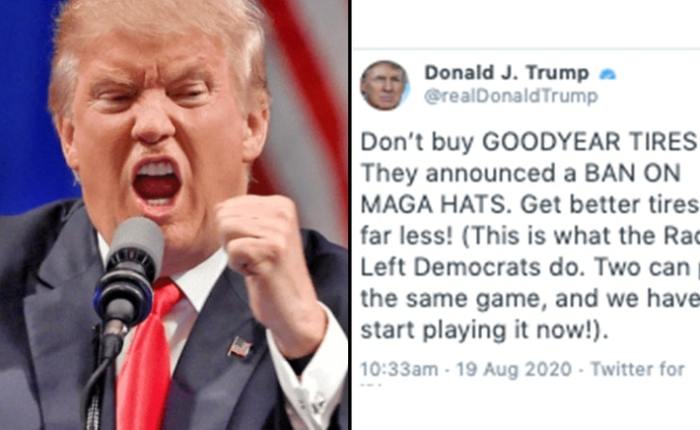
R.P.  Perfectly understandable.  Just said … wait, I’ve got it here.  “Don’t Buy Goodyear tires…”

L.C.  Hang on!  he said what?

R.P.  Sure, “Don’t Buy Goodyear Tires. They banned MAGA hats.  Get better tires for far less.  (This is what the radical Democrats do.  Two can play the same game, and we have to start playing it now!)”

L.C.  I can’t help myself.  I’ll come back to the swing state issue in a second, but I was an English major.  “This is what radical Democrats do”?  ‘This’ is an unclear referent.  What is that radical Democrats do?  Not buy tires?  Get better tires?”

R.P.  Ban hats, obviously.

L.C.  OK, but …

R.P.  Don’t get all pencil necked on this.  Big Picture.

L.C.  Uh, the big picture is that the President of the United Sates just asked Americans not to buy tires made by American workers.

R.P.  I don’t think that was the message.

L.C.  “Don’t Buy” is pretty clear.  Other tires are better and cheaper?  

R.P.  The issue is the hat thing.

L.C.  Not for people working at Goodyear.

R.P.  Now you sound like the Mayor of Akron.

L.C.  What did he say?  

R.P.  Talk about over the top wacko reaction!

L.C.  Harsh?

R.P.  “First you came to destroy American decency.  Next, you came to destroy American institutions.  Now you’re coming to destroy the American economy and heartland jobs.  Luckily, you seem to fail at everything you do.”  I’d call that harsh.

L.C.  Yeah, but “Don’t Buy Goodyear”…

R.P.  You gotta draw the line somewhere.

L.C.  Maybe not in Ohio during an election year?

R.P.  I get it.  You think this is like a normal campaign.

L.C. Uh, it’s not?

R.P.  This is a Fifth Avenue campaign.  Remember?

L.C.  What does Fifth Avenue have to do with …

R.P.  “I could stand in the middle of Fifth Avenue and shoot somebody, and I wouldn’t lose any voters.  It’s like incredible.”

L.C.  Incredible.

R.P.  So, you ready to start the Kamala suit?

L.C.  For …?

R.P.  Libel.

L.C.  Uh…

R.P.  She called him a predator.

L.C. You do know what libel is, right?

Falling In Love With America Again

Falling In Love With America Again

The opening of the 2020 Democratic National Convention was a revelation.

Until I heard the National Anthem sung by the Commonwealth Youth Choir, children from every state, the Cheyenne Nation, and five US territories, I had not realized how completely I had protected myself from the weaponized politi-patriotism peddled in the service of silencing voices that oppose the current administration. Just as the President did at his inauguration, when I enlisted in the Navy I took an oath to support and defend the Constitution of the United States. I am not the enemy; I do not hate our country, but over the course of four years, I felt I lost the flag, the anthem, the Fourth of July as they became celebrations of personal power. Athletes protesting police brutality by kneeling during the anthem were called sons-of-bitches, and we who support them bad people. Veterans and active military became props, like tanks, jets, and the Bible. I no longer recognized my country.

Those children gave our anthem back to me.  

I cried, of course, because I recognized the degree to which I had tamped down hope and because I understood that I still have an obligation to hope. These were voices asking only for hope. Their perforance of the anthem ought not to have been the surprise that it was, but the expression of love of country, the best of our country, by the many faces and voices of children was a confession of faith I had almost forgotten.

The theme of the convention, “We The People”, seems an obvious description of how the work of a democracy begins. Once again, however, somewhere along the way, the rule of law has been ignored, special interest has run riot, national security compromised, and honesty abandoned. The Constitution of the United States is a living document, a charter of government that begins with the assertion that We the People have an obligation to work toward a more perfect union.  That work ended slavery, secured the right of women to vote, and put into the Supreme Law of the Land a fifteenth amendment to ensure that neither race nor color be used to decide which citizens may be allowed to vote. That work continues.

The voices that introduced the Constitution last night included Khizr Khan, the Pakistani American Gold Star parent whose son, killed in Iraq, had been awarded the Bronze Star, Ady Barkin, the Israeli American founder of the Center for Popular Democracy and Health Care advocate whose long fight with ALS has affected his ability to speak, Megan Rapinoe, Olympic athlete and advocate for the Gay, Lesbian, and Straight Education Network, Robyn Seniors, national chair of the Historically Black College Students for Biden, Major General (ret) Frank Vavala, Agnes Moore, one of the surviving Rose Riveters, Peggy Flanagan, Lt.Governor of Minnesota and the second Native Woman to be elected to statewide executive office, and many others reflecting the rich diversity of people who live under the rule of law and the Constitution of the United States of America.

So, I fell in love with America again last night, even though I’ve seen the ugly turns we have taken at times.  We the people do deserve a better nation.  We can’t sing it into existence, but we can believe in it enough to do all we can to make it real.

Yo Semite

Yo Semite

I’m no longer keeping track of Presidential gaffes.  Try to number the stars or the droplets of Covid-19 still hanging in Tulsa.  Too much for the limited mind of man to hold in one lifetime.  So, but, how do we avoid pausing in reflection upon witnessing the recent celebration of the signing of the Great American Outdoors Act, a scripted, and yes, fumbling recitation of platitudes which almost obscured the relative enormity of actually getting a bill of any sort through the Senate much less a bill that has to do with the public good.  A grand moment for those who believe that the nation’s national treasures are worthy of recognition and support, made yokelish by the mispronunciation of Yosemite, among the first national parks to be established, and perhaps the most celebrated, you know, Teddy Roosevelt, John Muir, Ansel Adams, those guys. 

We know the President goes off script whenever he can, not only to indulge in the fanciful landscape of his counterfactual reality but to avoid stumble bumbling with reading.  He’s not the first public figure to mispronounce or manufacture words.  Former president George W. Bush is in competition with Yogi Berra for the greatest number of unintended but magically evocative malapropisms.  Who has not wished to be the author of, “They misunderestimated me,” as Bush said in Arkansas, or “I just want you to know that when we talk about war, we’re really talking about peace.”?  I personally have been misunderstimated more times than I can count, and even Tolstoy put war and peace in the same title.  No, the twice repeated “Yo-Semite” is of another order of misstatement.  Had the President had difficulty and pronounced the park as one would a mineral, Kyanite, or Ammolite, there’d be a few scratched heads, but separating the word as he did, putting an emphasis on Semite, well, that was just not great. 

And, of course, the President is not helped by the current use of the “Bro”ist greeting, Yo.  The etymology of the use of Yo as a salutation is entirely up for grabs.  I ran into a fellow  who argues that Yo is used among the Dravidian languages, and we’d have to travel to the Kasaragod district of Kerala to see if it pops up among those who speak Tulu.  I didn’t run into him more than once, but you can see where the problem lies if you believe, as I did, that it popped into contemporary usage when a blooded and sweat laden Rocky Balboa cries out to Adrian, Paulie’s sister – “Yo, Adrian! I did it!”  Competing claims come from a variety of sources including veterans of many military roll calls whose “YO” rang clear as an indication of their presence.

No matter how it arrived, we hear a fully articulated Yo as an invitation to turn and greet the speaker.  That said, Yo-Semite does invite consideration of a park greeting those of Phoenician, Akkadian, Hebrew, or Arabic lineage, and, since the most common contemporary usage is the term anti-semetic, referring specifically to Jews, and given that there has been the unfortunate description of Nazis as among the good people on both sides arriving in Charlottesville, we can be forgiven for indulging in some snide-lite questioning of the President’s remarks.

A sign of the times?  To be sure, as is the struggle of the online store of the American Museum of American Jewish History to keep up with demand for the Yo Semite T shirt they have sold for  years, “reminiscent of the shirts your own beloved summer camp provided”.  I find myself strangely moved and heartened by evidence that humor and resilience still endures after the relentless thumping of the past four years.  As I sit in isolation, the purchase of new clothing has not been a priority, but my shirt is backordered and will appear on zoom screens wherever I travel as a statement of faith in the human spirit to rise above the tumult.

Side Effects May Include Astral Sex

Side Effects May Include Astral Sex

In the midst of a global pandemic in what was once considered an advanced first world nation, we have demonstrated a level of moronitude that beggars the imagination.  Prevention would have been good, but we worked with great diligence to discount the verified reports of hellacious disease and death.  Perhaps you will have seen my earlier attempt at satire: “Democrats’ Hoax Inconveniences Hundreds of Thousands in China, Iran, Italy, and South Korea”?  Perhaps not. In any case, we not only could have seen it coming, dammit, we did see it coming.  

So here it comes, refrigerated trucks are stacking bodies in New York, and the stream of misinformation, disinformation, and sheer lunacy becomes a raging torrent.  Apparently saying, “It ain’t happening here” had to give way to, maybe it would be good to inject patients with disinfectant, the application of hydroxychloroquine, and to the most recent as-yet-unproven palliative, using the dna of aliens.  That’s a stretch, but if other accounts are to be believed, and they are believed, astral sex with demons is a major health risk as is the vaccination against religion.  

I may have strayed from the point.  Back to unfortunate Presidential endorsement # 6145.

“Dr.” Stella Immanuel, spokesperson for a group calling itself America’s Frontline Doctors, delivered an address in front of the Supreme Court (the building, not the august jurors) in which she ranted about the silly and unnecessary precautions, such as wearing masks or maintaining distance, as the cure for Covid 19 is right in front of us as the President has been saying all along.  She stated that in her practice, happy patients have danced away from her clinic in great good health following treatment with hydroxychloroquine.

Immanuel’s other and perhaps equally demanding job is as a preacher at The Fire Power Ministries Christian Resource Center located in the same strip mall in Houston as her “treatment facility”, the Rehoboth Medical Center, a walk-in clinic advertising the dispensing of hydroxychloroquine.  The actual wording of the message posted on the clinic’s door demands attention.

“Dr. Stella Immanuel MD.  We Screen and Treat Covid-19 Patients.  Early treatment is key!  Call and come in.  Don’t wait until you get too sick.  If you have flu-like symptoms its(sic) probably Covid-19.”

 Probably.

The first section should be warning enough, but here’s the meat of the promo in language that defies parsing:

“FDA(sic) had revoked its emergency use authorization restricting the use of hydroxychloroquine in hospital setting only.  It was not found to be effective in sick hospital patients.  Doctors can use it however outpatient(sic) where early treatment is ket to its effectiveness, off label to treat Covid-19.  That will also release the stock pile.”  

Stella Immanuel attended the Calabar College of Medicine in Nigeria where one assumes she was taught to use off label hydroxychloroquine in order to release the stock pile.  Her role in addition to taking a prominent role as the face of the American Frontline Doctors, a group sponsored by the Tea Party Patriots Action, includes her self-proclaimed position as “God’s battle axe and weapon of war.”  It is from that pulpit that she has preached and written about the dangers of “serious gynecological problems” caused by tormenting spirits.

This is where the astral sex comes in, and if you have been practicing astral sex on the sly, you won’t need her description of the phenomenon.  If you are new to the game, here’s Immanuel’s thoughtful observation:

“Many women suffer from astral sex regularly. Astral sex is the ability to project one’s spirit man into the victim’s body and have intercourse with it. This practice is very common amongst Satanists. They leave their physical bodies in a dormant state while they project their spirits into the body of whoever they want to have sex with,” 

Again, there are peculiarities of construction here, but the point is that this apparently GOES ON ALL THE TIME!

The person once known as the Leader of the Free World liked her support of his theories, and suggested that she’d had great success in her practice while simultaneously disavowing any knowledge of her medical credentials.  

Any port in a storm.

It’s only appropriate to end by quoting a man whose commandment that the German emperor go to Rome to be shot and the Pope jailed came from his conviction that it was he who had created the world.  It was Friedrich Nietzsche who wrote, “Madness is something rare in individuals, but in groups, parties, peoples, and ages, it is the rule.”

Saving Our Lives

Saving Our Lives

I’m privileged.  No one I know has been hospitalized, ventilated, or died as a result of contacting the coronavirus.  I’m privileged.  I live in a small rural town in a state that has taken reasonable caution in mandating closure of businesses and schools, limiting the number of people who can attend events indoors, and requiring the wearing of masks as we shop.  I’m privileged.  My sector of the nation has flattened the curve.  

My wife and I have been distanced since early in March, expecting a federal state of siege as the death toll in New York mounted so quickly that there was no place to put bodies. That never happened, but we live in a new reality, adapting to the strictures of life apart from our children and our friends.  We’ve developed interests postponed, read the books we meant to read long ago, and watch the shows suggested by those who know our tastes.  We stumbled on Netflix’s Lenox Hill, an eight-part documentary following neurosurgeons, emergency room MDs, and a pregnant resident in obstetrics at Lenox Hill Northwell Hospital on New York’s East Side .  We had no particular expectations in starting the series; medical documentaries are often informative but dry.  Lenox Hill is anything but dry.  We came to know and admire many of the physicians and to mourn some of the patients.

It is a remarkable document, celebrating remarkable people.

A ninth episode was added, however, that should be made mandatory viewing in every city, town, school, and church.  The documentary crew stuck with the physicians as Lenox Hill was inundated with the first wave of Covid 19.  Those who have come to know the staff of the hospital will be affected by the demands made on them as the virus transforms the hospital.  In watching only the last episode, even the most cynical and partisan coronavirus denier will see a city experiencing plague. Aware of the risk they face in attending to patients as the virus delivers an astonishing daily death toll, health care workers strap on their masks and lean into the critical care that only they can provide.  They have parents and children and friends. They ride home in empty subway cars as the city scrambles to find places to put the bodies of those who have died that day.  These lives on the front line are meaningful lives, rich lives.We can call them heroes and think of them with admiration but as this last episode plays out, the grim reality of their courage hits home. 

We can’t assess the cost to a nation in which a major portion of the citizenry is living in quasi-hypnosis, purposefully mislead in the midst of a pandemic.  We, our children, and their children are betrayed by the relentless venality of those elected to secure our well being.  Even as the third wave of infection surges in states determined to ignore the warnings offered again and again, we will enter into autumn and another season of contagion.

I sit in my quiet rural town, privileged not to have been touched by death in these days of plague.  I number heroes among my friends, the courageous few who step into the mess and do what they can.  This virus is no hoax; this pandemic is not a political football.  Watch the documentary, wear a mask, and thank the universe for people who keep us alive.

America’s Shadow

America’s Shadow

Great Jumping Jehosaphat! I’m keeping the exclamations PG here, but what the hell?  Only four years after the start of the Trump presidency, we have become a nation at risk of terminal implosion.  The world has experienced the pandemic, and with a few notable exceptions, managed to limp along with significant human cost but with the prospect of some sort of reconstitution.  Our President has declared that he is not responsible for anything, our Senate has willingly abdicated its responsibility to its constituents, kleptocrats continue to gut environmental protection, militarized police have betrayed the people they are paid to serve, and health professionals are hamstrung by crass political expediency.

Houston, for example, is in a crisis that might have been prevented. In addition to the reckless self-serving political fantasies which encouraged the spread of the coronavirus, the on-the-ground response to pandemic is overwhelmed, and ordinary public health initiatives are simply not supported.  The Washington Post reminded me of the essential truth in an article explaining why we are losing the battle, commenting on the discrepancy between the sane practice of public health procedures and the reality facing public health professionals in Texas.

“The main reason for that discrepancy is simple, historians say: Americans don’t like being told what to do. We want to be protected from infectious diseases and dirty water and bad food and crazed gunmen. But not in a way that undermines our freedom. That ambivalence was baked into our public-health institutions from the start.”

This is no time to get academic, but I’m recalling three books I read, appreciated, and promptly forgot.  The titles pretty much tell the story:  Democracy in America by Alexis de Tocqueville, Anti-Intellectualism in American Life by Richard Hofstadter, and The Pursuit of Loneliness by Philip Slater.  

All three authors would agree that as a nation we have not been eager to invite critical assessment of ourselves, particularly allergic to critical attention from outside the US.  De Tocqueville’s assessment of American democracy in 1835 was prescient and of little interest to all but a few isolated ivory tower academics.  He saw several issues that might turn out to be problematical, and problematical they are.  The first is what he called “the tyranny of the majority,” in his mind a danger to civil society in that it would stifle thought.  He found that there was,”less independence of mind and true freedom of discussion” than in any other nation.  The majority’s rule was likely to result in incivility, he observed, because people, darn it, are propelled by egoism and personal profit.  He prophesied that citizens of superior intellect would have so little impact on the culture that their abilities would inevitably take them to the pursuit of great fortune.  The elimination of a titled aristocracy allowed for equitable distribution of property but created widespread animosity toward those who could be considered among the intellectual or cultural elite.

De Tocqueville’s insight can be translated into the language today used with venom in dismissing experts, journalists, and science:

“You think you’re better than me.”

Hofstadter’s wide-ranging thinking in describing the history of anti-intellectualism finally settles on three major observations.  The first is that evangelical Protestantism, which has been alive and well from the start, places authority in faith rather than in reason.  The second is that the business of America is business and that capitalism is the secular religion of the nation, and the third is that the only corrective is in education, an enterprise that has consistently been under attack from the two more dominant cultural tidal forces.

Slater, whose career is beyond description and entirely fascinating, was a sociologist at Harvard and Brandeis before taking on twenty other occupations.  His book argued that individualism as venerated in American culture operated at the expense of connection and community.  The result, he felt, was a profound sense of emptiness in the American psyche.  His next work,Wealth Addiction , predicted the often mentioned but in no way mitigated obscene inequality in wealth we experience today.  Among the arguments Slater proposes is that those who chose to leave behind the certainty of the old world to make their way to the new shared a predisposition to isolation.  Space and freedom were virtually the same experience.  Those who were forced to emigrate by reason of famine or war might have held a different set of priorities, but the rugged individualism of the frontier, Slater contends, has had an abiding effect on the fragmentation of social order. 

I should have known.  I should not have been surprised by  Know-Nothing nativism, bizarre alternate reality, fake news, hate radio, pandemic as hoax.  There is an America that does offer opportunity, inclusion, dignity of labor, civility, and democracy … and then … the other America that has always been our shadow.

Alone

Alone

Against all odds and surprising those who have known us over the years, as the days of isolation wear on, we’ve been watching Alone presented by the “History” channel, which also offers Pawned Stars, American Pickers, Mountain Men, Lost Gold of World War II, Truck Night in America, Axe Men, Top Shot, Kife or Death, and Kings of Pain.  

I don’t wish to flaunt the advantages of a liberal education, but I was a history major at a reputable institution of somewhat higher education, and my book shelves are still groaning under the weight of the tomes I could not bear to toss out when as a be-tasseled graduate I packed up my undergraduate digs.  Herodotus, Edward Said, Arnold Toynbee, A.J.P. Taylor, G. M Trevelyan, Hugh Trevor-Roper, Gordon Wood, Richard Hofstader, Charles Beard, Samuel Eliot Morrison … they sit in silent disapproval, gathering dust, untouched since June of 1970.  Not only have I not read them in the intervening years, I suspect this is the first time that I’ve evoked their names in conversation or in print.

So much for them, and apparently, so much for history on the History Channel, which turns out to be perfectly fine with us as it’s become clear that in this household what we need are the extraordinary breed of men and women wiling to pack out in the wildest bush in Patagonia or the most forbidding tundra in Alaska, leaving family, safe shelter, food, and toothpaste behind for a span of time to be determined by their grit and the vagaries of life at the edge of extinction.

I have problems, Lord knows.  I have very small hands and have a heck of a time reaching across four frets in order to play the chords used to back James Brown’s “I Feel Good”.  I live with it, but it’s always there, reminding me that the only use I could have been to Brown was in carrying his cape as he pretended to stagger with exhaustion.  The people consigned to Patagonia or the Arctic attempt to fish and trap in the wild, rarely succeed, and often go days without eating, weeks without eating anything but kelp and limpets.  I’m annoyed because our neighbor decided to raise chickens, bad enough at the outset, then brought in a strutting time-disordered rooster who feels obliged to yodel from pre-dawn to dusk.  Guys on Alone contend with wild boars, pumas, wolverines.  Hang on, did I just say wolverines, with an “s”, as in more than one?  Yes, indeed.

The last person standing wins $500,000.00 which buys a lot of jerky and many, many limpets.  Ten men and women set out, are dropped at some distance from each other with ten items to keep them from a cold and lonely death.  Lots of tough choices there, and one of the pleasures we take here on the couch is in debating the advantages of the sharpened short shovel or the gill net.  Do they bring the Premium Ferro Rod Fire Starter or hope to find what they need to craft a bow drill from wood at the site?  They are allowed to bring whatever clothing they want to lug around, but tarps, rope,sleeping bags, and pot or frying pan count in the group of ten items allowed. 

 How long do they last, you ask?  One experienced woodsman saw a hefty pile of bear scat and called in the rescue boat after three hours in the bush.  I’m not judging.  The current record for endurance is eighty-seven days.  

The key here is eighty-seven days … Alone.

There is no camera crew, no medics, no cheerleaders or producers.  Entirely alone, day after day, night after night, wolverine after wolverine.  Some extraordinarily able people are overwhelmed by the distance from those they love.  They hang on, surviving for weeks, but the pull of home is in many cases irresistible.  The mental strain of isolation is a significant issue for almost every contestant and does take some out.  Luck is a factor as well.  The producers claim that all sites are comparable, but some folks hop off the boat onto a sunny beach with good fishing, plenty of firewood, and access to fresh water, while others sit in a dark, wet hollow smack in the middle of the wild boar’s hunting ground.  As I have reminded those around me for many years, accidents happen, and they happen with immediate impact on Alone.  As soon as we see someone heft an axe, we wait for the flailing go pro camera and the shouted yelps of distress.  They’re starving, addled, desperate.  A fish finally takes the hook,and in their haste to land the only meal they’ve had since September, they slide across a slimy rock face and the go pro documents the plunge into icy water.

In order to quit, the contestant has to “tap out” by calling the rescue team by Satellite phone.  We actually have no idea what the three or four people who show up on the small rescue boat do for the eighty-seven days; they have to be huddled somewhere close to the drop sites.  I’ll be honest; not much happens for many of the days spent in the wild; catching a fish gets twenty minutes of coverage.  What holds our attention is the process by which those who thrive manage to hold themselves together.  The most unlikely of winners have emerged because they are transformed by the hardship they endure.


So, here’s today’s life lesson from Alone:  We don’t know what’s coming next, we have no control over what’s coming next, our collective futures are far less secure than we had imagined.  It seems we have to be willing to live with transformation because tapping out is not an option.

If Today Is Friday, Yesterday Must Have Been Thursday – Secluded and Slightly Confused

If Today Is Friday, Yesterday Must Have Been Thursday – Secluded and Slightly Confused

I am a creature of habit, and the pandemic has played havoc with my neatly segmented and entirely artificial sense of how days should be ordered.  Of course, retirement from my career tossed the segments completely into the blender, as had moving, and before that employment, and before that having children, and before that marriage, and before that the US Navy, and before that misspent collegiate hours, and before that teen zombie self-absorption, and before that school and bedtime.  I’m not complaining about the new abnormal, not at all; I just need to acknowledge that as I am secluded, the parameters of my life are more … distinct.  

It’s not Little House on the Prairie, exactly, although I can’t remember how often the Ingalls family got into town.  They bundled up and harnessed the wagon to make special trips to buy ribbons, I think, and maybe sorghum drops.  Not often, is the thing.  In any case, I venture out once a week, stopping in at the two stores that adopted regulatory measures early on and which attract shoppers who have figured out that we are in pandemic.  The accounts of end-of-life Covid hospitalization scare the sorghum drops out of me, so too do the folks in our region who believe that choking death is the price of freedom.  I don’t go to the stores they seem to prefer.

That moderate political spasm aside, I confess myself now accustomed to a single foray, recognizing that shopping for pot pies and broccoli has now become my blowout event of the week.  The upside is that I spend less on a weekly basis than I did when overcome by the urge to find spumoni ice cream RIGHT NOW; the downside is that I have to sweep cobwebs from the interior of my car.  Disciplined, now, and menu minded, I shop with a list.  There are still the occasional impulse purchases, but they are few and more likely to be actual foodstuffs rather than an O Henry Bar for old times sake or mustard infused pretzels.  

One might think that mindful shopping would lead to mindful eating and the maintenance of a healthy dining regimen; after all, there are many fewer distracting items to pull me from the couch to the kitchen.  But the key phrase here is “pull me from the couch”.  I am not couch bound until the early evening, and often somewhat later than that, but, once couched, some portion of dinosaur brain begins to crackle, leading me inevitably to grazing after dinner.  I am aware that I have now attributed snacking to dinosaurs, which I’m pretty sure is an uninformed supposition.  What do we know about dinosaurs, really?  Much, much less than those supposed “experts” would have you believe.  What colors were they?  No idea?  What did they actually look like?  Just guesswork.  And snacking?  Pure conjecture.

When I refer to the couch, I am admitting that I dive into televised entertainment for about two to three hours most evenings, ordinarily mixing a fairly gritty British police procedural with a documentary or reality show of a particular character.  Given our current immobility, I’m looking for an escape into a landscape other than my own, so find adventures filmed in Patagonia or the Arctic.  From what I can gather, my citizenship will prevent me from being welcomed by the great majority of nations, so I’d best get ready for my two weeks of chewing bark on Kiska Island.  Once again, I’m grasping at straws.  I have no idea whether Kiska Island, one of the Rat Islands in the Aleutian chain, has bark to spare.  I do know that it was invaded by Japan in WWII, so there’s that.

That takes care of a shopping trip and eighteen to twenty-one hours of television per week.

Since removing myself from the world as I knew it, I’ve adopted the “little-by-little” approach to maintaining the house and the fields.  The deck, as anticipated, had become an eyesore in need of reconditioning.  I sanded a bit every day for two weeks until I got down to bare wood and then cleaned the deck one section at a time, then stained the deck over the course of two days.  La and voila, the deck is done.  Similarly, the mowing of the pasture has to be done every week, but in sections.  The blackberry brambles have to be cut back every week, but not all at once.  The fruit trees need water, the lawn needs water, the fields need water.  And so, watering becomes the second landmark event of the week.

We live in a rural agricultural irrigation district which channels water from the creek that runs along a ridge above our place to pumping stations adjacent to our fields.  On Tuesdays and Fridays, we live in waterworld.  It would seem a simple process – turn the wheel, prime the pump, stand back, and watch the towers of water spray.  It’s not a simple process because we share water rights with neighbors who persist in wanting to have their needs met.  So the dance begins at day break, and we shuttle back and forth sluicing more, sluicing less, pump on, pump off, dragging hoses and spraying pods from one corner of the pasture to the other.

All of this, of course, is actually a welcome break from the homogeneity of the rest of our secluded lives.  Yes, there is schlepping involved, but also action, adventure, and what passes for social activity as we yell across the fence lines.  “Are you getting enough pressure?”, a phrase I can’t remember using in any other context.

These are oddly circumscribed days, raising more questions than answers.  A recent headline suggested that we have reached a point at which we can no longer tell the story of our nation with any clarity, an observation that is both disturbing and hopeful.  The old story had played itself out and revealed itself to be threadbare; the new story is weaving itself as I plod from task to task in this quiet corner, remembering that July is halfway gone because the blackberries are starting to plump out and the pears and apples only a few weeks away from the first picking.  Plums are still green and rock hard and who knows what’s happened to the tomatoes this year?

Orange is the new black, seventy is the new fifty, and tomorrow is water day. 

Anyone Ready For Family Night Ethics Programming During The Pandemic?

Anyone Ready For Family Night Ethics Programming During The Pandemic?

We’re stuck for a while, and although there are many, many difficulties for those whose life has been upended, a few silver linings have shown through the tattered fabric of our days now spent at home.  Today’s silver lining has to do with the quantum jump in awareness of … everything.

My thoughts today turn back to the course I taught for several decades.  It had many names but was always directed toward ethics on the ground, practical ethics, ethical decision making.  My pitch was that life was going to be happening all around us whether we had thought about our ethical convictions or not.  In essence, the course provided practice in taking a stand.  I screened a series of films, both narratives and documentaries, each of which was intended to press as many buttons as I could identify.  In our discussions, we pushed each other to find our bottom line.  It often took heated conversation to reach the “Here I stand” conviction.

My suggestion is that instead of “Family Game Night”, you might enjoy “Family Ethical Hard Decision Night”.  I can almost certainly guarantee that there will be differences of opinion or conviction, even in families which have experienced similar circumstance of living.  Here are five films that invite discussion without any preparation on your part.  I won’t say you’ll enjoy these films; several are disquieting.  They are well crafted and worth viewing.

Return to Paradise  1998 

Vince Vaughn, Anne Hesch, and Joaquin Phoenix portray the central figures in a drama which presents an ethical dilemma played out over the course of several years and two continents. 

The heart of the matter is that Vaughn, a hedonistic opportunist, has spent a debauched holiday in Malaysia.  He is one of three men of roughly the same age sharing a beach cabana, a number of women, and pounds of hashish.  Vaughn is a clever jaded limousine driver.  His hammock sharing companions are a slick architect and a younger and idealistic naturalist on his way to Borneo to save orangutans.  Phoenix plays the naturalist as a good hearted and naive soul with whom Vaughn forms a passing friendship.  As the holiday ends, Vaughn and the architect leave behind Phoenix, a stolen bicycle, and a block of hashish. They return to New York, vaguely promising to stay in touch, but sink back into their urban lives.

After some time, Vaughn is approached by a lawyer played by Anne Hesch.  Phoenix has been arrested by those seeking the stolen bicycle, the hashish has been discovered, and the Malaysian court has decreed that Phoenix will be executed for the crimes unless the other two men return to Malaysia, accept responsibility, and join Phoenix in a prison for several years.

If the two men return, Phoenix lives.  

There are subsequent and bedeviling complications that add to the ethical distress Vaughn experiences, all of which make for lively discussion around the dinner table, or TV trays.  I found the film valuable; Kenneth Turan of the LA Times found it to be, “a lively piece of pulp not a profound exploration of of the vagaries of the human soul.” You decide which of us has it right. Take a stand, people!

The Life of David Gale

The next nomination has become even more problematic in the years since I last screened it.  Kevin Spacey plays a professor of Philosophy on Death Row.  The film presents his imprisonment and impending death through a series of flashbacks documenting the attempts by a journalist played by Kate Winslet to find the truth behind the sentence.  The film’s ostensible purpose is in questioning the death penalty, and there are a number of questionable circumstances worth discussing as the film plays out.  It is at the film’s ending, however, that my students found themselves at sea.  The director, Alan Parker, had an excellent reputation after his work with Fame, The Commitments, Midnight Express, and Mississippi Burning, but some believe that The Life of David Gale finished his career.  The reviews were not good.  Roger Ebert noted, “I am sure the filmmakers believe their film is against the death penalty.  I believe it supports it and hopes to discredit the opponents of the penalty as unprincipled fraudsters.”

That perplex is enough to keep conversation moving, but the subsequent revelations of Spacey’s sexual harassment of at least fifteen men and boys in the United States and another six in the UK essentially made Spacey entertainment poison.  He has several youtube videos in which in the character of Frank Underwood, his role on House of Cards, Spacey defends himself against the allegations. 

So,what ethical issues arise in choosing to view a film that features Spacey?  Or Roman Polanski, or Woody Allen for that matter?  Does criminality matter in one’s experience of the arts?  Does the specific sort of criminality matter?  Is the author/director/actor the work?  Does the work exist outside of the process by which it was produced?  Oh, and then the death penalty?

Not central to any discussion but fascinating/distracting is Melissa McCarthy’s portrayal of a Goth slacker giving tours of a murder house.

The Fog of War

Directed by Errol Morris with score by Philip Glass The Fog of War won the Academy Award as Best Documentary in 2003.  Subtitled Eleven Lessons from Robert S. McNamara, the film is an extended conversation with the brainiac who served the longest term as Secretary of Defense during the Kennedy and Johnson presidencies, during the escalation of the war in Vietnam.  The experience of entering into the fog in the company of McNamara, Morris, and Glass is an extraordinary complex of image, sound, and ideas.  

Any one of the eleven lessons is worth contention:

1.)Empathize with your enemy,2.) Rationality alone will not save us, 3.)There’s something beyond one’s self, 4.)Maximize efficiency, 5.)Proportionality should be a guideline in war, 6.)Get the data, 7.)Belief and seeing are both often wrong, 8.)Be prepared to reexamine your reasoning, 9.)In order to do good, you may have to engage in evil, 10.)Never say never, 11.)You can’t change human nature.

There are many moments during McNamara’s recollection of his role on the great stage in which an awakening viewer might scream “What the ….!”  Some remarkable observations are made with flat affect.  The segment carrying the observations made about maximizing efficiency resounds as the Glass soundtrack and Morris’ found footage document the extent of damage done during WWII to the civilian population of Japan, strikes that McNamara engineered for commander Curtis LeMay. McNamara himself wonders if he would have been executed as a war criminal had the outcome of the war been different, leading into his discussion of the cost/benefit calculation of dropping atomic bombs on civilians in Hiroshima and Nagasaki.

Not the jolliest of dinnertime entertainments, but once seen never forgotten.

The Baby Dance

It isn’t easy to find this film which originally aired as a Showtime film about adoption, produced by Jodie Foster, written and directed by Jane Anderson, starring Stockard Channing and Peter Riegert as a childless Jewish couple in Beverly Hills and Laura Dern and Richard Lineback as parents of four children living in squalor in a trailer outside of Shreveport, Louisiana.  The performances of Dern and Channing in this drama will forever change your estimation of them as actresses, and the quality of the script is devastating.  Yes, the film is about adoption, and surrogacy, but also about class and caste.  Virtually every aspect of this brokered “adoption at birth” is heartbreaking.

Anderson wrote the film after experiencing meeting the Paraguayan mother of the child she would adopt.  “The Baby Dance,” she said, “is the dance that these couples are doing to get a child and to give a child. It’s one of the most complex, delicate, dangerous negotiations. People are afraid of adopting because they feel there are no guarantees. You have this unknown being from people you don’t know and maybe don’t want to know. It is an act of faith to say, I will love this child.’”  It is a dance of a different sort in that it takes on the dirty little secret of poverty and wealth in America.  

“We’re still a country with enormous poverty and enormous wealth, which is half of what Baby Dance’ is about,” she said. “I was fascinated by the husband who has to give up his child because he can’t earn enough to take care of his family. The humiliation is so extreme and so awful. I have such sympathy for him. These people are all flawed and human, doing the best they can.”

The review of the film when first shown carried the title, “No Happy Ending Here”.  Lots to talk about.  The Baby Dance is available on VHS tape from Amazon.  I still have a copy.

OT: Our Town

The final film to be included in the series is a documentary directed by Scott Hamilton Kennedy chronicling the production of Thornton Wilder’s play, Our Town, by students at Dominguez High School in Compton, California.  Dominguez High School is an athletic powerhouse in Southern California, known for its football and basketball teams and for its marching band.  It’s a tough school in a very tough neighborhood.  An odd group of ill prepared but ambitious students show up to put on the school’s first dramatic production, Our Town as adapted by the teacher/directors Catherine Borek and Karen Green to reflect the immediacy of the life lived in their students’ town, Compton.  Gunshots ring out on the streets outside the high school during tech rehearsals, but they are met with calm acceptance by teachers and students working in conditions that do not promise much in the way of theatrical sophistication.  

And the production is not sophisticated.  But it is powerful.  Wilder’s play asked some big questions and the staging of the play was unorthodox in its time.  This version presents all those questions and many more as we witness a production that should keep conversation going for a few more housebound hours.