Play Ball

Play Ball

I’m stuck indoors today as July seeps into August and rain seems a constant companion for the next week. 

When the skies clear, I can limp around a golf course, hauling my shabby bag on my back for nine holes of erratic play, but I long for the days when I could shag flies and a few crisp ground balls, humming the ball back to the plate from the outfield with something like a crisp one bounce return. Balance is an issue in this late season. Tracking a ball in the air is a challenge, and my arm is pretty well thrown out, but hope springs eternal. I have a vintage glove in the back of the car just in case.

Some years ago I played catch with my son on the Field of Dreams on a summer trip dedicated to visiting sports Halls of Fame strung out between California and Connecticut. There’s no matching that moment, but warm nights in July remind me of a strange season between my junior and senior year in college, aimlessly driving country roads in Wisconsin, Illinois, and Iowa, ostensibly selling encyclopedias door-to-door. I’m relieved now to report that I never sold a set, never convinced a family to accept the free encyclopedia and the twenty year obligation to buy the annual update at astronomical cost. I stopped trying after my third day on the road, when  a family came close to accepting the cheesy pitch. I continued to drive the route for about a month, crossing into Illinois south of the Janesville County Fair, and Beloit in Wisconsin, ducking south past Rockford, then west to Freeport in Illinois, taking the long, sleepy route to Dubuque, longing to drive west to Waterloo, Iowa, an actual city, home of the John Deere Tractor Museum, fictional home of Jim Wellington, star athlete at Harvard in a series of books written by John R. Tunis. I read The Iron Duke, The Duke Decides, Keystone Kids, and The Kid from Tomkinsville, Tunis’ epic tales about kids becoming star athletes until the covers fell off and the books fell apart. 

From Waterloo, the drive to Omaha would have been a piece of cake, but I was running low on gas money, so I pulled myself north through Dodgeville and back to Madison. 

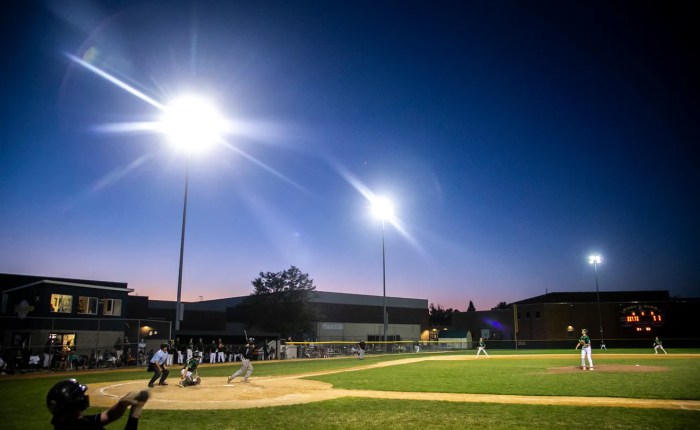
In my memory, every small town in that pokey odyssey shut down at dinner time, slowly gathering players to town fields, where thick grass with furry white foul lines stretched to uneven plank fences. At dusk, harsh lights clanked on, and players took the field. I’d pull over, buy a Dr. Pepper from the moms running the concession table, and sat in the stands as the games began. I cheered for both sides and saw some pretty good baseball from time to time. Some nights there was no game, but high school kids practiced under the lights for American Legion ball or Pony League. I’d pull up, park by the side of the field, grab a glove and ask if I could help retrieve balls from the outfield.

“You wanna hit,?” Sometimes a coach would offer a chance to step into the batter’s box, but my place was out in the field, out of the way of the real players, ready if the ball went over the heads of the kids who belonged.

My granddaughter has a friend playing Little League this summer, a good kid who happens to be a Red Sox fan as half the kids in Connecticut are. I went to his game last week and thought about getting the glove from the car. I saw at least four pop fouls ark above the backstop into the driveway behind the field and knew I could camp out there and see some action.

I would have loved to pull down a few foul balls, but tracking a ball in the air pretty much assures loss of balance, a stumbling tumble to the gravel, floundering to recover, and a distraction kids don’t really need. I watched kids playing ball, remembered how much the game had meant to me, and told the Red Sox fan his uniform number, 5, was pretty great, worn for a decade by Nomar Garciaparra (highest batting avg. by a right handed player since WWII, .372 in 2000) a Red Sox legend.

I didn’t tell him that it was also worn by Joe Dimaggio, a Yankee Hall of Fame icon and in the top ten in my pantheon of childhood heroes. I came home, rummaged through my collection of treasured books, and wallowed in The Fireside Book of Baseball, recalling with fresh admiration the great writers who made the game come alive in my imagination and the kind folks in small town in the midwest who let me shag balls and loft lazy throws back to the infield.
Stand Up and Cheer

Stand Up and Cheer

As a sophomore at Kenyon College in 1965, I ignored the opportunities offered by the college’s eminent teaching faculty, the many vibrant service organizations, an inclusive athletic program, several ambitious journals, and the excellent theater department. I was what was then known as a “wastrel”, a squanderer, a ne’er-do-well, a profession I maintained in part for the subsequent four decades. I did enjoy music however, particularly a cappella music, and had just enough initiative to dragoon a dozen unwary associates into the “Kokosingers”, a name referencing the college’s setting above the Kokosing River in Central Ohio. The group still exists; more than sixty of us, including the current group, assembled from across the decades to perform at the college’s 200th birthday celebration. 

A few of us from my generation live in New England and rehearse and perform as “Koke Klassics”, trotting out old tunes and a number of relatively new numbers for the edification or amusement of captive audiences, most of whom meet us in resident facilities for seniors. The pleasure in singing  is ours, no matter how responsive the audience; Our program includes standards from The Great American Songbook, a few relatively contemporary numbers, and a few old college songs. I returned from a college reunion with a “fight”song that appears to have emerged at Kenyon at the turn of the Twentieth Century.  It’s been fun recovering the four-part “Stand Up and Cheer For Dear Old Kenyon”, including what was apparently a boisterous college cheer, “Hika, Hika, Hey!”, but my attempts to track down the origin of that cheer have not brought much success.

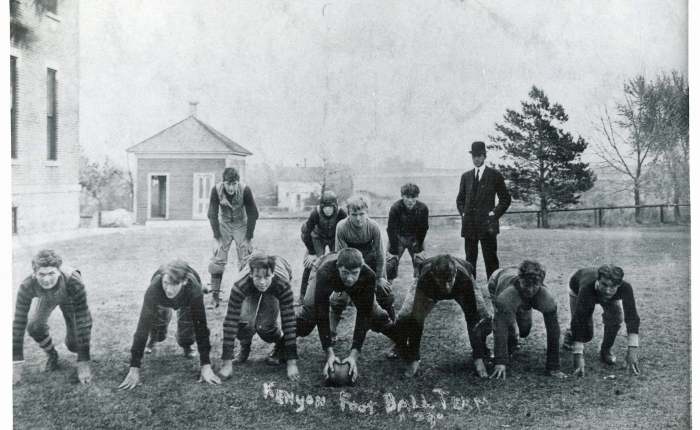
It’s clear it was a football cheer, and, in fact, seems to have been a common expression of greeting when meeting on the college’s historic Middle Path, maybe up to the 1930’s. I intend to offer it when I next walk Middle Path; we’ll see if it catches on again.

I did find some good information in the December 15, 1905 edition of The Collegian, including the identification of “The Big Six Conference” – Kenyon, Wesleyan, Oberlin, Case, OSU, and Western Reserve. In the 1905 season Kenyon beat Wittenberg (2-0), Otterbein (17-0), and Ohio Wesleyan (20-0), but got pretty well thumped elsewhere, losing to Ohio State 23-0. In 1898, Kenyon played both Ohio State and Michigan. 

Hika Hika Hey!

I went back to the 1905 Collegian again in the hope of finding a guide to Kenyon’s cheers at the turn of the (last). century and realized that the entire issue was directed toward the viability of football at Kenyon and in collegiate life. I did find a “Hika” reference as well as a reference to “Wahoo” as the comparable rejoinder from Ohio State, but also came away surprised and impressed by the quality of journalism the paper offered.

The Collegian was printed every other Friday in 1905. Fred J. Hartman ’06 was editor. Here’s two paragraphs from the lead story describing what was then a national conversation, the second of which contains the Hika reference:

“Kenyon has closed its fifteenth season of intercollegiate football. The termination of the season finds the game of football in a position which demands an answer to the question the Collegian of eight years ago asked, “Shall the game be crushed out of American schools , or shall it, altered and improved, to be continued as the great American game?”

The piece continues –

“As to the antagonistic spirit aroused in the intercollegiate games, the experience of the past season calls for an absolute denial. For never before, since Kenyon has been a member of The Big Six, has such a friendly disposition been awakened in her contests with other members of that organization. In her games with Oberlin, Case, Ohio State, and Ohio Wesleyan, sincere and genuine good feeling was a marked feature. It is seldom that the “Hika” and the “Wahoo” are exchanged in that spirit which was so manifest on the Columbus gridiron as the case on November 4th. Consequently, the Kenyon followers have no flaw to pick along this direction.”

I suspect “genuine good feeling” is less commonly observed in the contemporary experience of football at Michigan or Ohio State, but I have no flaw to pick in my observation of the great rivalries among colleges not tangled in the frantic semi-professionalism of major market collegiate sports. “Stand Up and Cheer” was adapted by E.W. Peake, Class of 1911 and includes the line, “For today we raise the Mauve above the Red and Gray,” “Mauve” denoting Kenyon’s signature hue, purple containing more gray and blue than magenta, and Ohio State’s colors, now more commonly known as Scarlet and Gray. 

I don’t mourn the loss of rivalry with Ohio State, a fool’s attachment, but I regret the absence of the sort of rivalry my wife’s alma mater, Williams, enjoys with Amherst, a college of similar size, tradition, and ambition. I had written a sentence that began, “Nobody gets very excited on the eve of …”, intending to pick a name from the contemporary ranks of football opponents, chose Oberlin as the most similar in terms of academic reputation, went to the Oberlin athletic site to make sure they were as unenthused as I suspected we were, only to find this article:

“Recounting Oberlin’s Storied Rivalry with Kenyon College,” wherein the author suggests: “It is often said that familiarity breeds contempt, and this has certainly been the case for Oberlin and its longtime rival, Kenyon College. Formed from frequent athletic matches and the similarity between the two schools, this rivalry has been embedded in the cultures of both schools; the Yeomen and the Owls have been close competitors for as long as students and faculty can remember.

Oberlin’s first football team was coached in 1892 by John Heisman, of Heisman Trophy fame, an outstanding player and coach who led Oberlin to an undefeated season, both coaching and occasionally playing, defeating Ohio State twice and the University of Michigan once. This dominant team was known as The “O” Men. I remember being pretty impressed with “Yeomen” as a team name, assuming it came from somewhere in the various iterations of the tales of Robin Hood, as virtuous land owners stood up to the cabal headed by a rapacious and usurping Prince John. Turns out, just an upgrade on “O” Men. On other hand, Kenyon’s teams were nicknamed “The Lords”after a founding benefactor, Lord Kenyon. A generation of “Lords” and “Ladies” played before good sense prevailed and Kenyon’s team became The Owls, referencing the owls that call from the depths of the Kokosing River. Amherst also sported an affiliation with nobility, competing as the Lord Jeffs until they adopted the wooly mammoth as their familiar.

An interesting and unexpected window into the absence of “genuine good feeling” with regard to Kenyon, however, opened as I parked my car displaying a Kenyon license plate at an event in Williamstown honoring the former coach of the Williams swimming and diving program, a wonderful man and an important figure in my wife’s time at Williams. Kenyon won something like 31 consecutive NCAA swimming championships during the years that many of those swimming for Williams had competed. For one fleeting moment, as a former Williams swimmer spotted my Kenyon plate, I felt the pull of rivalry.

“Gambier is so NOT a town compared to Williamstown!” The reference to Kenyon’s location may be the least injurious slight to which the college will ever be victim, and I walked away unscathed, slightly puzzled, but aware that for some, my college had provided a meaningful rivalry. 

This dive into college rivalries has been diverting and has given me just enough momentum to post the first article in several months.

Just to provide a slight touch of perspective, however, the most impressive team of the late 1800s were the 1899 Sewanee Tigers, winner of 12 games between October 21 and December 2, defeating:

Georgia, Georgia Tech, Tennessee, Southwestern Presbyterian, Texas, Texas A&M, Tulane, LSU, Ole Miss, Cumberland, Auburn, and North Carolina.

The 18 “Iron Men” of Sewanee played all 12 games on the road.

Oh, and they were unscored upon.