Ephemera And Other Fleeting Pleasures

Ephemera And Other Fleeting Pleasures

More than a year ago we moved from the place in which we had lived for eighteen years.  I started packing boxes a good ten months before the move, labeling everything, stacking cartons in the living room, thereby signaling that the time we had remaining in the home a son and daughter had grown up in was slipping by quickly.

Tempis Fugit.

Time Flies.  My favorite Classicists probably encountered the phrase in Virgil’s Georgics; I found my Latin in a comic book, as Archie tried to urge Jughead to hurry if he wanted a hamburger.

Yes, I said it.  I moved two boxes, one marked, “Archie” and the other, “Archie Double Digest”

Over the years I have collected matchbooks, bottle caps coasters, stamps, baseball cards, football cards, hockey cards, coins, marbles, issues of TV guide, yearbooks from schools I did not attend, signed baseballs, college pennants, theater programs, sheet music, toy soldiers, newspapers, comic books, the complete series of Science Fiction novels written by L. Ron Hubbard, old baseball mitts, and one Barbie doll – the Barbie Michigan Cheerleader.

All of that stuff belongs in the realm of ephemera, things that are not meant to endure, that are transitory, short-lived.  The word derives from the Greek, ephemeros, “lasting only one day”, which is not to say without value; in fact in odd cases, ephemera endures because it was not meant to endure.  The very fragility of the moment in which the thing came to be carries sentiment, of course, and memory, but also, dare I say, an ephemeral connection between us and the object.

OK, no need to wax philosophical about it; I just like stuff.

But here’s the rub:  I’m a mid-century modernist by training, inclination, and aesthetic.  I am pleased by uncluttered space. I enjoy leaving my keys on a table unburdened with flotsam; I am pained in encountering jumble.

The Life-Changing Magic of Tidying Up by Marie Kondo has surely been a boon to those of us who are not exactly hoarders but inclined to hoard things.  As I look at that sentence, I am aware that there may be some denial still at work.

The method by which one begins to tidy, the KonMari Method, involves snappy tricks having to do with folding and organizing, which is great, but not my problem.  I can fold with the best of them, travel for a week with a small carry-on bag, keep the socks organized by color, shape, and age.  No, my problem was with the cartons still stacked in the garage, preventing its use as, well, a garage.

There was hope, however, as Kondo popularized a mantra that seems peculiarly effective for sentimentalists such as I am.  “When I touch this object (Archie Double Digest, for example) do I feel a spark of joy?”  It’s odd that the word “joy” works for me in a way that “worth” or “value” do not.

So, you ask, what got chucked?  The Archie Double Digests?

Sorry, I think we’re losing signal.

Actually, I chucked quite a lot, although the garage is still strewn with a remnant of joy sparking ephemera.  What remains, for the most part, are remarkable collections, none of them belonging to me.  My son and daughter have been up and out for a while, bounding into the lives they were meant to lead, and I am delighted that they have done so well, but … I can’t bring myself to pitch their childhoods.

Some of that reluctance comes from having had my childhood pitched, particularly the comic books and baseball cards that could now be providing me a retirement income.  More persuasive, however, are the sparks that still seem to fly when I open the tub containing my son’s collection of Star Wars and G.I. Joe action figures, the Pokemon card binders.  My daughter’s side of the garage has the Breyer horses, all things Disney, and, in tribute to the changing tides of youth, the Buffy and romcom dvds.

Tempis Fugit.

I confess that it’s not just joy that sparks when I consider my kids in their various stages of personhood; it’s a more complicated array of feelings.  There’s loss, and regret, and some guilt; I do wish I had been a better father to each in turn, although all three have turned out to be smart and authentic adults, capable and interesting.

What strikes me now as it did at each transitory stage is that no matter how the circumstances of our lives stood, no matter what developmental hurdles were in the process of being cleared, no matter what scrape or folly came into play, my sons and daughter were always fully themselves from the start.  I don’t mean personality, per se, because the more accurate supposition would be something like personhood. The same circumstance elicited completely differing responses from each one, making raising children less predictable, but finally far more rewarding.

Some of this comes to mind as I meet my granddaughter, a relatively new person who has been fully herself from the start and understand the frustration my son and daughter-in-law feel when well-meaning friends and relations question their parenting decisions, assuming similar parenting experience.  It also comes to mind as a speaker visiting our local university touts the notion that the true meaning of “genius” is the inherent unique essence of each person; genius, in his view, is not remarkable intelligence but our calling, the gift we have to give the world.

What’s the relationship between genius and the hermetically sealed bags of stuffed animals now sitting on shelves in the garage?  It’s probably a stretch, but I think the personalities of the most beloved  animals were very much connected with the core of each child’s genius.  The walrus spoke to one, a bear to another, and a bulldog to the third.  By spoke I mean called to, but I also mean carried out fairly extensive conversation at bedtime.  When I’m able to give myself any credit as a dad, it comes with remembering that the animals called to me as well, speaking through me to the children they protected.

Tidy is sometimes overrated.


Seasonal Affect

Seasonal Affect

Against all odds I have been able to withdraw almost completely from my long-established reliance on  (NOT an addiction to) carbs and sweets of all sorts.

Do I have the fleeting dream of cookies packed with brown sugar and a stick of butter?

Sure.

OK, often, but my days are filled with satisfying salads, intriguing salmagundi of fruits, and a cornucopia of meals almost entirely involving chicken in one iteration or another.  The occasional pang of deprivation is forestalled as I allow myself the occasional snack, a single square of dark chocolate.

Ah, life is good.

But, I found myself in line at the market, head of lettuce in hand, checking out just behind a friend, who, in the spirit of the season, had grabbed two huge bags of the Halloween themed Tootsie Roll assortment.

In my ordinary life, I would no more buy a bag of Tootsie Rolls than I would gargle with dry ice, but, by way of explanation, the assortment was not simply a bag o’ rolls.  In what must have been the result of candy merger at the highest level, Tootsie Rolls, large and small and Tootsie Pops of various chemically augmented flavors were nestled with small boxes of Junior Mints,  Junior Caramels, Dots, and Mini Charleston Chews.  That was more than enough to jar me into sudden helpless pining, even as I responded with the (literally) visceral memory of having eaten bags of that size and larger, by myself, in the first day after Halloween.  Not a pleasant reminder of the wages of gluttony.

To be completely transparent, the bags in question were not trophies carried home from trick and treating; no, I lived in a candy wasteland as a boy.  These were the remainders of the three or four bags I bought in order to prepare for the parade of kids in costume.  The parade came and went, my movement activated shrieking zombie had the desired effect on children now scarred for life, and the proffered bowls remained almost full.

What to do?

My breathtakingly level-headed wife suggested tossing the stuff out.  Reasonable but unlikely.  So, down it went, peanut butter cup after Hershey Bar, until the cloying glucose assault finally left me spent, on the couch transported by the infomercial for the cloth that absorbs an entire gallon of milk with one swipe.

The first phrase that springs to mind  might be, as a friend put it, “stupefied in an unseemly morass of excess”.

Today I am ok with my single square of dark chocolate.  Really.

I am left, however, with a fondness for holidays that is now bereft of gluttony.  How does a person of my age and station in life join in the macabre jollity of a holiday that is now primarily the realm of children and of teens with poor impulse control?

I could, of course, revert to the older, more authentic, entirely pagan rites and rituals surrounding the invasion of our fragile reality by the spirits, demons, and hobgoblins waiting to wreak a year’s worth of havoc on a single night.  “Double, Double” and all that.

Risky on every level and completely unmanageable should I inadvertently summon something nasty that wants my soul and my chocolate.

I could sport a costume of some sort and confess that I have been tempted to buy the full Sith Lord rig from time to time, but was so unnerved by running into a friend in costume last year, that I want to spare others the dislocation I felt.

A friend, a pretty amiable guy, admittedly given to odd japery, joined a group of us in discussion dressed as a fully tatted, clearly dangerous, Hell’s Angel.  It was the arms that fooled me.  He wore a vest and sported the kinds of fully illustrated “sleeves” I had become accustomed to seeing among serious bikers in town.  In addition, he had shoved a wig under a bandana and allowed himself a full six day’s growth of whiskers.  In retrospect, I have to admire his dedication to the role.

I’ve become accustomed to seeing all sorts and conditions of people in this small town, and his appearance would not have been uncommonly jarring had it not been for the whispering conviction that I knew this specimen from some other corner of my world.  Vampires, zombies, werewolves – all daunting.  But the shape-shifter, the transformed person, the child occupied by Pazuzu, witches appearing matronly, people turning into leopards, these scare me silly.

In the “real” world, we see the smile that hides menace, the lulling reassurance that brings  danger; there’s a part of our world-scan that reads the hints of deception.

So, when I saw my pal as a menacing stranger, my relationship with him shifted, just a bit.  Fool me once and all that.

I’ve taken this account some distance from the array of Tootsie products bagged for the holiday, but hope the rambling accounts for the curious compromises I’ve made this Halloween.

I’m not buying candy, not even wax lips, not buying cookies glazed with an orange  non-soluble starch, not buying cakes in the shape of ghouls.  I am not sending off for the Jack-the-Ripper dissection kit.

I have inflated Tigger, the vampire tiger, and have placed twinkling lights of orange and black in the windows.  There is still some question as to whether putting fake blood in the sprinkler system is a good idea.

Better check with my wife.


Ambience

Ambience

I’ll admit it.  Sometimes the well runs dry; sometimes inspiration is tardy.

I’ve asked trusted friends and relatives to pass on subjects they’d like to see me take on, and, while more than a few are unspeakably inappropriate, I have built up a nice collection of go-to titles, each of which is large enough or general enough to allow me to ramble unimpeded by the need for particular knowledge or, for that matter, facts of any kind. Fortunately, my sister-in-law opened a treasure trove of single word titles, including this one, on ambience.

You might expect that an article on ambience might reasonably consider those elements of space or structure surrounding us that elicit distinguishable feelings or emotions.

Fair enough, so let’s talk about cows.

Jarring transition?  Hold on to your Holsteins because I’ve been aching to give cows attention too long overdue.

I have been to Canterbury.  I have been to Lourdes.  I have been to Santiago de Compostela.  Wonderful, beautiful, inspirational, serene, and so on.

The pilgrimage that has changed my view of the world, however, was the trek to Thorncrest Farm in Goshen, Connecticut, home of the best chocolate the world has ever seen.  That is not just my opinion, by the way; the author of a guide to fine dining in Connecticut as published in Connecticut Magazine said, well, what I said, roughly.

The reader is perhaps familiar with terms such as single-malt in reference to the finest whiskey, artisanal in reference to fine comestibles, from cheese to beer.  Thorncrest Farm offers … fine artisanal “Single Cow Origin” chocolates, the foundation of which is their signature milk.

The identification of the Single Cow Origin is not mere hucksterism; each piece of chocolate is made from the milk of a single cow, and the properties and nuances of each cow’s signature milk are matched with the sorts of chocolates to be made.  The milk of each individual cow is available for purchase at the Farm, should a visitor care to develop the sort of “nose” one needs to become a true lactophile.

With absolutely no understanding of the choice I made, I stumbled into a realm of caramel fashioned with milk and cream donated (no coercion here) by “Daydream”.  I chose Daydream’s Butter and Sea Salt Caramel,  a confection described by Thorncrest:

 Daydream’s fresh cream, butter and milk  are carefully blended together to create these one of a kind caramels.  The Sea Salt Butter Caramels have a splash of sea salt on top for an ultimate flavor sensation of salty, sweet, buttery lusciousness.

They aren’t lying, and you can see they take chocolate seriously, which means they also take the care and well-being of their Single Origin cows very seriously. It is the ambience (see?) of barn life at Thorncrest that will occupy much of the remainder of this piece, but in order to understand the relationship between artisan and cow, you will need this description of how it happened that Daydream became the cow of caramels.

When a young heifer who we call “Daydream” ( a daughter of Sweet Dream)  calved and began to produce milk. “Daydream” already had her place in the history of Thorncrest having been shown for two consecutive years and remaining undefeated. Soon after entering production, on a early summer morning as Clint and I milked the herd, I took “Daydreams” milk pail and commented on the pure buttery color of her nights work. It is best described as an ivory buttery tone and a purity all its own. I immediately turned to Clint and said, “Caramel”. I quickly excused myself from the morning milking and went right to the creamery with “Daydreams” milk.  

The first principle in nurturing their cows so as to produce the finest cream and milk is in making sure they are free of stress.  As the farm’s owners and chocolatiers, Clint and Kimberly Thorn, described the efforts that go into assuring that each cow’s day is purely magical, my view of cows, milk, cream, and chocolate were forever changed.

The barn (this shabby term does not even come close to what the structure actually offers) is open to the public from 10:00 am until 4:00 pm, allowing visitors to meet the cow that provided the blend used in the chocolates they enjoy.  No visitors during the milking, however… might be stressful.

About the barn.  The Thorns constructed this immaculate haven in order to provide the most stress-free and comfortable experience a cow could imagine.  They observed feng shui, having the cows’ heads or tails aligned perfectly with the earth’s magnetic field so that they are facing either east or west, whereas the huge barn doors at either end of the barn are oriented north-south.  Among the pleasures of the arrangement is the cross-breeze that not only circulates, but which rises from under the cow and up into the barn’s rafters.

Upon returning to the barn from the pasture, the cows are fed hay that has been harvested from the farm’s field and tended with natural compost; no herbicides, pesticides, or fertilizers touch Thorncrest hay.  Each cow is milked into an individual bucket, and within fifty seconds of the milking, that milk is carried by pail, poured into a gravitational system so that the milk is never pumped or bruised, and then is gently and slowly pasteurized.

There is a downside to the process, as I suspect the ardent cow lover will have anticipated.  The unique “Zesty Lime and licorice” chocolate, for example,  can only be made with the milk of one cow, Queenie, and that means that should Queenie not be available for milking, no zesty lime and licorice.  Long live Queenie!

Quite aside from the meticulous care with which this extraordinary chocolate is created, there is something to be said in recognizing that stress has its consequences, and it is in that sense that ambience is most properly considered.  The Thorns labor with love and the result is astounding. Love doesn’t always involve tails facing east and west, but it seems to have something to do with noticing what brings comforting alignment.

I’ve spent some time romanticizing this day with cows, and I am aware that they are not frequently seen as belonging to the highest order of mammals.  As a possible corrective to the misunderstanding of the range of emotion available to cows, I am attaching a short video at the bottom of this article.  Cows released from the barn in the spring frolic with an abandon I should like to experience.

I don’t eat mammals, in part because the scene I pass along convinces me that we are related, cows, pigs, dolphins, dogs and I.  Mark Twain suggested that, “Man is the only animal that blushes … or needs to.”, and I can’t contest the observation, but my opinion is that an animal capable of joy shares something important with me.


Trying To Look Like Marlon Brando

Trying To Look Like Marlon Brando

I recently received one of those chain-gag letters that presented the way it was and the way it is, a waggish somewhat wry admission that, zut alors, time passes!

One of the suggestions was that my generation once wanted to look like Marlon Brando or Elizabeth Taylor and now risk botched plastic surgery and gastric by-pass so as NOT to look like Brando and Taylor in their later years.

It’s a cute conceit, but off the mark.

Both Taylor and Brando were striking in their prime, not simply movie-star attractive, but charismatic, intelligent, vulnerable,tough, and world-wise.  As I consider the span  of their careers I am struck by their ability to bring depth to roles that might have been formulaic and mindless, even the saccharine string of Lassie films (Taylor) and the first Superman (Brando).  When given the roles they were born to play, Maggie the Cat in Cat on a Hot Tin  Roof, Martha in Who’s Afraid of Virginia Woolf, Brando as Stanley Kowalski in Streetcar Named Desire, Terry Malloy in On the Waterfront, they were transcendent, creating indelible characters that live outside of the films themselves.

Let’s get real.  Nobody actually tried to look like either one because each was a higher order of human, capable of a range of expression we mortals simply could not command. I might have done the Brando, “I coulda had class…I coulda been a contender. I coulda been somebody, instead of a bum, which is what I am” for my own amusement, but actually look  like Brando?  I could buy a leather jacket, slouch, attempt to look simultaneously earnest and injured.  Not even close.

There were other very effective method actors and other great roles, but anyone who has seen the play of emotions crossing Brando’s face in the course of a moment, who remembers his taking Eva Marie Saint’s glove, in a gesture embodying pure masculinity and gentle affection, knows that there is a kind of kinesthetic genius we can admire but never replicate.  The oddest and closest comparison I can make with current actors is with Keanau Reeves’ singular ability to show dawning understanding without movement of any kind.

In Taylor’s case, she too was one of a kind; the color of her eyes was a distinctive blue, so pronounced as to be seen as violet.  She was born with dark double eye lashes, a mutation that made her seem simultaneously sultry and wise.  We later learned that she, like Judy Garland, had been robbed of childhood and made by the studio into whatever facsimile of contemporary popular star they felt they needed that year, but unlike Garland, she managed to arrive in each role with crackling, understated energy.

Her roles after National Velvet are unexceptional; despite MGM’s efforts to make her into a teen prom queen in a series of adolescent romantic comedies, Elizabeth Taylor was never truly a teenager.  In 1951, she married Conrad Hilton, Jr. who had already demonstrated an uncommon gift for debauchery, having had an affair with his step-mother Zsa Zsa Gabor.  Taylor was eighteen and divorced within a year.  That was the first of eight marriages to seven husbands; she married Richard Burton twice.

Both Brando and Taylor were uncomfortable when seen as sex symbols although both had libido to spare.  Brando’s liaisons and affairs were the stuff of tabloid frenzy. he fathered sixteen or seventeen children, one of whom, given up for adoption, is almost certainly Courtney Love’s mother, linking Brando with Kurt Cobain, an unlikely association at first glance, but an oddly appropriate meeting of two men of genius defined by their demons.

Yes, the last years of Elizabeth Taylor’s life were less glamorous.  She was guilty of the sin that plagues women celebrities; she aged.  Her personal life was occasionally sloppy and too public.  She stole America’s Sweetheart’s husband (Eddie Fisher, Princess Leia’s dad), and abandoned him for Richard Burton.  In her last years, she shilled for her own lines of jewelry and fragrances.  She befriended Michael Jackson. At the end, she was bloated, wheelchair bound, and defeated by congestive heart failure.

Nevertheless, we who had seen her as Maggie or Martha were neither surprised nor disappointed at the end.  Taylor was unique in that we saw what she would become even as we were transported by the role that she played.  She was more than believable in those parts; she inhabited them completely, every sloppy, generous, bitter, sensual, unpredictable moment.  She was a force of nature and a complete woman in an era in which few women were allowed to reveal the complex entirety of their persona.

In a profession known for grotesqueries of ego,  Brando was certainly among the most outrageous, and yet, as we watched him slowly destroy himself as Babe Ruth had, hot dog by hot dog, his body swollen, we knew that he was literally eating himself to death.  He weighed as much as three hundred and fifty pounds, but he was no Sydney Greenstreet, a smug epicure.  He dieted fiercely, lost weight, binged, gained, lost.  On the set of Mutiny on the Bounty, he went through more than fifty pairs of pants as his weight elevatored up and down; in the end, his costume had to be made of elastic material.   In later roles, doubles had to be used for full screen shots as his weight ballooned during the course of filming.

Brando’s appearance was widely observed and discussed; the tabloids loved to print pictures of him at his worst.  His role as Vito Corleone in The Godfather is considered his redeeming return to the pantheon of actors, and he played the part well.  “What have I ever done to make you treat me so disrespectfully,” has now become the other Brando imitation I trot out from time to time, knowing I can’t approach his gravitas, but enjoying the plainness of speech with which a man of power offers a rebuke.

I have seen Apocalypse Now fifteen or twenty times and never fail to have the same reaction.  Critical language doesn’t do justice to the experience as the film is so over-the-top and painfully true-to-war that it can leave me shivering, but each time I screen the film, it is the image of Brando as Kurtz, shot so that his head appears a shard of uncertain and uneven light against primordial darkness.  He rubs his shining head with a hand that, in that moment, appears too large, too perfectly shaped to be genuine, and I find myself thinking year after year:

“That is the most beautiful man I have ever seen.”


Things We Said Today

Things We Said Today

I slipped yesterday.

A friend asked if I wanted a cookie, and I replied, “You’re darned tootin'”.  The slip was not in eating the cookie, a ginger snap, rich with molasses, and liberally sprinkled with sugar crystals, but in allowing one of the phrases from my childhood to emerge unbidden.

I try to do a daily geezer check, reminding myself that locutions once familiar can cause serious confusion in polite company.  I vividly recall a horribly dislocating moment when I used the phrase, “socked right in the puss,” in a class of 10th grade students who were appalled at the imagined act and my effrontery in evoking it. Equally apalling, apparently, was my description of wearing thongs on hot sand.  I meant flip-flops, they heard thong.

I don’t know exactly when the shift happened, although I could probably screen some vintage television and see when situation comedies stopped speaking my outmoded language.  And that is exactly the term to use – “outmoded”.  A la mode – to the fashion, fashionable, current, perhaps even “with it” and “hip”.  “Hep”?

Ah, there’s the rub.  I may not have access to language current enough to get traction in a discussion of dead language.  This is not a new phenomenon; I distinctly remember being called out for using the word “cool” in general affirmation of one plan or another.  My best guess is that I was about sixteen; I know it took place with regard to learning to drive, and I know the questioning adult was perhaps no more than ten years older than I was.

In defending my use of the word, I discovered that I had no way to include all that I absolutely knew the word meant.  I didn’t want to get into the distinction between beatniks and teenagers, and I hated the idea of imitating one of the contemporary teen idols.  I had not yet worked out whether to summon my inner James Dean or my inner Bob Dylan, and found myself simultaneously embarrassed and aggrieved.   Had I known my truth at that point, I would have said what I was inclined to say in almost every discussion with anyone not in my immediate circle of friends:  “You are too square to understand.”

OK, I know that “square” still has some purchase, but barely.  It’s a term I have not used for more than fifty years; it had degraded notably as I went off to college.  By the time it appeared in Quentin Tarantino’s Pulp Fiction, it had already become a quaint self-referential anachronism, hardly needing the even more antiquated “Daddy-o” to make the point.

I grew up with electricity, the telephone, and a variety of labor-saving appliances, but still occasionally call a refrigerator the ice box, a bathroom the can or the John, and a person who works at Safeway a grocer – You know, a person who provides groceries, in the same way that a pharmacy dispenses sundries, and a laundry uses a mangle.

All of those brain spasms aside, I find listeners, including my own children, puzzled when I use the sorts of euphemisms common as I grew up, language that avoided what we called swearing, what would now be termed restrained expression. I heard my parents say Hell and Damn, but that was about it, and I’ll admit I was shocked when the words landed, usually when we were running late to an appointment, even though were going like sixty.  This was an age in which a conversation approaching things sexual, referred to the subject as talking about the birds and the bees.  Storks brought babies.  My mother expressed anger or frustration by saying Ships, or Sugar!  When really agitated, she might let loose with Son of a Sea Cook!  My step-father talked about S.O.B.s.  I fear one of them might have been agitated enough to spill the F word – Fudge.

I’ll admit that at my worst I  let loose with stronger language more frequently than I would like, but I still notice gratuitous swearing in films or literature, now realizing that those around me hardly hear the obscenities ringing.  My eldest son takes particular pleasure in presenting me with situations in which I have to acknowledge that I am uncomfortable with very strong language.  There is not one quotable line of dialogue in Magic Mike – XXL for example, although the plot is reasonably tame, assuming, of course, that gyrating male entertainers are simply miming pelvic disorders rather than succumbing to orgiastic excess.  HBO’s featured stand-up comedians?  I’ll use a word that has also fallen out of favor in saying that their material is too blue for me.  I’m still stuck somewhere between Mel Brooks and Don Rickles.

I think I’ve always been over-vigilant about words.

My first memory of living away from home in a boarding school in my fifth grade year was a roommate referring to someone as a half-ass.  I was shocked.  I was amused. I was awkward and uncomfortable, leaving myself open to years of merciless teasing.  At the same time, I was impressed with the metaphor/simile.

What a concept!  I was unable to get the image out of my mind for years and still find it the most physically pertinent description of a person virtually too far gone to correct.

Whereas it had been marginally ok to use the word crap to describe a generally unpleasant set of tasks or poor argument, ok to use rear, and butt,maybe heinie,  I knew that ass was out-of-bounds in the company of adults.

Unfortunately, I spent time with a number of JDs (juvenile delinquents), also known as hoods, who wore DAs (hair slicked back and up to look like a duck’s ass) who tried to act tough and suggested those who questioned our posture were cruisin’ for a bruisin’. They didn’t go for finks or flakes, drips or drags.  They were bad, they were boss, and they had it made in the shade.  Time spent with JDs did not rub off, despite my best efforts to dress slick with pegged pants and snap jack shoes.  I wasn’t part of the “We don’t smoke, and we don’t chew, and we don’t go with girls that do” club either; I was somewhere outside the prevailing cultural orbit, using vocabulary I hoped would allow me to travel relatively unobserved.

So, having spent untold hours in the dark watching movies good and bad, many of which were made in the 30’s and 40’s, my default vocabulary is not simply outmoded, but positively archaic.

So, gangsters pack rods in order to grab some kale, long green, cabbage, lettuce unless they use a Chicago typewriter or Tommy gun to grab some moolah.  A con-man is a flimflam man, a grifter who knows how to chisel.  Maybe he runs a clip joint where marks get fleeced, a club where dizzy dames are cute as a bug’s ear with a set of gams that won’t stop, but  where the house dick stands ready to put the kibosh on a  Joe who tries to put his mitts, dukes, meathooks on one of the fillies.  A guy can buy a Jane a cup of java if he’s lousy with dough unless some mug has hacked a lunger or dropped a mickey in the joe.

On the other hand, as I look at terms I use with some caution these days, it strikes me that common lingo has become notably less colorful even as it has become more anatomically precise.  How can one compare “She’s hot” to “She’s the cat’s meow”,  “being uneasy” with “having the heebie-jeebies”?

By the way, proofing this piece will not be easy as the program I run to spot errors has underlined virtually every word I’ve written.

Hot dog!


What Happened To Hockey?

What Happened To Hockey?

“I guess we can officially say that hockey is dead, eh?”

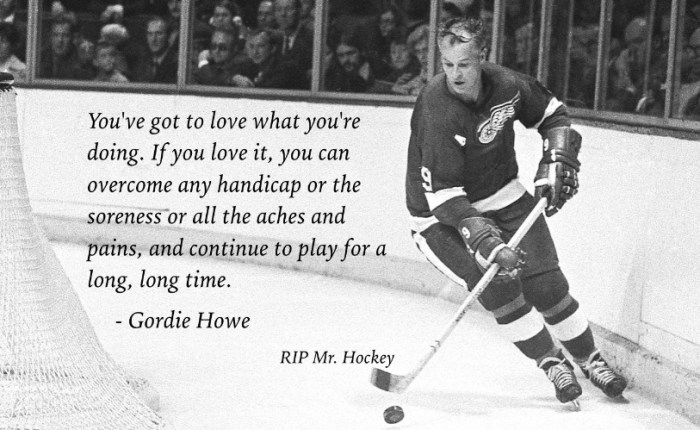
I couldn’t change the channel quickly enough.  I can take sports radio when one of my trusted advisors, Rich Eisen or Dan Patrick, is on the air, and the Loose Cannons, Steve Hartman and Mike Costa, when they stick to sports, and I will find Vic the Brick Jacobs wherever he lands on the dial, but the self-satisfied voice of a sports radio host dissing the game of hockey when I’m still not over the loss of Gordie Howe was just too much.

*Quick digression.  Vic the Brick is an original, the auteur who brought the phrase “Feelin’ You”  and ” Give it up to the Azul” to sports radio, and the fan who brought stalks of bamboo to Lakers games to show them how to “bend rather than break”.  Citing bushido and zen koans, Vic takes any broadcast to a new level, perhaps calling on his background covering cockfighting and the South Pacific Games in Fiji, or from his time with a punk band known as Dino Lee and the White Trash Review.  He’s been described as a Buddhist Wolfman Jack from Queens.  A sports purist however opined, “Vic the Brick makes Dick Vitale sound like Walter Cronkite”.  That’s fair.

So, with the exception of a few lonely sports radio hosts, hockey gets short shrift in almost every medium.

Pick the twenty sports films that are considered inspirational, from Rudy to Chariots of Fire – we might sneak in with Miracle, maybe.  Yes, we get to the ice with The Mighty Ducks and the successor films, but inspirational?  Then, with four exceptions, the remaining hockey films can all be classed in the odd-ball sports category – Slap Shot, Goon, Mystery, Alaska, Les Boys.

To be frank, the exceptions in this case absolutely prove the rule.

Youngblood is the bildungcinema notable for pairing Rob Lowe and Patrick Swayze and slightly featuring a very young Keanu Reeves (his second film).  Most notable moment?  When  Captain Patrick Swayze shaves Rob Lowe’s testicles.  Inspirational?

Sudden Death.  That’s the title of the film and its primary conceit.  See, it’s the seventh game in the Stanley Cup playoff between the Pittsburgh Penguins and the Chicago Blackhawks and a band of terrorists has planted bombs throughout the arena, and, to make sure we get the point, the hero, Jean-Claude Van Damme, picks up a terrorist in each of the three periods until the game goes to …Sudden Death.

And, every true hockey fan’s favorite, MVP: Most Valuable Primate, the first of the MVP films, spawning MVP2: Most Vertical Primate, and MXP- Most Extreme Primate.  You can pretty much guess what’s going on, given that the lead role is played by a chimpanzee with astounding athletic  ability.  He’s befriended by a deaf girl, exhibits a rare understanding of sign language, and turns out to be the best player in a junior hockey league.  I’m not even going into the plot of Most Vertical Primate, except to note that it, too, involves damage to testicles.

Great hockey novel?  Uh, none.  Great hockey song?  Yeah, none.

I can live without the movies, songs, and books, but try to find hockey on ESPN outside of the two resident fans, the incredibly underrated Linda Cohn and Steve Levy, who broadcast NHL games before taking up his work with the Worldwide Leader in Sports.  Neil Everett may like hockey, but his man-crush on Barry Melrose is the stuff discomfort is made of.

As a kid, I was absolutely sure of three things:  The Yankees would be in the World Series, the Heavyweight Boxing Champion of the World was the most celebrated title in sports, and hockey was played in Montreal,Toronto, Chicago, Detroit, Boston, and New York.

Any real sports fan knew all about Gordie Howe, Maurice Richard, Jean Beliveau, Terry Sawchuck, Glen Hall, Stan Mikita, Alex Delvecchio, Jacques Plante, Number 4 – Bobby Orr, Frank Mahovlich, Rod Gilbert, Bobby Hull, Ken Dryden, Phil Esposito.

I don’t dare ask how many current players are mentioned in everyday conversation about sports.  Syd the Kid, maybe.

So, what happened?

Well, as it has in all sports, expansion spread talent too thin and fan base too widely.  I’ll give you Edmonton, Vancouver, Calgary, Ottawa, Buffalo, Philadelphia, Pittsburgh, Washington, and Jersey, but Atlanta?  Phoenix?  Dallas?  Carolina?  Nashville?  These do not bring ice time to mind.  I know, the Hurricanes beat the Oilers in the Stanley Cup, and the Lightning are a force to contend with, but in terms of partisan fan allegiance, Atlanta?  Sharks fans are real fans, but Kings fans adopt the LA vibe, jumping on and off the bandwagon.

I was going to write about the absurdity of trying to play hockey in the South then remembered Buffalo 1975, a Stanley Cup game interrupted by fog in the arena.

I think the NHL could have maintained its place as one of the Big Four Sports in the US if ESPN had not dropped hockey from its schedule of televised games and if somebody had figured out how to televise the sport as effectively as the other Big Three have been televised.

NBC has done a great job of catching up as a result of having worked Olympic hockey and is now the major outlet for the NHL outside of the expensive package sold as NHL Center Ice.  NBC has figured out that the general public likes the Winter Classic, so they present that, even though it’s a tough game to televise and frequently a sad excuse for hockey as many cities no longer get crackling black ice even in January.  We get one game a week and a brief moment during the event known as “Hockey Week Across America” which culminates in one national game and four regional games televised on Sunday.  We get a nationally televised game on the day after Thanksgiving, and the Stanley Cup gets pushed around to three or four networks.

So there’s that.

Hockey is the best sport to watch in person.  Any seat in the house is a good seat, and for the most part, the cheaper the seat, the more knowledgable the fan.  Hockey fans love hockey and thus can appreciate the strengths of the competing team while loudly proclaiming its weaknesses.  My daughter and I wore our Red Wings gear to a playoff game in San Jose.  Could have been a terrible mistake as the arena is known as the Shark Tank, but the Shark fan seated next to us nodded and praised Pavel Datsyuk as the most skilled playmaker in the game and then begged Joe Thornton to put him down.

Almost nobody comes to a hockey game in civilian clothes; we are who we are.

It’s a fast sport, an elegant sport, and a sport offering non-stop action (except for tv time-outs – a regrettable necessity).  Non-fans complain about not knowing the rules, but there actually aren’t many.  A player is offside if in the offensive area before the puck arrives, but a skater can be outside the blue line as long as the puck is still within – generous!  Generally, if a player drives the puck from one end of the rink to the other team’s goal line, and the puck is untouched when it crosses that line, a whistle blows and the puck is brought back to the other end for a face-off.  When a team is short-handed due to penalty, however, or if a player shoots from behind their red line and puts the puck in the net or forces the goalie to play the puck, no whistle – all good.

The game is so fast, and the puck changes hands so quickly, that it is a very tough game to follow on television.  Added to that challenge, play around the net is hard to sort out; lots of bodies doing lots of things.  There are two other notable issues in building the sort of fan base that recognizes Carey Price  (2014-2015 MVP) when he walks down the street.

Any player who came into the league after 1979 has to wear a helmet at all times (ok, except for fighting) which makes it hard to recognize an individual player.  Very few viewers know what hockey players look like, which is especially frustrating because so many of them look like Viking warriors.  Those of us who treasure the knowledge that the team dentist sits on the bench during the game also love the post-game teeth out interview with the grizzled vet.  By the way, these routinely mangled gladiators are the most articulate athletes in sport; they love the game and know how to talk about it.

Look, lots of professional athletes are tough, but hockey players are routinely stiched up (or stapled up) on the bench between shifts, then back on the ice in minutes.

Finally, unless the Detroit Red Wings are on the ice, teams don’t score enough (just shoot me).  Watch an NHL all-star game to get a sense of the insanely talented skaters and puck handlers; they can do things with a puck the laws of physics do not allow.  At game time, however, they face a goalie such as Ben Bishop of the Tampa Bay Lightning, six foot and seven inches of goalie, assuming they can get past a defenseman such as six-foot nine-inch Zdeno Chara or six -foot seven-inch Chris Pronger.  Let us also remember that Ben Bishop is guarding a goal that is 48 inches tall; that’s a lot of Bishop and not much goal.  He’s wearing a blocker glove that is 8 inches by sixteen inches, a catching glove with a circumference of forty-eight inches, leg pads that are thirty-eight inches long and eleven inches wide, chest pads, arm pads, and carry a stick which can be as much as sixty-five inches long and a foot wide.

Not easy to put the puck in the net, and some great plays are foiled by bulk rather than skill.

“I went to a fight and a hockey game broke out.”

There is still fighting in the NHL, and enforcers still make sure the scorers and goalies are not abused, but the number of fights has been reduced substantially, and there are relatively few goons left in the NHL.  The San Jose Sharks have two of them, Andrew Desjardins and John Scott, whose combined annual salary is $1,400,000.00.  Brandon Prust of the Montreal Canadiens makes $2,500,000.00 all by himself.  Do these guys come off the bench specifically to mix it up with a player who has overstepped a boundary?  Yup.  And tv doesn’t even get the fights right, often missing the instigation.

Am I arguing that fights brings popularity?  Kinda.  But what is called the “European” style of play, seen in the Olympics and world hockey championships, often on a wider, longer rink, is also fabulous, especially when the right camera can follow the development of a play.

Yes, hockey has plays, just like soccer, but faster, with real hits that put players down without diving.  TV has been terrible in following the play, pretty much sticking to a crumby angle on the player with the puck until he passes, at which point, the viewer has no idea what’s happening.  Interestingly, the quality of image is much worse on local broadcasts, but the camera work is better.  NBC puts some money into its weekly games, and I am grateful for their efforts.

Oh, I guess I should mention that the NHL has the worst commissioner in sports, Gary Bettman, who has been commissioner since 1993, and who is ridiculed and booed at every event he attends, including the awarding of the Stanley Cup.  Booing Bettman has now become tradition, as much a part of the game as the octopus thrown on the ice at Red Wings home games.  Bettman essentially killed hockey in 2012 – 2013, locking out the sport from September to January, during which time he collected a salary of $8,800,000.00.  See what I mean?

It is a miracle that hockey came back from the lockout and continues to survive, despite Bettman.  Olympic coverage helps, and the cities that love hockey really love hockey.  It doesn’t hurt that different teams emerge as contenders throughout the season and throughout the years, and the Stanley Cup is rightly considered the hardest trophy to win after the best post-season play in sports.

You know what?  I don’t care if schlock sports radio doesn’t pay attention to hockey.  The World Pond Hockey Championship draws more than one hundred and twenty teams from fifteen countries to Plaster Rock, New Brunswick (that’s Canada for the non-hockey fan).  The U.S. Pond Hockey Championship pulls players of all ages to Lake Nokomis, Minnesota, offering competition to an Open Division, a 40 plus Division, a 50 plus Division, a Women’s division, a Senior Division, and a division for amateurs who don’t want to face former pros, the Rink Rat Division.

That’s in Minnesota.  Without contracts or an eight million dollar commissioner.

Anyone who has laced up skates with freezing fingers, shoveled freshly fallen snow off a patch of ice big enough to play three-on-three, felt a blade catch on cracked ice, used a shoe polish tin when the last puck dropped into open water, run cold water over frozen feet or hands until feeling returns, or taken a hip-check over a low board, knows that hockey is hockey on any level and like no other sport in the world.



What’s The Worst Case Scenario?

What’s The Worst Case Scenario?

I’m worried about three issues that will not be resolved at the polls in less than a month.

Vladimir Putin’s Russia is dangerous, actively aggressive in asserting itself as a super power.  The move into the Crimean Peninsula and the arming of separitist forces in Ukraine are the least of our worries.  Russia counts on disaster in the Middle East to send millions of refugees into Europe, creating havoc and reactionary backlash.  Russia’s support of the Syrian government serves its own regional interests, but also pits Kurdish separtists against Turkey, driving a wedge between the US and Turkey and between Turkey and NATO.  The cyber attacks directed by Russian intelligence are intended to destroy American confidence in the process by which power is transferred; their hope is to further unsettle the nation’s ability to function.

Hate Radio, Breitbart, and Fox News have convinced a significant number of people that they have been abused, lied to, cheated, and victimized by government.  President Obama and Hillary Clinton are not simply at odds with principles the hosts present; they are personally responsible for every shortcoming a listener has experienced in the course of a lifetime.  Rather than describe the complexity of global economics, financial chicanery, sectarian revolution, health care, or national security, they have personalized and demonized the Democratic Party, the President, and Hillary Clinton.  Trump’s continuing warnings that a Clinton administration means the end of the Second Amendment is both untrue and incendiary; background checks on gunshow and on-line purchases will not take anyone’s guns away, but the spectre of gun legislation is more than enough to start frenzied reaction.  And that reaction includes the elimination of the Democratic candidate.

These two strands would be more than enough to make the aftermath of election truly dangerous.  Events in recent days, however, have added the third accellerant with the Breitbart/Trump charge that the election is rigged, Hillary Clinton a criminal protected by the Justice Department, and the polling places subject to corruption, leading to the increasingly audible call for  violent response to the outcome of the election, should Donald Trump not be elected.  The responses from the Trump faithful in the wake of scandal and the defection of a number of Republicans has been to assure that they will not stand for a Clinton presidency.  Trump likes to call his candidacy a great movement, but his supporters increasingly speak of revolution, doing what is necessary to take their country back.

The signs have been in place all along.

Back in April I wrote a piece entitled, Can We Survive The Trump Candidacy?, essentially observing that the success of his campaign was dependent on forces that once unleashed would be difficult to restrain.

Trump’s candidacy is unfortunate; he is a narcissist, a philistine, a vandal, and thoroughly unqualified for the position he seeks.  His candidacy is a  reckless act of egomaniacal puffery and vitriolic conceit.  All of which would be more than enough enough to cause me to weep, but it is the gleeful dark spirit with which his acolytes preach tribal retribution that saddens me most profoundly.

We are no strangers to meanness of spirit, and other nasty episodes have resolved themselves at some cost, but this moment may signal the sorts of fissures that cause societies to break apart.

In June I posted Are Our Similarities More Important Than Our Difference? , in this case observing that the promise of compromise, already a casualty of partisan politics in government, was vanishing in what could truly become a fractured republic.

At some point, fissures become fractures.  The contempt that each set of contenders feels for the others leaves little room for compromise or cooperation.  We’ve already seen the administration of the essential functions of government paralyzed as partisan battles take precedence over efficacy; it may be that even at this juncture, too many people have been too wounded to work shoulder to shoulder with the other.  At some point, the complexity of ordering a thoroughly intricate global structure predicts plutocracy at best and tyranny and kleptocracy at worst.  Nasty racial and ethnic bullying and nativist thuggery are distractions, momentary emotional release, but the fabric of civility, once torn, is not easy to patch up again.

In August, in response to Trump’s suggestion that protectors of the Second Amendment might think of a way to prevent a Clinton appointment of a Supreme Court Justice, i wrote an article entitled, Trump Camp Warns Of Bloodbath.

What’s left to say as the poll numbers continue to slide, and the reality of imminent defeat become increasingly likely?  How about asserting that the only proper response to an election Trump factions consider illegitimate is civil disobedience and the recognition that the government no longer has the ability to maintain the rule of law?

 “The election of the winner will be illegitimate, we will have a constitutional crisis, widespread civil disobedience, and the government will no longer be the government.”

That remark and some of the nastiest suggestions are coming from Roger Stone, a professional disrupter of political civility and increasingly a voice Trump hears clearly.

What seemed unthinkable in August, “the government will no longer be the government” strikes me as a possibility now.

I saw a clip of Al Gore’s concession speech last night.  The circumstances surrounding that election were remarkable; the case had to be brought to the Supreme Court to determine that George W. Bush had won in a race possibly affected by Ralph Nader’s third party candidacy.

In spite of it all, Gore was gracious and generous in conceding.  Donald Trump will be niether.

Last month I wrote with some heat, hoping that I might be waxing hyperbolic; let’s see how this looks in about 28 days.

…but none of that has anything to do with the climate of free-form ugliness of spirit and provocation to violence that Trump’s campaign will unleash.

Unleash is the right term.  He has created a beast, hungry for vindication and unwilling to return to a polite resumption of business as usual.  We have reason to fear that the outcry will not simply be frustrated rhetoric, but a call to violence.  This losing candidate just may cry havoc and let slip the dogs of war!


Locker Room Talk

“It’s just talk.”

See, the problem is that we talk about what we think is ok to talk about.

Sure, there is the expectation that conversations held in the company of friends or close associates may be more candid than pronouncements made from a podium, though that line seems to have been crossed as well, but what we say and the way we say it defines who we are.  We present our character in the things we choose to say, which is not to argue that in the heat of a moment we might speak more candidly than we do after calm reflection but which does suggest that what comes to mind is what is in our mind.

“Everyone says things like that.”  Except they don’t.

Look, we are flawed, we are human, susceptible to every instinct that has motivated humans for a very long time.  It is likely that men and women will objectify, hormones being hormones and reproductive impulse still strong in the species, but giving voice to that objectification implies that the objectifier has the right to express a judgment about a person as an object.  Should that objectification be cast broadly, however, the statement moves from thoroughly unfortunate insensitivity to meditated irresponsibility.

So, to introduce the most discomfiting analog I can imagine, it’s one thing to inform the locker room that a teammate’s mom is hot, and quite another to post that sentiment on facebook.

There is a quantitative leap, though, from that sort of objectification to broadcasting the specific acts to be carried out upon the objectified person.  At the next level, boasting about one’s ability to carry out unwanted actions, citing examples of previous unwanted assaults carried out with impunity, talk is surely not just talk.

It is a confession.

It is disturbing that a significant proportion of the voting public in the United States appears not to find the Trump video important in selecting a President; for them, apparently he offers a longed anticipated escape from a system that is frustrating and complex.  And so, we are visitors to a Bizarro universe, a topsy-turvy, Alice-In-Wonderland landscape in which fact and fiction are interchangeable, and observed reality carries less weight than imagined fantasy.

All of that aside, the normalization of language considered deplorable in public forum only months ago allows the most regrettable instincts and actions to flourish unchecked.

Once again moving to examples that should never be raised, consider how the culture would and should respond to these statements:

“I can grab the genitals of any black person I want.”

“I can grab the genitals of any mentally challenged person I want.”

“I can grab the genitals of any disabled person I want.”

Just talk?  Really?

If as a culture we don’t respond with the same strength of revulsion to those statements with reference to women, we need to think hard about the bar we set ourselves.


OOOOO… Verrrry Scary

OOOOO… Verrrry Scary


I  used to love to be scared, saving what remnants of allowance I had for roller coasters, fun houses, and terrifying jump-out-of-the-closet, hand-from-under-the-bed, masked-face-in-the-rear-view-mirror, seemingly nice guy-is-a-psychotic-slayer-on-a-spree, children-calling-demons-to-eat-their-parents  sorts of movies.  Not so much these days, which, I’m pretty sure, has something to do with having arrived at what Psalm 90 announces as my agenda until it isn’t.

“The days of our years are threescore years and ten; and if by reason of strength they be fourscore years, yet is their strength labour and sorrow; for it is soon cut off, and we fly away.”

Uh, yeah.  So, here I am at three score and ten, watching Youtube videos of kittens and puppies, checking to make sure the frolicking doesn’t spike my blood pressure, but knowing Halloween is just around the corner, and I love Halloween.  I have my inflatable vampire Tigger at the ready, not to be inflated before October 15 (there are rules, after all), and I’ve harvested the pumpkins, but really, it all feels very tame.

I’m seeking safe terror, which would be entirely oxymoronic were it not for my memories of countless hours watching movies presented as blood chillingly horrifying on late night televison.

They weren’t.

Nothing remotely chilling ever happened, although a few inspired something like unease, primarily because figures and shapes were obscured by fog and mist.  Every once in a while the station would pop for a classic in the Horror genre, Dracula, Frankenstein, The Invisible Man, the Mummy, but most weekends coughed up groaners such as The Attack of the 50 Foot Woman, Reptillicus, Dementia 13*, The Thing From Another World. The Magnetic Monster, Dr. Terror’s House of Horrors, Attack of the Crab Monsters, The Abominable Snowman, Varan The Unbelievable, or The Deadly Mantis.


housecats

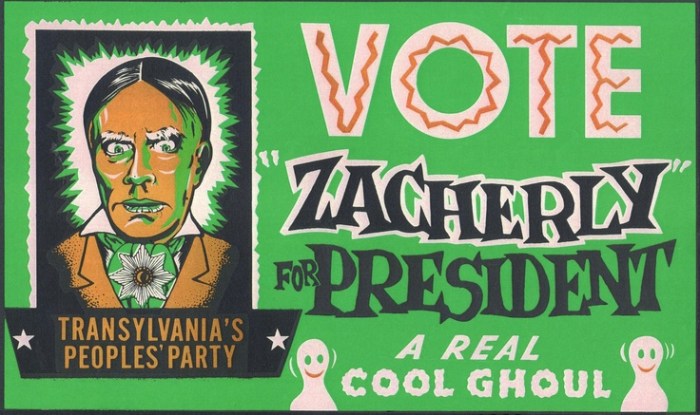
It didn’t matter, primarily because I was staying up late, often at a pal’s house, and because the host of the show more than made up for the lameness of the film.  The late night host in my part of the world was a voice actor turned creepy celebrity named Zacherly.    Although he moved from station to station, Zacherly remained wryly mordant, descending into the crypt to visit his wife, Isobel, shut in a coffin, berating his assistant, Igor, hoisting severed heads dripping with chocolate syrup, drinking from vats bubbling and smoking, the occasional toad caught in his flagon.  Fog, and flashes of lightning set the stage, followed b y Zacherly’s trademark howl, “Give me LIGHT!”.

Cryptkeeper, undertaker, vampire… it was never really clear what sort of creature Zacherly purported to be, and no one cared.  His job was to lurk, toss gore-stained objects around the crypt and mock the film about to be shown.  He occasionally spoke over the dialogue, clarifying one heinous act after another.  More reguarly, a break in the action revealed him napping or otherwise entirely disengaged from the action  on the screen.

So popular was this character that he mounted a presidential campaign in 1960, unfortunately failing to win enough support to appear with Nixon and Kennedy in the first televised debates.

58daaa0a31853284052a77804938bd40

By the 1970’s many stations had cloned ghouls and vampires of their own, Vampira, Sinister Sydney, and, the most successful, Elvira, Mistress of the Dark.  Whereas Zacherly looked like something literally unearthed moments before showtime, clots of dirt still clinging to his decaying clothing, Elvira was hot stuff, exposing cleavage and valley girl snarkiness in response to movies as uninspired as those hosted by Zacherly.

My favorite successor, Count Floyd, played by Joe Flaherty, was the lead character on SCTV’s Monster Chiller Horror Theater, one of several “shows” presented as sketch comedy by the Canadian comedy troupe of Flaherty, Martin Short, Euegene Levy, John Candy, Andrea Martin, Catherine O’Hara, Harold Ramis, Rick Moranis, and Dave Thomas.

Among the other imagined programs offered by the “network” were Battle ofthe PBS Stars, pitting Carl Sagan vs Mr.Rogers in head-to-head combat, the soap opera, Days of the Week, and The Great White North, in which Doug and Bob McKenzie mocked Canada and things Canadian while guzzling beer and referring to each other as “hoseheads”.  SCTV deserves a posting all its own, but suffice it to say that Martin Short’s grinning character “experiencing some difficulty in completing high school” as a contestant on SCTV’s version of Jeapardy, Half-Wits is must-see TV.

hqdefault-1

Flaherty’s Count Floyd was clearly not happy to be hosting Monster Chiller Horror Theater; the network was cheap so Floyd doubled as weatherman and vampire.  The Count was also not too clear on the concept, playing a vampire who howled as a werewolf might.  He wasn’t helped by the selection of films he had to present.  He limped along with Swedish auteur Ingmar Bergman, but had trouble convincing the kids that The Odd Couple was “verrry scary”.  The camera often caught him sneaking a cigarette as the film paused for a commercial break, often openly contemptuous of the travesty on the screen, but he became absolutely riveted when the network screened soft-core horror such as Dr. Tongue’s 3D House of Stewardesses, Dr. Tongue’s 3D House of Cats, or Dr. Tongue’s Evil 3D House of Pancakes.

John Candy played the lisping villain, Dr. Tongue, with gravitas, ponderous self-importance mixed with bouts of unbridled lechery.  In a memorable scene from Dr. Tongue’s House of Stewardesses, Tongue orders his faithful deformed servant, Eugene Levy, to, “rip off their blouses and their skirts,” which the hunchback does with more efficiency than one might expect, given that he is bent double and can only shuffle from stewardess to stewardess.

With the commercial break we found Count Floyd, 3D glasses securely in place, begging the producer to kep the film rolling.

Verrrry scary.


Boom

Boom

I am one of the seventy-six million babies born in the United States between 1946 and 1964, a Baby Boomer, the generation once called the pig in the python, the bulge in the snake, not the first generation to be tagged as a generation, as the “Lost Generation” and the “Silent Generation” preceded us, but perhaps the first generation to be aware of ourselves as a generation.  It was relatively late in our generational journey that our parents’ generation, the “Greatest Generation” received their due, when Tom Brokaw wrote of them as the generation that fought, not for fame or recognition, but because it was the right thing to do.  I’m fairly certain that my parents did not consider themselves part of a great generation, the greatest generation.  From what I could gather, both the Depression and the war were hellish, and they did what they did because there were no alternatives to hanging on, making do, and living in a constant state of flux.  They shared the circumstances of their time, but in truth they were as poorly described by generational characteristics as were to be.

One Great Generation, one Lost, one Silent, and one … what?  A boom?  A bulge?

To be candid, we are also the “Me Generation”, privileged as other generations had not been, raised in post-war affluence with a sense of our generational superiority to the sleepy repressed stiffs littering the world and workplace, keenly aware of ourselves as the new generation.  Thus, the “generation gap” emerging at the end of the 1960’s as we believed ourselves the champions of social awareness and humanitarian progress battling the useless vestiges of antequated, social conventions and convictions.

We watched Howdy Doody,  wore coonskin hats, listened to The Witch Doctor, watched The Mickey Mouse Club. bought hula hoops, watched Leave It To Beaver, ate sugary cereal, watched Walt Disney’s Wonderful World of Color, ate TV dinners,, listened to Chubby Checker, watched The Flintstones, went to high school, waited to see if the Cuban Missile Crisis meant nuclear war, fooled around, watched American Bandstand, saw JFK die in Dallas, ate pop tarts, stole copies of Playboy, watched The Man From Uncle, listened to the Beatles, experimented with drugs, registered for the draft, marched and protested, watched Laugh-In, went to Canada, went to Viet Nam,   saw King and Kennedy die, went to Woodstock, saw Neil Armstrong walk on the Moon, watched The Mod Squad, wore bell bottoms, listened to Crosby, Stills, Nash, and Young, put flowers in our hair, listened to the Doors, became hippies or yuppies or Republicans or Democrats, got jobs, watched MASH, got married, had kids, got promoted, watched Charlie’s Angels, went to roller disco, lost jobs, watched Magnum P.I., got divorced,  watched the Cosby Show, got fat, lost hair, got old.

Looking back, we had a moment, somewhere between Watts and Detroit and Newark and Nixon’s resignation, when we might have made a difference.  For all of our pride in our highly evolved sensibilities and sensitivities, we became a lost generation ourselves,  a hedonistic, self-serving bulge, taking up space, distracted by pleasure.

We became the generation that did not recognize itself.  What happened, we wonder?  Weren’t we the generation that would change the world?

Look around.  I’m afraid we did.

We believed in progress, that every subsequent age would continue to flourish as ours had done, but we did not hold the opportunities given to us in trust for those who came next.  We liked the idea of an increasingly comfortable world so much that we wallowed in it without securing the future.  We knew the environment was fragile.  We knew natural resources were limited.  We knew that cities built in the desert would need water.  We knew garbage had to end up somewhere.  We knew people lived in poverty and violence.  We knew the rich got richer and the poor got poorer.  We knew we were distracting ourselves with mindless pleasures.  We knew that schools had become warehouses.  We knew that children went to bed hungry.

We made a lot of noise in the 1960’s, but what remains?  John Steinbeck wrote of the dignity shown by hard-working people of good will; the Rev. Martin Luther King, Jr. broke the silence of the Silent Generation with words that took us to the mountain.  Where is our voice now?  We once heard Dylan, but now, perhaps hear Stephen King spinning dark tales of fun house world and stalking killer clowns.

We are perched now on a thin branch at the top of a tall tree.  The eldest of us are now seniors, seventy years old, retired, hoping that in these “golden” days, seventy-five is the new fifty.

I’m pretty sure it isn’t, but life isn’t over yet for many of us.  Maybe there’s time enough to circle back and put a few things right, plant a few trees to provide shade for children we will never know.  We’re outnumbered now, finally; Millennial are the current bulge, and our python is looking flatter with every passing year.

I’d sure like to see us go out as the next generation that did what we could, even at the end, because it was the right thing to do.