Really? What Were They Thinking?

Really?  What Were They Thinking?

My wife and I are watching The Crown, Netflix’s ambitious and lavishly budgeted original series chronicling the reign of Britain’s Queen Elizabeth II.  It’s visually striking and often provocative, providing a rich backdrop to the history of a family and a nation in transition.  As compared to the violence and scandal we have come to expect in the big-ticket mini-series, not much happens in the first few episodes, which is fine by us in that we have so much to look at, from the pomp and ceremony of monarchical routine to startling reminders of the lingering colonial possessions in Britain’s post-war empire.

All of that said, and with much appreciation for many other excellent performances, the lingering presence of John Lithgow as a declining Winston Churchill provides a nagging distraction; the scenes with Lithgow remind me that I am watching a performance, watching an actor doing Churchill.  Lithgow does replicate the late-stage portly shambling of Churchill in his last years as Prime Minister, and he does resemble a bulldog as Churchill did, but his delivery of Churchillian dialogue is a painful reminder that while Brits do an American accent relatively convincingly (think Hugh Laurie in House), American actors have a tin ear.

Part of the problem is that I have had  a long-standing admiration of Churchill and of his oratory in particular; after all, he won the Nobel Prize for literature in recognition of the body of his work, including his early journalistic accounts of conflict in Cuba, the Sudan, and South Africa, his engaging autobiographical works, My African Journey and My Early Life, his six volume history of Europe from 1911 to 1931, his six volumes on the Second World War, including the much admired first volumes, The Gathering Storm and Their Finest Hours, and, of course, in recognition of some of the most inspirational and widely quoted speeches of the Twentieth Century

Look, compared to some of the terrible casting gaffes I am about to describe, casting Lithgow is a triumph.  He is a magna cum laude graduate of Harvard, he won a Fulbright Scholarship to study at the London Academy of Music and Dramatic Art, and played Malvolio in a Royal Shakespeare Company’s production of Twelfth Night.

He just doesn’t sound like Churchill.

More regrettable casting?  Unfortunately, the mistakes are many and egregious, including a subset of bizarre and racially insulting roles given to Hollywood stars.  Without much reflection, any thinking person would have nixed casting John Wayne as Genghis Kahn in The Conqueror, , Marlon Brando as a wily Japanese interpreter in Teahouse of the August Moon, Mickey Rooney as a bucktoothed short-sighted Japanese neighbor in Breakfast at Tiffany’s, Johnny Depp as the Lone Ranger’s American Indian sidekick, Tonto, or Emma Stone as a bi-racial Asian in Aloha.  Toss in Natalie Wood as Puerto Rican Maria in West Side Story and Charlton Heston’s man-tanned Mexican in Orson Welles’ masterpiece A Touch of Evil, and we’ll be ready for Christian Bale as Moses in upcoming Exodus: Gods and Kings.

During the decades in which the major studios turned out movies at a clip of about one a week, actors under contract were shoved from role to role, based more on availability than on appropriateness of role.  It is in the years following the breakup of the studio’s monopoly that producers made decisions that left their audiences puzzled.

Keanu Reeves has played virtually every variety of character from teen street hustler in My Own Private Idaho to action hero in Point Break and John Wick.  He’s banked some other solid triumphs including Bill and Ted’s Excellent Adventure, Speed, The Matrix, The Replacements,  and Point Break.  On the other hand, he’s been nominated for the Golden Raspberry Award for Worst Actor for six unfortunate efforts.  He’s a serial killer in The Watcher, the surviving husband in a weepie with Charlize Theron, Sweet November, and the romantic lead in The Lake House, a film that defies description but one that almost surmounted an extremely odd script as Reeves and Sandra Bullock met on-screen for the first time since Speed.

Generally dismissed by critics and audiences alike, the film was tangled and confounding, and yet, one respected critic, Roger Ebert, labored to bring an audience to the film.

In “The Lake House,” it works like this. A woman (Sandra Bullock) lives in a glass house built on stilts over a lake north of Chicago. She is moving out and leaves a note for the next tenant (Keanu Reeves). He reads the note and sends a strange response to the address she supplies: He thinks she has the wrong house, because “no one has lived in this house for years.” She writes back to disagree. It develops that he thinks it is 2004 and she thinks it is 2006, and perhaps she moved in after he left, instead of moving out before he arrived, although that wouldn’t fit with — but never mind.

This correspondence continues. They both leave their letters in the mailbox beside the sidewalk that leads to the bridge that leads to the glass house. The mailbox eventually gets into the act by raising and lowering its own little red flag. The two people come to love each other, and this process involves the movie’s second impossibility. We hear them having voice-over conversations that are ostensibly based on the words in their letters, but unless these letters are one sentence long and are exchanged instantaneously (which would mean crossing time travel crossed with chat rooms), they could not possibly be conversational.

Never mind. They also have the same dog. Never mind, I tell you, never mind! I think, actually, that I have the answer to how the same dog could belong to two people separated by two years, but if I told you, I would have to shoot the dog. The key element in “The Lake House” that gives it more than a rueful sense of loss is that although Alex’s letters originate in 2004 and Kate’s in 2006, he is after all still alive in 2006, and what is more, she after all was alive in 2004.

Confused?  In defending the film, Ebert points to the quality that has distinguished these two actors throughout their careers – their likeability, an odd word, but one that communicate a kind of connection that is quite different from charisma or presence.

Reeves has been an actor audiences like to like from the start, which makes one wonder at Bernardo Bertolucci’s decision to cast him as Prince Siddhartha, the son of privilege and wealth who, in a story within the primary narrative, becomes an ascetic, a contemplative pilgrim, and finally, the enlightened Buddha.  Little Buddha is an odd film and eminently forgettable were it not for the Reeves’appearance as a pampered Indian prince, a starving, bearded ascetic, or the enlightened light of the world.  Well, the film would be among the most easily fotgotten were it not for the eye liner Reeves wears as a prince and for his weighty pronouncements, delivered in the most mannered and oddly intoned Indian version of Keanu speech.  I’ve never been able to shake this moment, as the young prince, having  discovered that suffering exists, sets out to meet the world beyond the palace walls.  He bids farewell to his father saying,

Even my love
for Yasodhara…
and my son…
cannot remove
the pain I feel.
For I know that they too
will have to suffer,
grow old…
and die.
Like you, like me,
like us all.
Yes.
We must all die…
and be reborn…
and die again,
and be reborn and die,
and be reborn and die again.
No man can ever
escape that curse.
Then that…
is my task.
I…
will lift that curse.

And so it goes.

Leaving Keanu Reeves alone in the pit of miscast actors is unkind, and, without belaboring the obvious, I ought to at least identify a few other notable puzzling choices.

Let’s leave the miserable adaptations of comic characters aside.  Jesse Eisenberg as Lex Luther?  On the other hand, kudos to Joel Schumacher in the casting of Arnold Schwarzenegger  as Mr. Freeze!

No group of actresses has been more objectified and poorly used than “The Bond Girls”, but the decision to present Denise Richards as Dr. Christmas Jones, a nuclear physicist was a considerable stretch.  In the real world, she did have the presence of mind to not remain married to Charlie Sheen; on the other hand, Kelly Preston had broken off her engagement to Sheen some years earlier after Sheen had shot her in the arm.  It doesn’t take a nuclear scientist…

Love Star Wars?  Hate Hayden Christensen, described as a “sentient fencepost”as the young Jedi who would become Darth Vader?  Join a very large club who feel his presence alone pulled the prequels into a galactic vortex.  Christensen won two Golden Raspberry nominations in almost destroying the franchise.

Finally, somebody thought it would be a grand idea to pair Matt Damon and Heath Ledger as the Brothers Grimm.  Enough said?

Your observations and nominations are, as always, entirely welcome.


Better Not Pout

Better Not Pout

I was thwarted again yesterday.

I don’t remember the details, but I’m pretty sure that a moment arrived in which I did not get what I wanted when I wanted it, delivered in the fashion I expected, and presented with the proper appreciation of the person that I am.

In this season of good cheer and wide-spread tolerance of others, however, I am prepared to take a look at my own failings, if only to rise to the demands of holiday folderol.

It isn’t much fun to ramble through the catalog of my faults.  Where to begin? When does it end?  It’s a necessary corrective, however, because I seem to forget the lessons life has been trying to teach me with considerable insistence day-after day.

For example, despite the evidence that withdrawing in injured silence in order to punish those who have wronged me annoys the heck out of anyone in range, and rarely (never) has the desired effect of changing my tormentor’s behavior or attitude, despite the lonely pain in pulling away when thwarted, I pout.

Pouting is not pretty, and my version is particularly unattractive in that it includes rustling, mumbling, the “accidental” slamming of doors and thumping of objects on counters, and physical contortion necessary to leaving the scene while remaining emphatically visible.

I suspect I am not alone in demanding attention and reparation without having the gumption to actually put my injury into words.  I seem to remember that The Iliad is essentially an epic generated by a sulking hero, Achilles, whose hurt feelings keep him pouting alone while a generation of his compatriots spend a decade waiting for him to get over himself. It takes considerable sacrifice to get Achilles back on the team, and I’d rather not spend a decade sulking in my tent, so it’s worth some effort to try to bring my hurt feelings into focus.

Apparently I occasionally take myself a bit too seriously, never actually saying, “Don’t you know who I am? ” but holding those captive who don’t.  Equally unhelpful is my insistence that the universe follow the unarticulated rules which I consider obvious.  I assume friends and family understand that there is a right way to park the car when shopping and a wrong way, a right way to tell a joke and a wrong way, a right way to order a meal … and so on.

It goes without saying that all of this goes without saying.  “Why should I have to ask you to turn down the volume when the sound annoys me? Don’t you know … ” and so on.

OK.  I get it.  Anyone making up a list of who’s naughty and nice is likely to leave a lump of coal in my stocking, and I have to admit pouting is not the most fun I will have in the course of a day.  There’s snow on the mountains and it’s beginning to look a lot like Christmas.  If Ebenezer Scrooge could  figure things out in one long night, I ought to be able to put myself aside for a bit and spread some seasonally appropriate good cheer while I can.


So Much More Than Meets The Eye

So Much More Than Meets The Eye

Ah!  The life of the mind!

I’d like to present myself as having spent my youth reading important works of literature, pondering deeply the most significant of thoughts, but the truth is that I had the attention span of a moth and lost countless hours wallowing in easily digested fluff and frivol.  From the age of ten or so until I headed off to my second boarding school, I read “The Saturday Evening Post”, “Boy’s Life”, “MAD Magazine”, “Sports Illustrated”, “Sport Magazine”, and a variety of comic books.  During my secondary school years, I dropped “Boy’s Life”, “The Saturday Evening Post” disappeared, I added “Time Magazine”, but stuck with “SI”, comics and “MAD”.

Oh, and during the entire period of time, I maintained my subscription to “Famous Monsters of Filmland”.

I missed the first two volumes published in 1958, but eagerly sank my teeth (heh) into Volume 3., featuring the alluring article, “For The First Time See Frankenstein From Space” and boasting an elegantly presented cover portrait of Lon Chaney as the Phantom of the Opera.  .The fourth described “Christopher Lee – The Handsome Horror”, but the true enticement was a feature on late-night shockmeister, Zacherly, with whom I had an unhealthy fascination as is described in an earlier post of mine on horror films and Halloween.  The fifth begged producers to bring back The Fly; the sixth offered the secrets of The Time Machine, and so on until the late 1960’s.

Contempt before investigation is to be expected, and the garish cover art certainty evoked the least reputable sort of cinematic fandom, but with great good cheer, the magazine celebrated the actors and artists who brought the fantastic to the screen.   I suspect only a few die-hard Famous Monster fans have seen the 2007 documentary Famous Monster:  Forrest J. Ackerman.  The film about Ackerman, the  editor of the magazine from the start, chronicles the history of the publication and places Ackerman within the mainstream of science fiction publication from the early 1950’s, as well as honoring his contribution to the revival of interest in horror films.  Forrest Ackerman was a prolific writer, an avid collector of genre memorabilia, literary agent for Isaac Asimov and L. Ron Hubbard among others, and a relentless advocate of the work of Lon Chaney, Sr. and Ray Harryhausen.  Chaney, known as “The man with a thousand faces” was a master of disguise, willing to go to any length to create physically grotesque characters that revealed the humanity beneath the horror.  Less renowned, Harryhausen was the genius who perfected the use of stop motion animation in fantastic adventures, pioneering the use of stop motion animation in live action fantasy and horror films.

I’m thinking of Harryhausen these days because a series of unexpected events allowed me to watch Harryhausen’s work in Mighty Joe Young for what must have been the fifteenth time again after a hiatus of about fifty years.  The film, made in 1947,  was intended to capture on the popularity of King Kong, made fourteen years earlier and employed the same method of stop motion animation and was Harryhausen’s first major production.  The models of the great ape were sculpted by the Michael Delgado who had fashioned Kong, and, as was the case in King Kong, the size of the ape varied from sequence to sequence.  Nevertheless, Joe was a better looking creature and a far more completely developed character than Kong, in part due to the contribution of the emerging stop motion animator, Ray Harryhausen.

My appreciation for Harryhausen’s skill grows even more profound year-by-year as I encounter the mind-stretching (and frequently mind-numbing) effects now available through computer-generated imagery (CGI) as exhibited in virtually every film made in the last decade, certainly in films of fantasy such as The Lord of the Rings, the various Terminators, the contemporary iterations of The Mummy, The Matrix, Inception, and the recently released Dr. Strange, each of which has earned a place of distinction in the catalog of films featuring impressive effects, but which also may be films in which the effects become the tail that wags the dog.

Endless waves of battling armies, buildings melting with Escher-like inversion, characters trapped as human batteries, shape-shifting predators pretty impressive, but although  I lack the language to adequately describe the curious dissonance for the viewer (ok, for this viewer), visually slick computer generated effects appear completely real even as we are aware that they are not; the sense of wonder is lost as we are bludgeoned by powerful visual gymnastics. I find myself impressed and disappointed in the same moment; I’m both impressed by the wizard and seeing behind the curtain.

Harryhausen’s Mighty Joe Young had personality; he spit at his pursuers from the back of a careening truck and knocked back a bottle of Scotch before busting out of his cage.  Yes, his size relative to live actors was inconsistent, and yes, he was obviously an animated model ape, but he never pretended to be more than he was – a wonderfully crafted pretense.  There are stirring moments in the film, such as Joe’s carrying orphans from a burning building despite his profound fear of fire, but even without knowing how many hours Harryhausen must have spent in moving the model with exquisite precision so that his brow was raised in disbelief, his fangs emerged with outraged anger, we know we are seeing an animated character and asked to join in the fun of the fantasy.

In a later Harryhausen films such as The Seventh Voyage of Sinbad, live actors faced a cyclops, a dragon, and a terrifying snake-lady that still disturbs my dreaming.  He carried Sinbad to other adventures in The Golden Voyage of Sinbad and Sinbad and the Eye of the Tiger bringing giant wasps, a saber-toothed tiger, a minoton, and dueling skeletons to the screen.  An all-star cast (Sir Laurence Olivier, Maggie Smith, Ursula Andress, Burgess Meredith) joined some of Harryhausen’s finest creations in The Clash of the Titans, a free-wheeling adaptation of the adventures of Perseus, including a writhing Medusa and the enormous sea creature known as the Kraken, giving birth to the cherished line, “Release the Kraken!”, now generally applied to any moment in which all bets are off.  The Kraken itself, by the way, was mostly obscured by bubbles, leaving the enormity of its power entirely to the imagination.

Critics panned Clash of the Titans, and Harryhausen left the tedious work of moving objects frame-by-frame to others.

I’m fond of a number of contemporary fantastists, such as Tim Burton and Wes Anderson, but even in their best work, I rarely find myself rocketed back into the willing suspension of disbelief which characterized my entirely uncritical and completely joyful absorption in reading as a child all of the Oz books, Peter Pan, novels by E. Nesbit,  H.G. Wells, Rider Haggard, Edgar Rice Burroughs, Fritz Liber, or in watching a succession of goofy films that were unself-consciously fantastic, such as the Harryhausen epics.

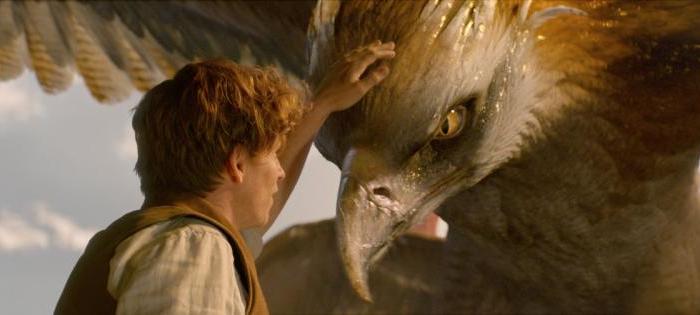
From the first pages of Harry Potter and the Sorcerer’s Stone to the last pages of Harry Potter and the Deathly Hallows, however,  my inner child was allowed to romp at will.  Fortunately, my younger kids were as absorbed in J.K. Rowling’s world as I was, so we shared the giddy anticipation of the next in the series of books, happily standing in line at midnight to grab a copy of the next book as it was released in the U.S.  We read Deathly Hallows,the last in the series, wept, and prepared to live in an ordinary world again, abandoned by magic and adventure … until the release of Fantastic Beasts and Where to Find Them,  exactly what I needed in a year that has been more than fantastic but hardly uplifting.  The film deserves thoughtful description, and I hope I can grab enough distance at some point to write without gushing, but, having bashed computer generated imagery in recognizing Ray Harryhausen’s contributions to film fantasy, a large part of my appreciation of this Rowling enterprise is in admiring the many  generated special effects that serve the magic in the film without drawing attention to themselves.  The fantastic creatures have their moments, of course, and are made to move as their character demands, but the greater fun is in the “ordinary” magic, apparition in particular.

I am indebted to the writers and artists who labored to create adventure I have experienced without risking life and limb.  The famous monsters helped me get through my own ungainly transformations, and the creators of fantastic worlds have allowed me to leave the world around me just long enough to restore my sense of wonder.


Just Do Our Job

When I tell friends that I’m not watching MSNBC or CNN these days, they assume I’m protecting my fragile hold on hope and faith in the future.  They aren’t entirely wrong, but my aversion to televised news goes deeper than that.

I felt so stupid on the after-morning when it was abundantly clear that my liberal convictions, beliefs I assumed were unassailable, grounded as they are in the tradition of rationality and compassion begun in the Enlightenment, were not shared by those in a majority of American states.  I had to reconsider the most basic principles.  Surely modernity had delivered scientific certainties and endorsed the celebration of a diversity of people.  Surely we had moved beyond racial politics.  Anti-Semitism?  Where did that come from?

And those polls.  And those commentators.

Apparently, thoughtful, articulate, experienced political pundits can be entirely hornswoggled by their own bias.  I don’t blame them for the outcome of the campaign, although I do wonder what the Republican primary might have looked like if the President-elect had not taken up so much air time.

I subscribe to the Washington Post and read their national and international news daily.   The district and surrounding counties have their own parochial interests, of course, but the Post seems to balance that with its responsibility as the paper of record in the capital and its interest in publishing a fairly wide range of commentary.  It happens that the Post’s editor, Marty Barron was the judicious voice of integrity at the Boston Globe, during the Searchlight team’s investigation of the widespread abuse of children by priests and the involvement of Cardinal Bernard Law in the reassignment of those priests to parishes unaware of the priests’ crimes.

Marty Barron is an unassuming guy, hardly a celebrity journalist, a tough character for Liv Schriever to play in the film version of the Spotlight team’s battle to get at the truth.

He’s not a character; he has character, as is revealed in the remarks he offered upon being awarded the Hitchens Prize in recognition of his long career as a journalist dedicated to the pursuit of the truth and the protection of free expression.  His remarks have been seen as a guide to responsible journalism in the Trump era, noting the degree to which candidate Trump excoriated reporters and the contempt with which some of his advisors feel for the mainstream press.

With customary humility, Barron described himself as an unlikely recipient of an award named in honor of investigative journalist and writer, Christopher Hitchens, but in recalling Hitchens’ reporting of the fatwah issues against Salmon Rushdie, the editor reaffirmed the importance of sticking to first principles and values.

Many journalists wonder with considerable weariness what it is going to be like for us during the next four—perhaps eight—years. Will we be incessantly harassed and vilified? Will the new administration seize on opportunities to try intimidating us? Will we face obstruction at every turn?

If so, what do we do?

The answer, I believe, is pretty simple. Just do our job. Do it as it’s supposed to be done.

Every day as I walk into our newsroom, I confront a wall that articulates a set of principles that were established in 1933 by a new owner for The Post, Eugene Meyer, whose family went on to publish The Post for 80 years.

The principles begin like this: “The first mission of a newspaper is to tell the truth as nearly as the truth may be ascertained.”

The public expects that of us.

If we fail to pursue the truth and to tell it unflinchingly—because we’re fearful that we’ll be unpopular, or because powerful interests (including the White House and the Congress) will assail us, or because we worry about financial repercussions to advertising or subscriptions—the public will not forgive us.

Nor, in my view, should they.

I’m collecting expressions of purpose that strike me as sustaining.  Marty Barron, an editor not given to hyperbole, put it simply.

“Just do our job.  Do it as it’s supposed to be done.”

Tell the truth.  Stand up for those who need help.  Offer kindness as often as we can.  It’s our job to stick to the important principles that were not endorsed.

Just do that job.  Do it the way it’s supposed to be done.

A full account of Barron’s remarks have been published in Vanity Fair, the magazine for which Christopher Hitchens reported.


Acts Of Kindness Aren’t Random

Acts Of Kindness Aren’t Random

A few months ago I wrote about Alison Guernsey, the teacher who went an extra mile for the students in her care.

“She had to see before she could hear.

Alison Guernsey is a teacher in a K-8 school in which numbers of kids simply stopped coming to school, some for considerable lengths of time.  Guernsey was saddened by the serial absences and the impact they had on her classroom and on the school.  Not surprisingly, she felt she had failed, or the system had failed, or the world had failed; she was overwhelmed by a problem she could not conceptualize.

She was puzzled.  Guernsey knew her students were happy at school; they had friendships that were disrupted by absence, and they missed significant special events.  Their absence did not make sense.  Finally, summoning her courage, Alison Guernsey went to her students’ homes to see if she could do anything to turn the situation around.  She persisted in asking the same questions and listening carefully, sticking with her visits long enough to build trust with her kids and their parents.

She found out that the children she taught often had no clean clothes.”

They have clean clothes now because Alison Guernsey found a way to bring a washer and dryer to her school.  Her efforts made an immediate difference in the lives of children and families and allowed other generous people to offer the same kindness to children in other schools across the country.  At the time, I was particularly moved by a teacher’s willingness to move past her own assumptions in asking parents to talk about their children and in listening thoughtfully to what parents had to say.

Listening is an act of kindness.

Last week, many news outlets presented the Thanksgiving feel-good story about  Jim Ford, a Repo Man with Illini Asset Recovery, who repossessed an elderly couple’s car, then paid off their debt, and returned the car to them free and clear.  He actually went father, paying for an oil change and a thorough detailing of the car.

Another act of kindness because Jim Ford saw the couple, Stan and Pat Kipping, and recognized their struggle in an instant.

“My grandparents are gone,” he said, “but, you know, I could see them in the Kippings.  I knew what was going on.  The cost of medications have doubled or tripled… I knew why they were behind.”

Truly seeing someone is an act of kindness, and the actions that follow are far from random.  Kindness follows connection, and connection arrives when we take the time or drop our guard enough to listen and to see.  Many voices remind us that there is no such thing as a small act of kindness, no wasted acts of kindness; each act of kindness speaks of connection, and  connection reminds us of what it is to be human and what it is to long for kindness.

Jim Ford and Alison Guernsey are ordinary folks who chose kindness; anyone can.

“My religion is simple.  My religion is kindness.”  His Holiness the 14th Dalai Lama


And Now? Hold On To What Is Good …

And Now?  Hold On To What Is Good …

About seven months ago I set myself the goal of writing a thousand words a day, hoping that at least some of those thousands of words might be of interest or value to someone at some point.  Over that period of time, I have missed a day here and there, and I have occasionally finished a piece and decided to trash it on the spot.  Still, I’ve posted more than a hundred articles, most of which have at least amused me and each of which has taught me something about self-editing or composition.

Since the election, I have posted two, one of which was an attempt to cheer myself by celebrating the generosity of spirit shown by a football player who since his retirement from the game has devoted his life to training disabled veterans as elite athletes.

That helped for a day or so, and then, thoughts and emotions entirely jumbled, I wrote and discarded four inauthentic attempts at “business-as-usual”,  swallowed twice, and posted, “No One Ever Told Me That Grief Felt So Like Fear,”  in the hope that I might find my way back to something like balance and purpose.

I don’t like to think of myself as depressed; on the other hand, I certainly have not been elevated. I haven’t been able to stick with much of anything for any stretch of time; I haven’t read a book, haven’t managed to get through an entire magazine article.  I haven’t watched a television program, haven’t been able to bring myself to watch the news, haven’t even watched sports with anything like real attention.  I have been going through the motions, simulating life:  I walk the dogs, turn on tv, turn off tv, rake leaves, feed the dogs, rake leaves, walk the dogs, but part of my mind is holding itself apart, trying to mute fears and losses I can’t completely absorb.

Yesterday, lacking any direction of my own, I accompanied a friend to the Celtic Evensong offered at the small Episcopalian church in Ashland.  I respect the work that this church does in the community and in the world, but I’m not a communicant in any church.  I do believe that we are more than meat on the hoof, but the mystery is far beyond me, and I don’t choose to believe that the universe operates to the benefit of a single body of faith.

I could be wrong.

In any case, I sat distracted and uneasy in that lovely and calm space surrounded by good-hearted people.  The play of candlelight on the exposed beams in the church was delightful as was the music played and sung, but I was too much with myself and too far from the authentic generosity of spirit all about me to attach myself to the moment.

It was a church, after all, so inevitably the time came to offer prayer.  I know the liturgy well, having once been head of an Episcopal school, and expected the familiar declarations of faith, but this modified service spoke to issues very much on my mind.

Here’s how the service ended:

“Go out in the world in peace, have courage, hold on to what is good, return no one evil for evil, strengthen the faint-hearted, support the weak, help the suffering, honor everyone…”

“Hold on to what is good.”  Without my permission, the phrase nudged me out of self-pity.  Holding on to what is good is not merely holding on, not merely surviving.  Holding on to what is good takes courage, and strength, and faith in principles that seem to have been rejected; it is an action and it demands committment.  Holding on to what is good is daunting and perhaps dangerous, but we have always struggled to find community and compassion; we have always found it difficult to honor everyone, to help the suffering, support the weak.  It would be easier for me to discount others and return evil with evil, but that would be letting go of what is good in favor of what feels good.

The more difficult job for me is in remembering that none of what I treasure came without cost; for the most part, other people paid for the principles that matter to me.  The future is not what I expected or asked for, but it seems to be upon us, and I have the choice to watch it spin by or step up as I can.  Holding on to what is good makes sense to me and provides purposeful focus for the work I can do as a writer.

What do I do with the rest of my life?

I think I’ll celebrate our better selves a thousand words at a time and remind myself that we have a lot to hold on to.


“No One Ever Told Me That Grief Felt So Like Fear” – C.S. Lewis

“No One Ever Told Me That Grief Felt So Like Fear” – C.S. Lewis

This piece was written in the aftermath of the election and set aside as I hoped to cultivate a more balanced and less emotionally laden view of the nation and its future.  I publish it now because I am even more aware of the privileged cocoon within which I lived for most of my life.  My political preferences have not changed, but I have a greater understanding of how my notions of good government are attached to the particular experiences I have encountered.

So, November, 2016:

I can’t tell whether I’m caught by grief or bound by fear; it probably doesn’t make much difference, particularly because I am beset by other equally powerful and confusing emotions as well.

At the top of the undigested emotional inventory is a profound sense of loss.  The sun continues to come up, football games are still broadcast five nights a week, the stock market has not imploded, but I feel a stranger in this land.  The world has changed in a moment; up is down, right is wrong, all bets are off.

I don’t belong.

The pundits can dissect and analyze election results state by state, group by group, but in the end, I simply feel foolish; I’m a sucker, a bozo who spent the last fifty years happily knitting blankets for the deck chairs on the Titanic.  I enjoyed an adult lifetime reading the Atlantic and the New Yorker, listening to NPR, watching PBS and assuming that modernity, good sense, good will, and the march of progress would inevitably pull the nation to increasingly inclusive and compassionate citizenship.

Seriously.  What was I thinking?

I have been obliquely grateful for the opportunities life has presented me, occasionally considering myself relatively privileged.  As I consider myself now, however, I take stock with sharper focus.  I always expected that I would go to college, that my kids would go to college, that I’d own a house, and then a better house.  I found a rewarding career and thought most folks could too.  My kids would be safe, find good jobs, and take up meaningful lives.  I counted on savings and pension to support me and my wife in retirement and expected that access to quality health care would always be near at hand.

I assumed the many of the great battles had been fought although some remained to be won, that while much work remained to be done,  prejudice of all sorts would give way to understanding.  I spoke to no one who did not celebrate diversity; we all saw the danger of Climate Change and assumed we’d convince the world to work with us to check it.

The families I know accepted whatever identity their children were born to assume and loved them without condition.  Globalization had its perils, to be sure, but working globally to address global issues seemed infinitely more productive than looking across a great divide at nations struggling to survive.  I knew people of denominational and sectarian faith, but they too believed that an enlightened planet demanded spiritual comfort rather than dogma.

Yes, I knew that partisan squabbling had paralyzed government; I blamed that on obstructionists in the other party, clinging to the hope that dissension in their ranks would cause them to crumble as my political banners flew high.

And that was the world I lived in.

I feel both grief and fear as acts of hatred follow the election; we are an uglier nation than we were only a year ago.  I am a dark-skinned person with a Spanish name; even in my privileged world, I was on guard to some degree, wondering when the trapdoor would open and my ethnicity would determine the ways in which I was seen.  My children look less Hispanic, but they carry my name.  I live in a blue state, but Klansmen have become bold, even in my small town.  When I pull into a gas station outside of the liberal cities, I worry.

I was obtuse when the Trump campaign caught fire, completely minimizing the conviction held by so many that their country had been taken from them.  It never occurred to me that what I saw as progress others saw as loss.  I’m ashamed of my hubris and saddened by my powerlessness to help bridge the divide.

In better times, I was fond of quoting Edward Everett Hale, an Unitarian minister and author who said, ” “I am only one, but still I am one. I cannot do everything, but still I can do something; and because I cannot do everything, I will not refuse to do something that I can do.”  I find comfort in that quotation and will work to find what it is that I can do.

I also admire Oliver Wendell Holmes, Jr., the jurist, not the autocrat, who said, “Beware how you take away hope from another human being.”  I do feel myself implicated in having taken hope away from other human beings, and believe my work may be in trying to restore hope where and when I can.  It was also Holmes, the Supreme Court Justice, who wrote, “If there is any principle of the Constitution that more imperatively calls for attachment than any other it is the principle of free thought, not free thought for those who agree with us but freedom for the thought that we hate.”

That principle is very much as risk in these troubled days, but it is just that task that I feel compelled to take on, even as grief and fear threaten to reduce me further, to a shadow person, merely hiding in a world that changed.


Hey! Somebody Pass The Glyptodon And The Stuffing!

Hey!  Somebody Pass The Glyptodon And The Stuffing!

My doctor, whose sense of humor is on the dark side, ordered the next in a series of plumbing expeditions, each of which descended more invasively into regions of my being that I hoped would never need scrutiny.  “Hope you don’t mind drinking an irradiated milkshake,” she chortled, handing me the necessary paperwork.  “Bottoms up!”

Yeah.  That kind of humor.

I would not have subjected myself to any of the well-meaning incursions had I not been doubled over in agony on a regular basis, unable to walk a city block with my daughter on a recent trip to Portland.  So, gamely slugging down the mocha chalk, I flattened myself on a cold examining table once again only to find that paddles, tubes, and prods could not reveal anything that might explain my distress and discomfort.  Fortunately, that same doctor is not above lobbing an arch comment my way from time to time and was entirely at ease in suggesting that my systems might be protesting the added work necessary to operate a body that had packed on the pounds since retiring  a year earlier.

“So, you think I should lose ten or fifteen pounds?”  I asked with some regret.

Blank stare.  No hesitation.  “How about thirty?”

I don’t diet well, not that anyone does.  My mother had the same inclination that I have demonstrated – losing, gaining,losing, gaining.  She was, and I have been, a weight elevator, rarely finding the ground floor.  I thought a thirty pound loss was unlikely, but, no doubt about it, my body was screaming for some help.

This will seem a digression, but bear with me.  As a teacher, I advised students to find the passage that seemed the most troublesome or confusing; when reading Shakespeare, I often referred to those moments in which it seemed the character was saying, ” Blah, blah, blah, blah, verily, blah.”  What they found was that in unpacking the blah bits, they found the key to the entire play.  It was hard work, but it paid off.

My point?  I needed to look at the most troubling aspect of limiting intake, and for me, the hardest part of any restriction of diet is in managing appropriate portions of pasta, rice, bread, buns, cookies, cake, pie, pretzels, chips, and fries.  I can walk right by a tub of Rocky Road, but the sight of a fresh baguette, crust crisp, soft flesh within, sitting next to a slab of salted butter reduces me to insensible burbling.  I may not be alone in that regard, but I appear to be not only powerless over carbs but powerless over thinking about carbs.  In admitting that, however, I started to think that my issue might be a sort of addictive attachment to foods that seemed comforting but which had betrayed me, pound by pound.

I don’t like betrayal, and I was feeling nothing like comfort, so I faced the reality that portion management was not going to work for me.  I had drop my favorite carbs completely.  Go cold turkey.  With regard to carbs, nada. nill, nothing, zilch.

Because the low-carb diets wouldn’t work for me, and since I had ditched white carbs, I grabbed all the fruit and vegetables I could carry, ignoring concern about sugar or calories, threw in bags of nuts, and began eating huge meals, often featuring eggs and chicken breasts.  I don’t eat mammals and am allergic to fish and seafood, so chicken and turkey hit my plate once or twice a day.  I’d read something about good fats, took a chance, and cooked a butter-rich chicken dish with green vegetables equally generously buttered.  As a snack, and I snack a lot, I toss some tomatoes in a pan, drench them with shredded mozzarella, and have a tasty crust-free pizza crisped to perfection.

I started this routine in May, allowed myself a few moments of wicked deportment with the aforementioned baguette or a wedge of pie, but pretty much stuck to a diet I have come to enjoy very much.  By the end of October, I had lost more than thirty pounds, gained energy, and felt fabulous.

A friend asked about my weight loss and nodded as I described what I do.  “Ah,” she said,”the Paleo Diet.”  I had not heard the term but guessed that she meant my days were essentially filled with hunting and gathering, probably approaching the sort of dining routine that might have fed a Paleolithic hominid.

Here’s the thing about this hominid living the Paleo lifestyle – I stick out in almost any dining circumstance.  It’s not that I fill my trough with curious comestibles; I put fruit on salad, but that’s about as racy as my diet gets.  No, the stuff itself is ordinary, but my grazing is steady, purposeful, and relentless.  I heap a plate with various sorts of lettuce, cucumber slices, chopped carrots, sliced chicken, green peas, chunks of apple, peanuts, almonds, turkey bacon, orange sections, and walnuts.  By “heap”, I mean pile.  My companions finish a thick sandwich, polish off the chips, down a cupcake, and I’m still chomping.  Take almost all of those ingredients, drop the lettuce, add spinach and four eggs, and I’m digging in to my first omelette.  Forget the lettuce and  eggs, add broccoli, spinach, beans, and baked chicken, and I’m good for dinner.

Happy as a kitten with a ball of string.

In the past, holidays and accompanying seasonal delicacies essentially took me out at the knees.  I was pretty good until Halloween, got through the actual dishing out of treats, but ran into the day-after-Halloween candy sales (irresistible!),  Thanksgiving pies (C’mon!  Thanksgiving!  Pumpkin pie!), a steady stream of baked goods and chocolate treats fresh from Santa’s workshop (HoHo!), and on to New Year’s Day, when the accounting was done, the spreadsheet documented spreading, and my self-regard was so damaged that I sought comfort with the only sure cure for my devastated sense of well-being – a baguette, crust crisp, soft in the middle, sitting on a plate with a pat of salted butter.

Elevator door opens.  Going up?

So, with very little struggle and remarkable results, I just do what great-great-great Paleolithic grandpa did, eat what’s good for me, and set aside a few extra hours for mealtime.

I did find that my Palaeolithic forefathers ate so ravenously that entire species disappeared, including the Glyptodon, which looks like he’d be a mighty tasty fella on a bed of lettuce.  So, you just might want to keep an eye on chickens in this part of Oregon.

Happy holiday greeting to one and all.  Please pass the turkey.


Had A Bad Week? Read This.

Had A Bad Week? Read This.

David Vobora was a heck of a quarterback, running back, and linebacker for Churchill High School in Eugene, Oregon.  Pretty good basketball player too.   Vobora was an even more effective linebacker for the University of Idaho Vandals, leading the team in tackles and winning first team All WAC honors as a senior.  A legitimate NFL prospect, David Vobora entered the draft in 2008 and sat on pins and needles as round by round, two hundred and fifty-one names were called before his.

As the last player drafted in that season, Vobora joined the company of other last-drafted players, known in their season as “Mr. Irrelevant”  There is considerable hoopla following the draft; Mr. Irrelevent is flown to California to receive the “Lowsman” Trophy, an awkward salute to the Heisman Trophy awarded college football’s best player. The Heisman pose is famous, displaying an artful athlete evading a tackle.  The “Lowsman” features a player fumbling the ball.

All in good fun, right?

Some Mr. Irrelevants have gone on to play with success in the NFL, and Vobora, who started as linebacker for the St. Louis Rams, is one of them.  His career lasted four years, after which, it might have been assumed, he would sink into obscurity.

And he almost did.

The commonly held conviction in the NFL is that players play, and players play with pain.  Vobora played with excruciating pain after a shoulder injury, an injury which would finally end his career, and, as other players have done, he became dependent on pain medication during his last year as a professional athlete.  A stint in a rehab facility and serious reevaluation of his life led Vobora to move to Dallas, where he opened an ambitious training facility, Performance Vault, Inc. in Dallas, specializing in training elite athletes and active duty Special Forces.  A career in the NFL, however short, and the establishment of a thriving business serving athletes might be enough for many of us.

Not for David Vobora.

Here’s where David’s story meets that of Retired US Army Staff Sergent, Travis Mills, one of only five quadruple amputees to survive their  tour of duty.  Miles was on his third tour of duty in Afghanistan when an improvised explosive device (IED) took both his legs and his arms.  Today, Miles is an author and inspirational speaker, traveling widely with his message, “Never Give Up.  Never Quit”.  Today, Wills describes himself as “recalibrated”, able to achieve at a high level with prosthetic arms, hands, and legs.

Impressed by Mills’ resilience and energy, Vorora introduced himself to the veteran and asked, “When was the last time you worked out?”  It was not a question Travis Mills expected; he tried to be tactful, reminding Vorbora that he had no arms or legs.

And David Vorbora replied, “So?”

Mills was the first to begin a training regimen usually taken on by elite athletes;  Vorbora established the not-for-profit Adaptive Training Foundation in order to be able to provide training for other veterans at no cost.  In beginning their work together, Vobora asked Mills to describe the fears he felt in taking on rigorous athletic training.  “Falling,” Mills replied.  “No arms and legs – Gravity wins.”  Together they found ways to adapt, starting with core strength, but also developing balance and confidence.  From the start, it was clear that while the physical aspects of adaptive training were important, an important benefit was in treating those who worked with him as athletes not simply disabled vets.

Vobora had faced his own crisis, questioning his identity if no longer a football player.  These veterans had suffered life-altering injury; what remained for them if no longer soldiers?  Many who approached Vobora had struggled with depression; some had considered suicide.

In a nine week training program called REDEFINE, amputees, veterans injured in combat, work through their fears and physical limitations to become adaptive athletes with a strong sense of identity and purpose.  David Vobora drew on his own experience to design a program intended to, “Restore, Recalibrate, and Redeploy,”.  A recalibrated Mills is one of the vets who has been restored and now is deployed in a career which brings hope to audiences across the nation.

It’s pretty clear in seeing David Vobora work with his athletes that he has been restored as well.

“So I train them here and I train them like pro athletes. What’s the difference if the guy has a leg or not? If a linebacker comes in with a knee scoped, we would create training around that knee as it heals. So what is the difference?  And they come alive through that.”

He speaks of his loss of football as necessary to his understanding of those who have lost their identity; he sees courage, grit, and strength on a daily basis and considers himself lucky to have found his calling.

“What I’m doing now has a purpose. I know who David is without football. And he’s a guy who gets to help train our first double-amputee to summit Antarctica (Vinson Massif).”

David Vobora’s Foundation, Adaptive Training, maintains a website at  http://adaptivetrainingfoundation.org. Pictures and videos do much more to communicate the work Vobora does than any article.  If the thought of a double amputee taking on Mount Vinson isn’t enough to put your challenges into perspective, take a look at Limbitless, The Super Bowl Commercial You Didn’t See.

Quotations used in this article appeared in the Nov.15, 2016 edition of The Player’s Tribune, an article entitled, “The Breakthrough”


Down The Rabbit Hole

Down The Rabbit Hole

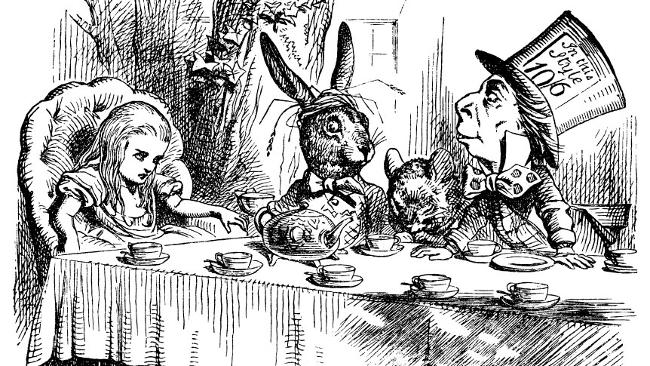
Lewis Carroll had Alice tumble into Wonderland via a rabbit hole, tossing her into a madcap, fantastical, occasionally disturbing journey in the company of  anthropomorphized mice, playing cards, flamingos, dodos, shrubbery, and the rabbit.  She wakes, shakes off the imminent beheading per the queen’s fiat, and presumably lives reasonably untraumatized until her further adventures are begun by walking through a looking-glass.

The contemporary rabbit hole opens as we click our way to a site, find an associated next site, and the next, and the next, and so on. In the same fashion that Netflix, Hulu, DVRs, and a growing company of aggregators allow binge-viewing, once we begin hopping from site-to-site, hours, days, weeks are lost somewhere between L.L. Bean and the 1964 World’s Fair (Corona Ash Dump converted into Flushing Meadows Corona Park – you could look it up).

Brief sidebar on binge viewing:  My wife and I found ourselves compelled to watch Jack Bauer waterboard dangerous characters for weeks at a time, essentially watching all 24 episodes of 24 in something like thirty hours.  Slightly abashed, we confessed our obsession to a friend who had the next two seasons at hand and could feed our addiction.  His experience with the series was more dramatic than ours in that he had been so caught up in hour 14 that he failed to notice that his car had been stolen from the driveway adjoining the room in which he sat.

In the spirit of adventure, taking courage from Alice and countless others who have dropped into the hole, I plan to pick a site at random and see where it takes me, allowing myself only thirty minutes of rabbit time.

How about Orson Welles?  Why not?  Welles is certainly worth a few minutes of idle perusing.

Hmmm.  the site offers a side-trip to Crime and Scandal,  pretty much have to follow that one.  Lots to choose from here, but I’m dropping into 8 Would-be Presidential Assassins and find that Richard Lawrence, an unhinged Englishman who believed himself cheated of his right to take the British throne attacked Andrew Jackson in the Capitol Building.  His gun misfired twice, allowing Jackson time to beat Lawrence to the ground with his cane.

There has been some talk of Jackson recently as the current campaign has some similarities with Jackson’s populist following and the election of an outsider to the White House.  I trust Wikipedia (and support it as well) so here we go.

Andrew Jackson

Ok, what’s up with Jackson?  Ouch!  Turns out that in 1824, he ran for office against John Quincy Adams and Henry Clay, received a plurality of popular and electoral votes but failed to get a majority, which deadlock sent the election to the House of Representatives who chose Adams, demonstrating what Jackson called a “corrupt bargain” between Adams and Clay.  Jackson determined not be robbed again, as a result of which his followers founded what was to become the Democratic Party, drove hard in 1828 and helped Jackson win in a landslide.

That’s the connection I was looking for, but the sidenote is that apparently in the heat of the campaign, an Adams supporter accused Jackson’s wife, Rachel, of having committed bigamy in marrying Jackson.  Although the charge was true, Jackson blamed Rachel’s death of a heart attack on the slur cast upon his wife’s honor.  Rachel died two weeks before Jackson took office.  So, of course, I wanted to know more about bigamy.

A quick look at the site reveals that for the most part, bigamy and polygamy are illegal.  No surprise there, except that in Egypt, the situation is more complex.  Apparently in Egypt, polygamy is fine if the first wife agrees to the situation.  Obviously, then, time to go to Egypt, but outside of the limited purview of Wikipedia.

Egypt is the largest Arab country, and despite the many enticements of an Egyptian rabbit hole, I want to check my understanding of what exactly is meant by the term Arab.

If you have landed in beingarab.com, you know know that Arabians are not defined by ethnicity but by being people who live in the Arabic world.  This is the sort of circular definition that annoys me, but, recognizing my own shortcomings as a person, I stick with the site until it identifies Arab cuisine as Lebanese cuisine, schwarma as the most famous Arab snack and baklawa as the favorite sweet.

Where to now?  The pull of schwarma is obvious, but the hummus laden nod to Lebanon and the similarity of baklawah and baklava pulled me in two directions.

I chose baklawa, landed on baklava, and immediately to a site describing Lebanese food.  Huzzah!  Two-for-one.  And yet … the blogger’s rhapsody about baklawa takes a curiously personal turn almost from the start.

“The role baklawa plays in the repertoire of the Lebanese home cook is formidable. Most every Lebanese woman of my parents’ generation makes her baklawa for special occasions, especially Christmas. We swoon over baklawa to such a degree that it’s like our little pet, our little coosa. We call it our baklawi (bit-LAY-wee), just like you might call me Maureenie, or my sister Pegsie, or your mother Mommy.”

Huh?  Our little pet?  Our little coosa?

Coosa is a sweet summer squash, and calling a child or pet “coosa” is comparable to calling the same “pumpkin”, so there’s that.

And, down the rabbit hole I go, not in search of other herbaceous vines but looking for pet names given children.  Using absolutely no discrimination, I tag the first site on the list.

Here we go again.

Beginning with pumpkin butter, the list includes, bunny, honey bunny, then veers to quinoa, cheese weasel, and cookie ears and countless others of dubious origin.

My 30 minutes are up, my curiosity reasonably completely extinguished (I lost it somewhere near Baby Cakes), and the rabbit hole now ready for sealing.  Time to power down, and yet… my own batch of names affectionately tossed around is crowding out my plans to take another crack at the novel stalled somewhere in the fifth chapter.

It doesn’t take much to remind me of my three kids, each of which deserves a far better tag than that I came up with in their formative years.  A few of the worst pop up immediately; I shrivel, I baste myself with shame, I cringe.  Toot Snoot?   Puffle?  Tiger Toes?  Really?

The pain is too great.  I think I need to search for “affirmations” just to get back to reasonable self-acceptance.

individuality