Just A Mild Case Of Gephyrophobia

Just A Mild Case Of Gephyrophobia

I had the dream again last night.

I’m in a car, a convertible, driving at high speed.  Where I am or where I am going is not important.  What is important is that I hit a ramp and start to climb.  I’m on bridge over water.  The pitch of this bridge is unspeakably steep.  It seems I am climbing straight up to a point at which the bridge disappears.  I will sail out and out and down.

I always wake at that point, gasping and choking.  Sailing from the end of the bridge is terrifying, but so too is the compulsion to yank the car to the left or right, bust through the puny guard rails, and send myself into the void before I reach the horizon.

I’m not fond of this dream, but it’s one from which I can awaken.  The actual driving over a bridge is a waking nightmare for me.  I do it, when I can find no other way to negotiate a trip, but the various stages of panic make the ordeal disquieting.  In the early stages I can see the sweep, the arc, of the bridge, and if I forget to look down, I can see the river or train tracks or highway below.  The setting is relatively unimportant, although bridges over wide spans of water tend to rise more precipitously and stretch for a longer distance than the relatively compact highway overpass.  I have to pull my vision back to the middle of the bridge.  As I gain height, I concentrate in seeing only a thin strip of roadway in front of me.  If I’m in the outside lane, I feel an obligation to slew into and over the guard rail; if I’m in the inner lane, there’s something seductive about the stream of oncoming traffic.

It never occurs to me to swerve into the oncoming lane in any other circumstance; I’m perfectly content to keep to my own space.  Perhaps other gephyrophobes have better language to describe what I experience as claustrophobia at high speed; it’s as if I am smothered by fear and can only break away by breaking away.  Sounds bad, you say, and I agree, but then traffic comes to a halt, and I am trapped mid-bridge, now compelled to look about me to assess the relative impact of my fall, stuck with thousands of pounds of automobiles on cantilevered concrete intended to bear the weight of far fewer standing cars.

“What?  Are you afraid of being blown off the bridge by a gust of wind?”  Yes.  “Are you afraid the bridge might collapse?” Duh. Of course I’m afraid of both those situations.  Who wouldn’t be?  Ask any number of intrepid bridge drivers, “How would you feel if this bridge collapsed?”  I doubt that many shrug and say, “Hey, it happens.”

Gephhyrophobia is described is an anxiety disorder, which is like saying that cannibalism is an eating disorder.  Anxiety is a cold chill down the spine; panic is all the air sucked out of the universe.  It’s not just bridges, although bridges always bring panic; I can feel the same powerful waves of fear on a boat in the middle of an expanse of water or looking out of the window in a tall building.  Doesn’t have to be that tall, actually.

What seems clear is that I am the living embodiment of Franklin D. Roosevelt’s oft repeated axiom, “The only thing to fear is fear itself,” which may or not be true for those facing real and immediate danger but is absolutely true for me in the midst of situations that are not threatening for most people.  I am overwhelmed with the fear that fear will prompt me to do the unthinkable, veer off the bridge, step off the building, jump into the ocean.

I don’t want to do any of these things; I don’t think about them until I am on a bridge, or near a window on the 50th floor, or looking at the horizon on a boat.  I absolutely understand a phobic response to sharp knives; I’m not afraid that I’ll stab myself, but I would get it if someone described their panic as they thought of doing just that.

Let’s get off the ledge for a minute and take a look at this fear of fear.  In my case, watching a movie in which a driver races across a long bridge is enough to make me swallow hard.  I’m ok, unless the director leaves the car and driver at the top of a swaying bridge, plugging in long shots from the bridge to water far, far below.  I’m suggestible and easily emotionally manipulated, but the bridge thing is more intense than the trapped in a submarine or diving airplane sequence, either of which should be about as nasty as conditions could be.

Suggestibility is another way of saying that I become fearful in the absence of an appropriately fearful stimulus; I’m afraid before I have reason to be afraid.  I’m suggesting a larger societal implication here, but the point to be made in advance of wider hypothesis is that my fear is not mitigated by reason or comforted by experience; I can’t be reassured out of panic.

To finish up with the bridge as metaphor, a nation may not be able to escape from undue anxiety until our feet are on the ground; there’s not much to talk about as we race out of control  trying to outrun fear.

Meanwhile, I’ve found a way to get to my destination without crossing a bridge.  It adds a half hour to the trip, but I’ll arrive chipper and unscarred, certainly worth a few extra minutes of back road navigation.  On my next holiday, will I be driving the hairpin four mile Megler Bridge from Astoria to Point Ellice, or the twenty-four mile Lake Pontchartrain Causeway, even though that bridge is not terribly high, or the Chesapeake Bay Bridge, which is two hundred feet above the water for more than four miles?

Sorry, can’t breathe.  Must stop.



Almost Book Friends

Almost Book Friends

“Mind if I sit here”

Two things strike me simultaneously:  We’re in a busy airport, flights have been delayed by snow and ice, few seats are open, and I can’t remember the last time anyone was courteous enough to ask.  And, in that same instant, I detect an accent, mildly central European, perhaps Israeli.  This could get complicated.

As he sits, my seat neighbor points to my shoes and asks, “You a runner?”  I’m not and explain that I’m not, without going into an explanation of my personal shopping creed, a set of convictions so rigid that I often buy and wear shoes and clothing somewhat at odds with my true persona.  Cheap but serviceable, in other words.  As I write, it strikes me that may, in fact, be my true persona, but to return to the moment at hand.

He’s brought his shoes, he says, but isn’t sure he’ll have time to run as he is heading to Medford for an intensive training seminar involving plastics and coatings.  I’m not sure that any sentence could have more surely prompted me to trot out some elaborate shuffling with the book I had been reading, but this guy is not to be shuffled off.

“I was in San Diego once, when my son finished boot camp, but this is the Northwest, huh?”

I nod and ask the question that had to be asked.

Newark, New Jersey,  he says, not a pretty place to live, he says, but affordable.  His son now lives in Arizona.  Yuma.  He and his wife might visit again, but not in the summer.

I agree that Yuma, Arizona in the summer would be hot, hellacious actually, but I keep that assessment to myself.   He points to my book and asks what I’m reading.  Ordinarily I would have been trying to mute my discomfort in flying by reading a fairly grisly potboiling tough guy police procedural, but I’d finally started George Saunders’ first novel and had found it irresistible.  Most casual conversations die quickly when literary fiction arrives as a topic, but not this time.

“I was a terrible student.  I don’t think we read anything, really, maybe some short stories.”  I might have nodded again and slumped back  into ostentatious reading, but it turns out that I am fascinated by what people read in school.  I confessed that I had been a teacher and asked him if he could recall any particular stories or collection, scanning my own memory of what might have been on the list in the late 1960’s , when I figured he might have been a high school freshman.  Maybe, “Paul’s Case” I thought, or a Steinbeck short story.

The names came quickly.  “Leiningen vs the ants”, “The Most Dangerous Game” He paused, then shrugged.  “I don’t remember the others.””

I do.  These were among the dozen stories contained in a remarkable collection, Great Tales of Action and Adventure, edited by George Bennett

Two copies of Great Tales of Action and Adventure are in my bookcase.  I bought both as used books from Powell’s.  I, too, read the stories in the ninth grade and can recall each in sharp detail.  Saki’s “The Interlopers”, still as unsettling as an extremely compact account of unexpected death at the paws of wild wolves could be.  I had been knocked out by Saki (H.H. Munro) and particularly taken with “Sredni Vashtar” and “The Open Window”, two stories with subtly surprising endings, a fondness for which unfortunately  crept into my own writing for the next decade, except for the subtle part.  “The Pit and the Pendulum” by Poe, “The Adventure of the Dancing Men” by Conan Doyle, ” “August Heat” by W.F. Harvey.  That one was a corker.  It’s not exactly a ghost story, but I found it again in a DC comic, Secrets of Sinister House.

This guy read twelve of my favorite stories!

I have three or four “book friends”.  I’ve met some of them no more than twice, but we fell into conversation about books and bonded.  We don’t share the same tastes, exactly, but we take books seriously, which is not to say that we bond over serious books.  Anyone who has experienced the rhapsody with which technologically minded people can speak of the Logitech Wireless solar keyboard K750 for Mac will understand that there is a subset of humans who are book nerds, book geeks.  We know each other almost immediately as we respond to even the slightest reference to any of the books we have loved (immoderately loved, recklessly loved – see?) as a Great White Shark does to freshly slaughtered chum.  Our voices rise, we lean into the conversation, we grab pencil and paper to copy down recommended reading.

Great Tales of Action and Adventure was a gateway read for me.  It was presented as a text to be considered in class, thus a collection worth studying.  And these were not dusty classics; these were the sorts of stories I had been reading for pleasure.  A clunky ninth grade book nerd had been given permission to take seriously a book I loved from the start.  That may have been the moment when I saw that I could be a teacher.

“My wife never read at all.”  I am jerked back from “Sredni Vashtar” to find myself in  a conversation with a potential book friend, a person to whom I might recommend one of the books I love.  “She didn’t know about books.  But now we read to each other.”

They read Kidnapped to each other, then Treasure Island.  The Chronicles of Narnia had been a great hit, followed by the C.S. Lewis’ Cosmic Trilogy (Out of the Silent Planet, Perelandra, and That Hideous Strength).  “We tried to read his books on philosophy and religion, but we didn’t understand them.”  I am impressed by their willingness to follow an author into a challenging conversation, but before I can respond with some suggestions they might enjoy, The Screwtape Letters, Surprised by Joy, he’s off again.

They’re reading L.L. Baum’s Oz books, now up to the fifth, which I recall is The Road to Oz, a strange, almost psychedelic, melange in which Dorothy Gale and the Shaggy Man, a disabled hobo, set out on an afternoon’s walk, meet two of Baum’s least engaging characters, Button Bright, a rich kid in a sailor suit, and Polychrome, the Rainbow’s daughter.  It’s all too precious until the gang arrives in Foxville.  Talking foxes are irresistible, and the chapter in Foxville almost saves the messy, Love Boat cast of faded characters brought out of retirement for a cameo appearance in this long wandering novel, but there’s no magic left in Baum’s Oz factory this time.

Baum was a racist, welcoming the extermination of Native Americans in a famous screed in which he describes Indians as “…a pack of whining curs who lick the hand of those that smite them.”  So, I’m not a fan even though I read the entire series as a kid.  I look over at my seat neighbor and decide we’ve made good use of our time waiting to board, but he will not be a book buddy.  I toss out a tentative recommendation, thinking they might enjoy reading The Golden Compass, but no pencil emerges, there’s no request for a piece of paper.

I can go for weeks without catching myself being myself, but as I wish my companion a good trip, I realize that before we had conversed, I had made up a story about him, based on his accent, his suit, his shoes.  I thought I was sitting next to a Willy Loman, a drab salesman pitching the plastic coatings in his line of coatings, liked but not well-liked. Perhaps that is his job, but at the end of the day, when he gets back from Medford, he’ll sit down with his wife and read The Emerald City of Oz to his wife, probably slowing down as they understand the crushing indebtedness facing the Gale family in the wake of the celebrated tornado’s churning through their farmstead.  They’ll talk about the characters, I guess, then go to bed, dreaming of the Gnome King and the plot to conqquer Oz.

I hope he reads better books along the way, but he is reading and enjoying reading.  I should have asked for his address. I have an extra copy of Great Tales of Action and Adventure; his wife might enjoy it.

Help me, Heloise

Help me, Heloise

Dear Heloise:

I’m out of options.  I’ve tried hot water, cold water, baking soda, toothpaste, mayonnaise, Ajax, Pine Sol,  You are my only hope.

You told me to put a dab of lavender on a light bulb to clear insects out of my living room.  It worked.  You told me to put a drop of clove oil on a cotton ball, jam that sucker into plastic wrap, and put it in my shoes to wipe out foot funk.  It worked.  You told me to grab the tablecloth covered with melted wax and shove it in the freezer before scraping with a dull knife.  It worked.  You reminded me that cleaning a dvd with a circular motion could damage data, and you jumped into the 21st Century when the chemical composition of hairspray changed, making it useless for removing ink stains.  I know, I know.  Rubbing alcohol but don’t rub.  Just dab.

Yes!  Fabulous!

Do I soak my feet in vinegar?  I do.  Do I use a hair dryer to blow crumbs out of the slots in the knife block.  I do.  Have I put ice cubes on the dents in my carpets left by furniture I have moved?  I have.

When company comes to call, I put a pan on the front burner, sprinkle a little cinnamon around, and, La, Voila, the house smells like I’ve been baking up a storm. Who knew?  Time to scrape the Kerry/Edwards stickers off my Subaru? Duct tape?  Genius.   

I’ve gone to any lengths,  any lengths to try to live the life you so obviously have mastered.  When you told me you had recycled your old pillows by making a bed for your schnauzer, I got a schnauzer and recycled my pillows.

But I am at the end of my rope.  It’s all my fault; I should have known.  I saw the lamp advertised in a magazine, saw the picture of the genie, and thought, what the heck, I could use a couple of wishes, this could be my chance to take care of retirement, and maybe Alice at Safeway could find me sort of attractive.  Not hunky, not going there.  Just ok enough.

The lamp arrives, I unpack the crate.  The instructions are in Japanese which threw me off.  I copied the sheet into Google translate and find out I have a Seirei, which is a genie but more of a ghost genie.  I probably should have found a real translator because I now know that the command for the Seirei to grant wishes is just a tone from the command to transport a person to a parallel world, which is where I think Alice is since I haven’t seen her at Safeway for more than a week.

When I finally did find a djinn master online (that’s a search I’d rather not do again), I was advised that the next wish, intentional or not, could release thousand of ghost snakes into the water supply, an outcome I would like to avoid.  And then, this thing has an appetite you wouldn’t believe, a distinctive odor (sulphur and peppermint), and an attitude I find really offensive.  Instead of referring to me as “Master”, the title I would think appropriate to my station, he/she/it calls me Kasatta Niku, Rotting Meat.  

I tried to wish it away.  No luck; apparently that’s not in the wish drawer for Seirei.  I tried putting the lamp in the freezer, figuring that might slow the thing down, but it and the lamp reappeared within minutes.  Put it in the microwave, lots of sparks but no change in basic profile.

The djinn master suggested burning sandalwood and sage, which I tried, but only made my place smell like the Health and Beauty aisles at Shop’n Kart.  

I’m out of options and about to drop thousands of ghost snakes in the water system.  Help me please, Heloise.

                                                                Wishless in Ashland

Dear Wishless –

I’m so pleased soaking your feet in vinegar and using the clove soaked cotton balls in your shoes has worked so well for you.  Did you know you can put used cotton balls in your rubber gloves to prevent your nails from tearing the rubber?  If you are fond of the smell of cloves, you can drop your used cotton balls in your vacuum cleaner bag for a refreshing pick-me-up.  Or, dip new cotton balls in vanilla and place them at the back of your shelves in the fridge.  You’ll be delighted with the fresh aroma each time you open that door.  Spring is about to roll around, so fill the hollow stems of daffodils with water and plug them with those cotton balls to extend the life of your cut flowers.  Finally, if you have a camping trip in mind, remember that cotton balls and a dab of petroleum jelly are all you need to start a roaring fire.

As for the genie issue,rest easy.  You are so close to finding your way free of that pesky demon.  Put the lamp in the fridge, not the freezer, then, when the lamp is cold to the touch, put it in the oven.  Leave it for about an hour at 350 degrees, plug the spout with a cotton ball soaked in sandalwood and sage and chuck your lamp out a car window on the side of a country road.

Hope these tips help,

Heloise

So, What’s Wrong With Plutocracy?

So, What’s Wrong With Plutocracy?

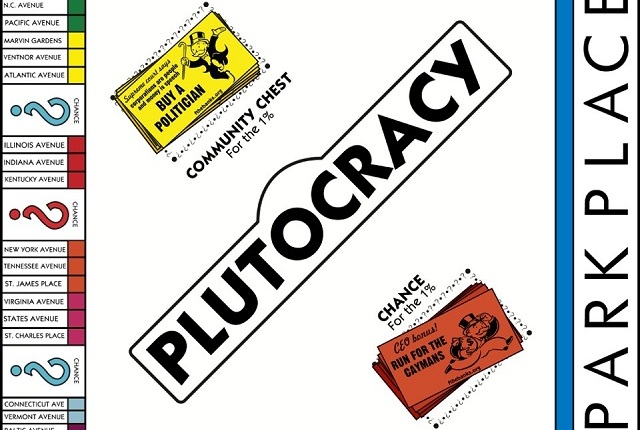
It’s worked so far, hasn’t it?  There have been momentary bursts of democratization in the relatively short history of the American Republic, but for the most part, the wealthiest citizens have directed the course of government with results that appeared quite satisfactory.  Well, satisfactory to a segment of the population.  In any case, while we celebrate the idea of a president working his way from a one-room cabin to the White House, the reality is that three out of four of those figures carved in Mount Rushmore were men of considerable means.

Just to be clear, a plutocracy is not an idea or ideology.  Plutocracy is a fact; the wealthiest govern the society.  Plutocracy can be relatively benign, as with the Kennedys and the Bushes, and can be positively progressive, as it was with both Roosevelts.  I’ll get to Donald Trump and the Republicans’ tax plan in a moment, but it is worth noting that people of considerable wealth have made important contributions to society, from Andrew Carnegie’s endowment of libraries to Warren Buffett’s support of health care initiatives.  Wealth can do a world of good, as the Bill and Melinda Gates Foundation, the MacArthur Foundation, and the less celebrated Atlantic philanthropy of Chuck Feeney demonstrate.

Wealth is just wealth.  But, as the top one percent controls fifty percent of the world’s resources, their interests and proclivities have an outsized effect on the rest of the population.  That’s probably not a good thing for a democratic republic, and that process now appears inevitably certain to continue to concentrate the sources of wealth in the hands of the wealthy.  The question we not in that one percent ask is, do the relatively less wealthy become absolutely less wealthy as the rich get richer?

The current cultural and social differences of opinion aside, the response to that question separates liberals and conservatives.  It is increasingly clear that we can study meteorology, hook up elaborate radar and imaging facilities, and still completely blow a weather forecast.  Economics falls into the same category of elaborately analyzed uncertainty.  The issue at the moment, however, is that economic convictions have become ideological.  Trickle Down economics is not a theory; it is the conviction that reduced taxation and regulation of corporations, and capital gains brings a vibrant, healthy economy in which all boats are raised by the tide of prosperity.

As the gap between the wealthiest citizens and the rest of the pack has widened, however, certain peculiarities of economic behavior have surfaced, the most notable of which is stagnation of wages, the absence of protective labor unions, and the migration of capital.  The crash of 2008, largely the result of large scale chicanery in the financial sector, left citizens homeless and robbed many of pensions and retirement funds, essentially removing a safety net for most working Americans.  Six years after the end of the recession, the bottom 99% have regained about 60% of what they had before the crash.  In that same period of time, incomes for the 1% jumped 37%.

The income gap is, for the most part, an invisible reality.  The 99% rarely see or meet those in the top 1%.  Where would, how could that happen?  That separation hardly registers in the daily life of most Americans.  What does register, however, is the disproportionate influence that 1% has on American political policy.

It isn’t easy to keep track of the players in that game.  Some, like the Koch brothers, seem to have a hand in virtually every institutional decision; others, like Robert Mercer, who has donated more than thirty million dollars to political causes, and his daughter Rebekah, now head of the Mercer Family Foundation, emerged as among the most influential forces in the recent presidential election.  Whose hand is on what campaign?  Well, could be any of those with clout.  Real clout.  There are, after all, 4.8 million millionaires in the United States but a mere 540 billionaires, 169 of which had holdings too unsubstantial to make the Forbes list of richest Americans.  That group of 540, you’ll be pleased to know, did have a combined net worth of almost 2.4 trillion dollars.

So, what’s the problem?

Big government with all its restriction and regulation is inconvenient in the operation of finance at that level.  If the operating principle of capital acquisition is the acquisition of capital, nothing is more pesky than taxation.  Taxation, however, seems to be the mechanism by which the operational needs of a nation are secured.  The transfer of wealth does not happen spontaneously, and the day-to-day needs of the 99%, education, clean water, healthcare, a protected environment, highways, and a safety net for older and under-employed citizens pretty much depend on funds secured by the business of the nation.

Hmmmm. That does seem to be a problem.

Back in 1975, acerbic author and political commentator Gore Vidal opined, “There is only one Party in the United States, the Property Party … and it has two right wings: Republican and Democrat.”  A lot has happened since 1975, but the basic question remains.  In this United States of ours a democracy, a democratic republic, or is it a thinly disguised plutocracy in which wealth and political power are indistinguishable?

The rich are certainly getting richer.  The poor?  Look around you.


Petting takes on a new meaning

Petting takes on a new meaning

Look, I’m antediluvian, a fossil, old as dirt.  You can’t expect me to keep up with a culture that stands on its head every twenty-four hours.  My idea of a ripping good yarn is a Dorothy Sayers mystery set in Oxford.  The Wodehouse comic adventures are equally engaging; I’d pit Bunter up against Jeeves, valet to valet, anytime.

The which is to say, I’m several steps behind in almost every area of contemporary social life.  I do watch television, of course, and generally allow most ordinary commercials to wash over me without noting the particular products advertised or the particular methods by which they are touted, fearful that I might again see an animated bear wipe its hindquarters with Charmin, leaving less paper behind (as it were) than rival tissue brand, Cottonelle Ultra.   In the woods.

Every once in a while, however, something pulls me to the screen, my will is thwarted, and I get the message an advertiser intends me to get, as in a recent unguarded moment when I was made aware of groundbreaking investigative reporting on pet dating sites as presented on rover.com.

I have seen examples of speed dating and know couples have found each other on line.  Rumors of a nether world of exotic “dating” applications have reached me, but, as I have not yet figured out how to answer my new phone, these remain obscure.  A quick scan of less frequently accessed, relatively conventional, sites, however, informs me that bearded men and those who seek bearded men can meet on Bristlr, a social network and dating site which promises, “… beard dating on a global scale.”  My viewing tastes, which include National Geographic Wild and Farm and Ranch TV, have  made me aware of Farmers Only, which, to confuse the viewer, announces that you don’t have to be a farmer to avail the services of Farmers Only, you only have to like farmers, or people who like farmers.  Equestrian Cupid similarly matches “cowboys, cowgirls, and equestrian singles”, whereas Trek Passions helps Trekkies find Trekkies available for “trekking”.  Tall Friends helps vertically advantaged people who apparently can’t assess size at a glance.  Need a partner for a luncheon date?  Salad Match is all over it, but you might be better served in accessing GlutenfreeSingles.

Let’s remember the days gone by when lonely hearts, singles, the shy and the reclusive found each other by posting quaint and plaintive coded messages in the personal columns of daily newspapers.  Some were virtually indecipherable – “I saw you.  Did you see me?”, some all too particular – “Man seeks woman not a cheating skank like Marcy Teddle.”  The digital age has allowed great specificity of search, so it should come as no surprise that dating has now brought dog addled singles together as well.

The pet economy is recession proof, jumping up from the sixty billion dollars spent on pets last year, adding another two billion.  Of course that reflects dollars spent on kibble, treats, and pet meds, but also includes the three hundred and fifty million dollars spent last year on pet costumes.  Dogs know each other by their scent, of course, so it should come as no surprise that aspiring dog matchmakers would spend seventy-five dollars for “Sexy Beast”, an apparently irresistible dog perfume, and so it goes.

Those seeking their “forever person” with whom to share a new leash on life now have a wide range of digital doorways through which to whistle up a partner.  Twindog/Tindog has been called Tinder for dog owners, but actually offers two services.  Registered hounds can seek pals for play dates, and their owners can swap photos of pets and selves in order to find, well, play dates.  The most unfortunate corporate branding is probably DateMyPet.com, a site not actually promoting cross-species frivolity.  They would rather be known as, “…the leading free online dating website created exclusively for pet lovers. Whether you are looking for a life partner, a buddy for your pet or just someone to hang out with…”.  Whew.

The very well received guide to finding the right dog-enhanced match, Leashes and Lovers: Where Dog Owners Meet, has broadened its base, now maintaining FetchaDate (“Find a date or even Love with Dog Lovers Like You”).  The FetchaDate website does not mess around; whereas others present portraits of singles or a stationary happy couple, Fetch jumps to a video, up-close-to and slightly-ahead-of a laughing couple, each partner holding a squirming Parson Russell terrier while riding on a motorcycle. Neither human nor any of the dogs is wearing a helmet; the countryside rushes past the bike, the happy pair chortles, the dogs squirm, and the viewer’s stomach lurches at the thought of terriers flying as the bike takes a tight turn.

The book’s website is more restrained, well, slightly more restrained.  We see a woman of middle age lounging against a sporty white convertible.  There are dogs in the picture; she has one arm over the chunky head of a large dog of indeterminate breed while a sharp snouted collie -mix of some sort watches with vigilant nervousness from the back seat.  Perhaps the word “slinking” or “draping” would be more evocative than lounging.  She’s wearing a Leashes and Lovers t-shirt, low-slung jeans, and offers a smile that is simultaneously panicked and predatory.

The book itself does encourage the establishment of healthy relationships through a series of articles by dog loving writers of some celebrity.  Cesar Milan takes a turn as one might expect, but contributors also include Rachel Ray, Monica Seles, and Howard Stern.  The idea is that dogs can teach us valuable lessons about ourselves, thereby freeing us to become the person we are meant to be, and thus, suitably attractive to other completely self-actualised dog fanciers.

I’m not completely self-actualised yet, but a dog fan myself, married to an even more actively committed dog person, and we have both learned important lessons from our dogs.  I’ve seen dogs actually correct unfortunate behavior, as was the case with a friend whose first impulse was to shout and toss his arms about when facing disagreement.  His dog, a retired Dog for the Deaf, in those moments shrank sadly, refused to be patted, and moaned softly.   My friend couldn’t take it; he learned to soften his voice and gestures, and the dog relaxed.

We did too.

I so believe in the ability of dogs to makes us better people that I am dismayed that this reasonably helpful book is marketed like a late-night infomercial.  The cover is alluring.  A woman’s long and perfectly shaped legs, crossed at the ankle, encased in delicate fishnet stocking, fall from the side of an overstuffed red chair.  She’s lying sideways in this chair; we assume she’s reading the book, although, since we see only her legs, she might be experiencing any number of moments of pleasurable relaxation.  There’s a dog, of course, a French Bulldog, peeking alertly from the depths of the chair, but there’s no doubt the book is marketed to women in search of ravishing romance and for a few men who find legs, fishnet, and stuffed furniture irresistible.

I find all bulldogs pretty irresistible, even though I know Darwinians take issue with breeds that are likely to develop hip dysplasia, cherry eye (don’t ask), deafness, brachycephalic respiratory syndrome, Stenotic nares ( narrow nostrils), and patellar luxation.  Also, they pant, and the larger ones slobber.  And yet …

It seems likely that folks who like dogs a lot probably do better in relationship with folks who share or have a high degree of tolerance for the dog-centered life.  There may have been pet dating organizations back in the 20th Century, but I happily stumbled into a dog-centered life without really knowing that I love dogs as much as I do.  I’ve loved all of our own dogs, but it’s significant, I think, that I’m more than eager to meet dogs of any size shape, or breed.

No slinking against convertibles for me, no wallowing in the embrace of armchairs, but I may send away for a t-shirt that simply asks:  “Can I pet your dog?”


I’M READY FOR MY CLOSE-UP, COACH PARSEGHIAN

I’M READY FOR MY CLOSE-UP, COACH PARSEGHIAN

Man Cave movies about sports?

We who love sports like to think we hold filmmakers to a high standard, but as I began to pull together a compendium of great sports films, I realized that critical discrimination is actually least likely to be found among those of us who will gladly watch the first round of Little League playoffs or the Barbasol PBA Players Championship.  Grizzled, hard-bitten sportswriters spit a chewed cigar on the floor and plump for Major League, Caddyshack, The Bad News Bears, The Sandlot,  and Rudy.  

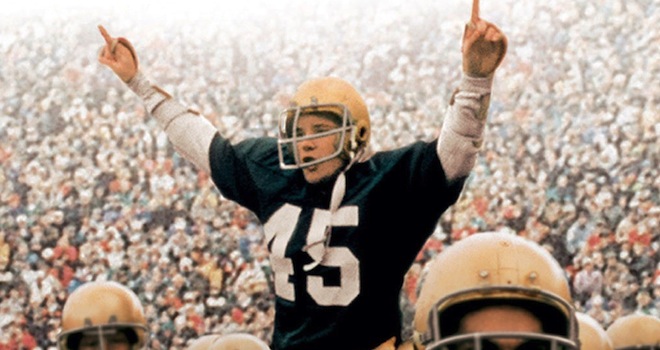
The title of this piece is an oblique reference to Gloria Swanson’s poignantly unbalanced, egomaniacal line in Sunset Boulevard (not a sports film) and Sean Astin’s role as Rudy Ruettiger as the inspirational Notre Dame walk-on in Rudy.  Billy Wilder’s Sunset Boulevard is a film classic; Rudy is schlock, maybe inspirational and emotionally satisfying, but fairly standard Hollywood Horatio Alger/pick-yourself-up-by-your-bootstraps/little guy overcoming great odds fare.

OK, maybe “schlock” is a bit heavy-handed; let’s go with intending to “please by playing upon the emotions of the viewer”.  Does that work?  Rudy never fails to put a good-sized lump in my throat.  As the crowd chants his name, I tear up.  Time after time.  Joe Montana, however, who was quarterback at Notre Dame while Rudy was walking on and who knows the unvarnished story, probably will not tear up.  The investigators at the SEC who indicted Ruettiger for stock fraud probably will not.  None of that changes my emotional response to a film about a good guy working hard to chase a dream; the more the world tells our little guy that the dream is out of reach, the more satisfying it is when he reaches it.

Hmmmm.  I have to wonder if there is a group made up of films that are essentially man cave films, pretty much admired and defended by guys because, on some level, they speak to the confusing and unarticulated complex of emotions that emotionally muffled men have a hard time explaining, to themselves or others.

For example, my son and I both started to blubber while watching The Rookie, the true story of Jim Morris, a high school baseball coach whose arm had blown out after a brief stint as a single-A prospect.  He’s coached his team to a state championship by encouraging them to follow their dreams, and, after taking them to the top, keeps a promise to follow his at the age of 36 by trying out with the Tampa Bay Devil Rays.  This is yet another of the “odds are against the little guy” tales and particularly rich in the “dreams we’ve kept to ourselves” category.

The real Morris trotted out a 98 mph fastball, got a contract, played his way up to the Bigs, and ended up appearing in 21 games, posting 13 strikeouts, a 0-0 record, and a career ERA of 4.83.  Dennis Quaid, our version of Jim Morris, is on the verge of quitting before the try-out, fearful that he could no longer throw a good fastball. He’s rigged up an old radar gun, and throwing as hard as he can, seems to register pitches somewhere in the low 80’s.  He’s ready to quit when the radar screen splutters, digitally coughs, and adjusts itself to an accurate reading of 98 mph.

Cue the tears.

Where do they come from?  We’re sitting in a darkened room watching what might as well be a digital thermometer, and slubbing in our seats as though our own lives had suddenly been touched by a magic wand.

Films about baseball outnumber the total number of films about any other sport for reasons that probably have something to do with the unique metaphorical resonance baseball has for fans and writers.  Poets write about baseball as Donald Hall does in “Fathers Playing Catch With Sons”:

“We listened on the dark screen porch, an island in the leaves and bushes, in the faint distant light from the street, while the baseball cricket droned against the real crickets of the yard. We listened while reading newspapers or washing up after dinner. We listened in bed when the Tigers were on the West Coast, just hearing the first innings, then sleeping into the game to wake with the dead gauze sound of the abandoned air straining and crackling beside the bed.”

Having listened to ball games on a radio I built from a kit, tented in under blankets so as to avoid being caught after lights-out, I’m immediately back in unquestioning fan mode again when a story or a film catches the kid in me and pulls me into a world I long to inhabit.

I’ve written about Field of Dreams elsewhere on this site and hold the opinion that it is the film that most completely captures the sustaining magic of the game.  It is a movie about fathers and sons, fathers and daughters, opportunities lost and opportunities grasped.  It’s a far better film than Rudy, and one I return to virtually every year, but I won’t even begin to apply the standard critical tools to the film as film.

In my cave, some things are better left alone.

Escaping Norway

Escaping Norway

A bright blue Volvo FH750 stands on the side of the road only miles from Sor Vanger, last town on the Norwegian side of the border with Russia.  The temperature has fallen quickly, and the road, already thickly covered with snow, is increasingly dangerous.  Two heavily muffled men reluctantly leave the relative warmth of the truck’s cab in order to meet twelve men, women, and children, blindfolded so they might never identify Steinar and Oddvar, “praerieulvs” or “coyotes”, who hide fleeing Norwegians in the large sand boxes located under the truck’s chassis, above the wheels.  On nights such as this, only sand dropped from the truck’s entrails will keep the wheels on the icy road into Russia.  Steinar and Oddvar know the roads and know just how much space they have, putting the heavier border busters over the rear wheels where weight is as important as sand.

Steinar, the praerieulv in charge, is a wiry man of about fifty, dressed in conventional Norwegian casual clothing under his winter gear, slacks, blue shirt with open collar, brightly patterned sweater presenting reindeer bowling.  This is not his first rodeo, but the current flood of Norwegians fleeing Trondheim has crested in the past few weeks, leaving him exhausted and his resources worn thin.  He is resigned in describing the work ahead.

“Ever since President Trump opened the floodgates, I have more business than I can handle.  I see twenty or thirty families a day, all trying to bust out of Norway.  I’m not sure I can keep up.”

Oddvar, the younger and more excitable guide chimes in.  “Me too.  I’ll go when I can.  People don’t know what it’s like here.  Medical care for everyone, high salaries.  We got almost no crime here in Trondheim.  A guy got trapped under his van last week.  Big news.”  Steiner nods.  “You think you know dull, but you don’t even begin to know dull.”  Oddvar spits with contempt.  “I get excited, you know, when I hear the president wants us to come.  He didn’t even mention Sweden.  Maybe too many Swedes already.”

Einar Pen, an engineer with Norsk Hydro has waited for weeks for this opportunity and has arrived with his wife and three sons in tow.  Steinar explains the ground rules as Pen shrugs into the jumpsuit he will wear hiding in the truck, as his family will as well. He  grumbles a bit as he is to be  wedged into the few square feet of space above the truck’s right rear wheel.  He is six foot and seven inches of university trained metallurgist with a head the size of a watermelon.  Groaning, his labored breath turning to frozen mist as he labors, Pedersen assures his wife that all will be well once they get to Russia where an easy train ride gets them to Pulkovo airport in Saint Petersburg.

“Yes, sure.  Hardship now, but in only a few months, it will be beautiful.  Just like the Wild West.”  Pedersen coughs broadly, scattering chunks of frozen phlegm onto the dark night.  “Right now, we have it so good, you know?  Good for everyone.  No excitement.  Everybody has a good life.  Money.  You know.”

“Now, Eidar…”  Pedersen’s wife interrupts.  “We do this for the kids.”

The three Pedersen boys stand quietly.

“Sure.”  Pedersen grins widely.  “But we live in Alaska in a few months, hunt bears, have guns.”

Berit Pederson shuffles uneasily; the Pedersen boys fist bump.

Nerves are on edge as the praerieulv hands out parkas and backpacks.. With practiced certainty he separates the Vikings from the victims, the younger from the elders.

Do not fall behind, I will have to leave you, we MUST leave you, there are going to be casualties, but we have to keep going.

Berit slumps anxiously as she is seated in the cab of the truck.  The boys have been placed inside sacks of turnips which will be delivered to grocers in the small towns on the Russian border.    “We thought about El Salvador or Mexico, exciting too, and warm, but Eidar, he wants to be a cowboy, like John Wayne, and he says US is just as dangerous but clean.”

In the wake of the president’s encouragement of Norwegian immigration and the flood of emigrants deserting the Norwegian economy, the Storting resorted to draconian measures, placing guards at the airports and monitoring the highways.  Only commercial vehicles have been allowed to travel into Russia.  In December, Erna Solberg, Norway’s Prime Minister, spoke with grave concern before the Parliament.

“Americans have taken so much from Norway, stolen some of our greatest human treasures.  Yes, certainly, it was hard to see Sonja Henie skate off to Hollywood, but since then, look at who could have been honoring Norway:  Marilyn Monroe, the Olsen twins, Eliot Ness, Knute Rockne, Paris Hilton, Rene Zellweger, Adam Lambert, Kristen Wiig, Roald Dahl.  The American entertainment industry has been built in the broad shoulders of Norse immigrants.

No more.  We keep our people now.  Did I mention Mary Kate and Ashley?”

Then, we are insulted.  This Prairie Companion mocks the Norwegian bachelor farmers in Minnesota.  “Ya, sure” and so forth.  From Garrison Keillor who is not even Danish much less Norwegian.  Canadian and Scottish.  Maybe never even has been to Norway.  Maybe some jokes about Canadian bachelor farmers would be a good thing.  Maybe he jokes not so much this day.

A brittle snowfall continues to cover the highway as the truck rumbles from the dark bypass.  The Pedersens, like countless thousands, will soon land in Anchorage, secure in the knowledge that there, at least, they are wanted.


Saint Thomas of Foxboro

Saint Thomas of Foxboro

His Holiness will see you now, but, please, only for a few moments.

Yes, of course.Thank you.  Uh, I brought Francis a …

His Holiness Pope Francis, Most Holy Father …

Ok, yeah.  So I brought a Pats sweatshirt, “You Hate Us ‘Cause You Ain’t Us.”  I figure he’s a large?

I’m sorry, your business with His Holiness?

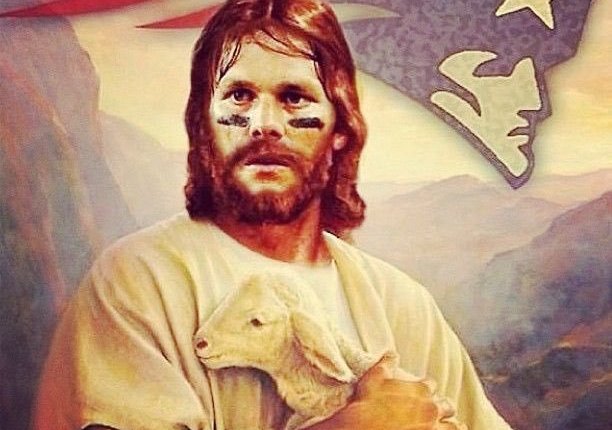
Well, we figured he’s the guy to see about getting Brady his sainthood early, you know, before he checks out.

Before he dies?

Before he retires.  Like in eight or nine years.

I’m not sure …

It should be a snap.  We’ve been reading up on it, and the miracle thing is pretty clear.

I’m sorry.  The miracle thing?

From what my wife found out, Brady moves from Venerable to Saint when we present the miracles and the Pope drops the hammer.

Are you suggesting that this Father Brady be canonized?  If so, the process begins …

Not Father Brady.  Tom Brady.  Tom Terrific, California Cool, GOAT.

You want to propose the canonization of a goat?

G-O-A-T.  Greatest Of All Time.  Brady.

And he performs miracles?

Does he perform miracles?  Is the Pope … never mind.  Sure, miracles.

Water to wine, I suppose, loaves and fishes.

Fishes?  What?  No,  and not just miracles; he’s been martyred.

So, deceased?

Nah, Remember 2016?  The four games?  Deflategate?

I’m sure I should know what that means.

It means Goodell and the whole league had it in for him … and the Pats.

So, alive then?

Certainly.  According to Giselle… heheheh.

I fear you have misunderstood the process by which a Servant of God is beatified then venerated …

OK, let’s start with the 92.9 completion percentage in the 2007 playoff with the Jaguars.

This Brady was more than 90 percent eaten by jaguars?

No way.  24-20 Pats.  And, how about this?  Brady can’t run, you know?  His 40 at the combine was ridiculous, but 2006, against the Bears …

Bears?

Urlacher’s ready to rip him a new one on the 20, and Brady, Brady jukes him.  Jukes Urlacher!

These are miracles?

Ok, maybe not miracles, exactly, but 2001, Drew Bledsoe is the franchise quarterback, Belichick’s second season, Pats 0-2, Mo Lewis out of nowhere, not only hits Bledsoe, he puts him in the hospital his chest filled with blood …

Oh, we have always considered stigmata indicative …

So, Brady goes in, the Pats go from 0-2 to the Super Bowl.  Against the Rams.  Greatest Show on Turf.  Miracle, right?

Uh….

Yeah, but, listen.  even Madden shut up when Brady takes the ball with 1:21 on the clock, starting at their own 17, no time outs, tied at 17, smart money said go to overtime, but no, Brady takes ’em down to the Ram’s 30 in 5 plays, Vinatieri nails it and second-string quarterback carries the Pats on his back to win Super Bowl XXXVI.

You don’t actually speak in Roman numerals?

I gotta.  But wait, there’s more.  Ok, fourth quarter Super Bowl comeback against the Legion of Boom?

You mean a Legion of Doom, apocalyptic visitation, the horsemen?

No, Boom.  Boom.  The Seahawks hadn’t give up more than 7 points in the fourth quarter all season, then Brady drops 14 leaving room for Butler.

I’m not …

No, ok, no question about this one.  Pats down to the Falcons 28-3.  third quarter, Super Bowl trophy definitely not going back to Foxboro …

Seahawks?  Falcons?

Down by 25 points and Brady has to pick up a long third down running the ball, himself,  start of the fourth quarter, and don’t forget, he’s been suspended for four games, his mom is fighting cancer, he’s the guy who barely got the start at Michigan, picked up by the Pats as the 199th pick in the draft, this guy picks up 19 in the fourth quarter and 6 in overtime.  Game over.  Good night, Falcons, enjoy the trip home from Houston.

This Brady is still alive?

Yeah, sure.  He’s got to play the Eagles in a couple of weeks.

We can’t … well, we don’t actually do anything.  Once deceased, the Servant’s life is brought to the Congregation for the Causes of Saints, and then…

New Orleans?

What?  No, Rome.  Rome.  I’m afraid the Pontiff will not able to hear your petition.

So, what?  We have to wait until he’s gone?

At the very least …

Yeah, the way things are going, that might not happen.

Everyone deals with the inevitable process of aging.

Have you been listening to me?  That’s another miracle.

I’m sorry, but I do have one question.

Ok, shoot.

Can we keep the sweatshirt?

It’s Alright to Cry

It’s Alright to Cry

My granddaughter is getting the best of the best  from the Golden Age of children’s educational entertainment :  Mr. Rogers’ Neighborhood, early Sesame Street, Harry Nilsson’s The Point, and Free To Be You and Me, the project attempting to move the culture beyond stereotypical thinking about the roles of men and women. Conceived by Marlo Thomas and the Ms. Foundation for Women, the all-star cast included Alan Alda, Harry Belafonte, Mel Brooks, Michael Jackson, Carol Channing, Cicely Tyson, Robert Morse, Diana Ross, Tom Smothers, Voices of Harlem, and The New Seekers among other luminaries.  We had the album, of course, and a VHS copy of the televised version of the album, and listened to the cassette tape in the car.

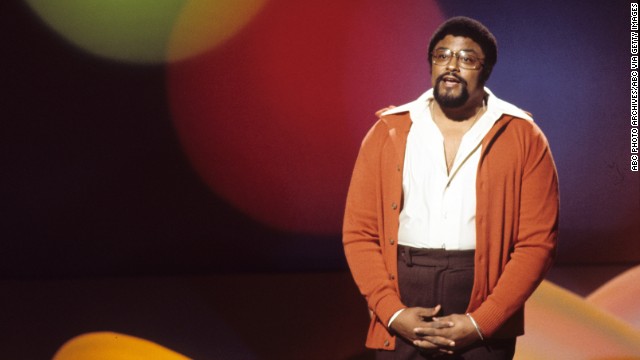
Rosie Grier, defensive tackle for the New York Football Giants and the Los Angeles Rams, appeared in a short skit singing, “It’s Alright to Cry,” a segment that received more attention than many of the other arguably more artful numbers as a pensive Grier endorsed the open expression of feelings, even by a large, physically dominating, man.  Shocking at the time?  Apparently, and the more challenging in that Rosie Grier was a large Black man, the sort of man presented in Shaft or Superfly as a pretty dangerous character.

Cultures change slowly, and Marlo Thomas and friends probably hoped for the more immediate disruption of stereotypical thinking about race, ethnicity, and gender; we’re still encouraging young women to believe that they can do or be anything, but delivering a cautionary note to them in that we find it necessary to bring up the topic.

In the year that Free To Be You and Me was released, Senator Edmund Muskie, the candidate expected to unseat sitting president Richard Nixon, removed himself from contention when he appeared to cry during a press conference.  Real men do cry, but discussion of the subject still makes men uncomfortable, and the public display of emotion (other than anger) is rare.

I cry a lot.  I’m frequently moved to tears by witnessing acts of kindness or generosity.  I cry when ordinary people are treated more gracefully than they expected.  Most of my ordinary crying happens in a movie theater or in front of the television, although the occasional novel can hit home as well.  My behavior would be described as choking up; my voice thickens, my nose starts to run.  I wipe my eyes, snorkle for a few moments, and try to keep that storm of emotion to myself.  I’m not embarrassed exactly, more aware even in the moment that my tears usually spring from unresolved issues of abandonment and powerlessness, issues I feel I ought to have put behind me decades ago.

I cried this week as we brought our good old dog to the vet’s office, knowing we would be driving home without her.  My wife and I and one of my kids held her as she left, loving her entirely. I sobbed uncontrollably.  For a long time.

It strikes me as more than alright to show sadness, and regret, and loss, and love.  We fall in love, have children, adopt pets with the knowledge that we will be inevitably face real pain.  We do it anyway.  We spend much of our alloted time in looking ahead and looking back and relatively little in the moment.  We try to seize the day, but it moves so quickly and I, for one, am easily distracted.

But in that moment, as I felt the enormity of losing a dog I loved, there were no more plans to make; there was no past or future, only immediate nd overwhelming emotion.  I was useless, of course, and did not offer comfort to my wife and son, ordinarily my first instinct, but I expect they understand.

I often catch myself being myself and find my foibles relatively amusing unless they ramble out of control; I endorse mindfulness as a way of life, recognizing that I probably take myself way too seriously.  What I’m after is authenticity and integrity, qualities that can remain more hypothetical and abstract than I would like for much of the time.  Every once in a while, as was true last Thursday, I am simply and visibly what I am.  That comes close to my definition of integrity, and I don’t intend to apologize for being painfully in the present.

I’m not sure where we are in this upside down chapter in the life of a polarized society, pretty sure there’s not as much equality and justice as Marlo Thomas had hoped we’d find in the four decades since Free To Be, but also aware that the culture has changed.  It seems changes of this order take longer to seep into the fabric of a nation than we had expected; “Old ways is best ways,” remains a recurring theme, and we do take a few steps back after leaping forward.  On the other hand, emotions once freed tend to stick around.

It’s alright, I think, to cry.


My year as a sports fan ends … not with a bang but a whimper

My year as a sports fan ends … not with a bang but a whimper

You give and you give and you give, and then Michigan blows a 16 point lead in 94 seconds and what the heck was I thinking?

“Hang in there”, I told myself throughout the weeks leading up to the Outback Bowl,   “Surely the second most extravagantly paid football coach in the universe ( seven million dollars a year)  will come up with an exciting game plan after a month off and the return of starting players.”

Well, no.   A plodding, clumsy, pedestrian Michigan team managed to become the ONLY team from the Big Ten to lose a bowl game.  Stupidly.  With penalties and turnovers.

Fa la la la la and so much for the collegiate football season.  The issue today is not whether Michigan’s coaching staff should be:

a.  given a raise

b. fired

c.  tarred and feathered

d.  fired, then tarred and feathered, then fired some more

The issue is that a season such as this, one that began with such promise and ended with such shame, so damages the heart, mind, and soul that some sort of rite or ritual is necessary to preserve the connection between the fan and the team that has abused him (me).  If so, and I believe that the tissue holding me to Michigan football has worn thin, then a formal process of reconstitution is in order.

This is not the first time I have been shaken as a fan.  The Steinbrenner years were brutal for this Yankee fan; he changed managers twenty times in twenty-three years and went through eleven general managers in the same span.  Comparisons with contemporary political characters may be inevitable; these were the years in which the Yankees were under the thumb of a tyrannical and mercurial self-promoting owner, known as The Boss.  It took Derek Jeter and Mariano Rivera to entice me into watching the Yankees again, and incredibly gifted rookies to nudge me even closer to something like the first stages of fandom.

Winning is not everything, as my long-standing allegiance to the Detroit Red Wings makes clear.  Yes, there have been glory days for the Wings, but not many in recent years.  And yet, my fondness for them remains unshaken.  They missed the Stanley Cup playoffs last year for the first time in twenty-five seasons; it hurt, but the they had snuck in under the wire for so many seasons that the end of the streak seemed inevitable.  Had they begun the season with fanfare and expectation, the pain might have been unbearable, but they did not and it was not.

Ah, but Michigan.

I’ve been so chippy with fans of other teams and so strident in my Michigan fandom that I cannot in good conscience hop off the Michigan bandwagon (tires flattened, windshield busted out, rusted fuel tanks) in order to flag down one of the currently superior programs.  Tempted.  Tempted.

In addition to principle, decency, all that stuff, what other conference could I endorse?  SEC? Uh, I’m not a Bubba.  Big 12?  Or a cowboy.  Pac 12/15 whatever?  Colorado, Arizona, and Utah are less Pacific than I might think proper, and, although Stanford and Berkeley are in the mix, I can’t get past USC.  ACC?  Have I mentioned Notre Dame?

No, the only conference I admire almost completely is the BIG, formerly the Big 10 , now made up of 14, including Maryland and Rutgers, whose inclusion bothers me during the football season but who are pretty interesting during the rest of the year.  I can root for Michigan State when Michigan is not in the picture, but sliding over to Penn State or Ohio State would be like giving my children to the Manson family, the Galactic Empire, or the Medellin Cartel.

I know, I know.  Cubs fans took it in the shorts for a century.  Red Sox fans brought suffering to a national pastime.  Indians fans, Bills fans, Lions fans – they’ve all shown thankless dedication.  But, all those teams have been good enough to come close, really close, and I know there is heartbreak in almost, as the Lions have found in the last three seasons, but fans of these teams need feel no shame.  Browns fans?  Another story for another day.

As I watched Alabama play Georgia for the National Championship this year I realized that the football these guys play is of a different species than that which my Wolverines have brought to the field.  There were some similarities on defense, but the talent and imagination presented on offense was remarkable.

So, what’s a fan to do?

OK, I’m sticking with Michigan.  Given what I see at the top of the BIG and SEC, I lower my expectations.  Can Michigan beat Michigan State?  Sure, and they will from time to time, not every year.  Should Michigan beat Ohio State?  Yes, and it could happen in the years remaining to me, although I see a gap in recruiting growing larger year after year.  Will Penn State continue to improve?  No doubt, and that side of the conference just gets tougher and tougher.

How’s this for high hopes?  We’ve went 10-3 in Coach Harbaugh’s first two years, 8-5 last season, won one of three Bowl games in that period, and beat Michigan State once.  How about we beat two of the behemoths on the schedule?  Notre Dame (230 days until we play), Penn State, Michigan State, Wisconsin, or Ohio State?  How about we beat Western Michigan, SMU, Maryland, Rutgers, and Indiana?  That puts us at 7-3.  Nebraska and Northwestern have both improved; toss ups next season.  Best case, 9-3 with wins over Penn State and Ohio State; worst case, 5-7 with losses to Penn State, Michigan State, Wisconsin, Ohio State, Nebraska, and Northwestern.

There, I said it.  Michigan could easily go 5-7 next season, and I’m going to have to consider that possibility from the start instead of fantasizing about a playoff bid.  Indiana looked better last season as well.  4-8?  Please, Santa, please.  I’ve been a fan for too long.  No coal in this fan’s stocking.  No need for upsets next season to tame the prideful.

I’m already tamed.