Unfinished

Unfinished

The Met Breuer Museum is hosting an exhibition of master works that were purposely left unfinished.  “Unfinished – Thoughts Left Visible”

The Met is the grande dame of museums in New York, and one of the most visited museums in the world.  Celebrated for the depth and breadth of its collections, the museum could reasonably rest on its well established reputation, continue to buy extraordinary works of art (2012 expenditure of approximately forty million dollars for acquisitions), and celebrate its satellite gem, the Cloisters Museum and Gardens.  Events conspired, however, to allow the Met to toss its considerable resources into the highly charged universe of museums dedicated to contemporary art.  The Met received a donation of 81 Cubist masterworks from the estate of Leonard Lauder worth approximately a billion dollars just as the building formerly known as the Whitney Museum became available.

Architect Marcel Breuer had been comissioned to design the Whitney Museum in 1963, creating a distinctive landmark on Madison Avenue and 75th Street.  The critical reception of the new building was not entirely favorable. Breuer, who had been one of the Bauhaus luminaries, designed a remarkable building in what was subsequently called the Brutalist style.  Midcentury sensibilities welcomed steel, glass, and open space; Breuer’s design called for a building covered with 1500 slabs of granite, a staircase of a building, often called an inverted ziggurat.  When the museum opened in 1966, Ada Louise Huxtable was architectural critic at the New York Times and one of the few critics to be won over by the building; she knew she would be alone.  She described the Whitney as New York’s most disliked building but found it fascinating.  “Like that fine old saying about sin,” she wrote,”first the Whitney repulses; then it intrigues; then it is embraced,”   and added, “…the taste for its disconcertingly top-heavy, inverted pyramidal mass grows on one slowly, like a taste for olives or warm beer.”

It seems inevitable now that the Whitney would seek a new home, as it did in 2014, abandoning the ziggurat on Madison Avenue.  This is the sort of an Ugly Duckling story that has been  slow in transitioning to a happy ending.

Marcel Breuer (BROY-ER) may be best known today for his furniture design, the Wassily chair in particular, but he was among the most prominent architects of his generation.  His buildings include the stunning chapel on the campus of Saint John’s University, the UNESCO building in Paris, the US Embassy in the Hague, the IBM Research Building,  more than thirty significant buildings, and private homes which are considered among the most distinctive of the mid-century period.  His own homes in New Canaan, Connecticut and Wellfleet, Massachusetts are among those recognized by the Museum of Modern Art and the National Building Museum among many others.

Breuer was also a teacher at the Harvard Graduate School of Design, where he taught the next generation of architectural giants.  He taught I.M. Pei, Edward Larrabee Barnes, Eliot Noyes, Paul Rudolph, and my father; he married my mother’s sister.  He was my uncle, and so, I’ve not taken the shabby treatment of his building well.  With its adoption by the Met, and the adoption of the name, Met Breuer, both the building and the man have the recognition they have long deserved.

“Unfinished”.  The reviews of the exhibit have been mixed, in part because the extraordinary unfinished works are not entirely contemporary.  The 197 works include pieces non finito  (intentionally unfinished) by Rembrandt, Titian, Cezanne, and Turner, as well as work by  Rauschenberg and Jackson Pollock.

The idea of looking at work intenionally unfinished so as to examine thoughts left visible, however, strikes me as a significant and entirely contemporary undertaking.  The definition of art itself has been tied to the completed act of creation or invention, but surely there is art in every preliminary brush stroke, in every decision an artist considers.  Conceptual art essentially asks art to question its own process and allows the artist to involve others in the completion of the work.  In a very real sense, art is an event, the conjunction of the work and its viewer.  So, I confess the title of the exhibition pulled me to a set of reflections not yet … finished.

The Met and the Whitney agreed to a sort of limited partnership, presenting the Met with the Breuer building for a term of eight years; after years of turmoil, the story of New York’s ugly  duckling has moved rather quickly toward a happier ending for the Breuer legacy, but remains, as all really true stories do, unfinished.


Who Loves Ya?

Who Loves Ya?

I don’t know when it began.

I’m not a close observer of merchandising ploys.  I’ll notice an ad that is disturbing or awkward or  uncommonly annoying.  Sure, pastel bears shilling toilet paper is mildly arresting, and the degree to which they describe measures of butt pleasure is slightly off-putting, but their playful hygene hijinx seems fairly benign.

Speaking of bears, one of my best friends, Ken Stewart, a paragon of creative merchandising, came up with the idea of linking Christmas, polar bears, and Coca Cola.  It is hard now to remember a time in which holidays did not include sledding bears, skating bears, caroling bears, luging bears, in which yodeling bears did not animate an Arctic wonderland,  quaffing every polar bear’s favorite beverage.

So, I give credit to Coke for all sorts of handsome advertising, from jolly Santas at their ease, to turn-of-the-century Gibson girls.  Who tried to teach the world to sing?  Who softened Mean Joe Greene?

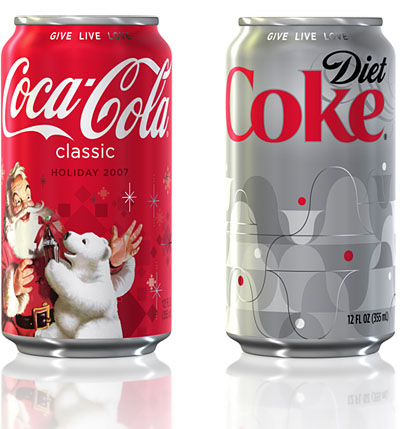
OK, but tonight I grabbed a can of Diet Coke, no longer knowing what to expect.  I’m a customer of habit.  Keep the same colors; keep the same logo.  Don ‘t change the type face.  Don’t mess around with my soda.  But, in the last few years, Diet Coke has sold fashion cans (Marc Jacobs and Jean Paul G), swirls of color generated randomly by Hewlitt Packard, and, in an oddly conceived attempt to personaize the Diet Coke experience, slammed both first names and what someone presumably considers charming sobriquets on the sides of the cans.  I’m still not sure why I would be especially moved to buy cans intended for Bobby, Heather, Prija, Cuppy, or Jenn.  What does the run of the mill customer do with  “BFF”, “Go Getter”, “Handsome”,  or “Star”?  I want a Coke.  I’m no star, no one’s BFF.  Can I fake it?

Look, I’ll still drink anything that fizzes, is roughly muddy brown in color, and has no calories.  Tastes like copper tubing?  OK with me.  But tonight I grabbed a can, settled down to watch th NBA finals, and found myself looking at the words,

“You’re beautiful it’s true”.

Even with punctuation the message would have unnerved me.  Affirmation goes a long way, and I endorse encoragement in almost any form, but unsolicited observation about my appearance is just creepy.  I’ll admit to some sensitivity in that regard; I was stalked by an admirer/hunter in my college years.  He left notes describing my appearance day-by-day.  The notebook was found in a closet along with articles of clothing and personal effects he had lifted from my room.  The Security Team thought it was a kindness to show me the notebook; it was not.

The issue, I think, is that my Diet Coke was remarking on my physical appearance.  Had it only promised “You will meet a dangerous challenge,” as a fortune cookie once did, I’d be concerned but not aggrieved.  As an aside, the fear of litigation must have changed the fortune cookie writng teams; I haven’t seen a fortune in years.  “You are thoughtful and kind,” is not a prediction of any sort.  To return to the subject under discussion, holding that can of Diet Coke, I felt slightly soiled, as if I had purchased a Fembot to compliment me on my manly good looks.

Perhaps I will find comfort in the next several iterations of can design.  The first, an extension of the HP randomly generated patterns, now finds its way to a line of curved bottles.  The next is a nod to “One Brand” advertising, placing increasingy large patches of red in the whole line of Coke products, as though we did not have the wit to connect Coke Zero, Coke Light, and Diet Coke with the grandaddy of Coke products, the somewhat original Coca Cola.

Only North Koreans and Cubans are denied access to the full range of beverages offered under the wider Coca Cola umbrella.  Mexico drinks the most cola,approximately 745 Cokes a year per person.  We lag behind, only averaging 401 Cokes per year, per person.  Perhaps we can catch up with our southern neighbors, if we take the challenge seriously and spend just a few more hours a day hitting Coke products hard.  It will take resolve and strength of will, and perhaps it is in this light that the curious nature of can graphics starts to make sense.

The new generation of cans and bottles are not simply designed, they are designed to be unique.  This could be the first mass movement dedicated to the distinctive experience of each individual.

I’ll drink to that.


Are Our Similarities More Important Than Our Differences?

Are Our Similarities More Important Than Our Differences?

Yuval Levin’s recent book, The Fractured Republic, argues that the two major political parties are trapped in nostalgic fantasy, fantasies that are so inimically at odds with each other that there is little room for agreement at the most basic, unconscious, and compelling levels.

Republicans, Levin argues, long for a golden age of homogeneity, one in which family values were clear and universally accepted.  School children were apple-cheeked, happily preparing for the Christmas pagent, sticking gummy whiskers to their pre-pubescent cheeks to portray Wise Men bringing gifts to the Christ Child.  Names were easy to pronounce; faces were familiar.  Oh, and the might of the only power unscathed by invasion, still capable of large-scale production, the only nation wth nuclear weaponry, the only nation with a rebouding economy confirmed the accession ofthe United Sates to the position of preeminent world power.

Democrats hearken back to the New Deal and four terms of FDR’s presidency during which the extension of governmental involvement in the running of the nation’s economy not only brought the nation back from depression but began a process of inclusion.  Unions and newly enfranchised minorities, immigrants and idealists joined together to build an America that was both secure and prosperous.

There’s nothing wrong with looking back, seeking the foundations of belief that bring political conviction … unless core beliefs are bound to circumstances that no longer exist. There’s nothing simple about diversity, or globalization, or a technological revoution, but virtually none of the elements of contemporary realpolitik proceed from convictions commonly accepted if not commonly held.

We are nearing the end of a disturbingly contentious season of primary campaigns, lacking both civility and promise.  Both Bernie Sanders and Donald Trump have tapped into the frustration and confusion that afflicts a nation in transition.  Trump looks back to a time before people of color had a place in the nation and Sanders promises the revolution that did not happen in the wake of activist protest in the 1960’s.  Libertarians may appeal to moderate Republicans and the Sanders Democrats; a conservative independent candidate may draw some of the true believers in the Republican Party and evangelicals who find Trump transparently amoral.  It appears unlikely that the general election will bring compromise and the establishment of common ground.  Reporters facing a Trump salvo in which he called a reporter from ABC a “sleaze” asked if this was the tone and tenor we might expect durng the course of a Trump presidncy.  The presumptive nominee assured the press that his contempt for the dishonest press would remin unabated.   On the left, the most vehement of Sanders supporters refer to “Hitlery” Clinton as a marionette dancing to the tunes played by Wall Street.

At some point, fissures become fractures.  The contempt that each set of contenders feels for the others leaves little room for compromise or cooperation.  We’ve already seen the administration of the essential functions of goverment paralyzed as partisan battles take precedence over efficacy; it may be that even at this juncture, too many people have been too wounded to work shoulder to shoulder with the other.  At some point, the complexity of ordering a thoroughly intricate global structure predicts plutocracy at best and tyrany and kleptocracy at worst.  Nasty racial and ethnic bullying and natavist thuggery are distractions, momentary emotional release, but the fabric of civility, once torn, is not easy to patch up again.

What can hold the Republic together?  What truths, finally, do we truly find self-evident?

Duty, Honor, Country?  All men created equal?  Honest pay for an honest day’s work?  The best government is that which governs least?  True Democracy proceeds from enlightened self-interest?  A woman has the right to choose?  God as revealed in scripture holds the nation to absoute standards of belief and behavior?  No child should go to bed hungry?  We are a nation of immigrants celebrating diversity?  We are a nation founded on Christian principles?  We are an English speaking people?  What is good for Wall Street is good for the USA?  Protected land should be held in trust for all Amercans?  We have an obligation to protect a fragile world environment?  We have an obligation to bring American democracy to other nations?  We have an obligation to secure the well being of America first?  The nation exists in order to secure the liberty and dignity of each individual?  Each state has the right to order its own affairs?

Transient isssues capture the headlines, as the furor over bathrooms suggests.  The issues in that case are complicated and reflect differences of conviction that go way byond the actions of a governor or state legislature.  At the core, the issue is really who do we see as human?

Who do we see as human, and what obligation do we as a nation have to secure their well being?

Much has been made of the regional character of Amercan lives and politics.  We can talk about Red States and Blue States, about  Cascadia and the mythical country of Jefferson, the Foundry, Dixie, the Breadbasket, MexAmerica, the Islands, and Ecotopia, the Nine Nations of North America, about  bio-regions and social norms, but the fissures, even within these subsets of nationhood, are clear and dangerous.  The sensibilities of Portland and Eugene are not the sensibilities of Pendleton and Burns.  Bakersfield is not Berkeley.

Fractious and angry rhetoric may accomplish what civil war, depression, and riots in city streets could not.  No matter the outcome of this election, we may remain a nation at war with itself.


Museums That Should Exist But Don’t

Museums That Should Exist But Don’t

The Museum of Toaster Art is located on the second floor of one of two “Art House” theaters in Bellingham, Washington.  Once a month, Bellingham celebrates the arts by inviting ordinary mortals to tour the various studios and workshops thriving in this small but uncommonly interesting city.  I walked past several unexceptional studios, nodded at working artists, turned a corner and spotted the entrance to the Museum of Toaster Art, assumed it might present a few amusing portraits of tasters and walked into a wonderland of toasting mechanisms.

I thought I’d seen most varieties of toaster, but toast has clearly been the mother of invention.  Toast carousels, toast Ferris wheels, toast guillotines, toast subways, toast castles – a toasting landscape both unlikely and impressive.

The heart of the exhibit, however, is the collection of photographs covering six walls of the studio/museum.  In each photograph, the artist and collector, Eric Brown, poses with a toaster; year-by-year, Brown chronicles the growth of his collection.  Imagine the most assiduously curated set of family portraits; now, replace children and grandchildren with toasters.

Of course, each photograph also chronicles Brown’s changing affect and persona.  I found myself simultaneously fascinated and uneasy.  Brown’s fondness for toasters is displayed without apology, and yet, I felt myself a toaster voyeur.

In any case, this visit inspired a series of assignments set my students as they entered the third week of a writing intensive.  I spoke about the Museum of Toaster Art and a few other remarkable museums (The Dog Collar Museum in Kent, England, The Hair Museum in Turkey ) and asked them to describe in detail a museum that does not exist but should.  Over the years, a number of inspired nominations came forth.  My favorite?  The Museum of Broken Dreams – a gallery responsive to each visitor, flashing images of the dreams that would never come true for each individual.

My own thoughts have rolled around over the years, but several have come into being even as I began this blog.  The Museum of Broken Relationships, for example, has recently opened in Los Angeles, soliciting and receiving artifacts from brokenhearted donors around the world.   Along the same lines, and perhaps more peculiarly attached to my own regrets are The Museum of Missed Opportunities and the Museum of Unfortunate Choices.

I wonder what the impact might be of walking through a display of misguided decisions,  not only  re-living the moment of choice but seeing the possible outcomes of other, perhaps better, judgments.  Heartening?  Maddening?  Do I really want to think about things said or unsaid, injuries too easily given, friendship too selfishly left untended?

Regret is a double edged reminder.  It hurts to see our flaws in motion, but it’s been said we grow at the rate of pain.  Maybe each encounter with one of those critical junctures could be followed by a short visit with an adept professional in the field of encouragement, not the huckster version, but a spiritual guide who helps connect our capacity for facing our own past with our capacity for change in the present.

OK, the museum is now turning into a self-help Disney Ride, probably more risky than I had intended.  So, with the recognition that when in doubt, the best response to a world about us is simple gratitude, I’ll propose The Grateful Museum.

The visitor checks in, undergoes a quick psychometric resentment inventory, then walks through gallery after gallery witnessing the moments of grace in which we have received more than our share, not to discount injuries accumulated over the years, but to provide a sense of balance and room for choice.  Imagine the cumulative effect of witnessing authentic kindness and tolerance in one’s life.

As a savory corrective to the sugary architecture of my self-reflective museums, I offer a more acerbic observation that the ordinary world offers delightful examples of bad judgment in action.  Not quite as grim as The Darwin Award Hall of Fame, my collection would bring a smattering of truly bad ideas presented to those who shop for children’s toys.

THE MUSEUM OF MISCONCEIVED TOYS

OK, so a toy “designer” thought it would be great to create a “Shave The Baby Doll”.  I get that.  It’s four in the morning.  Somebody starts suggesting a competition for the most unfortunate Christmas ad campaign ever.  From the depths of some misshapen imagination comes the cry, “How about a baby that a kid can shave?”  Convulsive laughter, unbridled hilarity, exhausted panting, and a moment of clarity as one aspiring magnate flashes on the untapped market crying for babies to shave.

“Daddy Saddle”?  Again, makes sense.  As a dad I found myself rode hard and put up wet.  Did I long to feel the tug of the girth as it was cinched up a notch?  Well, not so much, but I a sure there were /are dads who hope to give Trigger and Silver a run for their money.  On the bovine front, “Milky The Cow” probably produces no more egregiously liquid than any of the “wetting” dolls of years gone by, although “Milky”‘s liquid is slightly more opaque, which is not  good thing.

The various “poo” products, I’ll confess, have never won my admiration; they seem a bit too obviously pandering to the coprophilic excesses that pop up in any constellation of children at play.  Unnecessary as well as off-putting.

Similarly, the grotesqueries of hyper-sexualized products for young girls are similarly vile, as Pole Dancing Dolly certainly proved.


Similarly, the number of truly dangerous toys continues to keep litigation America’s favorite sport.  Ballerinas/fairies?  Set to spin into flight?  Irresistible!  These twirling projectiles did leave the launch pad with satisfactory torque, but … without any mechanism allowing direction or control.  Once loosed, all bets were off.  The twirling dancers were as likely to dart into an unprotected eye or groin, causing hundreds of documented injuries. In the current era of reasonable. Seemingly benign, the Sky Dancers twirled as a child pulled the spinning string just as hard as her little fingers could manage, releasing the projectile with violent force, often into the eyes, lips, cheeks of the person closest at hand, i.e., the child.  Attorneys of record were more than pleased to photograph torn flesh and broken teeth.

maxresdefault

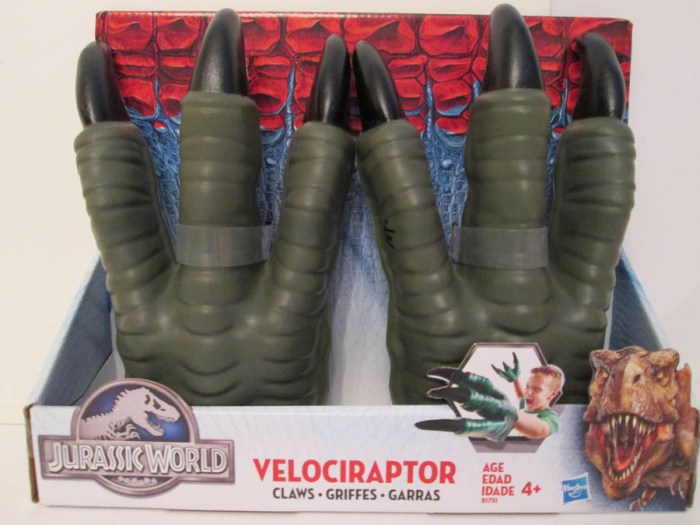
Kids love dinosaurs, and dinosaurs often have talons, so what kid wouldn’t love the “Jurassic World Velociraptor Claws”?  Hasbro suggested that the claws would be suitable for children four  and up and were clear in warning parents that small parts might break off, creating choking hazards.  Apparently, the word “claws” was of less concern to Hasbro and, we assume, parents.

Raptor

Any of the projectile devices were capable of equally life-changing injury, but sharp sticks and heavy objects have long been the staple of emergency room stitch-witchery.  It took a particular burst of invention, however, to combine a needle-sharp projectile with a weighted object.

jarts02

The centerpiece of any exhibit I curate, however, raises a completely different set of questions,  Well, actually the same question again and again:

Who thought this was a good idea?

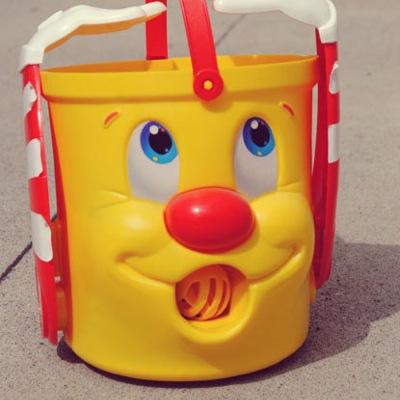
And so, “Mr. Bucket”.

The “game” itself is unremarkable; the name, the catchy jingle, the smile on the object’s “face”?  Hmmmm.

GHrE6YyN

Here’s the descriptopn fromWikipedia-

” The object of the game is for each player to get his or her balls into Mr. Bucket before he pops them out of his mouth. Blue, green, yellow, and red plastic balls are scattered around the floor like pins, and players each choose a shovel that corresponds to the ball color they will attempt to collect. Once Mr. Bucket is turned on, players must scoop up their balls that match their shovel’s color and drop them into the top of Mr. Bucket. While players are collecting, Mr. Bucket will pop out the balls that have been placed inside him out of his mouth at regular intervals. The winner is the first player to get all three of their balls in Mr. Bucket at the same time.”

And the jingle?  I’ve included the commercial.  The tune is irresistible; try getting it out of your head.


As the music fades:

“That’s right, I’m Mr. Bucket! I’m Mr. Bucket, toss your balls in my top I’m Mr. Bucket, out of my mouth they will pop I’m Mr. Bucket! We’re all gonna run! I’m Mr. Bucket! Buckets of fun!

Announcer: The game’s Mr. Bucket! The first to get their balls into Mr. Bucket wins! But look out, ’cause the balls will pop out of his mouth!

I’m Mr. Bucket, balls pop into my mouth I’m Mr. Bucket, a ball is what I’m about I’m Mr. Bucket! We’re all gonna run! I’m Mr. Bucket! Buckets of fun!

Kid: I win, I win!

Buckets of fun!

Announcer: Mr. Bucket, from Milton Bradley”

As visitors to the museum wind their way to the gift store, a docent hands out the mp3 ring tone now yours should you choose to follow this link:

http://www.madringtones.org/tone/869638-Mr.-BUCKET

Excuse me.  My phone is ringing, and I have to answer before that song takes me away yet again.


Words We Should Use and Those We Should Not – Snoot Part III

Words We Should Use and Those We Should Not – Snoot Part III


The folk at the Merriam Webster Dictionary asked a sample group of some size and definition to come up with words they had heard as a child that seemed to have disappeared from ordinary conversation.  Ah Hah!  I thought.  Finally!  A chance to recover perfectly good words from the slag heap of time.

I enjoyed reading the list, but the words presented elicit nostalgia rather than the satisfying endorsement of usage Snoots find so endearing.

Their list?  Dungarees, Hootenanny, Britches, Gallivant, Ice Box – fading perhaps, but recognizable for the most part.  Dungarees are a variety of britches now called denims or jeans.  Hootenanny is still used at folk festivals to indicate informal jammimg in the folk mode.

They also trotted out” Ten Words You Can’t Live Without.”  It turns out that you probably can as none are unlikely to be of much use in most circumstance:.  Pulchritudinous (having beauty), Omphaolpskepis (considering your navel when meditating), Trichotillomania ( compulsive pulling out of one’s hair), Myrmecophilious (close relationship with or fondness for ants), Psychotomimetic (anything that brings on psychotic behavior), Polyphiloprogenerative (spawning many, many offspring), Tirgiversation (evading the truth), Consanguineous (descended from the same ancestor), and Milquetoast(an extremely timid person).

No, I’m interested in past participles in the present perfect tense,  those that describe in the present moment actions that have already happened.  William Safire actually wrote about issues such as this in the New York Times/ .  Here’s his elegant explanation:

“For the irregular verbs shrink and sink, the simple past tense is “He shrank the material and sank the boat.” The past participle is the form of the verb used in the present perfect tense, which shows action completed at the time of speaking: “He has shrunk and has sunk.” Thus, the natural progression is shrink-shrank-shrunk, sink-sank-sunk.

At an embarrassing moment for the prosecution in the O. J. Simpson trial, Christopher Darden gulped, “The gloves appear to have shrank somewhat.” Incorrect; the past participle is shrunk or shrunken.”

Want more?

I sneak out every day.  I have sneaked (not snuck) out every night as well.

I have drunk (not drank) all the punch in the bowl.

I have dived (not dove) into a rain barrel.

I have got (not gotten) an A in every course this year.

I have swum (not swimmed) that lake until I was ready to grow gills.


Some verbs offer more than one correct form of the past participle.  It is equally correct to say, ” I have woken at six throughout the holiday,” as it is to say, “I have awakened at six throughout the holiday.” ” I have pleaded that case/ I have pled that case.”  ” I have proven that problem/ I have proved that problem.”  “I have shaved every cat in the store/ I have shorn every cat in the store.”

Others include slink/ slunk,  sped/ speeded, spit/  spat, strewn/ strewed, striven/ strived, sweat/ sweated, swollen/ swelled, trodden/ trod, woven/ weaved.

Hung/ hanged?

Here’s a tip to know and trade:  The stockings were hung by the chimney with care/  Santa was hanged when he dropped from the air.

Now, on to egregious errors in choice of word.  These are commonly heard words used in the wrong context or with the wrong meaning.

I was nauseous when we drove to Duluth.  Since nauseous actually mans causing a state of nausea, the speaker is intimating that he/she is a toxin of some sort, a carrier of disease on the way to Duluth.  The careful speaker will say, “I was nauseated by the fumes that crept into the car on our way to Duluth.

The conversation about aliens left me completely disinterested in all other Science Fiction.  Disinterested means having having no conflict of interests, impartial, neutral by virtue of having no personal (or financial)  connection to the event.  If the speaker means she has no interest, she is uninterested.

I was bemused by the very funny comedian.  The speaker intends to declare amusement but uses a word that means a state of confusion or bewilderment.

That story is so cliche.  Cliche is a noun, not an adjective.  the adjectival form of the word is cliched.

“I was delighted that the teacher finally honed in on the real subject.”  To hone is to sharpen.  Getting greater focus is to home in on a subject.

“It was ironic that it rained on our wedding day” Inconvenient or even coincidental, sure, but not irony.  Irony conveys a meaning that is the opposite of its literal meaning.

He was literally destroyed by that report.  Hmmmm.  Not unless the sentient report tracked him down and carried out unspeakable acts of unkindness that forced the subject into financial and personal ruin.  Literal does not mean figurative.

OK, a few parting shots.

Verbal does not mean oral.  Things put into words are verbal.  Oral describes things that come out of or go into your mouth.  You do not take medicine verbally.

And that leads us to… Feelings, whoa, whoa, Feelings …

A careless driver can have both sympathy and empathy for the rabbit twitching on the side of the road.  If you can feel the rabbit’s pain, you are empathetic.  If you regret the rabbit’s pain, you are sympathetic.

The rabbit’s passing, however young the rabbit, charming the rabbit, attractive the rabbit, is not tragic.  The course of the rabbit’s life has been essentially unchanged throughout – until the point of impact.  Too bad / so sad, but not tragic.  Had this hypothetical rabbit had a sudden, soul altering set of insights that had only recently brought significant change, yes, the untimely death might be considered mildly tragic.  Rome and Juliet?  Tragic.  Kardashian weight gain?  You know.

Can we talk?  I know the difference but no longer care about fewer and less, among and between.  Am I a backsliding Snoot?  Now, that would be tragic.


In case we forget …

In case we forget …

http://www.npr.org/2016/05/17/478337140/obama-guidelines-to-protect-transgender-students-is-life-changing

This morning’s broadcast of Morning Edition on NPR included an interview with Debi Jackson, mother of an eight year old transgender daughter, Avery.

When Avery was four, Jackson recalls, she turned to her mother and said, “Mom, you think I’m a boy, but inside I’m a girl.”

It’s as simple and as complicated as that.

On one hand, there’s really no way to miss the point; Avery knew she was a girl at the age of four.  With whatever grace the universe gives to the best parents, Avery’s got it and assisted her transition at the age of four.

On the other hand, we live in a messy and occasionally mean spirited world in which universal messages go untended.  The Jacksons’ school district could not adapt, and so Avery has been home schooled.

She belongs to a Girl Scout Troop, and those friends are aware that she is transgender.  The recent public furor over who gets to use what bathroom made Avery uneasy about going to Scout meeting.  Her mother described Avery’s distress.  “Everyone knows.  And if they know this law might pass, they might go ahead and tell me I have to go into the boys’ bathroom.  And I won’t do that.”

OK, that broke my heart.  What kind of country are we that puts an eight year old girl in the position of standing up for identity and principle at the cost of friendship and community?  Avery is eight years old with a sense of self and degree of courage that few of us can muster at any point.

She is also insightful way beyond her years.  When she learned of the Executive Order establishing guidelines by which school system are to respect the gender of transgender children, Avery’s response was extraordinary.  It’s reported that she whispered, “That’s life changing, Mom.  I could actually go to a real school.”

.Just in case we lose sight of children such as Avery as angry rhetoric gets ugly, let’s remember that it’s really quite simple:  It is the business of government to go to any lengths to protect the rights of its citizens; all children are our children.


Can We Survive The Trump Candidacy?

Can We Survive The Trump Candidacy?

I am disappointed, of course, that the state of public affairs has devolved to virtual chaos, although, as one who raised a fist in protest at the end of the 1960’s, I once longed for the cleansing of the nation that would follow the fires in the streets.  Not much cleansing in the next decades, as most will recall, in part because my generation fell into self-congratulatory hedonism followed by cheerful acclimation to conspicuous consumption.

We failed and failed quickly.  Many of us were genuine in our support of the extension of Civil Rights and equally sincere in our opposition to the war in Vietnam, and yet, when we lost sight of one of the great maxims in the modern military lexicon (You can’t win a war in Afghanistan), we didn’t march.  When we entered Iraq, we didn’t march.  When the Voting Rights Act was overturned, we didn’t march.  When ordinary people lost retirement pensions and homes, when Wall Street firms  and banks gave out bonus checks subsidized by taxpayers, when Standard and Poors  and Moody’s continued to do business, when none of the hedge fund billionaires were held accountable for the looting of the nation, we didn’t march.

We watched on tv.  We listened to NPR.  We shook our heads.

So, why wallow in indignation now?  Is the candidacy of Donald Trump a more egregious blot upon the national  escutcheon than any of the earlier low points?

He’s a bully, sure; but we’ve seen our share of those.  He’s a political dunce, ignorant of the most basic elements of statecraft.  He’s arrogant, willfully ignoring the conventions of discourse.  But, why does this arrogant dunce raise my hackles as others have not?

Some of my distress undoubtedly comes in having Trump force fed to me on an hourly basis; he is quite literally on every channel from dawn to dark.  In addition, there are issues of style and language that offend me; it seems self-evident to me that a candidate who boasts he has “the best words” clearly does not.Do his shabby, gold-plated gaucheries offend my aesthetic sensibility?  They do.  The piled Trump steaks, for example, appear to argue that meat is both totem and currency.  Donald Trump delights in flaunting his wealth, pointing to the things he has built (has had built) as examples of achievement; at best, Trump’s architectural legacy is grotesque.

To make things worse, Trump is a philistine.  Not only does a philistine hold all things aesthetic, intellectual, or philosophical in contempt, he radiates smug pleasure in dismissing the accomplishments and ideas of his betters.  In leveling architectural landmarks in his own city, Trump purposefully destroyed works of art that he had promised to the Metropolitan Museum.  Perhaps I see him as vandal as much as philistine.  Looting and pillaging his way as a real estate developer, he has taken his profit at the expense of others.

But, none of these mild objections are at the heart of my distress.

Trump has not taken center stage; he has been awarded it.  The media could have given him the space accorded to other celebrities whose only grip on celebrity is in being odd enough to provoke momentary titillation.  Trump was not wrong in boasting that his presence assured the networks of consistently high ratings; his boorish domination of experienced, genuinely astute men who had given their lives top public service was bizarre, outrageous, unexpected, and compelling.  The first time.  Of course the candidates were slow to understand that neutrality and civility allowed Trump to have his way with them, almost casually dismissing each with pejorative terms not heard since the raucous battles of the Nineteenth Century.  “Lyin” Ted Cruz and “Little” Marco Rubio must have felt themselves on the playground rather than in political debate..

I deplore the lack of civility with which the Trump candidacy has progressed; the greater injury, however, has been the unleashing of the ugliest of impulses in a nation quickly falling into tribal rigidity.  Time Magazine described the intensity with which hate-mongers and racists have promoted the Trump candidacy in an article, “The Billionaire and the Bigot”.  Describing Trump’s appeal to racists as nuanced, Time suggests that bigots hear their own strong prejudices in Trump’s confident scorn for those he sees as not welcome in making America great again.  There are no accidental overtures in the Trump candidacy.  For example, he chose to deliver his New York State fulminations in the very small community of Patchogue, Long Island, a community widely known for the 2008 murder of Marcelo Lucero, an Ecuadorian dry cleaning worker.  The seven teens accused of his murder described what they called, “beaner hopping,” a regular practice of looking for Hispanics to beat.

There is no subtlety  in Trump’s turning the nation’s attention to Patchogue at that point in his campaign’ even the thickest of bigots would be hard pressed to miss the point.

Trump’s candidacy is unfortunate; he is a narcissist, a philistine, a vandal, and thoroughly unqualified for the position he seeks.  His candidacy is a  reckless act of egomaniacal puffery and vitriolic conceit.  All of which would be more than enough enough to cause me to weep, but it is the gleeful mean spirit with which his acolytes preach tribal retribution that saddens me most profoundly.

We are no strangers to meanness of spirit, and other nasty episodes have resolved themselves at some cost, but this moment may signal the sorts of fissures that cause societies to break apart.


I’m Like… uh …

I’m Like… uh …

My daughter recently had occasion to correct an administrator at a highly regarded independent school.  In a letter, that functionary referred to my daughter as an alumnus whereas she is, of course, an alumna.  The worse mistake would have been to refer to an individual graduate as an alumni, an error found almost universally.  Her willingness to step into the fray allows me to bring up today’s minor kerfuffle, the egregious use of the word like instead of the word as in comparing action or state of being.

I begin with the certainty that relatively few people hear the difference, care about the difference, or want to talk about the difference between the two words.  Once again, however, I am more than willing to lob another uninvited broadside into an uncaring universe.

I had the good fortune to come of age as a grammarian battle raged over the use of like in a commercial jingle.  The jingle was catchy and easy to sing –

“Winston tastes good (clap clap) like a cigarette should.”

One’s first thought may be that the proposition that the taste of any particular cigarette is what should be considered good is difficult to argue.  Questions of taste aside,to grammarians at mid-century, the use of the word like was offensive; they felt the proper locution ought to have been –

“Winston (sic) tastes good as a cigarette should (taste).”

If they were correct, as I contend they were, the difference between the two words must be found in the part of speech that each represents.  I am aware, by the way, that discussions of parts of speech rarely take place in ordinary discourse.  I stand accused of snobbery in raising issues of this sort, but the best sorts of discussions depend upon thoughtful awareness of nuance and shades of meaning, as in this consideration of words appropriate to specific circumstances.  David Foster Wallace, the most astute and brutally confrontational student of contemporary language, referred to himself (and those who share his outrage) as SNOOTS.  As he suggests, “A SNOOT can be loosely defined as somebody who knows what dysphemism means and doesn’t mind letting you know it.”  That loose definition will suffice for the nonce; a treatise on SNOOTs will soon appear on a site near you. In an attempt to escape SNOOTISM, I’ll present this definition of a dysphemism.  In most cases, it is an  expression (figurative expression) that carries a negative connotation, often used to discount people.   “She’s a bitch” “He’s a prick” “You’re a pig”.

But for now, attention is on like and as.  The casual checker of grammatical correctness (i.e. normal person / not a SNOOT) may land on the first site presented, usually that hosted by the ubiquitous “Grammar Girl” from  which source the reader will learn that like is more properly employed as a preposition and as as a conjunction, a circumstance the Grammar Girl had not acknowledged until raging grammar battles have emerged.

As a SNOOT, I have to add to those who will listen that like can be used as a verb (I like lemurs/ I’d like a haircut, please), as a noun (I’d never seen the like of that beast.), and as a preposition or (rarely) as a conjunction.

So, what’s the problem?  Well, like as a preposition can mean typical, as in, “That’s not like you,” or such as as in, “My dog loves snacks like chips.”  In most sentences, the preposition can mean similar to, or in the manner of.   “I have an uncle just like that. ”

No problems there.

But … despite the protestations of the universe of casual speakers and writers, and recognizing that, yes, sustained contemporary usage does force modification and evolution of language, still…

Like is usually NOT a conjunction.  It does not join two independent clauses.

As actually CAN BE a conjunction.  It can and often does connect two independent clauses.

So what, you ask.  is the difference?

Let’s look at the infamous dilemma with regard to cigarettes:

“Winston tastes good like a cigarette should” is incorrect in, oh, so many ways.  I’m not even going to worry about the use of the singular Winston, a fairly common first name, leading to conjecture that this writer will not explore. On the most significant level, the statement uses like as if it were a conjunction.

Look at the statement: “Winston Tastes Like A Cigarette”.  An unnecessary proposal, but it works  because the statement is essentially stating that Winston has the taste of a  cigarette, which is a NOUN.”  One could easily sell fruit by saying, “This chewing gum tastes like an orange.”  There’s no room for confusion if we remember that gum has no sense of taste; no implied verb arrives with the statement.

You look like a pig.  Uncomplimentary but not an incorrect composition, if the speaker means to compare appearances rather than the pig’s manner of looking at things.

You act like a pig.  Also a grim assessment, but flawed in its structure.  And yet…

Interestingly, the evocation of piggishness is something of a special case; almost all of the comparisons have become too familiar to avoid.  Even a SNOOT would have a tough time saying, “You act as a pig”.

So, things being as they are, (not things being like they are) most SNOOTS will writhe quietly when this particular grammatical injury arrives, recognizing that some battles may not win us many friends, and friendship is clearly more comforting in one’s declining years than grammatical precision.


I Am Too Much Of A Snoot!

I Am Too Much Of A Snoot!

Throughout the course of a long career as a teacher of English at a variety of independent schools, I curmudgeoned (sic)  my way through countless fruitless corrections of contemporary misusage of what I called “English as spoken by the company of educated men and women”.

The very notion of such a company struck my audiences as both unlikely and unfortunate.  Had such an evenly accomplished group of speakers and writers existed (and why would it?) , they argued, surely it would have had better things to do than to cavil about the distinction between words such as alumnus and alumni, say, or like and as – words that obviously mean the same thing in any reasonable conversation.

The sharper of my linguistically slovenly adversaries would point to my own weakness for whimsical constructions, such as the playful repurposing of a noun, “curmudgeon” into a verb, as above.  “Ah,” I’d retort, “but I can toy with language BECAUSE I know the rules,” essentially playing the “Don’t Try This Until You Join the Company of Educated Men and Woman” card.

I have softened over the years.  Some.  I do understand that language has to evolve to meet the needs of contemporary speakers.  Grotesqueries of construction still sting, but I can get through most ordinary exchanges with little injury.

However, like the compulsive who must check locks and burners, I seem to be unable to ignore the steady, droning, inclusion of the word ‘of’ where no ‘of’ is needed.  I hear it everywhere and from every quarter.

“He is too good of an athlete to miss that shot.”

“He was not that great of a writer.”

“It’s not that big of a city.”

Too long of a trip, too much of a bother, too scary of a movie, too belittling of a comment, too rancid of a smell, too futile of an effort, too complicated of an explanation… to infinity and beyond.

In the cranky nether regions of my understanding, the word ‘of’ is a truly exceptional preposition, carrying more than a dozen meanings.  

A block north of here – distance

The sow died of measles – causation, indicating result

A box of chocolates – containing or carrying

Songs of Norway – origination, derivation

Made entirely of cotton – composition

From the two of us – comprising a group

Cheated of my chance to succeed – separated from, distanced from

People of your persuasion – identity, association

Graduation brings a moment of celebration – purpose, setting aside

I’ll see you at quarter of eleven – until, before

He grew to a height of six feet – specificity

Chauncey had a love of baseball – direction, attachment

The pen of my aunt – possession

The fruits of my labor – production, origination

He gave his word of honor – possessive identity

Nice of you to come  – identifying personal quality


Not bad for a small word.  

Or, as far too many would observe, “Not that bad of a range for that small of a word.

Less is usually more, and in this case, genuinely better.

In closing, however, I must observe the one great exception to my caviling exasperation with the omnipresent ‘of’.

In learning of his sister’s untimely death by drowning, Laertes replies, “Too much of water hast thou, poor Ophelia, and therefore I will forbid my tears.”

It’s a curious locution, slightly distancing, and the more effective in its awkwardness.  So, unless a writer or speaker has the extraordinarily nuanced command of  language as Shakespeare had, restraint in tossing ‘of’ around willy nilly remains valuable.

The keen observer will have noted the use of the word ‘as” rather than the word ‘like’ in the previous sentence, but more of that anon.